Daily writing prompt
What’s something you’d love to see in the future, but know you probably won’t live to witness?


A human world where things actually work out well for the 99 percent.
A human world where things actually work out well for the 99 percent.

The above title is a lyric from Pink Floyd’s iconic Syd Barrett-era ‘Pipers at the gates of Dawn’. It’s seemingly a throw-away rhyme to go with ‘cloak’.
There again, don’t our ‘throw away’ moments of creativity sometimes turn out to be our most poetic, our must truthful?
Barrett-era Floyd was short-lived. Yet in this one album they created something that walked that fine line between artistic masterpiece and something that was ‘a bit of a joke’.
This album taught me about how creativity must straddle the line between artistic seriousness and the utter ridiculous.
20 years ago, it is most likely that so many people viewed me as a ‘bit of a joke’. I had realised, perhaps prematurely, that I was incapable of adapting to acceptable forms of adult personhood, and in turn I was bursting with a desperate need to prove my worth via creativity.
I’d spend all my time trying to come up with artistic ideas and music lyrics, but I would be in such a rush to share my work, it was always embarassingly executed.
I would rush making recording after recording and then hand copies to random people in town, bemused to have a CD copy of recordings I’d often taped in a toilet prior to having other way of creating reverb. I even once walked up to the singer of a small indie duo called Slow Club in the Sheffield Leadmill and shoved a cd in her hand. Slow Club’s singer is now known as Self-Esteem.
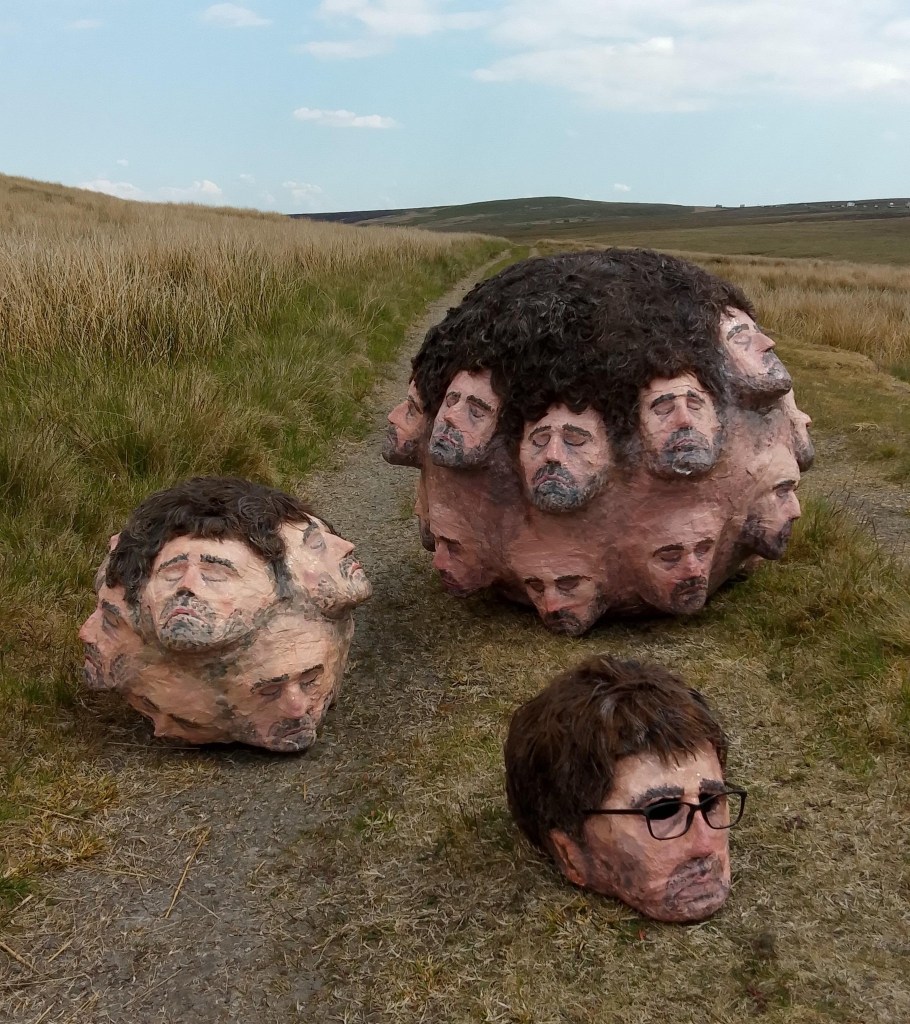
Exactly 20 years ago (the final week of May 2006) after month after month of making heavy and rigid work that largely documented depression, I shaved my head, stop caring so much, and knocked up a ‘silly’ little CD turning a ‘nickname’ that once was a point of humilation into my creative psyedomyn: Ooon Badger.
This knocked-together, bit of junk, proved to be a kind of wierd creative fluke. As a friend told me, “it’s shit, but really good at the same time”.
It was one of my most enjoyable artistic projects, ever – one I’ll never forget.
Social piers loved it, even if they thought I was kind of ‘a bit of a joke’.
However, validation-seeking never creates good energies when trying to be creative, and perhaps it’s rightly so that this a was one off piece of art, rather than the start of a music career.
But “as the first song says “I may be dirty, but I’m not rat – I’ll never join the rat race”.
I’ve uploaded 4 of the tracks from the project here:
One crucial lesson I learnt the hard way: you can’t ‘do’ politics when you’re at constant war with yourself. If you’re always criticising yourself, any dialectical opponent can easily perform character assasination on you with a well-timed verbal insult.
(I recall a life-beaten Londoner looking at me with weary-yet-strong judgement as I tried to scale the bottom half of a lampost in the 2011 Anti-austerity march. I only wanted to feel part of the energy, but ended up being talked down by the look of a man that took me right back to being called “a stupid little boy”).
….Alas, public displays of political conviction have never gone well…
However, I have now realised that even to speak from such a position is still to tell a story worth telling, even if that story illustrates a ‘wrongness’ latent in the times you speak of and also latent in you…
How do you properly convey politics from the position of being ‘dark-matter’? From a subjective hinterland? I’ve never really been part of any demographic. I’m an outcast to the urban sensibilities, and to the suburban senility growing all around me: I am invisible to ‘voxpop representation’.
I subsist in full view of a settled suburban demographic, which knows its place. I have been trying to walk out of it all my adult life; backpack on back, and surely with a purpose on the horizon awaiting me(?).
Yet all of this aimless walking has given me a keen eye for difference within place (and, often, sameness). I used to walk and write nearly every week in the 2010s. I would map out the world I saw In front of me, as evidence of struggles that I prayed a peaceful future could work towards healing.
Now, as we descend into the late 2020s, I try to retrace my steps. Deeply lost in my home town, where the idea of the aformentioned prayer seems utterly ridiculous. And, since the Pandemic the main desire has been to retain my dignity as I grow older.
For all my adult life, my home town has had a continuously contested geographical identity: sometimes post-industrial, sometimes rural, sometimes urban, and increasingly suburban. Yet in the 2010s this side of town began to gentrify, and assume a quality that felt more attuned to the leafier suburbs of Leeds and Sheffield.
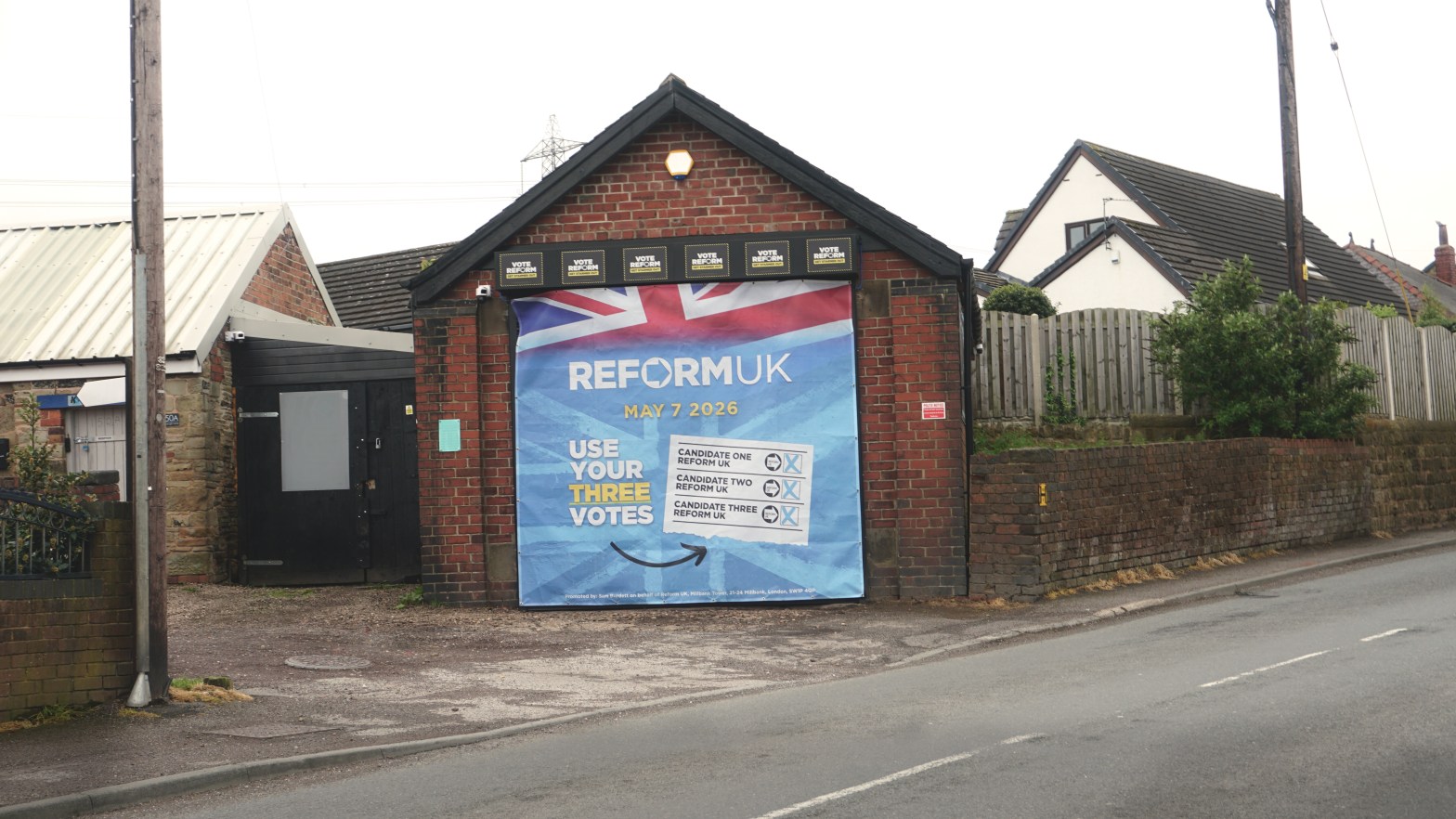
Yet, as I walk up this B road I approach a pompously large “Vote Reform” banner draped over a mechanic’s garage door; and, at least to my eyes it is a statement of pure aggression, which seems such a far cry from the decade-old ‘hipster dust’, sprinkled over the pub/restaurant opposite which still manages to entice the region’s gym-going professionals to dress up, for either Instagram or a possible Tinder date.
It’s at this moment that I viscerally realise that this synthesising ‘hipster dust’, that brought both liberal and conservative together in polite gentrification, is slowly evaporating in such places, only to be replaced by something deeply unpredictable, but most likely volatile.
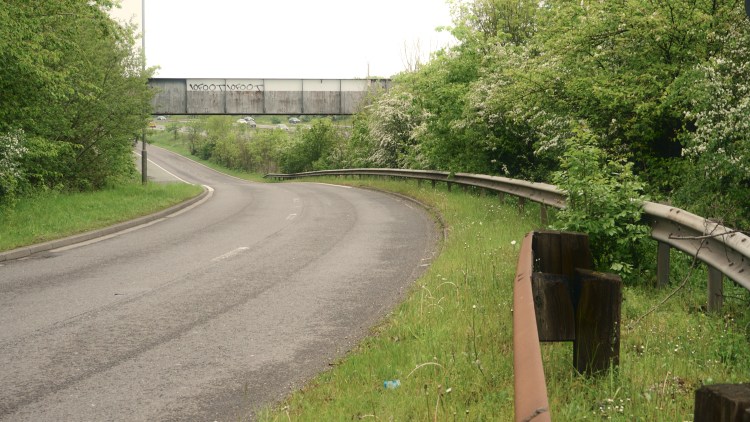
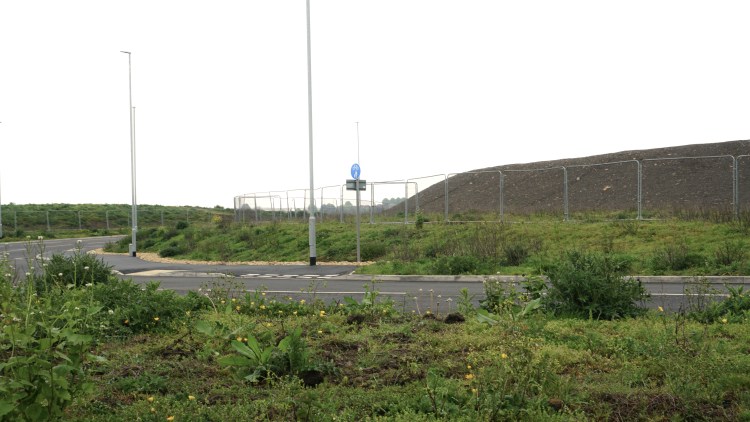
You must proceed. It’s all that you can do on this road, the road to what was once a huge spoil heap, but now overlooks an hinterland of random out-of-place industries and a new-build estate stuck in limbo.
The village up here is very typical of a small pit village that became a partially-desirable suburb due to its proximity to the M1 motorway. Old collier terraces still resemble a skeleton; bones surrounded by the fatty tissue of suburbia.
In one of these gardens stands a large flag pole. Yet, the flag upon it is not just any old St Georges flag. This is a flag that refers to the Crusades; it’s a flag that announces that ‘we have no wish to be peacefully patriotic‘.
I begin to sweat as I try to document it. “Why am I documenting it? What’s the point? A long-lost sense of affinity with a collective mass?
I feel deeply alone post-pandemic. There is no ‘we’ I can currently attest to belong to, and it’s an unpleasant feeling. A feeling, dare I say, that is so widespread, it makes some people climb up lamposts with flags, asserting how alienated they feel with spitting vengeance.
The Spring green that decorates the motorway junction is accompanied by grey skies; two colours that used to feel heavy with a potency ripe for a new tomorrow from the election box. But not this time…not here, at least.
The grey turns to cold by the time I have descended into the town centre. Addicts who look thinner by the day, carry the weight of it all in their plight. It’s why we turn away and pretend they don’t exist, like they do in turn to our moving cars, that they think nothing of walking in front of in their desperate pursuits for what they need.
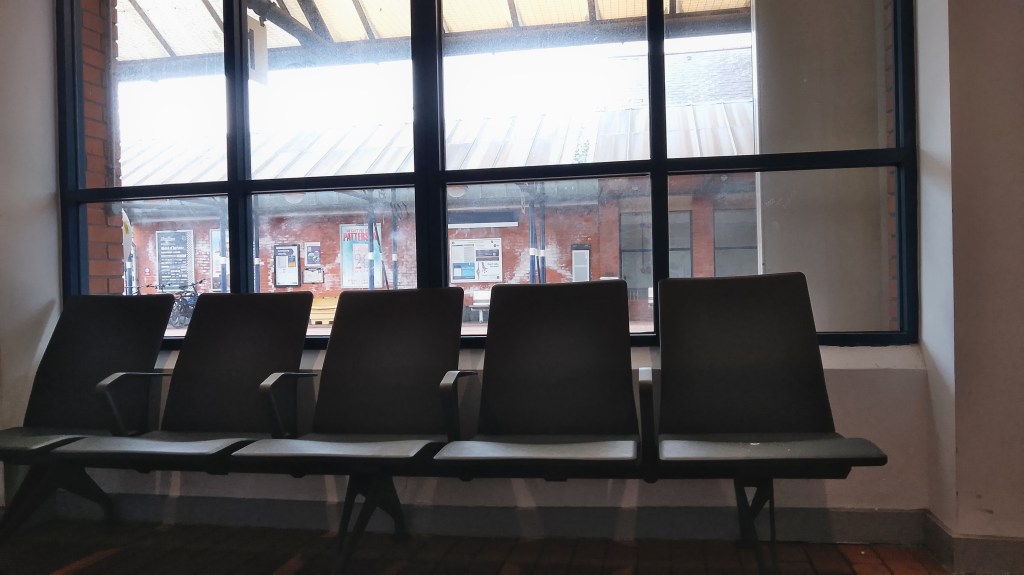
A coffee is the only thing I can think of right now. To sit down, in a place where the background music suggests history never returned; where we are all coffee shop customers, writing, typing and meeting friends ’till the end of time…
If Reform win (as predictedd) many councils in places like this tomorrow, it’s arguable it was a victory won in 2019, 2008, 1997, and every other moment where alternative pathways from this moment were blocked. Moments where there was a gigantic opportunity to be seized, to significantly take us away from a route that was laid down in 1979.
I walk homewards afterwards. There is slightly more sunlight permeating the greyness. A perfect atmosphere to conjure hope, you could say? (cloudless blue sky conjures nothing in a climate like ours).
However, it’s not there. The roads are angry, you can detect motorists driving slightly more hastily than normally. Everybody seems to be wearing their toughest emotional body armour, as car exhausts growl and pedestrians look away. I sense a latent aggressiveness; “don’t mess with me, today” postures, even as the luminous green of the graveyard Lime trees hangs above us, even in a place softened by commuter-belt accents and craft ale bars.
I walk home and get in my car. Around here, right now, I feel safer here…
Art/creative projects.
But it’s not that simple. I can go for months, even longer lacking purpose and direction because I lack any ideas that have any sense of purpose and meaning.
It’s how I define, and have defined myself: against a world in which I’ve never felt equipped for, or any good at, but aware that I have to exist in. Obviously this sews together personal and political exclamations, and it’s excruciating when you have nothing that feels valid up your sleeves, because you feel like you’re reduced to having to play by rules in which you always come up short in every concievable way.
Coming up with ideas for certain pieces of work, or projects has been repeatedly life-affirming, and suddenly you have an energy you forgot you had.
However, because it’s always art in ‘fight mode’, it doesn’t allow anything else to grow, which makes it harder to live like this the older you get.
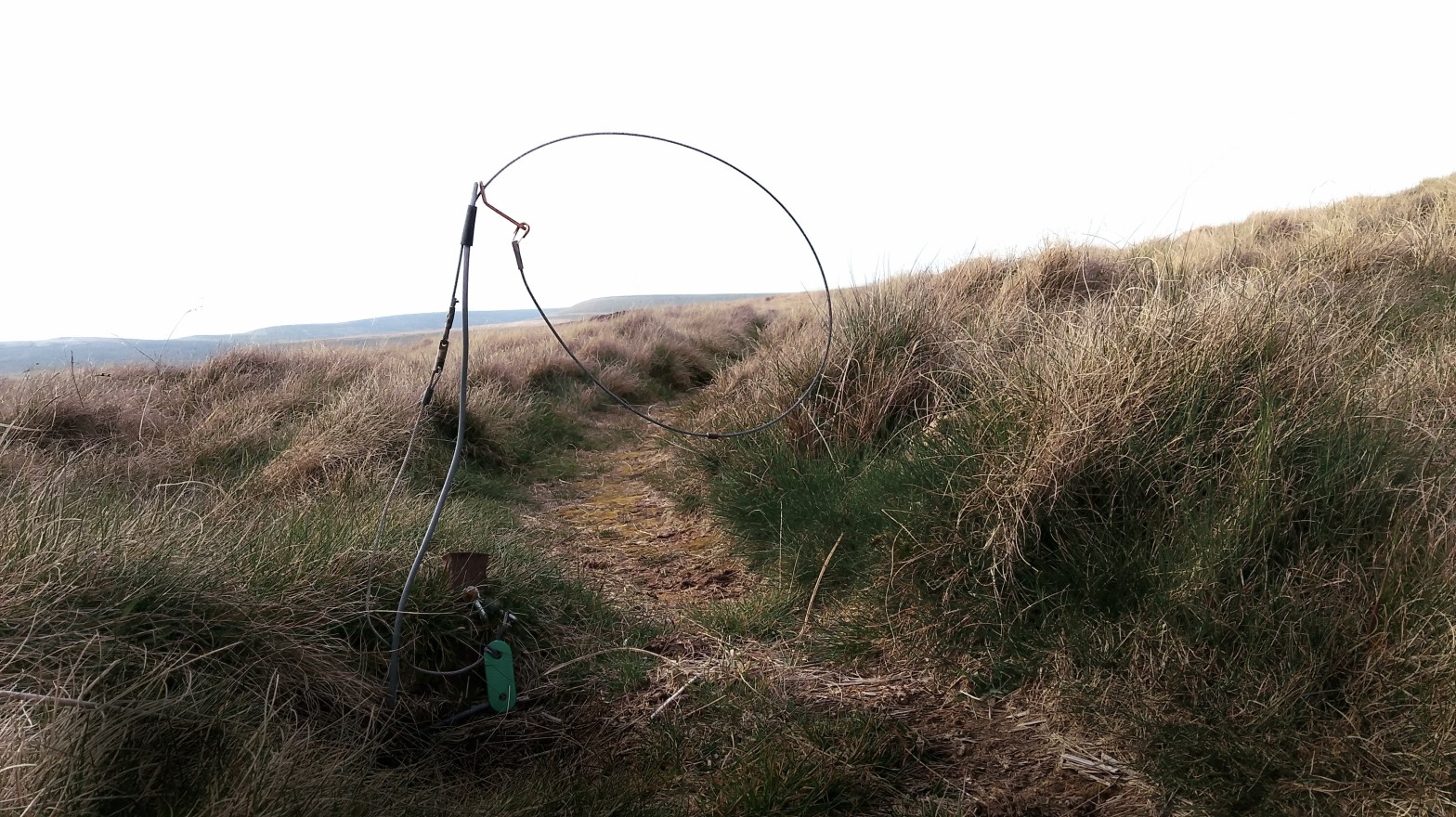
There is no exit, but death. But up on the tops the notion at least remains; a breathing space necessary for the escape-desperate pathos to recognise itself.
The possibility of a way out via peaceful parliamentary measures had its last chance in a hot June month of 2017 that momentarily melted perceived certainties as if they were plastic. And for many of us it was the first time in our adult lives we escaped the weight of depression. Perhaps this itself was already an hallucination, a Millennial one?
But it took until ‘operation: return to normal’, the escape from lockdown, to realise there was no longer a ‘way out’.
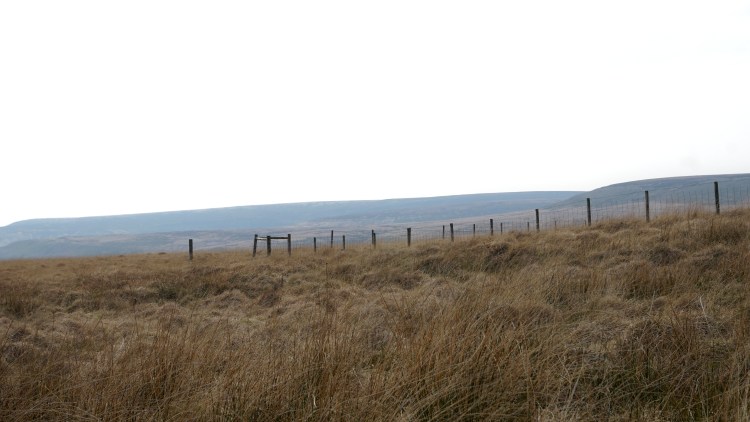
Operation: escape the Maddening House.
Between the Russian assault on Ukraine and the ‘atrocity exhibition’ of Gaza live-streamed, I reached an epiphany upon these tops, above the old-industrial North of England: I had never known how to be a human being, and by adulthood, through disorders, addictions, avoidance, art, I had been trying to find different ways of expressing this desire to ‘get out’.
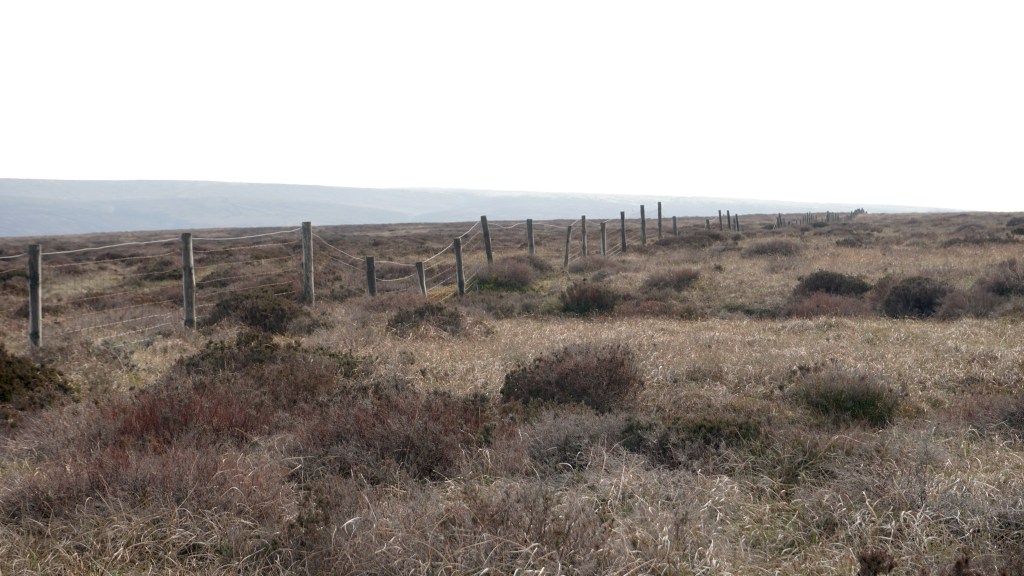
These tops are the outback for the Northern psyche, they store our collective trauma as if it was carbon. They also speak the language of the ‘frontierism’ that scoured the desert, reached the moon, and then crashed back down and began to devour itself.
The roads and paths towards here have always held an absolutist promise to them, in that they seem to offer one way in/one way out. No crossroads, no choice paralysis – just escape or come back down.
In my early 20s I would impulsively seek escape, drawn towards the tops by the trance-like Joy Division chant of ‘day in/day out/day in/day out’. I felt it ‘closing in’, and needed to get out before ‘it’ got me.
Today I know there is no true escape up here. ‘it’ is closing in; ‘it’ has won.
Regardless, the tops remain a crucial space in which to think.
Down there there no is thought no more, just chaos in the mind.
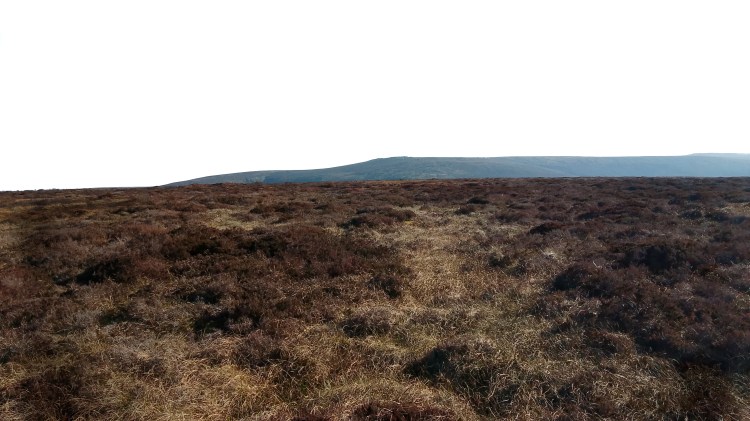
Technically in the Peak District, this area has avoided the post-pandemic influencer influenza that tramples over everything just to prove “I exist” in a culture where to be ignored is to be a living ghost, unimportant and forgotten.
On these outer-edges it is still possible to be alone through escaping the loneliness you feel subjected to down there. Its emptiness and waste allow for a reprieve from a socially-constructed loneliness, dealt out as punishment for ‘failure’. Here there is space to be weak, to be a loser, a degenerate, a nobody, with no shame.
At the very start of the decade this epidemic of loneliness was eased by the Covid Pandemic Lockdown. Although it caused mass isolation, there was a reprieve from the loneliness of humiliation, failure, and all the necessary afflictations dealt out to mediate a functional separation between successful and failed subjects in a neoliberal society.
But unfortunately it was also in this period that the networked mind ‘lost its mind’.
My late tutor called social media ‘the final battleground of Thatcherism’, and in the wake of the pandemic we were all now infected. All words became weaponised. And once the ‘better angels’ realised there was no escape, and justice had no horizon, indignation and accusation were all that was left.
Finger pointing in hell.
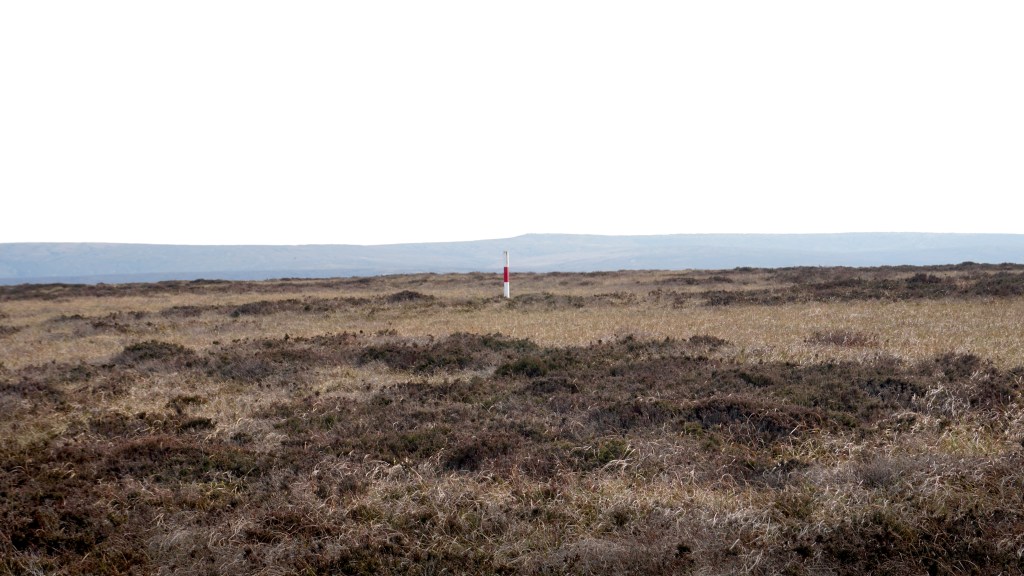
I feel a temporary peace looking at 320 million-year-old rocks, sunken and hidden amidst a deep mass of peat, like abandoned and rusting army tanks.
It seems that everything peaceful was formed in violence.
I long held faith in the human ability to prove such an idea wrong; that seismic change could be prised out on a pathway of peace. In the back of my heart the 2010s was the test ground, and I still had faith that the ‘networked mind’ could compound all historical traumas to reconstitute the collective psyche into something I felt was necessarily conducive towards thriving and surviving the 21st century.
I admit I no longer believe any of this. I now fear with an empty heart, that the violence that exploded since the pandemic is the start of what is to be expected.
I also admit am a weak person. I am somebody who has never been able to approach a conflict without taking the side of the opposition (I usually want to destroy me as much as they do).
For a long period of time I tormented and chastised myself for not being part of the noisy, active crowd – I felt I was betraying the mantras of the memefied 20th century activists, yelling at me from their graves.
I went to protests in the 2010s, usually balking, only to be found shakingly clutching a Strongbow in the nearest pub. The pressure to ‘show up’ contributed to excessive burn-outs as the 2020s restarted.
I fear the violence is now necessary, and inevitable. I sometimes believe it is collectively craved subconsciously in the collective mindset: the only craving that unites us all in the Maddening House.
And it is on this subconscious level that it seems that all of us secretly wanted Donald Trump; we want the next catastrophe, we want the haste towards destruction, because destruction is the only thing that makes any sense when locked inside a Maddening House.
Progress lost its soul to the machine. It can longer separate itself from all-encompassing spectacle and doesn’t even conceive that we need a way out. It produces pop culture that sounds increasingly dead behind the eyes before Ai could even get to it.
I am a weak person, violence makes me nauseous and shakey. I cannot be part of the violence that is already around us. The violence that I fear is tragically necessary in order to get out of the Maddening House. None of this is easy to admit as a child born the year and in the place of the Miners’ Strike.
I wish I was more.
Part of my ‘journey’ since my epiphany 3 years ago, was to accept myself. But it’s hard to go easy on yourself in the Maddening House.
At least up on the tops (my tops) I can accept that it for what it is: locked in the Maddening House.
I always reflect on this holiday.
I’ve reflected on it through the music of the time; the dreamy-quality to the pop music on Virgin Fm or whatever station it was.
I’ve reflected on it through the incomparable movie ‘Jurrasic Park’ that set a new precedent for cinematic hedonia before we would be bogged down in the ‘CGI of things’.
I’ve related the happiness to how, as a world society, we were now supposedly in an ‘end of history’ period on lasting peace. liberated from the shackles of the psot.
And connecting all the aformentioned dots with one main driver: I’ve always reflected on it through the fortunes of my own family, of how my dad’s new job as an F.E teacher at the local college was now a game-changer in how I began to percieve the future.
For a long time in adulthood people would ask me about what I liked, where I liked, and what I would like to do with my leisure time (the dreaded ‘leasure’ time). More recently I think people have simply given up on asking me what I’m doing with my life.
Thus I long felt deep shame for responding by saying “the happiest time of my life was a holiday I took in the summer of 1993 as a 9 year old.
When you’re getting grey hairs, and all the other things that make you invisible to youth, and you’re still saying your happiest moment was in when you were 9, surely something has gone wrong?
Long story short: after years of struggle, I am starting to conclude that I am neurodiverse, and I never knew how to be a person in the ways that were given to me.
I don’t want to go into this more, and I’m inbetween this all being conclusive.
Yet it makes sense now that, aged 9, before puberty, before adolesence – before all those specific expectations that I could never live up to – would remain frozen in time as a moment where things felt good.
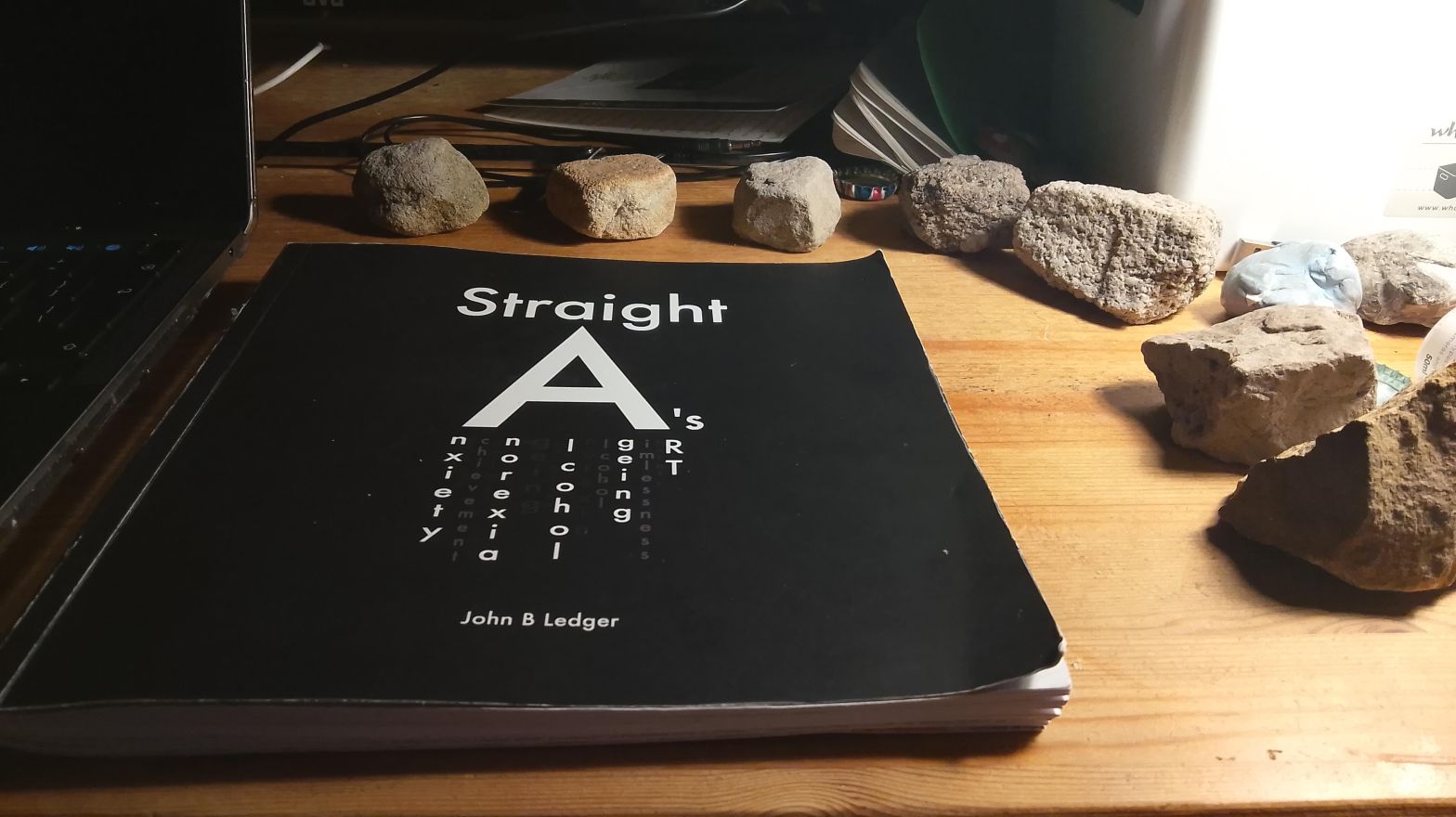
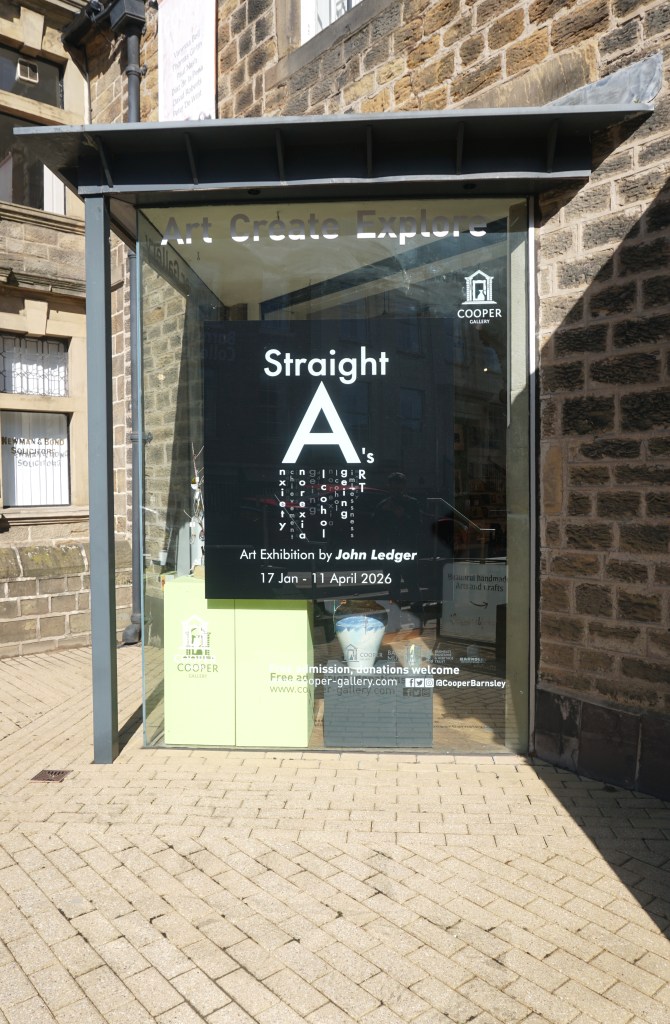
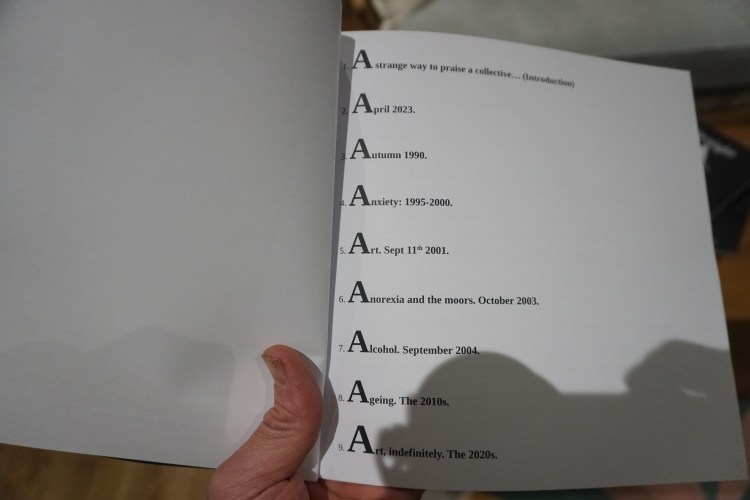
(This is the final chapter from the publication ‘Straight A’s: Anxiety, Anorexia, Alcohol, Ageing, and Art’, made for an exhibition of the same name).
I admit I’m still here; still trapped within the Straight A’s system of self-critical thoughts and go-to ‘remedies’, but I know I can’t physically upkeep these routines for much longer. I also admit I have written these stories countless times before. What is different now is that I can no longer use youth as a protection against truth.
My bones feel heavier…After years of walking long distances with a heavy rucksack the increasing throbbing pains tell me to stop, yet routine tells me to carry on like I’m 21. But I’m not… and the hope that there is something to save me around the corner has gone.
…But I know I’m not the only one…
I believe the struggle is partly generational. All Millennials (those who came of age in the years either side of the year 2000) were instilled with a ‘millenarian’ sense that all good things would finally reveal themselves in our near future. We’d grown up as the writer Francis Fukuyama’s famous ‘End of History’ proclamation had been willingly swallowed like a pill by an entire culture who had seen the fall of the Berlin Wall as a symbol of a coming age of lasting peace, where we could all find the freedom to live out our best lives.
But, by the 2010s, not only had this expectation been ground down (symbolised in the staggered punches of 9/11 and the 2008 financial crash) but this collective anticipation had mutated into it’s opposite: a belief that the future would actually be worse than the present.
Whatever your current politics, I believe that this sense of a ‘lost future’ embedded in Millennials fueled the ‘momentum’ behind the Corbyn-led Labour Party, energised by what felt like a last chance to salvage a 21st century we thought we’d had been promised in the final years of the 20th century.
But after Corbyn’s terminal failure at the 2019 general election, we then faced a global pandemic lockdown, which although initially offering glimmers of a kinder way of living, ultimately ushered in an aggressive ‘back to normal’ that frog-marched us back into a world that was even worse than the one we’d had before.
Thus, I think it’s fair to say that many of us have found the years since 2020 the hardest we’ve known.
One Sunday afternoon in 2023 as I meandered around Sheffield trying to conjure a sense of purpose (something I’d done countless times during the last 20 years) I suddenly couldn’t take anymore; I had to accept the fact my life wasn’t working.
I’d ‘had enough’ many times before, but this time I’d had enough of having enough.
I’d reached a point where I was both ashamed and exhausted by the adult life I’d lead, and wished there was a ‘life amnesty’ where I could hand my life in. Lacking this option I shared a post on Instagram, publicly confirming that I had been living with a mental illness for all my adult life.
Even writing this provokes the inner critics to come out of the woodwork and shout: “you’re so fucking so self-absorbed, John!”
Throughout writing this story countless inner critics have popped into my head, criticising me and making me feel scared about what people will say to me when they get me alone.
However, worrying about somebody having a go at me, verbally cornering me in the smoker’s corner after 6 pints, is very reason I should write this! I have to escape this stage in my head; this unlimited-seater venue built for the unlimited critics and bullies; this is what keeps me ‘entombed in self-centredness’.
I have to convince myself that I’m not writing this for the approval of others: I’m writing for and to myself. It’s a letter to the life I missed due the Straight A’s, and the letter to a life I may still one day have a chance to lead.
Both Art and Anorexia were political decisions: both were subconscious rejections that manifested into states of being once adulthood encroached upon a body that didn’t know how to take shape in the world as it is presented. Both are responses to a social/political atmosphere that, even in your teenage bones, you know will never let you breathe the way you need to breathe.
Both begin as negatives to a positive that actually offer no positive at all.
As an Anorexic you retreat into the position of a ghost, standing on a fine line where you are neither present or absent. This suspense is held up in the hope that a world, a world you can live in, will come find you. You do not want to die, you just don’t want to be in a world where you cannot live.
Art, as a life practice, started from the same position as Anorexia. However, Art allows you to create your own rules, your own system of thinking, your own path, and by default your own take on ‘reality’. All Artists know how hard it is, when your world, the only world you can breathe in, is perpetually attacked by systems of doing and living that deny its right (and by extension, your right) to exist.
However, you have no choice but to carry on…
In 1999 we’d deface our high school ‘student planners’, and my mate changed my planner name from John Ledger to ‘Ooon Badger’. Initially it was a source of ridicule, but in 2006 I had the confidence to own Ooon Badger, and change it to embody the creative impulse in its spontaneous, joyous, life-full form. Ooon Badger disappeared before the end of the 2000s, but there’s something in it that I constantly crave to rekindle.
I’ll never stop making Art. But rather than only being able to perpetually say ‘fxxk you’ to a world I can’t properly live within, one day I’d love to be able to make it the positive affirmation of a life I wish to lead.
I may never stop having issues around social Anxiety, eating issues, depression, and Addictive tendencies. But I know that this is a milestone that must set a precedent where I allow myself to something better than the Straight A’s.
(I have a small amount of copies of this book remaining, if anyone is still interested in purchasing one please leave a comment).
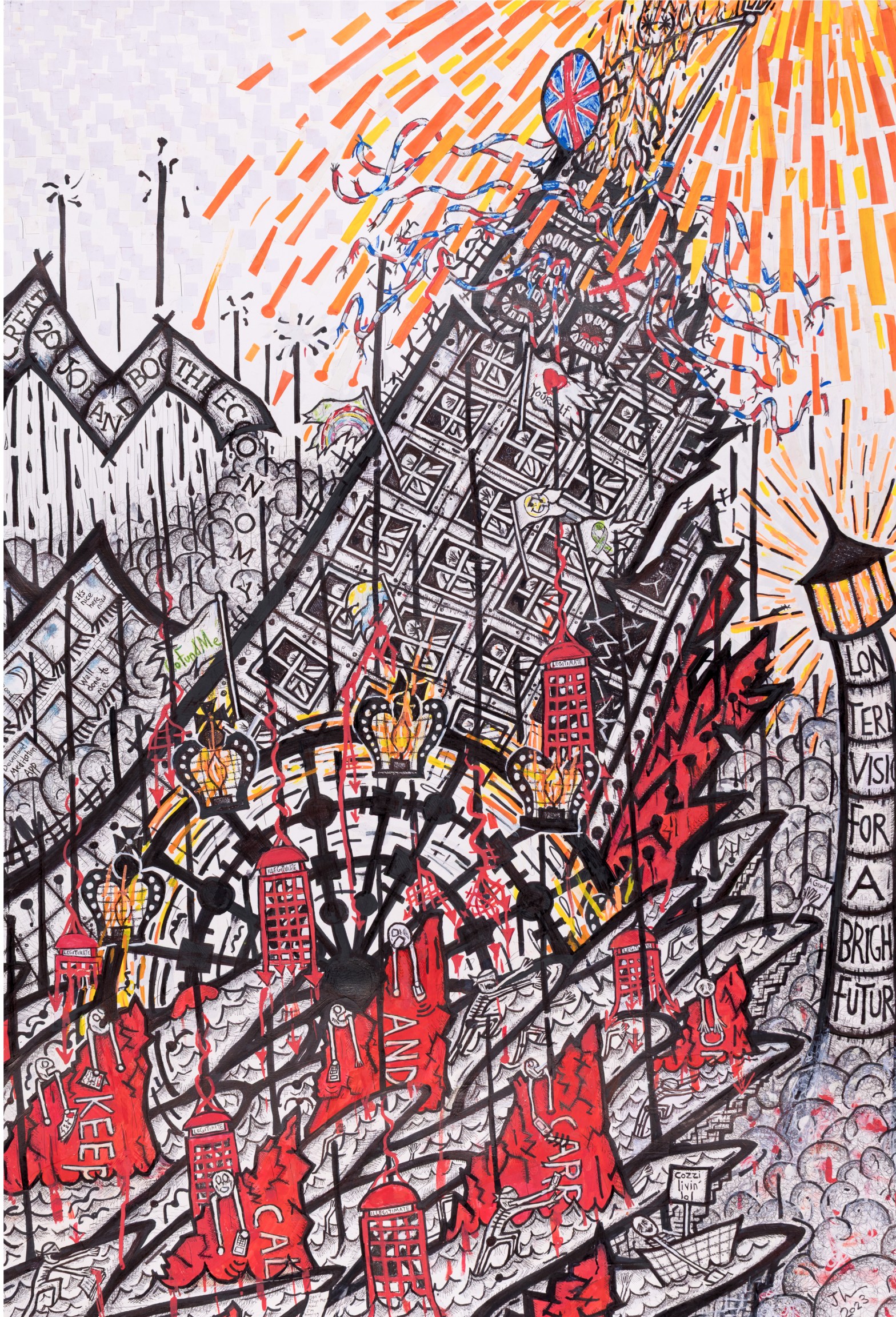
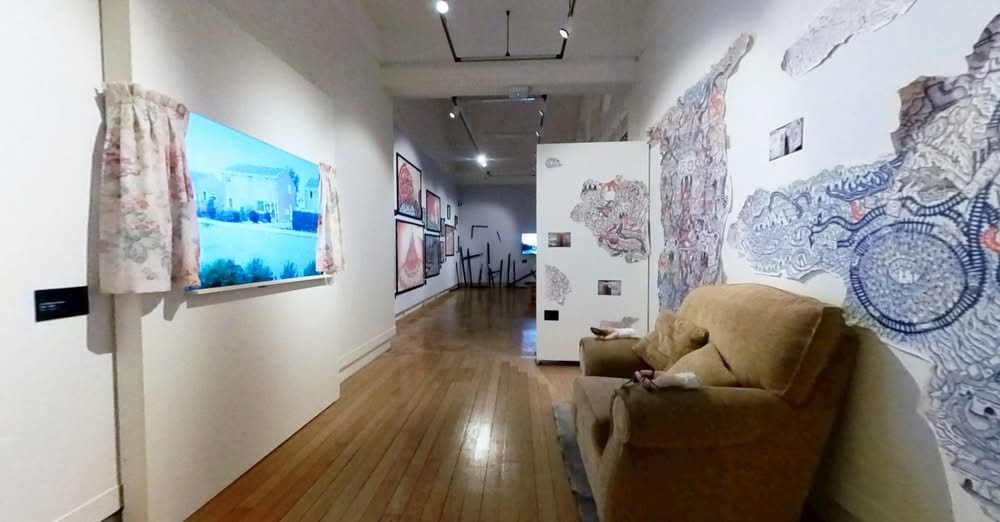
Straight A’s was a once in a lifetime exhibition – at least in terms of life so far. It’s only for this reason I am sharing work that didn’t make Straight A’s, because I feel it is interesting to speak about.
Canary in the Coal mine
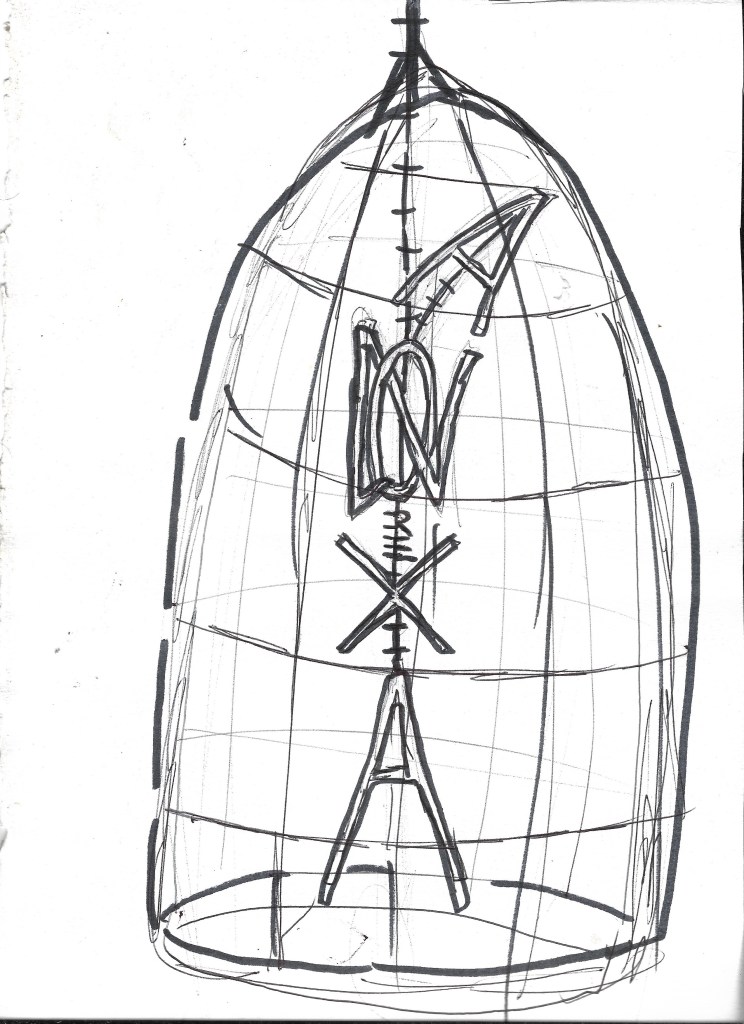
If I had been succesful with funding this sculptural proposal would have been made.
But it required welding and equally a skill-set I didn’t have.
I have explained why I used to Canary in the coal-mine analogy, relating the history of my home town to my own specific struggles with eating disorders, but in the end I think it couldn’t be done.
“IT’S WAR, THEN!” (2020)
A friend suggested I show this work as he believed it’s one of my strongest – and to be honest I think he is correct. However, the aggression of work wouldn’t have worked with the rest of the works.
The Alpha Forest (2009)
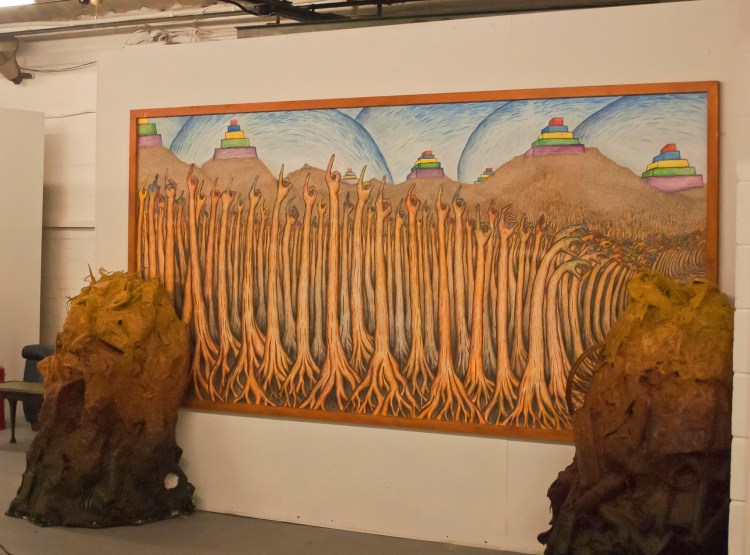
The Alpha Forest is the largest framed drawing I have ever made (5x10ft). I am still immensly eager to show this work, at least one more time before I realise it can’t survive many more winters in my dad’s shed. It’s size was the problem, and if I’d had put this in the exhibition, it would have consumed the exhibition.
Scanning for threat (2022)
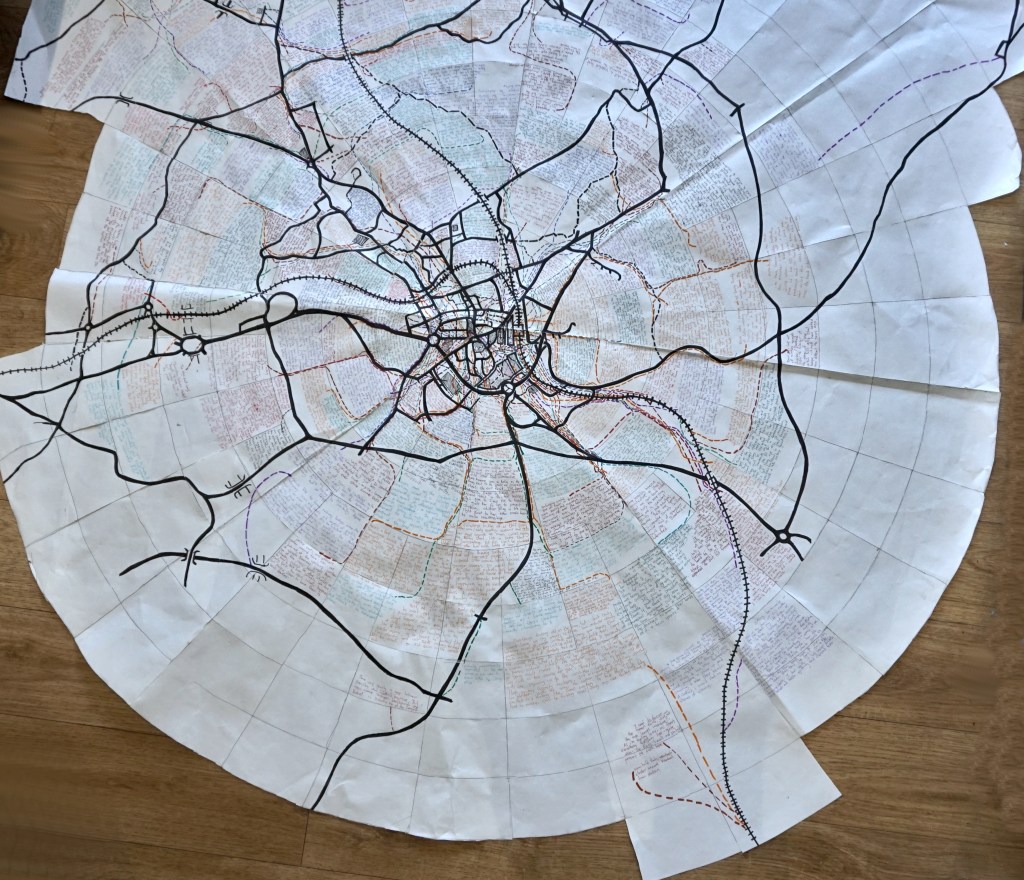
I really wanted to show the map-making that has been so crucial to my work, especially since the 2010s. However these maps just didn’t fit in, and in turned out that the large sketchbook ‘Best Amongst Ruins’ touched upon the maps – if you had the patience to look through it for them.
Central Bombardment (2009)
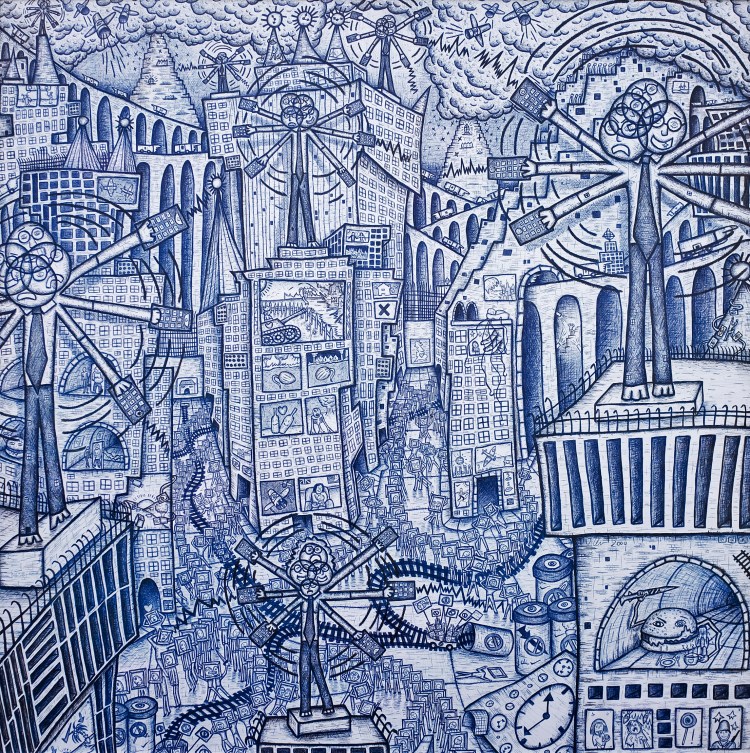
This work, owned by a kind gentleman in south Sheffield, was available for me to use for the exhibition. The only problem was I’d misjudged the size and it wouldn’t fit in my car, and I couldn’t afford to hire a van all the way down to Abbeydale Road for one work.
New Brutality (2024)
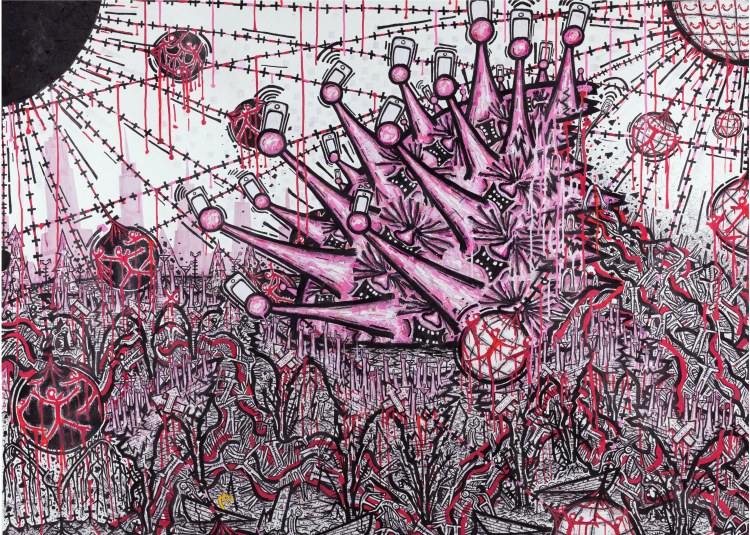
‘Everybody’s Fracking’ (2015)’
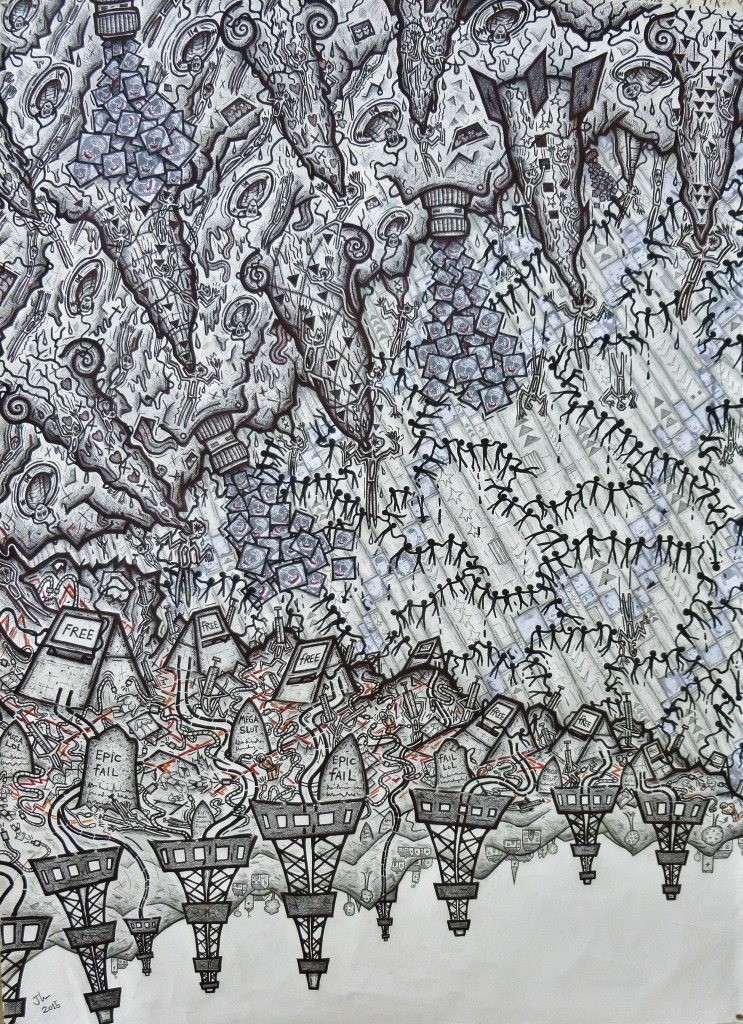
‘Running on Gaslight’ (2023)
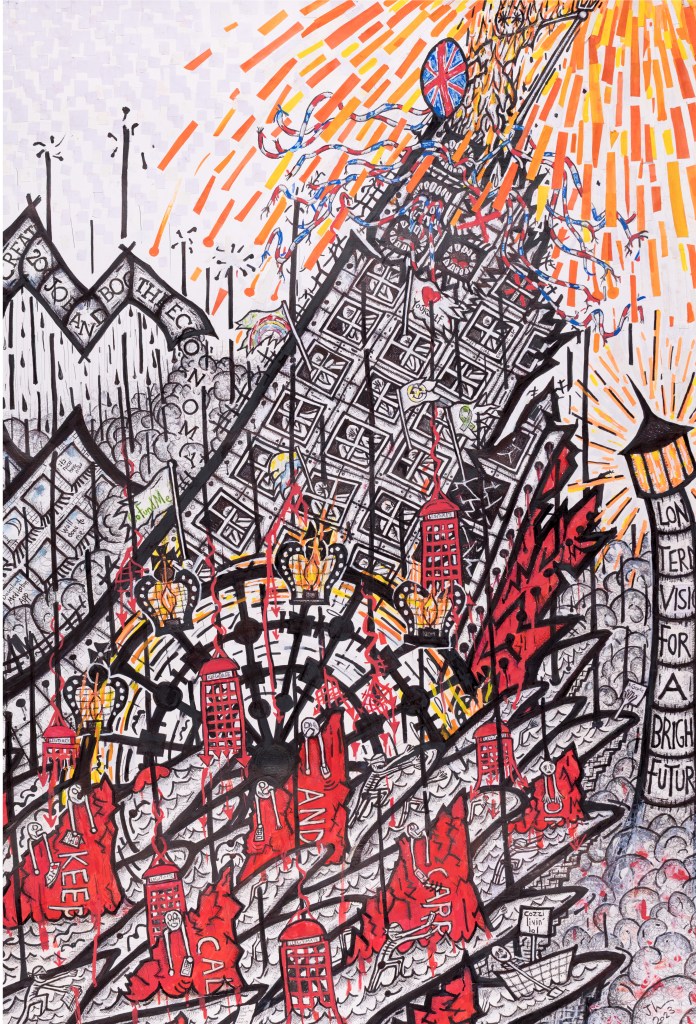
‘Monster’ (2017).
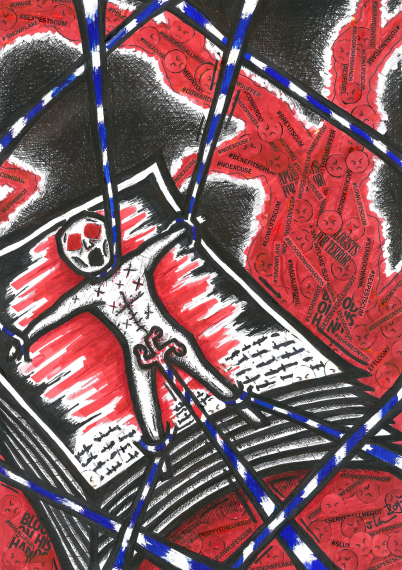
‘Who made the Monster?’
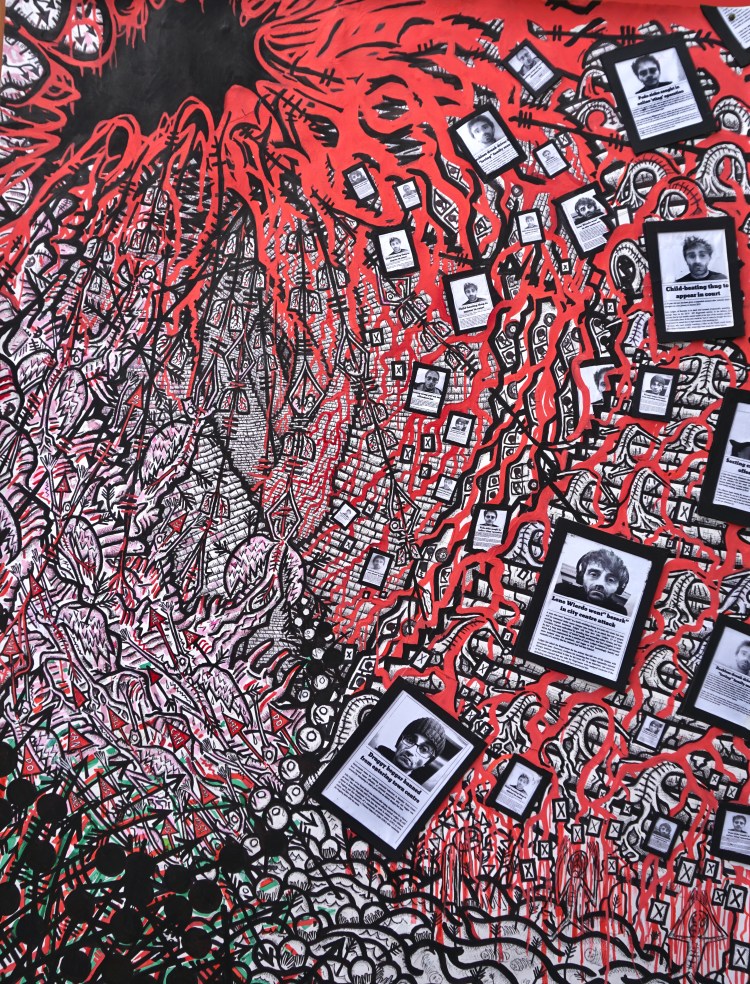
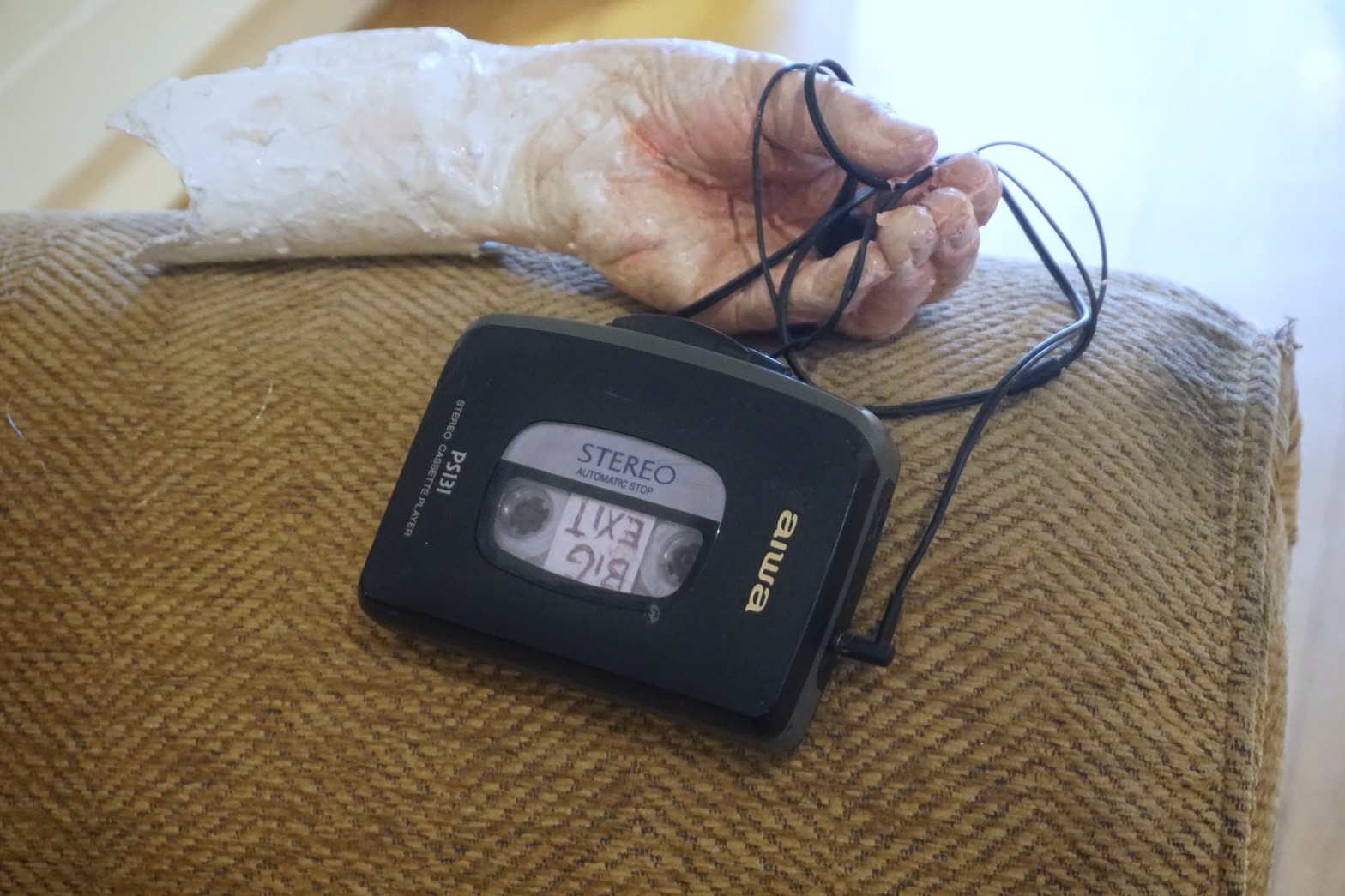
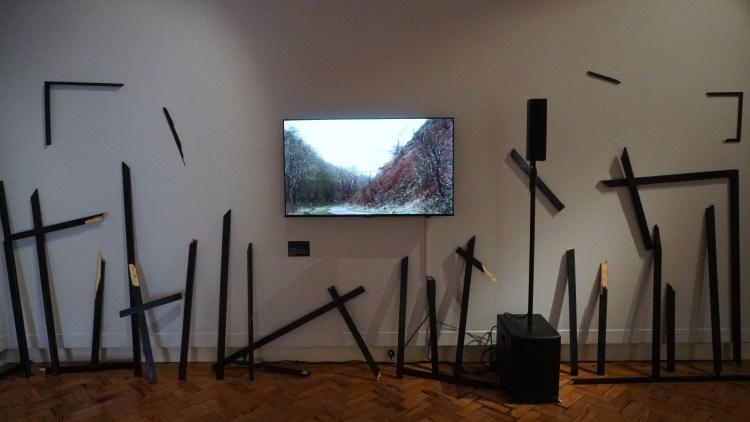
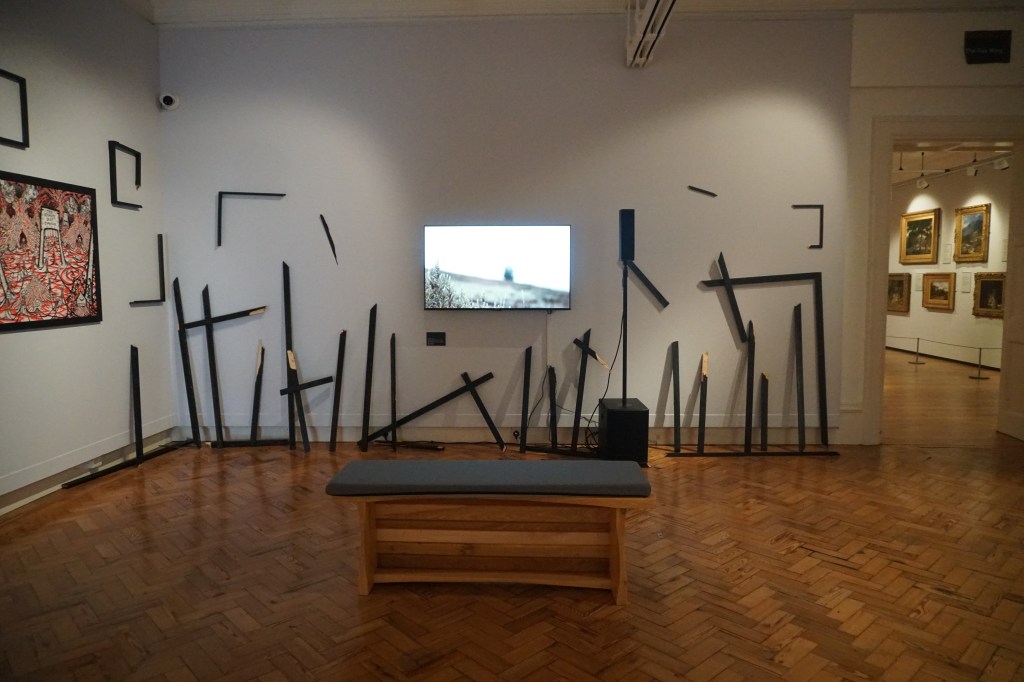
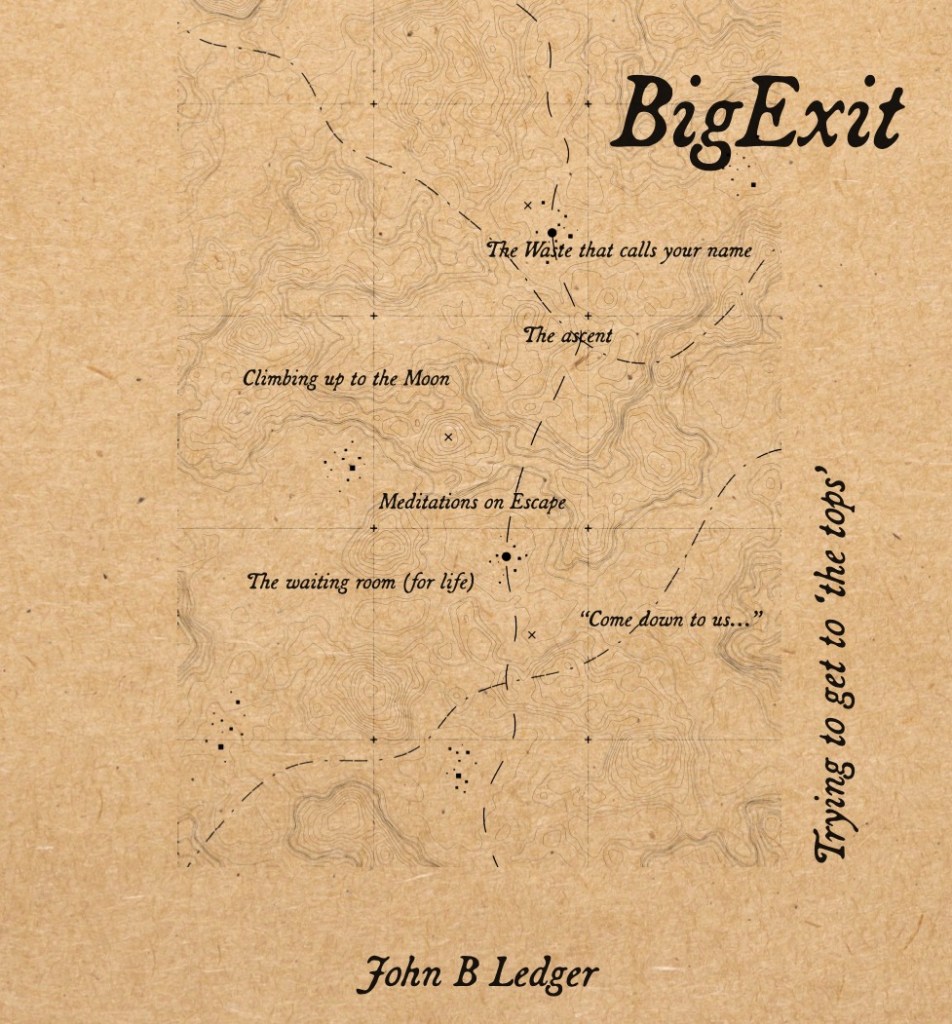
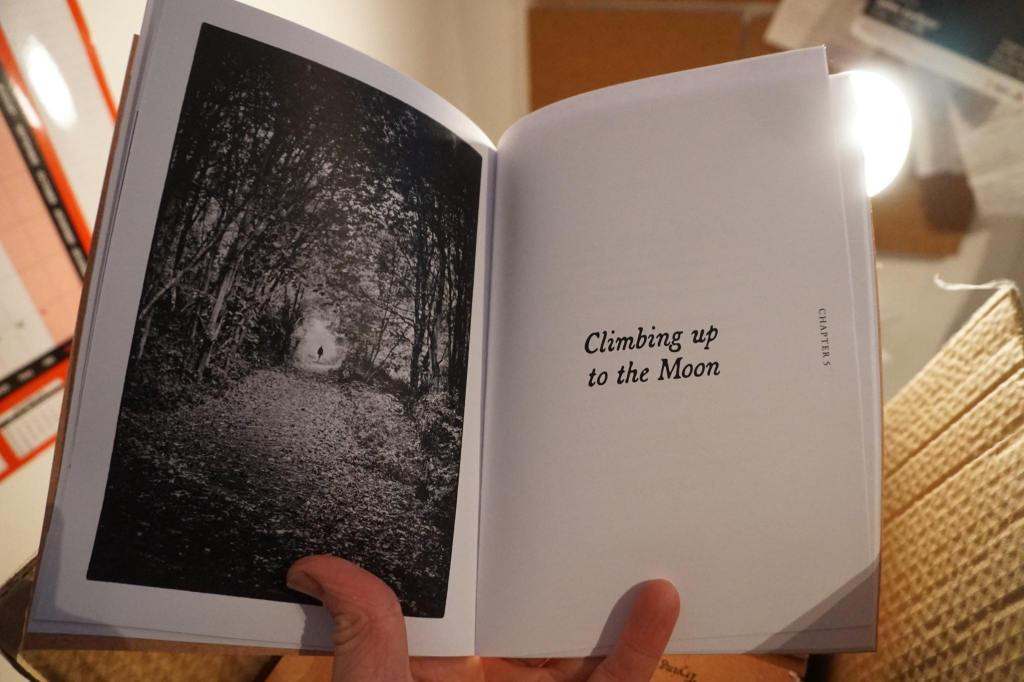
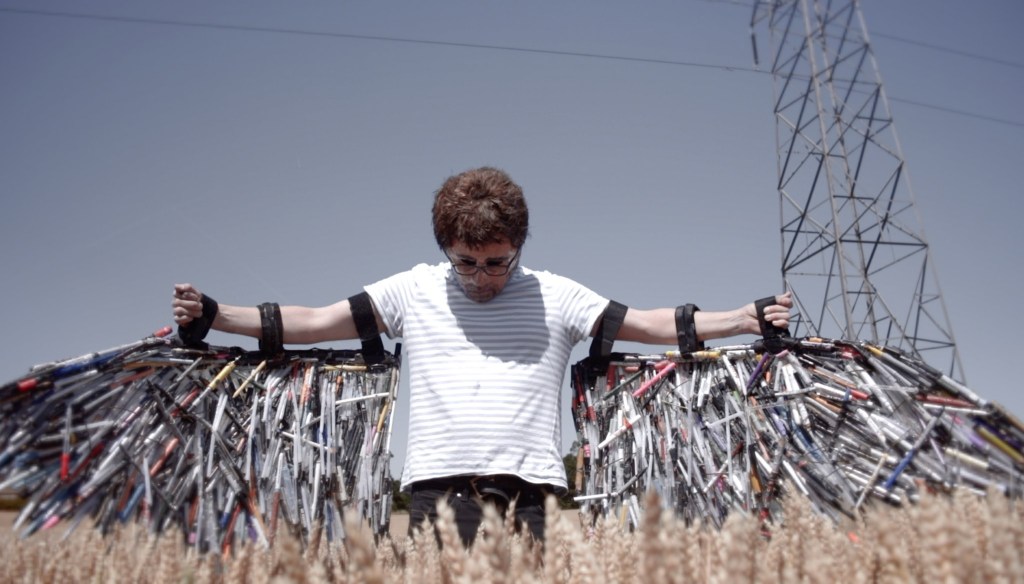
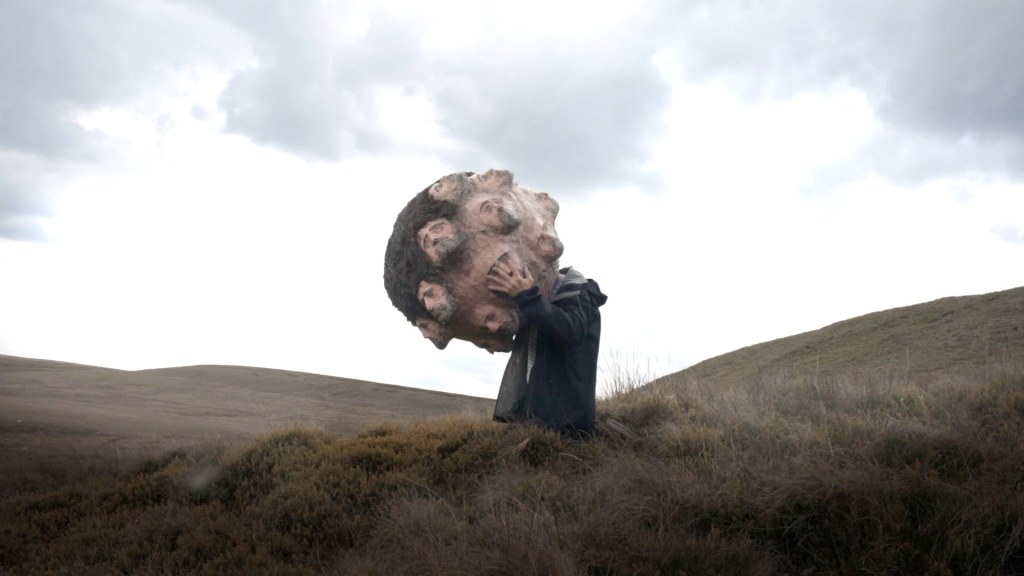
I had been reluctant to release Big Exit online, because it was primarily a film made to be seen in a gallery space. However, some people have told me they never got to see it in the space – so, on their behalf I have shared it here.
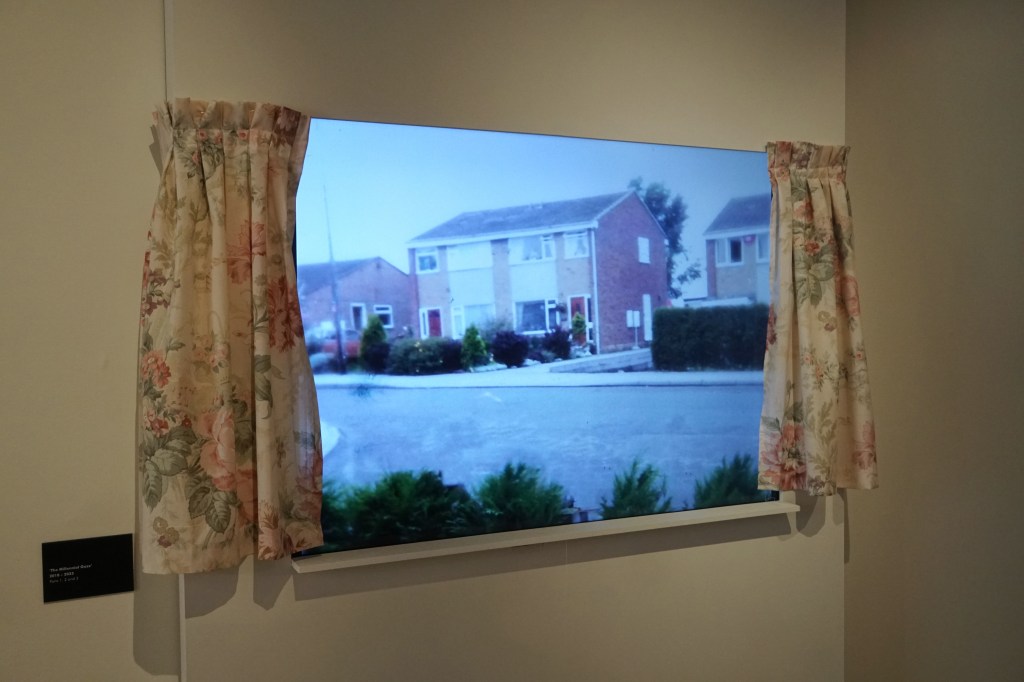
The Millennial Gaze.
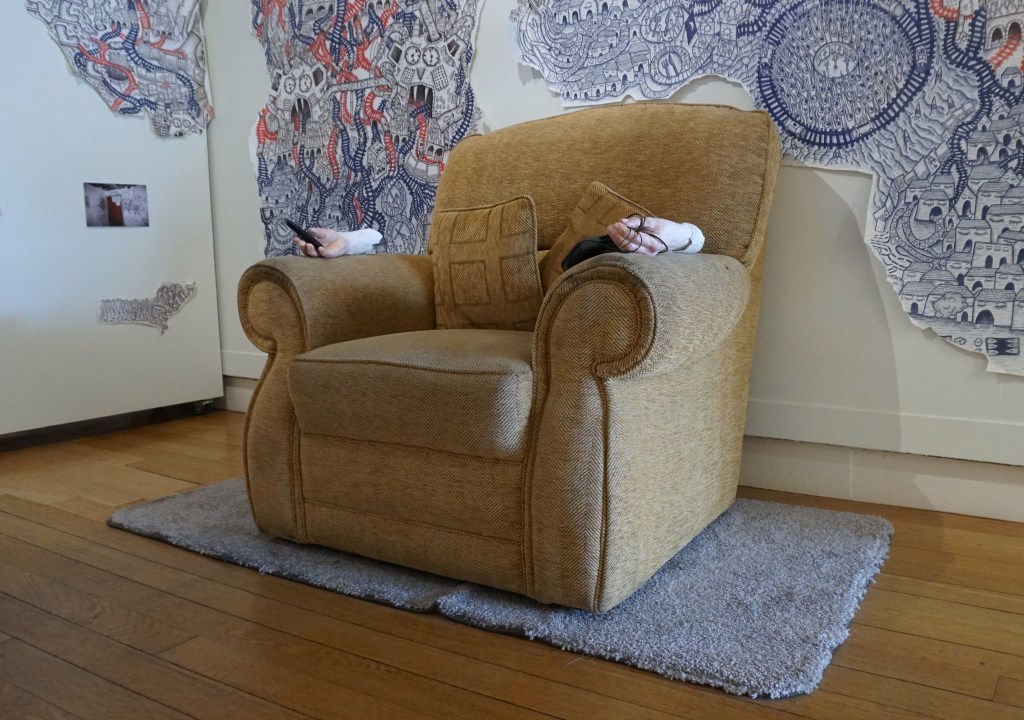
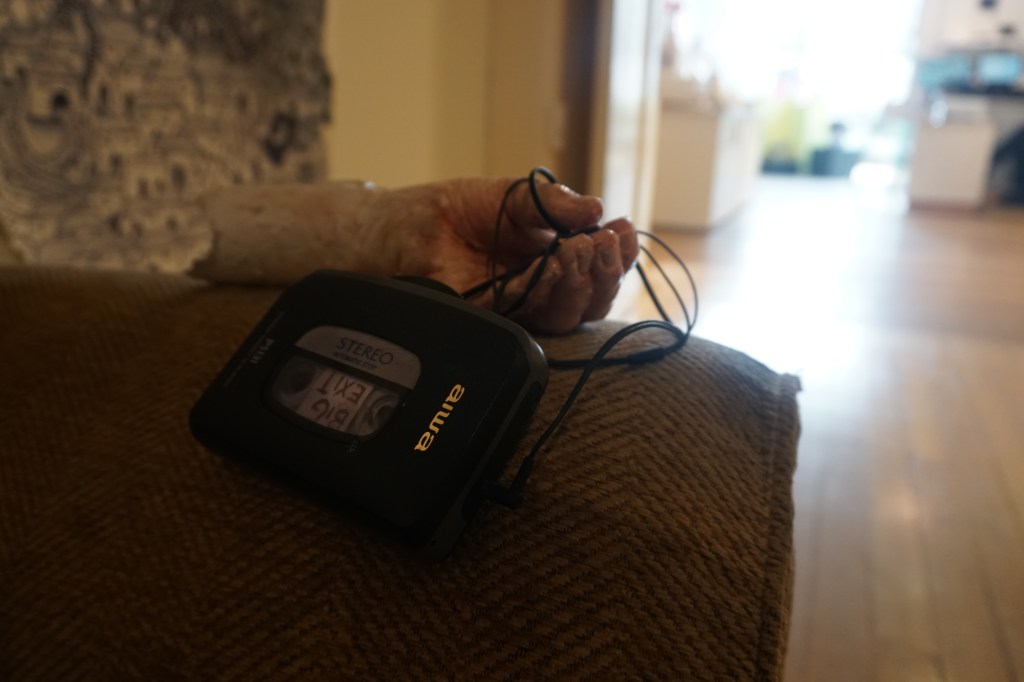
This long-running joke.
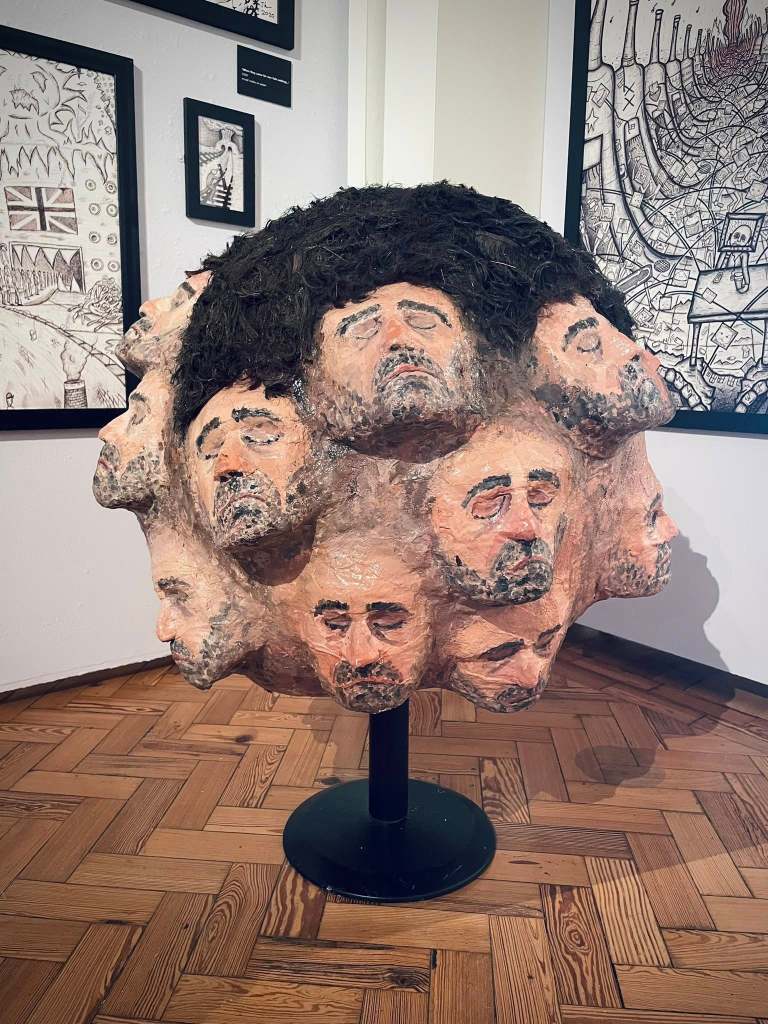
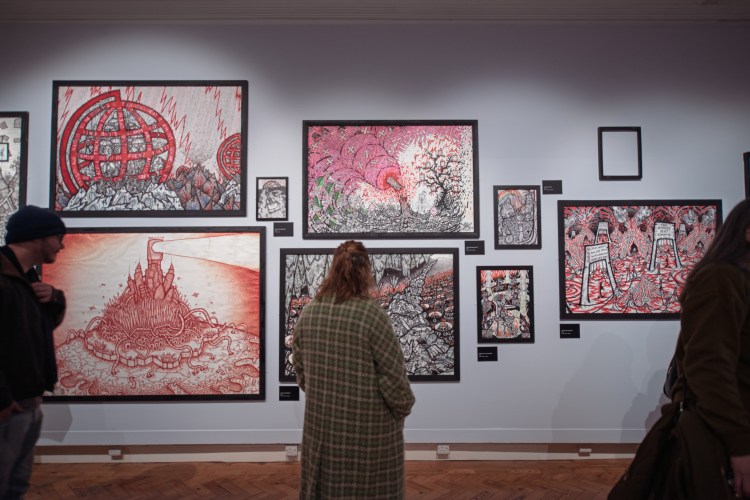
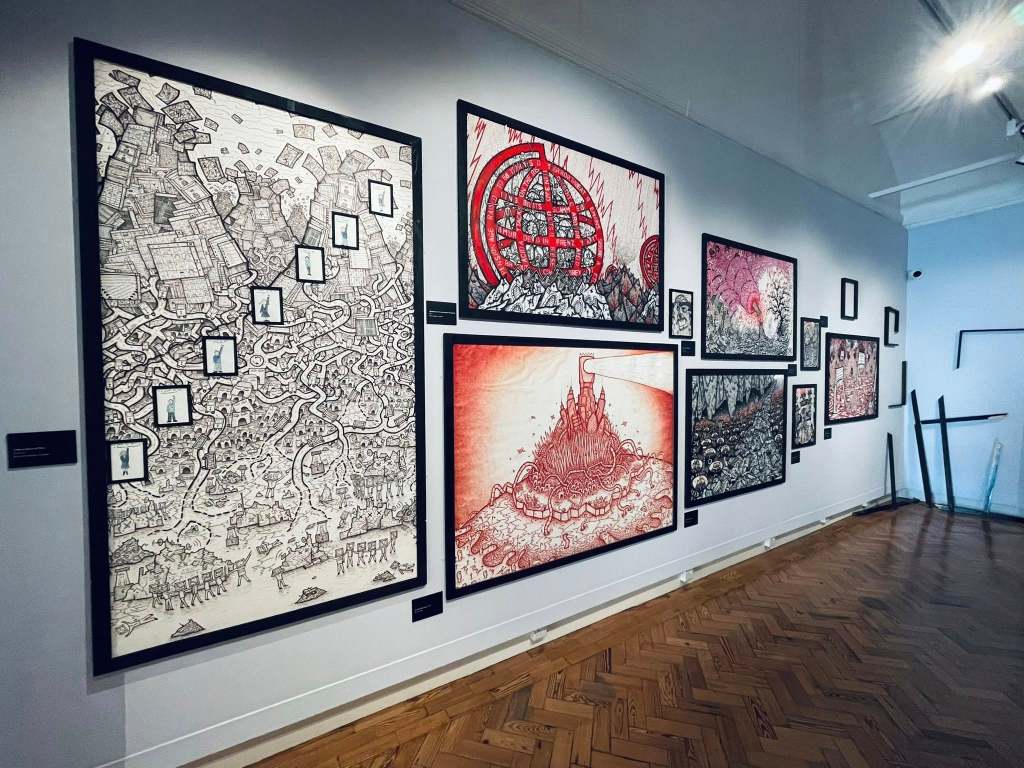
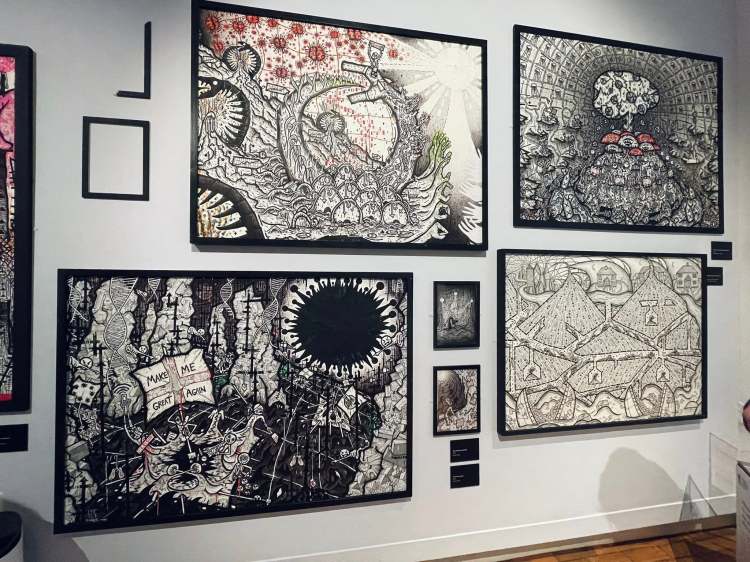
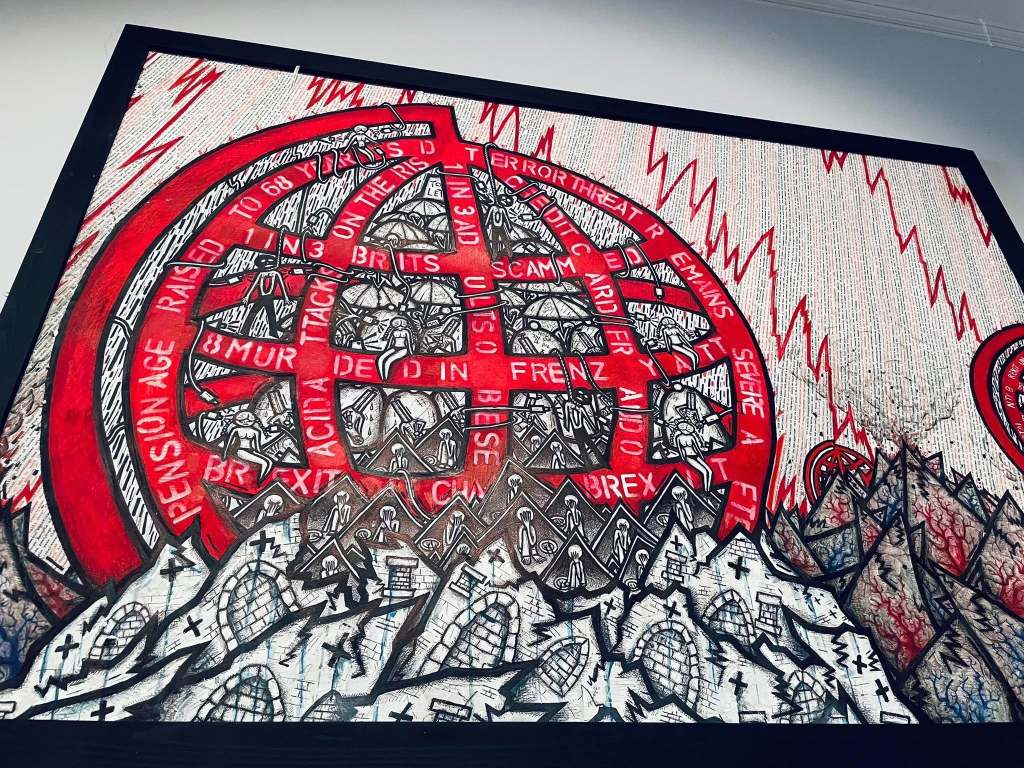
Best Amongst Ruins
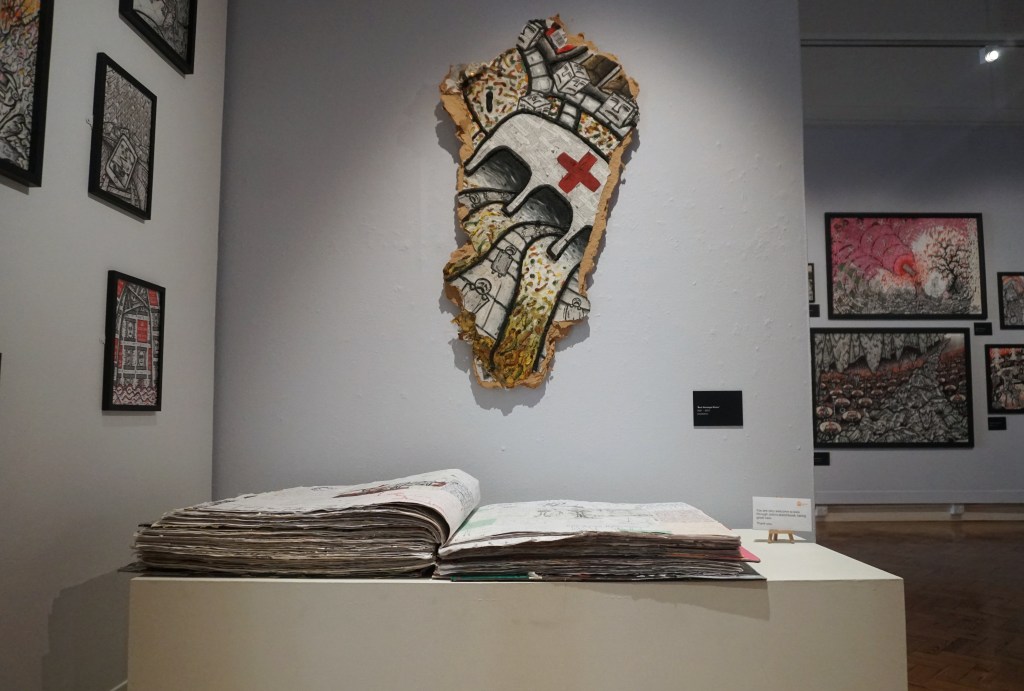
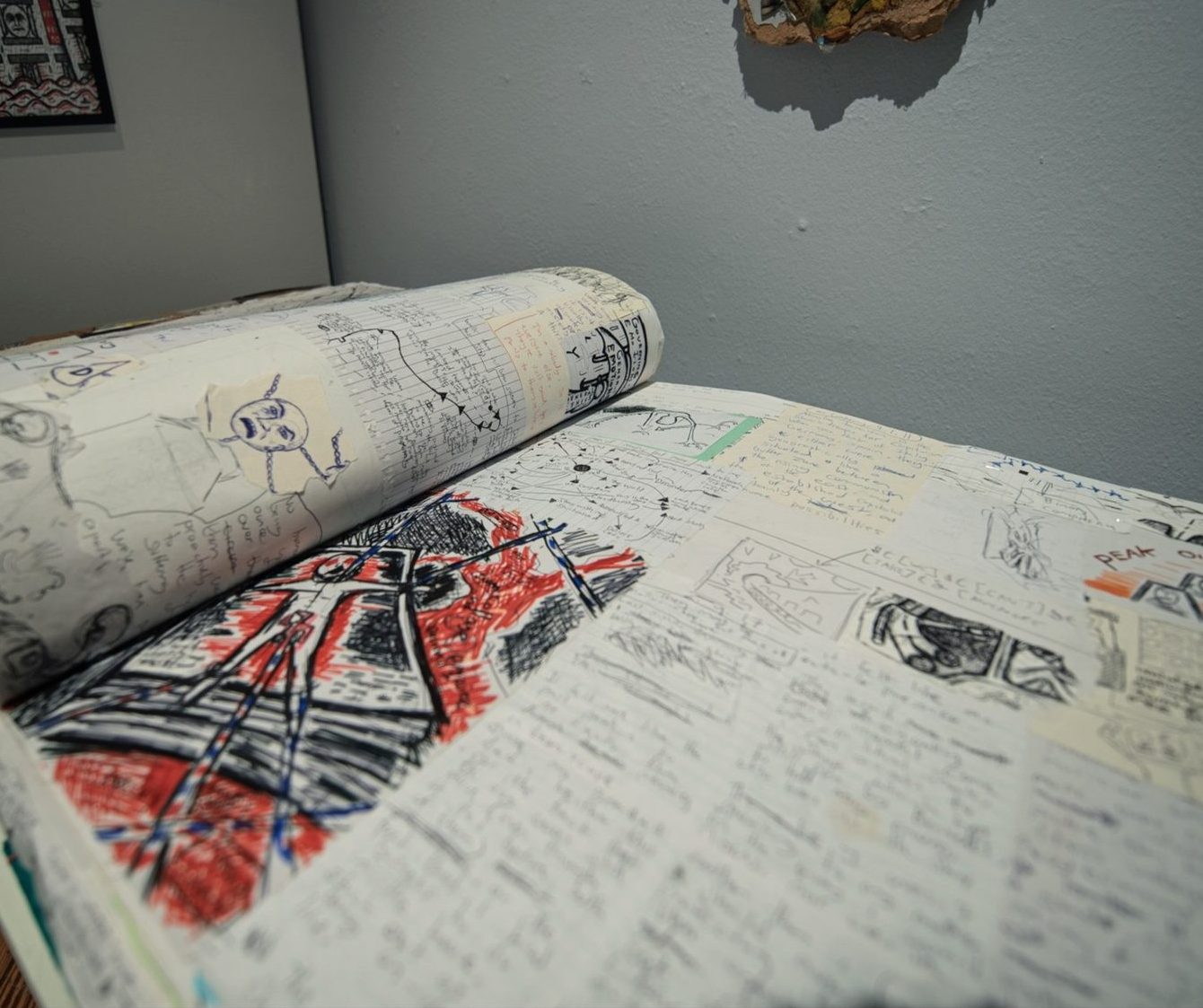
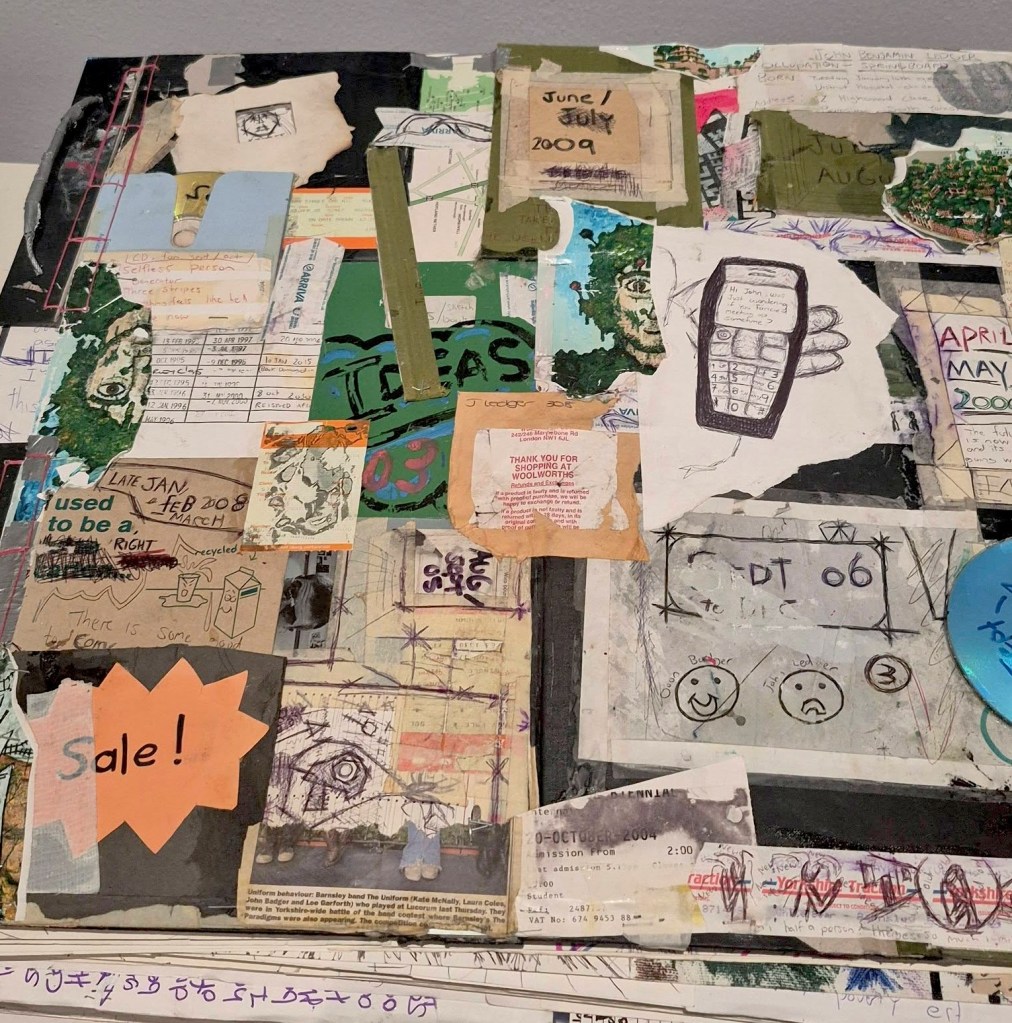
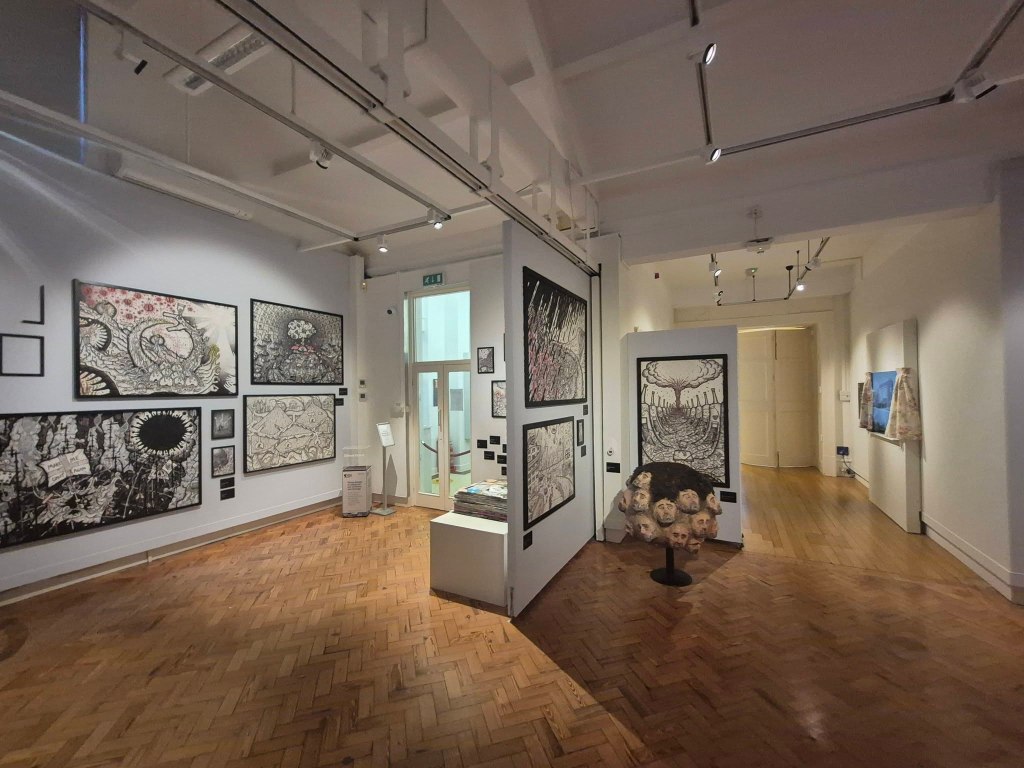
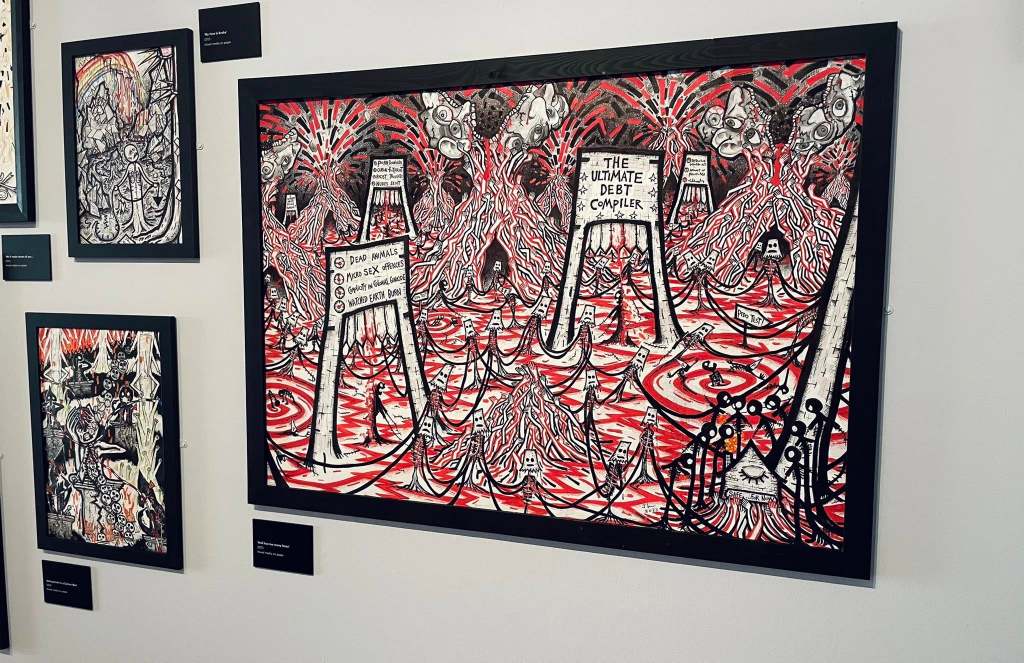
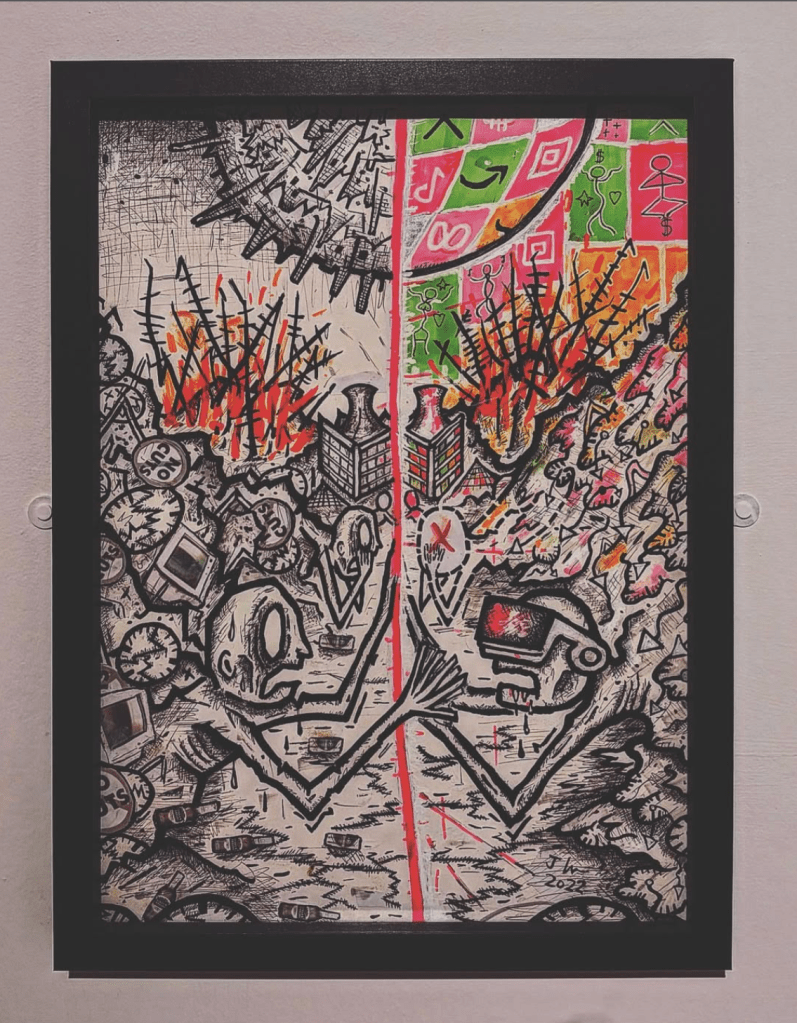
Image from the burn-out decade.
Big Exit..
Have a WordPress.com account? Log in now.


