What is becoming of us as we spend more of our lives in the virtual world?
The conversations which we may have shared between a few of us, the photographs which we may have shown to a few of us, are now shown to numbers that rise well over an hundred. Hundreds of people are seeing fragments of our otherwise more personal lives and they are making comment upon it, comparing it to their own lives, and, likewise, we find ourselves doing the same.
Why do we do this? Even those who are aware that something here isn’t quite right, and fear an alteration of perception, still end up explaining their lives away.
One gets reactionary thoughts in their heads at moments during the day which translates as “hey, that’s quite clever/funny; I should put it up on Facebook” or “that really speaks of who I am; I’ll post it on Facebook as it’ll give people a better understanding of the bits of me I want to be seen!”
For those who find theirselves caught between this urge and a concern about living our lives out on the internet, this thought is usually followed by “Is this all that my life is to become? Just an attempt to write something clever/of novelty value, to grab the attention of my fellow networker’s, whilst meanwhile my output into the real world diminishes?” It is a feeling of total negativity that, by getting caught in the mental environment of trying to prove oneself a valuable person on the internet, they are actually doing very little in the real world.
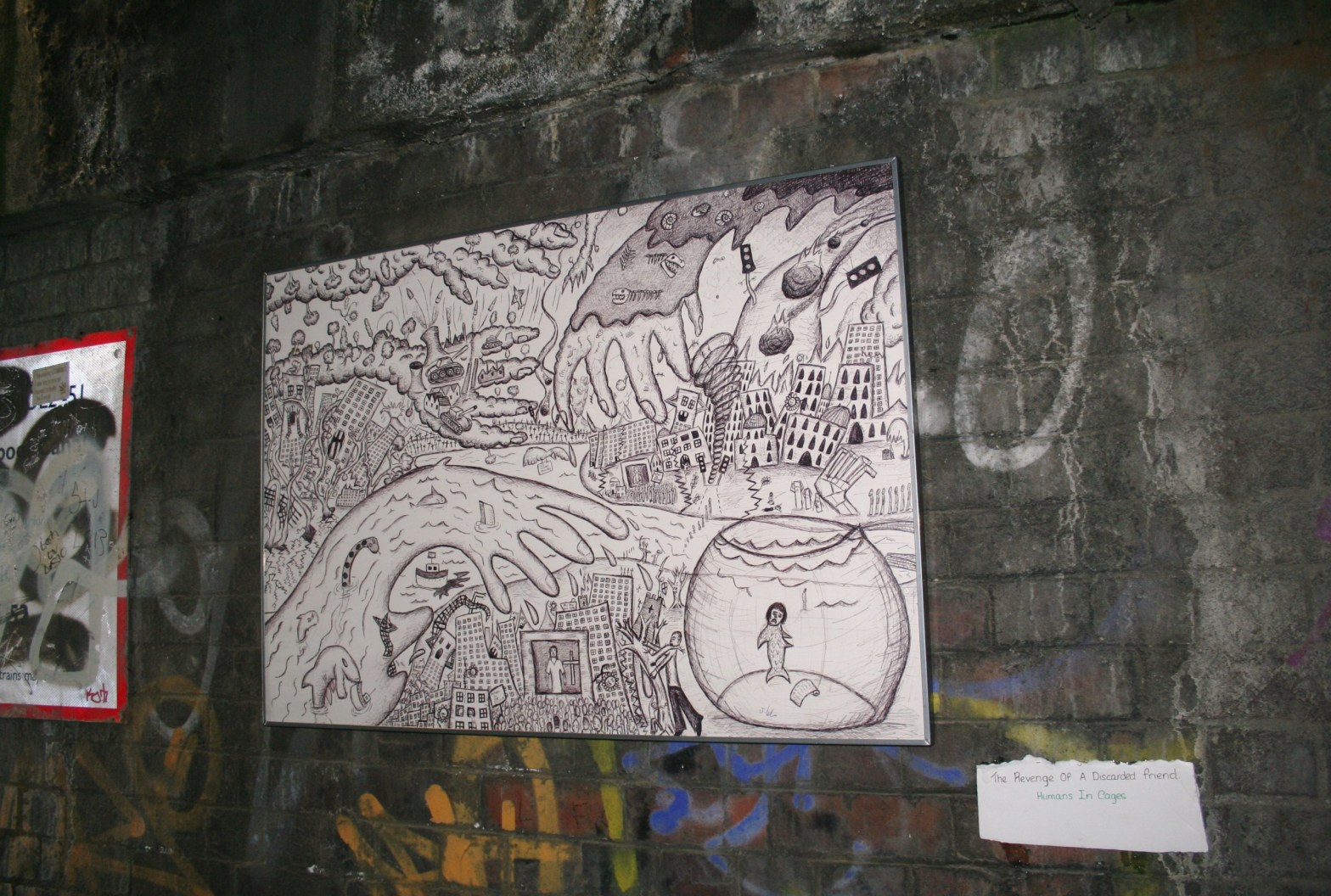
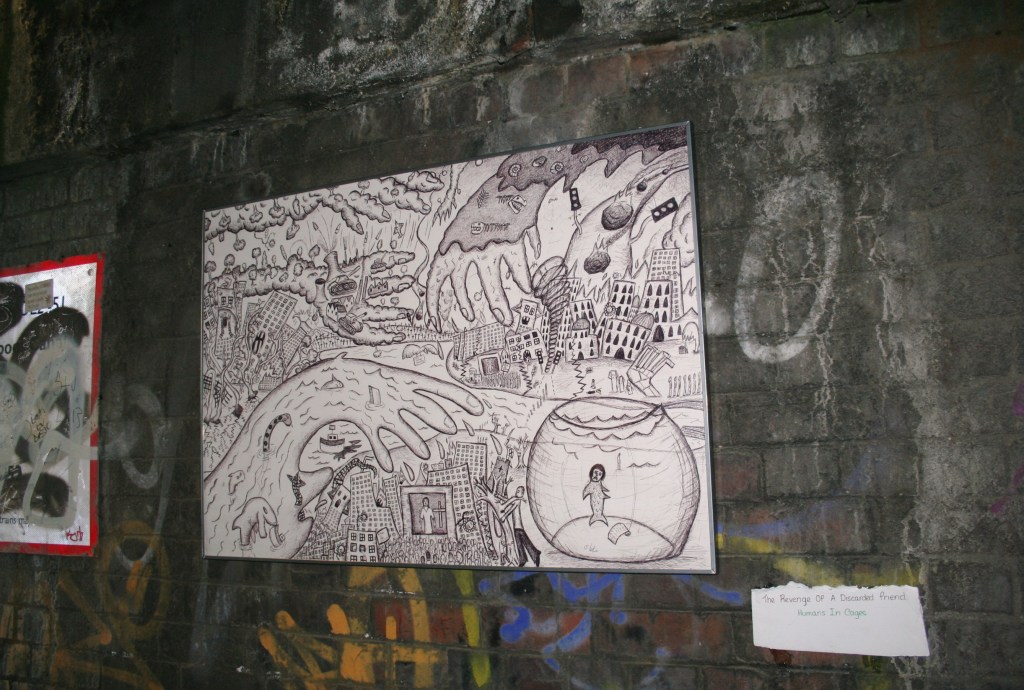
The life of a visual-artist, like me, fares no better on the social networking sites than any other individual vying for attention. The importance of being noticed online, and getting artwork online, suddenly seems to become one the prime motivations to make work in the first place. I become my page; just like others, except I am using my artwork instead of images of myself, to project what I believe is the best version of me, but by doing so I am placing my hopes onto the virtual world, loosing incentive for action in the physical world.
The paragraph below was something I wrote when this particular concern seemed highly probable.
I hide behind the veneer of the works I have made, which I am most proud of, but the veneer begins to crack from the day that the production of work deceases as I become ever-more dependent on online interaction as my real life becomes more solitary. My works of art, which I hide behind, become an empty shell; a creature once lived inside the shell but is now long gone.
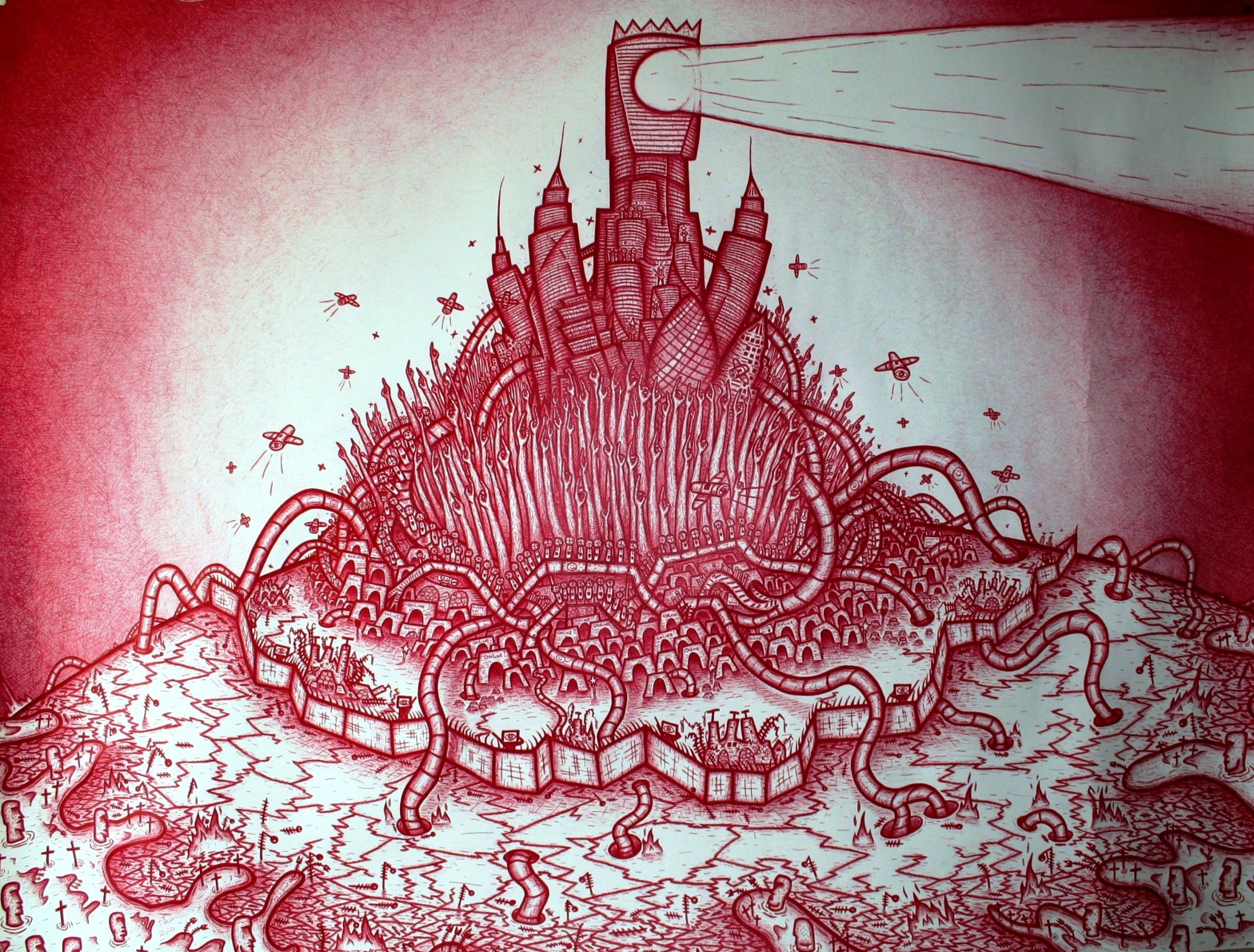
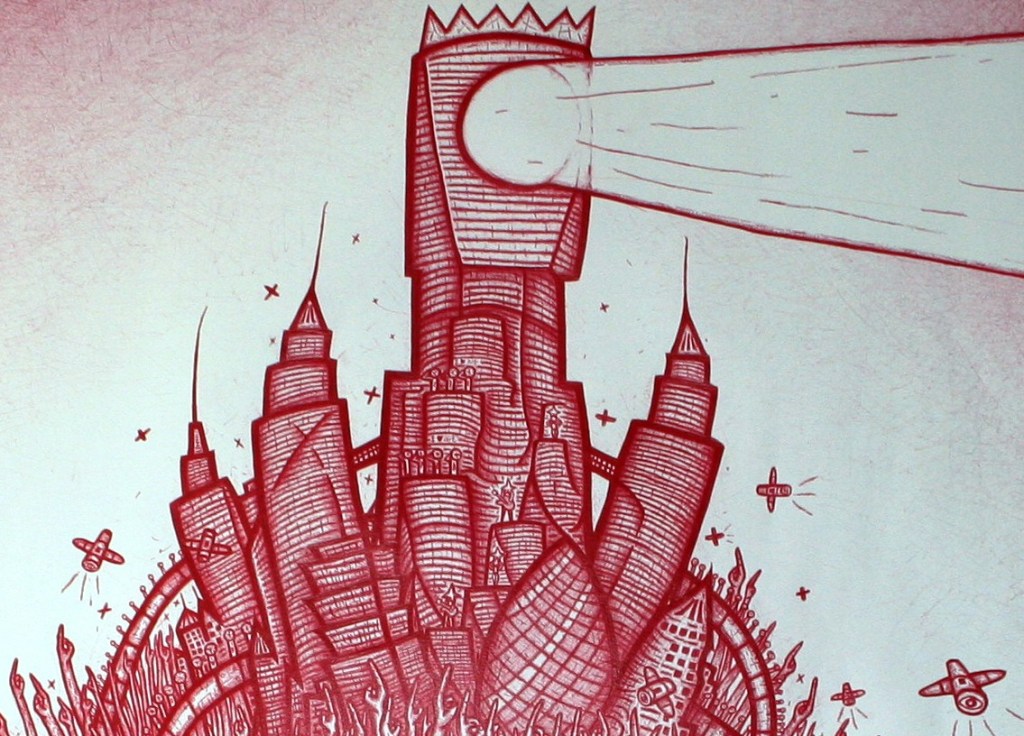
However, a sense of urgency to act more-so in the real world can be massively demoralised by empty feelings encountered when stepping out into physical human environment, luring one back to the ‘dreamscape’ of the virtual world. The physical version of world is never adequate after an immersion into the virtual; the virtual produces a much better vision of the world; continuity between events, with no empty spaces; an edited version of the world, all glitzy and free of discomfort. One looks up at the tops of a city’s tallest and most flashy buildings, from the train station as they head home feeling unfulfilled by the physical human interactions within the city, and one imagines that the people who reside in the top of these towers are having a better, more wholesome, more meaningful existence; an experience that we can only believe we can reach when in expectation of what we will find when we next log on to the world-wide-web.
However, it can never provide that human need for something more wholesome, no matter how much its promise continue to delude. The odd elations one may receive in their virtual lifetime, as one shares an online ‘intimate moment’ with another, are but grains of sand in a vast desert of disappointments and demoralisations caused by the futility of trying to express one’s self, showing one’s individuality, via novelty groups, novelty quotes and novelty applications -even the artist finds himself to be nothing but a budding novelty amidst this desert, which could never quench our thirst for satisfaction.
This is the triumph of absolute pointless pap over the human soul!!
A pointless pap which has also triumphed over important current affairs.
One finds ‘Networkers’ joining novelty Facebook groups en masse, stupid groups like ‘I once lost my phone up my arse!’ Groups which they’ll never ever go back on to, because they’ve joined so many of these it would be impossible to do so!; all this virtual novelty whilst the physical world carries on out there, getting more troublesome by the day, as it slowly veers into the abyss that the 21st century threatens to be.
Ok, distraction, novelty, stuff that serves no purpose but to give us a brief 2-second smirk, has always been around and has always been needed, but never before the internet has it been so omnipresent, so triumphant over all other information.
Fact: post a link on Facebook about something serious – i.e. a link to Naomi Klein’s The Shock Doctrine, or a George Monbiot blog on the issue of climate change– then post a feed about eating a big wedge of cheese before bedtime; the cheese will be triumphant, with many more replies and ‘likes’.
I read an interview recently in the magazine Adbusters with one of the main architects of the 1968 Paris uprisings Raoul Vaneigem; one sentence really stuck with me; “never in Europe have the forces of repressions been so weakened, yet never before have the exploited masses been so passive”
This is the result of a Europe indoctrinated by consumerism, but for me it spoke clinically of our collective mindset from the moment it was propelled into the virtual sphere (a moment which probably collectively happened after 2005 rather than before); one where an immersion in ‘quirky’ titillation seems to bubble-wrap our minds as if they are still on-course to be posted to the ‘better-world’ Millennium that was anticipated in the 20th century, before the sobering possibility of a millennia bleaker than the last one made itself known. But by ignoring this reality, we also ignore the opportunities to overthrow the ruling ideology that is directing us to this bleak place. But “the forces of repression” will not be “so weakened” in a future as bleak as our current ‘millennium-route’ seems headed.
Our desire to retain this passiveness, so not to notice the ‘grim expectations’ may be indirectly due to the bleak entrance into this new century, and the internet social networking site is providing our passivity, constantly, so we may waste time which may otherwise have been used to show us something we did not wish to be shown: a world outside that isn’t doing that well by any measure.
The passivity helps us imagine that “all is good”. “That I hate Jeremy Clarkson page really speaks for me, and it has lots of other followers too! All is good!”
The takeover of the social mind
As there ever been another moment in history where the private lives of individuals have been so non-private; transparent, as if we are looking down on each other, sat in roofless buildings, like looking down on a Lego toy-land or a computer game simulation of a town?
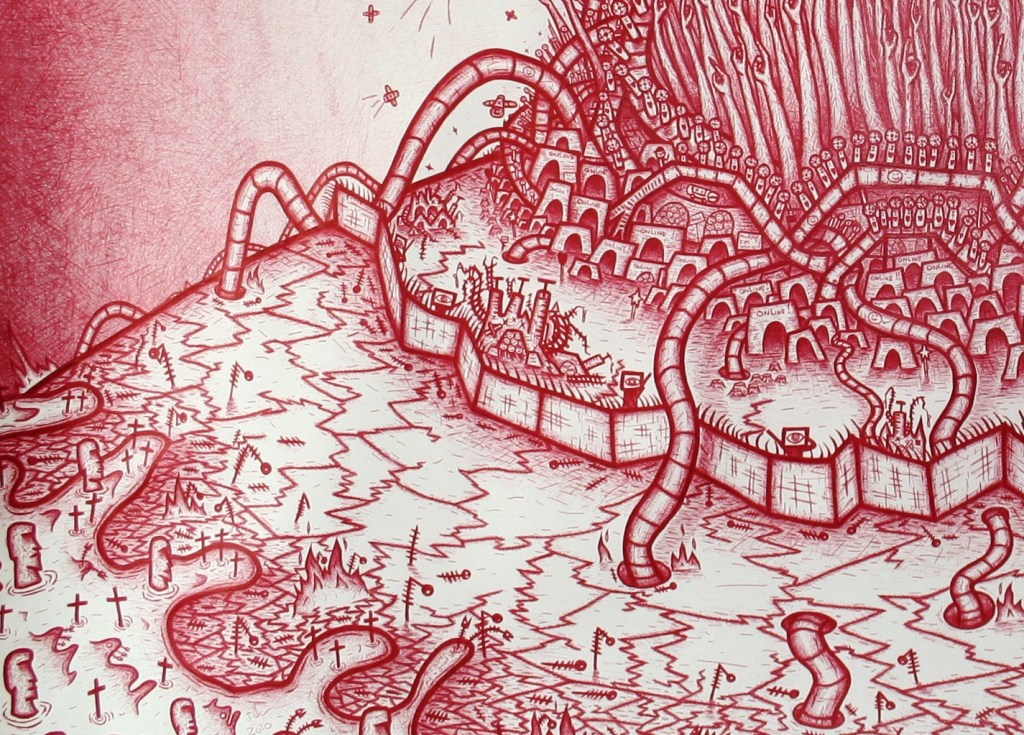
There has never been a moment like this. The dystopian fantasies, such as George Orwell’s 1984, depicted the terrifying scenario where the individual cannot escape the all-seeing eye; and this fear persists, and we recite it whenever there is in an increase in surveillance cameras in the area in which we live. However, perhaps such novels have encouraged us to look in the wrong places. Do we not all now feel actively encouraged to tell everyone about what’s on our minds/what we are doing by the means of social networking sites? The ‘big-brother’ eye, which we fear, is not the main concern, and this fear has distracted us; the biggest concern is how we are actively explaining our private lives out to a large community of people on social networking sites on the world-wide web; we are walking towards the all-seeing-eye, and we are beginning to live inside of it. We are all following like zombies, transfixed by a dream of a virtual utopia, being drawn-in by the buzzing sound of our computers; a scenario which seems to draw similarities with that of the fate of the Eloi at the hands of Morlocks in H.G.Wells’ The Time Machine.
Recently, sat next to a friend on a train, we were talking about cinema; a conversation subject I struggle to contribute anything to because I hardly ever go to the cinema. She was telling me about 3D film, where “you feel like you’re inside of the film” and how she believes it will become the norm in future cinema.
I’m hardly a technology know-all, I don’t know much about new gadgets and product names, but I am aware that there has been a massive shift in the past 10 years, especially through the way we communicate with each other, which as altered our perceptions of what is around us and altering what we take for granted.
At some point during the last ten years, I became somewhat more of a techno-sceptic than I had been (I think this moment came at the same point at which I started to become cynical of modern popular music and youth culture trends – this might just be when I became a miserable bastard, but I think it’s more likely to be an element of both aspects). More accurately, it was at a moment when my dependence on the social networking site ‘grandad’ Myspace grew. Since this moment, I have been alarmed by any further advancement which allowed further immersion into these sites in particular. My ‘environmental woes’ were alive and kicking by this point and I was probably feeling that further immersion could only have negative consequences for a species which is constantly loosing its connection with the terra-firm upon which it depends.
Whilst musing the idea of 3D cinema on the train, and before I could get on my usual ‘ranting box, I noticed that a man sat opposite us had flicked open his lap-top computer. The familiar crackling noise and the Windows load-up screen reminded me of my contradictory feelings towards technology. In the most explicit sense, I have a love-hate relationship with the computer world. The loading-up of the windows screen, and the crackling remind me of warm memories of my very early teens, when my dad brought the college lap-top home for the weekend; it evokes a feeling which is similar to the noise of running an hot bath on a cold winters day; and, of more recent times, comfy visions of socialising without the uncomfortable situations involved in the real world.
The song ‘Computer Love’ by Kraftwerk remerged in my head again, at this moment. The ambiguous yet prophetic voices, calling from way-back in 1981; a song which, towards it’s ending, evokes a feeling of submersion – the inevitable of a possibly doomed-species (like the Reptilian calls in the depths of the brains of the humans in J.G. Ballard’s Drowned-world voices, calling us ,mammalians, to go back into non-existence and let the reptiles rule once more). The lyrics of computer love could not have better described this era of virtually transfixed individuals.
Another lonely night
Stare at the TV screen
I don’t know what to do
I need a rendezvous
Computer love
At this moment, on the train, we started talking about whether 3D immersion computer interaction will be the inevitable next step after 3D cinema. In a capitalist society, if such a progression is possible then it is inevitable. 3D immersion would create the possibility for us to be sold to from all angles, without leaving our homes; imagine shopping mall, white walls, logos, a simulation of a real friend behind each doors, regularity, cleanliness, no uncomfortable moments. (Then imagine the outdoor world as this point, taking into the account the likelihood of a increasingly volatile world, due to arrive at some point in this century. Will capitalism go full-on virtual in order to survive the diminishing real world in which nobody wants to spend anymore?)
One only has to look at how closer technology has advanced towards this vision in just 10 years, to see the huge possibility of this happening; the web becoming permanently attached to people, just as it has attached itself to mobile phones – another relatively recent phenomena which the majority of humans cannot function without, although they have only been widely available for just over 10 years.
A 3D internet immersion would disconnect us from the ever-encroaching noisy urban environment. We would ‘switch-off’ from the noisy buses and trains, not by just putting our headphones in, but by talking to simulations of our buddies (a process which couldn’t really look much less schizoid than those who already use mobile phones with headphones) on a ‘walk-in’ Facebook-of-the-future.
This disconnection from the real world is exactly the kind of future which exists in the novel Feed by M.T. Anderson. This novel, which is categorised as ‘teen-fiction’ but is so much more than this, may actually be a prophecy. As well as the social and environmental consequences described in it, it also describes a future people fully disconnected from reality to a virtual land of distractions, created by internet corporations, who know how to tend to everybody’s personas. (Amazon and Facebook are already serving out adverts aimed at our personality descriptions, and Google is already attempting to transfer the entirety of the real world onto a virtual plane.) The real world is falling apart in Feed, but the consumers couldn’t give a shit. They are constantly satiated by a personalised virtual fun-land.
Does this sound like a far-fetch fictional novel? Does it sound like an unlikely scenario for our world? I am not so sure; I fear the worse under the current procession. The deterioration of the planet’s eco-systems is increasing at, what seems to be, a pretty much consistent level to the increasing technological advancements: as the world is getting more and more volatile and the waters rise, we are climbing into monitor screens, hoping to sale away into a virtual utopia. However, we are still made of skin and bones.
An increasing isolation
The major alterations, during the last decade, to the way we communicate – cell phones, internet communication – have, by their nature of requiring the user to contact the rest of humanity via their devices, perpetuated isolation. We are increasingly required to communicate with people without coming into physical contact with them. This creates an inevitable lonesome outcome, which prompts the individual to search harder, speaker louder, within the only places he/she can find an audience – which are in realms of cyberspace; thus further escalating the usage of these places to communicate, thus further escalating isolation.
When I’ve over-tired myself to the extent that I cannot join in, in the disconnection, and switch off to “that space cadet glow” on my MP3 player, I find myself ‘people-watching’ whilst on the train back. The people are not looking at other people they are tuning in to little boxes, with their gazed fixed on little screens of options. There is noise – babies crying etc – but most noise is from isolated sources; sounds from I pods, mobile ring tones, conversations through cyberspace with people miles away that we (the passengers on the train) can’t see.
There is a link between the reasons why I seem to spend my ‘days off’ solitary travelling up and down the rail-line, and the increasing amount of time I, amongst most others, spend contacting the rest of the world from behind a screen. I could spend an whole day behind a screen; not an happy day, certainly not a morally uplifting day, but certainly a day eternally finding ‘tasks’ to be done.
It is easy to feel captive to the computer room when more and more of one’s life appears to be channelled through the computer. Whilst in this captive-like state of finding endless cyber-space requests made of you, one is also a captive audience to the impression of the world that the world-wide-web conveys: it creates an impression of the world whizzing past you, succeeding, accumulating, producing, and leaving you, who is sat gathering moss on the computer seat, behind in the process.
The internet is a forest of people, all vying to be heard. The social anxiety, the pressure to be noticed, revered as someone of worth, is massively claustrophobic. It is a pressure that forces one to think “I need to be more productive, I need to show that I am a hard working and individual”. But equally present, no matter how much one ‘networks’ their perceived talents, are the feelings of malaise and uselessness whilst sitting, captive, in the computer room, urging one to go out and do something un-lazy and productive in the real world.
The urge to go out is fired by an urge to make the trip a productive outing, because of the feeling that all those ‘tasks completed’ in cyber-space accumulate to nothing, whilst the feeling that one still needs to prove themselves of worth in a forest of people, seemingly all doing likewise, persists. So, outings become a race to make a day productive; a productiveness which can hardly be guaranteed by a stroll in the countryside or meet-up with friends. Hence, one finds themselves ‘tasking it up’ in the physical world; organising their life around a train route (I don’t drive a car) to fit enough in, so “today can feel like a success and a day well done!” This is why as soon as something productive is achieved (in my case, a new piece of art made, or a thought written down) one feels an urge to “get it up on Facebook!”
After a morning, on a day off from work, of fruitless task-completing on the computer, I have a list of things I ‘need’ to do in order to feel that I have been productive. They are all solitary, because the ‘fast and productive’ world I see before me on the internet, and the feelings of idleness created whilst ‘task-laden and ‘captive’ to this impression of the world, pressure me into believing that I have no spare time for ‘chit chat’ and fun, as I need to be breaking my back, physically. this creates the social void, from which there seems to be no way out of but to venture back onto the world-wide-web, in search of a dream-like collage of long-lost friends, all waiting for me to restart the ‘good times’ – those times which have only ever appeared to exist on other peoples online photo albums. The realisation that I have isolated myself only becomes apparent when I’m knackered on the train home; when the opportunities for the day (except the opportunities to get ‘pissed’ in my home town) are all but gone, and I look to my surrounding environment for an answer, only to see that its answer is to talk to people I can’t see, listen to things I can’t hear, via the gadgets which I suspect prompted my own isolation. And who is there to speak with about my despairing isolation but to voyeuristically tell the entirety of my online community, as there’s nobody here in the physical world to speak to!
Perhaps the ‘need to be productive’ and the ‘watching of people drifting-off into cyber-space after their days work, on the train’ are tendencies/habits which are more peculiar to me. However, what I am trying to explain through my own experience is that the environment created by the increasing presence of cyber-space (computer/internet, cell phones) in our lives doesn’t just create isolation within our domestic environments, in which we dissolve into at the end of the day, but it also creates it within the life we seek to lead in the outer-environment. It does this by both constantly interrupting an escape from it, reminding us of ‘what we are missing’ when someone on the train/bus seems to be getting more attention through it than we are, as their phones ‘bleep bleep’ all the way home; and it also does it by coaxing out a feeling that we have no time to do anything else but task completing, because “you’ve wasted way too much time sat in front of the screen this morning, and you’re not doing nearly half as much with your life as all the others on the networking sites are”
The increasing amount of evening isolation is perhaps more apparent to spot, but cyber-space is certainly helping to create the social void within the day-time, which is wrongly catered-for by cyber-space in the evening-time, as one finds they have no alternative for a cure to the isolation but to scour the web more so, and, in the process, be subjected to the appearance that everything is happening everywhere but where they are, and everybody is pushing forwards and progressing but them. This creates the setting for another day of isolation tomorrow and so forth.
The unwritten destiny of humanity?
The invention of the Net is not a bad thing; the danger is that we will begin to live our lives entirely through the net, and this would further separate us from the outside world, a world which threatens to be ever more turbulent in the 21st century. If we ignore the world outside our doors it may evolve into an intensely hostile environment which no longer permits our species’ stay on the planet.
This would be a waste not merely for our own progress as a species, but also for the progress of the entirety of life. The evolution of a conscious creature is an incredibly important step for life. Despite our fragile existence as a species, and despite the fact that the rest of life would carry on, probably more triumphantly, without us, what we contribute to life on earth is unique. We (humans) are the earth’s brain, in every sense but that of a religious destiny.
The internet has the ability to connect citizens of the world providing a combined empowerment to stand up to the undemocratic system of capitalism, and eventually overthrow it. Yet, under Capitalism it has become the system’s most powerful tool – the most efficient of consumer distractions – distracting the bulk of its users with a barrage of novelties, badges of nonsense, which speak to ones claims for individuality, to mark out their sense of social status amongst the forest of others all doing the same (one may even actually join a group page for a democratic activist organisation for entirely this purpose!).
The net has just become the virtual equivalent of advanced consumerism in the physical world. The virtual form may not directly drain the planet of its resources, but it lights up the pathway towards doing so, like Blackpool illuminations. And It is equal if not more successful in draining individuals of their vigilance, awareness, making a nation a consumers who are indifferent to acts of global injustice and national injustice by the corporate state. So much hope was held for the internet to be a bringer of true democracy, providing information to all and eventually becoming a force to bring global Capitalism to justice Capitalism, however, had other ideas: It wasn’t going to give up so easily. It can consume anything and turn it into tool for its own benefit. These hopes were ‘so 20th century’. If an image could sum the first decade of the 21st century it would show a snidey grin on the face of capitalism, self satisfied with having taken democracy’s ‘bright new hope’ and turned it into its own ‘bright new star’
It seems apparent that Capitalism, left to its own devices, will seek to turn every aspect of our lives into a profit making venture: dependent on doing most of our communication via the internet and mobile phones means that we are always paying chunks of our wages to internet and mobile phone companies, to ensure that our connection to the world isn’t cut off; we are now basically having to pay to communicate, which makes the early mobile phone slogan ‘pay as you talk’ seem much more sinister. If they could they’d charge us for oxygen, in fact they probably will do if we end up having to breathe it via tanks.
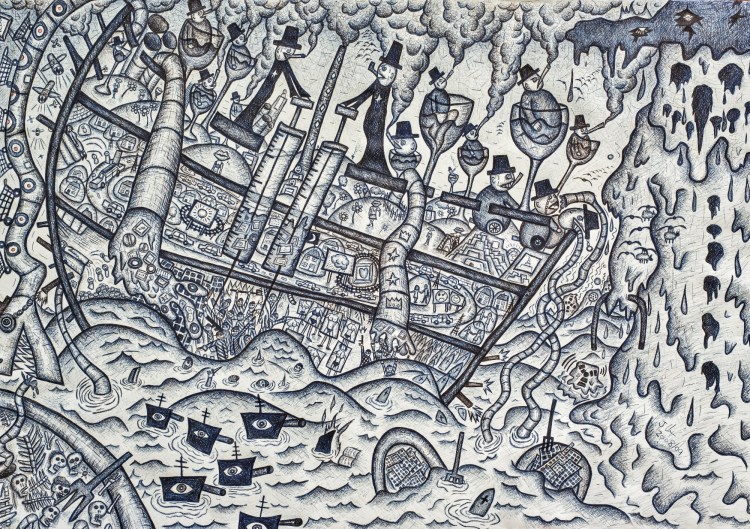
Communication through cyber space, although a creation made under Capitalism, would be put to better under a more democratic, and less socially anxious society – a bringer of doorways rather than the walls of an lonely room. All technology has the ability to be a benefit, and if it is actually doing us harm then something isn’t right with the way it is being encouraged to be used. It is yet another indication that although Capitalism may have propelled us this level of advancement, we need to abandon its voyage and head for another, as Capitalism is mesmerised by the siren “singing it to shipwreck” (more lyrics taken from Radiohead – THANK YOU). Capitalism is dynamic, and the world now needs stability not dynamism, we now possess the tools to create a much more harmonious and equal order, if only it could abandon the capitalist ship. It is a tragedy that we are still aboard this ship, looking for treasures that will forever elude us.







 John B Ledger