
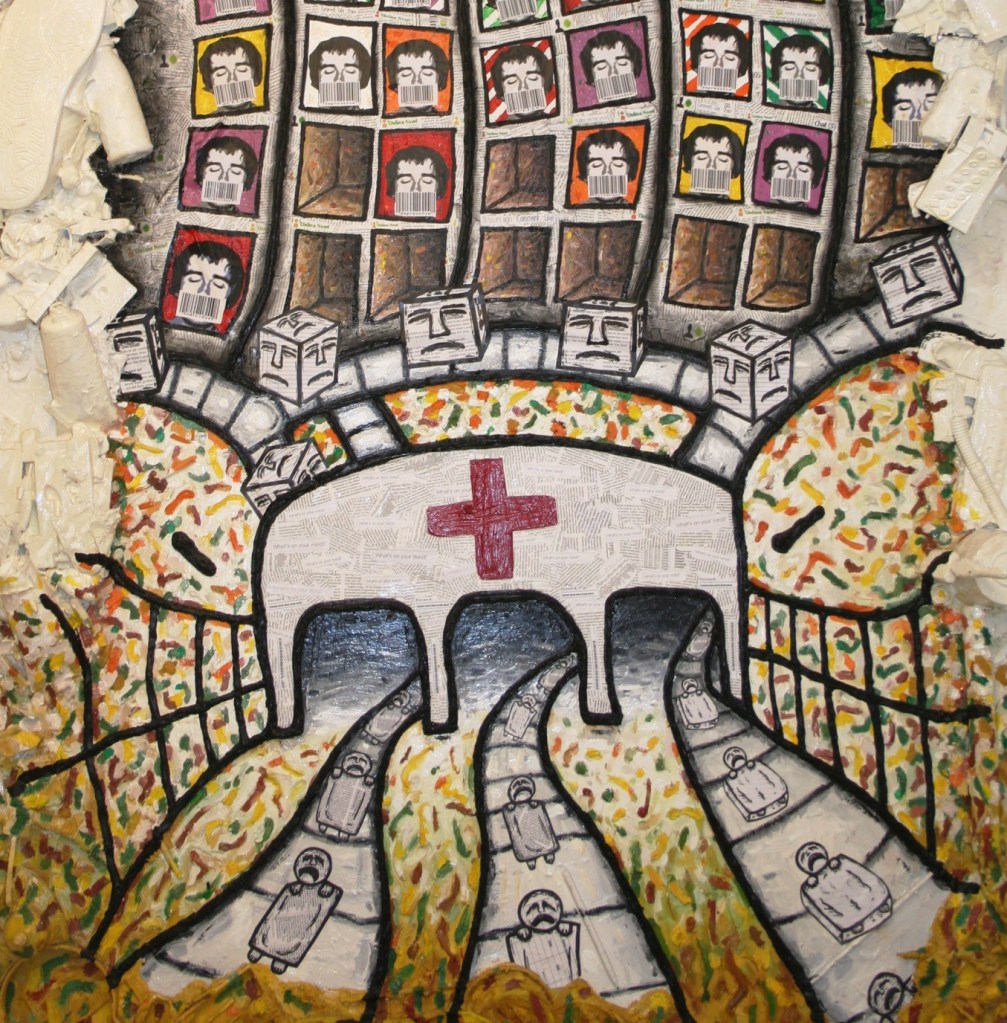
(image courtesy of Carys Bryan)
What is the right way to go about protesting against the capitalist system? This is the debate which has been at a deadlock in my mind since I returned from the Protests against the government Cuts on March 26th in London. The massive cuts to state welfare were the issue which fused so many groups into one massive demonstration, but they were wrapped in a mass of other causes which have all been caused by the capitalist system.
Truth be told, for all of my anger, despair and objection to the direction that the system is taking humanity in, demonstrations are something relatively new to me, and despite my age I am still unsure of myself within the social sphere and have always found joining in and acting on beliefs in public very hard (the past few weeks have been full of missed golden opportunities to do at least something: first I went to the protest outside the Liberal Democrat Conference in the nearby city of Sheffield, only to stand there shy and confused, like a crap football manager, not knowing what foot to put in front of the other; the next day, again in Sheffield, meeting work-friends, I was walking through Sheffield’s roof-covered Winter Gardens only to see Nick Clegg of all people walking from the hotel directly towards where I was! I just buckled and turned my head, pretending to look at the tropical plants in there, giving away an opportunity which thousands of people outside had been dying to have! – although a friend kindly pointed out that if he had noticed that someone was finding a leaf more interesting than him, it may have been quite ego-shattering! That wasn’t the end: out running a few days ago, the Google camera-car came driving past me, stopped for a bit and then drove on, probably ensuring my appearance on one of the last things I would ever want to feature on – it will look like I just willfully let it copy my image). The well known phrase ‘the only thing to fear is fear itself’ may well apply, and I am trying to overcome this, but it is a long hard road, especially when I still have so many attachments hooking me to the system, even as I know with (pretty much) certainty that the world as we know it is teetering on the brink of collapse (whether you locate this reality’s death as the return of pre-democratic capitalism to western shores or as environmental chaos).
The sense of what reality is is the main thing that really left an impact on me and my friends who I went to the demonstration with, as we left for our train back to the north of England. Due to having requirements in the north, such as having to work for a wage the next day, we had to leave almost straight after the bulk of the protesting which meant that we had to quickly switch from one experience of reality to a very very different one indeed. This forced-transition was emotionally draining to say the least. This is because the reality we experienced in London that day wasn’t as simple as an attempt at bargaining with a capitalism system which is threatening to be crueler to us, by pleading with it not to crush our welfare system and to keep things like they have been for as long as living memory (although I’m pretty sure most demonstrators didn’t just want a return to this, and wanted more also); the protests to us (especially as certain groups came into clashes with the police) seemed to suggest not an anomaly/a one-off disruption of the capitalist reality we are familiar with, but the seeds of new realities (positive and negative) and the blueprint for what is to be more common from now; more and more disorder as more and more angry people take to the streets in disobedience of the system’s requested of them, and a more frequent usage of the more authoritarian side of the police force by the state (the helicopters were hovering above the streets for a duration that I have never witnessed before, provoking an anxiety which made me feel like I had finally arrived in an ultra-authoritarian state). And alongside this experience of the increasingly repressive state, what we experienced/what we could almost taste (bearing in mind that, as I have said, none of us have had that much experience of protesting before) was glimpses of a new non-capitalist reality, the beginning glimpses of the seeds for potential revolution; it is the first time I have had the feeling that the time to grasp for system change (from capitalism) is coming within reach again.

(image courtesy of Carys Bryan) 
(Image courtesy of Sam Vickers)But it was my friend who said that it seems like it can only go so far and then it just turns into a festival/carnivalesque event, which can then only celebrate itself, until it simmers out into nothing, and the simmering out of another reality/another way is what made up most of the exhaustion as we then had to make the transition to the mindset for the reality we are used to living in, confused as to where we were, and where we actually wanted to be. Where are we in time? and does the fact that our pubs are still there, are electricity still on hand, our soaps, shower gels and toothpastes and everything else which has been there in our pasts, make us not care that much in order to keep on fighting to sustain another reality?
The carnivalesque atmosphere was happening whilst other groups were taking more radical steps just a few blocks away, rioting in certain locations in order to damage the worst of the worst businesses on the high streets (the bank branches and tax avoiding companies such as Topshop and Vodaphone and places that cater for the very wealthy such as the Ritz hotel). I had an instant shock at the point where the separate groups came into view of the main march, as I noticed, for the first time, conflict between the protesters. One man started shouting ‘wanker’ at somebody. I thought it must have been aimed at a cocky Tory trying to cause trouble by belittling the march, but it was anger aimed at a group of young people with their identities covered (The Black Block/Anarchists). Another woman shouted “cowards! why don’t you show yourself? What have you got to hide? and tried to grab the arm of a young woman who came running through the march with a group all covered in Black clothing.
There is no doubt at all that these people who were hiding their identities were responsible for most of the damage done the high street businesses, and for the ever-present threat of kettling from the police in the hairier situations up and down central London. What troubled me the most was whether their profoundly more direct approach was the right one, and whether I should have been part of a more direct approach also (a fundamental approach which means a rejection and fight against the whole capitalist system, which is more akin to my own rhetoric) or whether just for the sheer numbers (bearing in mind that I am still very scared on waging direct action in fear of a reprisal damaging the ties to the system which I do currently depend on), the peaceful and institutionalised demonstrations were the right approach. This showed on the placard I was holding which I picked up off the street earlier in the day: one side was a union message saying the “cuts will kill” and on the other side I wrote “only a few years until irreversible climate change. End of capitalism now!” and I kept on rotating the placard like a diner sign in the wind, as although I thought both were right, I was nervous as to which one I should publicly want to declare.

There is no doubt that from the writing I saw sprayed on shops, the stickers pasted over The London Underground and the places where they aimed their anger that in theory there would be very little for me to disagree on with the Block Block/Anarchist section. I refuse to condone the damage done to these shops, banks and hotels, whether it was done in the belief of a noble cause, or just by those for whom vandalism is the latest fad. Nevertheless, I do have doubts as to whether it was the right choice of action, precisely because it gives the mainstream media surplus ammo to ram home disproportionately covered footage of violent action to scare the populace into fearing anything other than capitalist realism, and I saw this fear resorting to anger of its own, in isolated incidents, whilst making my way home. But also, I couldn’t help but consider whether it was right to bring riots to the streets in front of children in what was largely a family orientated protest, threatening to cause distress to people who are after all out support a just cause (but, yet again, I saw little evidence of children in distress whilst attending the demo – I only saw it being emphasized on BBC news 24 when I got home later on), or were these necessary displays of a complete rejection of a system we must so crucially fight if these children are even going to have any future at all? (Capitalism’s inherent need to grow, thus continue to tear up the environment – surely this makes any attempt at its overthrow a necessity?).

(Tiny Mindless Minority, a cartoon by Martin Rowson, in The Guardian on monday 28th, perfectly sums up why, even if they don’t think the violence was the right choice of action, many people certainly DO NOT condone it.)
And for this reason, it wasn’t completely down to the rioting and the potential of real violence from the police, as to why I became so unsettled towards the end of the day: it was the inner conflict of who I am and what I really believe and what I want to see happen in the world. Part of me really wanted to see, and wished to partake in (if only I didn’t have a certain fear of being lambasted by those who I depend upon and a infuriating instinctive reaction of apology to any authority figure) the smashing up of a branch or two of big businesses and, to go further, the desecration of all things bourgeois in the near vicinity. However, another side of me longs for peace and togetherness, and a hope (and sadly I think that a hope is all that it is) that the right things for the people can be brought about by peace and togetherness (almost like the bizarrely simplistic ending to the famous 1920’s film Metropolis, where the leader of the city ever so easily comes to realise the errors of his ways and goes forth to run the city for the benefit of all its citizens) – which is pretty much a summing up of the main protests held by the Trade Unions. Knowledge tells me that the government simply won’t give in to such a peaceful protest, and, more than that, the system won’t even be tested. But this relates to a much more total problem as we still live in a time where capitalism is still massively asserted as the only option, thus making most campaigns and protest merely appeal for capitalism to be a little bit nicer instead of an attempt to challenge it (although, as I have said earlier, there is some signs that people are starting to search beyond capitalism again). It is a dilemma of whether to look for a complete overhaul or to just help do our best to make capitalism be better to the people; the latter being the more instantaneously self-congratulatory choice of action, but also largely futile; the former being the right choice over all, but much more difficult to follow, and even possibly inhumane to those around us who need our instant help, not some far off goal.
I am having the very same dilemma, whilst writing this blog, as I leaf through a letter from charity group Action Aid, asking me to lobby my MP to support action on global poverty and to tackle global hunger. Of course I think global poverty and global hunger are totally awful, unjust and unnecessary problems which need to end. But this is precisely why I am unsure that charity is the right method for ending it: like the bulk of the march 26th demonstration which was intending to fight to save the welfare state, it is campaigning within the real of capitalism, bargaining with it in acceptance that “there is no alternative” to it, not attempting to fight for a world where these gross inequalities need not exist.
Slavoj Žižek rightfully, but controversially, states how charity, although it has truly good intentions, merely perpetuates the inequalities it aims to challenge because it tries to ease them rather than abolish the system that makes them. He made the example of how the worst slave owners were the ones who treat their slaves well because they diverted the issue away from the abolishing of what, no matter how better treat the slaves were than before, was still a repressive and totally unjust and unfair practice. At the same time, again appealing within the real of capitalism, there is some truth in the fact that charity (especially in its high street form, where the logos on the jackets of their workers strangely reflect the logos on the shops and merely add bulk to the idea of consumerism) appeals to the pervasive consumer mentality of buying to make ourselves feel better; in this case, spending to slightly relieve us of the guilt of generally participating in a system which causes much more misery than we experience, to other people in less fortunate parts of the world. This doesn’t mean it is an unjust or bad procedure, but is perhaps the wrong choice if we do actually want to see things such as extreme poverty abolished and not just for an occasional easing of it and a release from guilt for ourselves, which would require actions taken outside the veil of capitalist realism.
The unwillingness, or incapability (which probably includes myself) to challenge the real of capitalism sadly seems true of the bulk of the anti-cuts campaign. The cuts are awful, unjust, and letting the elitist trolls off the hook, but merely appealing to the system to be fairer to us all simply doesn’t seem to be the answer we need, not to mention relying on morals from a amoral system which, even if some ground against the cuts can be made, only puts them off until they surface again in the future – bigger and harsher.
Yet, although I believe all this, I also see the inhumanity which could be enacted if we were to dismiss charity and welfare-appeal in order to see a bigger picture, and the sheer crudity in both asking those who devote their lives to just charities to give it up for the ‘bigger picture’ and never giving to those in need again because it isn’t the answer to the overall issue; this would abandon vulnerable people who need help immediately, and the good nature and wanting for a better world from those bargaining for a fairer world through capitalism means that they simply shouldn’t be left to do this by themselves. The radicalism which is required to challenge rather than merely fight back against the worst aspects of capitalism is a hard practice to live by; where do you begin? and how do you sustain it? And in respect to the demonstrations, should one go with the direct actions of Black Block and The Anarchists (I am still not sure who did what at the protest so I have referred to them both, if it was either and not mainly people working for the media and authorities) knowing that there is a possibility that 1; some of them aren’t in it for the right reasons and possibly just want a riot and 2; that the power and pervasiveness of the mainstream media means that more negative and fearful feeling about these actions can be generated within the majority of the nation’s population than positive feeling; or should one go with the more peaceful demonstration which, unlike Black Block/The Anarchists, doesn’t have an air of challenging and other-throwing the system, but merely wants it to look after us better, knowing that most of these demonstrators do have the hearts firmly in the right place?
Not to mention my inability to act, and persisting fear of the unknown, although this might be exacerbated by a confusion which seems to increase with the more that I learn. The later and more tired I get, my depression kicks in as a noble justification to give up and hide away. Out comes my mp3 player, on comes the music which speaks to me of hurtling towards a dead end more than anything else; the music of Joy Division; “who is right and who can tell and who gives a damn right now?”
How to act outside the veil of capitalist realism with the intention of fighting it, well that’s a problem (both in my art work and in my search for content and freedom from the consumer mentality) that has been causing me mental havoc for years now, as it has done so too for many an artist, poet, and musician, and arguably playing a significant role in the famous suicides of our ‘fallen stars’.
Philosopher Alain Badiou’s idea that subtraction from the real of capitalism, rather than trying to replace the state with a new state (thus running a major likelihood of repeating the disaster of 20th century communism) is a truly inspiring idea, but I cannot think of many ways of acting this out. Perhaps, however, a good example is in the actions of the UKUncut direct action group who, despite their name which may give over the idea that they are predominately appealing from with the framework of capitalist realism, gave a really good example of subtraction from the state, when in the midst of the Saturday demonstrations in London, they occupied some of the main high street shops and banks (unjustly arrested after being tricked by the police into believing that would be set free, but this is another issue) and turned them into make-shift health-treatment centres, places to stage musical comedy performances etc, excellently turning ‘Dave’ Cameron’s phoney ‘big society’ idea against him, making something which if implemented and repeated more so across the country with preplanned tactics, could really test the legitimacy of this government. Returning to the march, out of all groups UKUncut are perhaps the ones with the right ideas. All that is left to do (personally) is to fight my own condition which (because it has affected and is still affecting so many young people, has been given a name) Mark Fisher labeled as ‘reflective impotence’, rather than the much more more simplistic apathy.

(Images courtesy of Sam Vickers)
Referring back to the Black Block and the Anarchists, If anything did make me slightly skeptical about them it was that, despite their faces being covered up, one could see that their body frames were nearly all very slim/slender with narrow shoulders, making it blatant that most were not out of their teenage years. My instant doubt was that many of them were possibly taking part for excitement and too young to have developed such a concrete philosophy. However, reflecting on these assumptions, and taking into account my views about the state of the world and that turning a blind eye to it is almost impossible due to the sheer amount of information out there, maybe it is possible that the reverse of my assumptions is true; that many of today’s youth are in such absolute despair about the world that is being passed onto them that they already do have concrete philosophical and political beliefs, a necessity in order to try to do something about it. Maybe, after all is said and done, the spirit of revolution is genuine this time? A long shot it’s true, but still, something new may actually be brewing.
Nethertheless, the other thing which did cross my mind, however, was in regards to a protest in 2010 in Toronto, Canada. Similar incidents of property damage (thus prompting extreme police tactics) had occurred involving the Black Block, prompting the anchorman for The Real News Network (and independent, unbiased online news broadcaster) to condemn their actions, airing a suspicion that many of the people enacting the violence may not be not who they said they were, and were actually working for the authorities, instigating criminal damage so that the police forces then had a legal justification to charge on, and oppress the bulk of the protesters in general. This is not unheard of; it happened in the 1984 miners’ strike, where someone dressed in plain clothes from the authorities would stand with the striking miners, and throw something such as a rock at the police which then gave them authority to charge forward (in fact there is now footage from the March 26 protests which show an ‘hooded individual apparently showing a pass to officers before walking through police lines. Likewise, a friend of mine told me of how a friend of his who was involved in the protest was offered a brick by a SKY TV journalist, with the offer of money if he threw it through a window).
However, a dominating factor in my initial doubts/suspicion may be a reflex to ease me of the guilty feelings from being inadequate at, and fearful of confrontation and direct action in the face of authority; I know that my body is still full of institutional toxins leading me to buckle and to give in when coming face to face with a figure, or building which possesses authority. The images of the Police with their shields and batons, protecting the Ritz, put as much fear into me as it did anger. I felt like I just wasn’t up to this; and there came a point when I just wanted to leave the streets where ‘the ‘action’ was happening; I wanted to get out of this ‘mad city’. And because of all this fear of change and the disorder that surrounds it, conflicting with the knowledge that this is precisely what we require at the moment to pave ourselves any kind of future, I am currently feeling very lost, and less sure of who I actually am than I have been for some time. It must be said that although I am battling hard to alter my outlook on life, I am a depressive: I see deadlocks and I actually fear change even when I know it could be for the better (for example, ask me take on something new in life and my first reaction is fear not opportunism).
But this depressive outlook – that any fundamental shift is a terrifying unknown – is the natural state of a media-fed citizen of a capitalist nation, in which freedom is only advocated, and allowed as long as it is the narrow definition of freedom-to-purchase-commodities, from one purchase of freedom to another, where anything beyond this horizon is pose potential disaster to our hedonistic trail. This world says “switch on the screen, switch yourself off; consume, be the same; stay in and watch the BBC, the Dave comedy channel and the endless stream of “warnings from history” about fascist Germany on the Yesterday channel” (whilst the world outside slowly starts to resemble a dictatorship itself!) “Because, remember, life under capitalism may have shit parts/gray days but it could be much much worse, and would be much much worse. Hey! Why don’t you get something nice from the fridge? You deserve it!”
On the way back through the underground system I was reminded of the depressing but ‘safe’ (for now, at least) existence of the conventional reality: advert after advert containing images of generically beautiful women, who as much as I am conditioned to pine for, I will never actually see in reality becasue they only exist on photoshop files. Then I was reminded of the police state infrastructure via the endless and repetitive automated tannoy announcements (voices too sharp not to penetrate) and the posters advertising the usage of CCTV cameras within the location, with words and the visuals of peering eyes, reminding us to the fact that the extent of the surveillance state is so far down the line of normalisation that the vulgar similarities between the imagery and the warnings from writers such as George Orwell no longer even raise a voice of concern amongst the commuters.
As we got on the train we were already expecting that the coverage of the demonstrations on the main news channels would be predominatley negative – speaking as the voice of capitalism’s superego; shocked and perplexed as to why people would be so ungrateful and aggressive to it after the “good life it’s given us” – because we’d already received a small dose of negative comments as we walked back through the city with our placards (even though we had been peaceful protesters). You could tell that these opinions had been formed from being informed by
the mainstream news channels (no surprise, as I turned on the television when I finally got home, to find the BBC news reporter treating the whole incident as if he was being led by the police through a landscape of fire-loving ghouls, acting out the image of the rational, reasonable, law-abiding face-mask of the state, informing us with the air of shock that “he had already been threatened”).
As the train was waiting to leave London a group of reasonably drunk me came and sat in the carriage (from what they were saying they’d been to watch a football match and were heading back to Wath – a village not far from where I live). From the offset they were being very loud/rowdy. After some time some of the other passengers had had enough and told them to quiet down. The aggressive reaction of the men that followed sparked an argument, in which two men who had been to the demo, by all accounts, joined in.
Without being able to hear much of what was said the drunken men, who were speaking considerably louder, started slagging off The Labour Party and the smashing up of the windows of Topshop in aim of the two men who had been to the demo. Without knowing if these two men stood for either of these or anything in-between, the drunken men seemed to lump everything that could possibly be related to the demonstrations in the same boat, in one big slag-off of it all. There was a hostility to it all, and it instantly reminded me of the power the mainstream news channels and the most dominant newspapers have for generating fear and anger in so many people, in defence of things most often not in the interests of the people consuming the information – and one begins to fear those who are possessed by this fear, in case of nasty reactions.
At this point, I began to feel ever-more regret for not having the confidence nor the guts to leave my system-tied life behind (by putting it into jeopardy to join the more direct protests) towards this system, by which we are so easily fooled by the nicey niceness of the mainstream news into believing is an OK thing (for a long time Ive contained a muted longing to smash the windows of high street stores, without the injustice of tax avoidance fueling my rage; feelings which are more to do with the sheer destructiveness that the consumerist environment perpetuates). True to what I was more or less expecting to see, the argument got violent: one of the drunken men grabbed the neck of one of the other men, and started shaking him aggressively. I’m not sure what was actually said, but the conclusion that we came to on our own table was that any threat of a tear in the “way things normally are” (capitalist realism) frightens people, making many aggressive; learning the true cause of discontent/unhappiness and accepting uncomfortable truths (evident to one who has witnessed aggressive reaction) is a long and painful journey which can be made very hard to even get the chance to take due to the environmental one is raised in (this is in fact the diagnosis of the popularity of far right groups such as the British National Party; as global capitalism is at the route of all their discontents of those who vote, and stand for them, but they react by blaming other groups of people, easier targets to locate, who are in fact forced to live in the same areas as the dejected white working class because they too are being exploited and uprooted by the system). I did wonder, however, for how much longer so many people can devote all their eloquence to ‘football talk’, because the disgraceful amount of money now involved in professional football all-but guarantees its eventual collapse.
From this confrontation then came the police (I’ve never seen so many police in one day), boarding at Doncaster station, questioning all but the one who actually grabbed the neck of the other man, who spotted the police on the platform and made a dash for an exit further down the train. What this dramatic day seemed to reveal, for me, was a tester for the future, whether I like it or not. I am already very aware of how the streets will be become more unsafe with angry and confused people as the cuts begin to slap us in the face; tensions about and within groups of immigrants will grow as more and more leave their homelands due to war caused by resource exploitation or environmental disasters; we can expect more upheaval both in protest, despairing outbursts and unexplained violence, and we can expect more and more police blockades and interventions, perhaps becoming more repressive as the system carries one as it shakes off all its democracy as it tries to save itself.
“Where will I be, and how will I deal with it?” I keep asking myself this. I am currently at a crossroads in my mind (maybe a rock and a hard place is more accurate to the way I feel) Do I fight the system in every way I know, risking an immediate risky upheaval in my life? Or do I capitulate further more to my fear and depressed reflexes which call me to build mental walls, and hide behind physical ones in the cocoon of my broadband internet access room? It isn’t so simple as to put up a fight.
I feel very much like Theo, the lead character in the Film The Children of Men. To use Mark Fisher’s explanation of the importance of this film to our present situation in his book Capitalist Realism, The Children of Men is an “extrapolation of or exacerbation of” our current world. It is a dystopia which is not an “exercise in such acts of imagination” but is rather like the world we live in already but where a gradual deterioration of societal qualities to an extent which we in our world would find shocking has been slowly normalized (“internment camps and franchise coffee bars co-exist”).
Without paying too much attention to the reason behind the predicament of the human race in The Children Of Men (mass sterilization meaning nobody has been born for a generation), Life in the film seems to have followed a path right from our present; a route that gets increasingly unbearable (the film is set in 2025; I’d say that there is evidence from all parts of the social spectrum that life is already considerably less bearable under capitalist realism that it was at the turn of the millennium – fear and pessimism are much closer to the surface). Theo has taken the path of trying to forget; he is passive, has a dull office-like job and drinks and smokes to anesthetise him to the madness going off around him. (With bombs going off often, having to walk past refugees in detainment cages as if they are stray dogs, feral groups living outside state control who attack the well-armoured passenger train he travels in, he strangely manages to ignore/forget about it in a similar way that people today can ignore the desperately poor and the homeless who exist in our city centres). This is the world I expect, if we do not fight capitalism, and Theo (who he is at the beginning of film) is the type of person who I would have to become in order to survive this world, without fighting back against the awfulness slowly culminating under capitalism. Actually, one of the experiences of the protests was shockingly Children Of Men-like: amidst the peak moments of the protest, there were people sat in chain cafes talking, reading, not showing any response to what was going off directly behind the pane of glass that separated them. Each of us independently remembered how weird this looked (we only spoke about it, well over a week after – these few sentences are a later addition to the blog). Perhaps this was because we could see ourselves on both sides of the window (depending on how we proceed to deal with the world now a return to blissfully naivety is just a most-missed memory)?.
Despite the numberless hooks this system has stuck into, one thing does seem certain to me now: in every possible meaning of the two words, death is capitalism and life is communism. Do I have the guts to go down fighting for the right world instead of vegetating in the wrong one? I really cannot be sure; I keep thinking that one day I’ll be strong enough, but I may be putting this off, as if the choice had to made tomorrow I think that, sadly, I’d buckle and stay under the wrong one to lead a life in a constant search for sedation, dreaming about ‘the old days’.
As I got off the train at Wakefield Westgate and went in search of a taxi back to Barnsley, I remembered that it was a Saturday night, and that the wait for a taxi may be long. Facing waiting on the main ‘nightlife’ street of a British town on a Saturday night is not a very welcoming proposition for someone who is stone-cold sober at the time. 18 to 50 year olds were stumbling around, pink and red signs were flashing back to each other from each side of the street, and loud music and the smell of take away food competed with other for peoples’ attention.
Although Britain has an history steeped in drink, the binge-drinking culture seems to correlate with a more recent history of cultural and political changes: the hedonist-nihilist tendencies of post-modern culture and the move towards free market global capitalism. But the general assumption made of late capitalist revelers that their attitude to life is that “you only live once so you might as well enjoy it to the full/there is no alternative to capitalism; communism is a nice idea but it doesn’t work, so lets just enjoy life hey?”, is not the full picture, possibly not even a fraction of the full picture these days. I cannot stress more that the need to get so drunk is just as much to do with a need to forget the unpleasantness’s of life; also that the need to party on a regular basis is also just as much to do with fooling oneself into believing that these are the ‘good times/great days/a constant veneering of a otherwise thankless life. I think this takes on extra emphasis when we live in an age where it is difficult to picture a bearable future. None of the people out around Wakefield, and any other town that night are ignorant to the critical predicament of the human race at this moment (with looming ecological catastrophe and a growing demand for fewer resources), it’s impossible not to know. But what do people do? I’m an heavy drinker also when I get going, and I’m no stranger to stumbling around the streets of my home town on an evening, and Ive been doing this at least 1 day a week, most weeks, for the best part of a decade now. I looked around at the middle-aged drinkers in town that night and wondered whether I wanted to be still drinking to anesthetise myself at this age (when the task will become much more difficult to achieve), trying to do my best to forget and avoid, or will I, and many others (for that matter), stand up and do all we can to try to bring about a future worth living in?
this question needs answering.
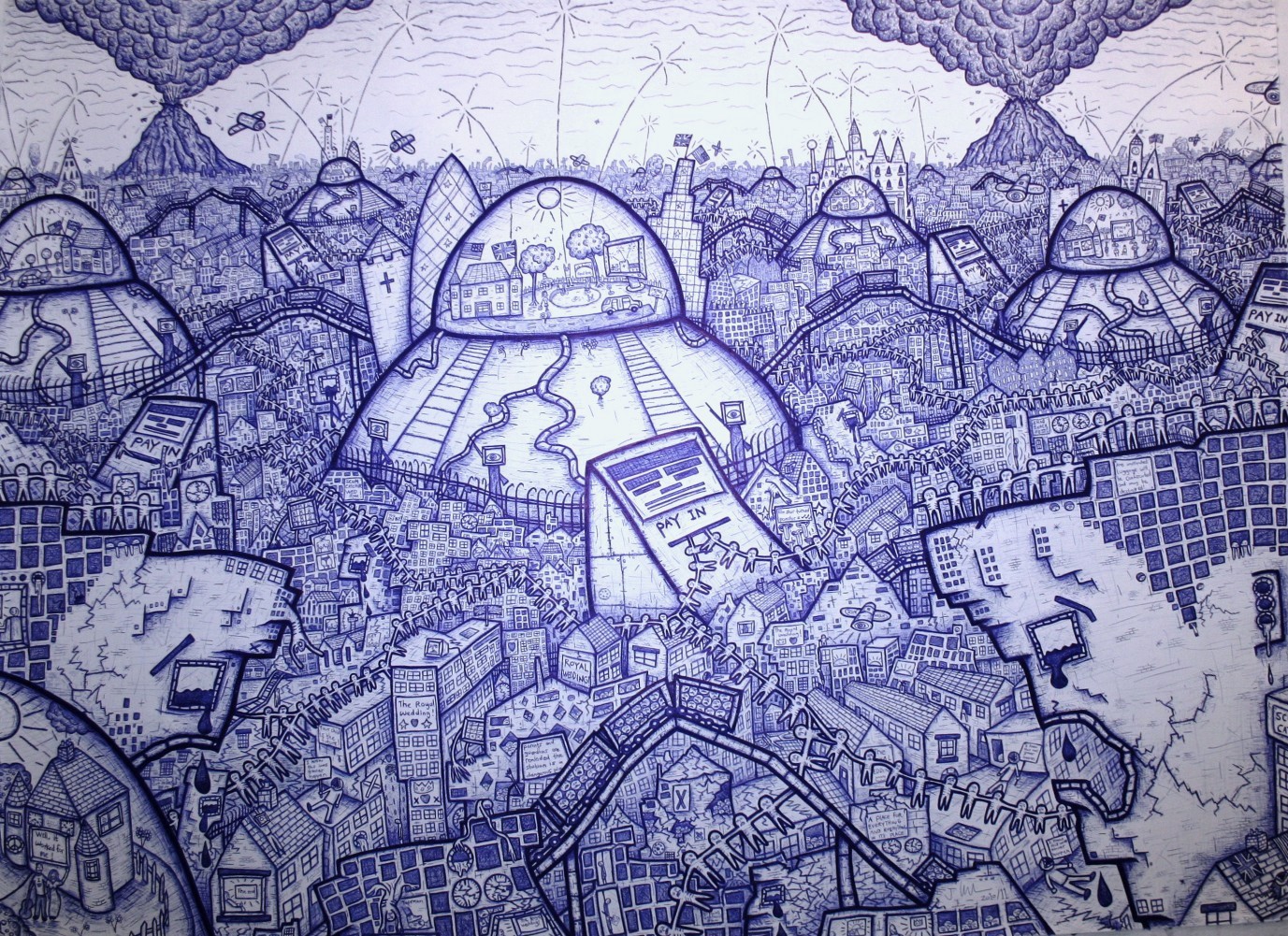

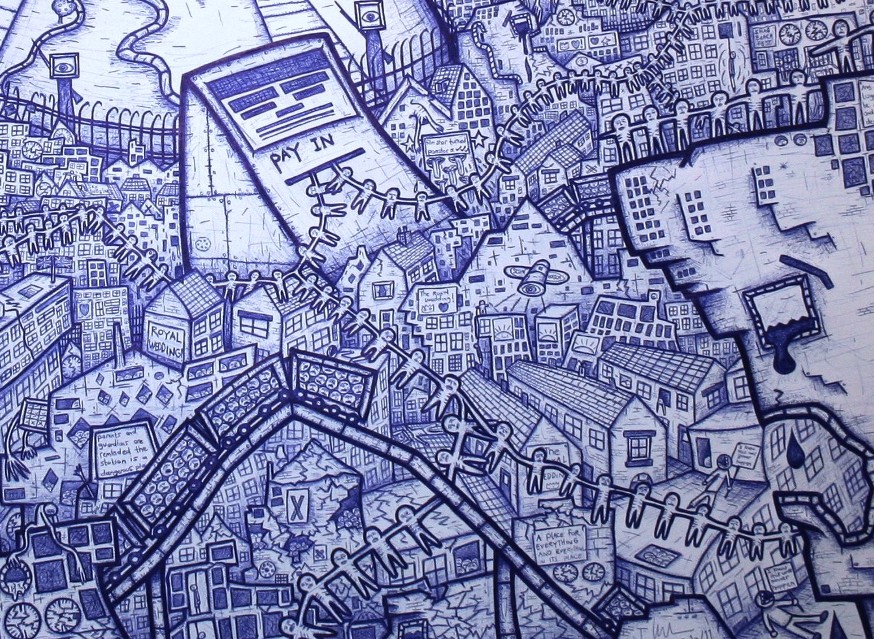
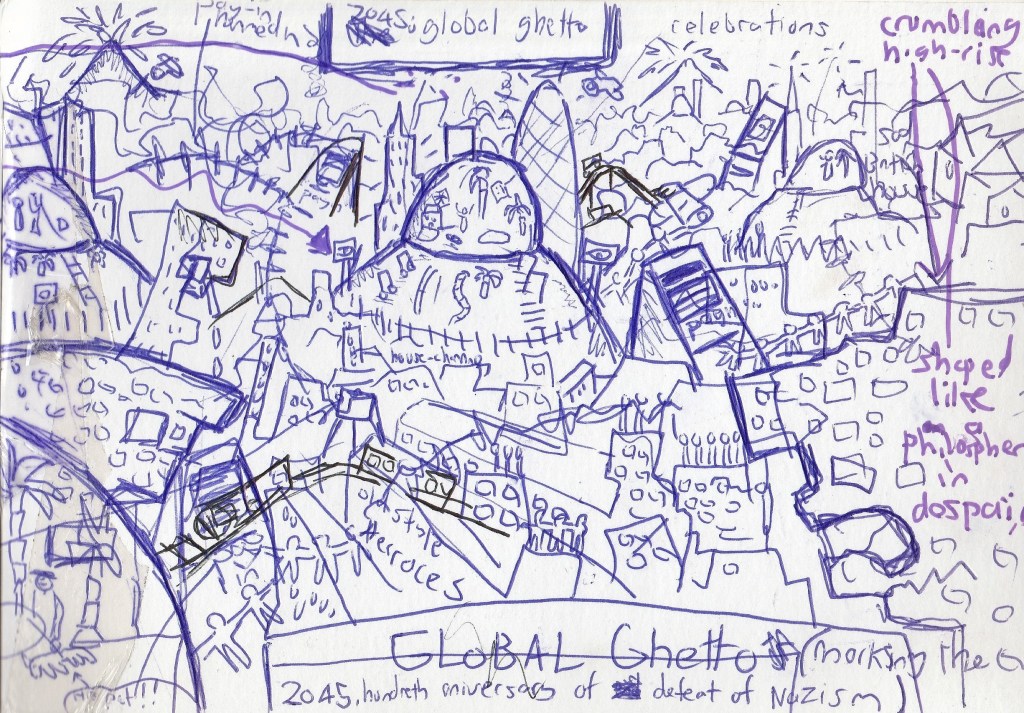


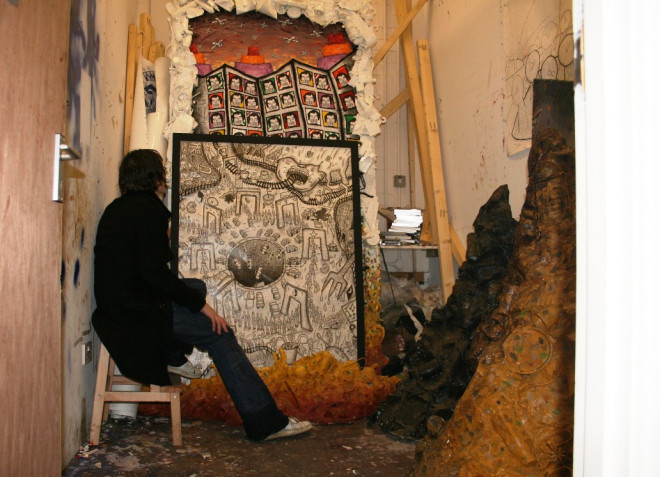








 John B Ledger


