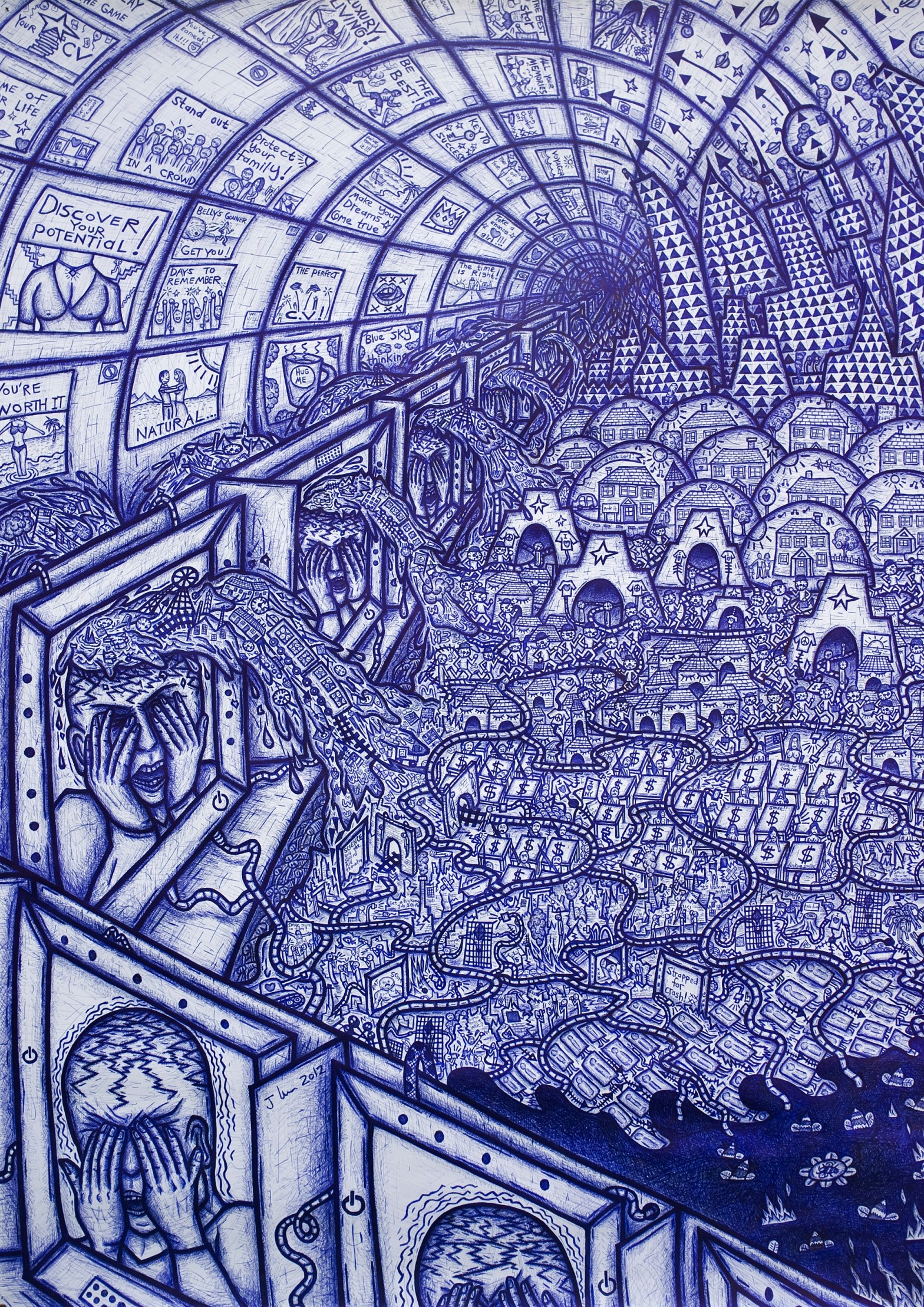
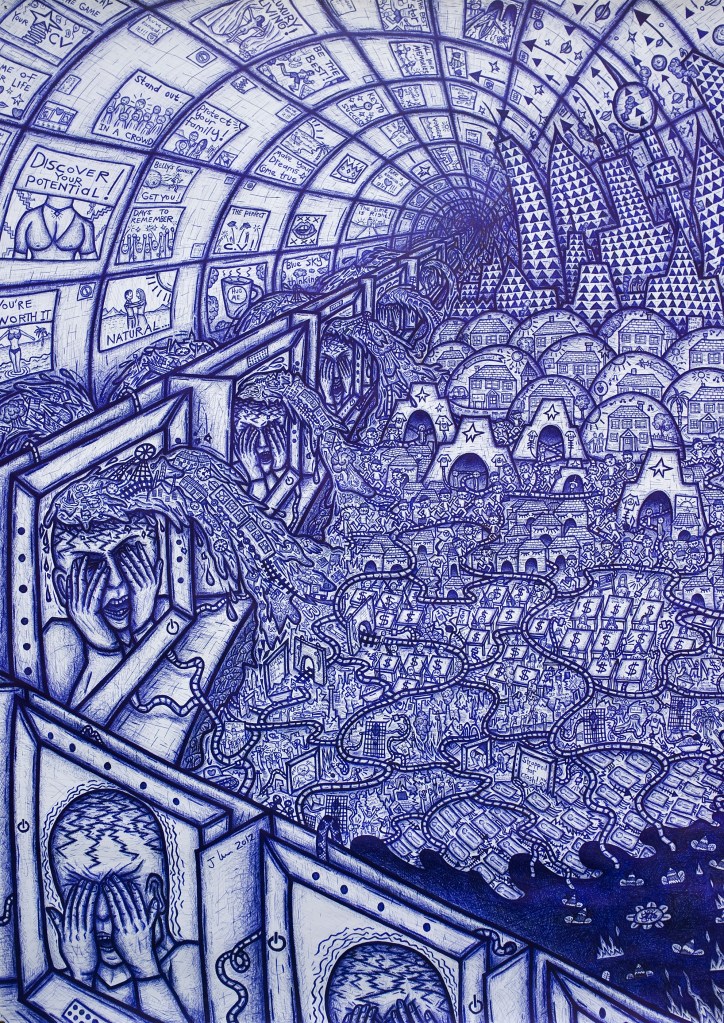
The Planet’s Mental Illness (2012, biro on paper, 105X145cm)
The first thing I need to explain about this piece is why I chose the word planet instead of world; the latter being specific to humanity and all of its concerns, whilst the former describes everything that makes up the ball of rock, gas and liquid that constitutes the earth. I need to do this as it is evident that what I am trying to depict here is life in the grips of the dynamics of the human-made system. The word planet seemed more specific to dealing with an infliction on the earth of this all-consuming human system. I wanted to look at this culture (or civilisation) as something that, despite its initial intentions, has coated everything, making its logic inescapable, a logic that deals with maximizing all resource extraction, destroying the body upon which this civilisation needs to survive. This is why the word world simply did not suffice in representing the extent of the saturation of the issue we have here.
In a completely unreligious way, I see humanity as being life’s brain: its ability to think about everything that is and has been; the ability to look back at what came before it. I don’t mean it in a sense that it is our destiny, more that the evolutionary process has placed the human being in this position. Yes, this way of seeing has been inspired by the Gaia hypothesis (a scientific hypothesis), which argues that all of the ecosystems on earth, and each living thing within it are interdependent to the extent that life has adapted this ball of rock, gas and liquid into a super-organism, self-regulating the earth to maintain conditions the best it can for life, in the way that a smaller system regulates itself in order that its stability is maintained. And I am in no way a new-age hippy: I’m too saturated in this wasteful and exploitative cultural logic/too infected with this globally-spread mental illness to be anything that comes near to genuinely fitting such a persona.
The term mental illness applies at every level here, right down to the individual. As we now clearly see, this life-sapping system is now creating a mental-illness epidemic, where the use of anti-depressants has become on commonality, and it being rare to walk around a shopping street without noticing a victim of eating disorders. Earlier this year, my friend spoke of how such a high number of his friends were complaining from migraines due to the stress of being unable to fathom out what the hell is going on, from the local to the global, that it couldn’t be dismissed as mere coincidence. I situated such heads, fit to burst, in isolated computer screens within this piece of work, as more and more of communication between one another is mediated through mechanisms. The spaces between us, in cyberspace, are full of arguments and attempts to explain what just is going off all around us. However, rarely does the action transcend the screens and have effect.
Computer screens seemed like the best place to position individuals separated from each other to suffer from the exact same causation, alone. It may be worth adding here that the scientific methodology that dominates our culture, has always sought to reduce everything to its individual components, to see everything as atoms per se, rather than as interdependent/connected atoms. And although this is certainly very useful, it seems to be a methodology with penetrating perception in one eye, but utter blindness in the other. The philosopher Martin Heidegger uses the term ‘modern technology’, where I would always use capitalism, to show how it is not a coincidence how a system based on reducing everything to “standing reserve” for future exploitation appeared historically not long after the beginnings of modern physics. This one-sided view of the world saturates our culture to an extent that it’s hard to imagine anything else, even whilst it slowly makes us more and more ill. The tube-like tunnel this landscape is situated in is just this: the hegemony/the logic that has spread so intensively and extensively that one cannot imagine a world outside of this tunnel, even as it leads us into a darker and darker place. Towards the end of the last century, as systems that tried to challenge capitalism began to fall apart, the theorist Fredric Jameson claimed that in this time of late capitalism (or what he called ‘a time of no time’) “it’s easier to imagine the end of the world that an end to capitalism”; and as humanity stumbles into the second decade of the 21st century, this diagnosis is becoming terrifyingly tangible.
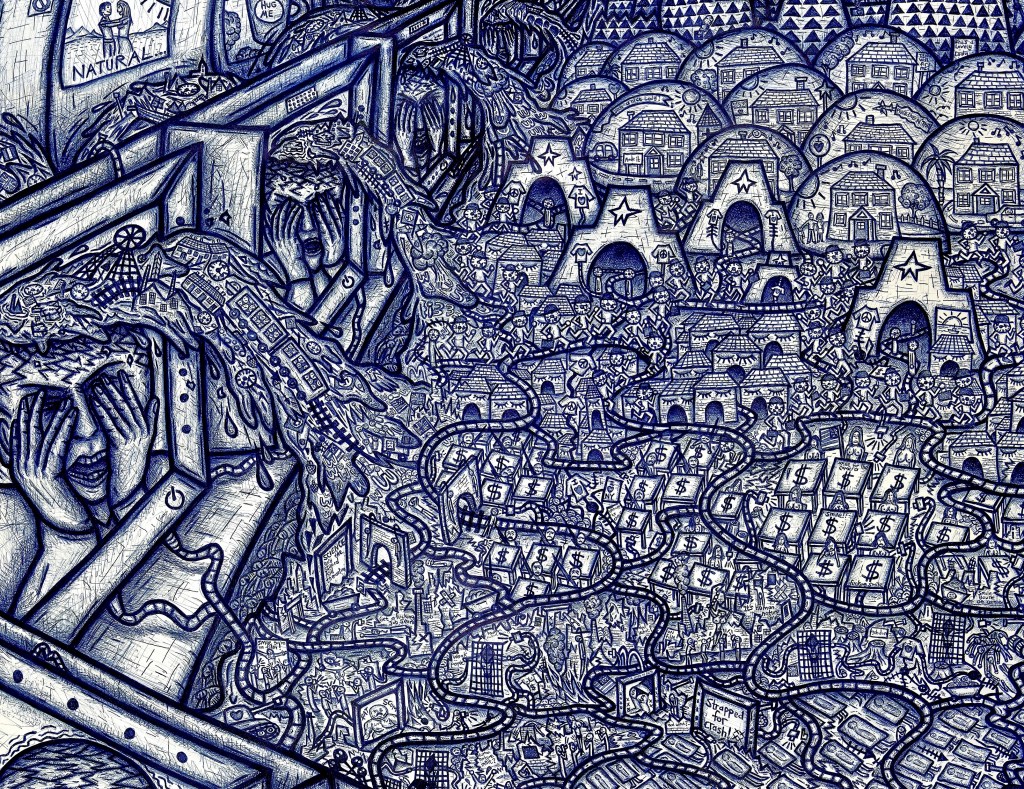
As the heads inside the computer screens veer closer to the dark ends, they burst, re-releasing the cultural logic, in a chronological waterfall of the destructive cycle in motion since early European colonialism and the beginnings of the industrial revolution pours out, recreating the only world they know, as they self-destruct. It is almost the genealogy of the system being revealed, like DNA within we who know no other way even as it causes us to break down.
The landscape being constructed from the genealogy of our culture is of course intended to be the world we have now. As much as we see the brutality of the social gradient, from the private houses, and finance skyscrapers to the corpses of the global poor as they are the first to reap the harvest of climate breakdown, and those who are cultivated to sell their bodies in whatever means as the only means to earn a living, it is still clear that nobody is safe from these destructive dynamics. The lyrics of the late Richie Edwards in the Manic Street Preachers song Motorcycle Emptiness claim that “every where’s death row, everyone’s a victim”; this is the case under a truly global capitalism. Whilst this doesn’t excuse the vast injustices, where more and more millions are being dumped on the waste pile, whilst a minority enjoy the luxuries of kings, it certainly makes the case that we all have an investment in a different the future to the bleak one the logic of capitalism has in store for us and the planet
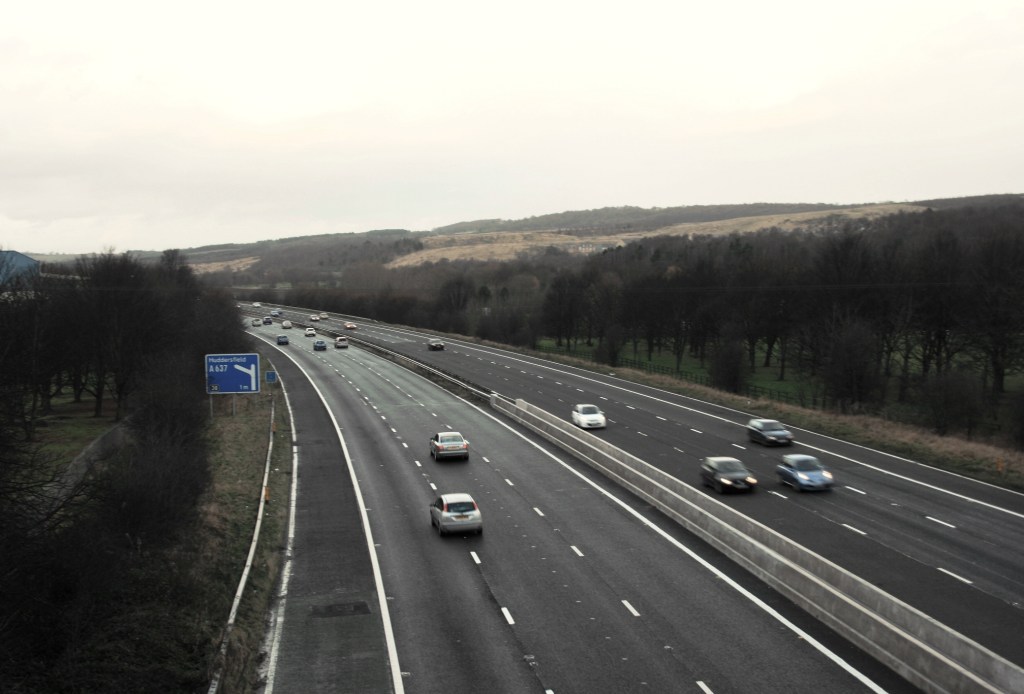
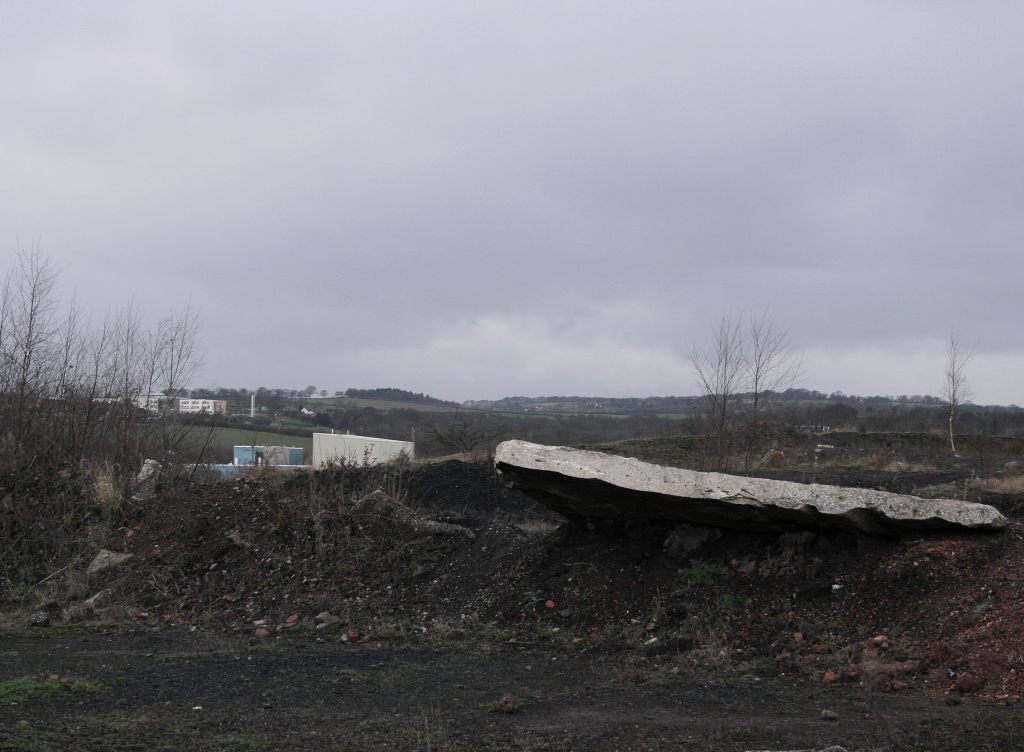
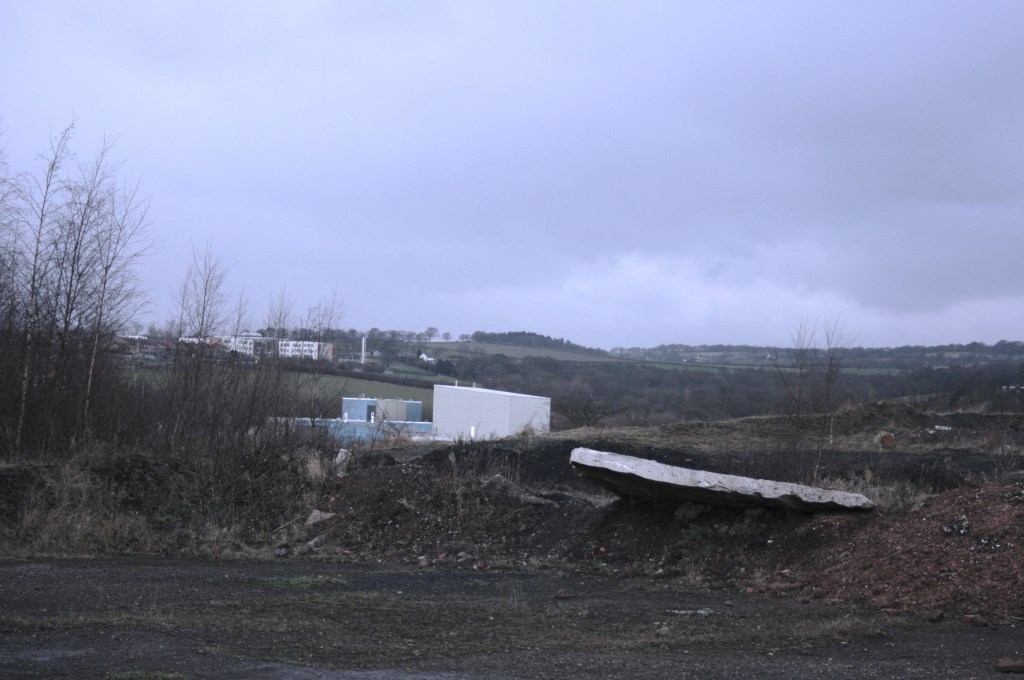
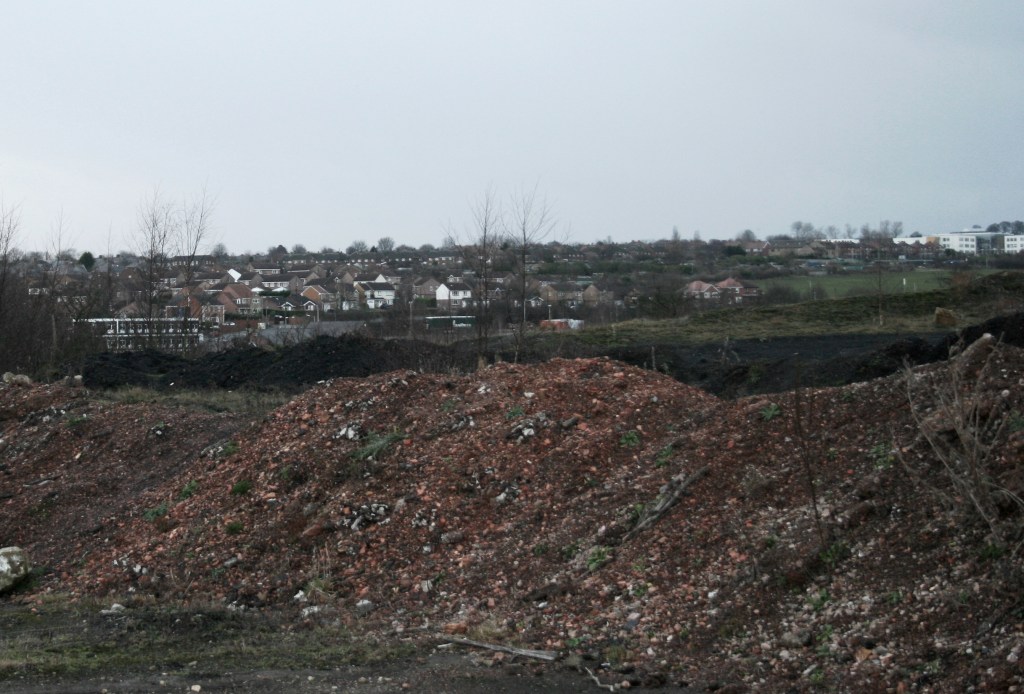
I am sat staring down a hillside, sat where I often sat when I worked here for 5 years, with my mp3, on shuffle function, playing out sounds from my last 10 years of accumulated music, staring as if looking for something in the manner in which I have so for as long as I can remember.
After trying to make a change in my life only to have it fire me backwards as if there was an elastic band tying me to something, I find myself one year off 30 and on the same ring-road lacking exits as I have been on since the fading days of naive and sentimental youth-hood.
I’m sure it would be a mistake to wish myself into a relationship, my own family unit, and a joint-bank account, but what I have is no kind of existence to wish to take to the end of my life.
It’s like No-man’s land never ceases in my mind. The opposing sides never reach a conclusion. A cold grey sheet of mist blocks the view past the trench that I have planted myself in. I sit and wait and wait, for something to change, after a decade of failed attempts to change the predicament myself. Yet I know this to be fruitless.
I am told I have built walls; that I need to knock these walls down.I know I have built walls. This advice misses one crucial factor: there may be nothing behind that wall, Like the void left when a rain-forest tree is so strangled by vines, it dies and rots away leaving just a coffin of vine branches reaching into the canopy.
We aren’t born with a solid personality that remains to the day we die, we are layers that are built up over the years. Peel back too many layers and you may find everything has been bled dry. After all, the one thing in the world that has given me the confidence to live in it has been my art, a form of expression that has become so congealed within my obsessive and negative tendencies that any attempt to kick down these walls could crush my art underneath.
Nor do I buy the philosophy that one is “fully in control of their destiny”. A human being is thrown right into the world. He/She is hammered, and shaped, as if a sculpture, by his/hers immediate (mediated) environment, the historical period they find themselves in, their family genetics, and, let us not forget, the social ranking he/she is born into.
Like the difference between a strong, confident-looking English Oak tree in a country estate and a withered and bent English Oak which has been long exposed on a high hillside with poor soil, a human character is the plastic put into the mould of the environment him/her is thrown into.
Yes, a human can change their predicament, they can make the best of what lies in hand to shape themselves into where and what they wish to be, but this is very different to the prevailing pre-austerity-measures (and still popular) philosophy, that everyone is surrounded by infinite opportunity, that he/she can be what he/she wants to be, “if only they try“.
Opportunities are more like slivers of light, eventually appearing through cracks in what for a long time seemed to be a dead end, rather than an horizon, seen from a hilltop, of opportunities just waiting for us to go out get them. The cracks appear because, most of the time, a human being finds a way out of what appears to them, for a long to time, to be a dead end. But sometimes they don’t find a way out.
Just as it would be foolish to use this writing as an argument that those born into comparative privilege in today’s world aren’t unwillingly moulded by their own environment (despite the gaping discrepancies in opportunity that separate them from the less privileged), it would also be foolish to argue that this inability to move on in life is specific to myself.
True, the stalemates I reach in my mind often seem too strange to be normal, yet I would argue that in our current state of permanent crisis under global capitalism (which includes the slow domino-effect it is playing out with the earth’s ecosystem’s) that obsessive disorders and depression are widespread.
People feel trapped. Even amongst the more light-hearted, talk about the future world is usually saturated by dread. Obsessive disorders are an attempt to stave off the drop into depressive states: obsessive disorders are fanatical rituals that allow the person to forget he has reached a dead end; depression is being face to face with the dead end.
The problem is the advice each of us receive, no matter how well-intended, makes us feel alone. Yes, we know we are not the only people suffering from depression/obsessive disorders, but are led to feel that we are in total control of our ability to pull ourselves out of it. In life-lived rather than advice-given, this is true. But the assertion that one is in total control of their destiny positions us alone, where the only option is to deny the causations of our predicament or be forever-blamed when ruing our inability to move forward.
This makes people less likely to reveal their feelings of being unable to move on, because it becomes a sign of weakness, and of failure. When the world looks like a giant cruel game where we are all pitted against one another, who dares confide in their failures?
However, the confusion comes now as I realise that nothing good is going to come from allowing my thoughts to expand to a global situation, when it is clear I become obsessive about these things to the point that I cannot even gain better knowledge of them because it makes me so dis-functionally miserable. I need to prevent it reaching this stage from where it all backfires resulting self-destruction.
So….
When did ‘all that is solid melt into thin air’?
Spending most of my school days day-dreaming, all I ever really wanted was a lover (somebody to spend my life with) and maybe, one day, a family. But as I write this down the sheer embarrassment I feel in admitting this reveals how far removed I have become from these day-dreams.
I don’t day-dream any more. I just stare away, and look around me all the time, still waiting for the dreams to be replaced; trying to figure out where something of substance to replenish me with optimism, hope and enjoyment for life can possibly come from. Whilst it may a blessing that the old day-dreams fell away, I have been left in limbo with no new ideas of how I would best like to live my life. And I certainly haven’t had any luck searching within myself.
It is clear that I haven’t got over losing the old dreams that guided me. I cannot find substance so I run round and round in circles to tire myself out everyday, so that this emptiness isn’t staring me in the face.
Writing on his K-Punk blog, Mark Fisher describes the band Joy Division and the suicide of their singer Ian Curtis as a Nihil Rebound: an inability to overcome the empty feelings and erosion of hopes and beliefs by the horrors and collective madness of the 20th century and to use nihilism as a powerful tool. That this made “the slow, quiet hell[.] in which most of the proletariat endure their working lives” Unendurable for the incredibly psychologically-trapped Ian Curtis, and all that he found he could do was to make his “…case against the world, against life, [my italics] that is so overwhelming, so general, that to appeal to any particular instance seems superfluous”. Fisher explains that “Depression is…a theory about the world, about life”, and it is the fate for those who find themselves overcome with nihilism, but who cannot (for numerous reasons) begin to use it has a tool to rebuild their life from their ‘zero-hour’.
I have friends who champion the power that nihilism can offer the individual. To me, this ‘world set-free’ still feels hollow, meaningless, and with nothing there to counter the suffering and destruction in our world today.
I am haunted by the ghosts of the past. Whilst enjoyment and meaning don’t amount to anything in the present. I remain in constant orbit around myself. As a means of keeping myself afloat.
It’s quite calm right now. No one can escape the anesthetization of the Christmas period whether they like it or not. And I need to do some calm thinking, not get lost too quickly again.
Yet, all this musing as I sit here and stare is rather different from the anxiety one feels when these very questions bother one’s mind whilst in the fragile position of being half-asleep. At these moments the real worth of the anxiety is revealed.
And one cannot escape the misery that spreads like a fog from the attack of more or less everything by the neoliberal system. Walking into 2013 is certainly like walking into the wilderness.
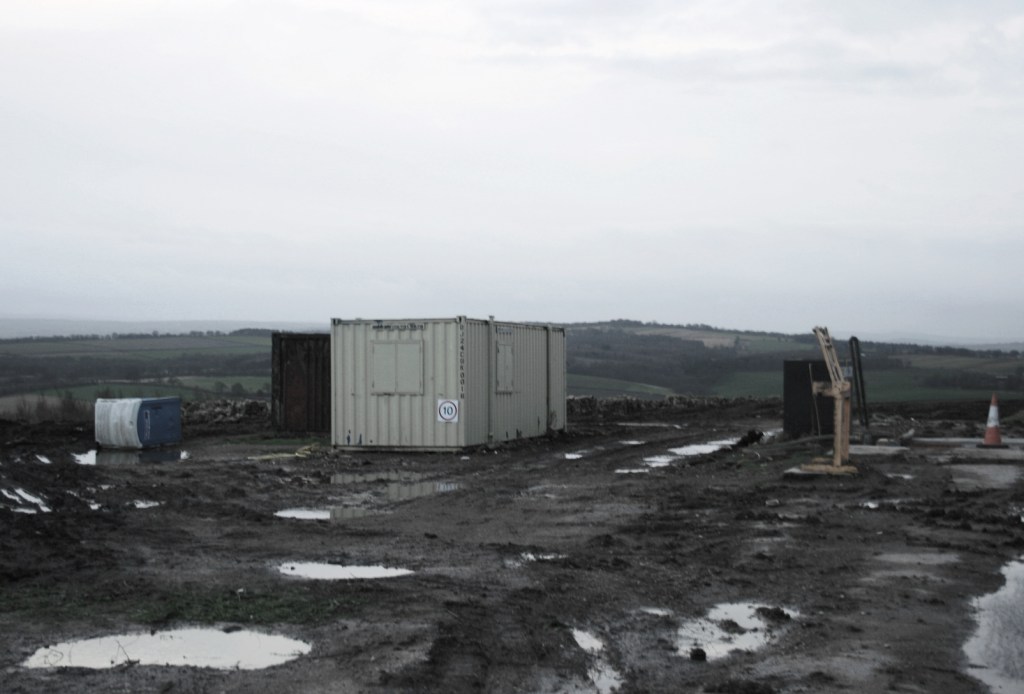
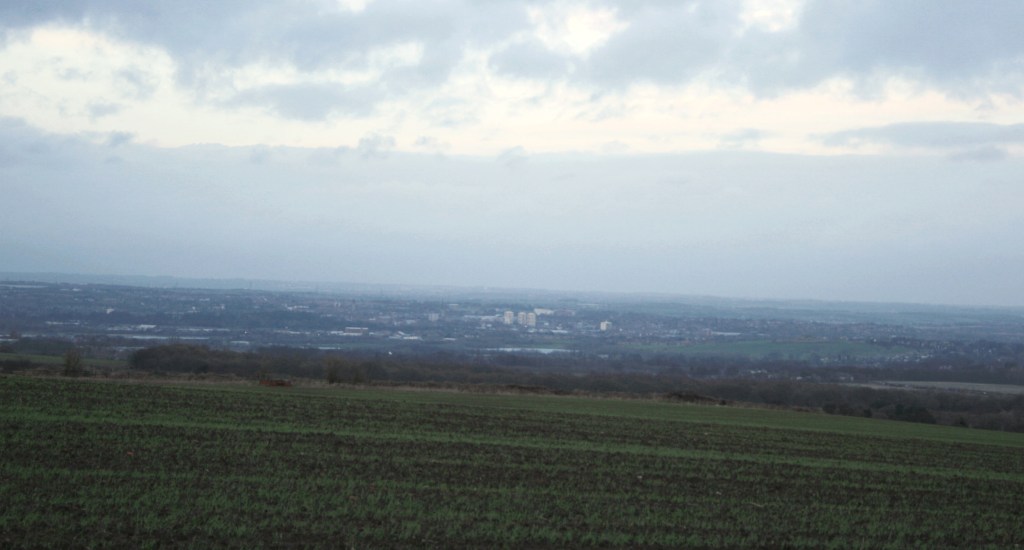
My recent move to London was much needed for disparate reasons, but more than any, because the course my life has taken during the past 10-12 years has served its time, and has run out of energy. As I say in the previous post, life is just a series of shimmies away from the pits/total dead ends, and it seemed to be reaching that point on the previous course. Obviously there is an element of wishful thinking to all of this, yet if I stick it out down here it is a change that must surely force difference and paths away from any dead ends in the narration of life that one must make. However, it was certainly wishful thinking to convince myself that my past wouldn’t follow me down here, and it did, exercising many of the issues I talk about in this blog http://johnledger.blogspot.co.uk/2011/09/past-returning-to-haunt-and-all-roads.html. Once in a depressive spell, it is pointless to convince oneself (and certainly for others to convince you!) to see sense becauseit saturates everything, creating an objective despair. It is like one has dropped into their own underworld, where everything is the same, yet seems utterly different to how it did on their surface world. As a concept, to move to a metropolis, where everything that I write and make art about is literally on my doorstep, seems amazing. The reality of it can be so, yes, but when everything is happening all of time, a sample of everything from the world (positive and negative) is seemingly on the street outside, it can eventually be so much that everything begins to have a sense of meaningless to it, especially when you’re new to a place, haven’t got many friends yet, so have no anchor of familiarity from it all. So I had to return north. At the time, my mind, in its underworld, said it was for good. But as soon as I would be out of it I knew I would have to return south. Whilst I was up in the north I felt that I needed to head to an area that I hadn’t had chance to before I came to London. This area is the Pennine hills to the west of my home town. Not so much the moors, but the spacious and bleak roads and hills that separate the moorland heath from the more lush and green areas further down the hills towards town. I wouldn’t regard myself as somebody who’s life is mapped out by the symbolic, but perhaps I am, or perhaps I need to be. The founding issue of all that has been in the past 10-12 years has been the loss of narrative, a feeling of emptiness, yet despair that nothing seems to be accountable or be able to stop (what I saw as) the immense suffering of the human race unfolding before my eyes in the 21st century. This concoction also gave a leg up for dormant personal disorders in order for them to become active, as they did. This area became a important locus in the mind map, and narrative that I developed inspite of the larger sense of the loss of narrative; a self-defensive narrative. During this period, after walking up to these hills to the point that my anxieties about the world down there were drained of care, the emptiness of these hills seemed to resonate and give landscape to how I was feeling about life in general. The few objects on these hills, because of their loneliness, become powerfully present in the mind, have a monolithic presence (most notably, the cluster of wind turbines, which already embody some kind of hope for the future). They absorb the meaning which is generated by this wider landscape as one finds it resonates with their feelings of meaningless/emptiness generated from the world at large. Thus they fix themselves in my mind, especially when I listen to the music that soundtracks this past decade and a bit. I felt that I needed to visit this place to try to help put a closure on a stage of my life. It may not work, may never work, but yet I feel an oath to visit this landscape whenever there is at least a glimpse of a departure from a part of my life which (despite of all the good points – mostly that the art I have made during this period is perhaps what I am most pleased with in my life) I do desire to leave now.
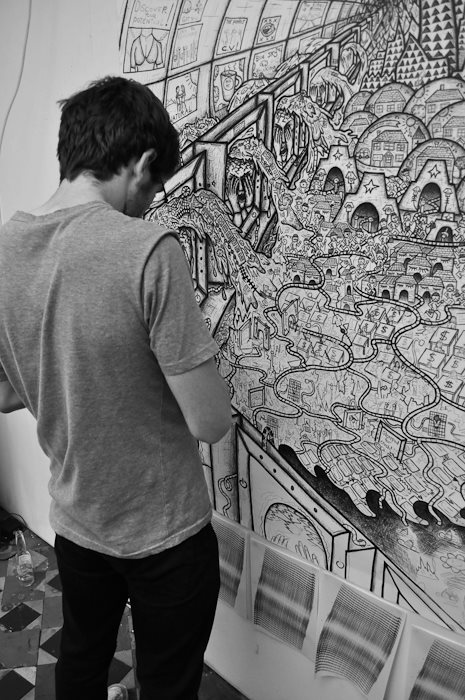
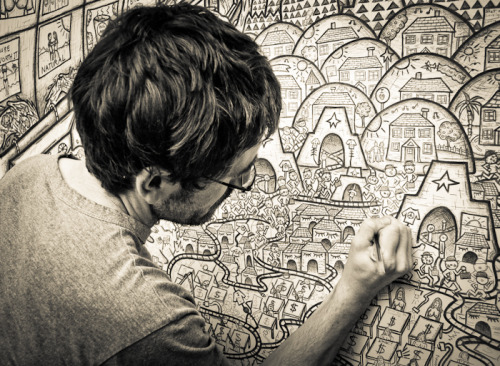
I took part in York this weekend just gone. P A N D E M I C, inspired by the Situationist movement (notably the philosopher Guy Debord, who wrote Society of the Spectacle), invites anybody to come along, to perform, discuss, or whatever they feel they want to do. But it is also an environment of questioning, where preconceived views are challenged – but by everybody, in a none pedagogical environment. It is “a balance between the intellectual and the intuitive: organic evolutionary change via experimentation, deviation and panic is [the aim of P A N D E M I C]”. I was part of the first P A N D E M I C event in Sheffield 2011, and it had a very positive affect on my own, not just artistic, but philosophical/political ideas. I, although my work is usually finished before it is seen by other eyes outside my studio/workplace, have always severely missed the interaction of the days of university, when ones work itself was, by the very nature of being in a place of communication, always evolving organically. Bringing the art I have already been working on to an environment of discussion and other art is always something I see of being of great value. The energy (and even the rhythmical movement of making my drawings) can often feel lost once the piece is finished and up on a gallery wall, where, although it looks how I want it look, can sometimes feel like the dead skin shed by the ideas. Here are some images of my working at P A N D E M I C York on a (still unfinished!) piece called ‘The Planet’s Mental Illness (or) Plantery Mental Breakdown (not decided which title does the job yet – opinions welcome). Images courtesey of Iain at http://iggoire.tumblr.com/
Here is some more about P A N D E M I C Pronunciation:/panˈdɛmɪk/ adjective – (of a disease) prevalent over a whole country or the world. noun – an outbreak of a pandemic disease. Origin: -mid 17th century: from Greek pandēmos (from pan ‘all’ + dēmos ‘people’) + -ic
P A N D E M I C, like the great plagues that inspired it, will spread like a disease that does not discriminate. It can and will affect anyone, no matter what superficially constructed group they may identify with, no matter what class, gender, race, sexuality and income level. It is an ever changing vehicle for discussion, ideas and dissent.
During a series of happenings in Sheffield, UK during November 2011, P A N D E M I C incorporated a continuous programme of visual art – along with events every evening for 2 weeks consisting of a combination of experimental music, film, lectures, talks, workshops, readings and performance. We have used several spaces already including gallery spaces, lecture rooms, pubs, car parks and other less conventional spaces. —some of these inspired by the Situationist International, some just by life itself. We wish to promote the ideas of reclaiming space, and reappropriating images with a D.I.Y ethos in response to the advanced capitalist dystopia we now find ourselves in. We now experience life through an abstraction – in the form of advertising, prescribed gender and social roles and media manipulation which leads to the us living in a substitute for reality instead of living reality itself. Via television documentaries we have armchair tourism, via royal spectacles we have emotional tourism (like the public reaction to the death of Princess Diana), via soap operas we have drama and intrigue, via reality T.V we are given “reality”. We advocate that we: create not consume; question not accept and act not just dream.
The purpose of P A N D E M I C is to inspire as many people as possible, to involve people who are not just the usual already “converted” art types. We want the project to spread to other towns and cities as a continued and evolving social and creative platform. So far we have infected York and London too. P A N D E M I C has evolved in direct opposition to the prescribed and elitist, market driven nature of the artworld, and the government funded stuff which is often only commissioned because it ticks the right agenda boxes. P A N D E M I C exists with no money spent or earned at all.
We are tired of going to the “right” place, at the “right” time and behaving in the “right” way in white-washed, sterile spaces to look at “art” that has been chosen as “significant” by the wealthy and the egotistical. Art is life and it should reflect life’s beauty and it’s misery in all its complexity. Only our everyday lives have meaning, and through them we relate to others, not only this but if art is life, then art should relate to all facets of life and thus should be experienced in all of the places and spaces we inhabit.
P A N D E M I C is in direct opposition to the artworld and art market, for this world is boring and elitist, it consists of a series of cliquey institutionalised in-jokes, and is fundamentally controlled by rich buyers and investors. As well as this we see how the media constantly dumbs down conceptual or experimental art – or mocks it with dismissive comments like “my 5 year old could do that.” And so art is kept this way to a) make said elite feel culturally superior and b) disenfranchise us from sentient culture. The ability to engage with art entails our ability to deconstruct images, this skill can then be used to deconstruct the images in the media that attempt to control us. Most importantly we must learn deconstruct our lives and the problems we face as a species.
We already have many visual artists, writers, activists, lecturers, dancers/performers and musicians involved – and there is always room for more. We remain open to anybody. From you we are looking for support, promotional help, for you and your friends to get involved too – and any other groups that you know of being made aware. Particularly we are looking for spaces to utilise as well as people to take part in whatever form. Our ethos is that anyone can be creative and anyone can relate to and enjoy art if art reflects their own lives – as opposed to art merely reflecting art itself, or the elitist institution and the social status attached to it.
Bordeline Ballardian is an exhibition of works that questions and observes British society and the psychological effects of technological, social and environmental developments. The word ‘Ballardian’ originates from the works of British novelist, James Graham Ballard and is defined as resembling or suggestive of the conditions described in Ballard’s novels and stories, especially a dystopian modernity, bleak man-made landscapes and the psychological effects mentioned above. Ballard’s novels, classed as science fiction are now seeming to resemble the real more than ever, as our 21st century lives hurtle towards huge environmental and psychological uncertainties.
Reckless industrial growth is slowly killing the planet, as air and Water is polluted and littered, food is grown chemically and unsustainably, and oceans are turned into acid pools. What little democratic rights we have are being shaken to their core by the intertwined forces of runaway capitalism and the nation state, which require nothing more of us than alienated consumers. We are stolen and then sold back as make up and fashion.
All this certainly Sounds like a Ballard novel to me… But do we ever ask ourselves the question, in all seriousness “could the world I’m living in now be rightly classed as dystopian?” It can be hard to the see the world for what it truly is whilst you’re in the midst of it. The exhibition aims to take a step back, observe and inform.
“The (Diamond) jubilee has made the union jack more unavoidable than perhaps any time since the war” Owen Hatherley
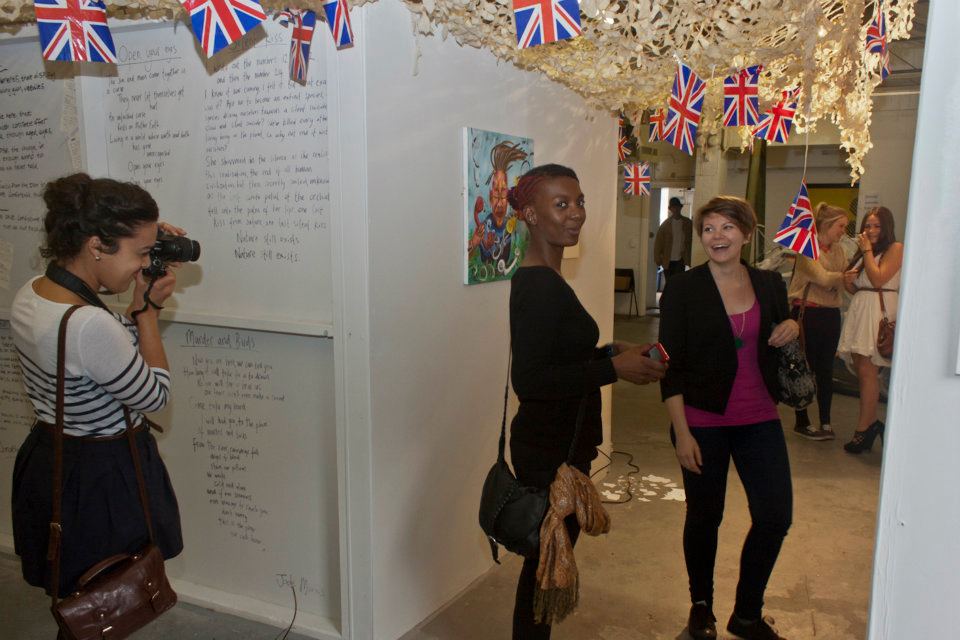
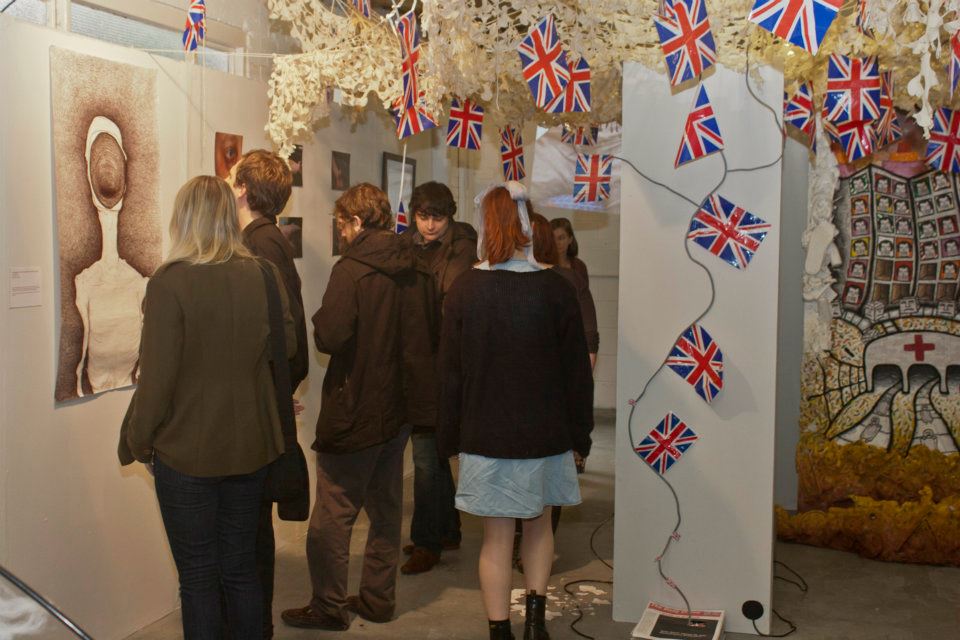
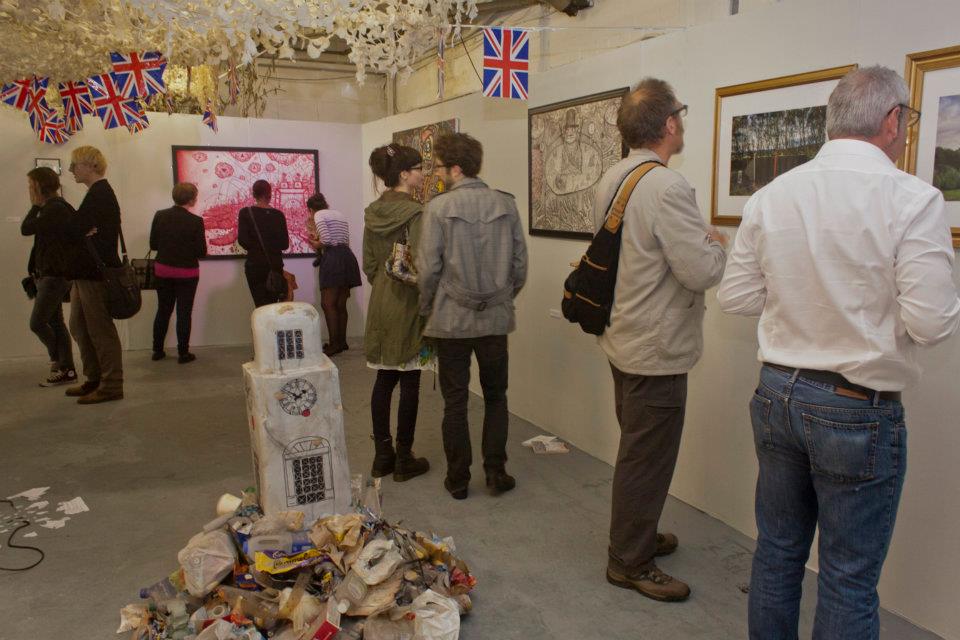
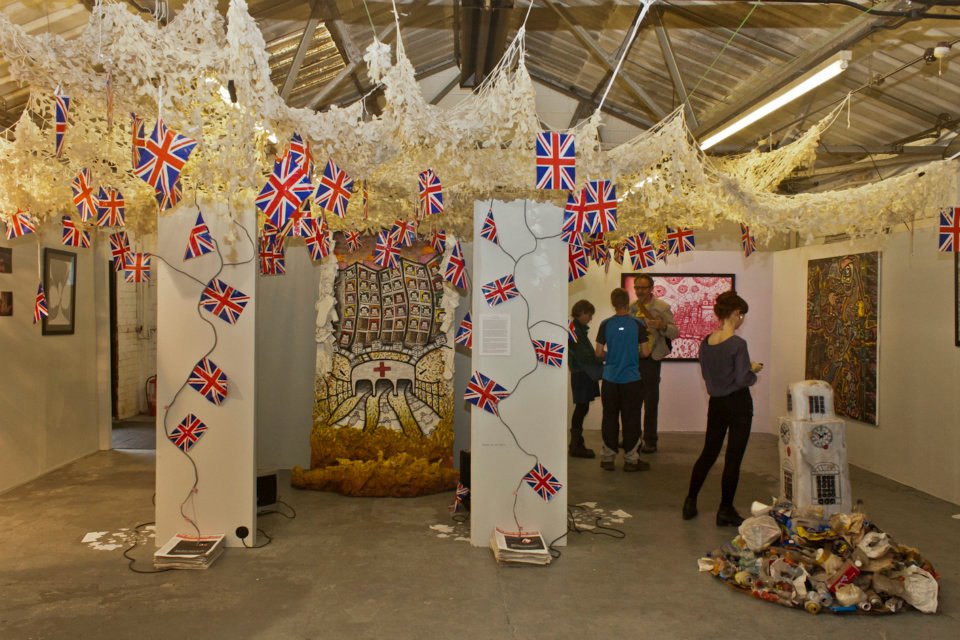
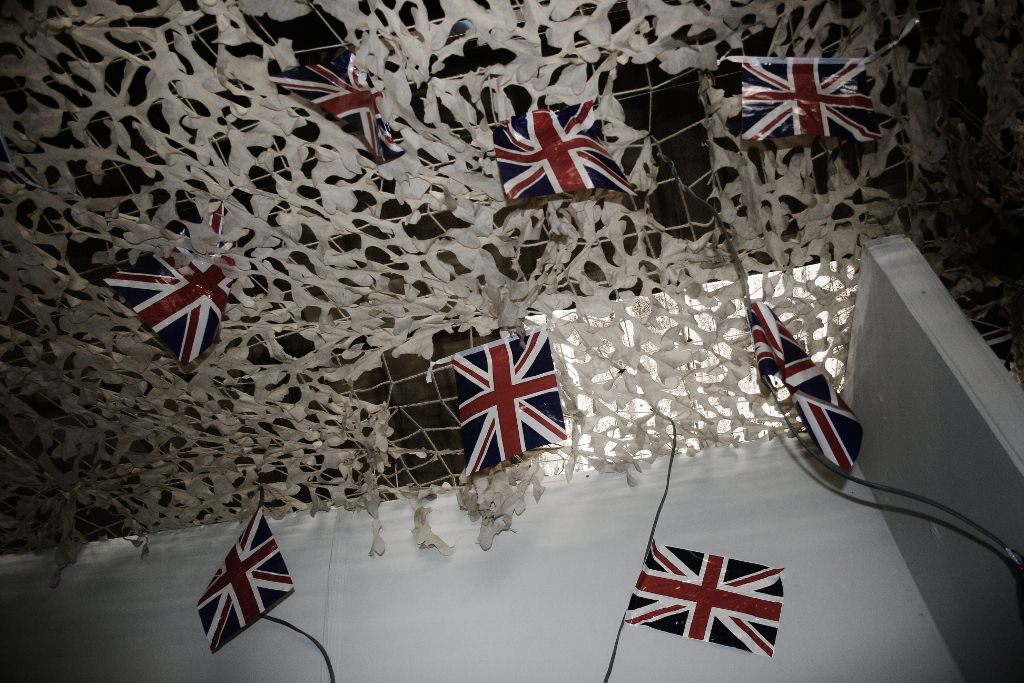
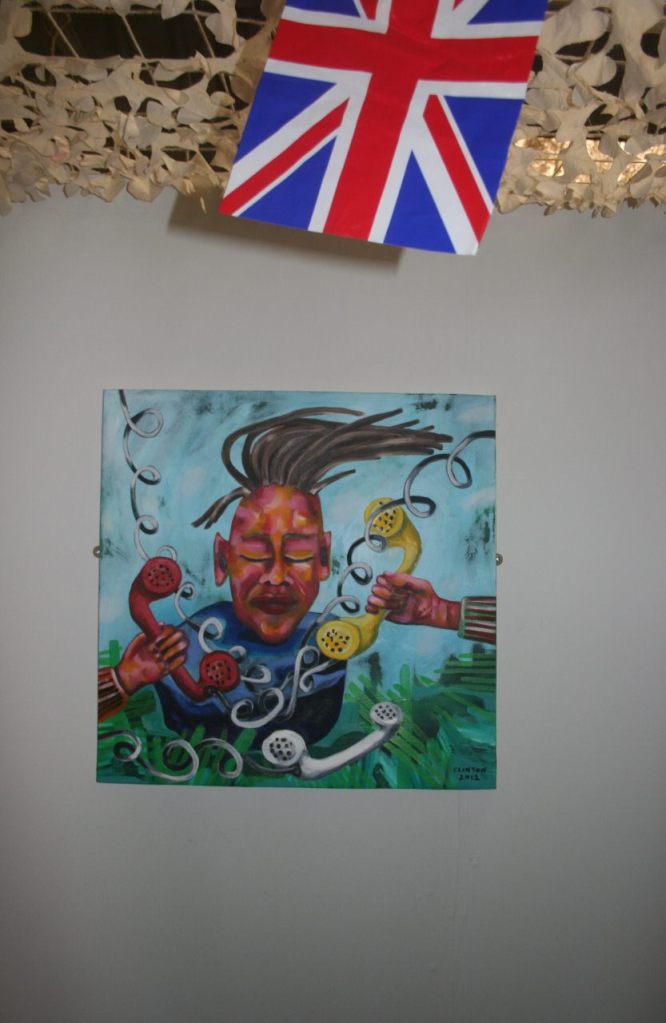
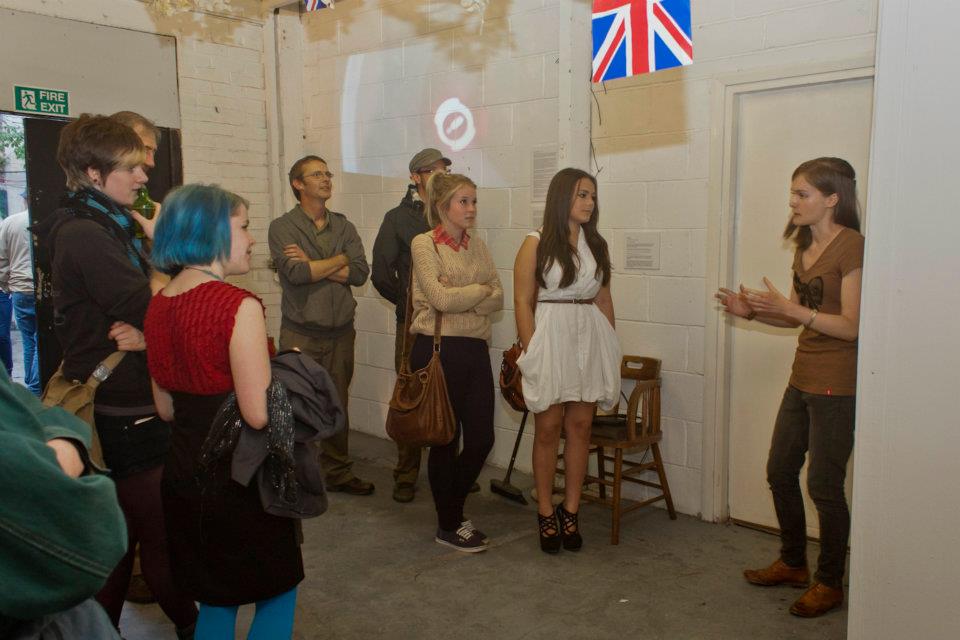
This installation was for the exhibition Borderline Ballardian, at Creative Arts Development Space, Sheffield. When thinking about the proximity of dystopian forewarnings to the present tense the visuals of fabricated national pride featured very frequently, as a kind of showy coating over the top of a society that is potentially falling into dark times. As George Monbiot points out in his article ‘Dark Hearts’ (The Guardian, 23.4.2012), about how the ‘British have a peculiar ability to blot out (their) colonial history’ …’even when the documentation of (its) great crimes is abundant, it is not denied but simply ignored’. Through excessive mainstream focus on other stories, stories which direct to thoughts of Britain past and present as being a more benevolent Imperial force, a collective amnesia ensues, which in turn cannot help but evoke ideas on memory control thought up in 20th century novels about societies of totalitarian control (an issue touch upon again in Borderline Ballardian in the work Memory Hole). A collage of images of welfare-state culture, decent chaps standing up to the Nazis, and the ‘swinging Sixties’ is what we seen when we are told it’s time to start waving the flag again.
But what made me feel an immediate need to lay more emphasis on this worrying national self-identification with ‘goodness’ and freedom being naturally occurring tendencies under flags such as the Union Jack (whilst keeping in the exhibition’s narrative of fictional dystopias looking increasingly akin to the real we inhabit) was because of big national events this year which seem to be engineered in ways that suffocate criticism and even the right to protest. I feel shivers of anxiety when I imagine the damaged done to society through the manufacturing of mass approval to the Queen’s diamond jubilee and the London Olympics, whilst simultaneously we are threatened by possibly the most ruthless ever attacks on our welfare, democratic rights, dignity and our environment in order to keep the capitalist system going.
The omnipresent flags drape seemingly every enterprise/institution on the island, speaking the language of the ‘keep carry, carry on’ posters: “be quiet will you?”: “learn to love the country, and get on with your own business!” Has here every been a period in the history of the nation state where subsumption to the smiles-feast drone-like stance of flag waving has even been more dangerous?
When creating a mental picture for the exhibition, I thought of how I would like union jack flags to spread out like strands of a web from sources representing their most trusty servants for welding them to our thoughts; the televised and newspaper media. I imagined the web spreading to provide an unwanted ceiling haloing the critical matters expressed in the art pieces. I thought that a net over the work would resemble the anti-boarding netting so crucial in the fate of the Mary Rose warship. The Mary Rose sank just south of Portsmouth when England’s empire was in its infancy. The anti-boarding netting, covering the deck, prevented most of the ship’s crew from surviving the sinking.
These visuals seemed to fit well with the idea of nation state’s patriotic ‘wrapping’ getting tighter and tighter over our democratic rights (a curtailing of rights that has marked the arrival of the Olympics in London more than any other matter) the more the nation feels under threat, as it tries to protect capitalist interests from the people it claims to protect.
7 Smithfield, St Vincents, Shalesmoor, S3 7AR Sheffield, United Kingdom
“It is the psychological effects of technological, social and environmental developments I am interested in.” JG Ballard
To question the environment around us, to take a step back and create reality in a world ruled by fictions. Is this the artist’s true role?
Bordeline Ballardian is an exhibition of works that questions and observes British society and the psychological effects of technological, social and environmental developments.
The word ‘Ballardian’ originates from the works of British novelist, James Graham Ballard and is defined as resembling or suggestive of the conditions described in Ballard’s novels and stories, especially a dystopian modernity, bleak man-made landscapes and the psychological effects mentioned above.
Ballard’s novels, classed as science fiction are now seeming to resemble the real more than ever, as our 21st century lives hurtle towards huge environmental and psychological uncertainties.
Reckless industrial growth is slowly killing the planet, as air and Water is polluted and littered, food is grown chemically and unsustainably, and oceans are turned into acid pools. What little democratic rights we have are being shaken to their core by the intertwined forces of runaway capitalism and the nation state, which require nothing more of us than alienated consumers. We are stolen and then sold back as make up and fashion.
All this certainly Sounds like a Ballard novel to me… But do we ever ask ourselves the question, in all seriousness “could the world I’m living in now be rightly classed as dystopian?” It can be hard to the see the world for what it truly is whilst you’re in the midst of it.
The exhibition aims to take a step back, observe and inform.
Exhibiting Artists:
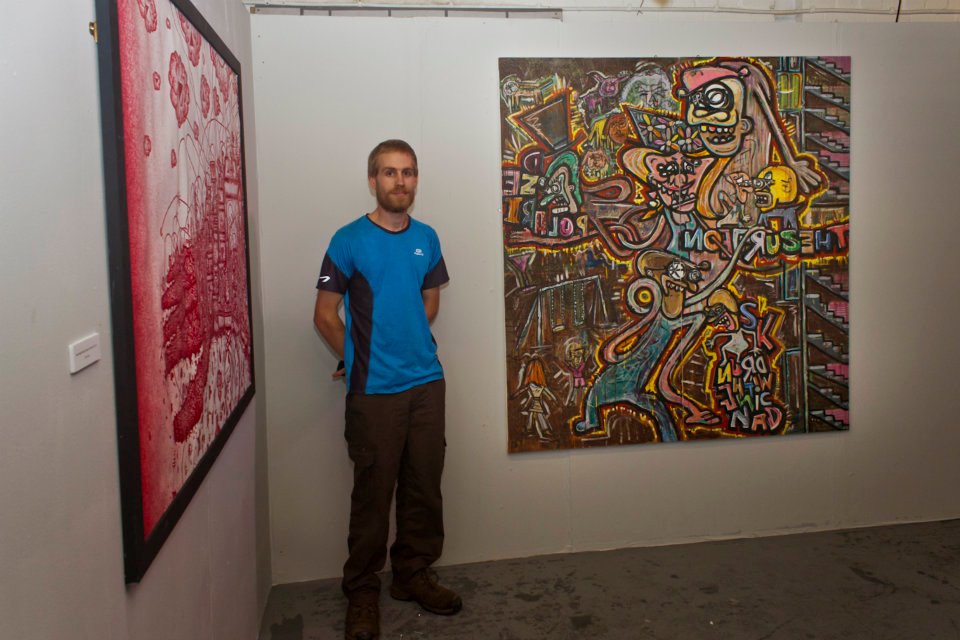
Clinton Kirkpatrick (Lisburn) Gary Steadman (Barnsley) Jade Morris (Sheffield) Jonathan Butcher (Sheffield) John Ledger (Sheffield) Kim Thompson (Manchester) Mikk Murray (Sheffield) Nancy Richardson (Sheffield) Robert Norbury (Holmfirth) Ryan Vodden (Sheffield) Stuart Alexander (London) Leeds Annonymous (Leeds) + friends!
Traces of a genuine article seem to generate the emotions that the genuine article used to generate but cannot any longer.
“If you can see your friend through this tiny lense, then you know that there’s no way home” Touch and Go, John Foxx.
Now the world-wide-web has finally encroached (via laptop) upon the territories where I use my time to make artwork, I have begun to use Youtube to play new music/new sounds to my ears, which are thirsty for just this due to my exhaustion of the music I have listened to way too often, because it resonates with my methods of artistic production. Moments, and certain sounds, in those songs are very important to me, so as well as forcing an initiation with new sounds, I am tempted back to my old staple, but with alternate versions of the said exhausted sounds.
Not as good quality, not as good versions, cover versions, poor live performances, these rejuvenate shivers in me that the original/and landmark (to my ear) ones can no longer create. The ghosts of the past seem to be only awoken through the second hand versions of those special (for bad or worse) moments in my life: the replicas of the songs that bind my life experiences together move me more than the originals can do now, and the issue of replicas extends to other aspects of life (although I’ll not go into all that right now).
The original is of course always a replica (arguably the case even before the first days of mass production), but now we are surrounded by so many replicas of replicas of replicas that the illusion that there can be any genuine article is completely dethroned,often making that closest to the original unable of emotionally touching us; and the further away the replica sounds from the original (and I mean in terms of distance not in re-working of the song structure) the more it moves us possibly by allowing us to have in mind that distant genuine article, that cannot move us once it is at hand.
At one extreme you have the obsession with String music compositions of famous indie tracks (such as The Smiths’ There is a Light That Never Goes Out, and The Cure’s Boys Don’t Cry), and at the other, the even more peculiar 8-bit video-game sound replicas of landmark albums such as Radiohead’s OK Computer. The latter is most intriguing; there’s something strangely moving about listening to the sounds of an album that once made a massive impact on one’s life in the late 1990’s using a kind of sound that made an impact on many caught up in the late 80’s/early 90’s video console era; almost a fusion of two parts that can no longer move in their initially-experienced form. And it works; it reminds you of both more than the original replicas would do if you were to listen to them! It’s almost like having to put an original document through a photocopier to have a copy 100 times removed until you can take the original subject matter from it.
We live in a time where it is evidential that technological advances have done entirely away with the possibility of there being originals/genuine articles. Yet, rather than culture merely being in catch up (as is usually argued), I would speculate that it has actually gone into reverse: it is obsessed with cultural products from the past (which is another much more extensive issue), but can only truly reap their fruits by allowing technology to make it sound/or look further and further away from it’s perceived home (like somebody singing our favourite song to us from a high mountain top), it relies on a medium to deliver the past in ever more detached forms because we cannot get close to the original, because we (culturally) cannot accept that it doesn’t exist. Strangely enough, the musicians who seemed to deal very much so with these issues were artists who were recording music right when we were moving from a capitalism based on analogue technology to a capitalism based on digital technology (the late 1970’s to early 1980’s shift from fordist modes of production to post-fordism); the likes of John foxx, whom the blog title and above lyrics are accredited to, Gary Numan, whose famous album was called ‘Replicas’ and of course the quintessential band of technology; Kraftwerk.
The digital, by multiplying the possibilities for multiplication of already-existing products/works of art threw a culture already confused and distressed by the questions technology asked of it, into a world where anything can be altered/arranged/multiplied at will – the age of the computer. We now live in a peculiar time which (with the potential of sounding daft) is far more futuristic than it seems, and I would speculate that this is because we are desperately rooting through our collective archives trying to find the genuine article, saturated as we are in culture that still demands it exists (and does anything exemplify this better than the phenomenon of Youtube, which is basically one giant tin of photos, seemingly holding all the past – almost acting as a force-field separating us from being able to perceive a future?).
About half a year ago I wrote about how two different albums by the band Primal Scream ‘are actually the same record, just flip-sides’ (or more like the contents of the first album had been brutally emptied out creating a nightmarish inversion that guided the second album). However, when it was written the first album was 20 years old and the second was 11 years old. Despite making it clear that my objective wasn’t merely to review the albums/or to say how much I liked them, I still felt wary that an initial sloth-like pace could be attributed to me (accredited the usual reaction of “where have you been for the past 20 years?”). I felt that the more sober message in the latter had been staggered in our culture by its latent denialism which the album attacked, and could now be of value in the present tense to aim to fulfil the hopefulness generated in the first album. By my standards, this blog was very optimistic.
During the time that has passed since writing this piece I have been occupied by the notion of certain media products being heavily pregnant carriers of the prevailing cultural Geist; more so after reading Steve Shaviro’s Zero books PublicationPost Cinematic Affect (2010), which excellently explains certain media products which are symptomatic of the brutality of the logical conclusion of neoliberal capitalism. I have a bit of a fixation with many albums from the first 18 months of the new millennium because I believe there are some which are profound embodiments of the then cultural Geist of the naive liberal dream of a capitalist democracy where things could work out OK, after the disastrous communist regimes in Eastern Europe had fallen down a decade earlier, and the 1990’s had such fun and cool surface to it, with its recycled swagger. I have this fixation because they almost seem to embody a crossroads with our world and another; a world which could never have been, yet they reside here, a now distant past of naive optimism. To me it still seems relevant to look at music/film from this period because of its other-worldliness to the present, just over ten years apart.
Even albums from this period which contained a dosage of sadness, a confrontation with the postmodern condition, were still meekly satisfied with the world: The Strokes’ Is This It and the Super Furry Animals’ Rings Around The World (both released in 2001) sound like albums sighing at the realisation of the End Of History, or perhaps from post-modern relativism; accepting that nothing grand is going to happen, and nothing can be better than it is now under liberal capitalism; but it is just a sigh, no more, and it is rather quite comforting; today it has the sound of something from a totally different world. But more than anything there was a naive optimism within society in the late 1990’s to the morning of September 11th 2001. It looked towards a millennium that could never be; one which seems more than a full millennium away from the post-Sept 11th world of increasing state authoritarianism alongside runaway neoliberal capitalism, which Shaviro depicts with such frightening insight.
The album that seems to embody such a late dream more than anything else is Discovery (2001) by the French group Daft Punk. Purchasing Discovery from the second hand store CeX for one pound last year (a store in which the collapse of civilisation already seems to have occurred, as one feels that they are almost looting products once deemed to have value but now so cheap) I was instantly taken back to a place I used to frequent; old day dreams tied to a world that seemed like itcould have been, which still seems there if one puts on headphones and looks nowhere in particular. There was in a period in my mid-to-late teens where I used to visit the local Gymnasium; the singles from Discovery remind me of that period; a soundtrack for such an attempt at personal betterment from within a ‘non-place’ reminiscent of the virtual. But this self-betterment, like all of them in our culture, isn’t narcissism but (to quote Jean Baudrillard) “frantic self-referentiality: … It (the body) is the only object upon which everyone is made to concentrate” (America, 1986). It is a demand that we conquer ourselves. The opening track One More Time is an order not an encourgement.
Discovery evokes a fantasy world, a virtuality free of friction, a world specific to the Utopian longing in capitalism. It gloriously embodies the work hard/play hard ideal of liberal capitalism, from where friction, if it occurs at all is only situated under the ‘life is a game’ banner of ‘what doesn’t kill you only makes you stronger’; rejoin The Game tomorrow. All well and good if life worked that way, but it is an illusion, that to some extent, the entire premise of maintaining of positive attitude is balanced on under neoliberal capitalism. One which became more difficult to believe in after September 11th 2001, and then the Financial meltdown in 2008 (Philosopher Slavoj Zizek’s book First as Tragedy, Then as Farce (2009, Verso Books) uses Karl Marx’s ‘correction of Hegel’s idea that history necessarily repeats itself’ but that ‘”(h)e forgot to add : the first time as tragedy, the second time as farce”‘ to deal with these ‘two events which mark the beginning and the end of the first decade of the twenty-first century…’). Although, it is arguable that in such times the need becomes greater for us to cling to the illusion of a Utopian capitalist world free of friction, thus a necessarily virtual one, (which itself brings to mind ‘the phrase attributed to Fredric Jameson and Slavoj Žižek, that it is easier to imagine the end of the world than it is to imagine the end of capitalism’, Informed by Mark Fisher’s Capitalist Realism, 2009, Zero Books), the geist captured in this record seems ancient.
I haven’t written this because I am critical of the album, quite the opposite: it is an incredibly seductive record. But it is what it seduces with which is of concern. So, as informed by Steve Shaviro, the aim here isn’t to place Discovery as a record that deliberately endorses the then prevailing geist, or as a record that aims to depict it: some bands can embody it without possibly being aware of doing so, and thus become brilliant historical artifacts. It is often said how Post-Punk music of the late 1970’s embodied the feelings of misery and fear in western countries during a time of mass decline and decay of the old industries; likewise the dance music scene of the late 1980’s/early 1990’s embodied a sense of optimism and a desire for freedom, at the dawn of a naively optimistic decade after the fall of many bad things such as the Berlin Wall. Discovery continues that optimism, but after the freedom of early 1990’s dance had been largely co-opted into a lifestyle of self-betterment rather than freedom as such; now for nightclubs, gymnasiums, and holidays to the Mediterranean, and Festivals that have become corporate theme parks (track 5 Crescendolls, sounds a like an mp3 compression of a fairground ride). Discovery encourages us to transcend the screens around us, and live inside the Myths its media weaponry have been programming us with our entire lifetime. The album half transports you to a place that feels like it is waiting just beyond view in a capitalist society.
The cartoon characters that feature on the videos for the singles from the album (which one can never quite forget when hearing the songs, as they are the only spectacle for it, and they seep into your thoughts) could be anybody. Indeed the smoothness, lack of dimples, lack of split hairs on the characters (as with many more human-based cartoon characters) is the logical conclusion of life-as-conquest over our mortal bodies; our only destiny in a depoliticised world. This conquest is very alluring, and is a very seductive. As is Discovery: it is the music over which to plan your next trip to the gym, night out/holiday; a permanent betterment of physical and social self.
The desire to become cartoonised (cleansed of all mortal ailments) in such a society in turn cartoonises our desires. In fact this is the narrative of the single taken from the album Digital Love, where the content isn’t as threadbare as it possibly intends to be“Last night I had a dream about you In this dream I’m dancing right beside you And it looked like everyone was having fun the kind of feeling I’ve waited so long” A virtual liaison, where nobody really touches; a simulated encounter “There’s nothing wrong it’s just a little bit of fun…” The liaison in our listeners mind becomes one between a cartoonised listener and a cartoonised desired person. “Why don’t you play the game?” the song then entices us with. The purely capitalist game; a Utopianism that is of course virtual. One consisting purely of a ‘work hard, play hard’ ethic without the consequence of the physical/mortal world.“Work It/Make It/Do It/Makes Us Harder/Better/Faster/Stronger” (Discovery, 2001)
Jean Baudrillard, in his accounts of the oldest Hyperreal place, America (1986), writes “America is neither dream nor reality. It is a hyperreality. It is hyperreality because it is a utopia which has behaved from the very beginning as though it has already arrived”. Of course, Baudrillard, like many writers before him, went to America to give a cultural diagnosis to what would spread from this “centre of the world” to everywhere else. Baudrillard was from France. So are Daft Punk. Judging by this, their prophecies are true to form. If Utopia is achieved already, reality cannot really be accepted; simulations of reality become the place in which to play Utopia out. Daft Punk’s Discovery encourages us to dive right in.
But could this world truly be believed in before the rude awakenings of the the first decade of the twenty-first century, especially the world after September 11th? Daft Punk’s Discovery still has more in common with many albums from that time than may at first seem apparent. Although without the jubilance of an avatar-like existence of Discovery, other albums from the period such as the aforementioned Rings Around The World by Super Furry Animals, and Is This It? by The Strokes (realised literally on the brink of the world-changing event of September 11th) still possess a sentiment that if we sink away from the problems of the physical world, ‘well, that’s all we can do. Nothing will really matter anymore, but that’s OK, because we’re safe here’. A sentiment that seems so far away now.
I’m obviously not suggesting that we are all suddenly wide awake in contrast with living in a dream beforehand. But it is much harder to hide from the problems of the world now. And although the troubles can still at times seem unreal, they no longer seem so far away. And as the need to cling to an illusion becomes more desperate, Discovery is still probably the best album to fit the headphones on us to drown out the world. But, if others are like me, it is a fading sound of a late dream, now it is so hard to drown out the world; always expecting something to occur, where harmless noises that penetrate the music one is hiding under, become terrifying calls to remove one’s headphones, because the world is alive, not a playground frozen in time that such records embody.
But the ideology still tries to convince us to live in the world Discovery was brilliantly symptomatic of. The instrumental track Voyager sounds like a world in which the oceans have become an aquarium; the sky just a fantastic backdrop, as one flies through life. Again we see the ‘work hard, play hard’ ideal with no friction either side. In Ways Of Seeing John Berger describes the touristic ideal that capitalist publicity surrounds us with where “the entire world becomes a setting for the fulfillment of publicity’s promise of the good life. It offers itself to us. And because everywhere is imagined as offering itself to us, everywhere is more or less the same”. A place’s history, no matter how troubled, becomes a mere artificial backdrop to pleasure-seeking.
Voyager and the album title Discovery seem to conjure up a friction-free around-the-world trip, from where, in such an hyperreality, we become spectators of our own movies in our minds, and the latest logical extension of the ideology of self-betterment (self-conquest), social networking sites, allow us to display the movie shots in photo albums. Roland Barthes, in his essay The Lost Continent, (Mythologies, 1957) similarly describes a touristic approach to the rest of the world: “Penetrating (in this case) The Orient never means more for them (the producers of the documentary) than a little trip in a boat, on a azure sea, in an essentially sunny country”. But he warns that “the device that produces this irresponsibility is clear: colouring the world” (as in colouring in into a destination) “is always a means of denying it”
Many people I know are heading to Greece this very summer. All very excited; fun-times in bars/clubs staffed with English-speaking peoples. Live the dream-scape that Voyager embodies, fair play to you, it seduces me from time to time also, but wait? Greece is in turmoil. The hell capitalism has created in the physical world has spilled out onto its streets; people cannot even afford to eat; will this cause a rupture to Voyager 2012? It is the logical limit of late capitalist ideology hitting the roof of what is fighting back.
It is also useful to keep in mind that Daft Punk are maybe the digital heirs to the analogue world of one of the pioneers of electronic music: Kraftwerk. Kraftwerk were conscious of technological advancement, maybe ever-so slightly critical (one may be able to dance to Computer Love, but what it suggest is solitude and sadness). Daft Punk; digital equivalent; of neoliberalism and post Berlin Wall pleasure seeking; uncritical; embodying it; living it. And this is why Daft Punk are Kraftwerk version 2.0. First futuristic robot men, then cartoon kids who never get old, stay forever young. Possibly, Kraftwerk (before the melancholy nature of the 1981 album Computer World) is the sound of modernist thinking; progressive; a Utopia sought after, looked for. The Utopia in Discovery is the one of Baudrillard’s America: one already thought to have happened; an End of History utopia set in a capitalist hyperreality. Just keeping that virtual Game ticking over and over; “One more time we’re gonner celebrate it….don’t stop the dancing”. At the end of Digital Love, however, once the climax is over and the soothing synthesiser resonates to its audible vanishing point, I have the image of the smoldering twin towers just beginning to appear, as “that dream” was just a dream. Look Backwards now towards this dream-scape at the other side of the horizon. From here there is one fact of reality that is even harder to ignore that the rest: climate change has all but set in now; it alone can tear down any hyperreality
But if it is the sound of a capitalist Utopian dream that is now an utterly pathetic one, it is also the sound of an enslavement to the necessity of self-betterment/self-conquest at the cost of the power to try to change the condition of the human race; an enslavement that encourages us to want to be simulations of our mortal selves because of the impossibilities of a virtual perfection expected of us. Perhaps, in the current period of turmoil, and dread at the depths this system will happily take us to, unlike back then we can see this enslavement clearly for what it is? (afternote: A friend pointed out with constructive criticism that I had failed to mention the important feature of Daft Punk’s song construction: that they are samples from other songs, altered. I already knew this, but had forgot to mention it. The use of samples, through digital technology is a method quite specific to music creation in a our post-modern (or post-fordist) times).
















 John B Ledger