I get it, but always forget it.

2:30pm, New Cross, 18/6/13. Back in South East London. But it doesn’t feel like I’m back in London. Yes, South East London’s atmosphere, look and attitude seem far removed from the areas seen as quintessentially London (North and West London), and New Cross often feels more familiar to those raised near Northern English cities, because it has a look of industrial decline to it. But this doesn’t account for why it doesn’t feel I’ve arrived 200 miles south of where I live! 

.

It’s interesting to observe, when you return to a place that you once spent a certain time-span in, how we experience time in a very non-linear way; that, when you return to a given place after a lengthy gap, all periods of this reality seem to merge together seamlessly, as if every geographical space was instead a reality that you can just simply walk back into. Like time/space can be moved around, cut and pasted with a simplicity of editing tracks on a modern sound recording computer program.

.

London, and especially New Cross now feels like one of a number of stage sets that make up the entirety of my mind, as if it were a building with different apartments/levels in. I don’t really mean ‘stage set’ in a sense that it feels like a simulation, that is, a place made Hyperreal; what I actually mean is that my mind is made of the many places, social and geographical spaces, that I can seemingly moved in and out of without really moving through time and space. Stage set as in the scene ends abruptly once I step out of the familiar zone.

.

This sensation can often be quite discomforting, as it makes that task of keeping a grip on a reality that we know we must understand and abide by survive feel like trying to walk in a straight line whilst very intoxicated. 4pm, 18/6/2013, New Cross, the A2 trunk road. There’s noise volume and there’s noise volume. When I say that a road is noisy in Yorkshire, and that I can frequently hear Emergency service sirens, the words have much less weight to them than if I was to say the same whilst sat outside a cafe next to this section of the A2 trunk road that connects London to Dover.

.
.The intensity of the noise volume here may be comparable to putting your ears next to a functioning pneumatic drill. The city is itself one big factory, even just through the likelihood that the noise volume damages one’s hearing like the old steel and cotton mills used to, before this world left the shores of these Islands in search for workers who could be paid less. Is it just a fitting analogy to conclude that with the internalisation of power during the final 3rd of the past 100 years (so that obedience to the designs placed on us by the system appear to emanate from ourselves), work itself has externalised/deteritorialised and spread itself onto everything, as public space (with the aid of the gradual increase of road traffic during the same period) has diminished under neoliberal privatisation logic? Thus the road is the factory; as are we.
7pm, Deptford. It often feels like London has stolen the Lion’s share of young adults (roughly aged between 20 to 35 years) from the rest of country (and other countries), leaving the remaining young adults to be massively outnumbered by other age groups, like Robinson Crusoes, shipwrecked, waiting to be rescued by a crew made up of people their own age.
And what exactly does London do to these people, once they enter this over-active stomach of humanity? Well, it seems to suck these ‘best years’ out of many, using up their youthful energies to fuel the ever increasingly flow of capital, that thrives on young naive juices; spitting them out, withered, pessimistic, faces old before their time (not the bodies; these are dutifully kept in trim), from where they discard themselves (like intelligent used crisp packets) on their home towns, settle down into the type of anti-social, middle England quagmire that breeds conservative thinking, and Fleet street Newspapers. …Just a thought, mind.

.
10am, Crossing London Bridge, 19/6/13. I don’t dream any more. I have no investment in a graceful coming into being, I just get pissed up. It wouldn’t be so bad if drink didn’t act like chloroform on my constructive anger and scrutinising; the only things left for one who no longer dreams.

.
10:30pm Central London, walking towards St Paul’s, 19/6/13. Seen as much discussion yesterday was over the internalisation of power (meaning systematic means for dominance work at a ‘neurophysical’ level), debating whether this is what the philosopher Michel Foucault specifically saw as biopower, I was now observing the more manicured, sleek/toned human being of the busy city districts through a biopolitical lens. There’s seemingly a connection between the importance of a geographical area to capital flows/their semiotic gravitational pull (as in their importance in the network of signs/information saturating society with capitalist dreams) and the pressure placed on human beings synchronised to these spaces to be ‘physically perfect’, because you cannot have success without being so within this current stage of capitalism.
As if a military fitness instructor is buried inside of me, out of view, I respond to the sight of seeing others who, to my eyes, are signifiers of ‘the beautiful people’, by tensing my muscles, grinding my stomach muscles, unconsciously trying to adapt, not the ‘the norm’, but to the expected/the accepted. Yes, this is an idiosyncratic reaction, but it has its cause in a culture-wide phenomenon.

.
The internalisation of power doesn’t just mean that we are obeying codes to the benefit of the reproduction of capitalist relations the other side of our skin, it also means the automatic obeying of codes to the benefit of capitalist relations this side (I prod my stomach) of our skin; the ideal body, lifestyle, fashion, to adapt to social groups that are beneficial to this reproduction.

.
Last Saturday I went to see a collaborative sound and video performance (two of the musicians were friends of mine) in Sheffield. The music was pure noise, machine-like, industrial and post-industrial. Picture then how this was juxtaposed with fitness videos, all VHS videos from the exuberant ‘new economy’ geist of the 1990’s. In the context of sounds that had a sinister tone, certainly a world away from the music from ITV’s Good Morning Television, the infamous fitness classes by ITV’S Mr Motivator look, if anything, totalitarian. Figures on our screens demanding that we follow their lead, and keep ourselves trim and healthy, a visual that here began to look scarily like the compulsory exercises 1984’s protagonist Winston Smith, and all the other constantly surveilled population of Airstrip 1 do every morning, whilst the gym teacher watches them on an all-seeing screen (1984, George Orwell).

.
For whom are we keeping ourselves as ‘perfect specimens’ for? For power, for it’s reproduction of course. Power in Orwell’s 1984 and power in Mr Motivator’s (I’m using him as an exemplar) world function quite differently. Mr Motivator doesn’t make us do exercises through the promise of punishment if we don’t (Winston Smith is literally forced to join in with the exercise). Yes, Orwell’s 1984 did pick on power’s ability to invade our minds to control how we think, and although this was already occurring to some extent with the rise of nation state power in the early 20th century, 1984 was still ahead of its time. However, it was also a product of its time, and largely deals with the power’s dominant form in the first two thirds of the last century: external dominance, what Foucault called the ‘Discipline and Punishment’ society, where, using the architectural example of the panopticon (a structure built to allow total surveillance over the ‘inmate’s  to maintain order and control) showed how obedience to the codes beneficial to social reproduction worked.

.
Mr Motivator, and his gang of flexible and toned young female adults, aren’t literally forcing us to to join his exercise regime, but we have, instead, an anxious feeling informing us that we really should do so! That, if we don’t join Mr Motivator, we should at least do something else to help us maintain a socially accepted human body. What was so scary whilst watching these videos under dark electronic noise waves, was realising the finesse of a totalitarian force that doesn’t need to shout at us and tell us what it will do to us if we don’t comply, because it’s already inside of us; it is part of us. Despite the increase of state/corporate surveillance in society, we don’t need to be watched to comply with the codes.

.
But with 24 hour media making examples of the ‘best choices’ of how to live our lives (which are then internally digested into orders), thus bombarding us with a world of people, moving so fast that they begin to look like they aren’t moving, but are static/solidified into perfection, well isn’t it obvious why cases of psychological disorders relating to the body and obsessive compulsive disorders continue to rise? Isn’t this the malfunction of the human, unable to keep up with (or figure out) biopower’s ‘requirements’ of them?

.
11:am, walk past St Paul’s Cathedral 19/6/13. “So What?!” I thought. I initially feel like a bit of a dead soul after I think this, because it is a self-defence mechanism against a discomfort due to being unable to find any emotional investment/intrigue in places deemed to be very important/iconic/”must see!” places. Whether it’s Victorian, Medieval, Roman or Dinosaur bone, it all leaves me with one overriding sensation; the awareness of my general indifference.

.
But I have seen these buildings and famous streets countless times on Newspapers, Television and cinemas and train station billboards so many times that by the time I am stood in a place where I can view them with my own eyes, they don’t even seem real, and certainly don’t seem more important than another photograph of the place. It remains a picture, yet a picture my culture expects me to be moved by far more than any of the other pictures (this is why I have so little energy for traveling to destinations). I remember going past the Houses of Parliament on a bus last year and observing our unreal they looked; like I was looking at a photo or a model of the building, seeming no more of a genuine article than the photo masks of Kate Middleton in the tourist shop across the road.

.
Of course, this is this hyperreal, where references to the original become more than the original, which ceases to exist because it is seen as just another reference to itself.  The philosopher Jean Baudrillard has already brought the concept of Hyperreal, but it is a process that still needs our full attention today because there is a continual process underway erasing the original ‘real world’ from which replicas must draw on. 30 minutes later I was walking past Westminster Cathedral, traffic islands were full of tourists with cameras taking more images. I just thought, “oh dear, the world is being made less real by the second” Every photo pumps a little more of the residues of an original away from its origin, until nothing but references to references can exist.

.
Tourism and holidays often seem all so worthless to me, a feeling I struggle to ignore when ever I do these things. I’m no ‘killjoy’; I want to be happy, be fulfilled without the usual substitute for satisfaction, alcohol (or intense scrutinising/analysing of things – which usually tires one out, leading them again to a slight need for drink). But I just struggle to experience. I struggle to be convinced that others do when they tell me they do; often wondering whether in our times we just instantaneously reference the feelings of joy and satisfaction, rather than actually experiencing them. Is it not the most uncomfortable feeling when something truly upsetting has happened involving yourself and all you can think is that you’re referring a tragedy or series of tragedies you’ve seen references to before?

.
11:20 am. Look out onto the Thames. There seems to be a crazy amount of skyscraper development along the Thames right now. Yes, buildings are always doomed to be in a cycle of construction and demolition, but the amount of concrete skeletons and cranes occupying the London skyline right now must surely not have been since the postwar construction boom. I can’t help thinking about something I heard once about how civilisations/or ruling system’s build some of their most pompously grand and powerful-looking architecture on the brink on their collapse. Is this a view one of extreme cultural denial then? That the dominant ideology is doing what most of us are individually doing; trying to cancel out the doubt that this whole way of life and the dreams that sustain it are about to collapse in on themselves, by believing in those dreams and this way of life more defiantly.
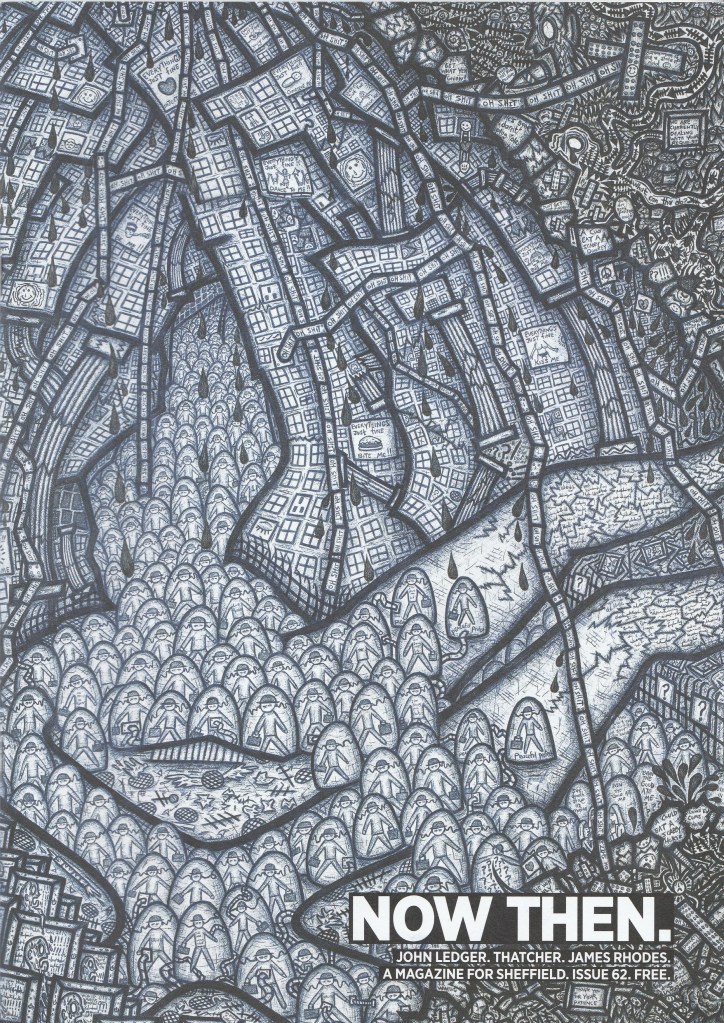
My artwork features in this month’s issue of ‘Now Then’

My artwork features in this month’s issue of Now Then, an independent magazine centered on the Sheffield area. I am pleased to have my work featured in this magazine, as I have great admiration of it and its impact in the Sheffield area; it being an incredibly refreshing (free!) magazine, and which more often than not contains more relevant articles on contemporary world issues than t more nationwide media sources.

I also give an interview in the magazine in which I talk about my work, and life in general.

http://nowthenmagazine.com/

‘The Place of Dead Ends’

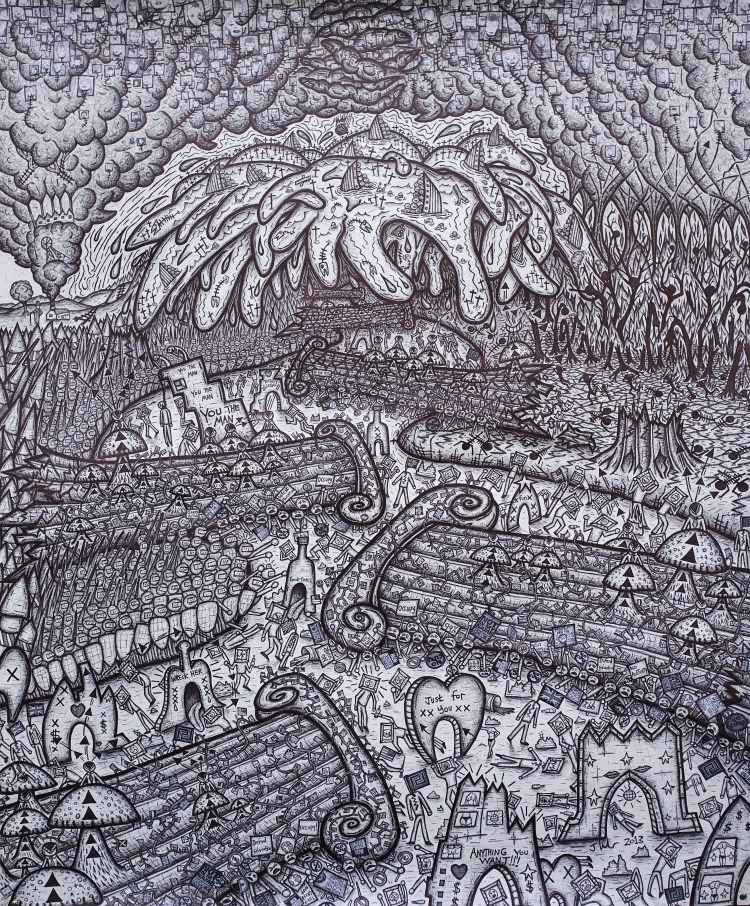
The Place of Dead Ends (2013, biro and collage on paper, 120X100cm)


The idea for The Place of Dead Ends fixed itself together whilst I was walking around the park-lands of Greenwich, London (a place saturated with popular history), in the autumn of 2012. I stumbled across the Queen Elizabeth [the 1st] Oak, a tree that the Tudor queen is said to have often taken refreshment under. Queen Elizabeth the 1st reigned over an historical period that played a crucial part in the formation of the British Empire, and (of course) the modern industrial world.

What I didn’t realise until then was that this tree had actually been dead for well over 100 years old. Yet the tree trunk remained; laying heavy upon the ground. Always having the gravity of the 21st century stalking my thoughts, I couldn’t help but see this dead relic as a metaphor for a world which is being ruled to ruin by ideas and beliefs that belong in the past; a result of a civilisation that is unable to look to the future.

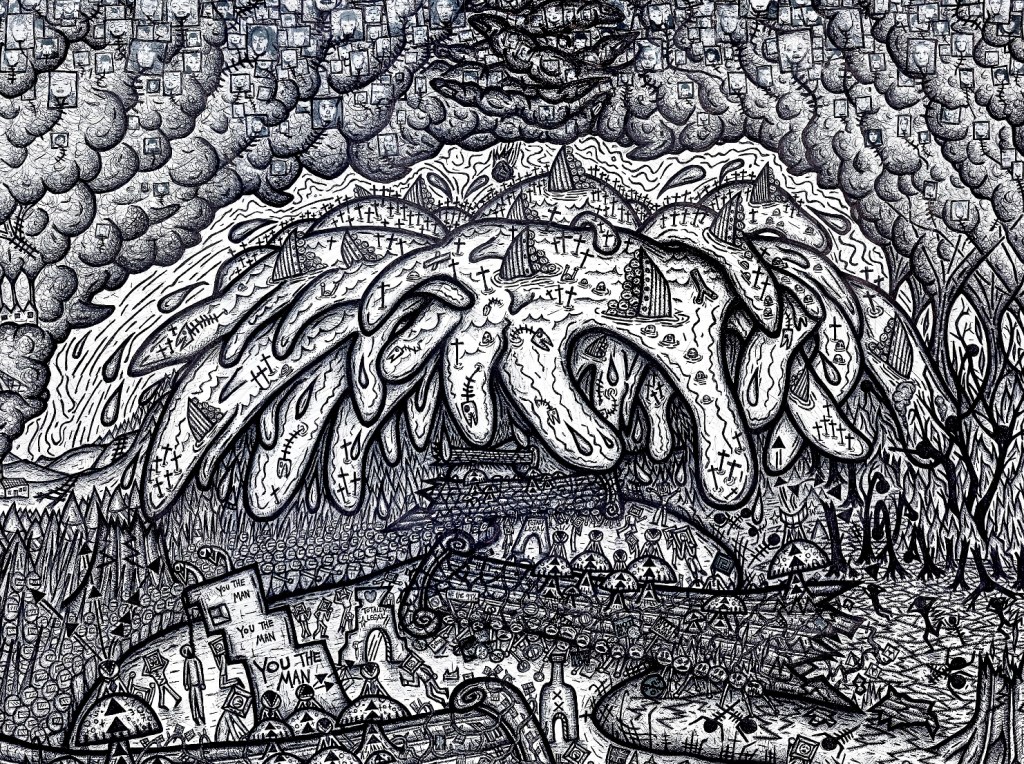
In the drawing the pillars of (a) civilisation have fallen across the route, like dead trees blocking the path. In this landscape protests are being made by many who desperately want to change the world into a better, more just place, but these pillars have landed on the protests, trapping them, making them unable to move – unable to make a difference (the most well-know example of this would be the 2003 protests against the US/UK imperial war on Iraq, where millions filled the streets world-wide, and were utterly ignored by the decision makers). On the rotting of the tree-like pillars grows all the forces that feed off the death of a future; runaway finance with no grounding in theory, and jingoist patriotism that feeds off the fears of global uncertainty.

The rest of this blocked route is occupied by people who have given up on the belief of a better future, and have given up fighting ; they live in a never ending avoidance of truth and empty feeling, condemned to the pursuit of immediate pleasures (drugs, alcohol, sex), only to spend much time in stupors of dissatisfaction and depression. I am not excluded from such a scene; I am both the protester and the individual drunken and frustrated roaming the evening streets, trying to forget reality. Every figure is interchangeable in my drawings; no individual is solely to blame and yet everybody is complicit.

Each side of the road are the barriers one faces when they try to think of a way out: the violence of the nation state, which becomes more ruthless and repressive the more it is threatened; and at the other side one faces the even worse plight of the poorer parts of the world, and the parts of the world already suffering greatly from changes to the global climate brought on by this governing system. There seems to be no way out. Clouds envelope preventing us from imagining another kind of world; they are both the very real human-made pollution we are failing to tackle, and the blotting out of imagining ourselves somewhere different; the clouds are full of the faces of ‘dead stars’, the icons of 20th century capitalism, who died and became immortalised in our collective hearts, having an ever greater ghostly presence that seeps onto the skins of us as we run backwards from the current world, in search of better times.

Drawing, for me is as much as a controlling (or management) of my darkest thoughts in which everything seems out of control. Yet, I hope my work can reveal the modern world to viewers in a way that is constructive to a collective demand for a better world.

A Couple of Recent Psychogeographical Maps

These maps were made on Thursday in the Barnsley area (which I’ve mistakenly labeled as being on the 27th, when they were in fact on the 28th. I am making these maps as part of a psychogeographical project where I intend to explain back to myself the experience of inhabiting certain human landscapes I am most familiar with. It is certainly an artistic project with social and political motives. I  also hope they serve to others as a interesting guidances to an often unrepresented reality of place. Even though I do find it hard to shut my mind off to negative occurrences, all of as (most of the time) are preoccupied with keeping our spirits up when we walk through an urban environment, trying to find something that makes us feel at ease. After these walks yesterday I wasn’t physically tired, but was mentally drain. I found the task of keeping my spirits up such an effort. Looking back on these maps, out of reach of the impact of that area on that day, I can see a nature of environment that I would instinctively try to deny myself whilst within it in order to feel calmer about things. These maps are helping me understand the Real which we often don’t look at when in our own daily endeavors; yet this Real still has an impact on our mood, for bad or good.

Black Mirror/Utopia/2013

“2013 is unfolding real horror-show-like” said the protagonist Alex, as he sat back in a bubble of styles and tastes, mixed, and mashed together from decades gone, too alcoholically inebriated to care that the here and now is almost unidentifiable  except for a general distinct lack of faith in everything” (Imagining the protagonist from A Clockwork Orange inhabiting  our present social landscape).

The ghosts of every era have frighteningly come fully to life in our times. Full-throttle hyperreality. A world where people are more Victorian than the Victorians were; more 60’s than the 1960’s were, more Madchester than the Madchester scene was. A world full of simulacra. But why?

Surely the anxiousness caused by the inability to visualise/represent our postmodern (or late-capitalist) times need to be fueled by more than just confusion, in order for the past to embalm the present to such an extent that it becomes alive at the expense of the present? A collective sense that, in our blindness to our times, something is running amok, off its leash, slowly unraveling that which holds together civilisation?

In my last blog I described a feeling that 2013 gives me: a feeling of the uncanny. That all that should be dead and gone – inanimate – has now been brought back to life; or in another way of looking at it, we are behaving like ghosts ourselves; that the world we knew is dead, yet we go through the motions. We go through the motions despite there being so much scandal and corruption, in media/political/business establishments, that there is nothing left to trust in. We don’t know what else to do put to repeat our old actions.

A protective veil of simulcra helps us believe we are elsewhere in time. This veil gives way (either due to a descending social gradient or the passing of hours in a day) to the protective bubbles of alcohol/drug intoxication. You happen to pass through a certain part of your local area, at a different time of day, to realise the necessity of illegal drugs in peoples’ lives in order for them to exist (subsist). All avenues to deny the present have become so entrenched that you realise out-right madness is indeed a requirement to survive the strange and unsettling passing of days in 2013.

Amidst, what I would describe as a landscape of chaos,  two television dramas (in particular) have settled into this mental environment, like large plants that have grown out of it all. They portray a tangibly close to The Now world, a sort of science fiction; the type of science fiction specific to a time that no longer believes in a future (our time). They are so close for comfort to be Pizza-eating TV-watching fodder, that you have to be in a severe state of disillusion not to notice that we are indeed looking through a Black mirror.  Appropriately most of us are in just that state – in order to refrain oneself from running around and screaming. These two dramas being Utopia and Black Mirror, both shown on Channel 4.

As much as the extreme violence in Utopia initially sends jolts of shock through your nervous system, it isn’t what makes the lasting impact: it is that all this violence is perpetrated in order to find certain people and certain items crucial to controlling a global sterilisation project, which is being planned due to the very same issues that we must face in the century above anything else; resource depletion and feeding a growing population, with such a situation possibly leading to hellish ends.

Utopia reflects back to us the humongous issue that, due to its appearance of having no immediate effect, has almost vanished to the social conscious since the financial crash in 2008. We are locked into a cultural infliction that the theorist Mark Fisher diagnoses as ‘Capitalist Realism’. Utopia presents back to us the only solution we would have to save the human race under our ‘Capitalist Realism’ infliction: mass sterilisation. Surely one must retain the hope that a human race outside the dynamics of capitalism may yet find itself with a humane way of dealing with these century-defining problems?

Utopia’s networks of conspiracy get the mind working overtime, but the lasting mark it carves into our minds is the thought that says “hang on? what are we actually going to do to save the human race?” The violence is perhaps a welcome reflection of the levels on inhumanity that unaccountable powers will go to to get their way, but we need not rely on the possibility of acts of secrecy to know that this occurs. One must surely then follow up the first thought by asking whether the continuation of humanity under unaccountable power, which leaves a snail-trail of corruption as it inches towards the cliff face of civilisation, would be worthwhile anyway. But I’d argue that this is when one’s thoughts die via the thought-guillotine of Capitalist Realism, that places thought back into the survivalism of the here and now under extreme austerity.

If I do appear to have a somewhat paranoid feeling that I’m seeing the unraveling of things, so be it, (I hope it is!), I can’t help it, but I don’t think I’m alone in seeing the drama Black Mirror as being a zeitgeist-moment. Black Mirror is written by satirist/presenter Charlie Brooker, a man who is so apt for our cynical times, that it is maybe right that he doesn’t show the true size of his intelligence so often, allowing him to sneak it under peoples’ noses without them knowing.

Black Mirror is Science fiction specific to these cynical times, where we just hold on day in day out; a science fiction for a time when we have forgotten our own times, unaware that they are far more futuristic than we think – which has disastrous consequences. Three different episodes show a future so incredibly close, but it’s like looking a picture you know well yet then suddenly spotting something is incredibly wrong. This is our future, as with the future depicted in the Children of men; one where what is already present now is just made to get more extreme.

Yet Black Mirror operates perfectly in a postmodern society where more pedagogical warnings are told to go fuck off and get back on their high horse; it’s incredibly subtle. For example, the last episode. A cartoon character standing for election becomes more popular than real politicians. Anybody who has read ‘The Hell of It All’ ( a collection of Charlie Brooker’s columns for the Guardian’s G2 section) will know that this is what he more or less summed the then-London-mayor-candidate Boris Johnson up as being. Brooker showed a meek fear of the political consequences of people voting for somebody for their cartoon-character likability. With Waldo (the name of the character), in the last episode, who actually is a character, Brooker subtly leaves the consequences of the rise of such a figure to political power to short intervals between the ending credits, the point when people usually assume the story has ended: the man who did the original voice for Waldo, who quit because he became worried about they way it was all going, finds himself homeless in a fascist-looking state ruled over by Waldo television screens. The last shot shows him being beaten by police in black uniforms.

What does such an ending have in common with our times? Black Mirror’s subtle stabs through the blindness of cynicism, show us what social consequences can arise from a culture of cynicism and lack of trust. Our cynicism has been growing and growing, as the pillars of society have crumbled into total untrustworthiness over the past decade. In 2013, we now find ourselves in a landscape where we have no trust or hope in anything that orders our society, yet we have to carry on because we know no other way. We just Ipod ourselves out, even further so, and drape ourselves in even thicker reflections of a more comforting past. But the cracks in the present are getting harder to step over, and many are already tumbling down into them.

If One Noise Could Represent a Century…

(Note: my dark imagination got carried away here; it’s not really a blog that calls for optimism)

Whenever I hear two particular sounds they  emotionally grip me so intensely, because they seem much more than sounds that embody a time; they sound as if all elements of an entire era were being smashed together at high speeds. These two sounds are the terrifying siren noise made by the German second world war plane, the Stuka, and the monstrous sound of the flamethrower (which one is most likely to be accustomed to hearing from footage of the war between Japan and the USA in the Pacific).

The period that sounds like it is being smashed together within these noises is, for certain, the first part of the 20th century, but I’d probably argue that those noises are almost a some sum total of the entire 20th century. The noises sound more futuristic than possibly anything that has come after; an horrific modern era, where all the hopes of modernism were being torn to shreds, landing us in a postmodern desert, abandoned by geography;  when the rock music (a sound of freedom), that rose up and died in the stars that culture burnt to a cinder, was at its most violent sounding, it sounded like the noises of warfare from the first half of the century.

In fact the death drive of modernity, and the death drive of the fated rock stars (who were possibily fated due to their late arrival to the modernist project), is what these sounds almost seem to capture. They are darkly intoxicating noises to all generations born afterwards, who don’t really know where they are in time anymore. One could actually imagine the protagonist from A Clockwork Orange enjoying the sound of a Stuka on repetition. Sometimes it feels like the future did well and truly die in the 20th century. And these noises sound like its death.

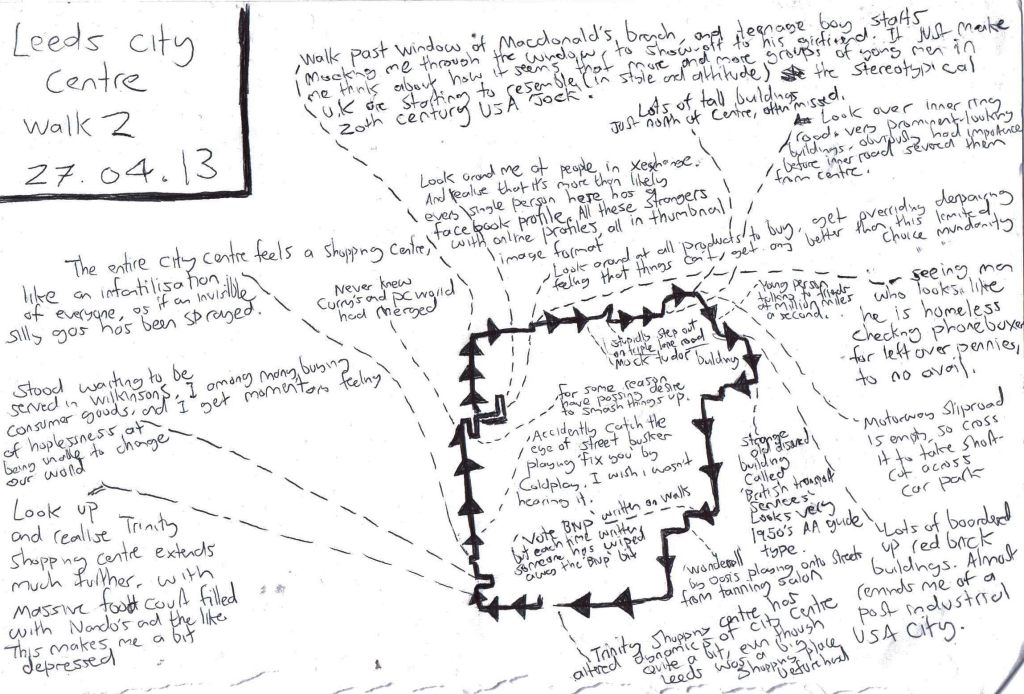
Mind maps. Recounting experience of walk, by mapping out the route.

To follow up yesterday’s post, regarding leaving London and having to return to my home town, an incredibly less busy and noisy place, I have posted two maps I drew of routes I have walked, in order to show my thoughts and experience of that area whilst walking through it. One map is of a walk from Shoreditch to New Cross in London, and one is from the Mapplewell to Darton, in my home town, Barnsley.My intention was to show that the thoughts in ones mind whilst walking through an area and experiencing it, can make interesting documentation wherever one happens to be; that whether one is in the heart of a metropolis or in scattered former mining villages, the internal running commentary that accompanies that walk can be just as revealing and conscious-awaking of our real material conditions.

This all related to the Mapping Capitalism course I began, but couldn’t complete, in London, and in particular theorist Fredric Jameson’s notion of cognitive mapping, as a modern means to class conciousness and awareness of our real material conditions, in the disorientating world under late capitalism. Informed by both the philosopher Althusser and the urbanist/town planner who used psychogeographical ideas to create better living environments, Kevin Lynch, Jameson argued that the “mental map of a city explored by Lynch can be extrapolated to that of the social and global totality we carry around in our heads in various garbled forms”

These maps are just the beginning of many I wish to make. I do lots of walking, but not so much leisurely walking (in the sense of a country side stroll), more like walking to town to town, village to village. I have attempted to draw these maps right afterwards, visually the area as I draw the route I walked, in order to remember my emotions and things I saw whilst walking.

If not to anyone else, I find this deeply informative to myself. It’s like when I look back on what I have written the landscape reveals its true identity to me; something an A-Z or Google map could never do. It also made me realise that there is something to be gained conceptually from any walk. Not just a walk through the most tourist-friendly spots on earth.

Map 1. Sunday 7th October 2012

Map 2. Thursday 7th February, 2013

That my life doesn’t seem to grow and change is because time itself doesn’t seem to move things on anymore.

Oh yes, things change, but it’s as if the entire world is speeding up its exchanging and obtaining of things already bygone. And when all that happens is that things are circulated faster and faster, little of it seems to have any substance. When one thinks of our present time and what could be seen as new, one thinks of applications, social-media sites; they don’t bring anything new into the world they just stretch out and speed up the circulation of everything that’s already happened in our civilisation (recent technological advances merely turn the world into one giant tin of old photo’s, and all we do as a culture now is constantly browse that tin).

I have never found myself able to allow myself to leave my teenage physique and demeanor behind. Reality would show that I have left it behind, but it doesn’t stop the need to maintain what has already gone.I cling to a past that retroactively becomes more and more massive, as a future never seems conceivable. The more I speak to others (although it is played out in different ways) the more I realised it wasn’t specific to myself.

That I make sure that I can still fit into (some) size 30 waist jeans is merely reflective of a culture that continuously makes sure it can still riff on the past. According to The independent newspaper,  the United Kingdom, in terms of soft power (or cultural capital) is ranked as the most influential nation in the world, and if there was ever a nation that has continuously managed to riff on its past (whether the royal spectacles or re-hashes of the same British rock group formula every 5 or so years) it’s the United Kingdom.

We are trapped in a cultural logic that believes nothing can be done to shape and make a new world. Because of this we are held to ransom by the logic of a system that told us its world is the only world. Our culture has nowhere to turn, and as this systemic logic brings the world into farce, we look further and further backwards, in order to grasp something that we feel we can control, in order to stay sane.

I would speculate that with every crisis the capitalist system has produced this side of the year 2000 that it further entrenches this immersion in things of the past (albeit with modern devices that we rarely try to rationalise). The legitimacy of the system has been smashed by farce after farce; we know we it is failing us, but we cannot perceive away around it, so our world is built out of a past that we can control and predict.

Image

Because we can’t face up to the present, or even acknowledge it, time feels out of joint. This disjunction between time and our experience can be unnervingly evident in the aftermath of the 2008 financial crisis. Dotted around every urban settlement up and down the U.K are, what I call, ‘Mary Celeste‘ Developments; never completed housing estates, barred off by metal barriers, and skeletal structures which are frozen in their foetal position. Precisely because we are culturally unable to face up to the present, we usually walk past these spaces and instantly forget about them. But if we make a conscious effort to observe them  we are confronted with the disconcerting fact the the financial crisis began half a decade ago, when it doesn’t feel long ago at all. It only feels like it happened a few weeks back, and everything at these construction sites stands, waiting to resume business, as if it were only a temporary blip.

Image

Because we have found ourselves at our cultural dead end (or at least at a blockage in the pipelines of time) the world hasn’t been able to come to terms with the truth that the world has been irreversibly changed from that day on. We can’t really picture the world as it actually is, now, because it gives us the sensation of already being dead, and having an after-death experience. So we wait for things to return to as they were; we wait and wait, and only rarely realise just how much time we have spent waiting.

It’s like we are the new Pompeii, but haven’t realised that we’ve been turned to stone and burried by the normal functioning of time. At times when we can passively flow through this world, without observing or experiencing the world-wide suffering that confirms that the world is still alive, one can be forgiven for at least imagining that the end of the world has already occurred, that we are literally spectres going through the motions unaware of being so, like the fate of the Characters in the film The Others, who do not realise that they are the ghosts haunting the living.

More people now dress like people from the past than the people who lived in them time-periods did. People in the 1960’s thought we’d be walking around in space-suits, but we actually walk around looking more like them than they did. More 1960’s than the 1960’s; more 1980’s than the 1980’s; we are more or less living in a simulation of the past, which helps keep us blind to ‘the desert of the Real’. This is the world of simulcra/hyperreality, understood well by the philosopher Jean Baudrillard in the 80’s and 90’s. Yet he makes it somewhat fantastical/exciting to read; it doesn’t feel like the bleak haunted house our post-recession culture occupies. The ghosts of the past are running out of energy just as we crave them the most; the music/pub/night-out scene which embalmed our culture with cheap drink is now often the arena where you feel most like you’re in spaces haunted by their past (empty pubs).

On a personal level, my predicament could be clumsily described by the previous generation as that of somebody who is “30 going on 18”, but the situation is far more serious. Much of the previous generation often refuse to acknowledge the reasons for this cultural inertia, because they grew up in a time when culture burst forward faster than anything before, only to exhaust itself in the form of tragic endings for many young pop icons. I have to ask myself whether I will be still heading to the “indie music” bars, not knowing where else to go, when I’m pushing 40. Experience of my past ten years, living in a culture that turned up the volume on its IPod every time news arrived of another crisis/catastrophe, is that doing so may be a necessary coping-method.

Thinking along the Hallam Line (Leeds, Wakefield, Barnsley, Meadowhall and Sheffield)

Untitled

Leeds

Along with the Engineering of Leeds (my 4th town) into a (relative) economic powerhouse, there seems to have followed an almost identi-kit pasting of all the traits usually found in the big financial centres like the City of London, yet in a much smaller area circling the railway station (after which it begins again to look more like a typical post-heavy industry northern city, and a Yorkshire town).

IMG_2556

The swankiness; a desert to all retailers except the most upmarket of independent and chain stores. The speed of life in this colony-island of the global finance empire is much much faster than ten minutes walk either way. There is an expectation to be met with tuts if you take your time; you have to run across the street after actually casually stepping out, because a car, that in normal circumstances is a safe distance away, advances towards you with the speed of a motorway slip-road acceleration. Maintenance; you get on the train in your local town feeling pretty well dressed and tidy only to feel like a medieval peasant in contrast to those rushing back and forth from the train station. Homelessness; the homelessness in Leeds, in comparison with its size (irrespective of the wider urban area now dependent on it), is apallingly bad. You do wonder where they could have all possibly come from, as it looks too extreme – without forgetting the suffering such a existence must create, it does often look like a stage-set of a typical city scene, almost hyperreal, which could explain why people find it so easy to be indifferent to others’ suffering in such areas.

IMG_4055

Leeds is often seen as the capital of Yorkshire, and this is very true – certainly regarding the West Yorkshire Urban sprawl, as Leeds has increasingly become the only hub of this 2 million-plus area, as other large towns (especially Bradford) have seen gradual decline since their demise as industrial bases.

Wakefield

This may not include Wakefield (my 2nd town, living 8 miles from the centre), which does often seem to have something going for it now, quite possibly down to the needless construction of the outdoor shopping centre Trinity Walk and two international sculpture galleries (The Hepworth and Yorkshire Sculpture Park),which surely do deserve their place here with two of the most accredited sculptors of the 20th century originating from the borough.

But Wakefield, or the half of Wakefield mentioned so far, is if anything a suburb of Leeds, that seems to owe its ascendancy to what Leeds has become. This seems to be in an almost identical manner to the relationship towns such as St Albans, Reading, Stevenage have to London. This could well be because Wakefield is the only stop the mainline train line from London (which is so important in the ‘commuter-age’- which shrieks at the sight of snow on the tracks) makes in West Yorkshire on its way to Leeds.

In fact what has become more evident, since the observant eyes of the Southerner Owen Hatherley pointed it out in his book The New Ruins of Great Britain, is that Wakefield feels “like a southern city” (for which he did instantly offer his apologies for saying). But if you look at all the towns served by the East Coast Railway from London to Leeds, they all have a similar feel to them; all commuter towns, and they reek of modern industry, which to inhabitants of the old industrial areas of the north looks like the south (If you were that way inclined you could certainly feel a little bit of treachery, when seeing the a large London Underground map at the visitor service desk in Wakefield Westgate station).

IMG_4520

But there again, this beating organ dependent on the beating heart that is Leeds is only really one half of Wakefield. Wakefield really does seem to be two towns stitched together. One half of the city is the aforementioned town, served by the suits-and-ties-populated Wakefield Westgate station; the other half  is the remnants of a former mining town (culturally closer to Barnsley and Castleford than the other half of the town), served by the incredibly neglected Wakefield Kirkgate station, in a side of town that is full of sad sights, especially once the night draws in.

IMG_8565

This is the problem with Leeds in general, it is the hub of a larger Yorkshire urban area (which Hatherley suggested is a Supercity which possibly doesn’t know that it is), yet much of the urban area is neglected/ignored for the sake of Leeds, which itself is now nothing but a colony of the financial world-city. But there again, could the same not be said for Canary Wharf and its surroundings?

At one point Bradford was probably as big as Leeds, and Leeds would not have the gravitational pull it has without being less than 10 miles away from another large urban settlement. If West Yorkshire was recognised as the metropolis it more-or-less is, one would maybe begin to see a more reciprocal relationship between these already conjoined towns. What you get instead is each town (and this applies for all of England expect London) maintaining a provincial small-town mindedness, which results in London absorbing the lion’s share of (what remains of) alternative culture.

12

(Emley Moor Mast, from the former Woolley Colliery pit site, between Wakefield and Barnsley)

I have always had a bit of a longing for West Yorkshire and South Yorkshire to be re-merged to reform the old West Riding of Yorkshire, which stretched from the Yorkshire Dales, down to Sheffield and Right across to York where it ended. It would mean an end to the ridiculous train fare hikes once you cross the South/West Yorkshire border to a town not 10 miles away. This has helped create a divide, with everything in West Yorkshire being Leeds-orientated and everything in South Yorkshire Sheffield-orientated. This is maybe a personal frustation due to being raised in an area right at the top of South Yorkshire, just a mile from West Yorkshire.

Because this area will always be what I call homeland I never really differientated between South and West Yorkshire. Yet there is certainly a gap in the continuity of human settlements around here, which does seperate the South Yorkshire mining-village-conurbation – which begins in Barnsley, heading down the Dearne Valley to join Rotherham, at which point becoming the Sheffield urban-area – from the West Yorkshire urban-area, which begins with Wakefield, Dewsbury and Huddersfield, just over a series of hills.

Barnsley

IMG_8494

There’s just enough of this gap in continuity to give the town of Barnsley (my nearest town) a more isolated location than the other (former) West Riding towns. Barnsley is a strange place. Defiant, proud, but confused about what it is actually defiant and proud about. It certainly has a sense of self (under of the banner of ‘tarn ‘n’ prard – meaning ‘town and proud’) big enough to match that of the much larger urban settlements around here. And I would argue that what has elavated this sense of self in recent years is that it is relatively more isolated and hasn’t become a suburb of the bigger cities, which is evidentially the case with towns such as Wakefield and Rotherham.

IMG_3385

But I would also argue that it stems from its identification as being the centre of the South Yorkshire Coalfield, possibly with more right to claim the east side of Wakefield, the mining villages within its borough, and the Dearne Valley than the actual townships these mining areas resided in. Despite the pomposity of the size of the construction at the time of its erection, perhaps the reasons for the construction of Barnsley town hall, upon a hill looking across the landscape, were for it be a beacon to all of the mining villages under its far-reaching gaze, like a benevolent Mordor overlooking its coal-ming empire(the clock at the top even looks like an eye). However, since a neoliberal agenda replaced the damaged and scarred physical landscape with a more invisible damaged and scarred mental landscape, the idea of what Barnsley is, and how it is still important has been shaken to the core.

The result of this has been an ever-more defiant sense of self with fewer and fewer decent sources with which to proclaim this sense of self; a culture obsessed with past because no real alternative identity has been found. ‘Professional Yorkshiremen’ such as Dickie Bird and Ian Macmillan have capitalised on this huge sense of self, magnified by the ridicule the rest of country deals the place, to the benefit of their careers, but unfortunately (I would argue – although not to completely slag them off, just that I observe this to be the case) it is to the detriment of the town – because by playing this parody back to the rest of the nation, they give it what it wants, which is beneficial to them no doubt, but unfortunately seems to have helped culturally stunt a borough that contains a quarter of a million people; a place where countless people have thrown energy into trying to help the place develop, but to no avail.

The culture of the area is difficult to build on however because of the lay-out of ex-coal mining areas. Barnsley, the town, probably only has 70,000 residents, but the wider borough (not even including the mining villages which are under town halls all-seeing-eye, but not in the town’s borough) has over 220,000 residents. But this village-after-village layout creates a village-culture that dominates the entire town. A village culture is very damaging to a town centre that still sees itself so central to these 220,00 plus residents. For this reason I did have some sympathy for architect Will Alsop’s idea for the town (not the one about having a giant Halo of light over the town, making it look like the class-clown of the north) to rehouse a greater number of the population within the town centre. True, the reality of this would be massively different, but I liked the idea on the grounds that I wish for something to generate life back here, even although the sell-by date for these Blair-year grand schemes has long passed.

The F.E. students, who populate the centre during term-time give some life to the place, and as much as Barnsley College has shrunken from what it was at the turn of the millennium (largely due to financial difficulties caused by corruption at management level) it still attracts many students from all over South Yorkshire, and parts of West Yorkshire. But they leave. Or merely give up on their dreams (not necessarily careerist ones, but also dreams of a different way of life) and return to their respective village quagmires, leaving an age gulf in the town’s culture; a gap that seems to begin at 18+ and end with 40 year olds. Most young people who don’t give up on their wish for something different, and have the (all important) means to do so, leave Barnsley, usually for Sheffield, but also Leeds, Manchester and London.

There is a new museum opening, and as much as museums are obviously about the past, that past doesn’t seem to have anything now to enhance the future of the place. Especially the romantacising of it. Of course there is plenty of unfinished business; the poverty left from the demise of the coal-mining industry and the police brutality dealt out in the strikes. But the centre of an empire of coal mining it isn’t now, unfortunately.

That centre was moved, perhaps with tactical intentions.

IMG_4145

Meadowhall

As much as Barnsley constructed its large Portland Stone town hall in the 1930’s seeing itself at the centre of the greater Yorkshire coal-mining area, this centre has been moved since the demise of the industry. The centre of South Yorkshire (specifically) is (and has been for 20 years) the Meadowhall Shopping complex.  Sheffield is a city with much to offer, and the only place that can really offer decent (again, what remains of) alternative lifestyles to the one just mentioned in Barnsley, but it is not the centre of South Yorkshire, it is more of an alternative within it; the centre is Meadowhall.

IMG_4147

This consumer paradise/hell on the north-east edge of the city is where all of what remains of the railways in South Yorkshire connect; it’s the hub that brings together all the scattered ex mining villages, and steel towns. It is the nearest connection the railway has with the M1 Motorway, and it is where all the coaches for Sheffield pull up. It certainly takes those villages away from towns like Barnsley, and one could certainly speculate that there were political means behind the locating of such a huge shopping centre here. South Yorkshire was once referred to as the Socialist Republic, as after the war it was the home of strong unions and home to a lot of very socialist-orientated housing schemes. It was surely a statement to the New Capitalism being drilled into us at the time to bury the epicentre of all of what South Yorkshire was under a palace devoted to consumerism/commodities (and just a few years after the defeat of the National Union of Miners in a battle at Orgreave just one motorway junction down from Meadowhall).

If you want to see the dominant culture of South Yorkshire, don’t go to Sheffield go to Meadowhall via the interchange. See the masses leaving the trains to walk the aisles (sometimes not even shopping, just going there because it’s where to meet people), people who have had all meaning ripped from under their feet, not future granted to them, save one of acquiring more and more consumer goods. The sight of all these people flocking here is far sadder than the sight of the characterlessness of such shopping complexes.

Sheffield

sheffield (5)

The Majority of people in South Yorkshire don’t even get as far as Sheffield (my 3rd town), one finds the train completely empty for the final leg of the journey on the Hallam Line from Meadowhall to Sheffield.

Sheffield is certainly a far more attractive city centre than Leeds. Although apparently the opposite was true in the 1930’s when George Orwell visited it during the great depression. The centre is certainly my favourite urban area in the old West Riding, and is where I wish to relocate if I get the chance. The hillyness of it, and thus the areas of it unsuitable for development make it a relatively green and attractive city; the train station layout is incredibly attractive, being greeted with pleasant water features and walkways, the opposite of the grey,hustle and bustle outside Leeds station. The city has always seemed to be an important place for street art, and compulsive taggers; I like this, as for me, it almost seems to be an embodiment of the aforementioned unfinished business, and makes me imagine that an alternative to capitalism lies dormant in the rolling hills of South Yorkshire. The Supertram system, as it goes up and down the steep hills, has something really positive about it, just to see it, perhaps it feeds into the potentiality of the city to be something different from the others, looking more like a European city.

The city itself is as big as it’s more money-minded brother Leeds, but the wider urban area dependent on it is quite a bit smaller, and the Meadowhall shopping complex prevents it from having the level of consumerism seen on Leeds’ streets. Which, all in all, is definitely a good thing. Meadowhall largely takes the landscape of shopping bags and legs away from Sheffield, and as much as this has shrunk the city, it has opened up opportunities for the creation of many small independent art/music venues, something Leeds may have, but always seems pushed out of reach by the big money in the centre. Not to say that Sheffield hasn’t got all of these things mentioned here, and that Leeds hasn’t got alternatives to its finance, but they are both far less prominent features.

sheffield (8)

But one thing that can easily go unnoticed, unless a concerned local tells you, is that the poorer residents of Sheffield have been by and large turfed out of the centre of the city into estates on the outskirts. One of these estates is Gleadless, which is a peculiar looking low-rise estate. Obviously real thought was originally gone into the layout; the buildings weave in and out of the steep green hillsides, and the views are quite leafy, and apparently architects from all over Europe came to view it when it was completed. But now it is a sad place to be. With exhibiting my work quite often in places in the centre (the city’s receptiveness to artist is one of the reasons I’ve warmed to it more than Leeds, for example) I was picking up something from a house down there one day. I just felt sorry for the residents, and realised that many of them are as abandoned and isolated within this city as people in the deprived mining villages are further out in South Yorkshire.

I will always have some kind adoration for the 1960’s brutalist Park Hill housing development next to the train station (whether is a morbid and more positive fascination, depends on my attitude towards the past and present), and I actually would have liked it if they have kept the other similar ones (Kelvin, and Hyde Park) that were demolished in the 1990’s, because the steep rise of the hills around there makes the buildings look so much more profound. But Park Hill is now nothing but a shell, much like the way that New Labour were nothing but a shell of the old Labour party. The original inhabitants of the then-run down estate were relocated, and then the regeneration company Urban Splash turned them into luxury pads for city workers/Young professionals, going for £95,000 each.

But in many ways the reason I do have more positives to say about Sheffield, is because it always makes me think of what Barnsley could be, and is often in dreams (sleeping dreams not daydreams) what it is (as Sheffield’s proximity to the Peak District, Woodland, and then almost immediately high rise, and factories, has an almost collage-like nature to it, usually found in dreams). One just wishes there was something that connected all these towns up better, and didn’t leave them to be the provincial small-town fortresses they seem to end up wanting to be.