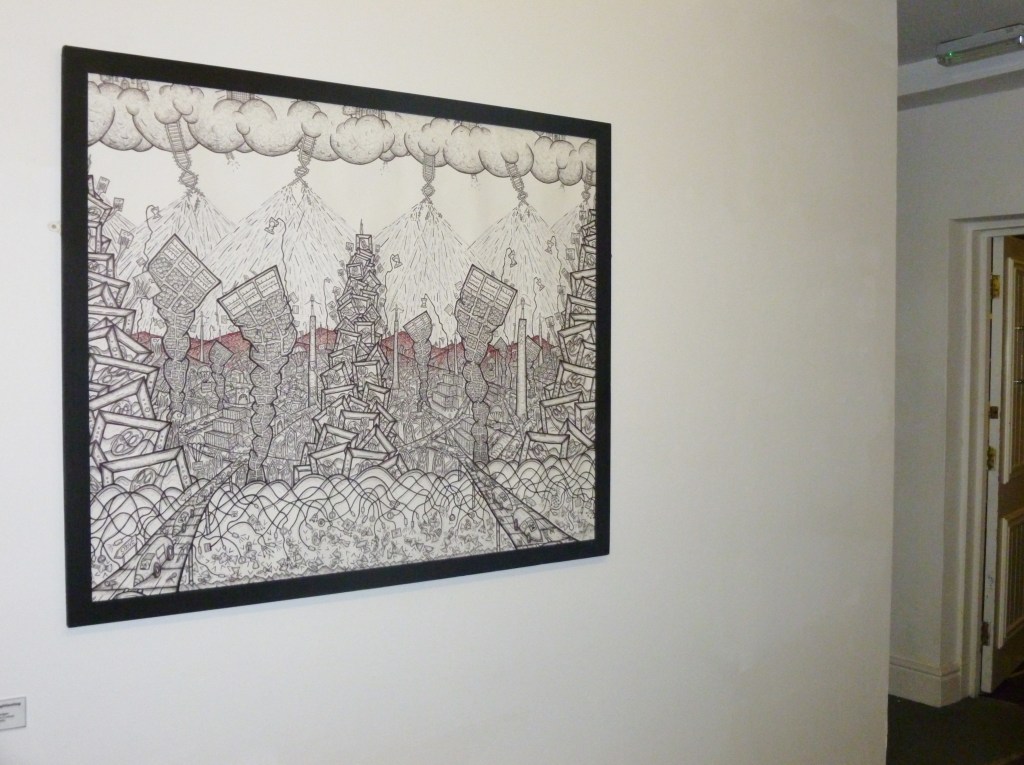
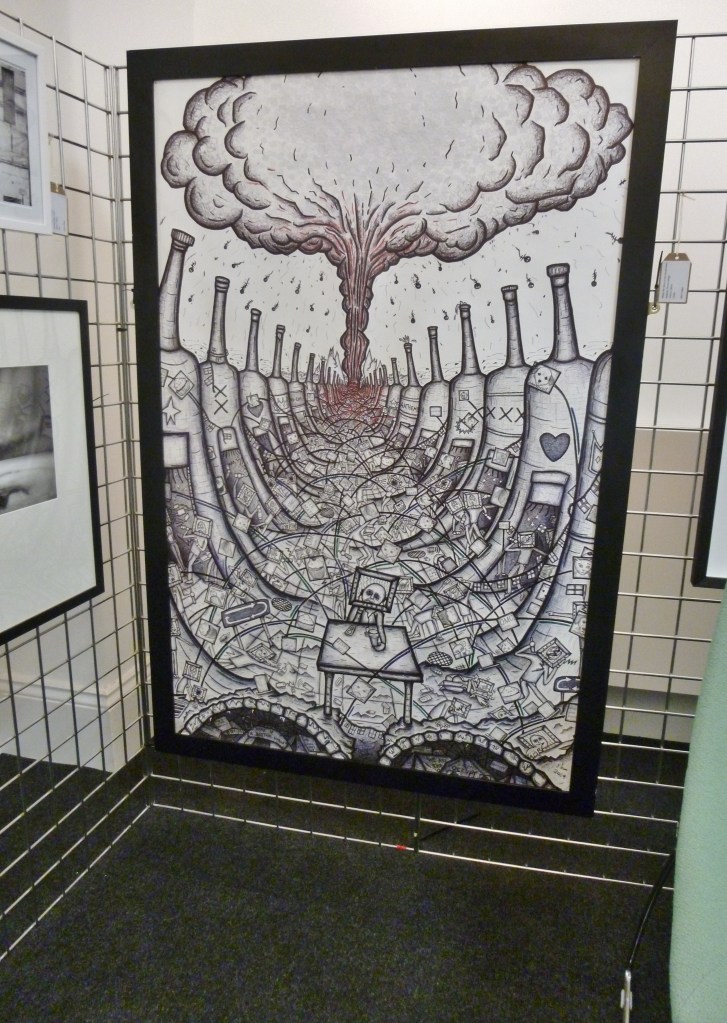
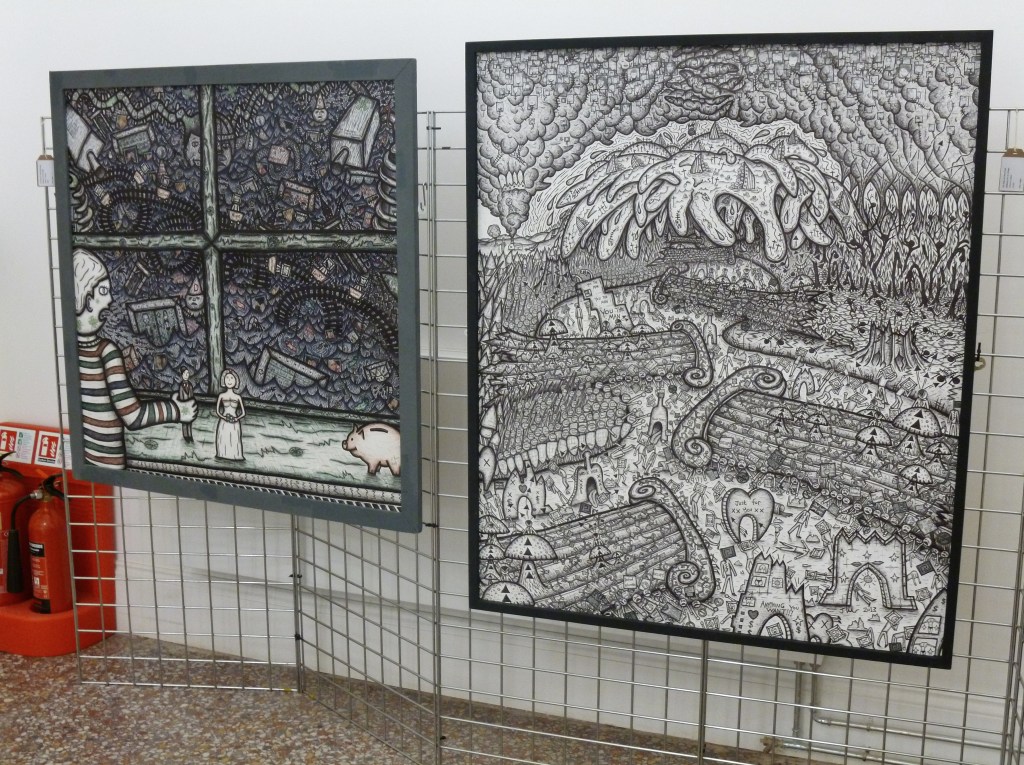
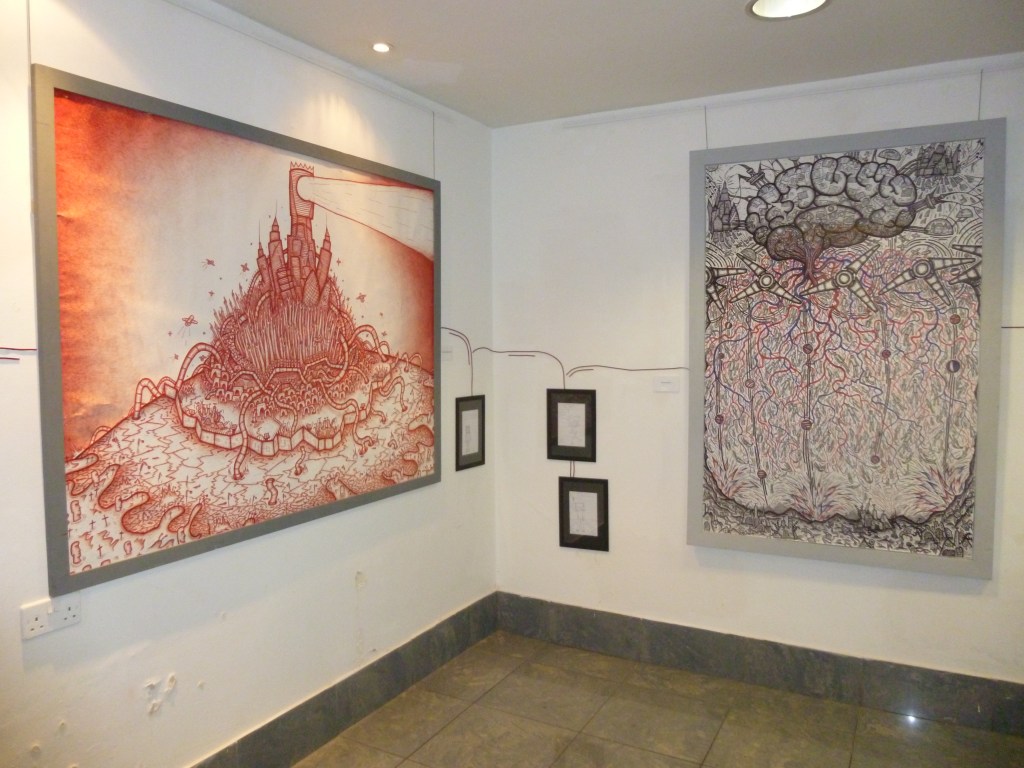
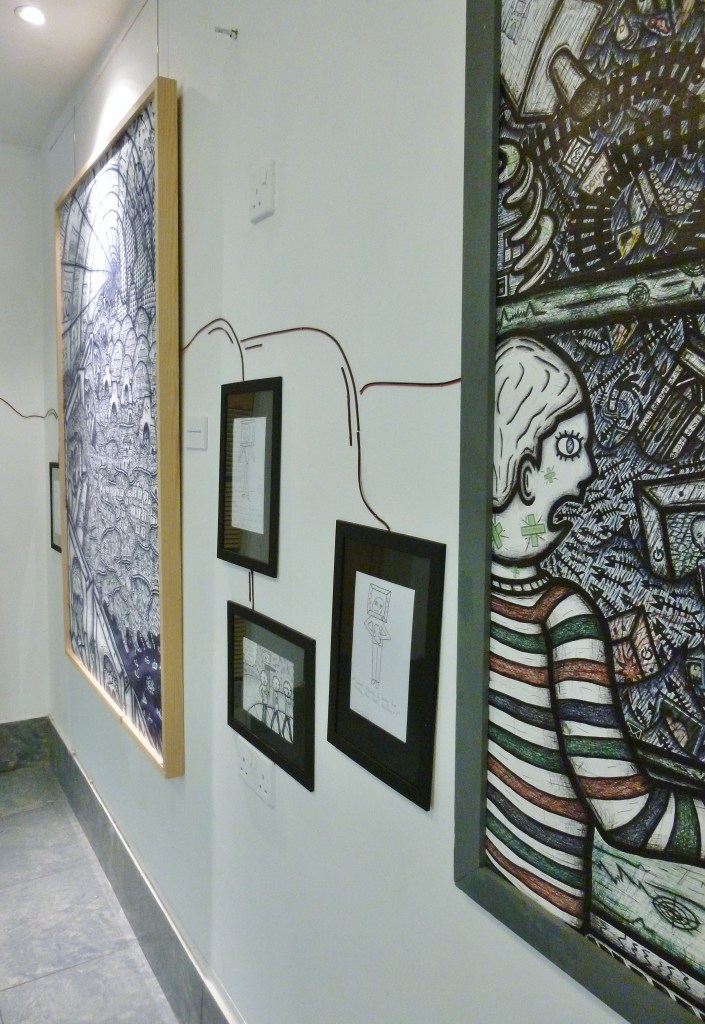
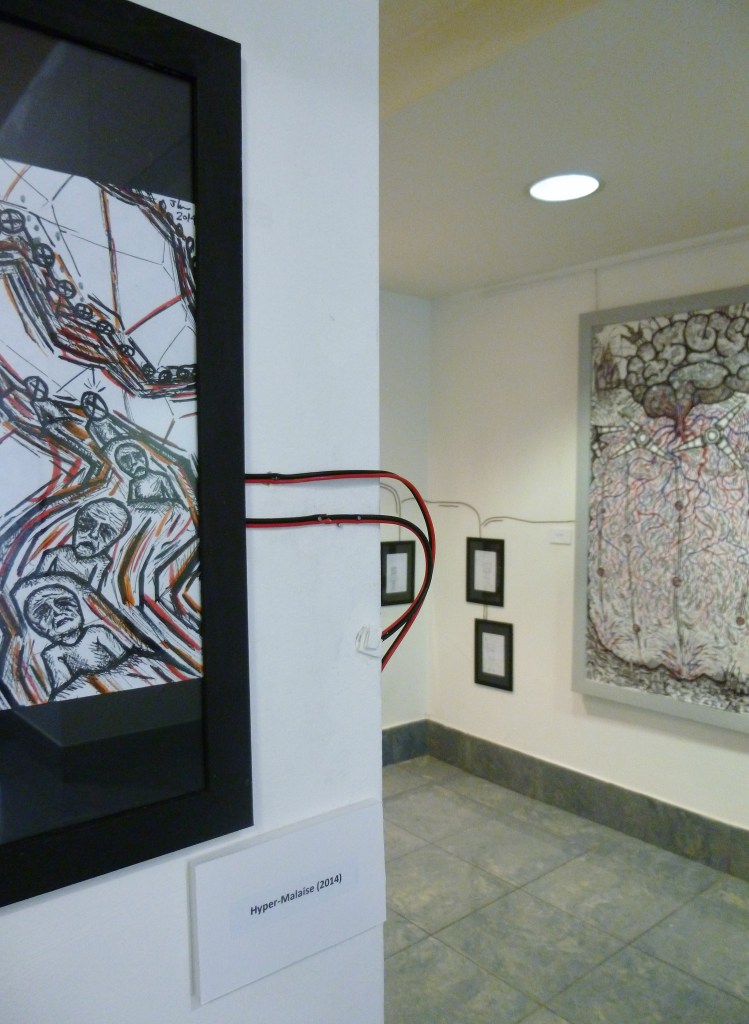
Over the past 2 week I’ve had my works in two exhibitions:
In Unity Hall Launch exhibition in Wakefield I exhibited The Place of Dead Ends, The Index For Child Well-being and Whilst We Were All In The Eternal Now…
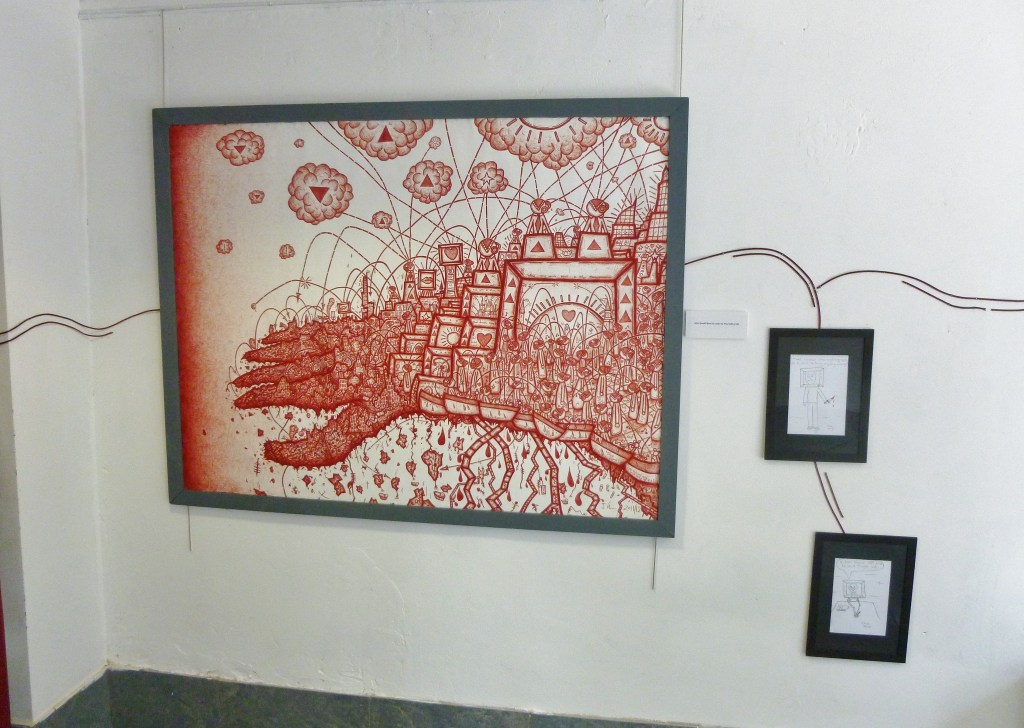
And in Our Corner: Art as Political Expression, at Bank Street Arts in Sheffield, I exhibited …Coils Tightening.
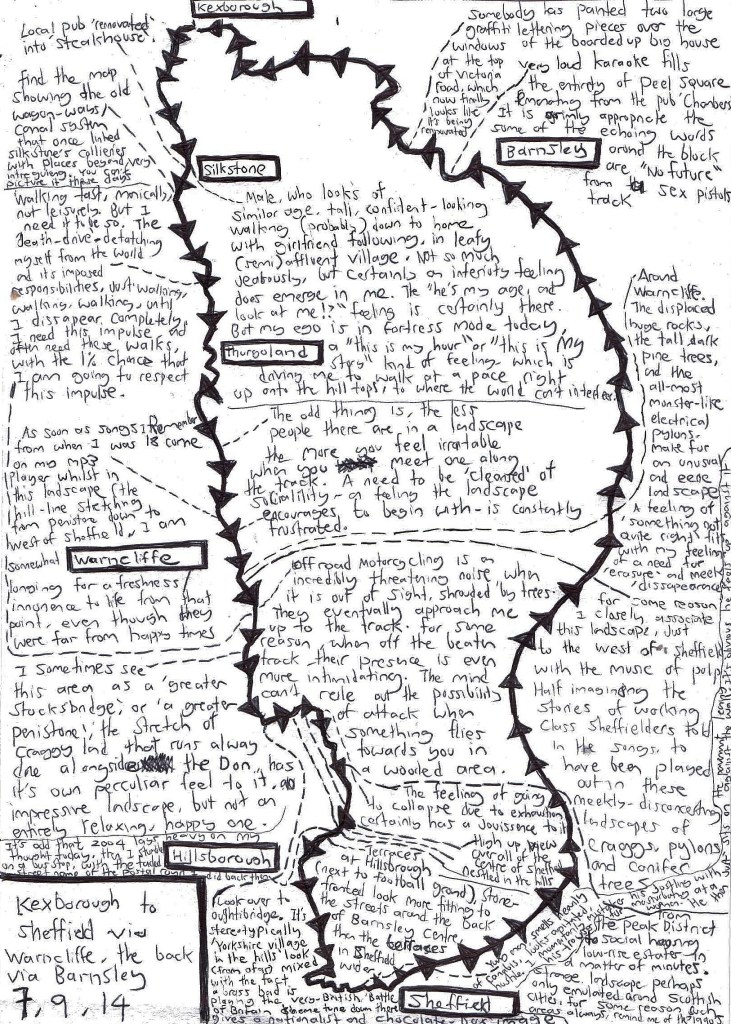
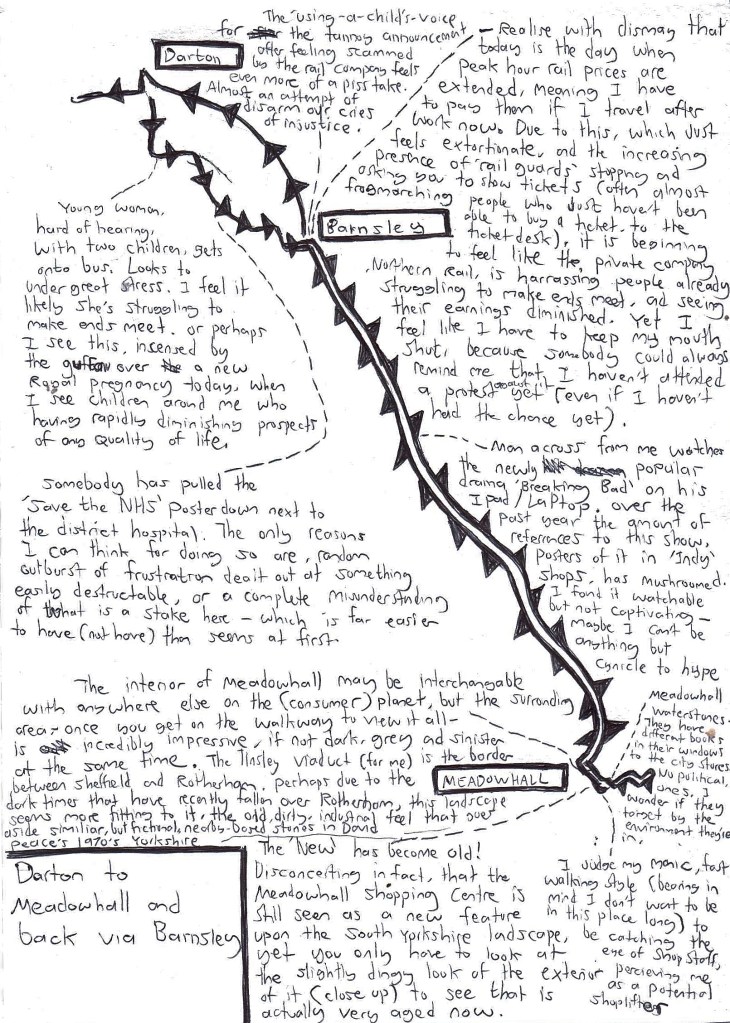
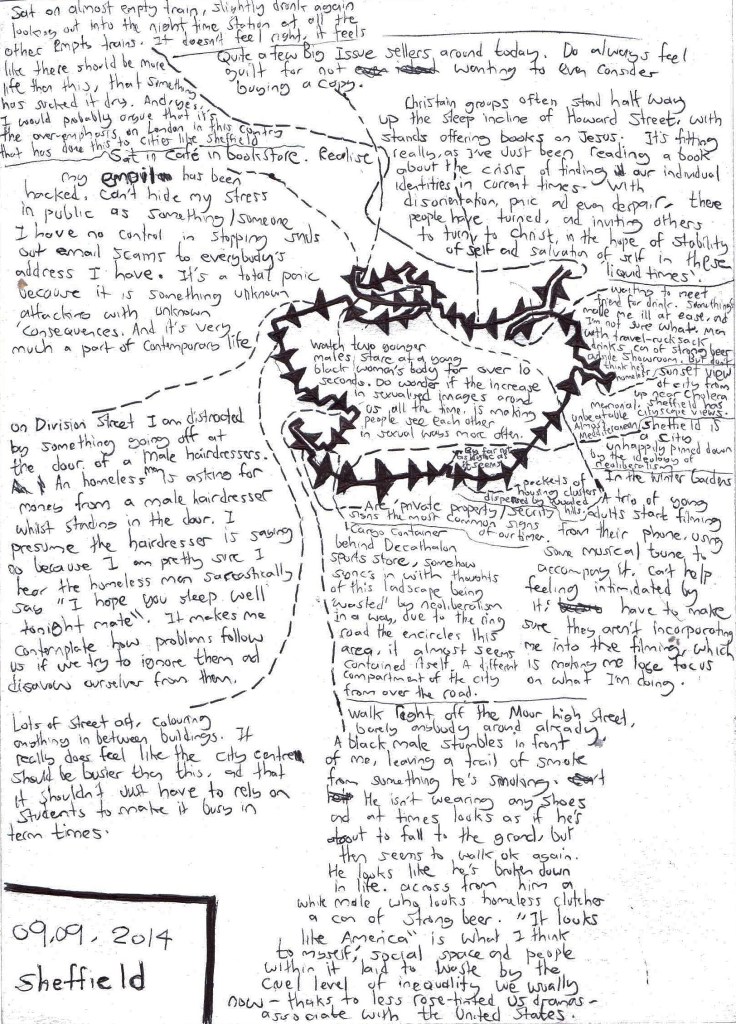
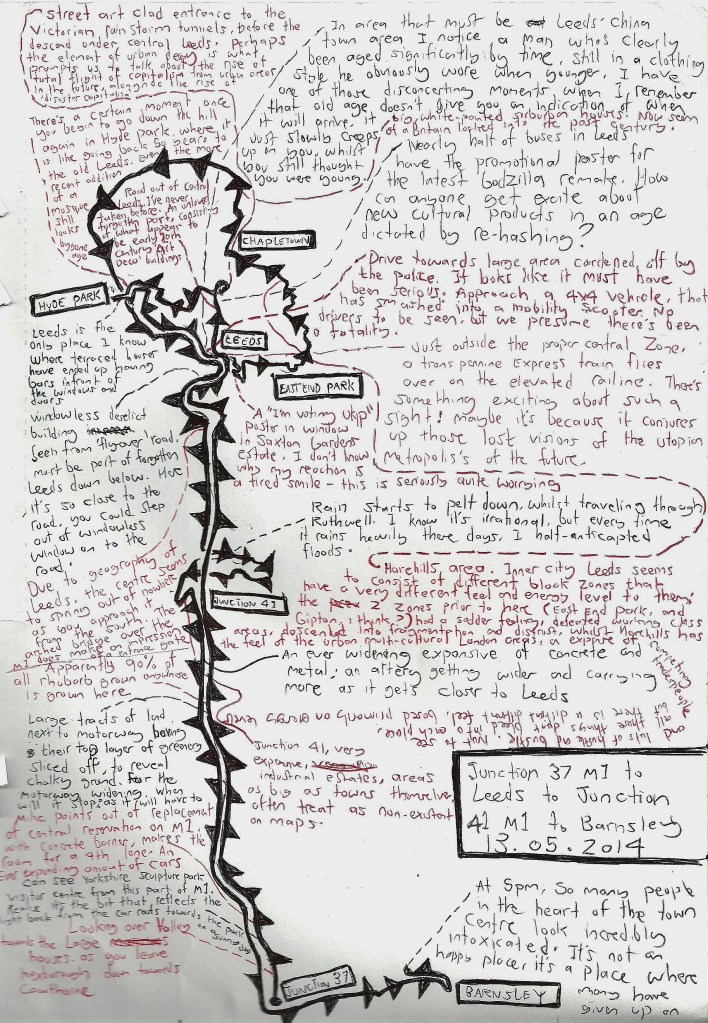
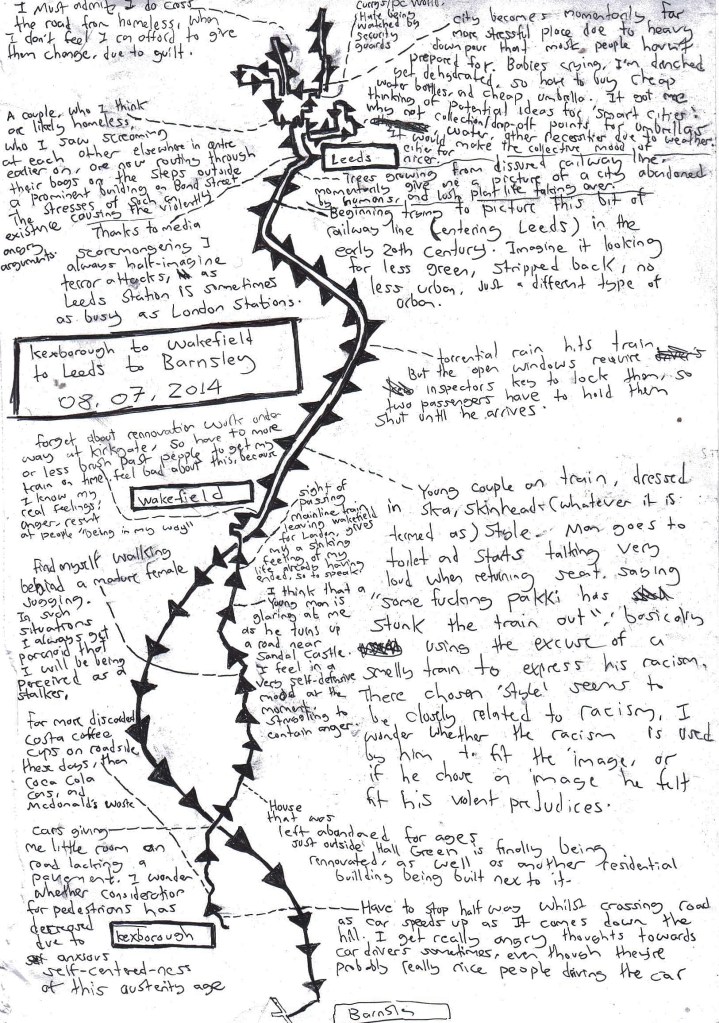
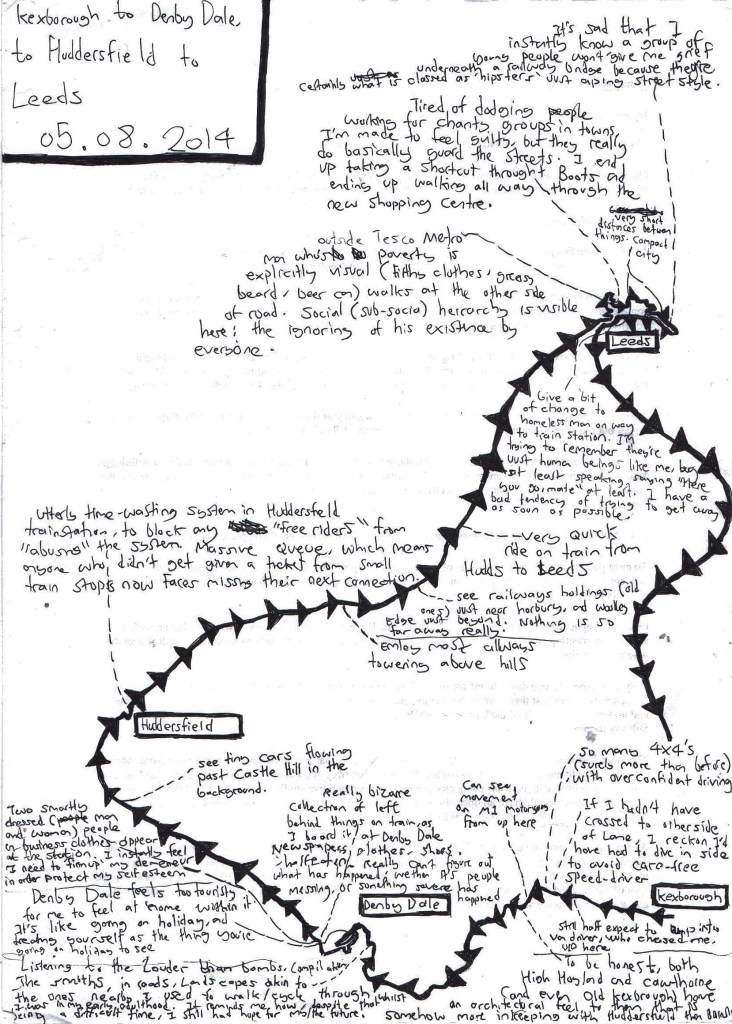
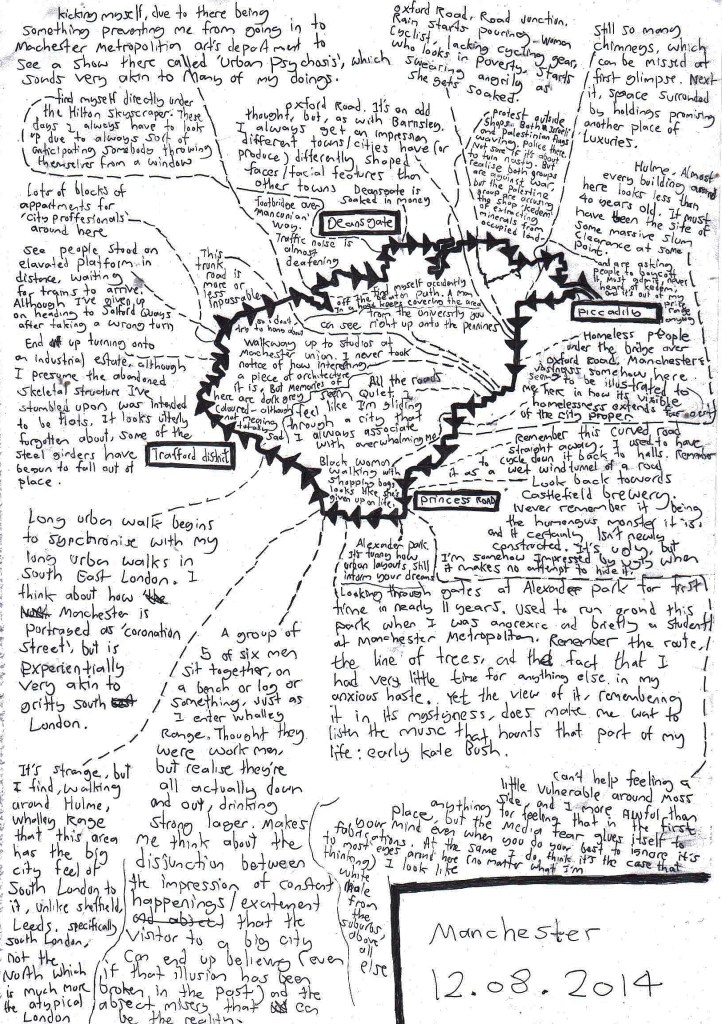
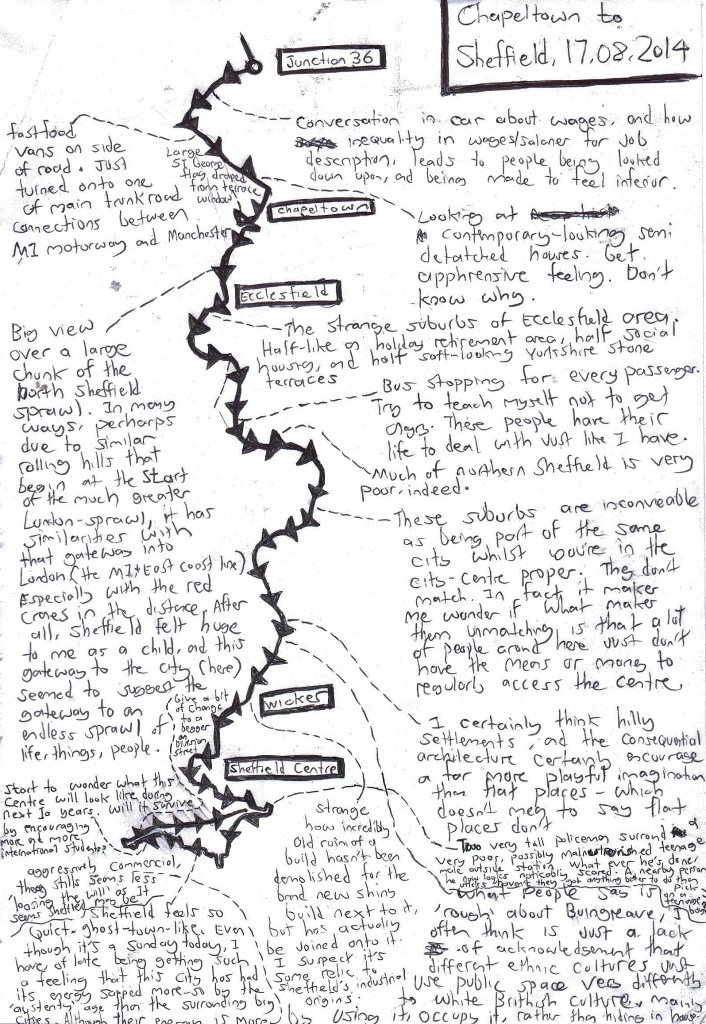
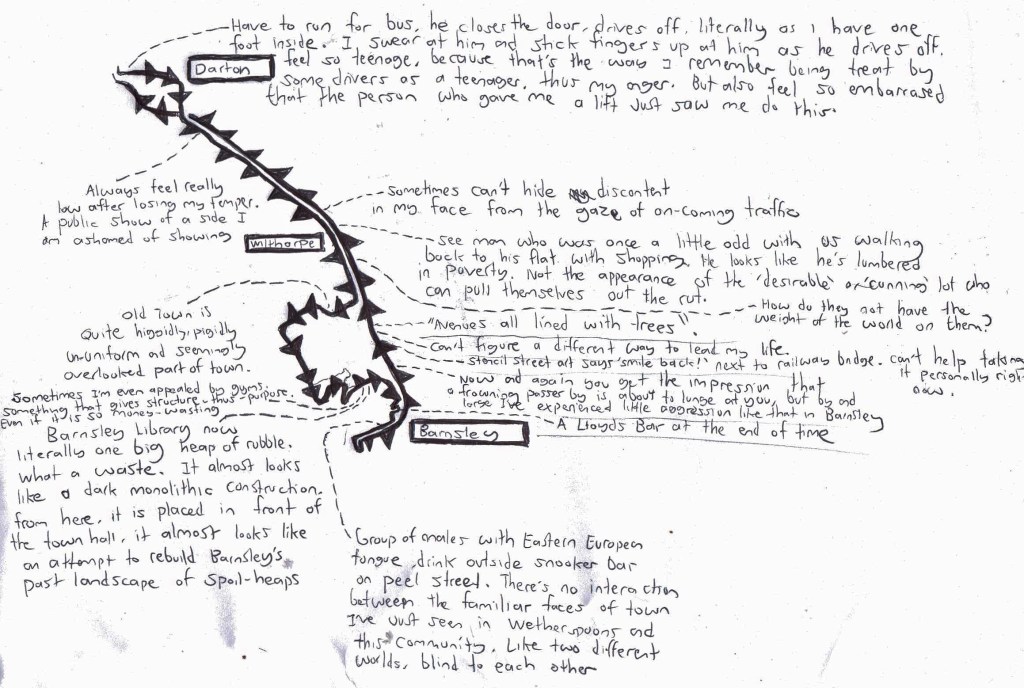
This is the third post in a series that I still call psychogeographical maps (or cognitive mapping). Quoting certain sections and using a selection of photographs to widen the project, which at its core still has the intention to be a Cognitive Mapping of Now – aiming to be useful for locating the current socio-political mood, and the psychological impacts of it.
“Homeless man [near bus station, Leeds], head tucked into jacket (probably soaked by the rain earlier on). He looks beaten [by life]. Strangely I never expect to see homelessness on a weekend. Has the 9-5 logic fooled me into thinking that homelessness isn’t a never-ending job?”
7 September 2014
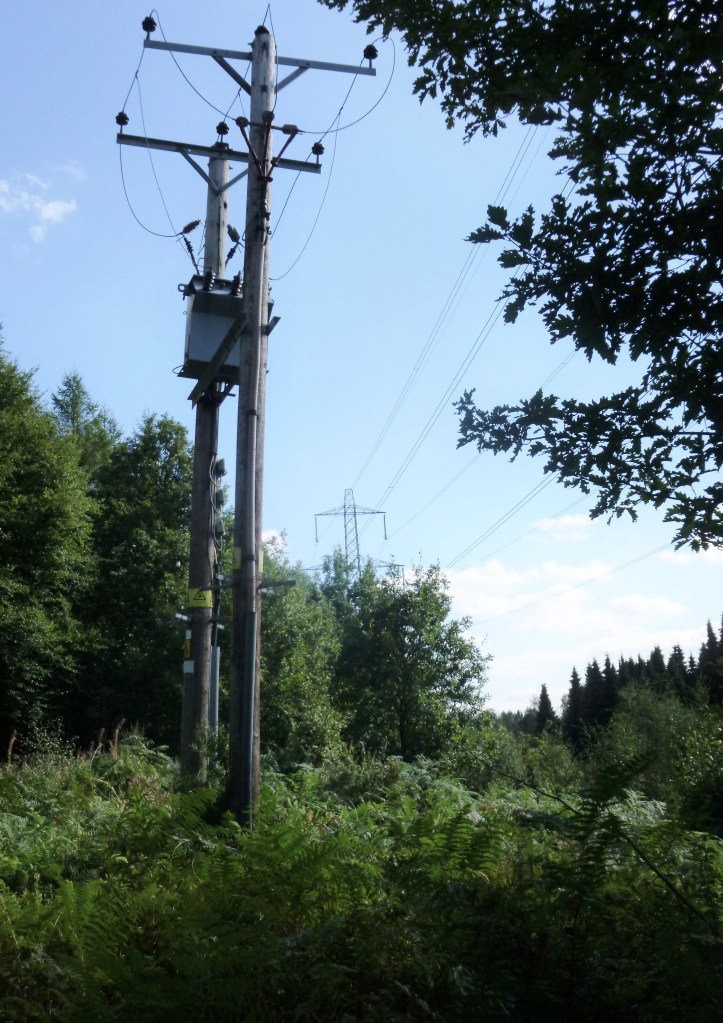
“Around Wharncliffe, the displaced huge rocks, the tall, dark pine trees, and the almost monster-like pylons, make for an unusual and eerie landscape. A feeling of ‘something’s not quite right’ fits with my [current] feeling for a need for erasure or [momentary] disappearance”.
8 September 2014
“Realise with dismay that today is the day when Peak Hour rail prices are extended [by Northern Rail, meaning that I have to pay them if I travel after work now. Due to this, which just feels extortionate, and the increasing presence of ‘rail guards’ stopping you and asking to see your tickets (sometimes almost frog-marching people who just haven’t been able to get a ticket yet to the ticket desk), it is beginning to feel like this private company is harassing people already struggling to make ends meet, and seeing their earnings diminished. Yet I feel like I have to keep my mouth shut, because someone could always remind me that I haven’t attended a protest against it all yet (even though I haven’t had the chance yet)”.
9 September 2014
“Walk right, off The Moor high street. Barely anyone around already (at 6pm). A black male stumbles [just] in front of me, leaving a trail of smoke from something he’s smoking. He isn’t wearing any shoes, and at times looks as though he’s about to fall to the ground, but then seems to walk OK again. He looks like he’s broken down in life. Across from him a white male [sat in a doorway] who looks homeless clutches a can of strong beer. “It looks like America” is what I think to myself; a social space and people within it laid to waste by the cruel level of inequality we usually now – thanks to less rose-tinted US dramas – associate with the United States”.
16 September 2014
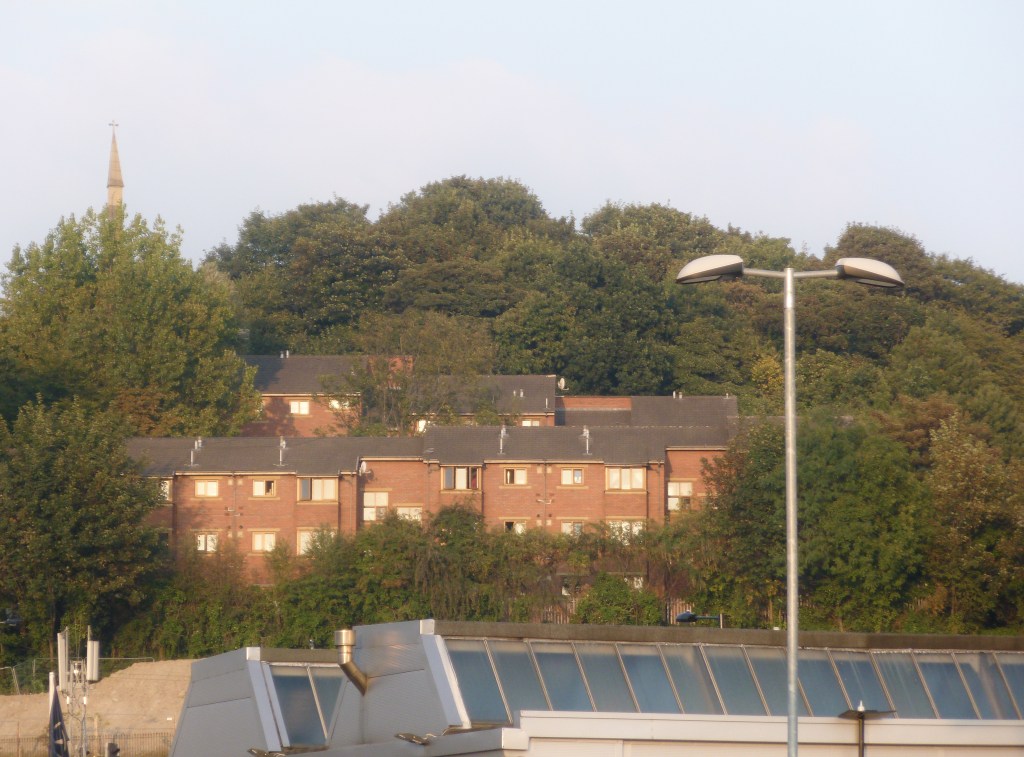
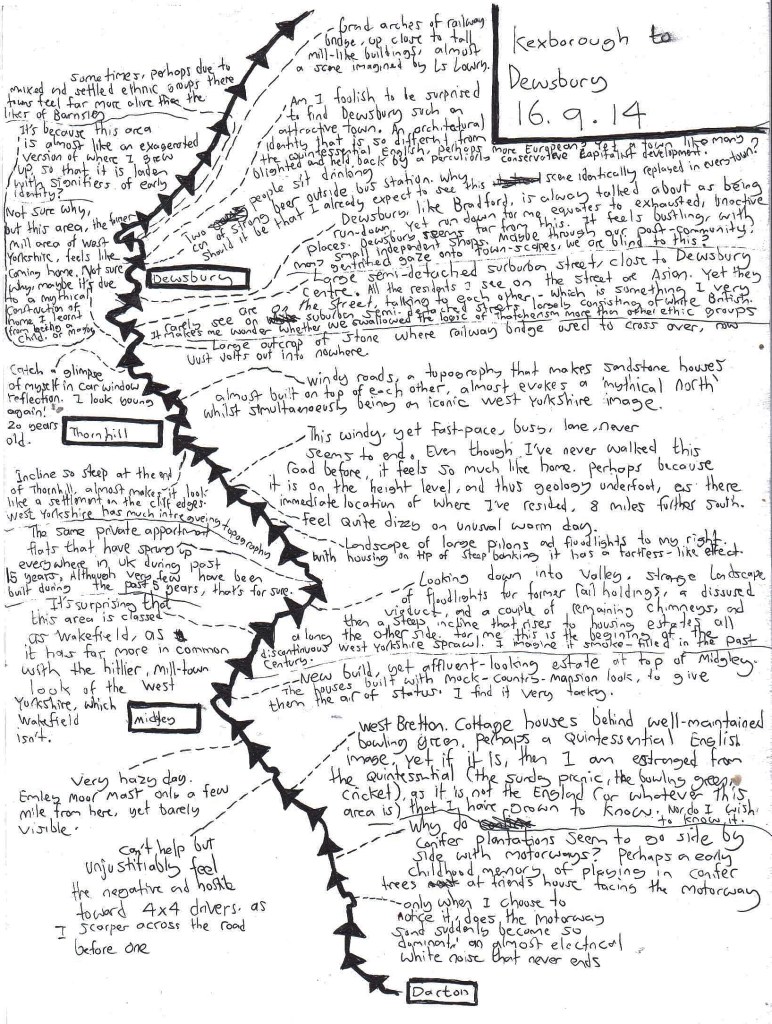
“Not sure why, but this area, the [hilly] former mill area of West Yorkshire, feels like coming home. Maybe it’s due to a mythical construction of home [as in ‘the north’] I learned from being a child. Or maybe it is because this area is [topographically, and settlement-wise] almost like an exaggerated version of where I grew up, so that it [this area] is laden with signifiers of early identity-forming?”
16 September 2014
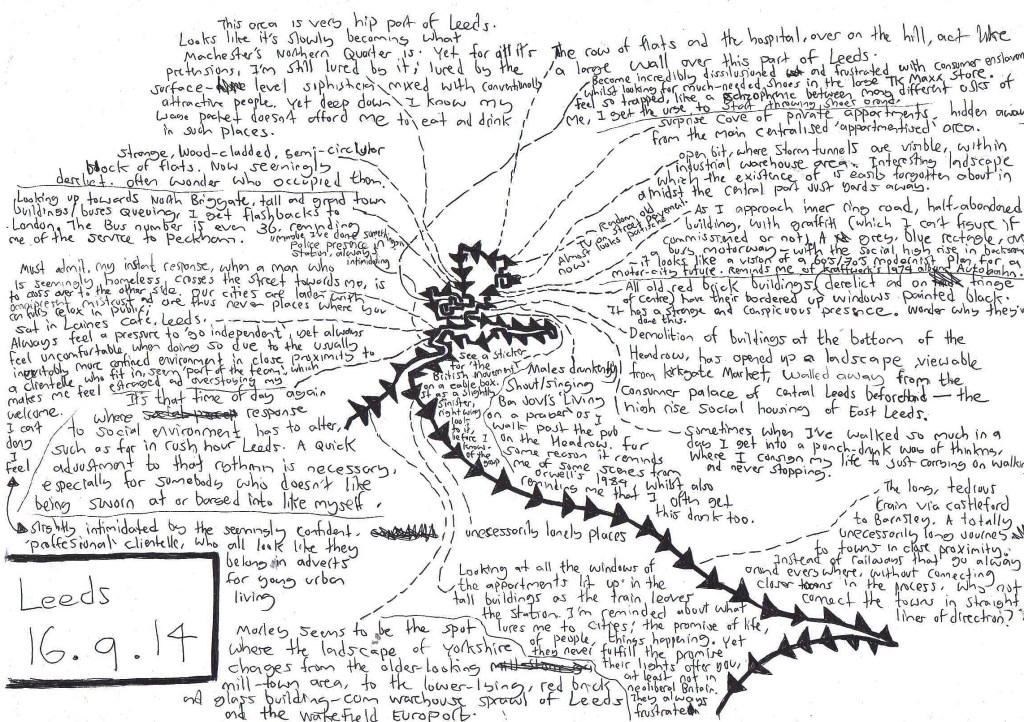
“Looking at all the windows of the apartments lit up in the tall buildings, as the train leaves the station. I’m reminded about what lures me to cities; the promise of life, of people, of things happening. Yet they [cities] never fulfil the promise the lights seem to offer, at least not in neoliberal Britain. They always frustrate”.
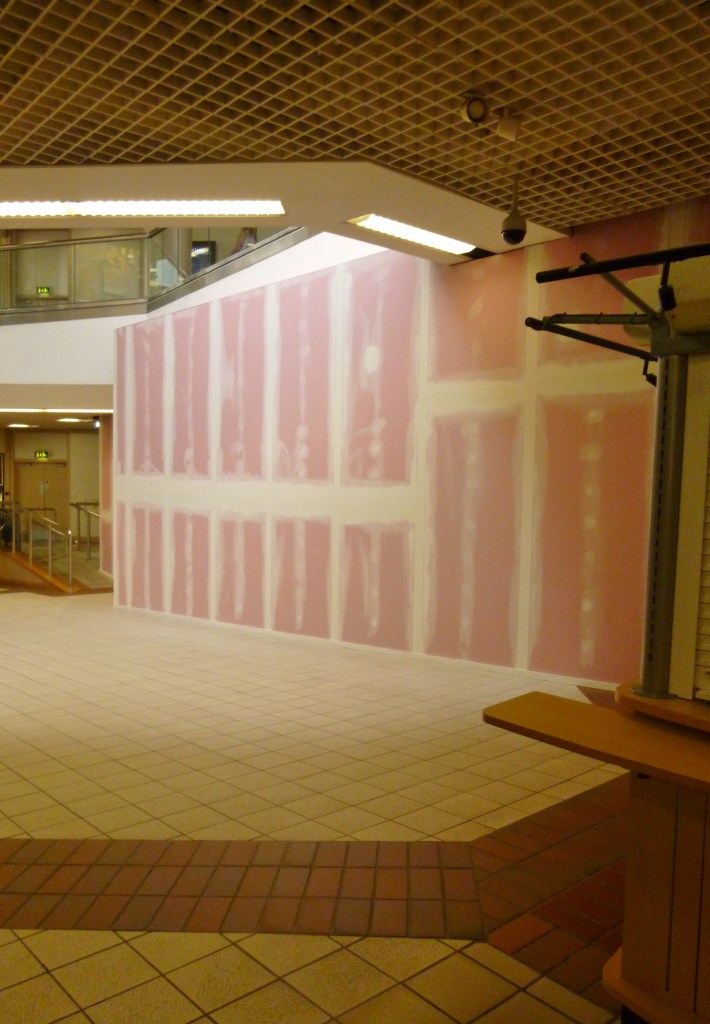
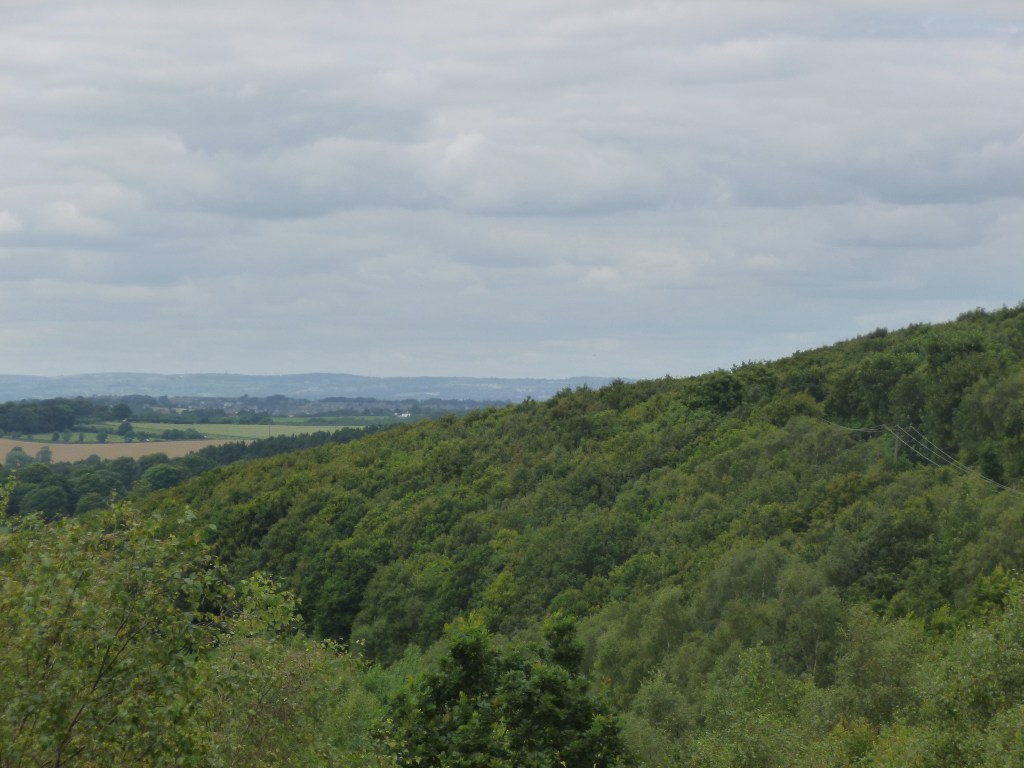
I’ve begun including a few photographs within my (what I still reluctantly call -as I’ve not found a better word for them yet) psychogeographical maps.
13th May 2012
“Street Art-clad entrance into Victorian storm tunnels, before they descend under central Leeds. Perhaps the element of urban decay is what prompts us to talk about the rise of capital flight from urban areas in the future, alongside the rise of ‘disaster capitalism.”
24 June 2014
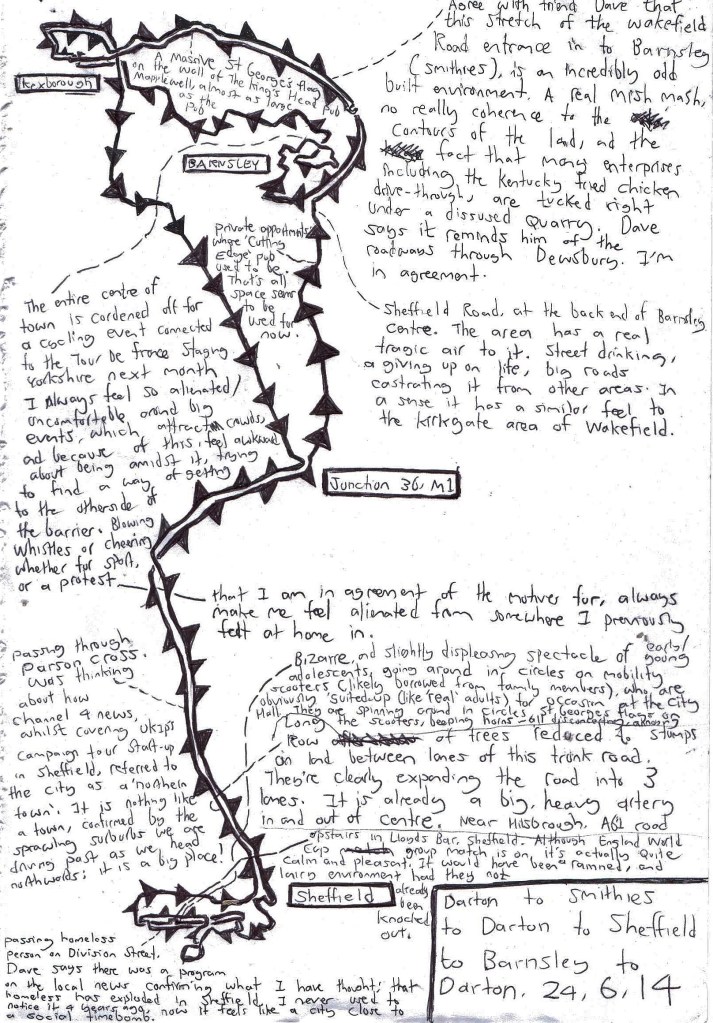
“Passing homeless person on Division Street. Dave says there was a program on TV recently confirming what I have thought: that [cases of] homelessness has exploded in Sheffield. I never used to notice it 4 years ago. Now it feels like a city close to a social time-bomb.
8 July 2014
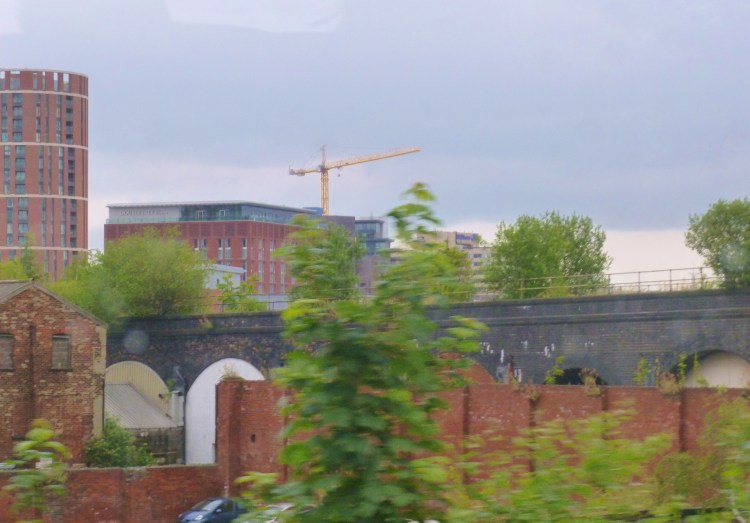
“Trees growing from disused railway line momentarily give me impression of a city abandoned by humans, and lush plant life taking over”
15 July 2014
“Aspirational poster of good-looking couple pillow-fighting next to private apartments. I always find this advert offensive, even as its believability fades as it gets bleached by the sun.”
5 August 2014
“Listening to the Louder Than Bombs compilation, The Smiths, in roads/landscapes akin to the ones I used to walk/cycle through whilst I was in my early adulthood. It reminds me of how, despite it being a difficult time, I still had hope for life/the future.”
11 August 2014
“Head to Baby Jupiter, a pub [I frequented] often in the early recession days. Near-past friendship groups. There’s a little glass jar on the bar; “help us from going bust”. This is the most ‘Retromania’ bar I can ever imagine. Yet, right now it feels like a comfort blanket, immune from time”
12 August 2014
“The long urban walk begins to [blend together] with my long urban walks in South East London. I think about how Manchester is portrayed as ‘Coronation Street’, but is experientially very akin to gritty South London.”
17 August 2014
“Two very tall policemen surround a poor-looking, possibly malnourished teenage male, outside [the train] station. Whatever he’s done, he now looks noticeably scared. A nearby person says “haven’t they got anything better to do than to pick on a boy?”
18 August 2014
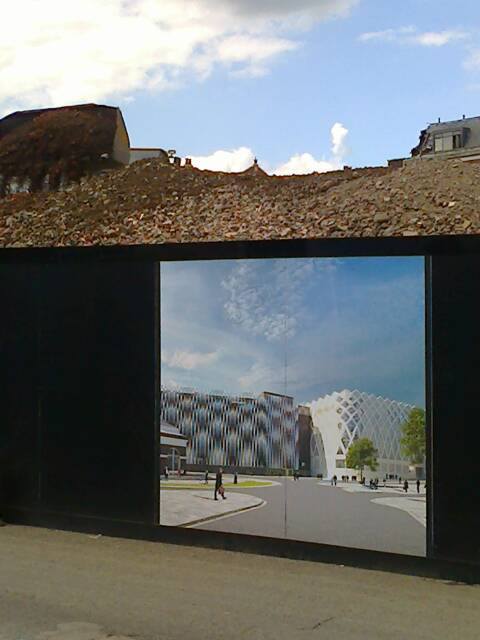
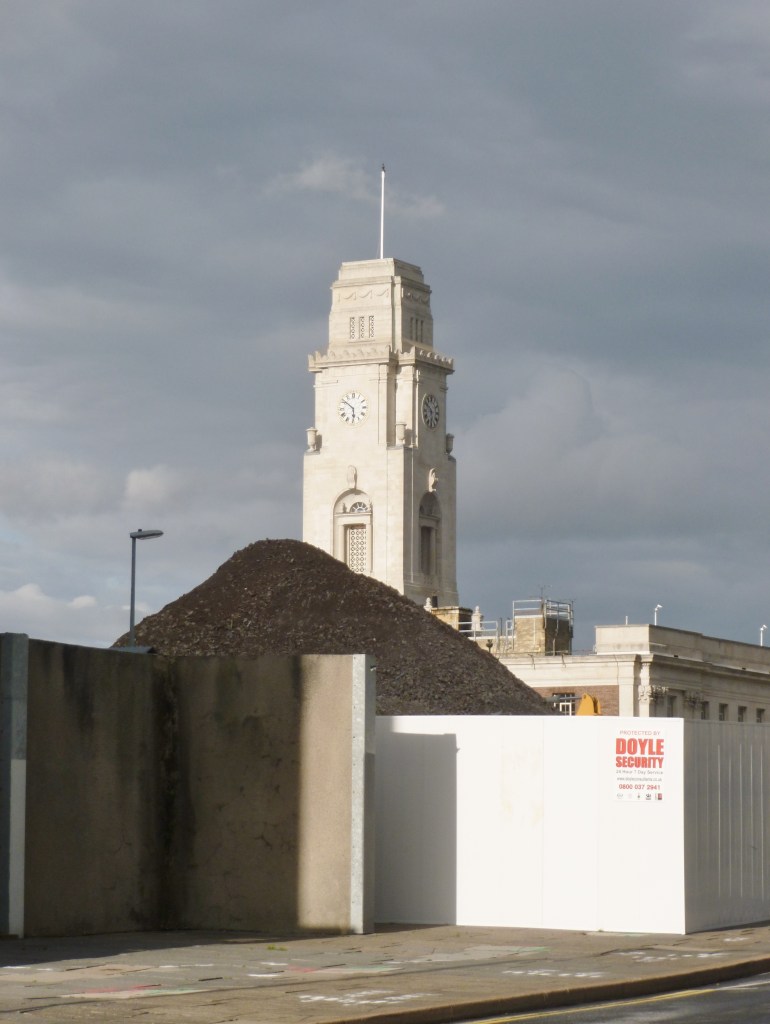
“Barnsley library now literally one big heap of rubble. What a waste. It almost looks like a dark monolithic construction. From here [viewed on Shambles street] it is placed right in front of the town hall – it almost looks like an attempt to rebuild Barnsley’s past landscape of spoil heaps.”
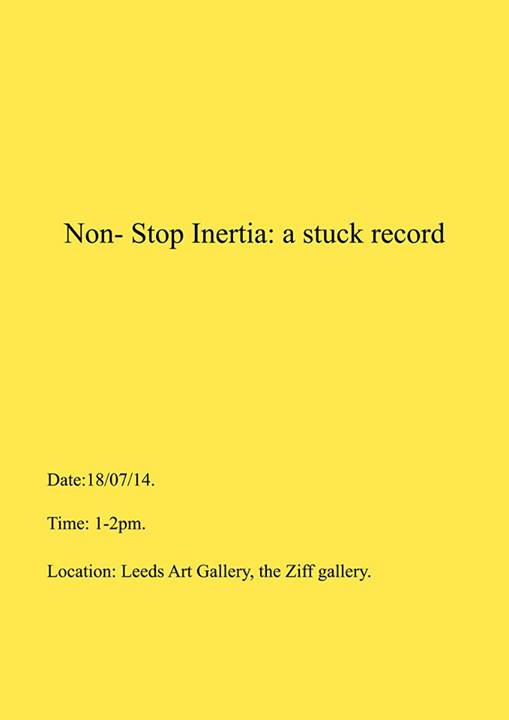
Artists intervention at Leeds Art Gallery this Friday (18th July) from 1-2pm. Artist John Wright and I will be performing a philosophical debate. Visitors are encouraged to interrupt.
Here’s a piece of writing I have made regarding my take on the performance Non-Stop Inertia: A Stuck Record:
Non-Stop Inertia is a performance piece named after an Ivor Southwood book of the same name. Southwood’s book takes an comphrensive look into the situation of the “deep paralysis of thought and action” caused by the “ideologically constructed” landscape of precarity. This affects mainly the younger generation of workers, but it is increasingly dragging even more people into a role that the economist Guy Standing calls that of the ‘Precariat‘, replacing the older term for the working class, the proletariat.
The little red Facebook notifications, the vibrating phone are more than analogous with violent rashes/itches that produce an inescapable mania over the body. No wonder, as J.D.Taylor shows in her essay ‘Spent: capitalism’s growing problem with anxiety’, that cases of compulsive/anxiety disorders have shown to have spiraled upwards since we entered an intensified stage of neoliberal ‘race to the bottom’ from 2009 onwards. The immensely informative book Alone Together by Psychologist Sherry Turkle, about the predicament and consequences of being “always on” in a world dominated by cyberspace technologies, misses a crucial causal factor in the becoming of this cold turkey-like dependency, and cyberspace’s mushrooming presence in our lives: that the social landscape which has been so ripe for it to flourish in is (at least, in part) ideologically constructed. What Standing and Southwood refer to as the ‘global precariat’ is the necessary 24/7/”always on” agent that makes cyberspace the teaming immaterial beehive that it is.
I [John Ledger] originally undertook this performance as part of an umbrella of artistic events under the name Pandemic, based in Sheffield in the autumn of 2011. Pandemic began just as anti-austerity direct action groups and Occupy movements were asking questions, and demanding accountability in Sheffield around the world. Its aim was to create other spaces for interpreting and expressing a desire for the possibility of ‘another world’, that supported but also provided an alternative to the more direct aforementioned methods. Since then the speed, quantity of information on cyberspace, and our dependency on it, seems to have sped up so much, in just 3 years, alongside the feelings of unpredictability in our lives, that spaces for such contemplation feel ever-more compromised. This makes Non-Stop Inertia, and our performance concept, increasingly relevant.
The performance attempts to mirror this ‘paralysis’, to illustrate just how the ability to understand the social reality we are amidst is continuously broken up. With this performance being in a gallery institution, the predicament of the gallery worker (out of all service industry workers) seemed most appropriate. Compared to many service industry jobs, it is surely a far more pleasant working environment. Yet, because a gallery is an environment that has evolved over time to be a space for contemplation and an absorbing of different ideas, the gallery worker (who remains there all day) is psychologically ambushed by contemplation, (over)thinking. Yet the job requires a standard spiel to be given out to every visitor who enters the gallery. The environmentally-enforced contemplation is continuously interrupted and sent back to square one. Indeed, visitors subjected to more than one of spiels given out often say “you sound like a stuck record“. For such a relaxing environment, one’s head can often feel like a crushed tin can by the end of the day. Due to this I felt this predicament in itself was almost an analogy for the wider state of Non-Stop Inertia.
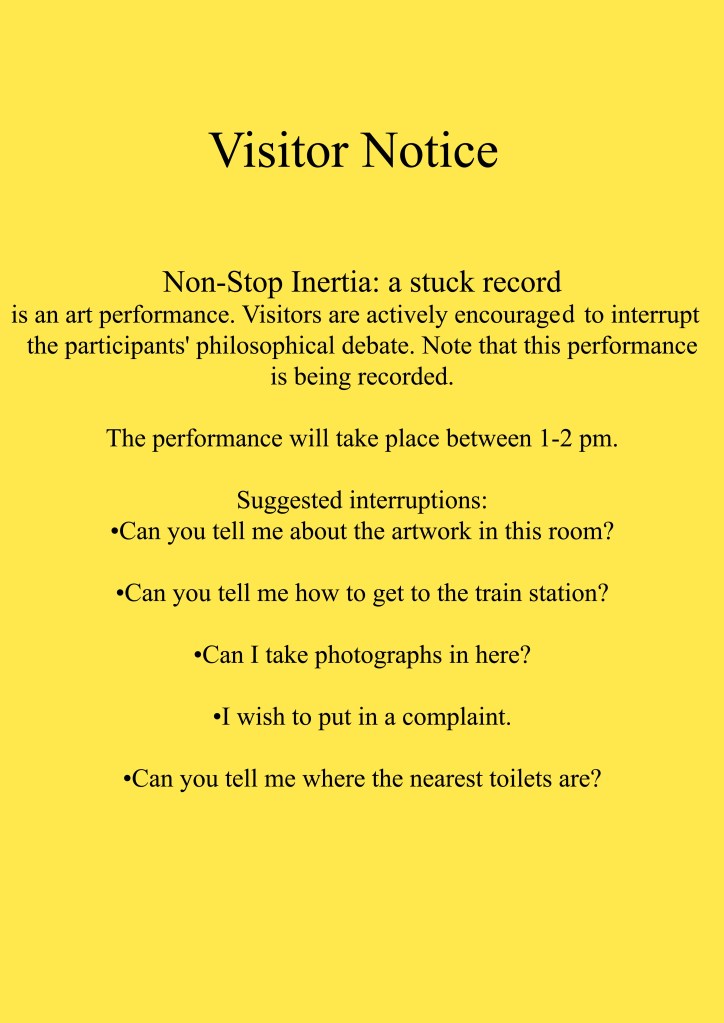
Below is the sign showing suggested interruptions for visitors to make on Friday:
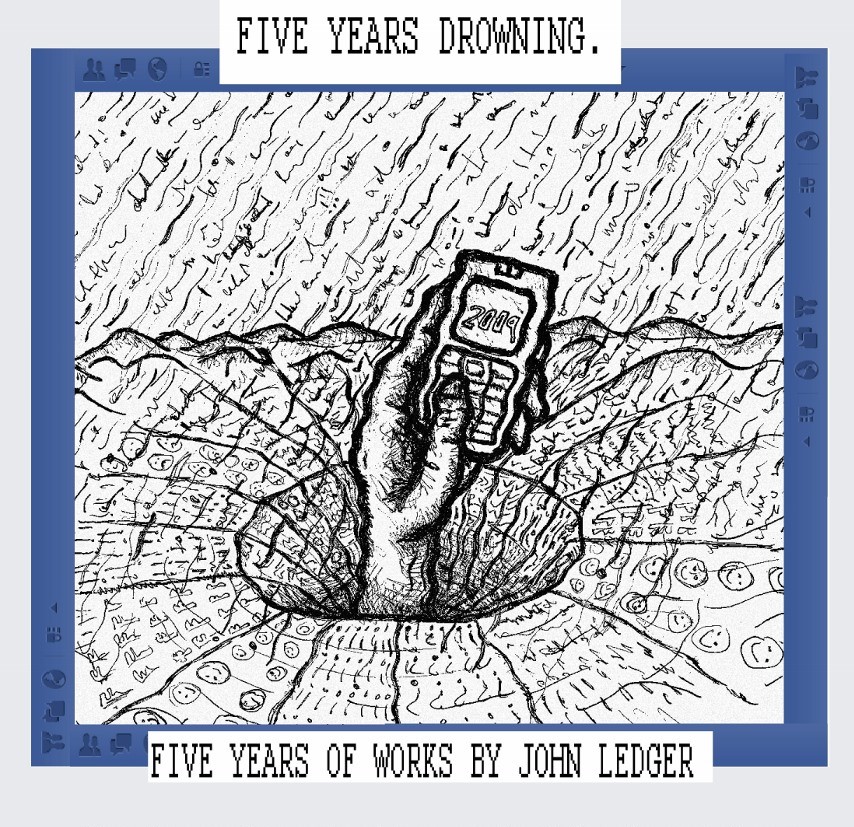
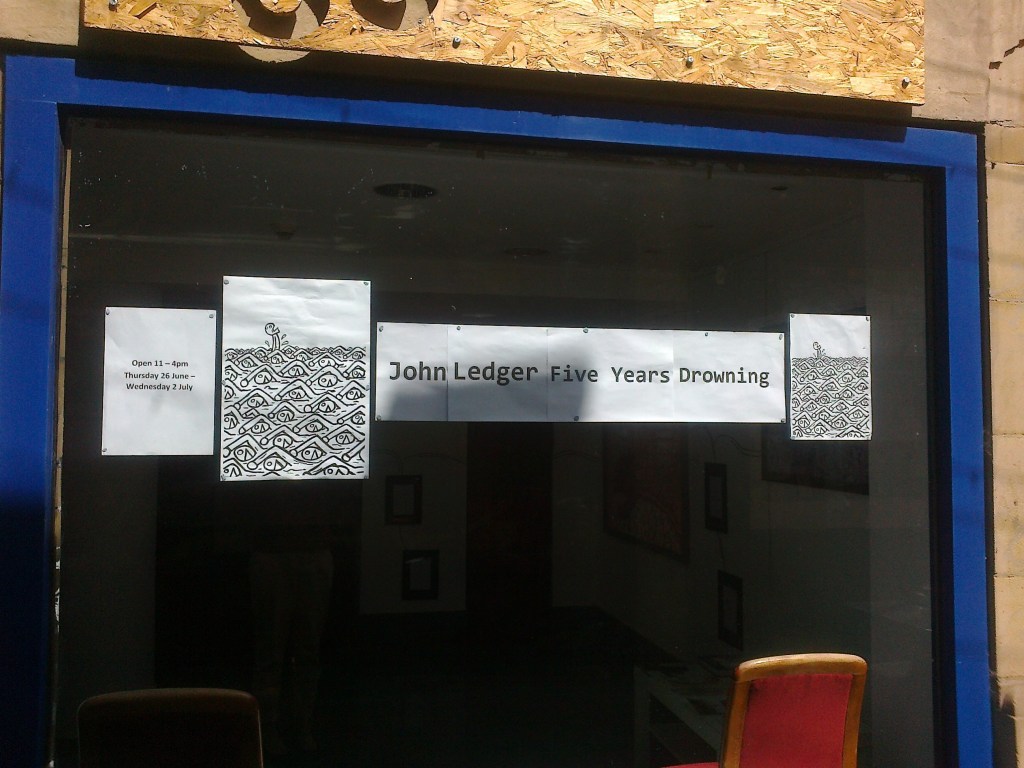
…Attempting a cognitive mapping of chaos…speeding of information causing its very disintegration…a proliferation of incomprehension…a deluge of auto-suggestions against the panic attacks of rare clear perception…being brayed between mumbo-jumbo-unreality and the biggest ever threats to humanity…underneath it all an cracking of skin and an aging of bones #CanIHaveSomeTimeAlone? Five Years Drowning.
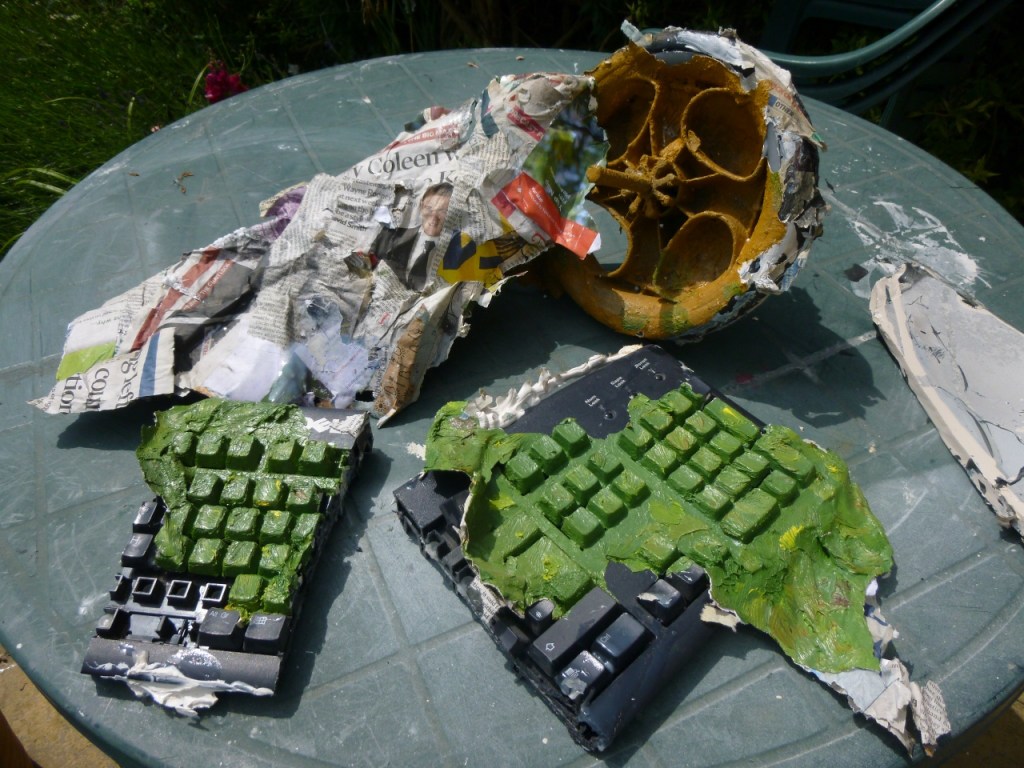
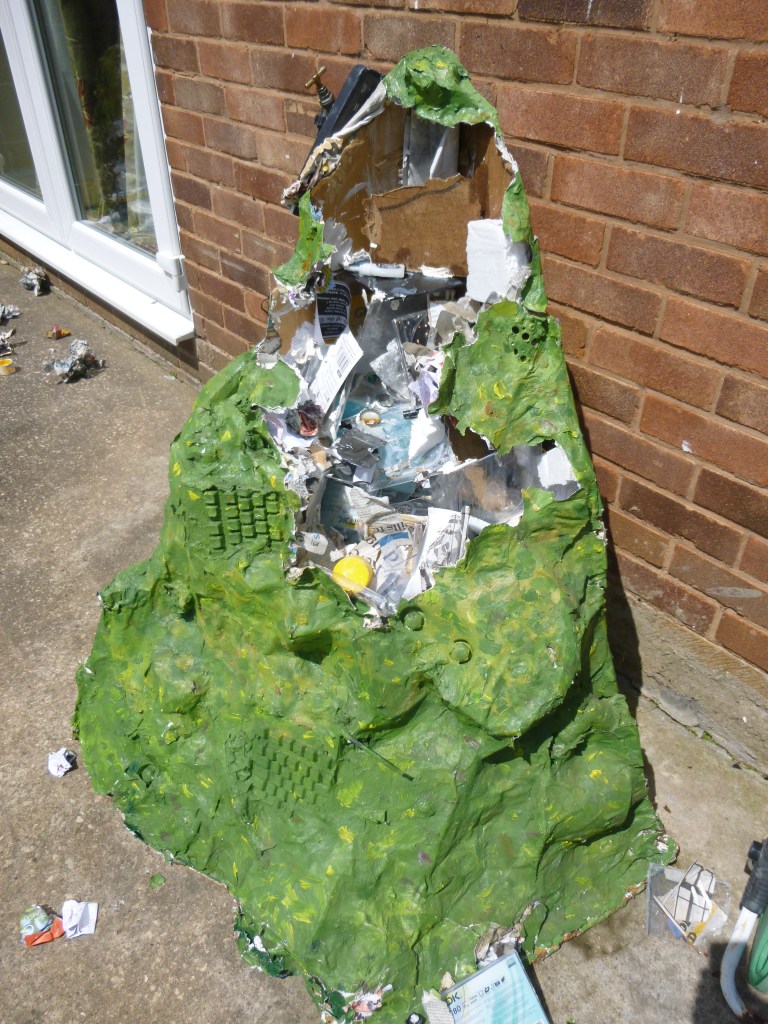
The Sad but necessary demolition of some older pieces of work.
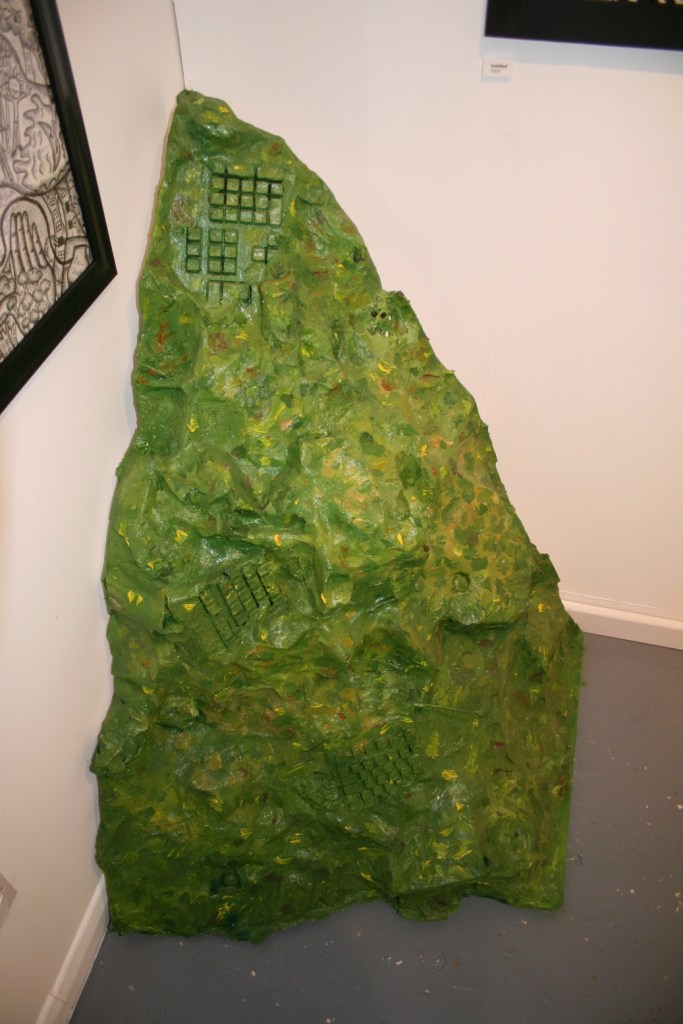
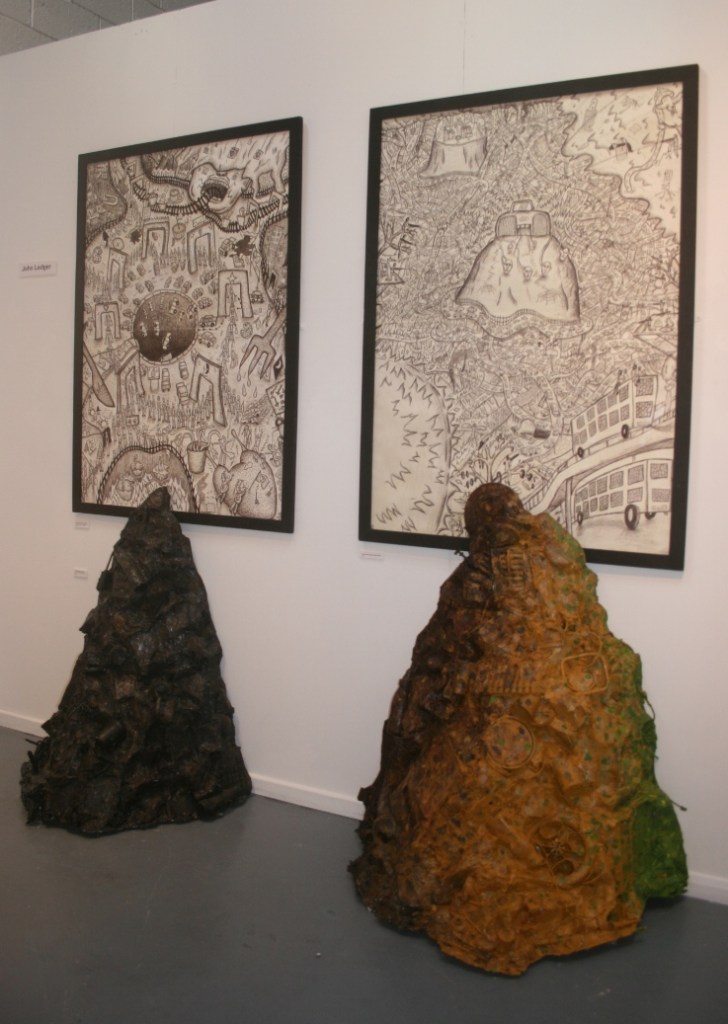
Although I wouldn’t really call these pieces of work sculpture – they were more accompaniments to my drawings, mounds rising up to slightly obscure the pieces I was showcasing/like a weight on a stressed chest that won’t go away (guilt of being part of/wedded into the trappings of a destructively consumptive society) – they certainly shared the demand for storage space that sculpture demands. Unfortunately for most of us, such space just isn’t available (I genuinely believe the main difference between sculptors and painters/drawing-based artists, is that access to ample of space to expand into to is a necessity before you even begin to contemplate being a sculptor).
These pieces of work were made in 2008, and became crammed into a shed with other works. The began to get damaged, but they were beginning to damage other, less damaged works. So, to save those works, I decided that these works would have to be demolished. They were originally part of an installation called‘The Healing Process’ which I exhibited in the fall of 2008 (healing, as a coming to terms with things, a gradual greening over of scars on the landscape I grew up in, reflecting a hope for a gradual healing over of psychological scars I’d carried with me for some years). Yet I made them from waste and fly-tipped material (largely non-recyclable, except for the newspaper used for Papier-Mache) in the summer of 2008, before it became aware to everybody that we were amidst a huge financial crisis.
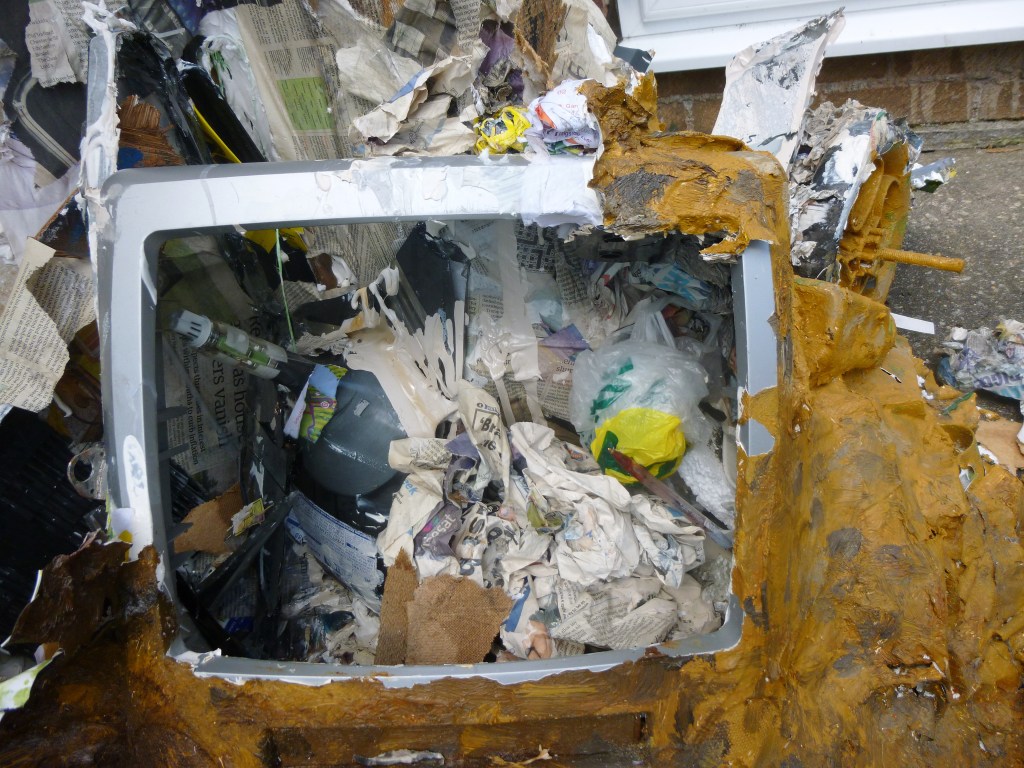
Largely because I am overly concerned with the notion that time as become (even further) out of joint since then I was quite keen to document all that stuff that hasn’t seen light of day since summer 2008. The pre 2008-crash point feels like another epoch whilst it still only seems like yesterday, amidst the austerity-age logic, and superstitiously-embedded faith that things will ‘return to normal’, our experience of time is spinning on a stuck broken record. This meant that it felt weirdly like uncovering relics to a world only 5 minutes past.
Demolishing them, kind of also felt like knocking down old buildings with the interior of somewhere once lived-in in full sight. Truth be told, the items, even the shards of newspaper stories bear no real difference to what they would look like now, it isn’t as if the world of seeming permanent austerity looks that different – yet something is different, and opening up these soon to be destroyed pieces of work made me think of this difference.
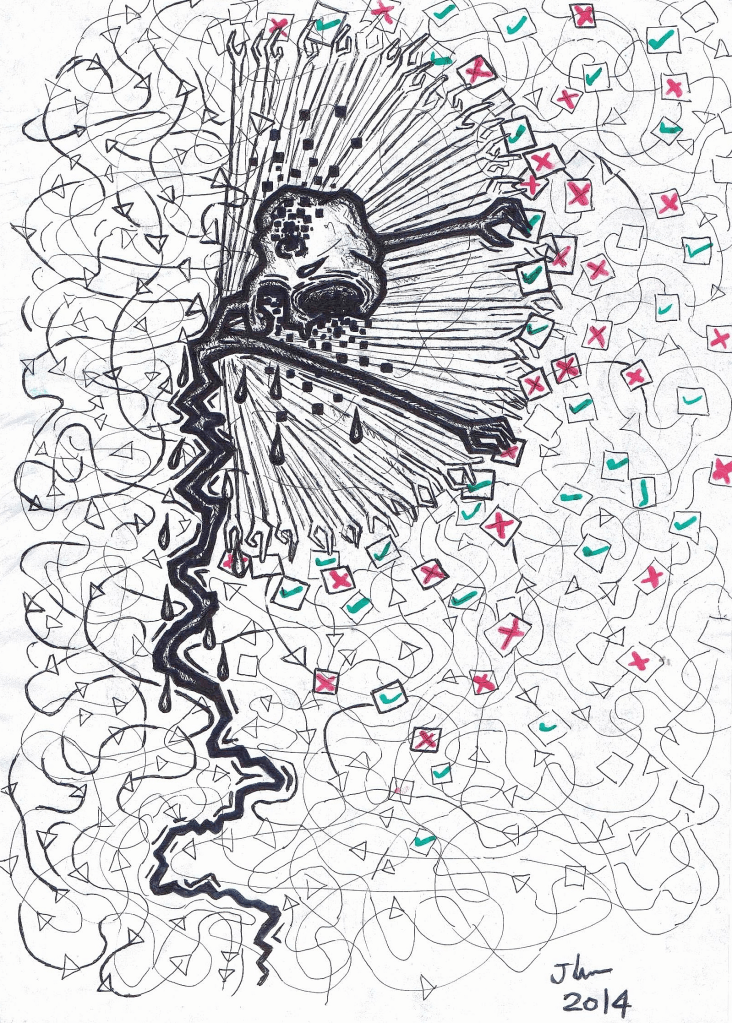
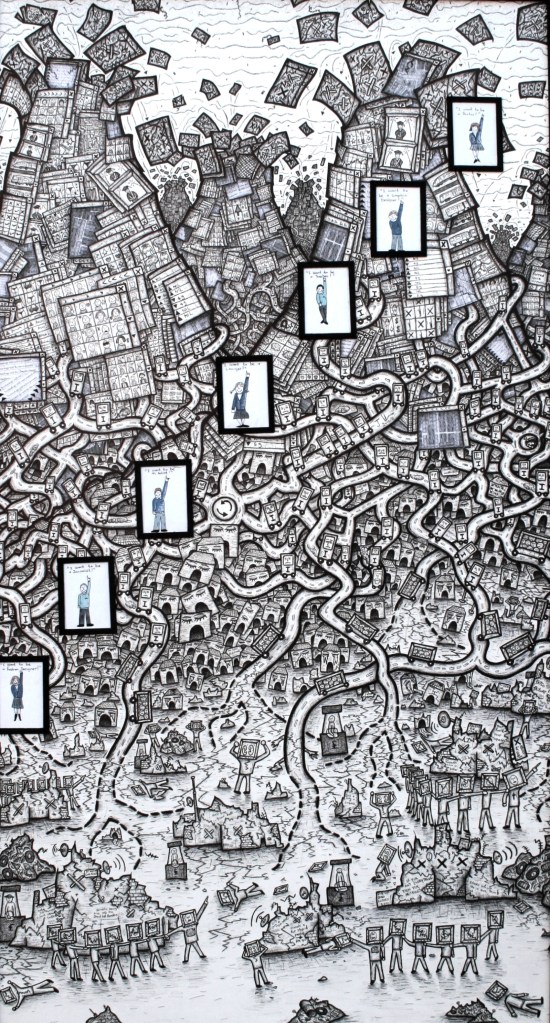
I’ve donated a large print of my drawing ‘I Want None of This’ to ‘Going Once, Going Twice, Gone!’, a fundraising event in aid of the Save Devonshire Street Campaign.
When Sheffield Council approved demolition of 162-170 Devonshire Street, home to three of our most prized independent businesses, it didn’t follow the proper planning processes. We’re raising funds for a judicial review which would overturn the planning decision – http://savedevstreet.org.uk/
There will be a selection of artworks from a large number of artists who wish to help the cause. The works can be bid on in aide of fundraising for the campaign. The event will be held at Moor Theatre Delicatessen, The Moor, Sheffield. Friday 26th June. 7pm. Eventbrite tickets are available here https://www.facebook.com/events/388205214700948/












 John B Ledger