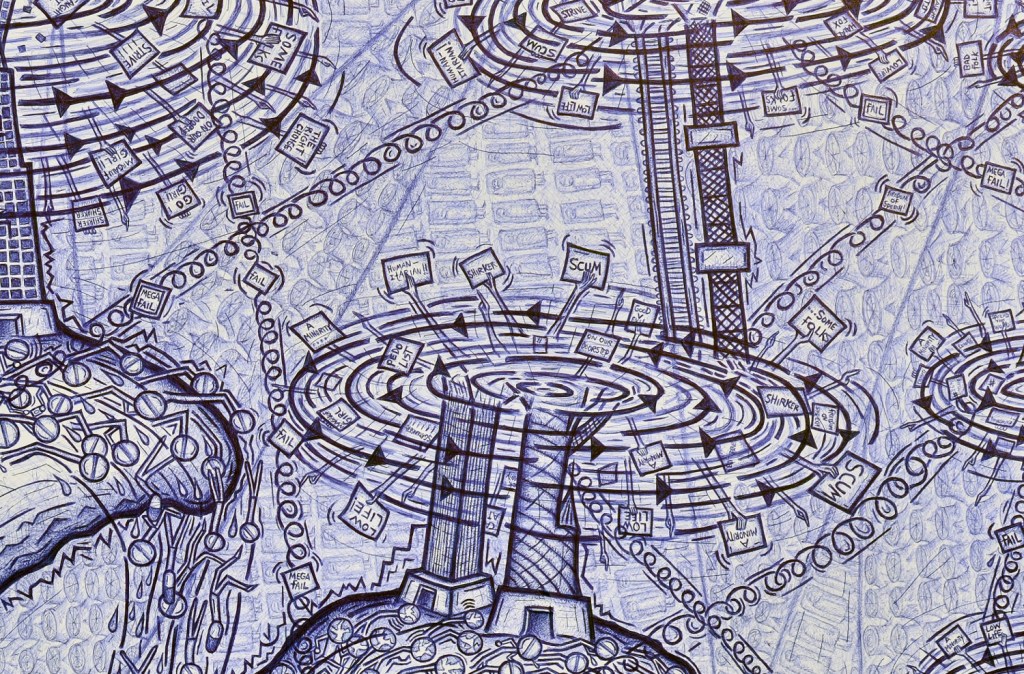
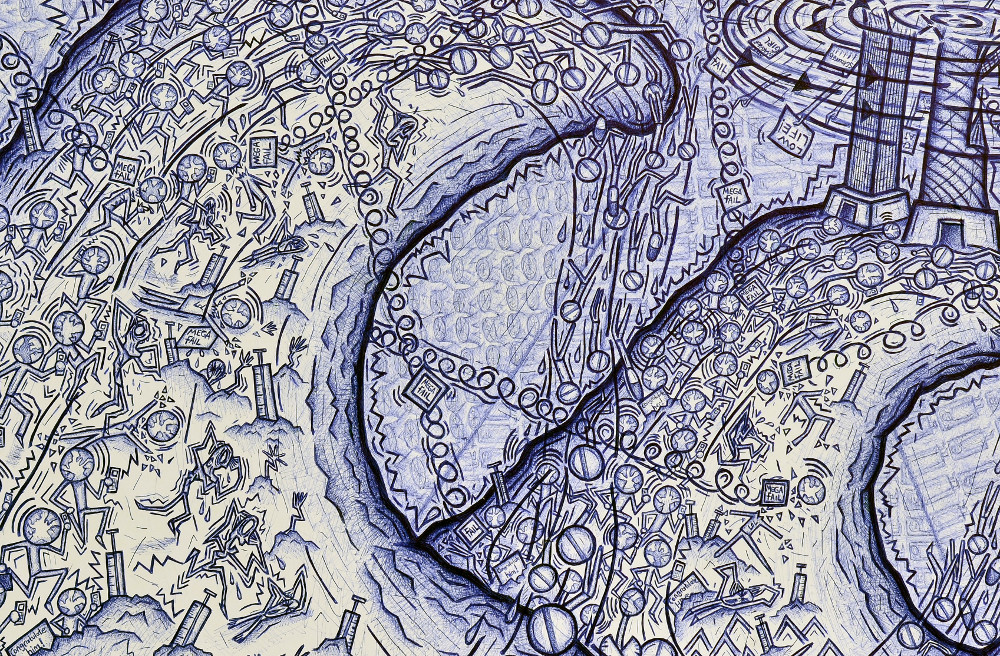
2014 mapmaking (part 9) – End of Year Haunting

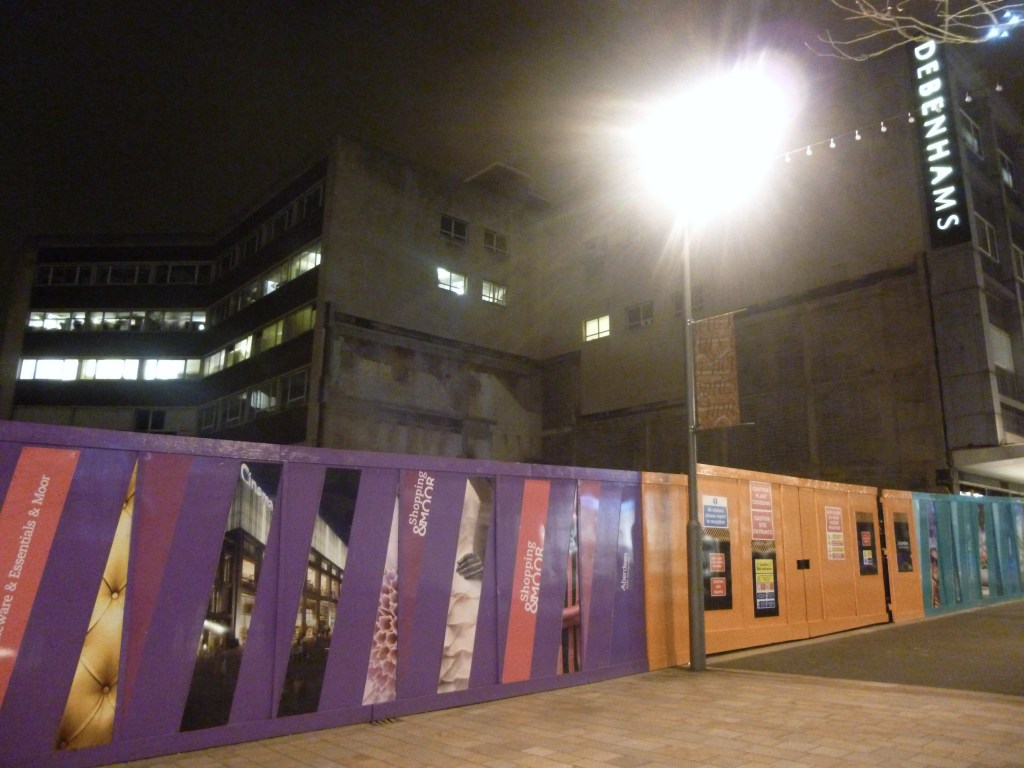
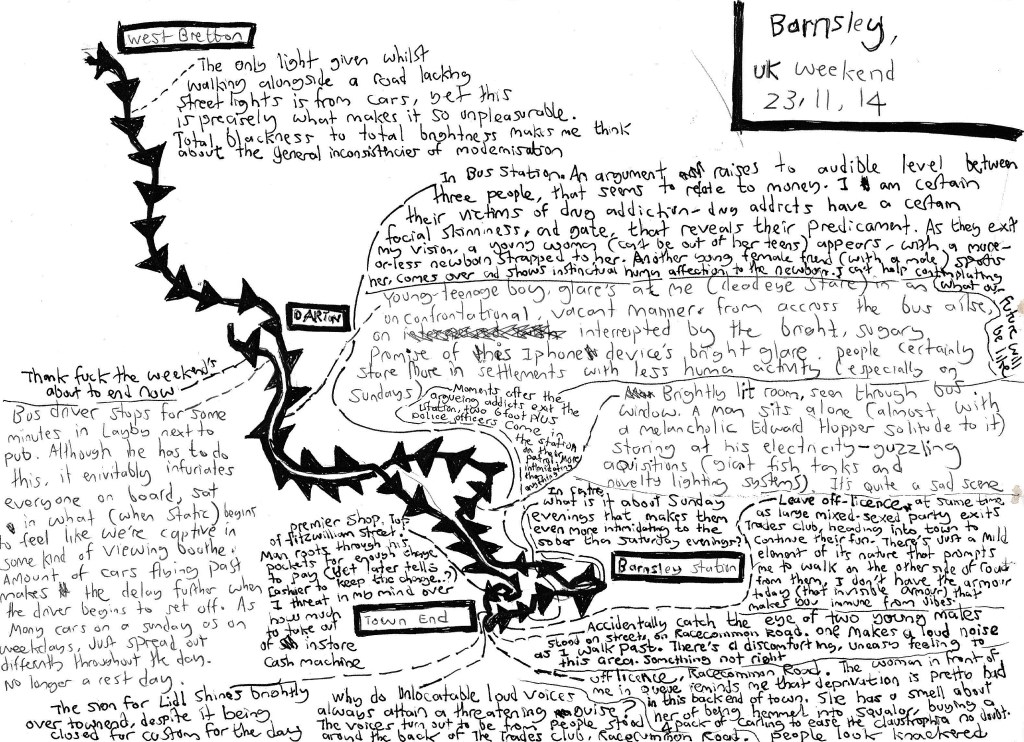
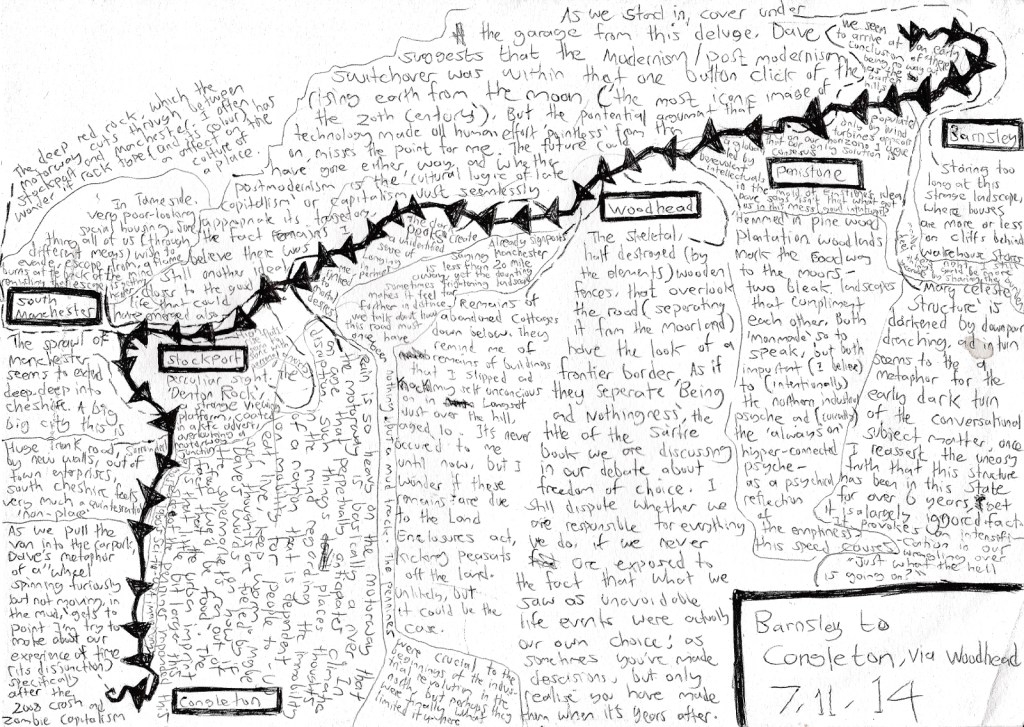
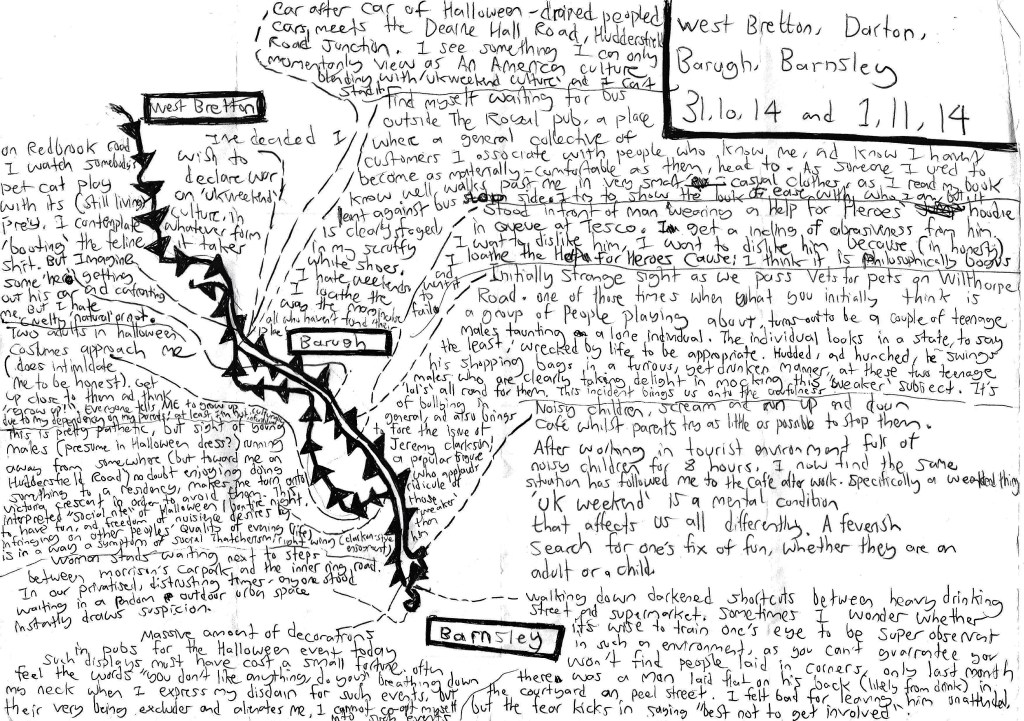
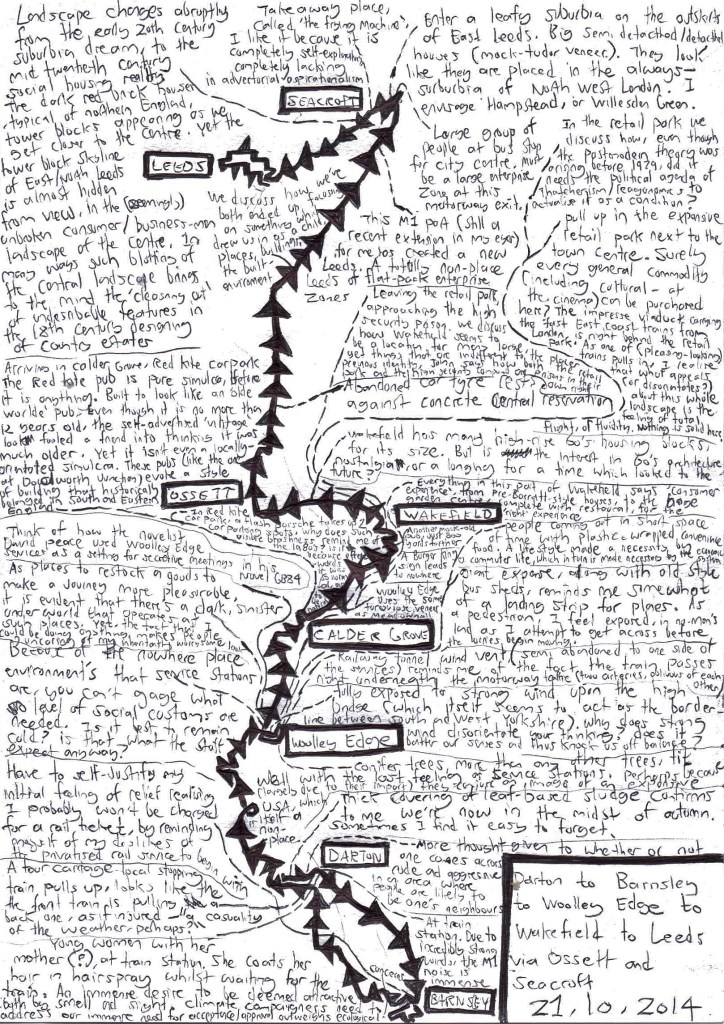
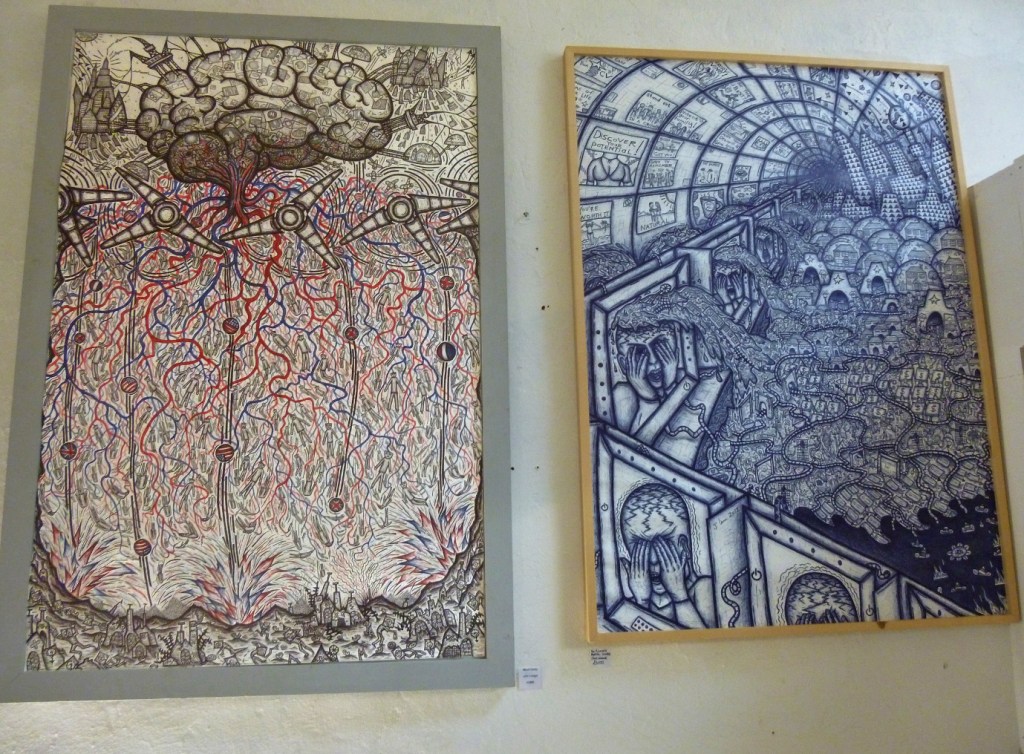
This is the 9th and the final post of 2014 in a series that I still call psychogeographical maps (or cognitive mapping). Quoting certain sections and using a selection of photographs to widen the project, which at its core still has the intention to be a Cognitive Mapping of Now – aiming to be useful for locating the wider socio-political mood, and the psychological impacts of it. This project has been ongoing since 2013 and has largely been an artistic response to Frederic Jameson’s 1990 essay, and call to action, Cognitive Mapping, which is posited as a means of class consciousness in our contemporary social landscape. Arguing that the “mental map of a city [I’d say the wider human-made landscape] can be extrapolated to that of the social and global totality [one that we] we carry around in our heads in various garbled forms”. Also, due to often residing in places deemed culturally ‘insignificant’ I feel that my work is justified by the words of social Geographer Doreen Massey in that  “…spatially, the local place is utterly implicated in the production of the global and the globalisation that we so often find ourselves wanting to confront”. Although some of these maps aren’t made in places I live in, whilst traveling through them I am implicated and involved in that locality and the myriad of circumstances and incidents that constitute it.

The project has also allowed me to bring my love of maps into my art.

16 December 2014

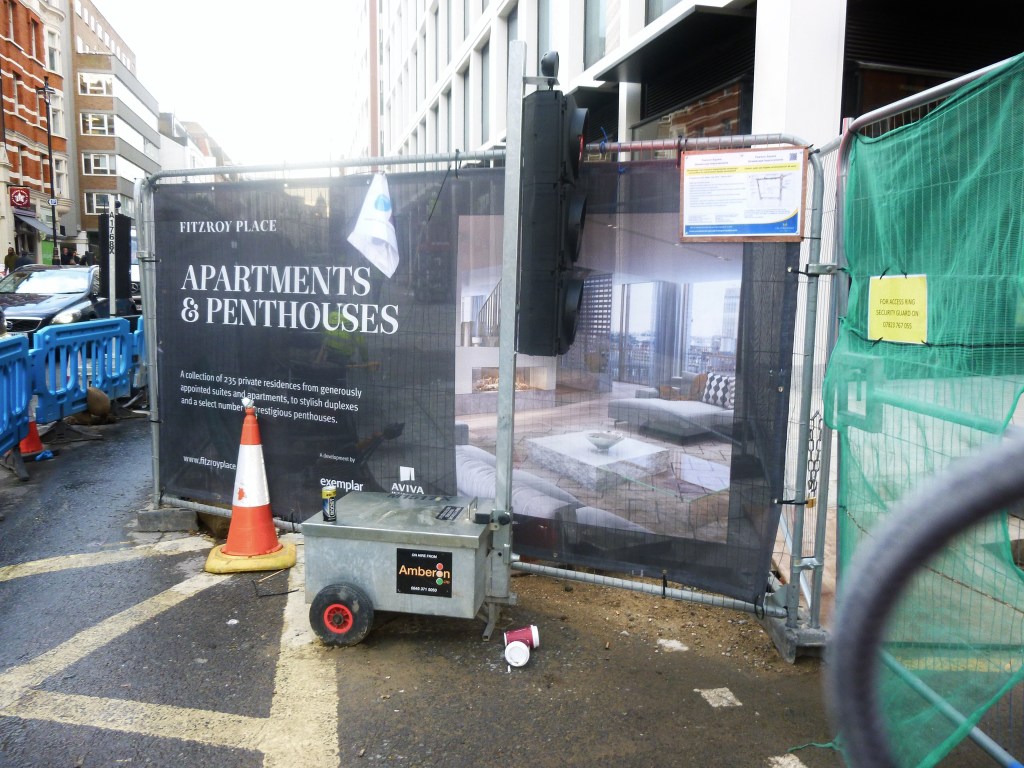
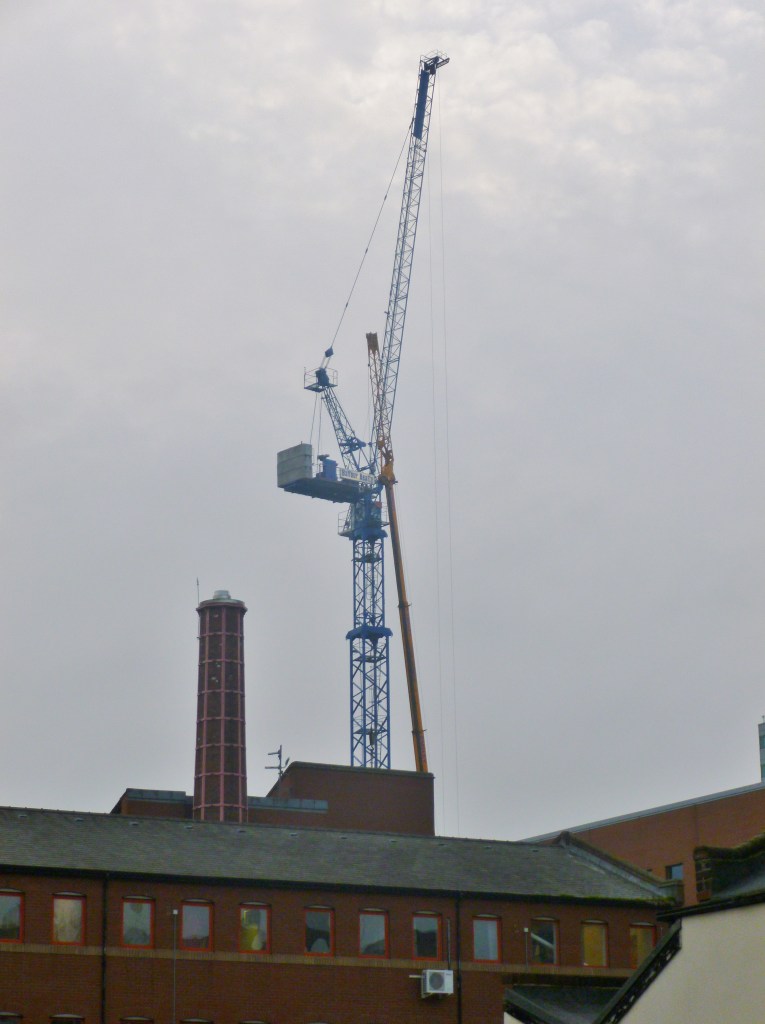
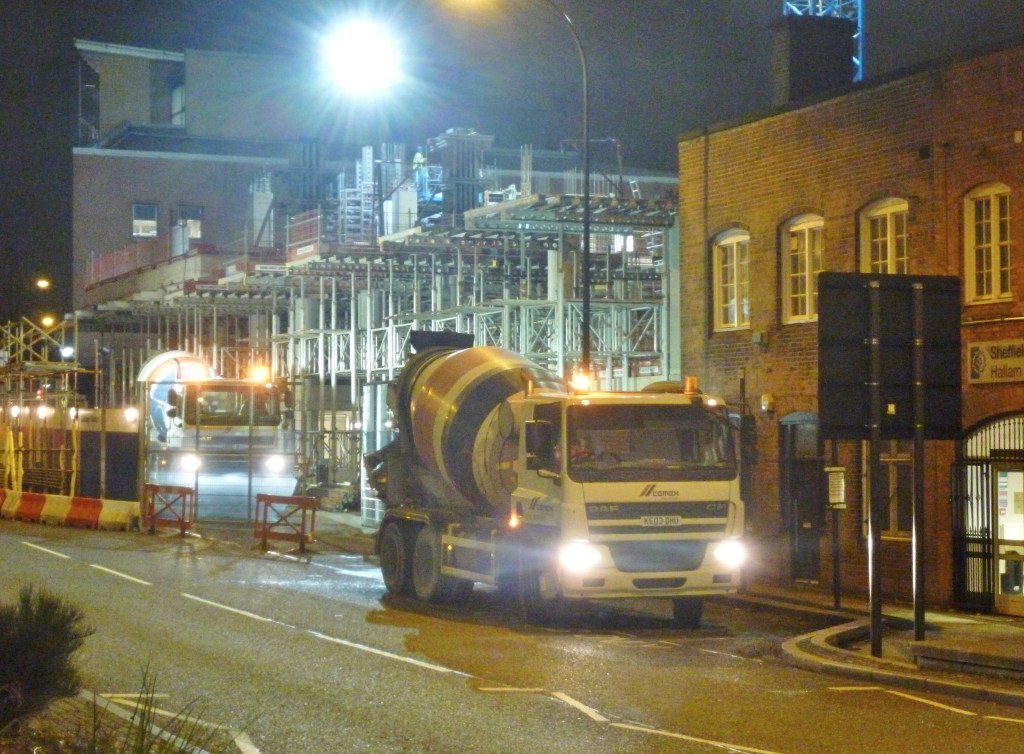
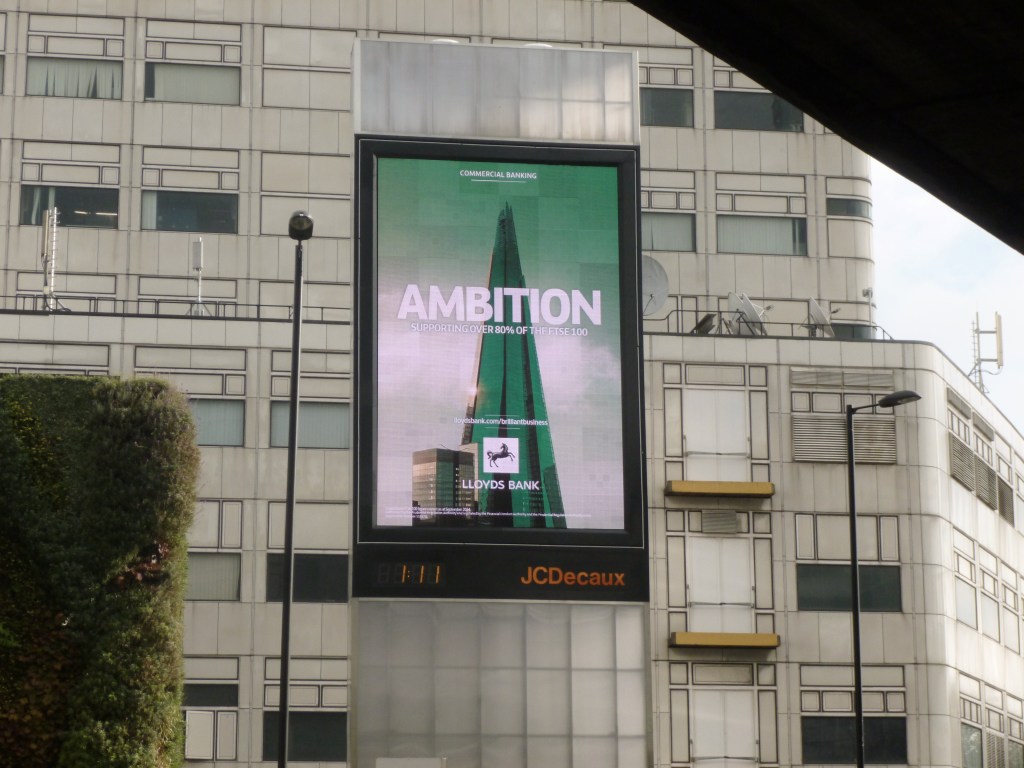
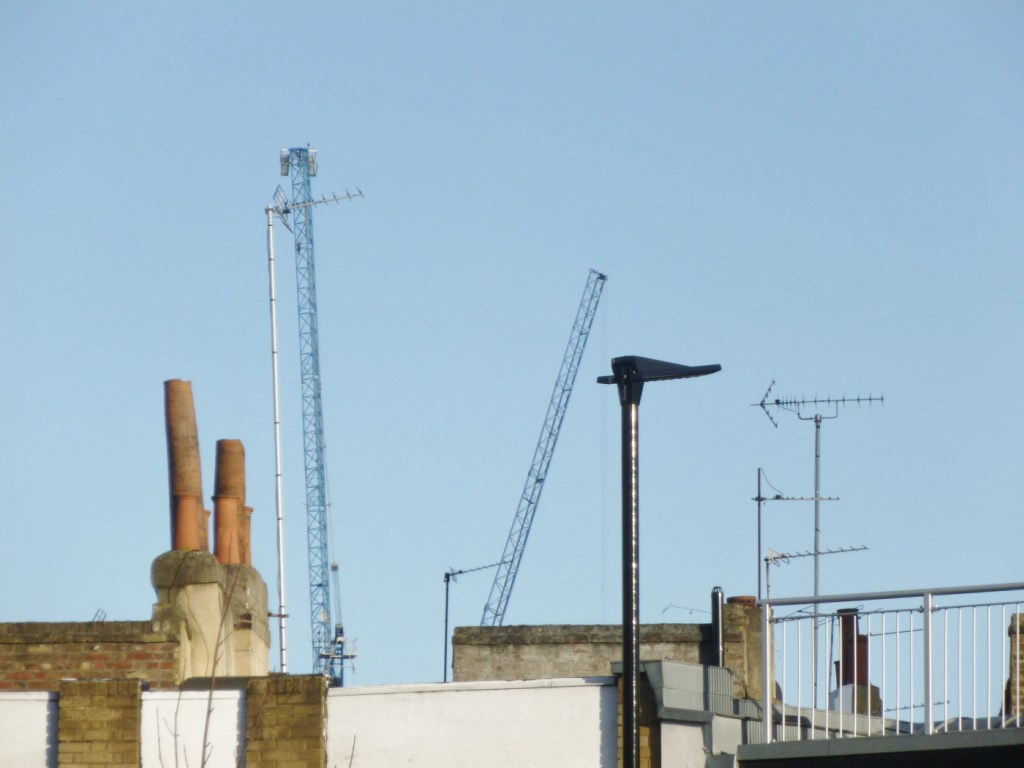
“Always surprises me when I suddenly come across steep inclines in London. Like rivers (excluding the Thames), they are features that just don’t seem ‘natural’ in London as it stands. The place is such a concrete+metallic machine in its own right, that you don’t expect rivers and hills to start forming until you’re beyond the M25.”

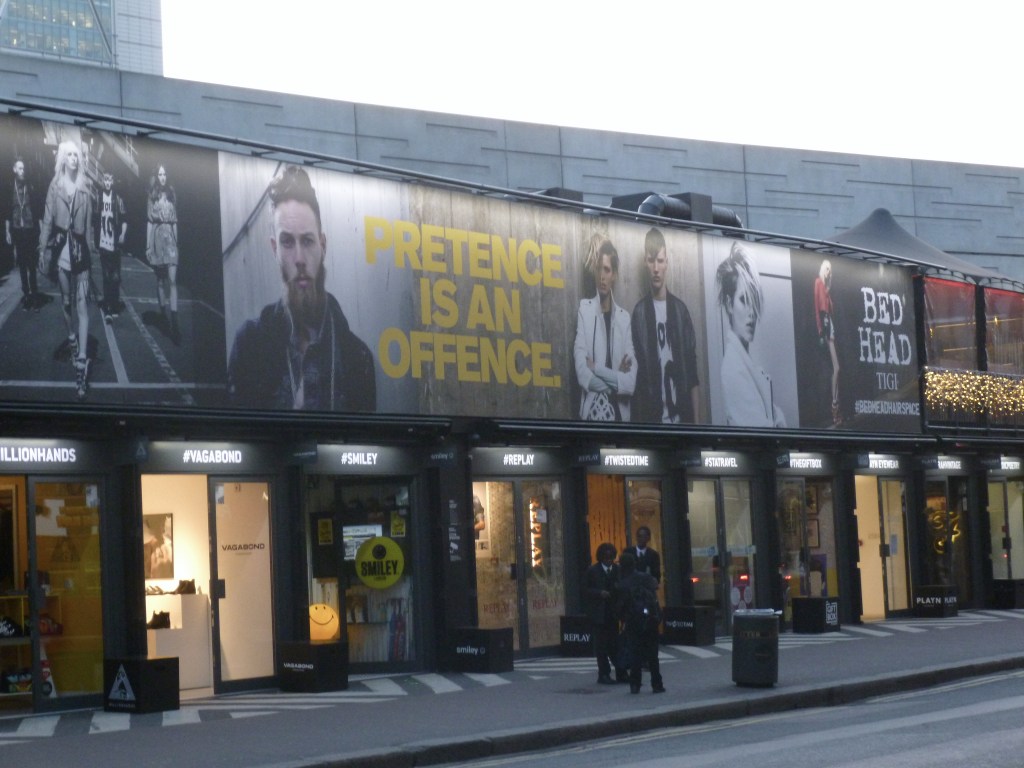
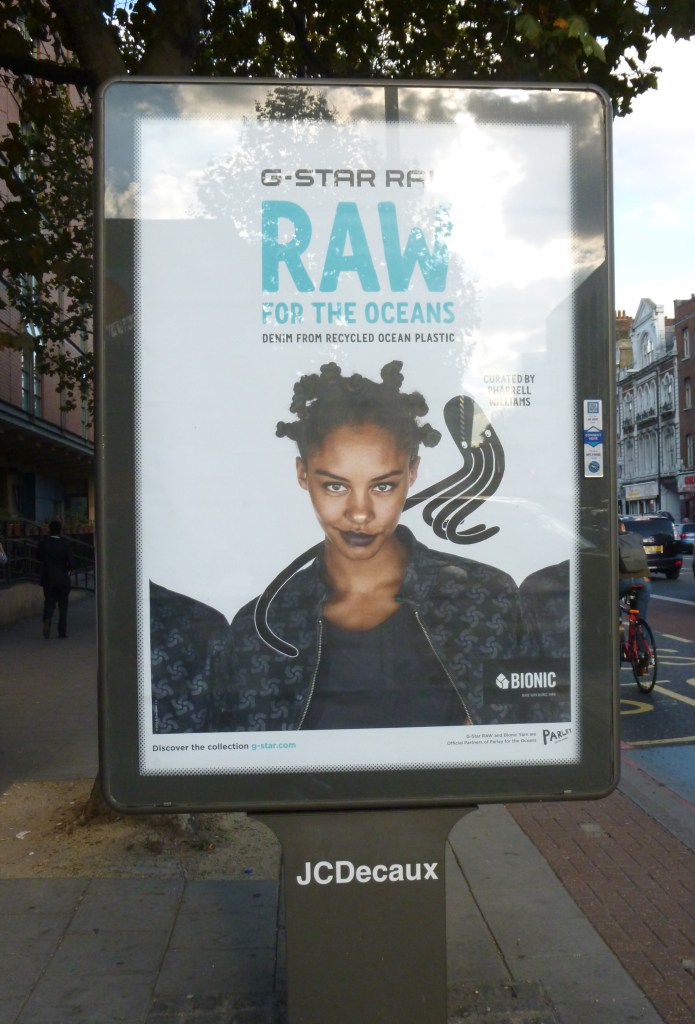
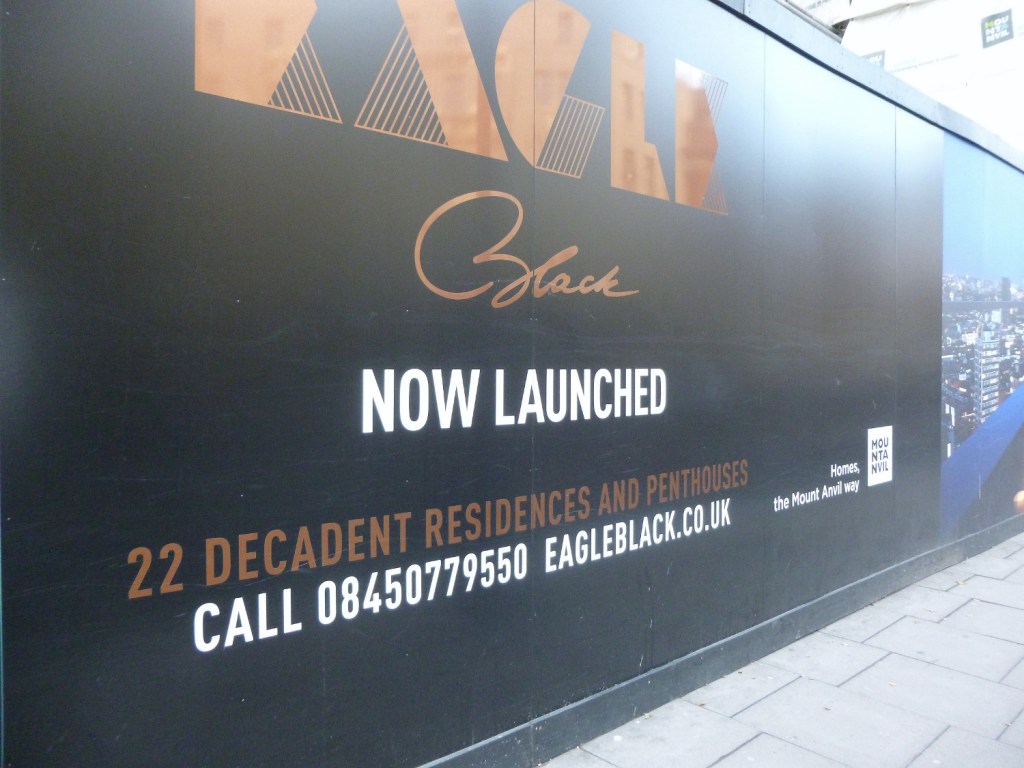
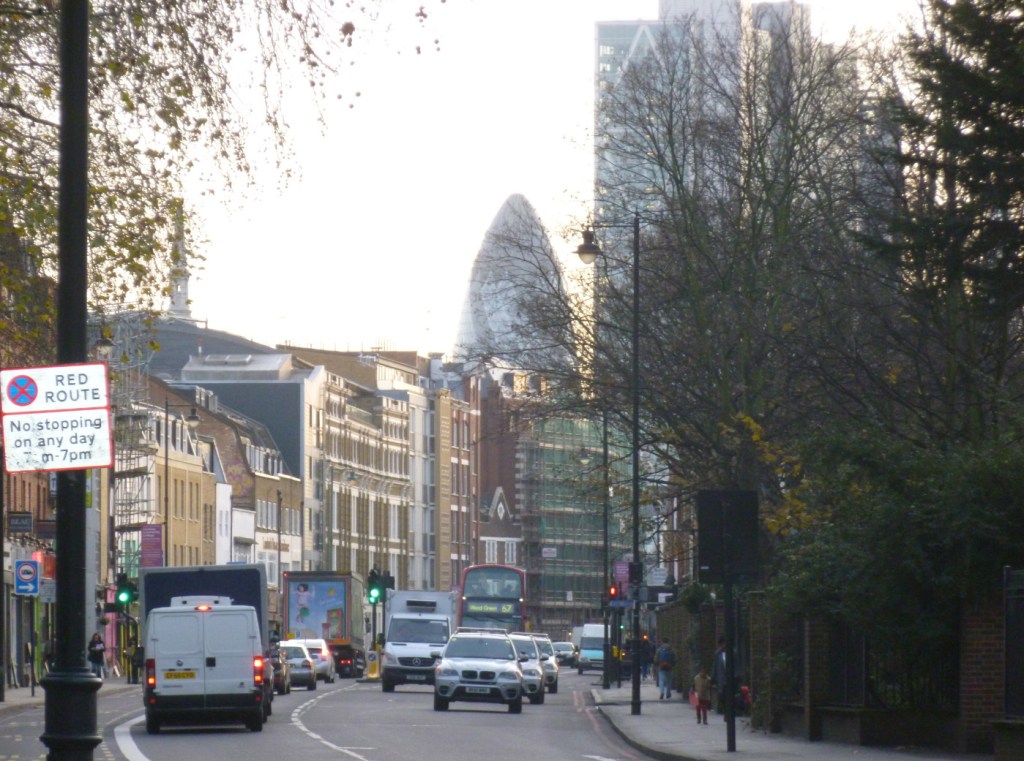
“A fashion store on Kingsland Road, that looks [to be] webbed into some local scene. A single trainer shoe is on a plinth in the window. An area that presents itself as ‘against the grain’ [is] evidently as slavishly obedient to the consumerist reality, as anywhere else that is deemed less ‘edgy’.”

22 December 2014

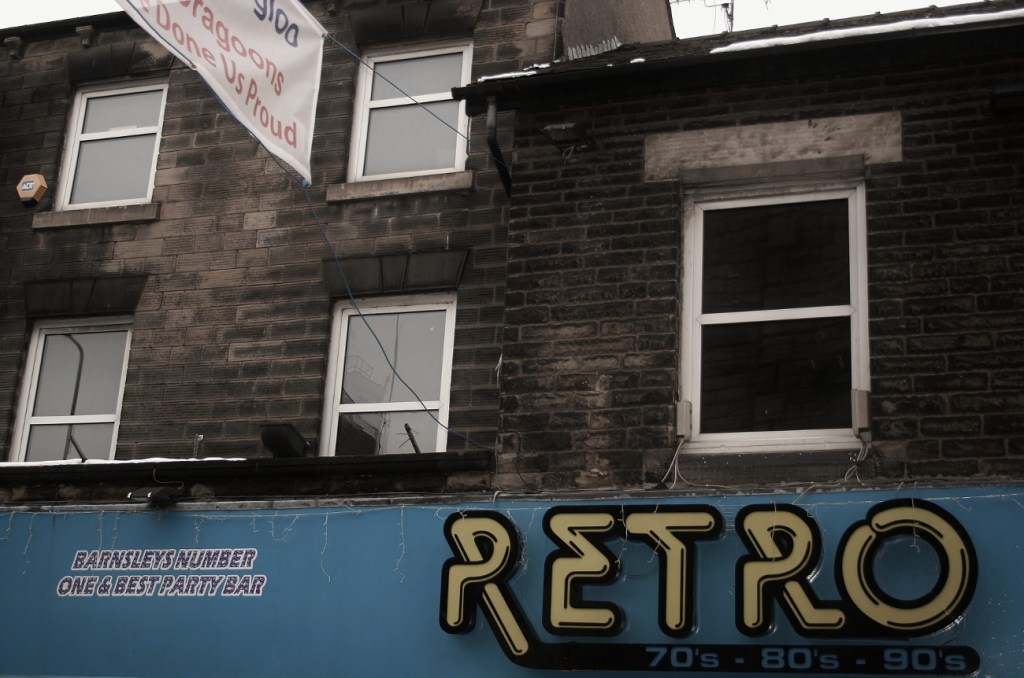
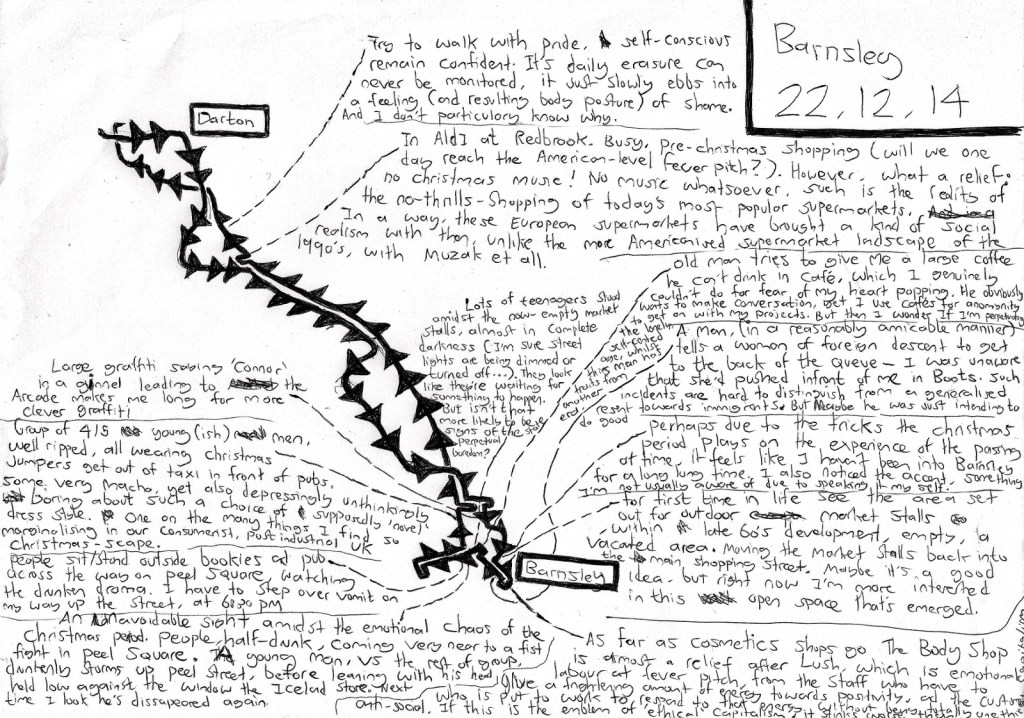
“An unavoidable sight amidst the emotional chaos of the Xmas/New Year period: people, half drunk, coming very near to fist fighting, in Peel Square [Barnsley]. A young man VS the rest of the group, [he then] drunkenly storms up Peel Street, before leaning, with his head held low, against the window of the Iceland store. Next time I look he’s disappeared again.”

“Lots of teenagers stand amidst the now-empty market stalls, almost in complete darkness (I’m sure the streets lights are being dimmed or being switched off completely) [in Peel Square]. They look like they’re waiting for something to happen. But isn’t this more likely to be [the usual] sign of the state of [existential] boredom?”

24 December 2014

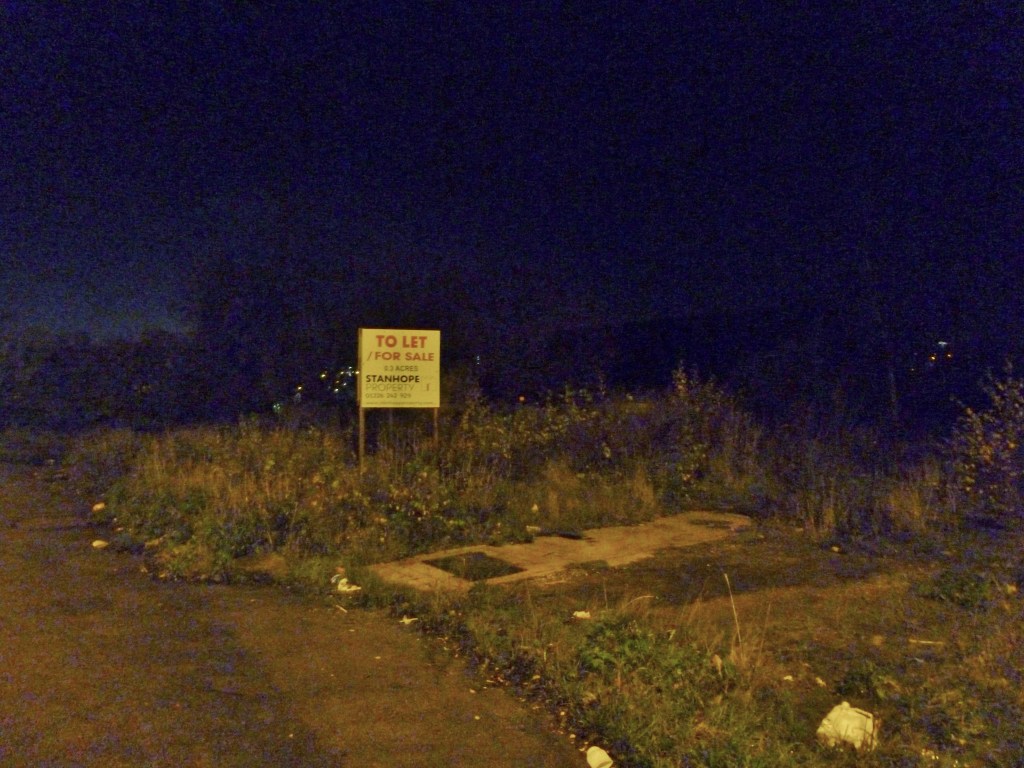
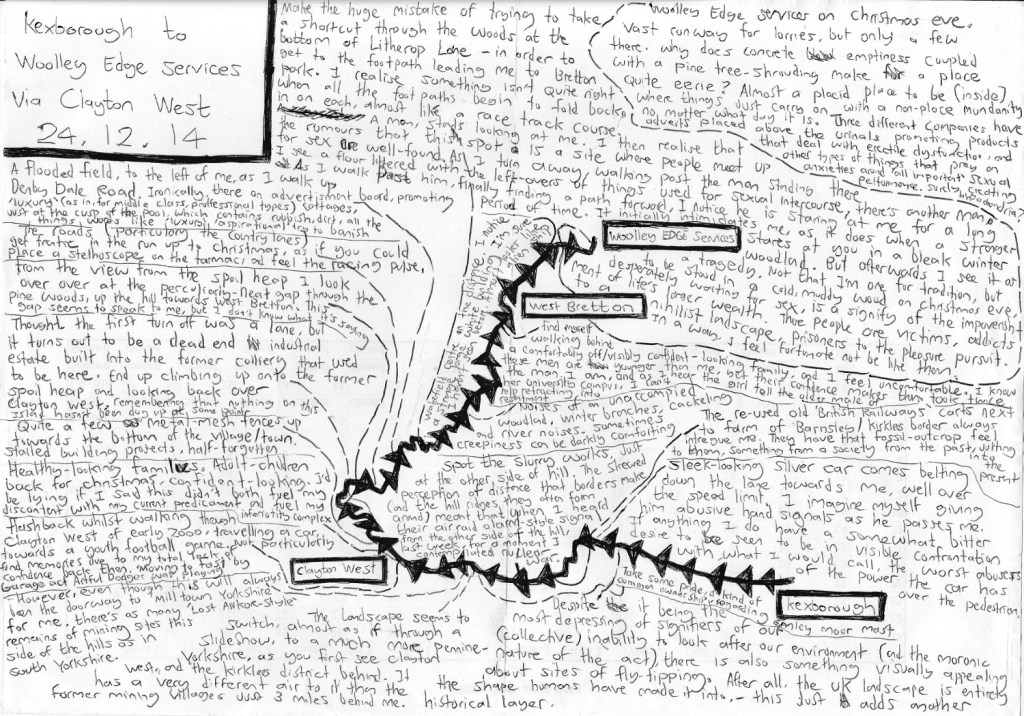
“Despite it being the most depressing of signs of our (collective) inability to look after the environment (and the moronic nature of the act), there is something visually appealing about about sites of fly-tipping. After all, the entire UK landscape is shape humans have made it into – this just adds another historical layer”.

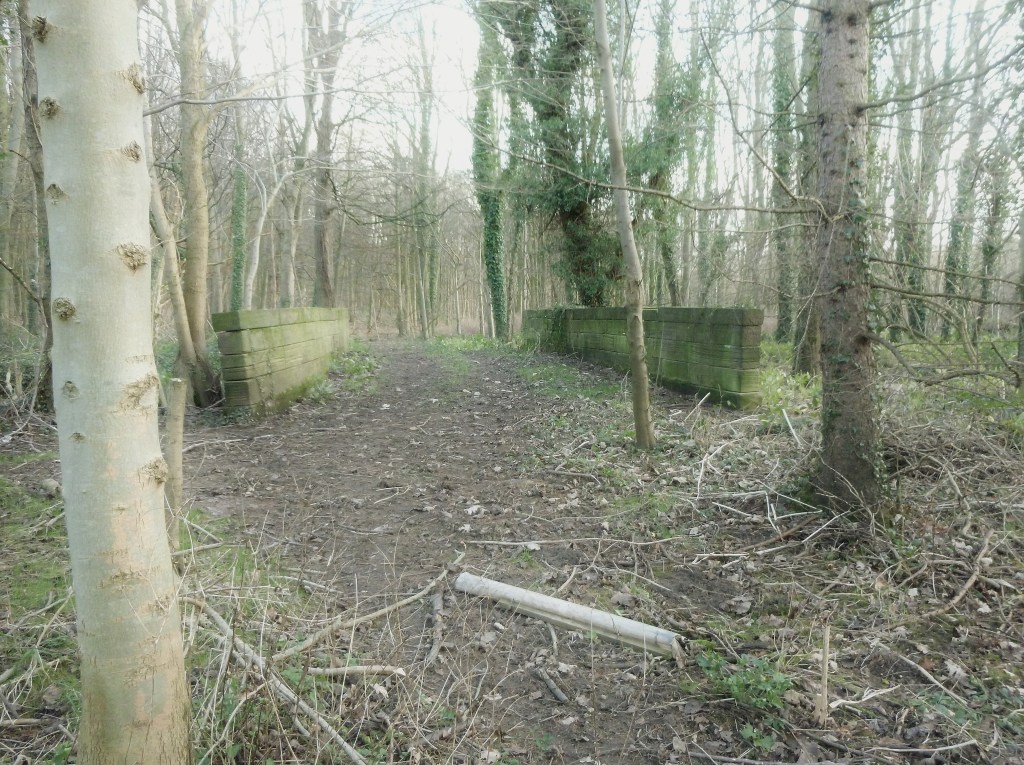
“Make the mistake of trying to take a shortcut through the woods at the bottom of Litherop Lane, in order to get to path leading to Bretton Park. I realise something isn’t quite right when all the footpaths begin to fold back in on one another, almost like a race track course. A man stands looking at me. I [then] realise that the rumours that this is site where people meet up for outdoor sex are well founded. As I turn and head in the other direction from the man and notice the floor is littered with the left-overs of things used for sexual intercourse, I notice another man. As I find a path heading out of the woods in the right direction, I notice that he has been staring at me for a long period of time. It initially intimidates me, as it does when a stranger is staring at you in a bleak winter woodland, but afterwards I see it in a tragic light. Not that I am one for tradition, but to be stood there in a cold, muddy wood on Christmas eve, desperately waiting for sex, is a sign of the impoverishment of life’s larger wealth. These people are [more than anything] victims, addicts to a nihilist landscape. prisoners to the pleasure-pursuit.”

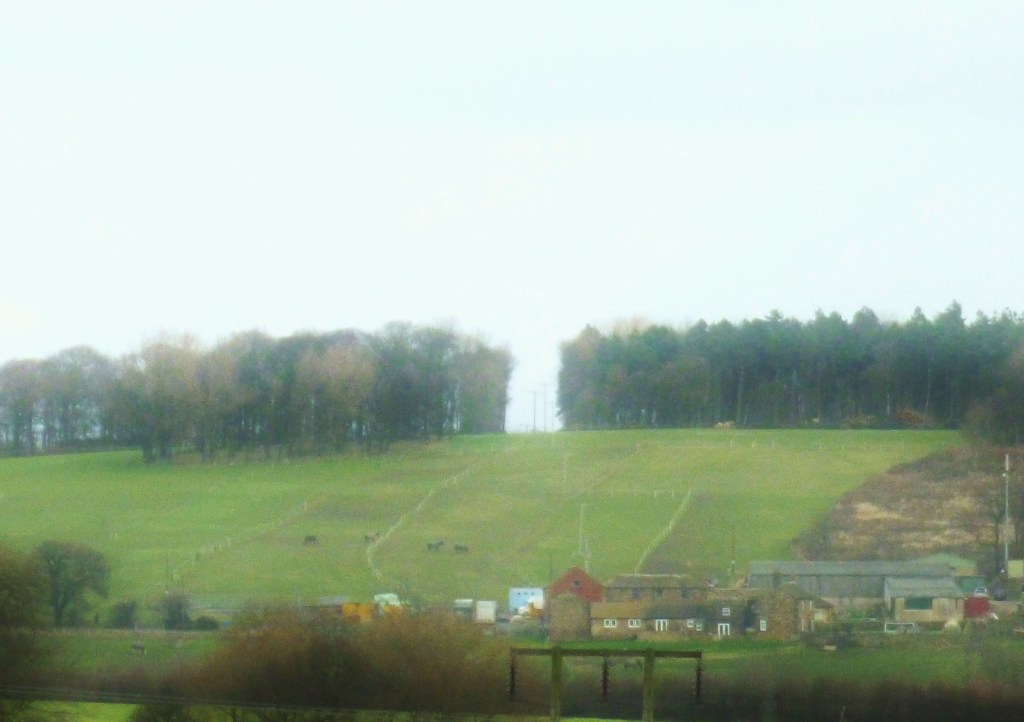
24 December 2014

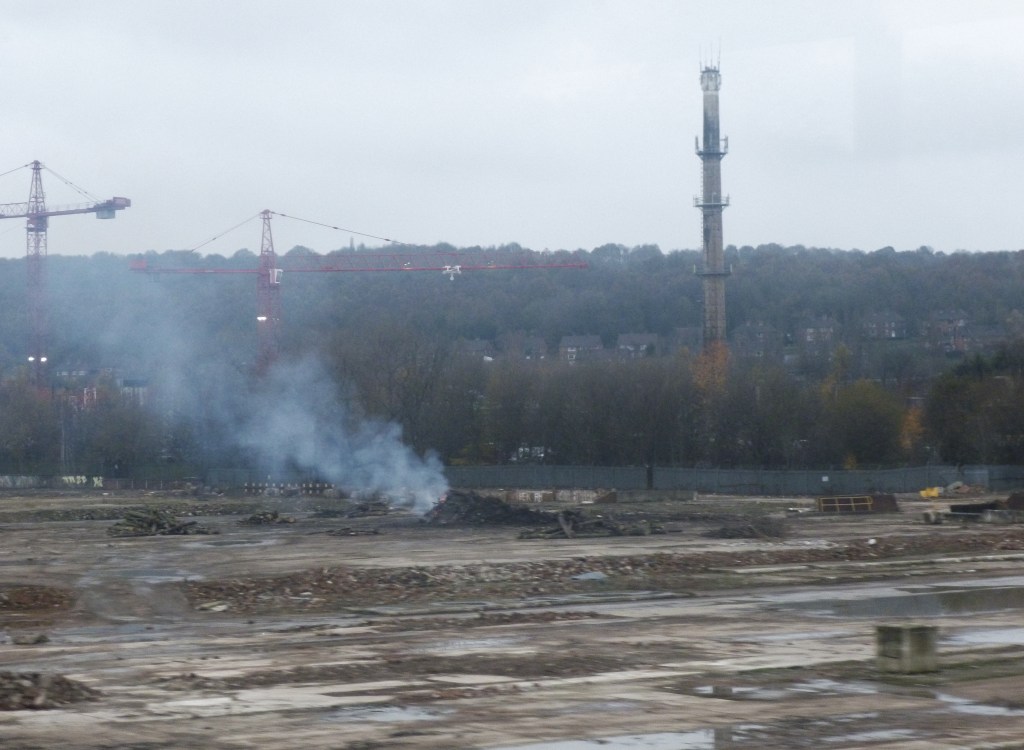
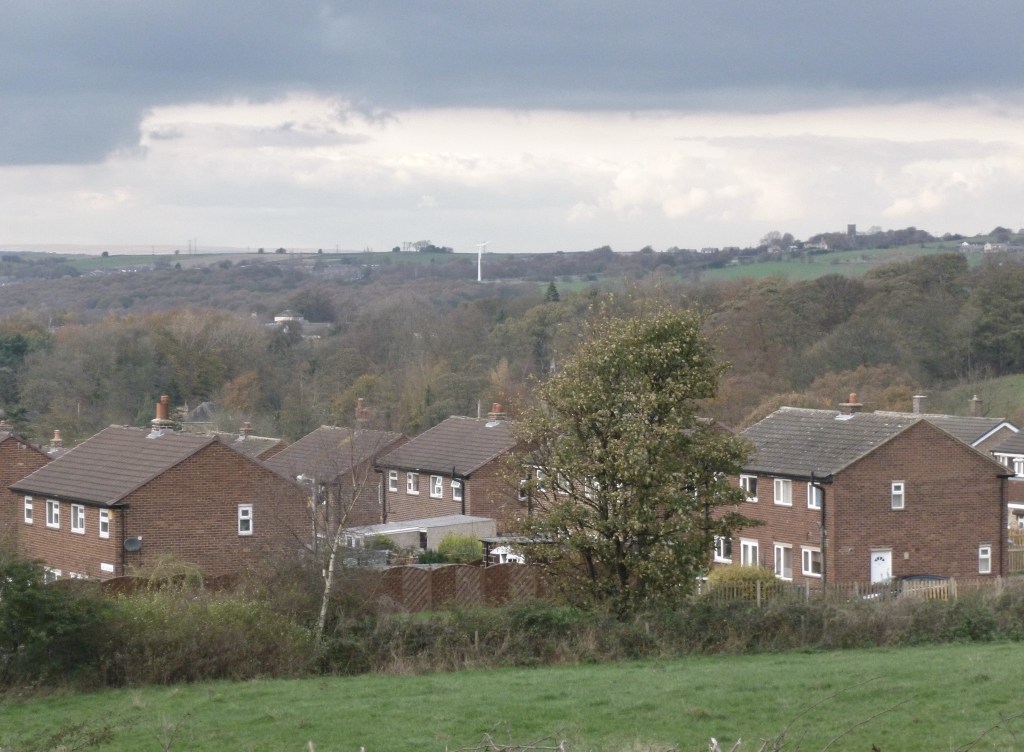
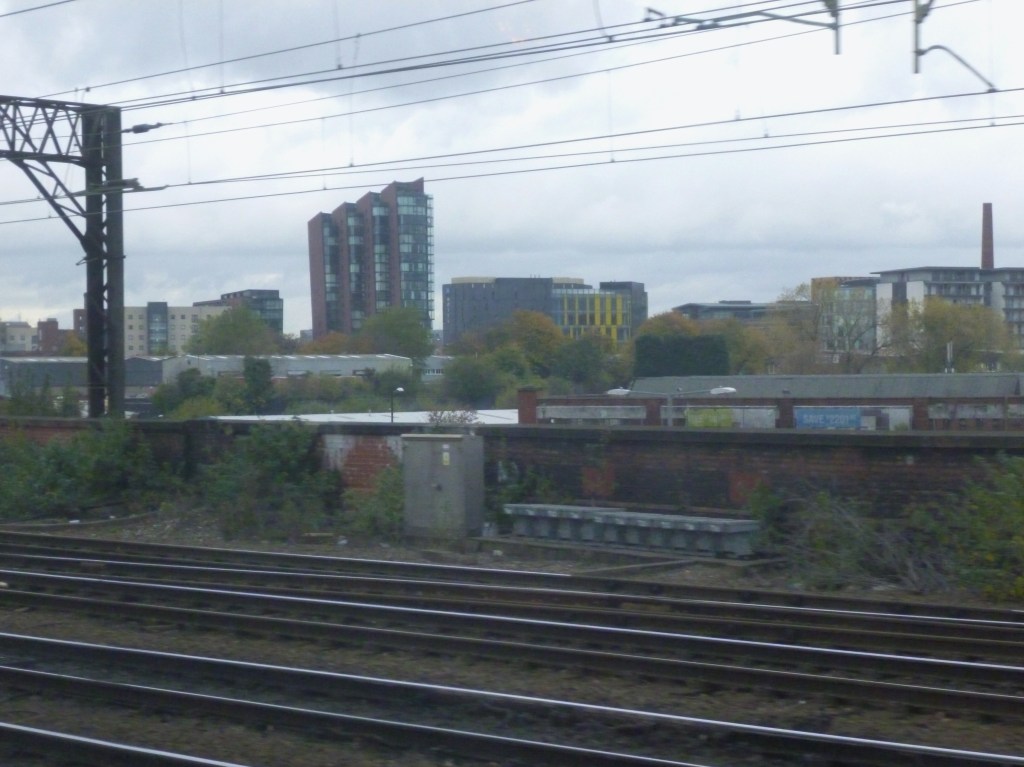
“All the talk: that something big/a seismic shift from the current state of affairs is bound to happen soon, takes on an ominous feel within this eerie-looking early evening, which doesn’t settle easy with the [East Leeds] landscape through which we are witnessing it.”

“In the Dark Arches, walking above the river [which is at its] winter torrent levels. something awe-inspiring, specifically due to how if you were to fall in you wouldn’t stand a chance. These rivers are almost the hidden powerhouse, both past and present, of cities. I say ‘hidden’ because the common image of the river in the contemporary city landscape is as an appendage for pleasure for urban professionals – as if the river itself had stopped flowing in the ‘post industrial times’.”

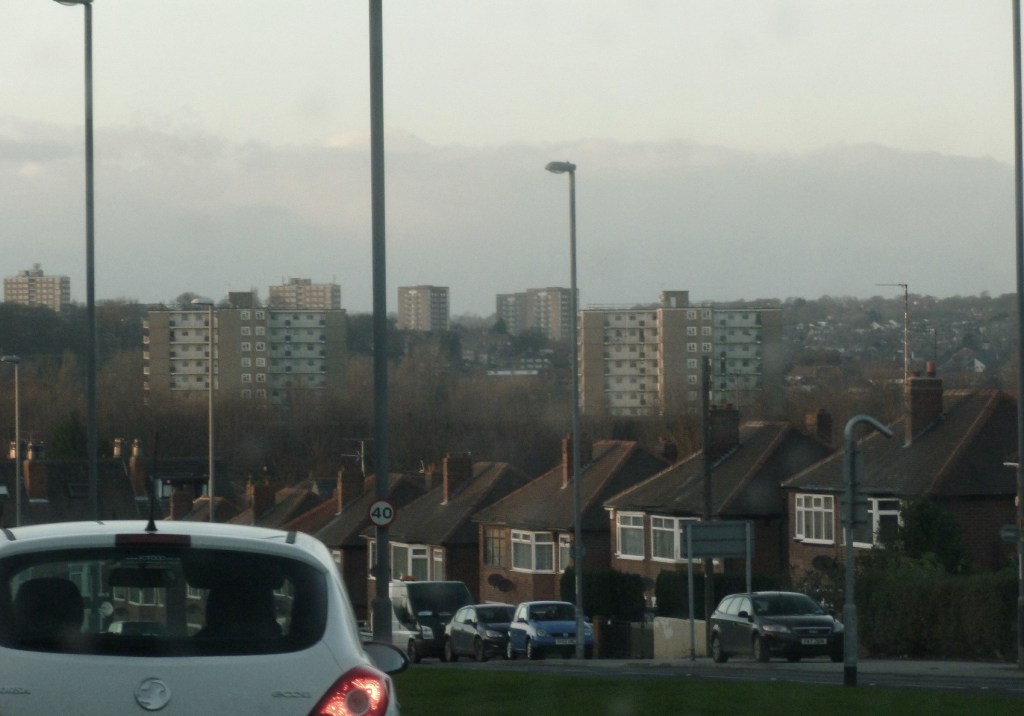
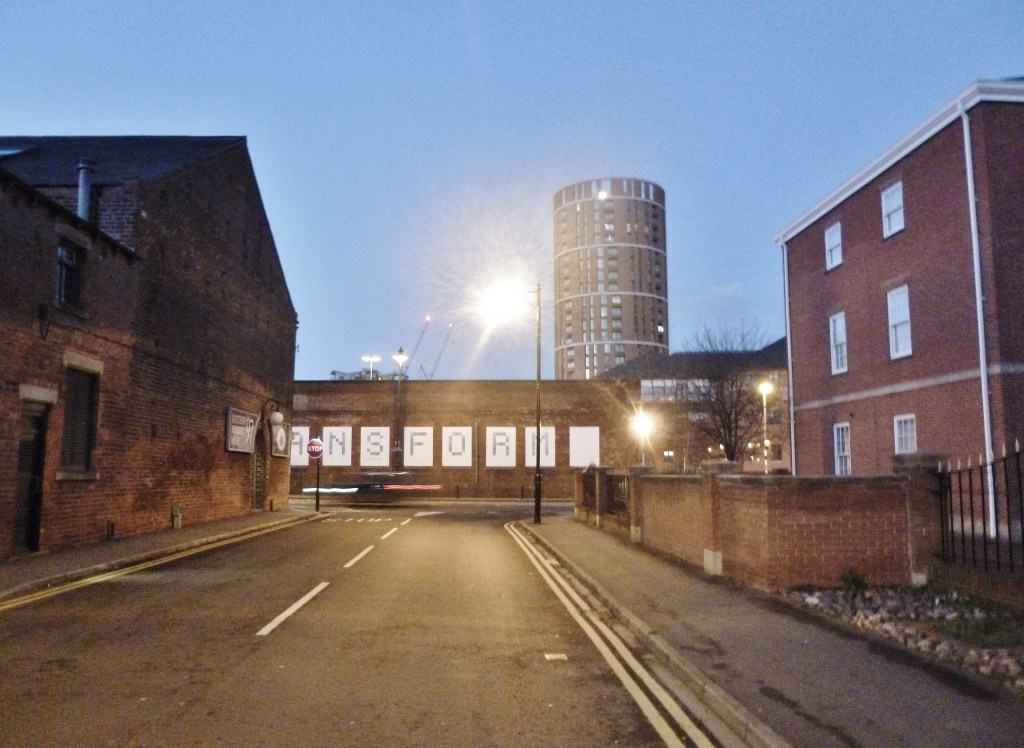
27 December 2014

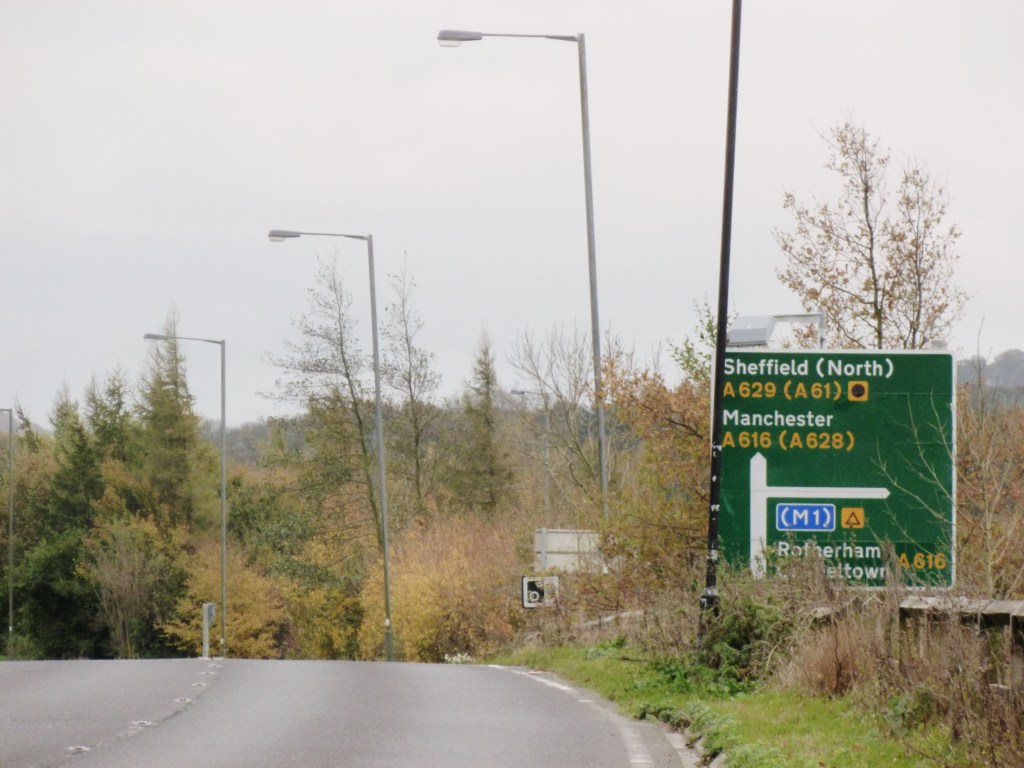
“I flare up inside at gawping [at me] passengers going around junction 38 [of the M1]. I realise that my year has been stained by bubbling anger. A deep frustrations with things that I cannot deny, but worry what will become of it as time moves on. Something must change. And maybe I’m not the only one harbouring this deep frustration with things?”

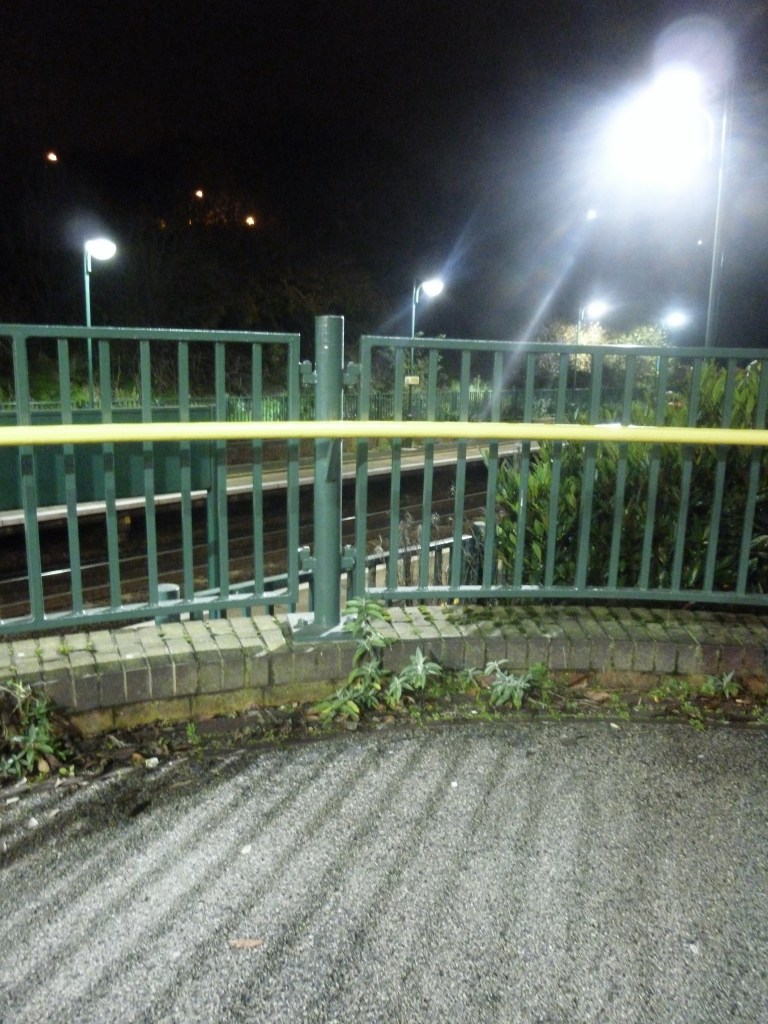
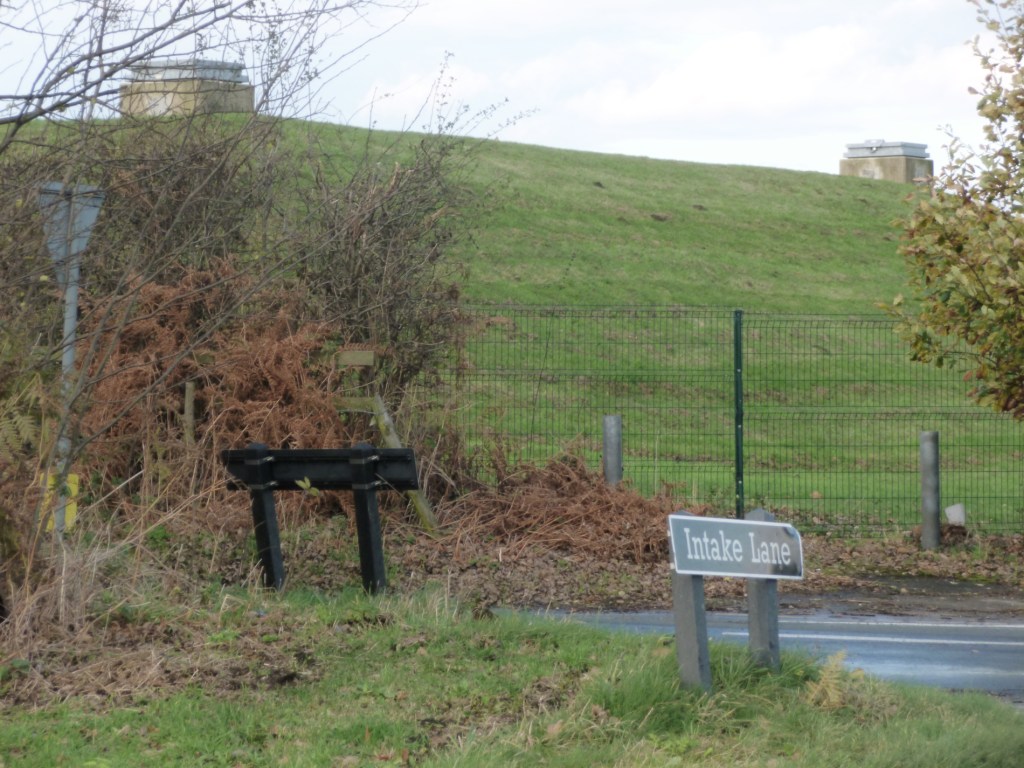
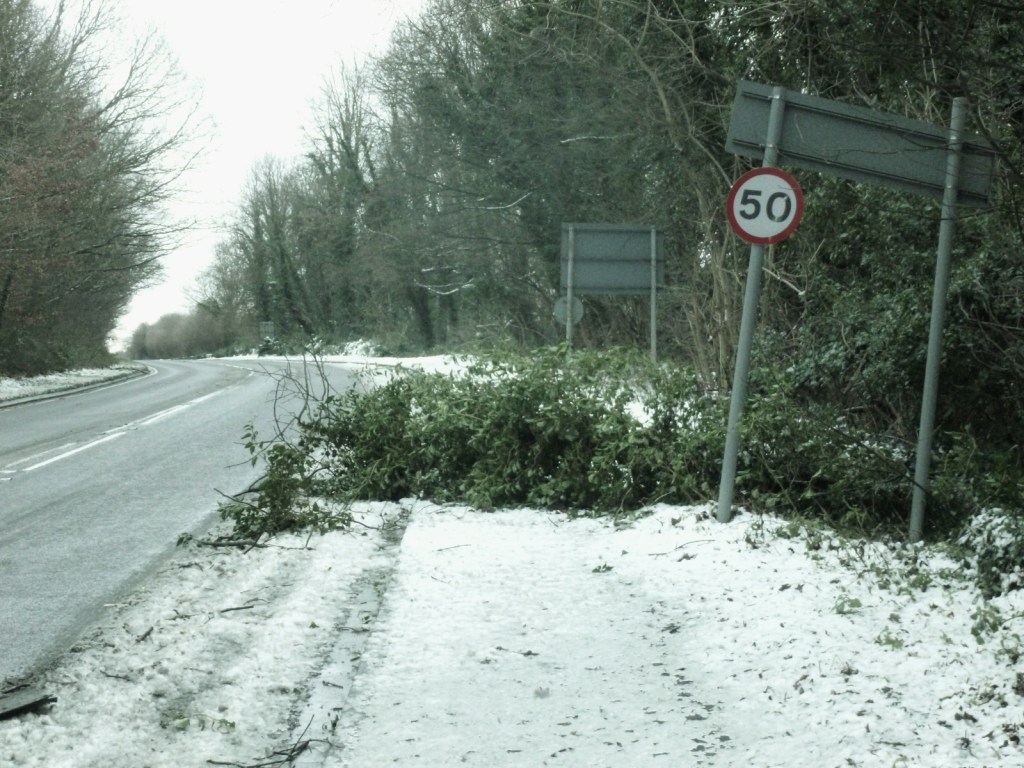
“A sharp turn in the road at the top of Woolley Edge serves as an analogy for a desperate need to change course in life – after a dead-end-style unenjoyable binge-drinking night in Barnsley, and my 31st on the horizon. But,as with every year, the question still remains “but to where?”.”
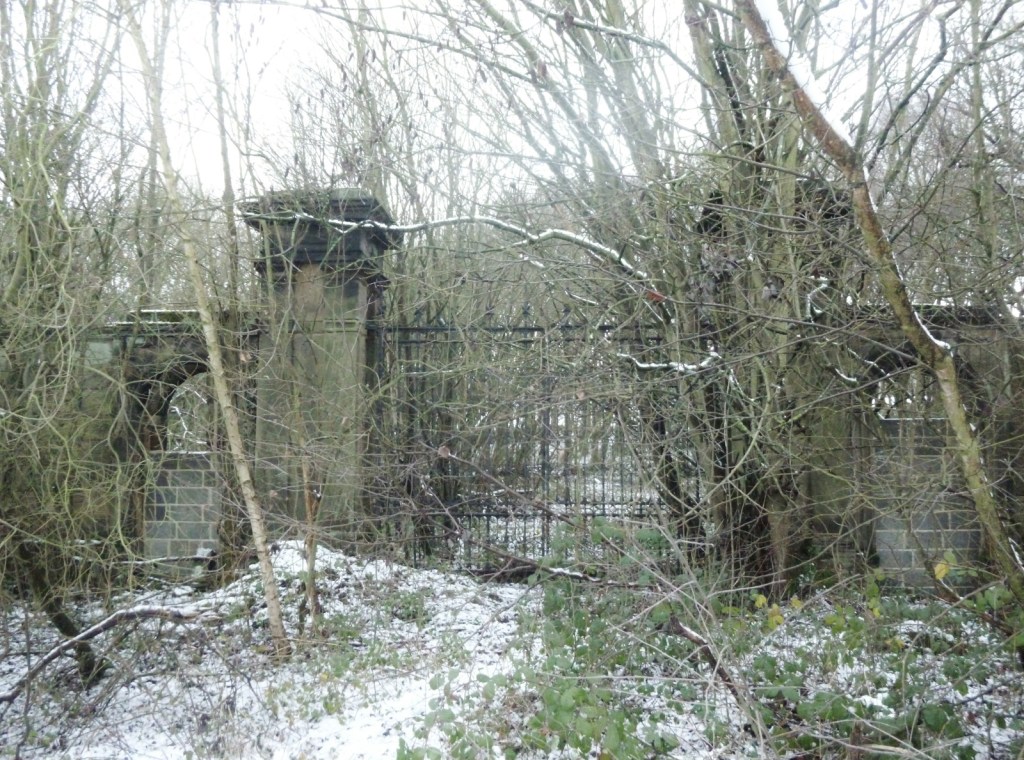
Share the Pain

How the command to have perpetual good times causes its opposite

During the time I have kept this blog I have found myself annually writing a pretty messy and uncontrollably pessimistic piece around this time of the year, usually titled Crash-Landing of One’s Life at The End of The Year. This year [yes!] “to save me from [fucking] tears, I’ll try pre-emptive action, by getting to the source of the tributary that leads to Lake Breakdown. I have struggled around this time of year for as long as my post-millennial-mind can remember, yet what always makes it doubly hard, is that doesn’t feel like it is allowed the voice it usually carves slowly but surely out of the late-capitalist landscape. I know I’m not the only one, maybe even within the many, yet the banishment remains in place. As my mind labours throughout the day on this, blowing hot and cold, the words “Sharing the Pain” are repeatedly reiterated in my head, as a means of articulating what I mean in the face of accusations more or less inciting I take a pleasure in pessimism. I get to the point whilst I’m walking from place to place where I’m internally screaming “yes, sharing the pain is what is crucially missing” in our contemporary situation.

In a BBC Radio 4 documentary from 2013 commenting on the 25th birthday of the “wonder-drug” Prozac, Will Self argued that we shouldn’t be trying to be happy all the time that “[M]aybe the world is a difficult and abrasive place and hard place, and we’d be better off as a society if we acknowledged it in some way rather than papering over the cracks [and we] shared the pain”. The title of the documentary was [a] Prozac Economy, and maybe Prozac is emblematic of the implicit dictum of late capitalist society to be happy and living life to the full, 24/7. After spending 3 quarters of my 20’s on another brand of anti-depressant, I became convinced that what was often mistaken as/and resorted to by patients/customers as a solution to a genuine inability to function in life was actually the ‘papering over the cracks’ of all the things that were inconvenient to the command to be fully active, well-rounded, happy subjects in the ‘game of life’. What is being referred to here, isn’t even the massive cause for ‘pleasure-depletion’ caused by the expanding trail of ‘externalities’ (poverty, pollution, violence) sweated, and spat out by capitalist growth; what is being referred to is the banishment of the bad-to-mundane parts of life from the social lexicon. Good times and success have come to mean the same thing and an implicit command to be living life to the full glares at us from the workplace, street, and living room, making for an unending sensation that our lives are somewhat lacking.

“Life tends to come and go. That’s OK as long as you know”, I Won’t Share You, The Smiths

The Smiths/Morissey’s lyric on their  final song of their final album from the late 1980’s almost seem to be wise words of warning for the increasingly USA-like consumerist landscape that the UK would increasingly exist as in the two decades following on, that life isn’t always full and memorably-great. Yet we now live in a social landscape drunk on expectation that life should constantly flow and never ebb.

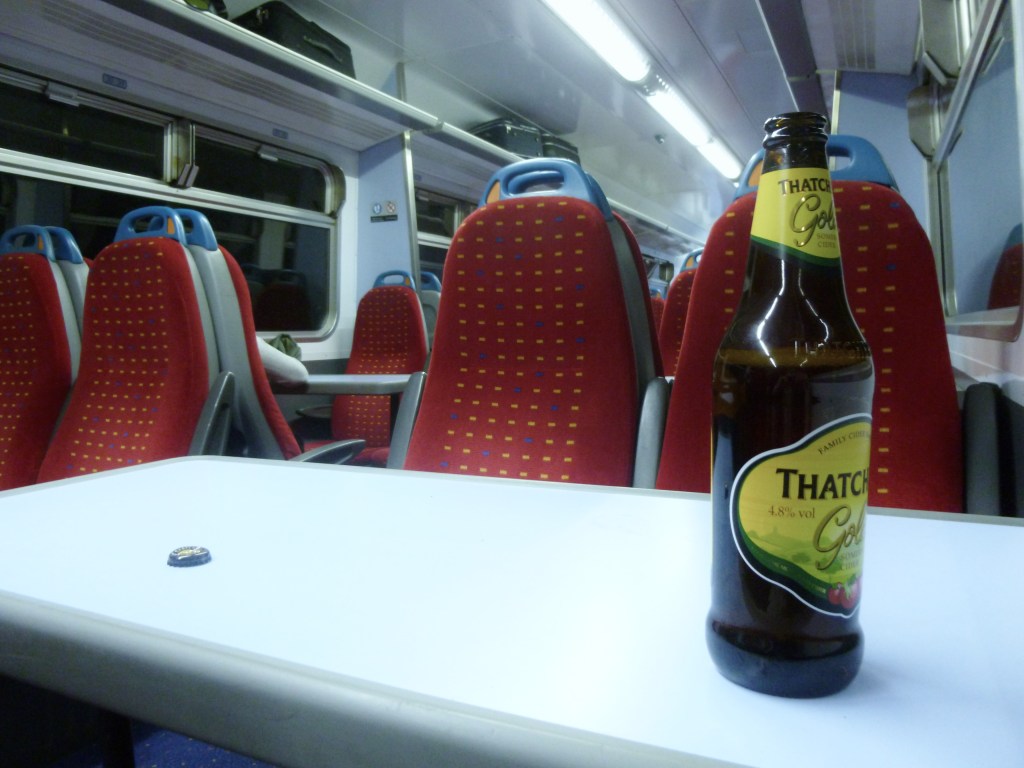
But without going much further just yet, in comes the emotional-stomach-pumping that is Xmas/New Year; a annual occurrence that is more of an unwritten consensus for a time of mental illness more than anything. Tears, relationship breakdowns, taxi-rank travesties – a general unhinging of minds. It’s like being sucked into a black hole; you have to make plans well in advance to ensure your coordinates are on course to steer you way past its gravitational pull. Most of us fail to do this, and just have to hold on in the best psychological state we can until we come out the other end in early January. It disorientates, messes any routines we have that give us scope for making (some) sense of things; giving us no means of coming to terms with the burning sensation “why aren’t I having a good time? I’m supposed to be. What the hell do I do now?”.

Many of us (usually referring to some unfortunate other – but often meaning ourselves) talk about how Xmas/New Year can be a ‘lonely time’. But I don’t think it is actually that much to do with being alone at this ‘special time’, but more a loneliness induced by this omnipresent command to be ‘living it up’. We feel more left out, missing out, with a need to be having good times-max for 2 solid weeks – no wonder we feel so exhausted by the end of it. This pressure to be constantly sociable, in the thick of good times, coincides with the increasing atomisation of human beings, due to an increasingly presence of market forces coming between al human interaction, so much so that George Monbiot wrote a recent column calling this “the age of loneliness”; both our real and imagined loneliness have increased.

My interpretation of the usual defence of Christmas [specifically, regarding the UK], as an ancient tradition of good will in the deep dead of winter, is that the difference lay not really in loss of belief in the Christian story (or tradition), but in the shift from it being a time of bringing good will, and an easing of pain, to a time where the language describing pain and general not-good times is banished from the existence. A burgeoning feeling of unease, makes us feel more distant from the (seemingly) joyous crowds. But my suspicion is that most of that crowd are actually only connected by their hidden loneliness.

Perhaps this shift can be placed at a point within the 20th century when a newly emerging stage of capitalism (a more completely market-saturated, market-dominated and deterritorialised society) snatched the mores (the demands/actions for the liberation of pleasures, freedoms to enjoy life) from the cultural revolutions of the 1960’s that fought to overthrow a previous style of capitalist domination. The counter-cultural liberation of the human soul in the mid-to-late 20th century turned out to be like rocket fuel to what could be called an emerging hypercapitalism, that re-appropriated and ventriloquised it so well, that tracks like the Velvet Underground’s All Tomorrow’s Parties becomes a slogan for this different style of domination.

Many theorists have worked hard to interpret this crucial shift, usually located in the 1970’s-80’s, but most notably Gilles Deleuze. Deleuze’s essay Postscript for Societies of Control, using Michel Foucault’s description of societies of Discipline and Punish (“operating in a time frame of a closed system”, based on containment and territorial in nature) to delineate the previous form of domination, talks of the beginnings of a new form of domination by “ultrarapid modes of free-floating control” where the “corporation has replaced [the older model] the factory, and the corporation is a spirit, gaseous”, it extends into all walks of life and “constantly presents the brashest forms of rivalry as an healthy form of emulation that opposes each individual against one another, and runs through each, dividing each within”. We are no longer citizens and workers, we are competitors and consumers; enforced individualism. (Digression slightly, but being as I am referring to many bands here, I will argue that the quintessential record for a discipline and punish society is Pink Floyd’s The Wall – released at that crucial point, 1979, when the transition was truly occurring, and that the quintessential record for control societies is Radiohead’s 1997 pre-cyberspatial-horror record OK Computer).

And, In a simplified way, it would seem that what the revolutionaries of the 1960’s were trying to overthrow was the discipline and punishment stage of capitalist domination, unfortunately oblivious to the more gaseous ‘control society’ stage of capital that was de-territorialising the sources of power, and re-appropriating the energies pitted against that older form, at the time. Unlike in a society based on discipline and punishment our pleasure drives aren’t something to be kept in check from a watchtower, but something left to the management of the individual, whilst advocated as a consumer rite of passage. As Zygmunt Bauman wrote in his essay The Riots – On Consumerism Coming Home To Roost, the 2011 UK rioters were ‘disqualified consumers’ who were (financially) unable to carry out their ingrained duty, and thus the rage of injustice was followed by the return of the repressed rite of passage to consume/enjoy – thus came the looting. Because control societies are always losing control, from the macro-economical right down to individual level.

What has all this got to do with Xmas/New year though? Well, all the factors that drive our contemporary reality, hit a huge power surge at this point every year; as Xmas/New Year now operates as some kind of social nervous breakdown, from which it rises back out in vain with redemptive plans for the new year. All the cities in the UK, by weekend, transform into landscapes of people desperate in pursuit of pleasure, in what is still seen as ‘leisure time’ – do they find their fun? Maybe eventually. Christmas however, is this on overdrive, when we truly do become lonely prisoners to the pleasure pursuit. ( The Black Friday escapades, that are condemned by those who foolishly think they are exempt from consumer subjectivity, are if anything a mirror image of the London Riots).

I don’t believe the pursuit of pleasure, and the unrealistic expectations we become condemned to place on such periods deliver their promise at all (In all honesty, the best nights out I have are ones that come out of nowhere, usually when you bump into a friend whilst out on a mundane town centre stroll). The failure to find pleasure on a singular weekend night out can be shrugged off far more easy, but the command to be fulfilled around Xmas/New Year can bring about series mental distress.

There is no way to go much further than this when the most crucial thing (on my part) is getting through the period with minimal damage as possible. It’s fair to say, I think we’re all swept along (or pulled under) in the tide of society at different degrees. At least I’m being honest in saying I’m far more seduced with the perfume of aspirational hyperbole than I’d ever wish on anyone else. It’s like a sealed pocket that releases its poison at certain points throughout the year.

I truly believe if ‘sharing the pain’ was a dominant paradigm, in the place of ‘everyone must enjoy themselves’, life would be truly more easy. It is impossible for a society to share the pain, and accepted the difficulties of life whilst there is a command to be a ‘player’. I also feel a society that acknowledged the difficulties of life would find it easier to adjust to adverse scenarios, rather than responding to it like the infantile consumers it currently moulds us into; to consume and suffer in silence.

2014 mapmaking (part 8)

This is the 8th post in a series that I still call psychogeographical maps (or cognitive mapping). Quoting certain sections and using a selection of photographs to widen the project, which at its core still has the intention to be a Cognitive Mapping of Now – aiming to be useful for locating the current socio-political mood, and the psychological impacts of it.

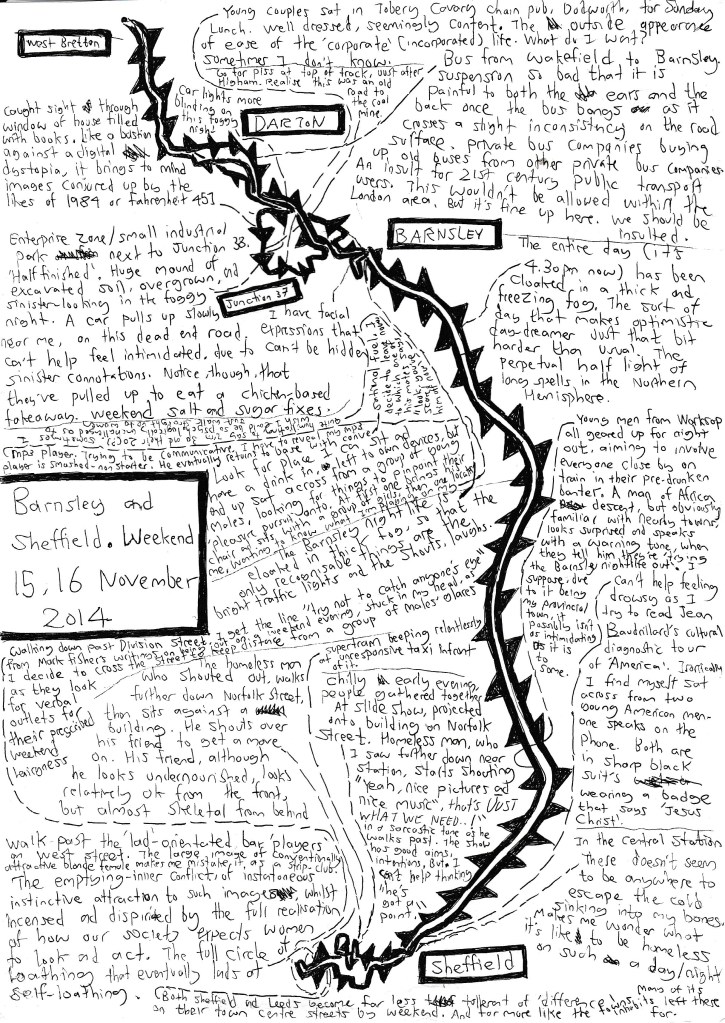
UK Weekend 15/16 November 2014

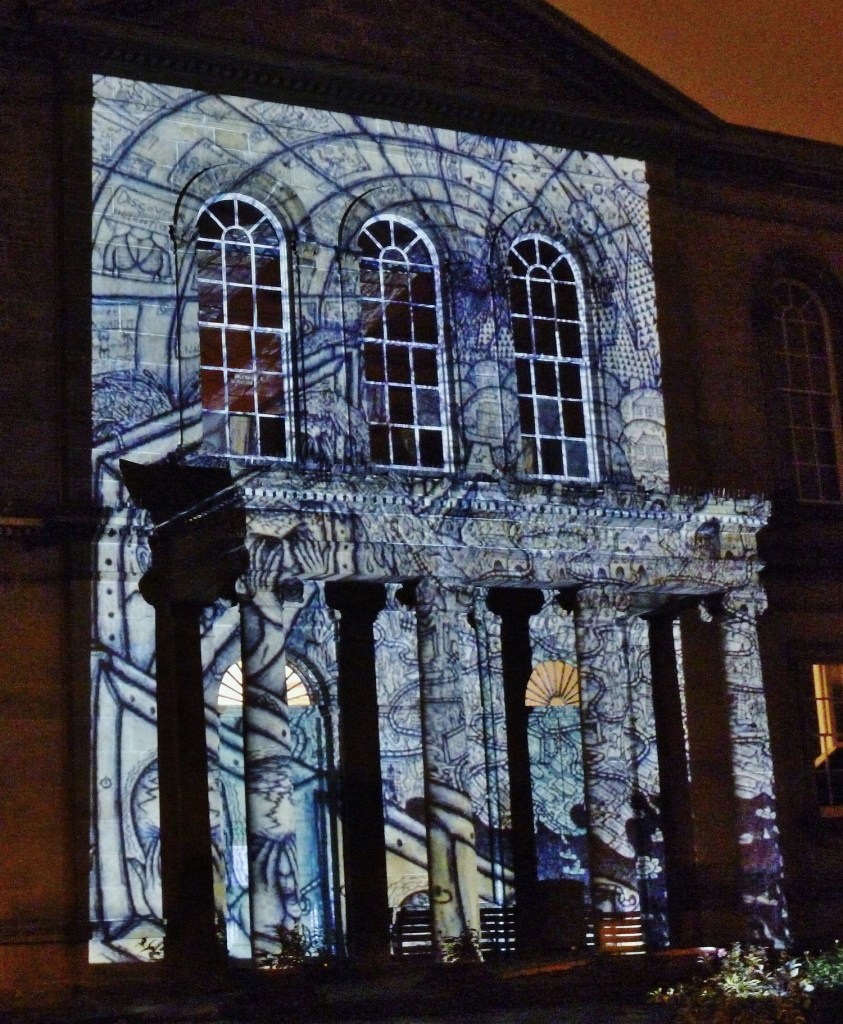
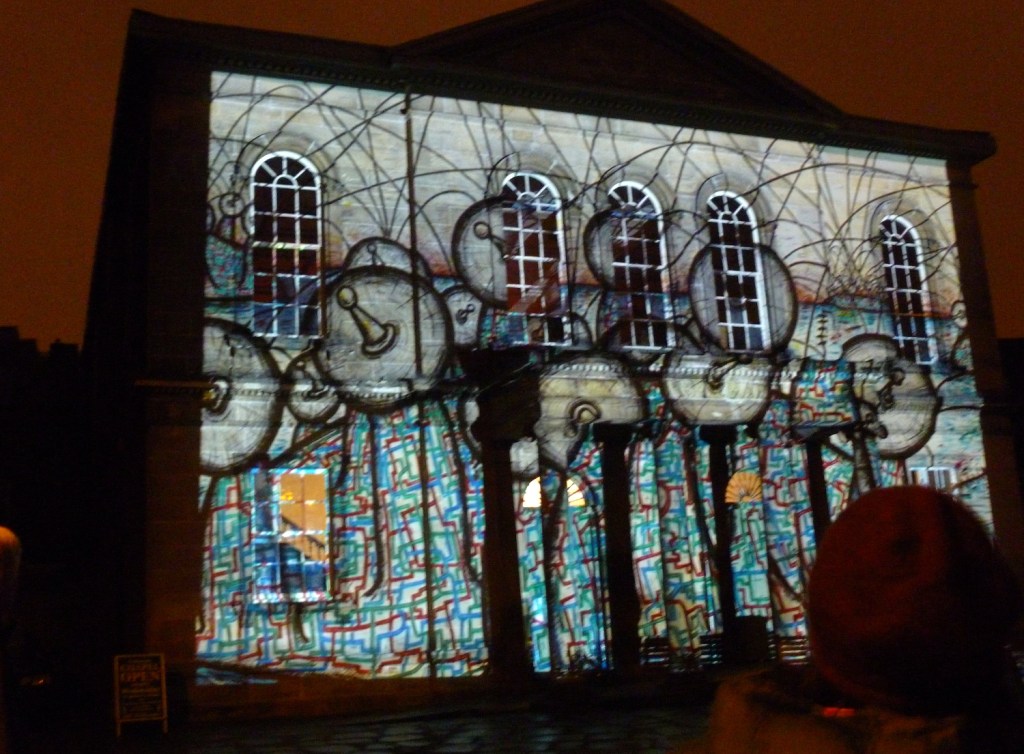
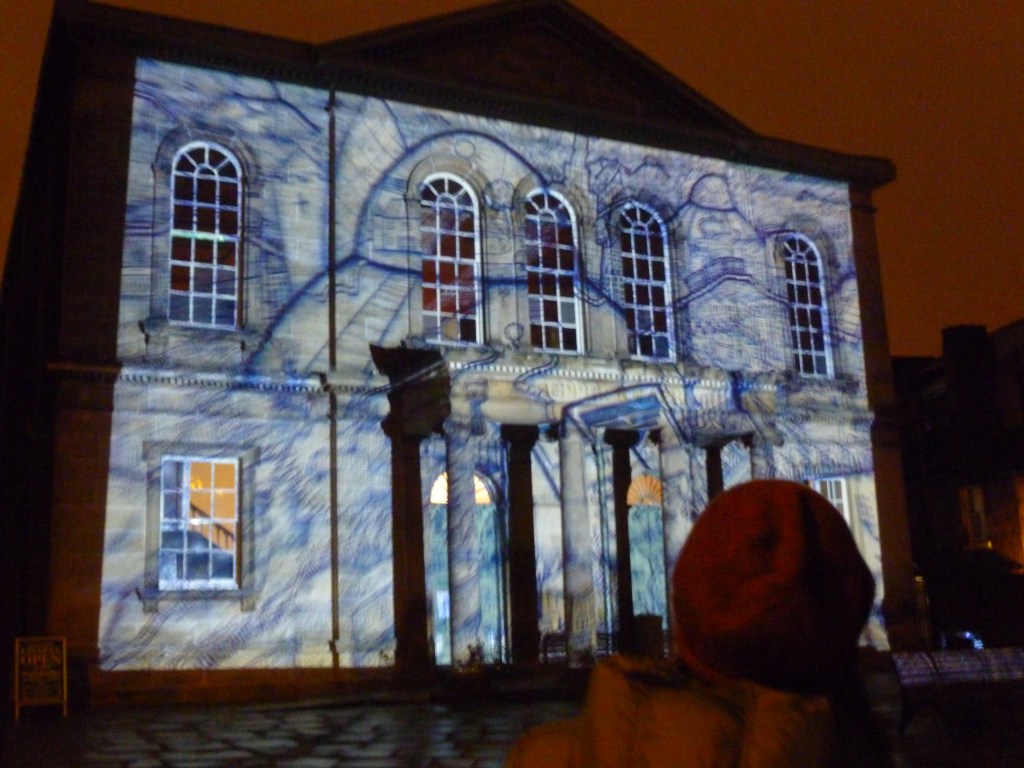
“Chilly, early evening, people gathered [for] slideshow projected onto building on Norfolk Street [Sheffield]. A homeless man, who I saw [asking for spare change] further down towards the station, shouts “yeah, nice pictures and nice music – that’s JUST what we need!” in a sarcastic tone as he walks past. [Even though my own art is featured in the projection] I can’t help thinking “he’s got a point.”

UK Weekend 15/16 November 2014

“Chilly, early evening, people gathered [for] slideshow projected onto building on Norfolk Street [Sheffield]. A homeless man, who I saw [asking for spare change] further down towards the station, shouts “yeah, nice pictures and nice music – that’s JUST what we need!” in a sarcastic tone as he walks past. [Even though my own art is featured in the projection] I can’t help thinking “he’s got a point.”
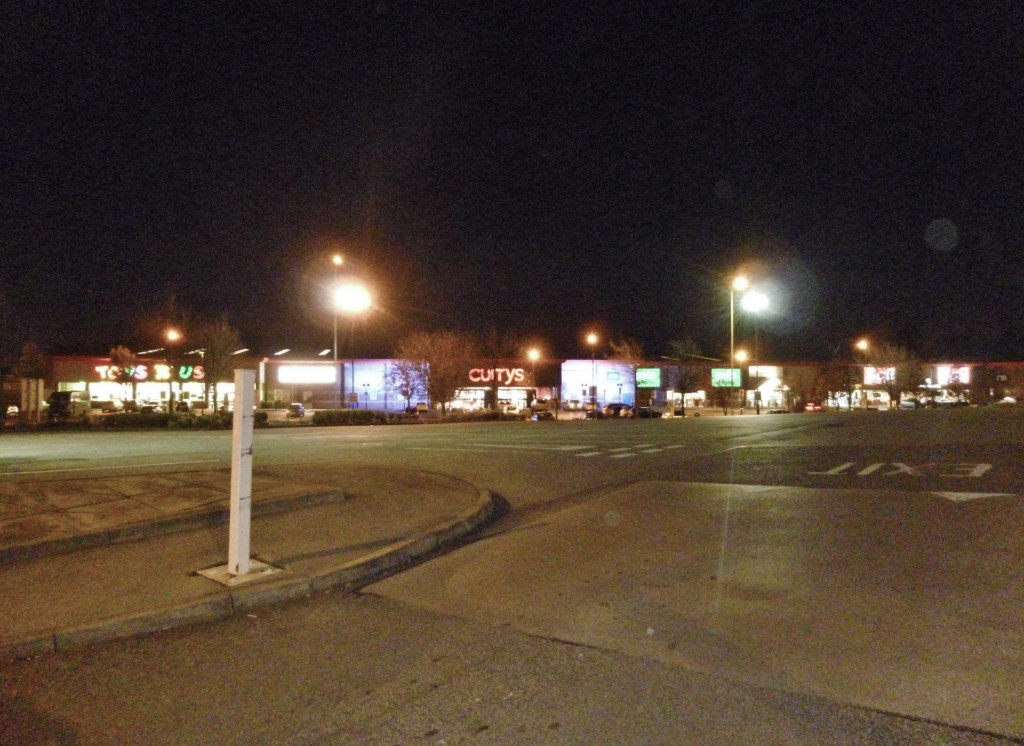
“Enterprise Zone/small industrial park next to junction [37]. Half-finished. Huge mound of excavated soil, overground and sinister-looking in the foggy night. A car pulls up, slowly, next to me, on this dead-end road. Can’t help feeling intimidated due to sinister connotations. However, I noticed they’ve pulled up to eat a chicken-based takeaway. Weekend salt and sugar fixes.”

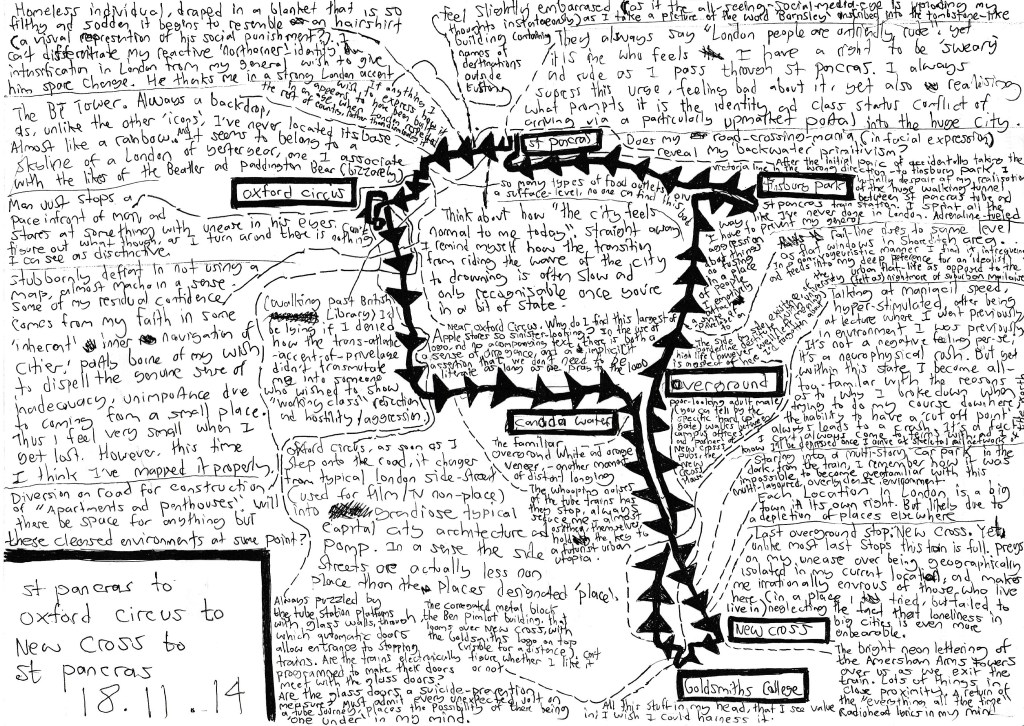
18 November 2014

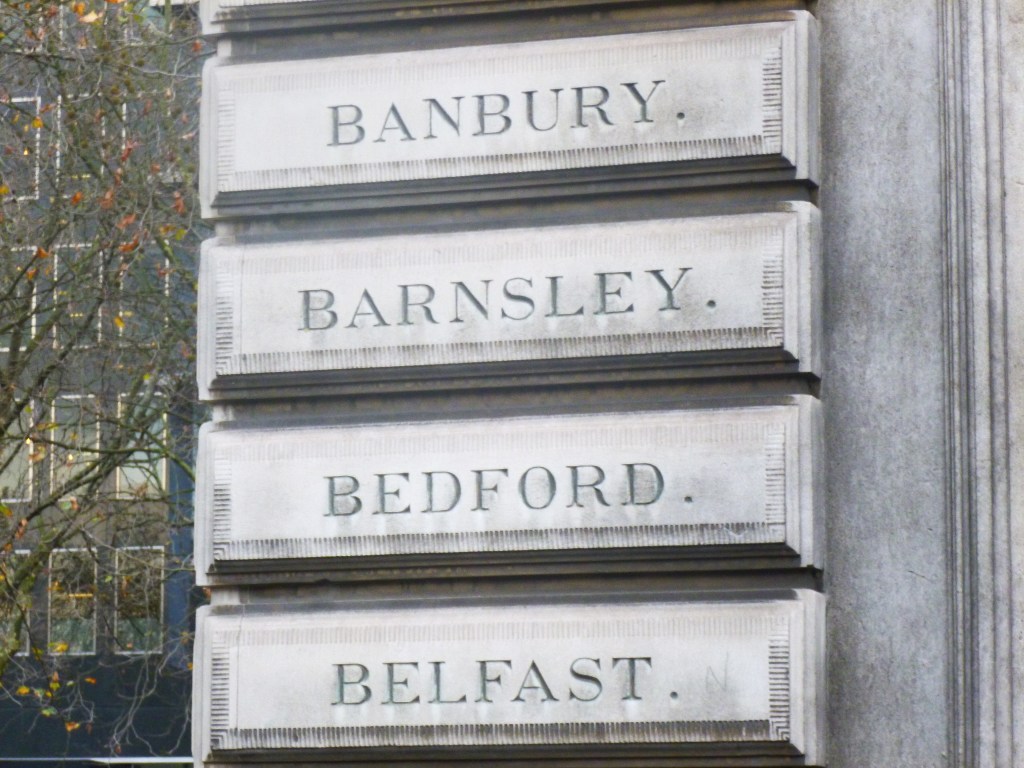
“Feel slightly embarrassed (as if the all-seeing-social-media-eye is uploading my thoughts instantaneously) as I take a photograph of the word ‘Barnsley’ inscribed into the tombstone-like building, [that lists] the names of destinations outside Euston/London. If anything, I wish[ed] to express how it appears to have been built/engraved in an age when London respected the rest of the country, rather than dismissing if [maybe].”

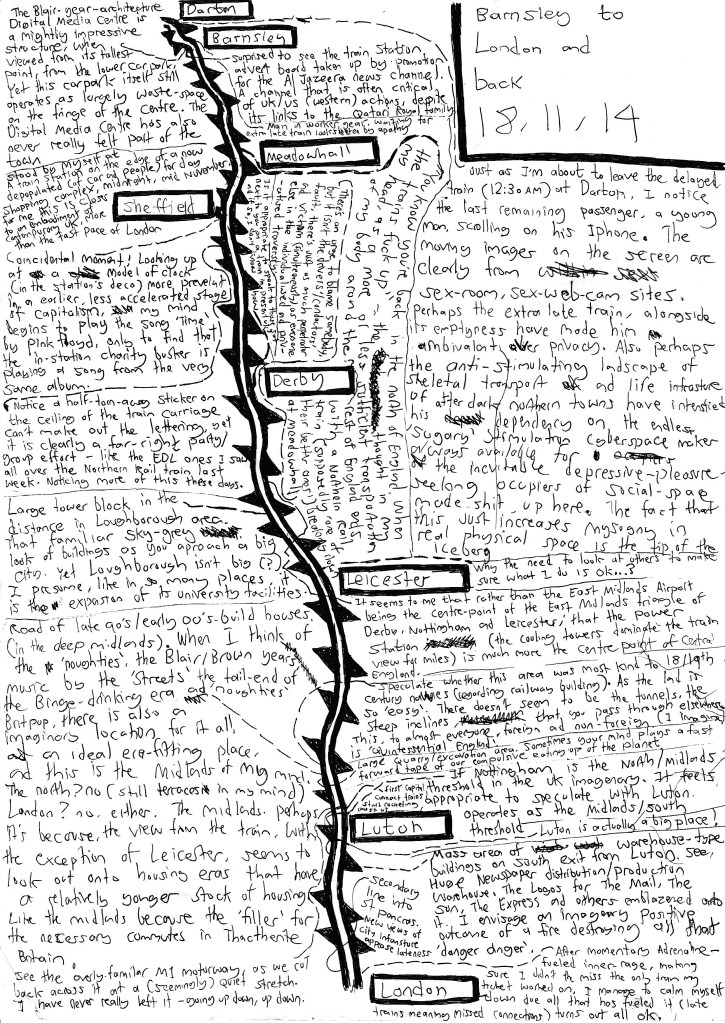
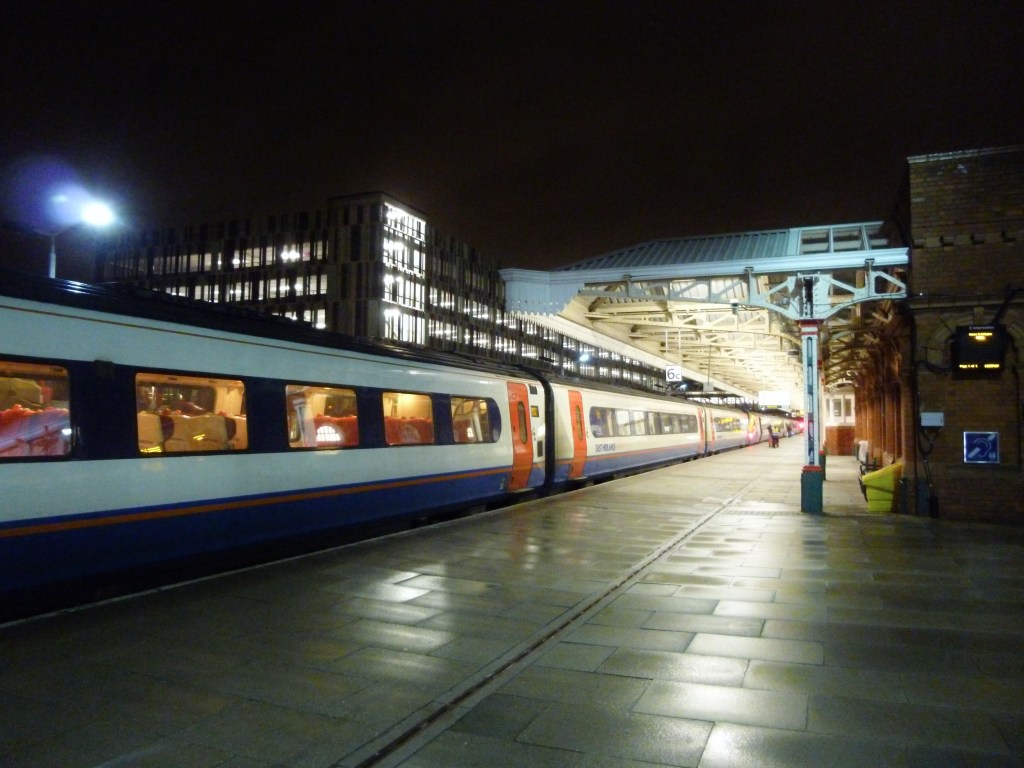
“[At New Cross Gate Station] Talking at maniacal speed. Hyper-stimulated after being at a lecture where I went to study [once], in an environment I was in previously. It’s not a negative feeling, it’s a neuro-physical rush. Yet within this state I become all-too-familiar with the reasons as to why I broke down when I tried to do my course here: the inability to have a ‘cut off point’ always leads to a crash. It’s a fact I can’t always come to terms with, and I know I’ll be depressed [later on] once I arrive on the ‘skeletal’ rail network of the north.”


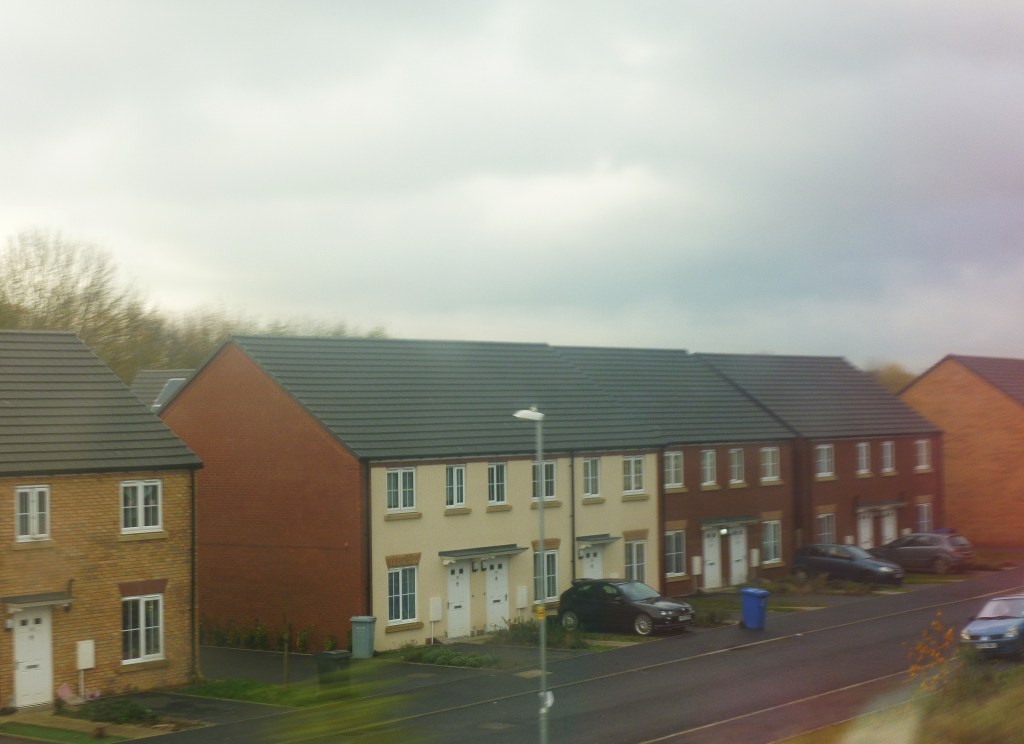
“[Row] of late 1990’s-early 2000’s-built houses, in the ‘deep Midlands’. When I think of the ‘noughties’, the Blair/Brown years, music by The Streets, the tail-end of the ‘binge-drinking era’, noughties ‘britpop’ [and the Iraq war as background noise], there is also an ideal-fitting location for it all, an era-fitting place. This is place is the Midlands of my mind. The North? No (still [older] terraces in my mind) London? No, [I think London is Now]. The Midlands. Perhaps it’s because the view from the train, with the exception of Leicester, seems to look out onto a landscape of [the last mass construction of – private – houses, in the boom years of New Labour]. The Midlands looks of younger housing stock. Perhaps it became the ‘filler’ for the necessary commutes in Thatcherite Britain[?].”

“Just as I’m about to leave the delayed train (at 12:30 am) at Darton, I notice the last remaining passenger, a young man, scrolling his Iphone screen. The moving images on the screen are clearly from sex-room, sex webcam sites. Perhaps the delayed train, alongside its emptiness, have made him ambivalent over privacy. Also, perhaps the anti-stimulating landscape of skeletal transport and life infrastructure of after-dark Northern towns have intensified his dependency on the endless ‘sugary’ stimulation that cyberspace makes always available for the inevitable depressive-pleasure-seeking occupiers of social space-made shit, up here. The fact that this just increases misogyny in real physical space is just the tip of the iceberg.”


19 November 2014

Sheffield

UK Weekend, 21, 22, 23 November

“[Sheffield Station] Water drips from Northern Rail Carriage, as everyone waits in haste for the doors to open. Two young men arrive in [sodden sports clothes]. [You can tell with some people that they’ve had a hard upbringing from their face-shape, their posture, and even their mannerisms]. They are drenched– only the poor get drenched in a rainy city. You never see the poor with umbrellas.”

“Peel Street often feels like the ‘Barnsley Badlands’. What I mean by this is that it feels like one of those locations where the fallout from welfare-eroding neoliberal economics [and the ideology it generates] is most acutely sensed. A one-time boulevard now in social disrepair – it almost feels more fitting to downtown America.”

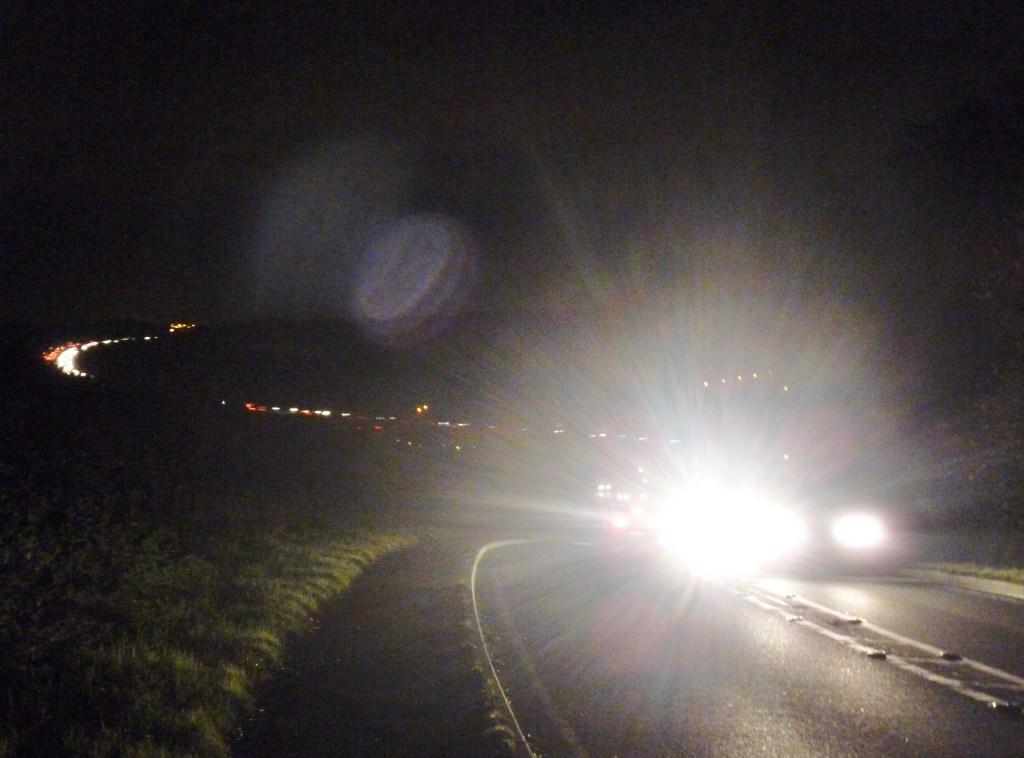
“The Only light given whilst walking alongside a road, lacking street lights, is from cars. yet this is what makes it so unpleasurable. Total darkness to total brightness makes me think about the [gaping] inconsistencies of modernisation.”

“Brightly-lit room, seen through bus window. A man sits alone (almost with a melancholic Edward Hopper solitude) staring at his electricity-guzzling aquisitions (giant fish tank and novelty lighting systems). It’s quite a sad scene.”

Image featured in publication for ‘In The City’ project

The Image Dead Dreams from my video-piece the Mary Celeste Project (The Scene of The Crash) will feature in the In The City limited edition publication.


The publication is part of the In The City Project, hosted by Hanover Project at the University of Central Lancashire

Conference: Harris Building Room 155, Friday 21/11/14, 10:30am – 3pm
Exhibition Preview: Friday 21/11/14, 3 – 5pm
Exhibition Open: 20/11/14 – 10/12/14, Weekdays 10 – 5pm

The purpose of this exhibition is to explore perceptions of the city on a global scale. Artists are
invited to reflect current cultural, social and political subjects through engagements with the built
environment in which they live and / or work. The exhibition is the result of an open call for
submissions, and works have been received from artists working in Ireland, Sweden, UK, Portugal,
Lithuania, Denmark, Italy, Sweden, USA, Austria, Israel, Romania, Germany, and Qatar. A
conference will take place alongside the exhibition at Hanover Project, where speakers will present
themes central to the exhibition concept.

Travelling is an odd experience in the 21st Century. As one steps off a plane and heads towards a
city, one is confronted with a familiar scene. There are a few relics from a distant culture, a few
touristy spots for the ‘selfies’. But increasingly present are the generic office tower blocks and
shopping malls – McDonalds, H&M, Lidl – the same lattes, fashion trends and boutiques. In cities
such as Berlin, you cannot ignore the word gentrification as old buildings and autonomous
establishments disappear to make way for more shopping malls, flash apartments and expensive
bars.

Globally, urbanity is changing radically. In the UK, traditional and historic markets are being turned into expensive artisan trade fairs and unique independent shops are being replaced with generic chain stores. The city is increasingly a playground for the wealthy, yet economically the West inparticular is in global financial turmoil. As late capitalism persists and growth continues beyond its means, individuals are increasingly suffering through job and service cuts alongside an increase in living costs.

All of these issues are imprinted onto the city through increasing evidence of affluence and
depravity, and in the signage, buildings, bureaucracy, people, history, moments and actions that
surround us. In this exhibition, works will collectively capture the impact of globalization as
reoccurring themes are unearthed, whilst providing engaging dialogues between differing
viewpoints.


Hanover Project, c/o Victoria Lucas, Hanover Building, University of Central Lancashire, Preston, PR1 2HE

Work as Big as Houses

I was really pleased to have images of my work in a projection show on Norfolk Street in Sheffield as part of the Wealthy Weekend event going on in the city over 12/16 November.

WEALTHY WEEKEND takes place on one of the busiest shopping weekends of the year, the University of Sheffield and the Guild of St George present a weekend of talks, visual projections, artworks and activities to re-define wealth that matters, inspired by John Ruskin’s belief that ‘THERE IS NO WEALTH BUT LIFE’.

Apologies for the poor quality imagery.

2014 mapmaking (part 7)

This is the 7th post in a series that I still call psychogeographical maps (or cognitive mapping). Quoting certain sections and using a selection of photographs to widen the project, which at its core still has the intention to be a Cognitive Mapping of Now – aiming to be useful for locating the current socio-political mood, and the psychological impacts of it.

7 Nov 2014

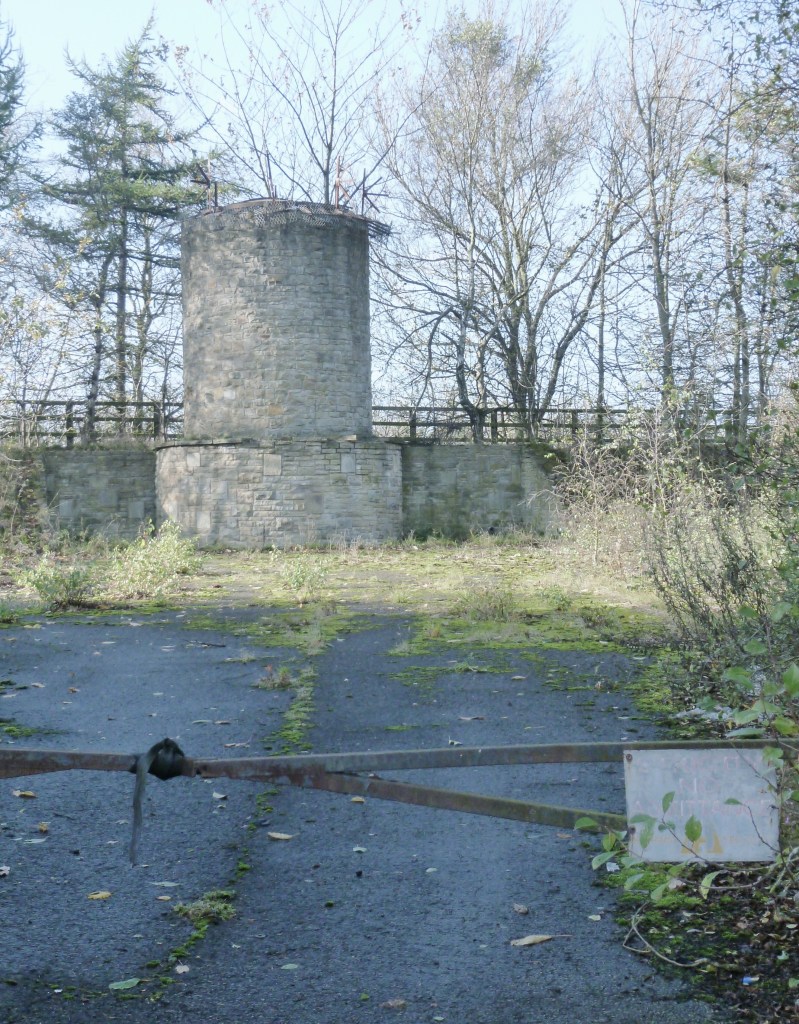
“The Mary Celeste structure [overlooking Barnsley’s inner ring road] is darkened by the downpour. And in turn it seems to be a metaphor for the early dark turn of the conversational subject matter, once I reassert the uneasy truth that this structure has been in this state for over 6 years – yet it is a largely ignored fact. It provokes an intensification in our wrangling conversation over ‘just what the hell is going on?’ “.

” Hemmed in’ plantation woodlands [Flouch roundabout] mark the roadway to the moors. Two bleak landscapes that compliment each other. Both man-made, so to speak., but both important (I believe) to (initially) the Northern Industrial psyche, and (currently) the always-on, hyper-connected psyche. [They act] as a physical reflection of the [empty feeling this speed causes [in us].”

11 November 2014

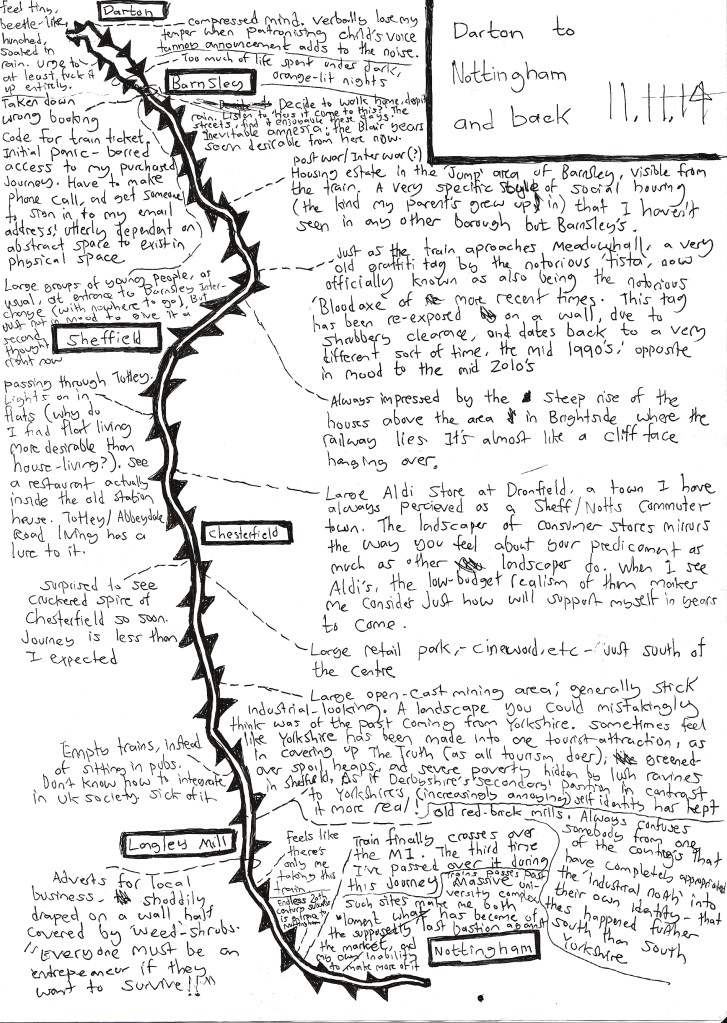
“[Nottingham city centre]. Walking past recruitment centre. People of all ages sat facing computer screens, and people stood outside [the centre] waiting at the bus stop. I feel for them; what an incredibly rigged game it is when you’re at the bottom [and you’re trying to get a break]. I get the lyrics to [Pulp’s] Common People running through my thoughts: “yeah and the chip stains and grease will come out in the bath”, because there’s no way of disguising your poverty, it really does cling to you. Everyone can see it, no matter how you try to hide it. Look over [the road] at massive concrete hotel. Now highly unfashionable. Built in a different era; with a different social reality.”

“Find myself incredibly hungry, with well over 2 hours until I get the train back. [My mind starts running down old and unhelpful psychological warrens, and when it’s irrational thoughts VS illogical thoughts – one has to win over]. I lie to myself, convincing myself that the meandering that follows is for my ‘projects’. The hidden motive being the ‘eating disordered’ mental[ity] that returns when I’m low, lonely, tired and in an urban centre surrounded by (seemingly) infinitesimal choices. My thoughts pace back and forth between getting ‘food involving a drink’ in a pub, but I relapse [ever-so-slightly] into the late teenage me, who spent hours in supermarkets in a decision-making paralysis, due to all the choices on offer. the anorexic control mechanisms still try to get out of their cage from time to time; [the urge to have it back at the reigns is still very seductive].”

11 November 2014

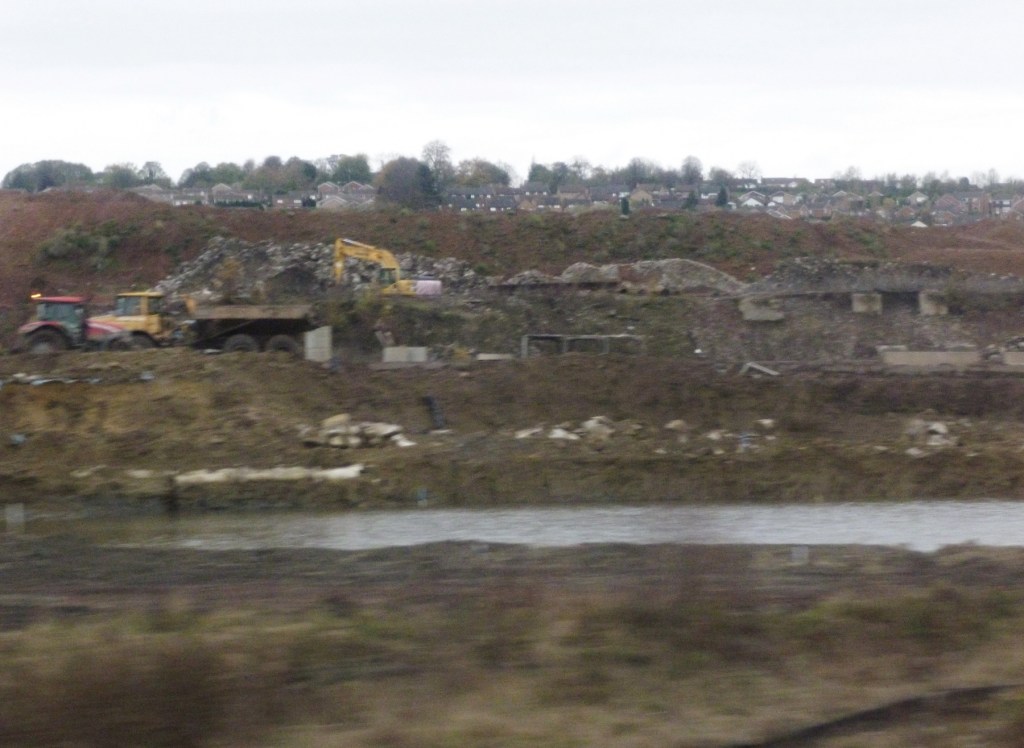
“Large open-cast mining area; [this area is still] generally industrial-looking. A landscape you could mistakenly think was of the past, coming from Yorkshire. Sometimes feels as if Yorkshire has been made into one tourist attraction, as in covering up the truth (as all tourism does); greened over spoil heaps, and severe poverty hidden by lush ravines in Sheffield. As if Derbyshire’s ‘secondary’ position in contrast to Yorkshire’s (increasingly annoying) self-indentit[ification] has kept it more real.”

.

12 November 2014

“Unused grassland/wasteland area between railway track and disused viaduct [just outside Leeds Centre]. About 10-15 police officers walk together [through the grass] in a line, looking for evidence. A serious crime has obviously been committed here, in [an] area that will no doubt be swept under the glitter of ‘regeneration’ once the south Entrance to Leeds [railway] station is [completed]. But, as it stands, it looks like a ‘ideal crime scene location’ – as if this wasn’t real at all, but actually film set for the crime drama A Touch of Frost, which was actually filmed in this area.”

“As I head for the exit at Darton station I noticed stickers all around where the train doors are: English Defence League and Britain First stickers vowing to ‘protect us’ from ‘muslim pedophiles’. A sickly and medieval style to the stickers, and far right party logos. [It] makes my heart sink: “this can only get worse”, it feels to me. ‘The diseased isle’ to [paraphrase] Carl Neville. I wish I knew a solution; as far as I see much anti-fascist protesting isn’t quelling such views. And it’s so bad around here – alienating me from “my own turf”, so-to-speak. Only yesterday I saw a poster on a road sign near Cawthorne saying “Halal Fox”. Stupid/idiotic coupling of presumed ‘lefty’ things, but also dangerously striking subconscious chords – I’m sure.”


2014 mapmaking (part 6)

This is the 6th post in a series that I still call psychogeographical maps (or cognitive mapping). Quoting certain sections and using a selection of photographs to widen the project, which at its core still has the intention to be a Cognitive Mapping of Now – aiming to be useful for locating the current socio-political mood, and the psychological impacts of it.

29 October 2014

“Perhaps due to lack of significant change in my [cassette] walkman-cum-CD-walkman-cum-mp3 player-cum Ipod, it still often occurs that music specific to certain haunts replays itself when I return to the haunts. Looking towards the landscape break [between] the rolling hills of Barnsley and the barren-Pennine hills, I remember how this landscape break functioned as an analogy for a break off occurring in my life, when I frequented this route, often by pushbike, aged 18. The song evoking this powerful feeling of [seemingly uncalled-for] loss is ‘Politik’ by Coldplay (one of the only tracks I hold dear by a band I largely associate as the main audio backdrop to [the] socially-cleansed ‘Bland Britain’ [that the 2000’s became].) Looking up at the green hills towards the (seemingly) always broody enclosure of Penistone, the song gives me a gut-wrenching feeling that I feel powerless to finally put to bed now. It is the break off of one reality to the general reality I occupy now. I see my 18 year old self with a sense of innocence, not really understanding where exactly he was leading his thoughts to the rest of this young adulthood.”

“Looking over to Burngreave’s cluster of row-rise flats that cover the sharp, hilly, incline. Remember being surprised to find out that there was once a large estate [Woodside], including tower blocks, just over the other side of this small hill, but is now long-gone. Although the flats may have fallen into decline, as a South Yorkshire resident I get a sense of deep injustice over the de-metropolising and de-futurising of Sheffield, inflicted on it from Thatcher onwards.”


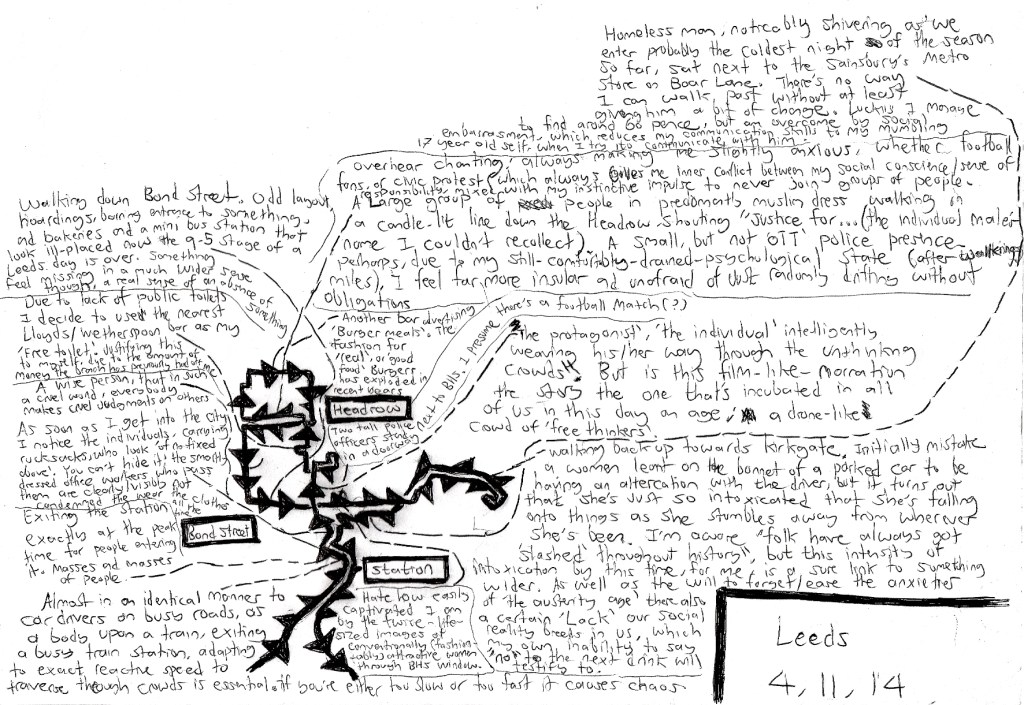
“Young man, clearly homeless, sits outside the Division Street Sainsbury’s [store], on an evening where the temperature has noticeably dropped. Perhaps because I’m a little more beaten by things today, I haven’t got my ‘rat-race’ [need-to-get-things-done] mentality’ on, I feel genuine empathy for him – something I think we [generally] do our utmost to avoid [doing]. But I can’t avoid [doing so] because he has a relatively similar physical appearance to me, which makes the prospect of homelessness far more imaginable.”

30 October 2014

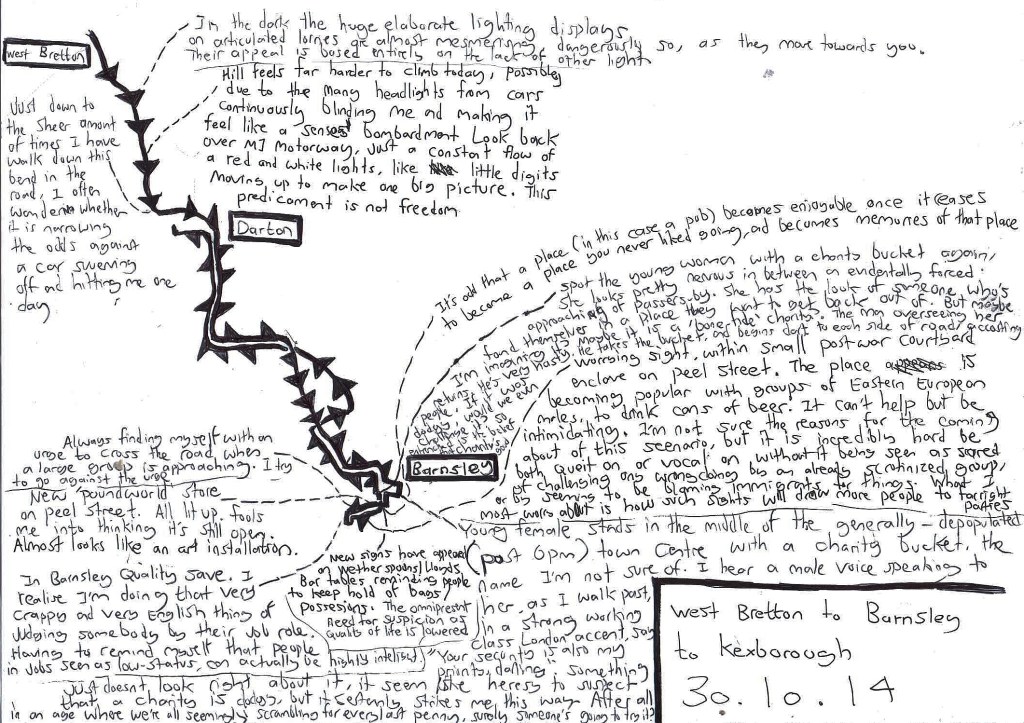
“Hill feels harder to climb today. Possibly due to the many headlights from cars, continuously blinding me and making it feel like a sensory bombardment. Look back over the M1 motorway – just a constant flow of lights, like little digits moving up to make one big picture. This predicament is not freedom .”

“Young [woman] stands in the middle of the generally depopulated (post 6pm) town centre with a charity bucket – the name of which I am unsure. I hear a male voice speaking to her, as a walk past [and onwards], in a strong working class London accent, saying “your security is also my priority, darling”. Something just doesn’t look right about it [all]. It seems like heresy to suggest that a charity [may be] dodgy, but it certainly strikes me as being this way. After all, surely in an age where everybody [is having to] scramble for every last penny. surely someone’s going to try it?”

30 October 2014

“Hill feels harder to climb today. Possibly due to the many headlights from cars, continuously blinding me and making it feel like a sensory bombardment. Look back over the M1 motorway – just a constant flow of lights, like little digits moving up to make one big picture. This predicament is not freedom .”

“Young [woman] stands in the middle of the generally depopulated (post 6pm) town centre with a charity bucket – the name of which I am unsure. I hear a male voice speaking to her, as a walk past [and onwards], in a strong working class London accent, saying “your security is also my priority, darling”. Something just doesn’t look right about it [all]. It seems like heresy to suggest that a charity [may be] dodgy, but it certainly strikes me as being this way. After all, surely in an age where everybody [is having to] scramble for every last penny. surely someone’s going to try it?”


3 November 2014

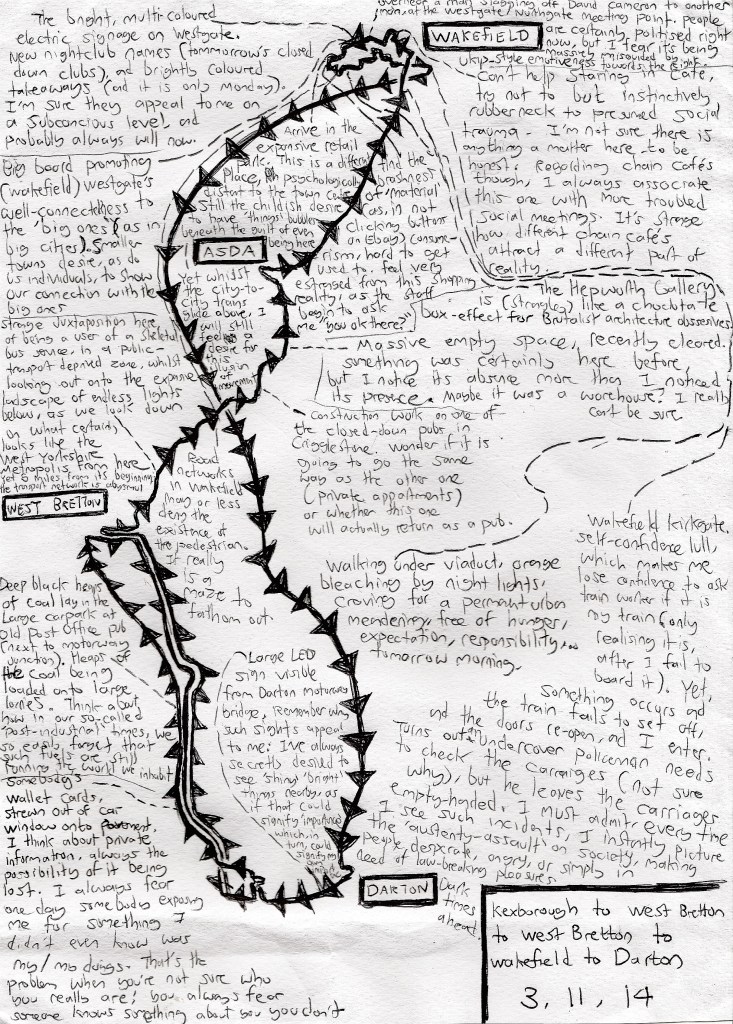
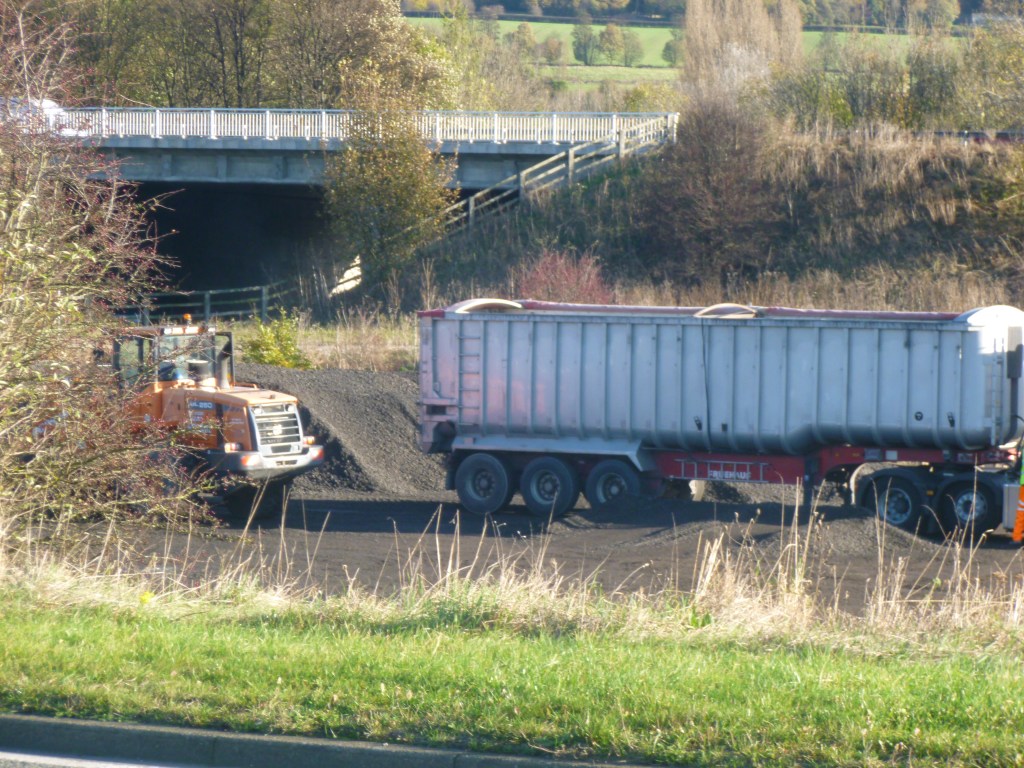
“Deep black heaps of coal lay in large car-park at The Old Post Office pub (next to motorway junction). The coal is being loaded onto large lorries. I think about how in our so-called ‘post-industrial’ times, we easily forget [due to its disappearance – at least in raw form – from our immediate horizons] that such [resources] still fuel the world we inhabit.”

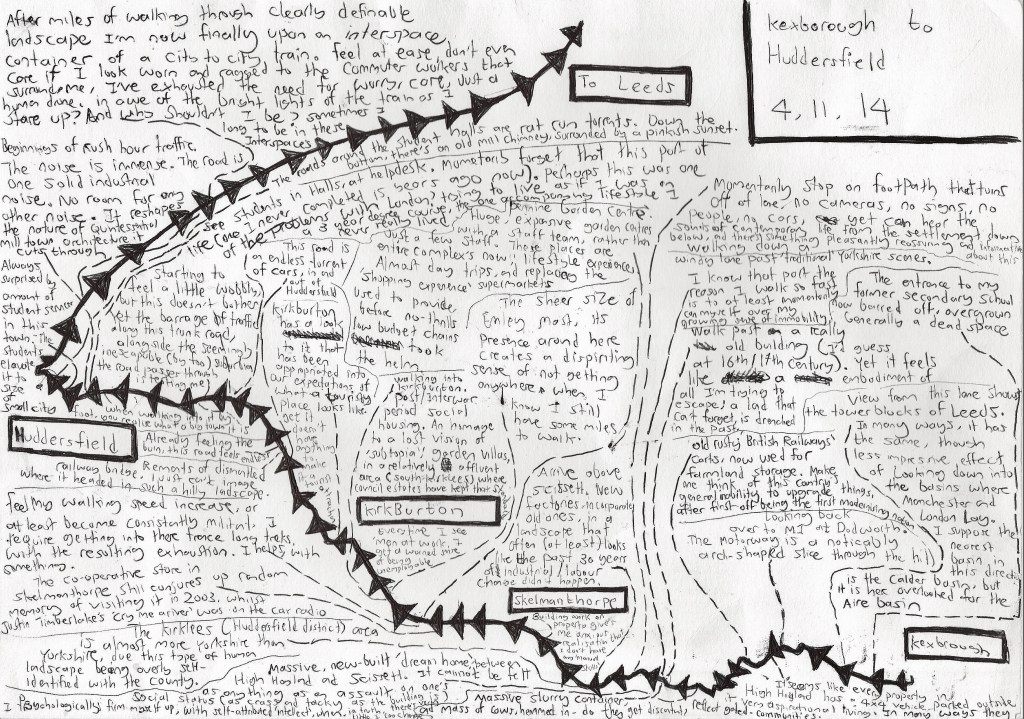
“Walking under viaduct. orange bleaching by night lights. Craving for permanent urban meandering, free of hunger, expectation, responsibility …tomorrow morning.”

4 November 2014

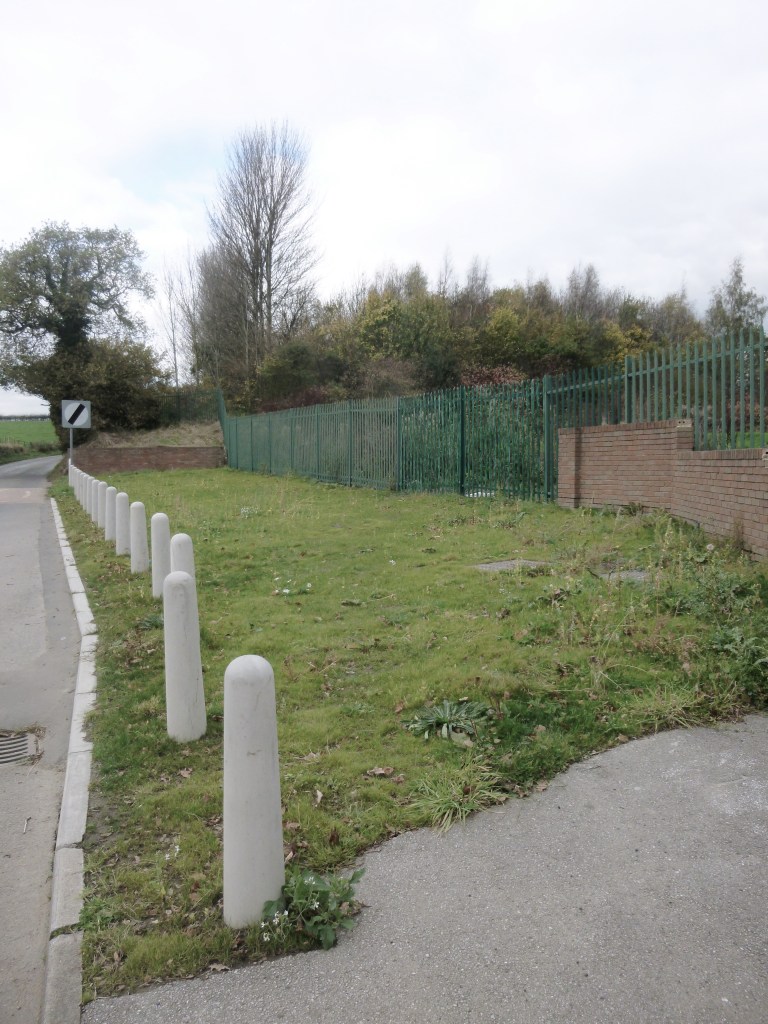
” Windy lane next to ‘traditional’ Yorkshire scenes. I know that part of the reason I walk so fast is to, at least momentarily, con myself over my growing sense of immobility.”

“After miles of walking through clearly definable landscape I am finally upon an interspace container – a city to city train. Feel at ease, don’t even care if I look worn and ragged to the commuters that surround. I’ve exhausted the need for worry, care – just a human drone, in awe of the bright lights in the train as I stare up. And why shouldn’t I be? Sometimes I [crave] to be in these interspaces.

“As soon as I get into the city I notice individuals carrying rucksacks, who [certainly look to be] ‘of no fixed-abode’. You can’t hide it [no matter how hard you try]. [because] the smartly-dressed office workers who pass them by are visibly not condemned to where those clothes all the time. [Such a predicament clings to you].”

“Walking down Bond Street. Odd layout. Hoardings, barring entrance to something, and bakeries and a [small] bus station that look ill-placed now that the 9-5 stage of Leeds day is over. Something feels missing in a much wider sense though; a real sense of an absence of something.”


Recent Mapmaking (2014 so far) part 5

This is the 5th post in a series that I still call psychogeographical maps (or cognitive mapping). Quoting certain sections and using a selection of photographs to widen the project, which at its core still has the intention to be a Cognitive Mapping of Now – aiming to be useful for locating the current socio-political mood, and the psychological impacts of it.

3 October 2014

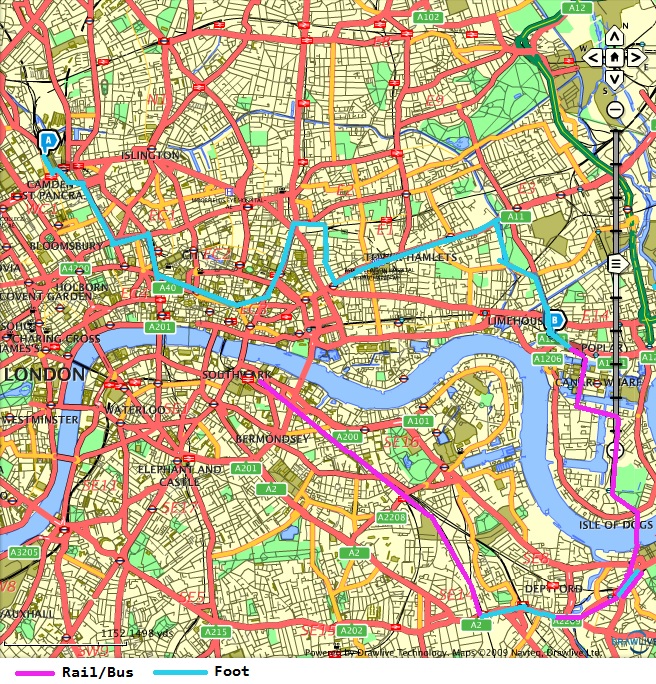
London St Pancras to Westferry on foot, DLR to Greenwich, Bus to Deptford, on foot to New Cross Gate, Train/tube to Willesden Green.

Maps got destroyed. Little clear memory that remains.

“Find my mood caught out by the city this time around. Not tall enough today to stand up to city of tall asks. Strangely comforted by Greenwich. Always destined to head to once-to-be-familiar pubs in Deptford/New Cross. Hauntological hysteria intensified by 1990’s dance music. Lost in an intoxicated mood. Listen to slowed-down dance track in New Cross Sainsbury’s  – it doesn’t feel real, I feel like the ghost this time. Too far gone.”

4 October 2014

Willesden Green to Southbank on foot, then on to London Bridge. Tube to Moorgate. On foot to St Pancras via Barbican.

“Come to realise why I could have never lived here. All thought liquidated by city. Round in circles in City zone. No reason to communicate anymore. A Meloncholic walking drone – no desire to be anything else. Just keep Walking, Walking, Walking.”

21 October 2014

“Arriving in Calder Grove, The Red Kite car park. The Red kite is pure simulcra, before it is anything [else]. Built to look like an ‘Olde Worlde’ pub. Even though it is no more than 12 years old, the self-advertised ‘vintage’ look fooled a friend into thinking it was much older. Yet it isn’t even a locally-orientated simulation [of an old building]. These pubs (like the one at the Dodworth junction) evoke a style of  building that historically belonged [only in] South and Eastern England [not Northern England].”

“[Driving from the east into Leeds] The landscape changes abruptly from the early 20th century suburbia dream to the mid-20th century social housing reality. The dark red brick houses, typical of Northern England, tower-blocks appearing as we get closer to the centre. Yet [this] tower-block skyline is almost hidden from view [from within] the seemingly unbroken consumer/business-man landscape pf the centre. In many ways such [a] blotting of the central landscape brings to mind the ‘cleansing out’ of undesirable features in the 18th century designing of country estates”.

24 October 2014

“Something strangely reassuring about the [reasonably[ tightly-packed sprawl of Manchester proper. A would-be [more desirable] capital city? Quintessential red brick [housing] blocks, overlooked by supermodern complexes – like a safe metropolis compound? As if I could momentarily imagine this (that almost feels like a parallel world to Yorkshire over the Pennines) is free of the anxieties dealt by neoliberalism. Imaginary, yes. The reassuring feeling can only be felt in urban spaces I don’t spend much time in. I wish to be a citizen, a true city person; not a peasant or consumer (which, in reality, I am a mix of).”

“As the taxi approaches the chain pub complex at the roundabout (Redbrook/Barugh Green) the taxi driver says he’ll be voting UKIP at the next general election. I think we got to this point of topic due to talking about trying to survive on low-pay. He [tells me] UKIP have announced they [would] bring in an £8 per hour minimum wage. I find it hard to imagine how a party of right wing (largely well-off) reactionaries would ever truly action such a policy. yet, harder still is trying to explain to people how [I believe] UKIP aren’t really in their interest. Yet they’ve [UKIP] seeped into many peoples’ fears and desires. I exit the day with a sense of foreboding for the near future, feeling there’s very little I can do to alter this path”.