Why, I wondered, do I only notice Telescreens (the object itself, rather than what it is showing) when they are turned off? Looking up at the sleeping boxes as I enter the transport interchange, there was suddenly something more about their presence; they almost had a creepy presence as they hung above my head, and all the other heads on their way home. If they were switched on it would have been giving me information – what us humans gasp for, and can’t ignore, even if it bears no importance to our own endeavours.
Our lives are surrounded by screens. Something about the image on them, be it another humans or just simply text, has an authority over us. For example, just look at a conversation and how the communication going on in physical reality merely acts as an interval between the urge to get back to what really matters: text chatting on mobile phone screens. For another example, put a TV in a pub/bar and suddenly the place becomes like a theatre with a captive audience rather than a place for conversation.
But when the power goes off, we have these blocks and squares staring at us. And it feels really weird. It is as if our leader has abandoned us. “What the hell do we do now?” We can only hope they are switched back ASAP and that things get back to ‘normal’.
And still the screens advance! Barely any of us drive places without guidance from the sat-nav screen; we now read books on screens rather than carry real ones about; I also find myself feeling that my music player is incomplete if there isn’t the album sleeve of the currently playing artist beaming back at me as I stare down at it, whilst frantically clicking at its buttons (mind you, that’s also just a tactic because I’m scared of eye contact with the hyena-like gangs of teens running about in the transport interchange, to be rude to them and true to how they make me feel).
Ok, using screens in this way isn’t a bad thing on its own. It’s our growing dependency on them which is the concern, and it only seems to hit home when they are turned off, and we aren’t blindly (not literally of course!) obeying the information they give us. More than that, all this is run on finite energy, what will we do if we find no new way of powering it all and it stops? Will we do what Thom Yorke Suggested in ‘My Iron Lung’, “just hum”?
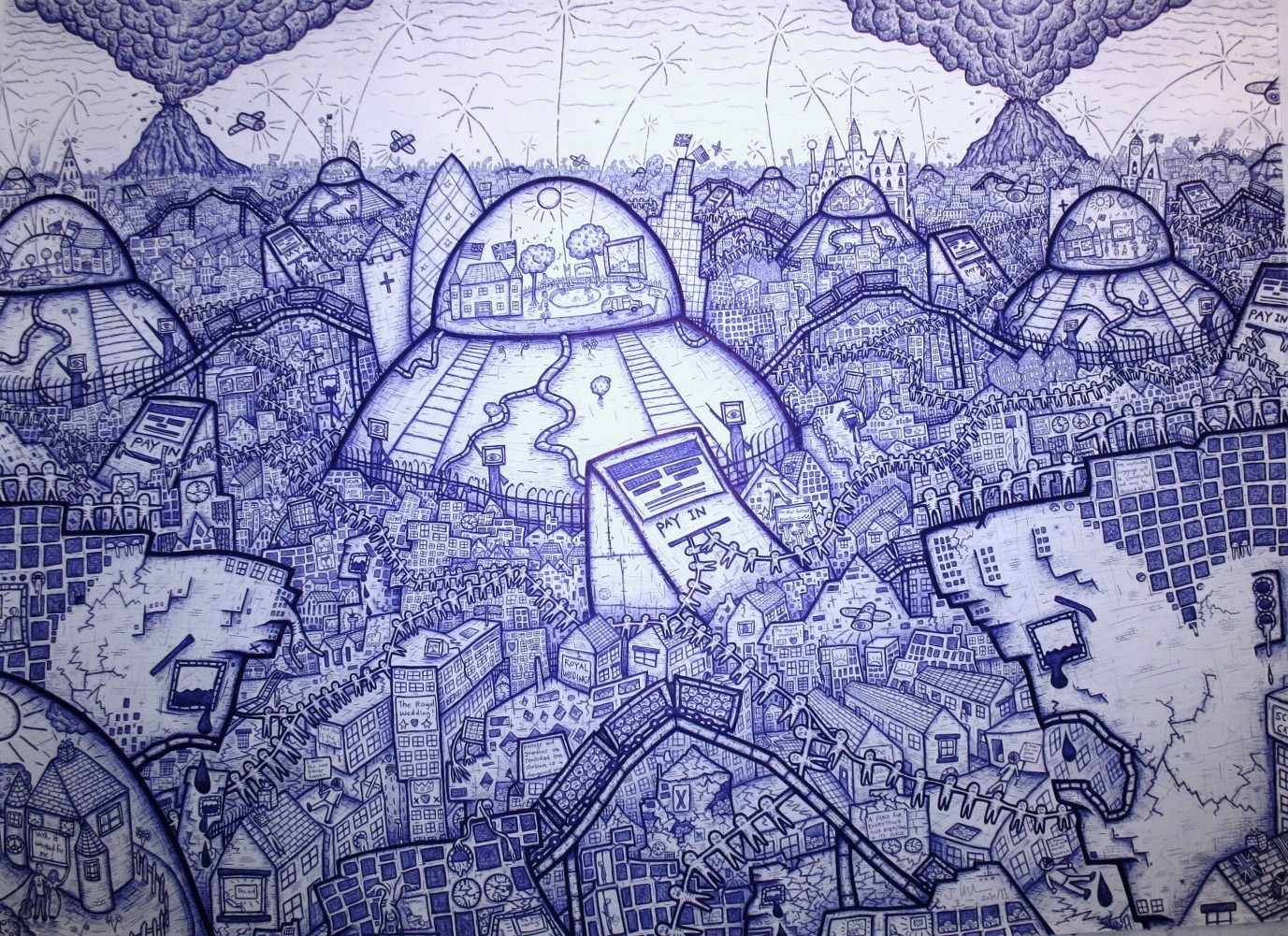
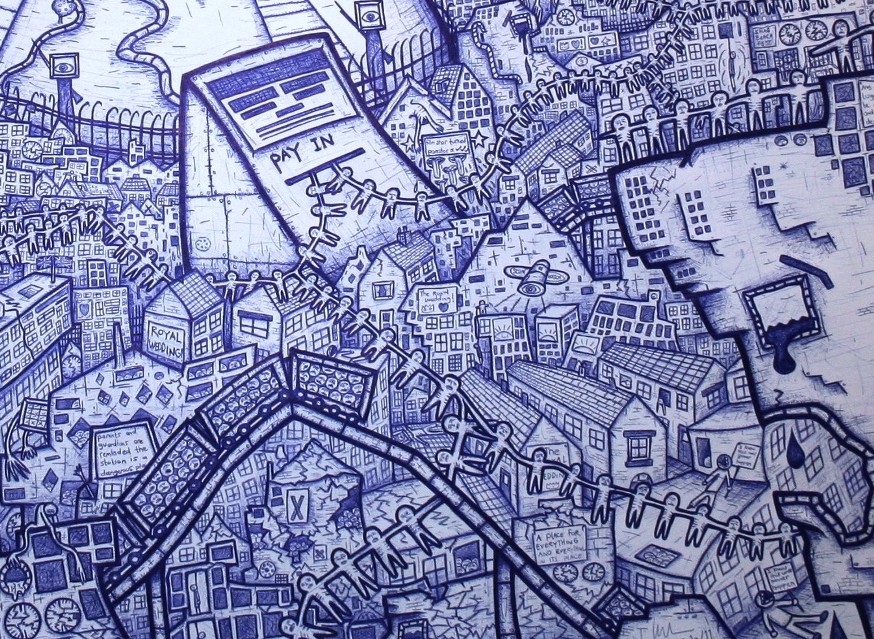
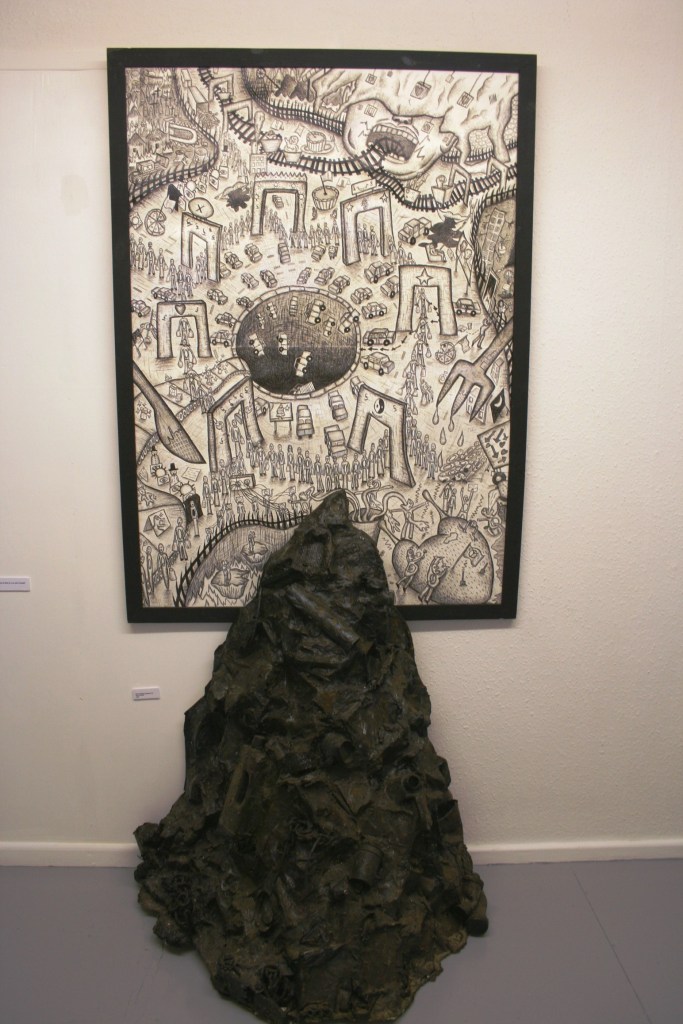
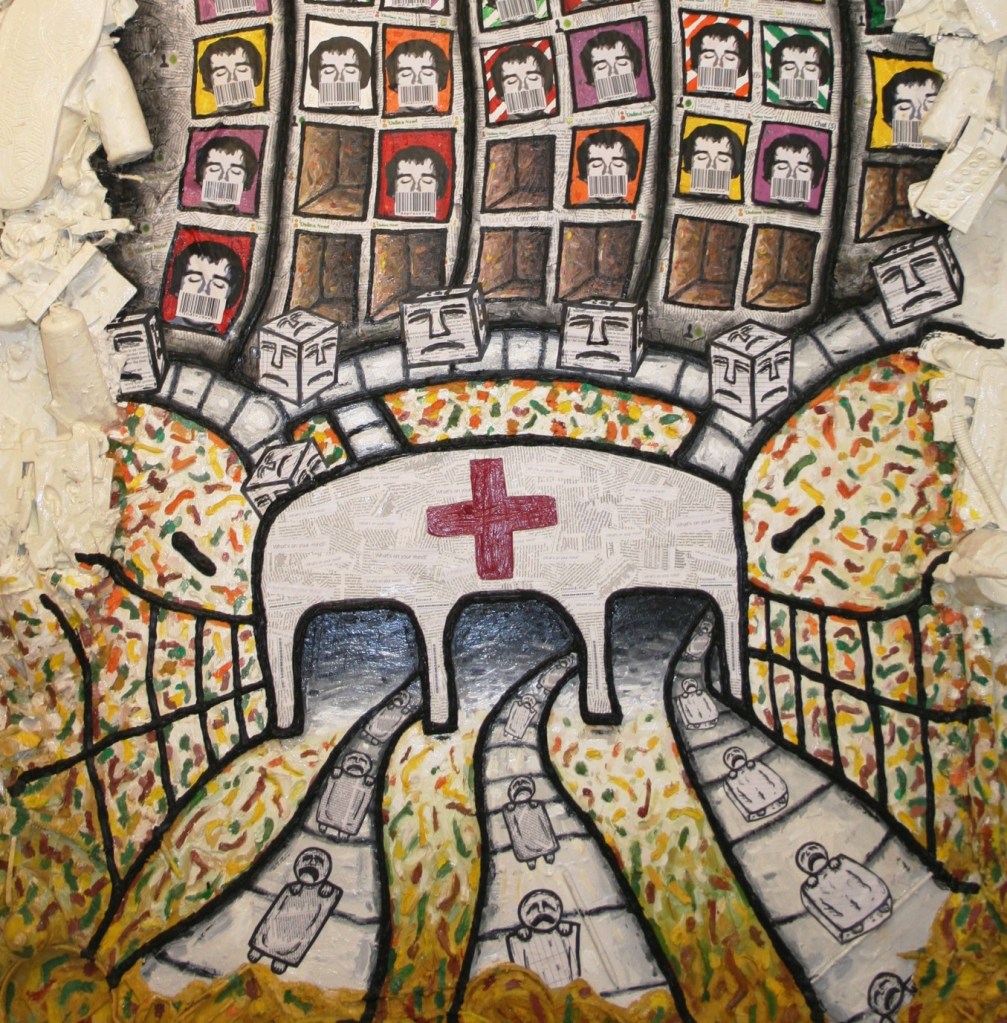
Global Ghetto, 2045, marks centenary of defeat of Fascism, (Biro on paper, 140x100cm, 2010/2011)
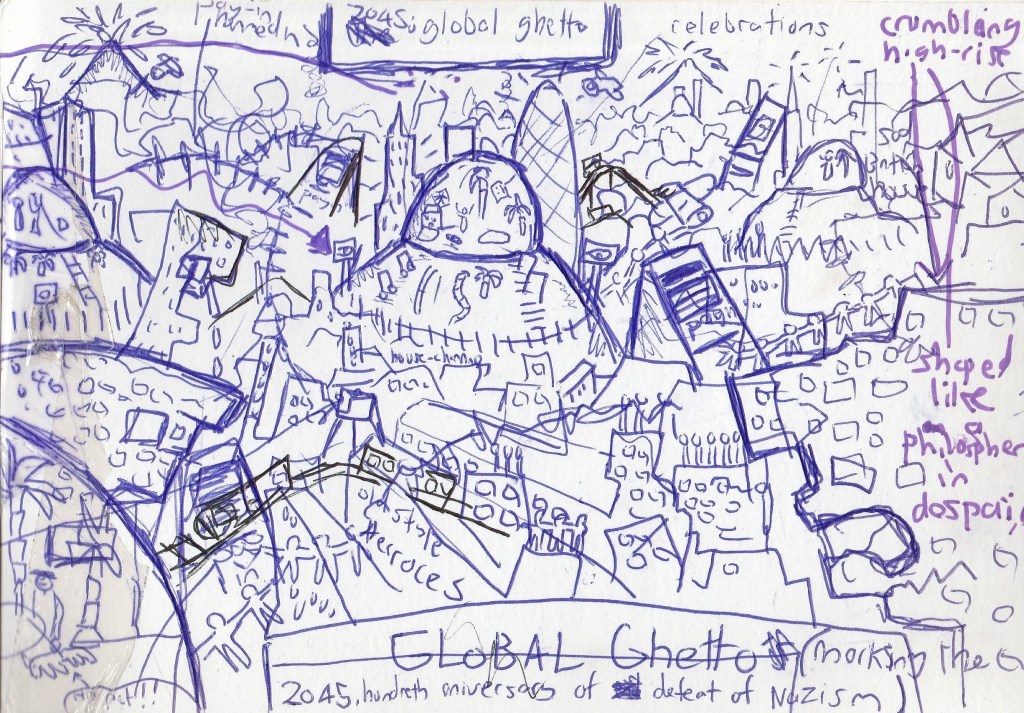
I began making this drawing in November 2010, and have only just completed it. I began to develop the idea whilst sat in a café one afternoon. This is how the ideas begin:
My expectations of a future under global capitalism are bleak. Whilst imagining a future, the date 2045 seemed to stick with me. This is because it would be 100 years since the defeat of fascism, a date which we all look back at where good won over evil, and we were told that such human suffering must never be allowed to happen again.
With the defeat of fascism and the end of war, despite the threats of the nuclear age, people alive in 1945 had a belief in a future that would continue to bring them a better life. At present we see the future in the opposite sense: things are only going to get worse if we carry on like this.
In my darkest moments I fear that there will not be any of our “great cities” left in order for the global ghetto, predicted in this drawing, to be actualised. But the future date of 2045 was very important to the idea of progress; 100 years since the widely assumed end of the Second World War, it stands as an historical landmark from which ‘evil’ was defeated and ‘good’ would now make the world a better place. But this idea, which still rests solidly in the hearts of all those indoctrinated by western ideas, has turned horribly sour.
This piece intends to be seen as an extrapolation of the present; my grim expectation of the fate of most of the people as the world continues to be driven by capitalism. It also just solemnly looks backwards and bluntly asks “What went so horribly wrong (in order for our future to end up looking so bleak)?”
Fascism was like a tragic car crash, from which the ruling powers of the time were never really held to account for their reckless driving, and, thus, have continued to drive recklessly. It isn’t alien to our own ruling system; they share the same roots, like cousins. Likewise, our system has the ability to fall into dictatorship, if put under severe stress. I have intentionally tried to put elements that we are currently familiar with into a landscape which is terrifyingly worse than what we know now. But such a world may be actualised, as deterioration is all we can now expect under global capitalism; its welfare state period is dying, the planet’s resources are becoming more and more expensive as they dry up; the future for humanity can only get worse on this route. The system can now only deliver a slow erosion of democracy and a dystopia which the prophetic writers of the 20th century would have struggled to imagine. The future we may once have expected has taken a horrific u-turn.
The idea of the survival of the best/the most competent has certainly been normalised in contemporary society – as opposed to the pre-Thatcher era when there was more (but not much more) emphasis on equality rather than the equality of opportunity which compresses our outlook now, which began to take hold under Thatcher here in the UK.
This is even more so in our “current economic climate” (another phrase which has been normalised to the extent that we no longer question why it must be this way) when there is a distinct lack of jobs. I’ve stuck with the same, not very well paid job for 4 years now – it is not a ‘career’ job, a factor that makes a 4 year spell at the same place an oddity in modern times. I don’t even attempt to be a confident career aspirational, and my lack of confidence in my ability to stand a chance in the job hunting world has both made this refusal to partake and has been influenced by it from then onwards.
I only have to hear about my friends’ and family’s attempts to find work (work well within their experience and skill levels) and being rejected because there’s so many people from all over the land competing for the handful of jobs going in this “current economic climate” (stop fucking saying that!), to find myself seething with aimless rage about a world that is grossly unfair under the normalisation of extreme competitiveness.
This normalisation pressures us to live our entire lives trying to be better than others. Of course, many people believe in being good to other people at the expense of, or at least as well as, personal triumph. Nevertheless, they are always on the back foot. And they know it: they know that there’s enough of a force out there, made by social conditioning, to kick them down for trying to be fair with people, and they know that unless they adopt some part of this attitude that they are in for a life of strife and hardship.
We’ve all heard the sayings “you can’t go through life thinking like that” and “you’ve got to look after number 1 in this world mate”, well, it isn’t human nature which makes these ways of behaving rule over all others, they are ways of behaving which supersede all others because the systemic structure has normalised them to be so.
Once the word ‘brainwashed’ is used people turn away, presuming they are listening to a deranged conspiracy theorist. But there’s no need for conspiracy, the truth is laid bare that a system conditions people to think in certain ways, to act in certain ways, instead of other ways – isn’t that brainwashing?
It is a ‘design for life’ (as the Manic Street Preachers put it) and I feel a great pressure to adopt it in many conversation patterns I have, which roughly run like this
Me: “I don’t want to drive, it’s just adding to the problem (of too many cars)”.
Other Person: “But you need to learn how to drive if you want to get anywhere in life”
Me: “well, I don’t even earn enough money to learn how to drive”
Other Person: “Well, you need to start looking for a better paid job then. You can’t just work in this place forever!”
Me: “I’ve got no family, no girlfriend, no mortgage to pay, and I don’t want a job that takes up my life, because I want the free time to spend on my art work”
Other Person: “Yes, but you don’t even try to market your work or get yourself out there more. Surely you want to be able to make a business out of it?”
Well, never wanting to fall out with people, I usually shut up at this point, when what I would want to say is “well, actually NO, I don’t want to make a business out of it, I don’t ant to reduce it to a fucking business. You say you like my work, but do you even take any notice to work my work is actually about?
This is when I hit the brick wall, unable to challenge this normalisation of the idea that competitiveness, thus business, should rule over all aspects of life.
An image that will always stick with me is one which was on a video in an exhibition commemorating the holocaust, at the Imperial War Museum, London. In a well-meant diversion from the Jewish Holocaust, the video narrator spoke of all those other holocausts which have happened since then in the late 20th century, mainly in the poorer parts of the planet, which we hear significantly less about. The moment which gripped me was about how these awful events come to be, as it spoke out to the whole of the humanity for our parts played in them, describing how seemingly minor actions made by citizens in richer consumer societies have an affect on other areas of the world.
.The camera focused on people drinking take-away coffee from some cafe-chain. This struck me, as I have (certainly did so back then) a fetish for buying ‘Mochas’ from cafe chains such as Costa, Cafe Nero, and at that moment I certainly was looking forward to one. Never quite escaping the bleeding obvious in this globally divided planet of exhaustible resources, I spent hours trying to justify getting my chain cafe coffee fix. The likelihood that that one purchase would trigger some genocidal rampage is low, but this is irrelevant as I am playing the game: I am keeping the entity of capitalism in motion/in power (at which point it must be pointed out that, far from fighting against racism/bigotry, capitalism needs them to be there, unconsciously, playing a part in the psyche of all able consumers – if aware of capitalism’s destructiveness, the bulk of consumers need some unspoken sense of superiority to allow them to carry on doing what they know is potentially harming somebody else). True to form, the battle for attention between the guilty me and the hungry-for-more me, played itself out, right through the rest of London visit, until I was at a familiar lull from where I realise that I cannot obtain enjoyment, thus a life devoted to the making of my artwork is the only saviour. The image of the people drinking coffee, which followed on from images of the Killing Fields of Cambodia were the iconic images of all that day’s trekking.
.It’s easy to imagine a future moment when one no longer feels so discontent with themselves so that there remains the desire to be constantly consuming, but this moment never arrives. The propagandist infrastructure, that surrounds us, constantly refers to this period when all finally rests OK around our necks – a point when there is no demon and angel battle battering us from alternate shoulders – but of course it would refer to this stage; it keeps us hooked into the matrix; constantly jumping from one failed holiday from work-time to another (and just to point out, most holiday-speak in postmodern Britain refers to binge drinking sessions which nearly always end in farce). To add to this, personally, it is easy to imagine a future weaned off capitalism, growing my own ‘veg’, being less worried about “looking a mess”, yet as soon as I meet people and go places that are more down this alleyway I feel a desire to be heading towards the city lights, railway journeys and the clean shaved feel. I feel disgusted with myself about this. I am reminded about my own stupid capability of making myself feel alienated and detached from everything once I am next to it. I put my hat on, my long black coat, my rucksack, and play Metanomic by John Foxx on my music player (dark synth-pop from the early 1980s) and set off to walk the streets by myself, and I feel myself again.
Today after a day/night trip to help on an organic farm my sister is staying on, apart from a love for the English oak and enjoying finding things buried beneath the soil, I felt so much more myself as I returned to my big coat, rucksack-on-back, as I entered the concrete gridded postwar town of Stevenage. I felt weird to feel at one in a human way of living which I am all-too-aware is provoking a disastrous 21st century, but I did feel more like me; a socialist-orientated thinker who ironically feels more at home in his isolated urban meanderings, looking for hope in places that he all-but-knows he will never find it in.
It is a slow process in becoming who you want to be; you’ve spent you’re entire life spoon-fed media and ideas that make you lose your identity and make you lose a true sense of enjoyment; in a consumer society, where we are bombarded by images of enjoyment and fulfillment, one should take note that they are profoundly lacking. I have taken note, yet my cockles are still warmed by the prospect of a night-out piss-up which usually, although nice for the the fist 2/3 pints, turns into a regrettable experience. Although possibly more screwed up by it, these ‘occasions’ are what most of us earn our wages for and anticipate with glee. The holiday is perhaps the greatest example of this, and thankfully the piss-up seems to be the only one I am still wired-up in – precisely because the act of getting pissed is the act of forgetting both the state of humanity and that state of ones own life (although both come back to haunt you after 6 or 7 drinks).
To be honest I can’t even be arsed with holidays. Take away the one thing that usually exempts me from guilty feeling – producing works of art/rantings that work as a defiance against my 21st century despair and also divert me from the truth about my inability to enjoy the present – and I feel constantly shit about the fact that everybody but me appears to be having a good time, in an apparent enjoyment which just seems to pass me by.
I always get the lyrics from the final song (Fragile Happiness) on the Super Furry Animals’ 2001 album Rings Around The World (which, it has to be said, is perhaps one of the best albums for depicting the postmodern condition, and seemed to be released just in time before alternative music got incorporated into, and began to solely exist for TopShop fashion parades). The lyrics go like this:
“well go to Miami Take old friends and family we’ll stay out and party does Will Smith lie? does he ever cave in and cry?” (Fragile Happiness, from the album Rings Around The World, SFA, 2001)
You see, as much as I know that breaking free, living off-grid, without a need for shaving foam, and moisturiser is the right thing to do, its those who are miserably trapped within who I resonate with. I suppose an artist has to live within the mess to depicted it; I just wish I could be certain that this was the main reason why I stay within it and not mainly because I enjoy being led by its carrots on sticks. I’ve made many works depicting the sinking ship of humanity in the 21st century, and know that this is because I’ll definitely be on it. .I really wish I wasn’t so paranoid around people, and not so negative as to be unable to be part of anything which equates to helping the environmental cause, but I’m not this person. Sadly I’ve built myself into a pessimist who seeks morbid fascination in concrete jungles and dystopian music – I do not like myself, so I suppose I find the places that suit me. The iconic factor of my inescapable addiction to the process of humanity’s self-destruction is possibly that of being constantly attracted to women who consent to the shallowness of late capitalism, living behind a veneer of brand-new clothes, make-up, ‘top’ hair does, and big nights out, as opposed to a woman who would actually probably be right for me. I don’t like what’s good for me; I’m captivated by what I see as I lift up a fold on humanity’s death throw. I am a decent bloke trapped in a western pigdog – or maybe it’s the other way around?
I had to trawl through all the old household photo collection to find what I wanted; you know, photos from a time when they actually meant something, before images of everybody from every place at every time where splattered upon the social networking sites; you know, the times when it took a couple of weeks before you’d see the photos – not just the next morning when you check your online accounts to finds photos of your drunken self from only 6 hours previous.
These are images of Woolley Colliery in the 1990’s – before it was demolished and whilst it was being demolished. (apologies for their poor quality).
(Woolley Colliery – in the background – in the middle of being demolished by explosives, in 1993)
(Woolley colliery – the left of the picture – before it was demolished and before the factories were built in the foreground)
Within the valley (upper Dearne valley) I grew up in, these were the last traces of a landscape and meaning of the place I was born into disappearing and making way for something else. I’ve been interested in my family tree a little more of late also. It seems sensible enough to assume that I do this at times when I do not see much of a future, and if one takes into consideration the full scale of the ancestry websites, making money out of people also looking up their family roots, then one can see that as a society we don’t seem to be able to see much of a future at present.
For me, personally the expectation of already irreversible (to some degree) environmental problems is what drags a landslip over a doorway to a future which I once expected to walk into. But for many it may be a realisation that the liberal-democratic order has failed us, after it wiped out any suggestion that there may be another way to build a better life for us all. Whatever may be the case, there is most certainly a lot less optimism than there was even 8 or 9 years previous. Something has to change.
The landscape in which these photographs are situated is an interesting one to point to especially: as the old coal mining towns/villages themselves suffered incredibly from the destruction of the sole meaning for their existence in the first place, the landscape improved and greened over massively during that same period, and although much is being leveled off for housing developments, it is still a much greener place than it used to be. Now, I do not for one moment intend to suggest that this is compensation for the heartless economic decisions made which destroyed so many peoples’ way of life, but it is a good in its own right – if it stays that way, that is, and developers do not run amok (which seems likely under the ultra neoliberal capitalism the current government are bringing through).
However, more than anything, I am making NO real point here at all – I’d be lying to pretend that I have any over-positive thoughts up my sleeve to finish this blog off with, so I will just idly try to relive the past like everybody else seems to be doing.
So, yet again I find myself in a personal battle to abstain from the technological dictation of communication. Caught in a dilemma, knowing full-well that abstaining from the social networking sites will sever many social contacts but also never ever forgetting the miserable state of mind I sink into whilst scrolling up and down my profile page (although this blog title is assertive the real me sways like a Silver Birch in a strong wind). However, a recent Facebook FAD has reviled me to the extent where I simply didn’t want to have any presence on the site full stop. To many this revulsion may offend, as it is all too clear that most see this application as nothing but harmless fun, but I sense a massive underlying sinisterism. I am talking about the ‘Fat-Face’ application which allows Facebook members to manipulate photographic images of their faces to see what they would look like if they were considerably more overweight than they actually are. Thus, people post these pictures on their walls, for digi-friends to hoot and howl at how they’d look if they were 7-8 stone heavier. What nobody seems to mention is that, because the program’s manipulations are convincing, it actually makes the enlarged faces look like real people in existence – you know, people who may actually be on facebook, like? friends of yours, like? On Facebook to try to make a better social life for themselves, like? As a former anorexic I take a severe dislike to this new FAD. Anorexia, you see, is a fear of being fat, in fact it’s more than that – its a terror of being fat. And this kick-starts an obbsessive disorder in a drive to become what society informs us is perfect; ultra-skinny. I wasn’t born seeing fatness as the worst thing possible, it was learnt behaviour which I became fully concious of in my teenage years. To be fat, although it is never stated in such a clear-cut way, is the worst thing to be in this advanced consumer society (the explosion of eating disorders no doubt runs side by side with the beginnings of Neoliberal Capitalism in the early 1980’s). I never knew until recently that the anorexia-causation-model-Barr-none Kate Moss actually once said “nothing tastes as good as skinny feels”. If one couples this quote with lyrics from pop-culture’s polar-opposite, The Manic Street Preachers “I am Twiggy and I can’t see the horror that surrounds me” (late lyricist Richie Edwards suffered from anorexia) you can easily see how when one is really skinny in a mass consumer society, it basically lets you off the hook – “you’ve no need to feel guilt, shame etc”. To be fat in a mass consumer society is to expected to feel like a nobody, a dis-likable blot on the landscape of desirable’s (even now, when I wake up feeling fat, I feel irredeemably depressed for most of the day). So, if you then go back and observe the jokes and hoots at the fat versions of people, you can see that it speaks as a mass denunciation and humiliation of overweight people. And I know that most people who have made a fat-face picture of themselves will be offended by this, but I’m not here saying that you intended for it to be an attack on the very overweight. Nevertheless, this is what your collective fat-faced images convey. I’m sorry, but when you’ve studied the societal hounding of physical imperfection for years due to the very fear of being hunted down, this is the conclusion that one arrives at.During my flitting on a off Facebook during that past 4 years it has, at times, appeared to be more of a Facebully. Its programs, add-ons often encourage users to attack those who society sees as the undesirables, those too ‘ugly’, too unpopular to be able post pictures of themselves on the site – an older application named ‘Compare your friends’ was equally as bad, as visuals appeared documenting the disparity between those who nobody cares for and those who everybody adores. Obesity is as much a symptom of late-capitalism as anorexia is; the incidences of each rising simultaneously almost in a sadistic compliment of each other as the system’s jaws open wider to unveil the dystopic beast. One of my favorite ever sayings is “it is no measure of good health to be well adjusted to a profoundly sick society” and when the desirables who light up the aspirations of the population include people like Kate Moss and Pete Doherty this saying becomes ever-more pressing. If anybody with a Fat-Face App image of themselves on their Facebook account is reading this, try not to dismiss this post as an overblown reaction (I am in fact calmer than usual as I write this). Likewise, don’t dismiss it as an attack on you personally for your decision to use this application. All I’m saying is that the bigger picture of all the Facebook Fat-Faces, amongst the even bigger picture of society’s denunciation of all people without the perfect face and body (and personality, if you want to complete this picture) is one of a mass undetected discrimination. Thus, all I’m asking is for you to find fun and humour amongst yourselves without using this program, as it is a signifier of downward discrimination, which, because it has become a normal thing to do in society, few realise they are partaking in.
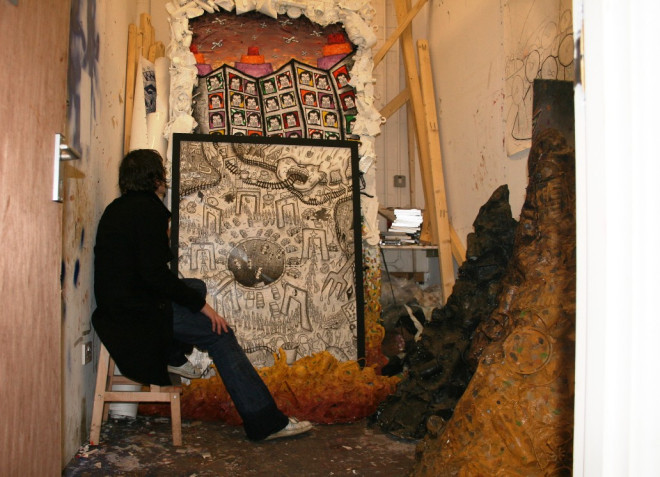
One of the reasons why there is more writing on this blog than artwork at present is ecause the place where I make my work is so cramped with old works that I can hardly move. I have provided truthful photographic evidence of this, for anyone bored enough to be interested in such A NON EVENT of me telling you that “nothing is happening”. There again, I kind of like the look of the studio when it looks like a trove of all the stuff in my head – but there again I would wouldn’t I? because it’s my head. So here it is a post about NOTHING IN PARTICULAR. But at least I’m not posting pictures of my every last carbohydrate being used up,to put on Facebook. If my studio continues to get more cramped – I’ll probably turn to this in a week or so. Sorry to waste the time of anyone who’s time is actually important.
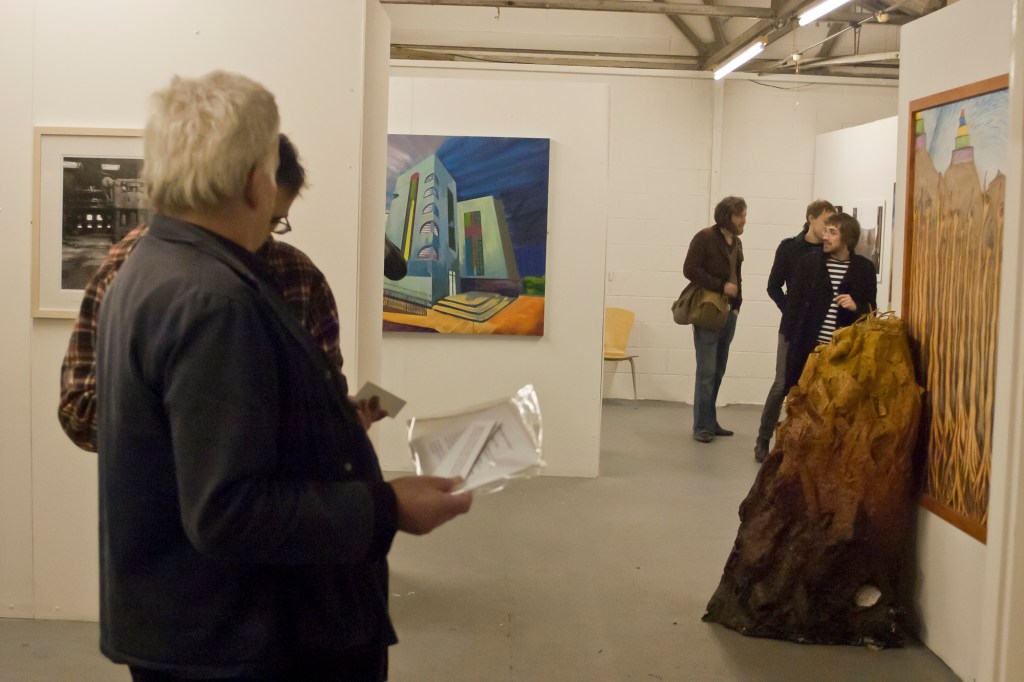
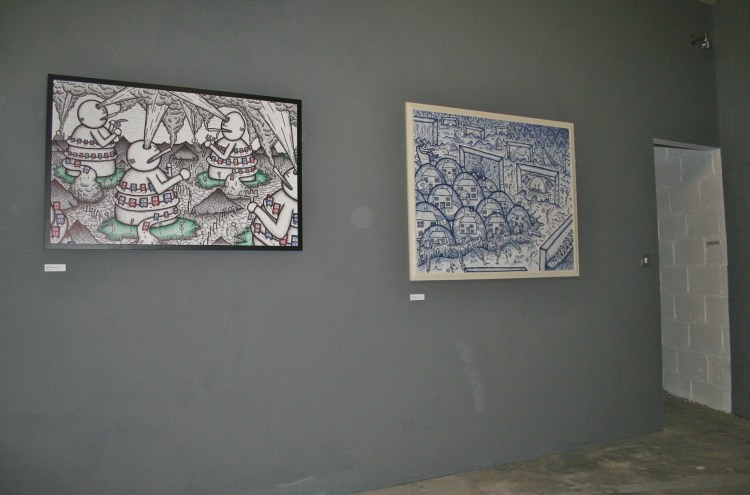
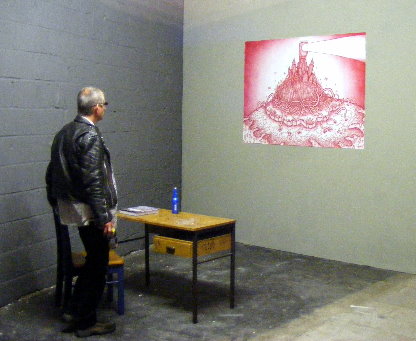
This exhibition was held in the Shalesmoor area of Sheffield, October 2010. The works I made for the show had been shown previously (I usually try to show new work for each exhibition) but my current work takes me so long to make I sometimes just cannot manage this. Anyway, thanks to those at CADS for inviting me to be part of this show. There was some really high quality work in this group show..(some humans looking at a picture)
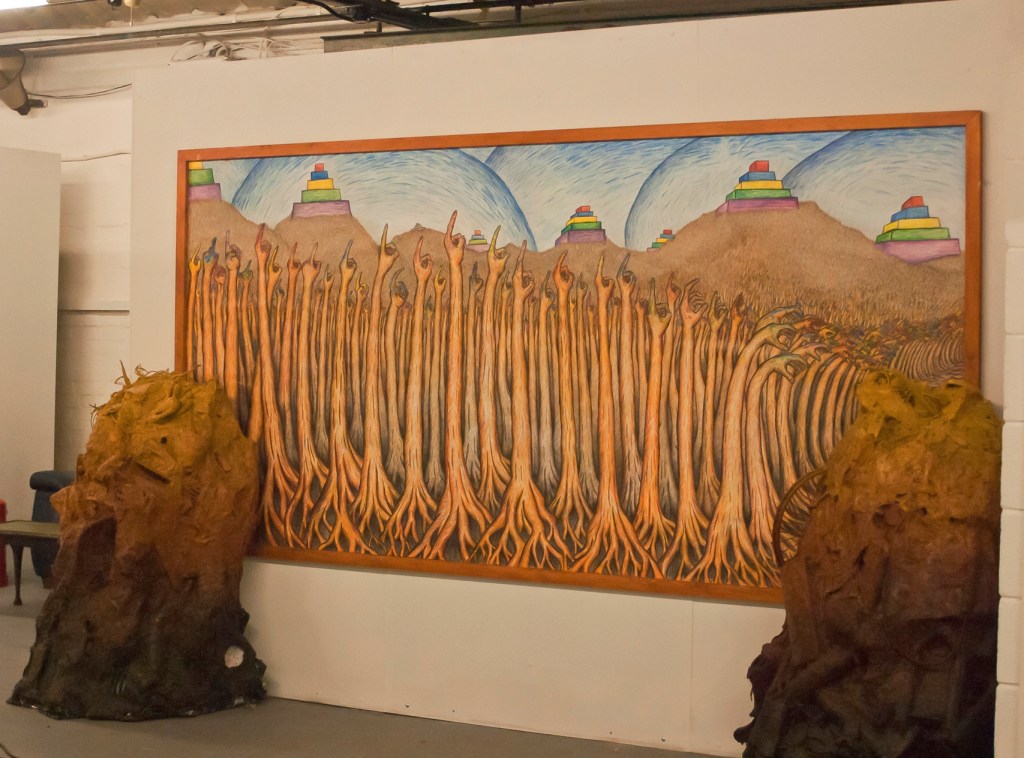
The Alpha Forest, 2009, pencil crayon on paper, 10X5ft
“I Believe in Capitalism”, 2010, biro on paper, 120X160cm
The Tide of Society is an exhibition of works central to the battle to retain a sense of true self amidst the mental bombardment from mass persuasion and systematically imposed duties. Trying to swim upstream is the only option for one who is subjected to this, if they wish to retain a true sense of self.
Although I created some ideas and imagery based around a tide of society whilst I was still a student, the majority of these ideas have been prompted by an unavoidable (due to position) 9-5 working life undertaken afterwards. The looming domestications, brought on by these duties and expectations of one, team up with the (already present) pressures of living in a consumer society. Indeed, for the first time I am beginning to understand my subjection to both ends of Capitalism: pushed into a job to become a wage slave, and pushed into the shopping aisles to become a participative consumer (“amusement under late capitalism is the prolongation of work” – The Culture Industry: Enlightenment as Mass Deception). Work and leisure time, alike, are confronted with the fact that “it’s much easier if you don’t think about these things too much” and so comes the lure to consent and conform to all that seems to be being suggested to you.
But where is this tide dragging society towards anyway? The ultimate compulsion within my work is to link every issue tackled to an ultimate concern: that of our predicament upon this planet in the 21st century. This fear has always engulfed and incorporated all other fears. We are pressured to increasingly consume more on a planet of drying-up resources; pressured into seeing that continuous growth is “the only way” on a planet which cannot afford our species much more growth; and then we are pressured to live our lives through digital devices, prompting ever-more isolation, hence more need to satiate ourselves via consumer outlets, whilst also becoming more separated from the ‘terra firma’ on which we depend.
The list of ways in which the tide of society is flowing to a place from which the earth can longer give us what we require goes on and on. This exhibition is mesh of global, social, and personal concerns, as we leave the first decade of the 21st century behind us: a fear of a possible ‘shared downfall’ of my own life, humanity and nature.
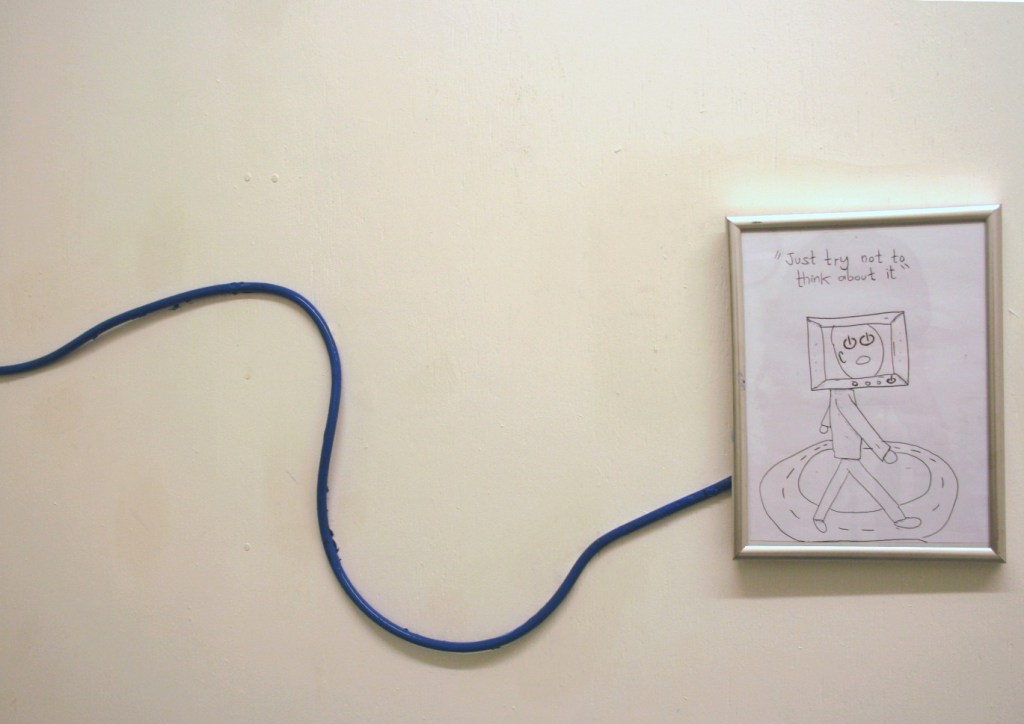
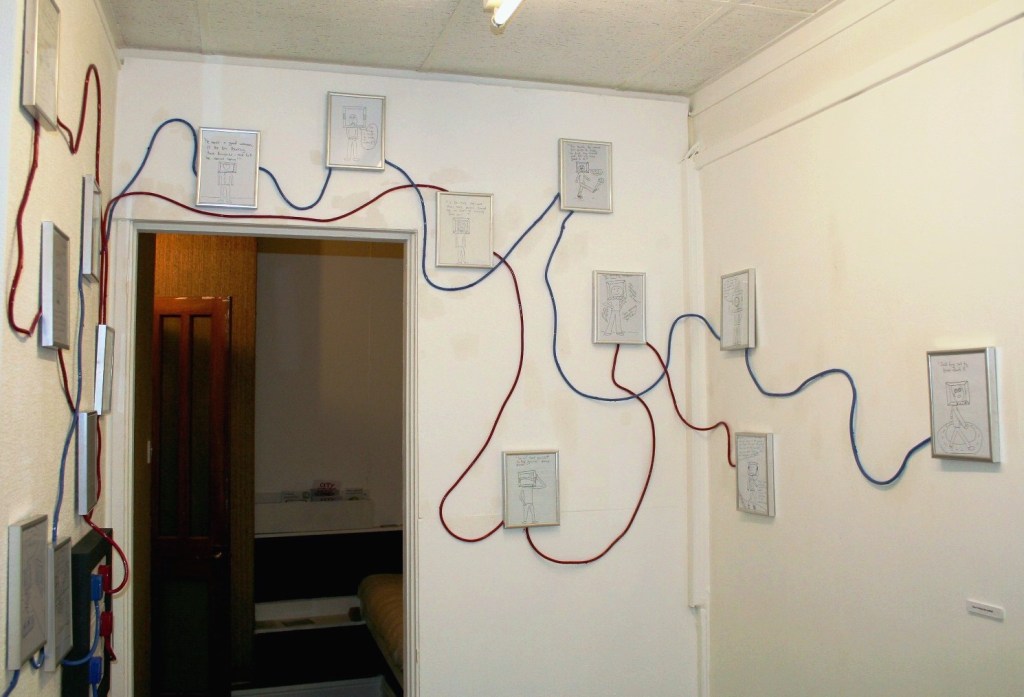
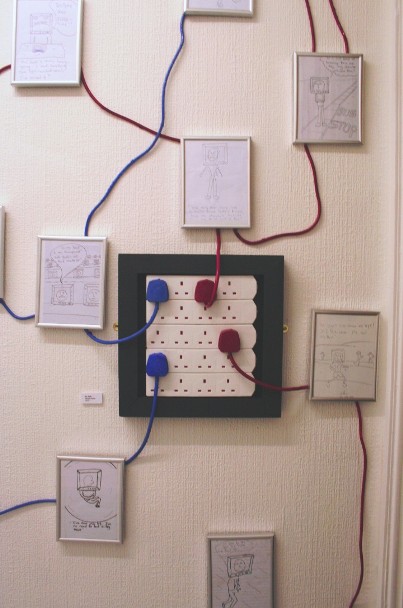
The isolated human figures with television boxes over their heads are named TV talks. They document moments when I have reiterated society’s directions/persuasions as pure reaction (my own TV Talk moments). I’ve used them to depict lonely, entrapped figures, eternally subjected to an indifferent larger power’s directions and diversions, rendering them into walking televisions sets: the self has been compromised for the rhetoric pushed along by the tide of society. They utter the social anxieties of a people reared to be self-obsessed and ‘bleakly’ individual; indifferent, and too self-concerned to pay attention to the collapsing world around them.
The Sprawl
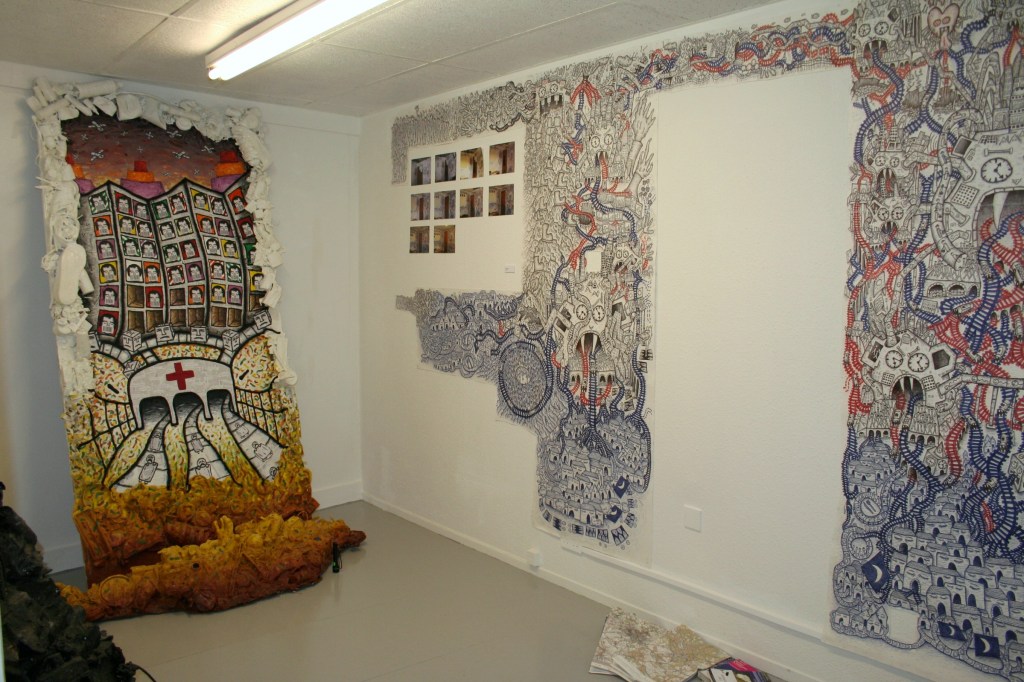
The Sprawl is incorporated around the shape of half of my bedroom, colonising all workable surfaces in the manner of the ever-expanding city. It is an expression of a how the city has become one giant super organism (although separate and hazardous towards the Earth’s working life systems). To realise that we (humans) have become like termites – economic slaves, acting for the benefit of this super organism, which is a completely unnatural way for humans to exist – is a necessity when one is finding modern life stressful and pointless, yet cannot figure out why.
The Sprawl is closely related to my obsession with maps. I have always been transfixed by the urban environment, perhaps down to an unwanted feeling of detachment from the rest of the human race. I am also transfixed by dates, the importance of dates which have shaped my perception of what is going on around me, and also the melancholy musing over what we are always losing as time passes. It seems highly probable that we will all become embedded in sprawling mega-cities, and amidst the life it dictates, as urban areas continue to expand.
THE HEALING PROCESS
These mounds have an unwanted and heavy presence, and even slightly obscure my drawings. The sculptures are piles of man-made rubbish, the guilt of an artist in a consumer climate that is piling up to obscure the things he feels most proud of (his framed drawings). The fossil-like traces of man-made objects are like the traces of a species now extinct. I realised the mounds took on an almost pyramid shape and they started to look like monuments to a species that had died out. They have both a positive and a negative suggestion: the positive being the individual appeasement I find from using at least some of the junk material made by the society I am bound up in, and the negative being the extinction of our species and natures resilience in regaining a ‘firm-footing’, leaving only traces of our species, which no other species can even acknowledge.
A FINAL ACCEPTANCE
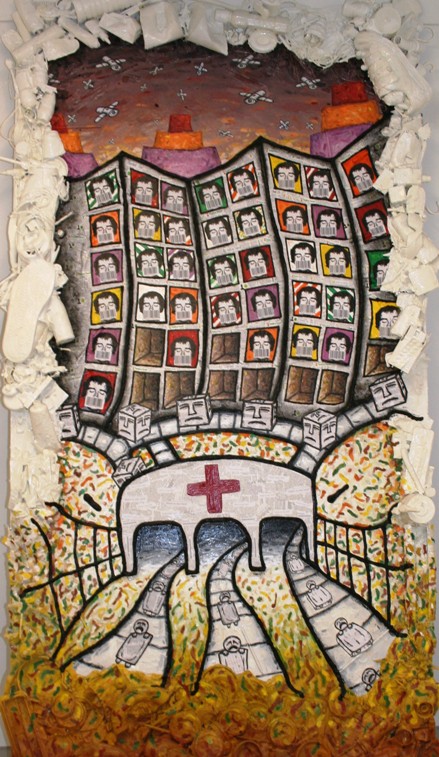
The implications of living in such a commercially driven society are that one’s personality is chopped, diced, and edited, until it is able to fit in to the slots created by a society that has become more and more homogeneous as commerce prospers in a global community, where the means to distribute information are owned by so few: the pressures to conform to a whole manner of conventions are immense. My capacity for developing, re-learning and growing is massively constricted as the domestication into a system-friendly, ‘able and flexible’ adult, takes up more of the free mental spaces which allow my development as a human. The intensity caused by trying to resist a barrage of pressures causes a mental debilitation, which ‘hammers one down’ weakening them into submission. A final acceptance, in order to stem mental debilitation, seems like the safest option.
It is hard to explain the motives behind my work without dragging the explanation into an intensely political and, sometimes, personal debate. My works are the tip of the ice-berg of my thoughts, and they take time to emerge in my mind; resulting in a feeling of great relief. My doodles have no choice but to become murals, as I try to match the size of my concerns. The act of creating for the sake of creating used to be enough to de-throne my looming concerns, but over the last few years, my work has taken a much more direct and polarised stance; as the act of creating, by itself, ceased to be enough.
The work for this show represents what I see as a realisation, and finale, of all my sketches and writings, from the past 10 years, becoming more direct and solid as I reached the decade’s end.
“I believe in Capitalism” is almost a showcase of what I have become during the past 10 years. The large drawing piece is explicit in how direct it is, as it organises and crystallises the ‘budding’ of my thoughts and ideas from the past decade.
The title quote was taken from an interview with a banker on the BBC during this recession. Its usage is ironic. However, there remains a suspicion that my inner drives still do believe in Capitalism. Thissuspicion is consistent throughout the book Going nowhere, writing letters to nobody, which forms part of this piece of work. Nevertheless this accumulation of drawings and writings, which go far in explaining my becoming during the past decade, also leads to a conclusion of an apparent massive dissatisfaction with my life, and society as such, under this system and an urgent desire for a massive societal change; in doing this the book has become a manifesto of my life so far.
The School desk, the chair and the book, face the drawing as if it was a teacher’s blackboard. This suggests, an education system which rears a society’s children for the benefit of the growth of Capitalism, but it also suggests the possibility of re-learning; being educated to perceive the world differently; which, judging on humanity’s predicament in the early parts of the 21st century, may be essential for forthcoming generations.
On the drawing
My drawings require me to undergo shifts of manual labour; seemingly endless daily repetition. I could be almost undertaking a factory duty, and sometimes I feel like I am using a production method which rivals, in scale of input, that of the mass produce of the system I am trying to stand up to. For this task, the sturdy, bog-standard, office-like nature of the ordinary biro seems fitting.
The landscape of “I believe in Capitalism” shows the insanity of proceeding with a system which is only
sustainable in the kind of dream-like world actually fabricated by the system to keep the masses as

“Glazed-eyed passive citizens”. The conglomerate of the richest cities’ skyscrapers looks for this very world.

Reaching into the sky, its searchlight looks out for a place that doesn’t exist, whilst destroying the only thing

we humans currently do have: a life on this planet. Directly below the skyscrapers, The Alpha Forest - a

habitat of rampant materialist individualism of a million voices all trying to be heard like a million trees all

vying for sunlight - blocks out any alternative, making the citizens willfully accept that “this is the only way”.

Below The Alpha forest, the advancing consequences of this all-consuming system become more and more

tragic, until we finally find the doom-laden waves which carry the Easter Island heads, reminding us of the

tragedies that befell their island when its inhabitants outstripped the island’s resources, resulting in conflict

and a deserted island. Are we recreating the Easter Island Catastrophe but on a global scale?