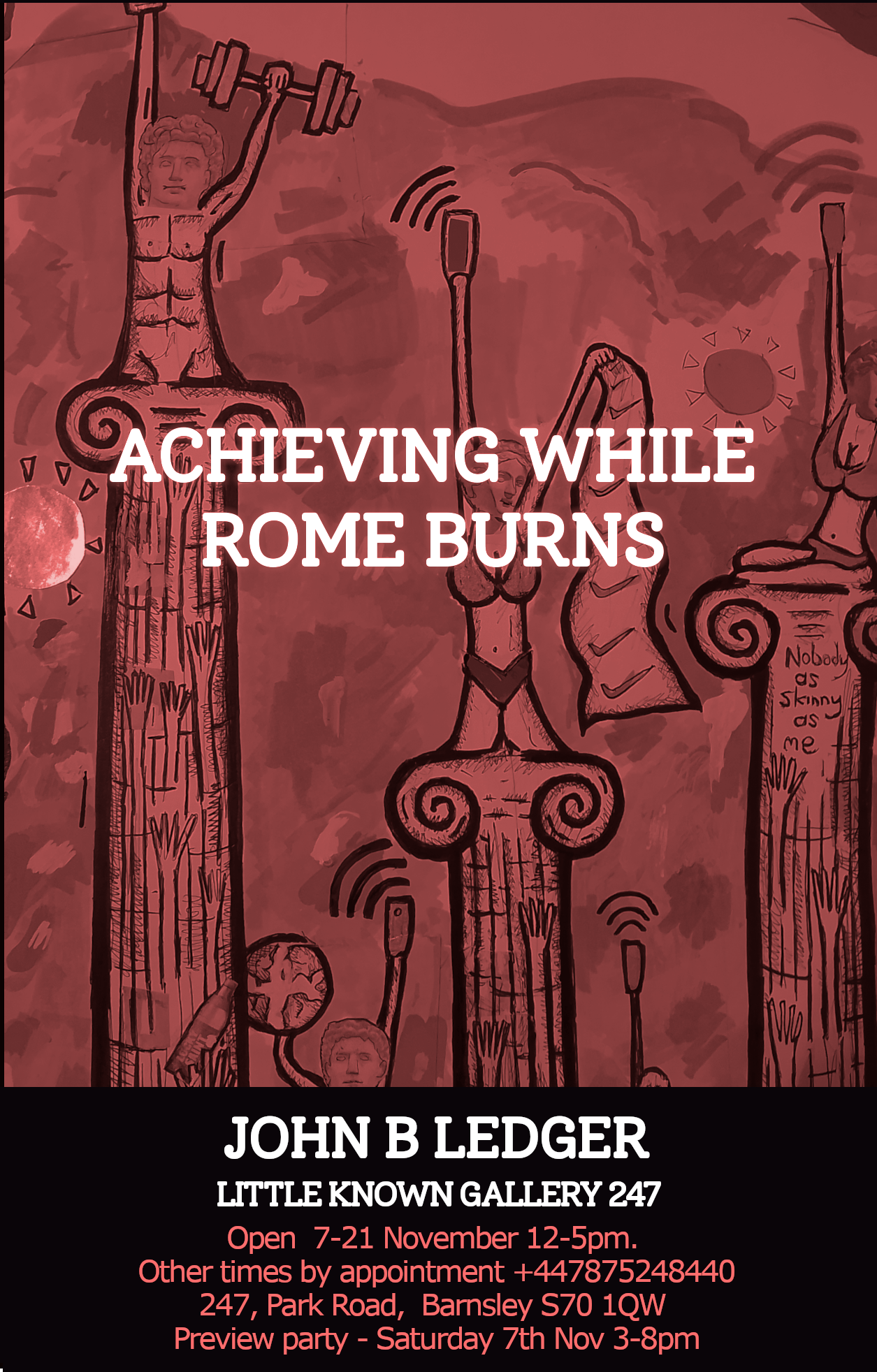
Hi, just to let you know that we have a closing event at ‘The Little Known Gallery’.
5pm onwards on Saturday 21st November. Please come down!
Thanks
Hi, just to let you know that we have a closing event at ‘The Little Known Gallery’.
5pm onwards on Saturday 21st November. Please come down!
Thanks
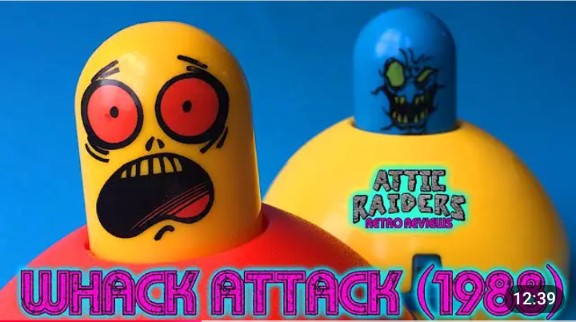
It was probably 1991, possibly in Skegness. I saw a game in the arcades that I loved playing. I can’t remember it’s actual name, but it was almost identical to Whack Attack.
I began having great holiday fun bashing these resurfacing heads, until a group of kids probably a few years older suddenly appeared, grabbing my hammer and taking over the game as my mum looked on helpless to stop them.
It was a case of who was the biggest and loudest and I came to recall this lesson at a later age after I began to develop my own political opinions.
It is beyond doubt that life increasingly feels Gameified. From the smiley/angry face buttons to rate your shopping experience, to how we gain popularity as social media actors.
Yet, nowhere is this more evident than in how we engage in politics.
Anton Jäger has recently published a popular book called ‘Hyperpolitics’, in which he partially speaks about how organisational politics and the adjacent long term movements have been usurped by a tendency to swarm from one issue to the next, shout about it and then move to another.
This is what I’m calling Whack Attack politics. Instead of the heads popping up out of holes, it’s a fresh injustice or news scandal. In turn we also respond like a sea of bobbing heads, screaming injustice and denouncing the latest baddie, only to move onto the next one in a week or so.
I do believe it comes from a genuine desire to live in a kinder, more equal world, but it blends with this hipster-ish tendency found on social media to always be ahead of the game, with a finger always on the pulse of the latest good cause to fight.
I don’t pretend I am not guilty of indulging in this (after all, it’s quite hipster at the moment to reference Anton Jäger). There’s this sense that if only I share something enough justice will be done.
But I am a firm believer that justice-seeking is just one part of a genuinely progressive movement, which requires an ability to meet/see the opposition, sworn enemies or not, and importantly to have genuine faith that a better tomorrow is possible – an horizon that I believe must be able to accomodate everyone; ‘goodies and baddies’.
And this is what is really at play. A persuasive sense of powerlessness because we lack faith in a better tomorrow and don’t know what to properly do about this.
This leads us to Whack Attack politics, where justice becomes an endless game to find the next ‘baddie’ to blame, bashing one head with a mallet after another, in perpetuity.
My 43rd year has been quite a marker point. So much so that I haven’t really recognised this yet.
I haven’t processed or truly come to terms with recieving a diagnosis for AuDHD (ADHD and Autism combined). I haven’t figured out who I should and shouldn’t disclose this information to, what frame I should look at my life through, past, present and future, and how the diagnosis can best be utilised to make me feel a little more OK about myself.
So much already makes so much more sense. The life-long struggles with mental illness that were very often a result of learning to see myself as ‘wrong’ and problematic. The ability to excell at certain things, and throw my full arsenal at it, whilst being utterly shit at normal things, like being a ‘normal’ functional adult.
Yet the diagnosis will also never truly be without its frictions.
For a start, although I began to ask the questions that led to the pursuit of a diagnosis due to 6 years of experience working neurodiverse adults, I know I will never find my condition anywhere near as inhibiting in regards to leading a full and independent life as so many people I support will do. And I can fully understand why some adults with a long term diagnosis feel some sense of personal injustice when they hear of another well-known celebrity recieving a late diagnosis.
Equally, all diagnoses are constituted within an historical context and, despite the traits the define them existing irrespective of any particular zeitgiest, they become visible and understood through how they rub against the ‘normative’ expectations of that social moment.
The suffering and daily difficulties a condition presents to an individual remain undoubtably real, but the diagnosis itself may change or be more easy to be overlooked in a different time and place.
However, I believe that the binary between neurodiversity and neurotypical needs an extra layer in order to understand why so many people are clearly buckling in their attempt to keep up with normative expectations.
A percieved space of normative functioning is being slowly engulfed by what I’d call ‘supernormativity’.
My understanding of the ‘supernormal’ in a contemporary context is that it emerges out of the meritocratic mantras that dominate our neoliberal world. But could only really take root in an a moment where we are hyperconnected to social media platforms.
The philosopher Byun Chul Han calls our current society an ‘achievement society’, and says that we have all become ‘achievement subjects’, and at no time is this more evident than in an age where our daily posts about our lives are either rewarded with adoration or ignored.
Before the 2000s most human achievement was mediated from a top-down platform; we would see celebrities on billboards, beautiful people living beautiful and succesful lives on televisions. Since 2010, the meritocracy now mediates most aspects of everybody’s lives, and we primarily now see others (our friends, work colleagues, piers etc) through life highlights.
The shadow haunting the post 2010s achievement subject is an increasingly difficult and competitive work culture, where austerity strips back support networks and it feels like the only person we can rely on his ourselves. We must all learn to run faster, jump higher, look more beautiful and be more employable.
Supernormativity is the new standard. Normativity is being crushed by it. We look to our phones to self-sooth after a long day at work to see a stream of personal bests. We get up and go for a walk, only to find old car showrooms turned into gymnasiums, no longer showcasing perfect cars, but perfect bodies.
I don’t want to go into what supernormativity is too much, it kind of doesn’t exist in any one person, it’s more of a expectation that permeates us in age of crisis where being average no longer feels to be enough to grant us survival.
Conversatives (by which I now largely include those who a generation ago would’ve been called liberals) are reacting to the current explosion in Autism and ADHD diagnosis’s by seeing the individual’s suffering through the lens of moral failings (such as being work-shy, too soft to deal with to the daily suffering of life).
Their typical argument of ‘we just got on with it back in our day’ will continued to be reeled out no matter how physically or psychocologically difficult the times might be. It’s objective has always been to moralise, to blame individuals for their failings, when in truth the state just cannot keep up with what is happening to people in the 2020s, and is unable to percieve of how radical an economy we’d need to find a new collective steady state.
Without that hope, even the slightest hope that all of this is going to get easier sometime soon, people are crying out, not just for help, but for validation that its ‘not their fault’. Personally speaking, a large part of the reason I opted to get a diagnosis rather than just let it be was because of the immense shame I have carried through my adult life.
Returning to the individual level, this idea that we exist under the pressure supernormal expectations isn’t in opposition to the creeping revolution of neurodiversity. Quite the opposite, getting a diagnosis is a deeply useful support structure for many people like myself to both understand and come to peace with life long difficulties we have encountered in regards to socialising, emotional regulation, and ‘doing life properly’.
But we are also ‘canaries in the coal mine’ for the time we live in.
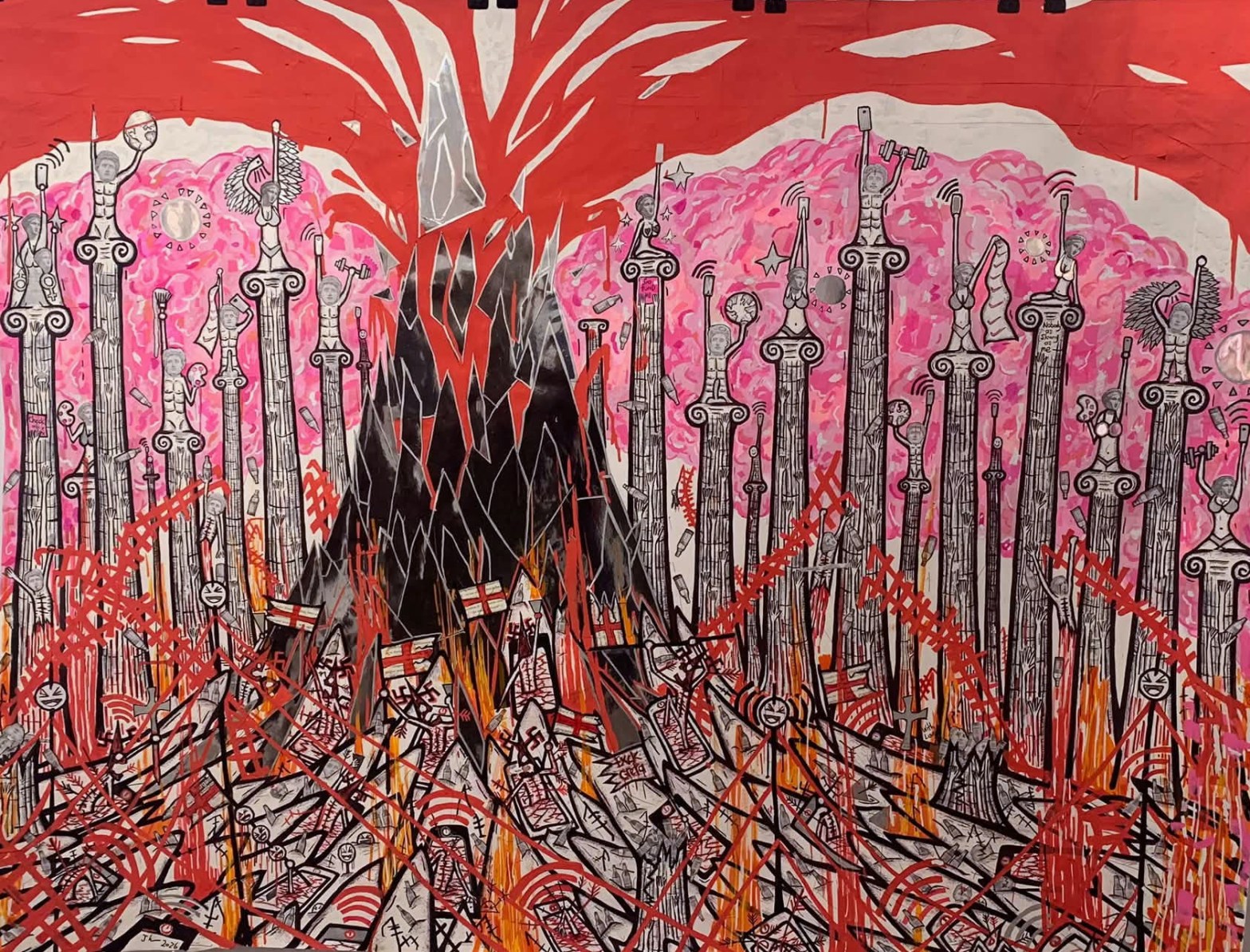
‘Achieving While Rome Burns’
John Ledger
The Little Known Gallery, Barnsley.
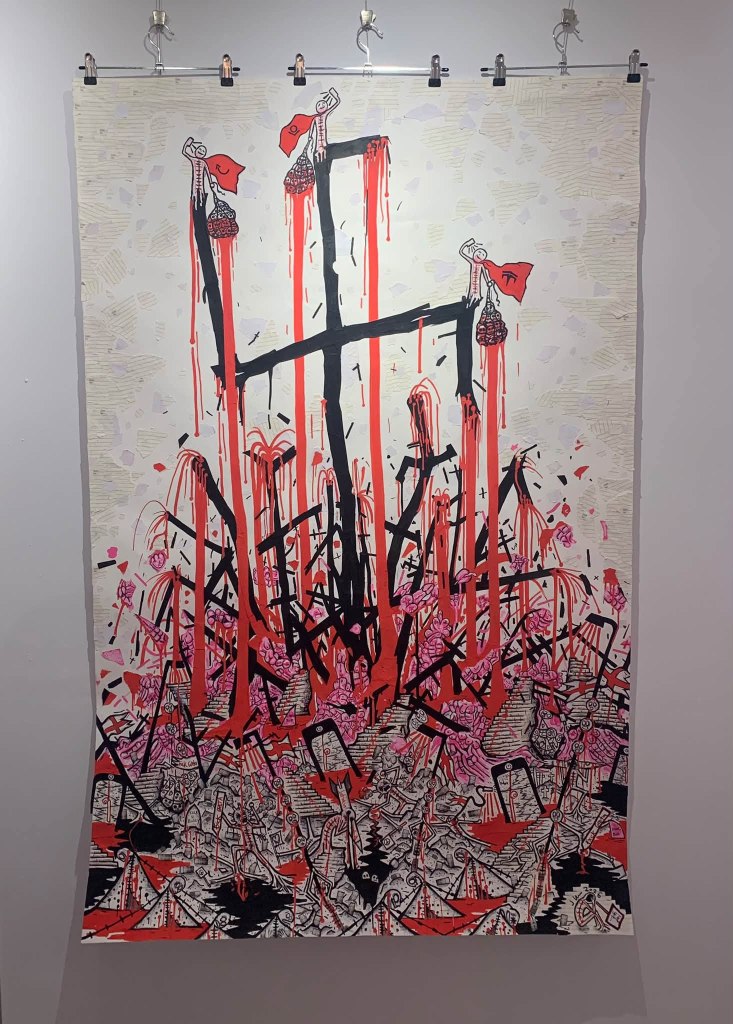
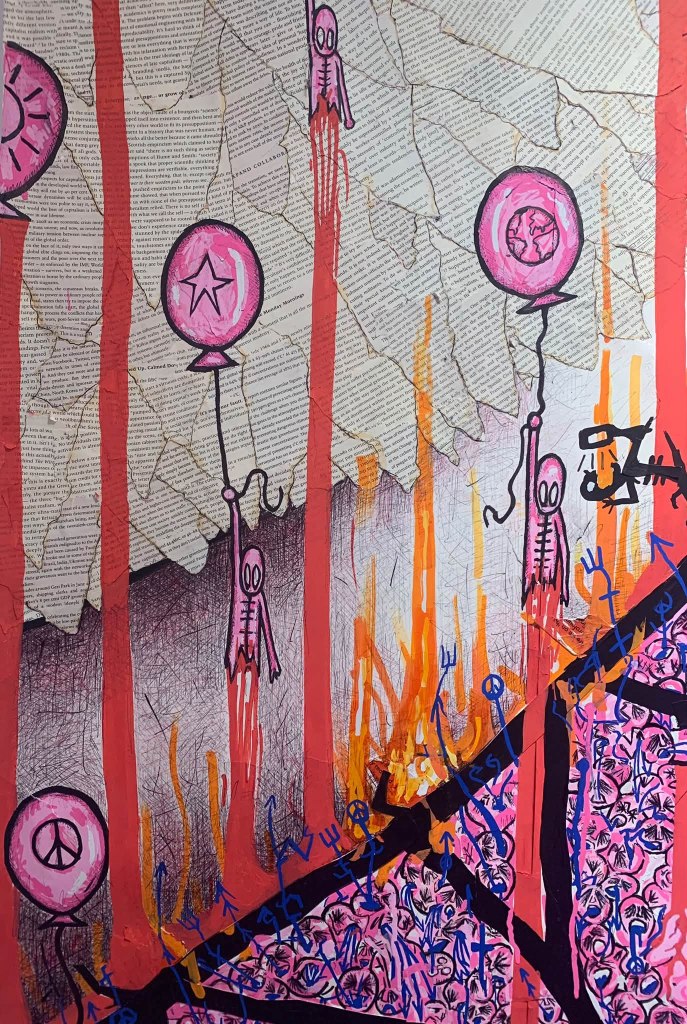
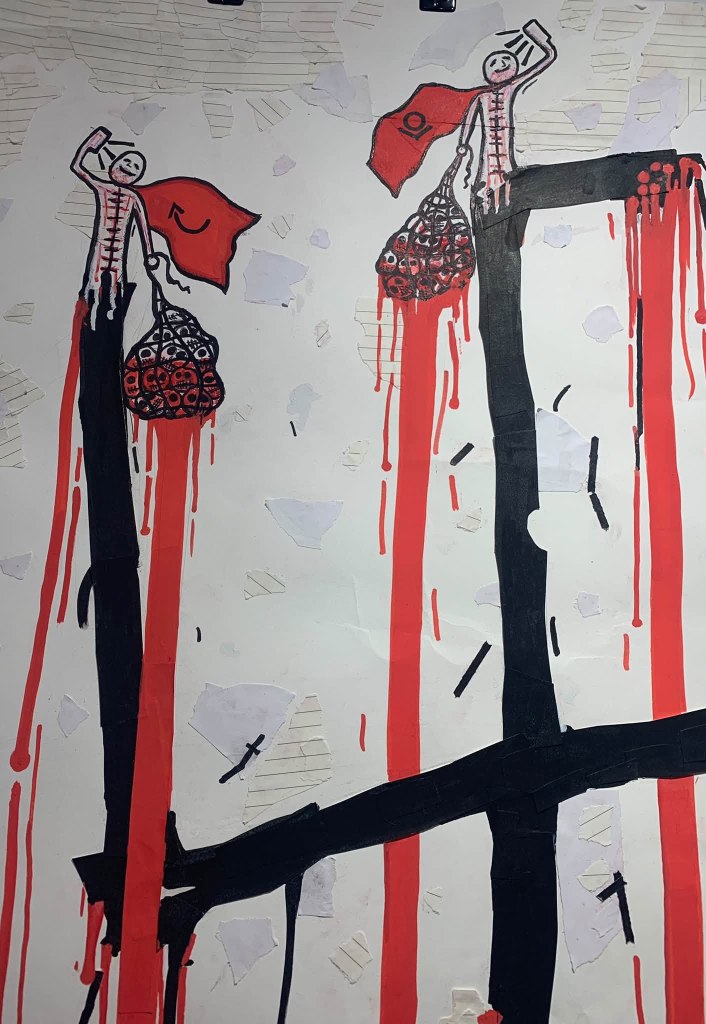
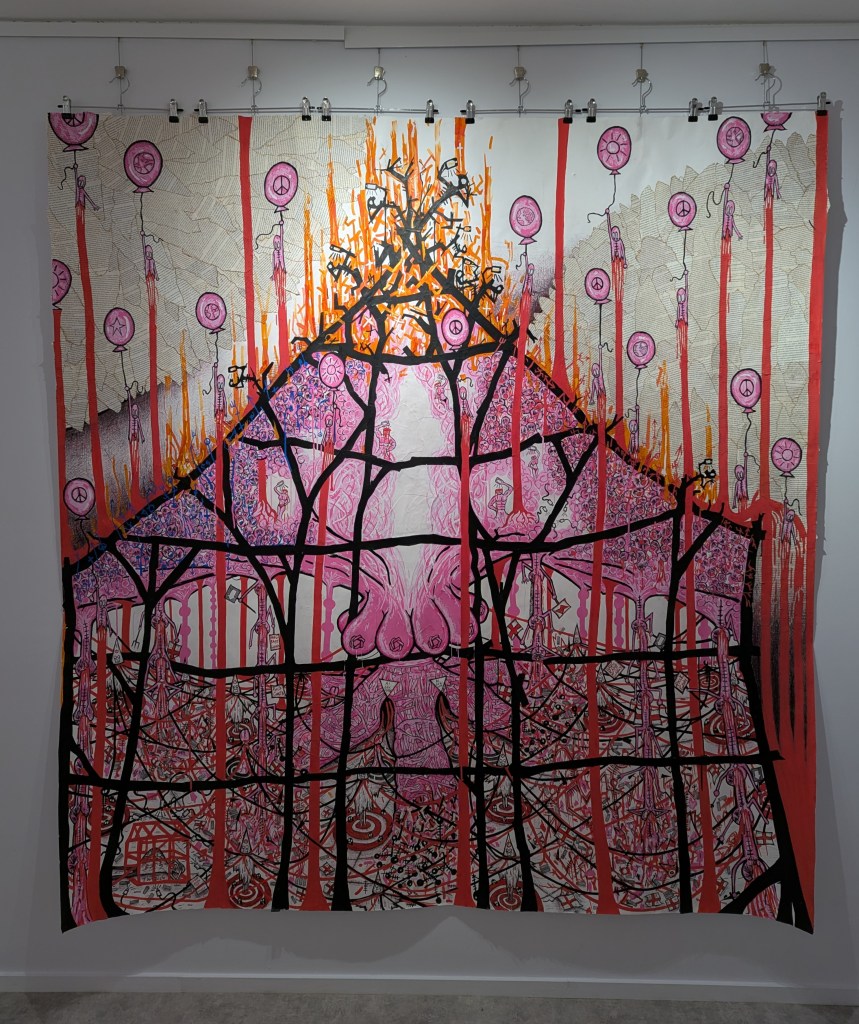
The exhibition has been inspired by one of the many unrealised projects pitched for the artist collective ‘the Retro Bar at the End of the Universe’ – this one in particular built on the theorist Byun Chul Han’s argument that in last few decades we have come to live in something he calls an ‘Achievement society’.
Han argues that we have begun to see our lives, and everything that circulates it as a project to achieve. Not only have we internalised the external oppressive forces of the state, but also the meritocratic paradigm that dominates our post-Thatcher society. Further more in age of social media we are all arguably ‘achievement’ subjects, perpetually stuck on project-building treadmills… and nobody more than the artist in the age of Instagram.
‘Achieving While Rome Burns’ came from my own understanding that whilst ever in an achievement society we never can truly reach towards our own humanity, and although we may desperately crave to connect with that which is beyond ourselves, to truly come together and help fight for the things that truly matter on this earth, we find ourselves locked inside achievement loops.
Little Known Gallery, 247 Park Road, Barnsley.
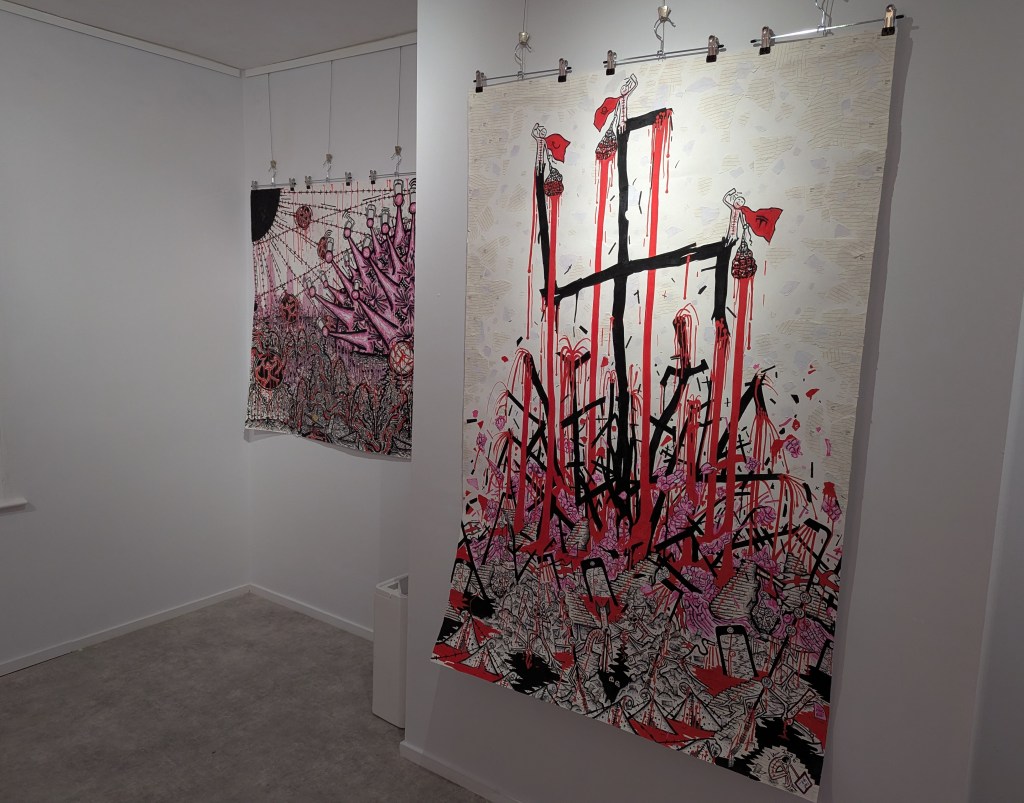
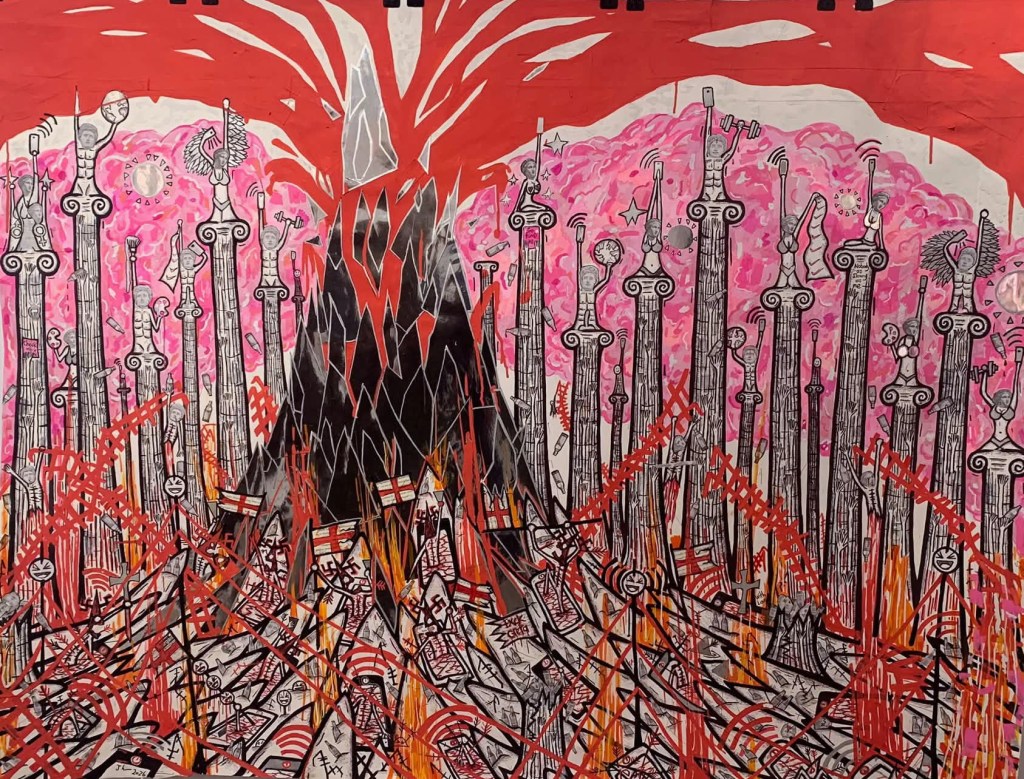
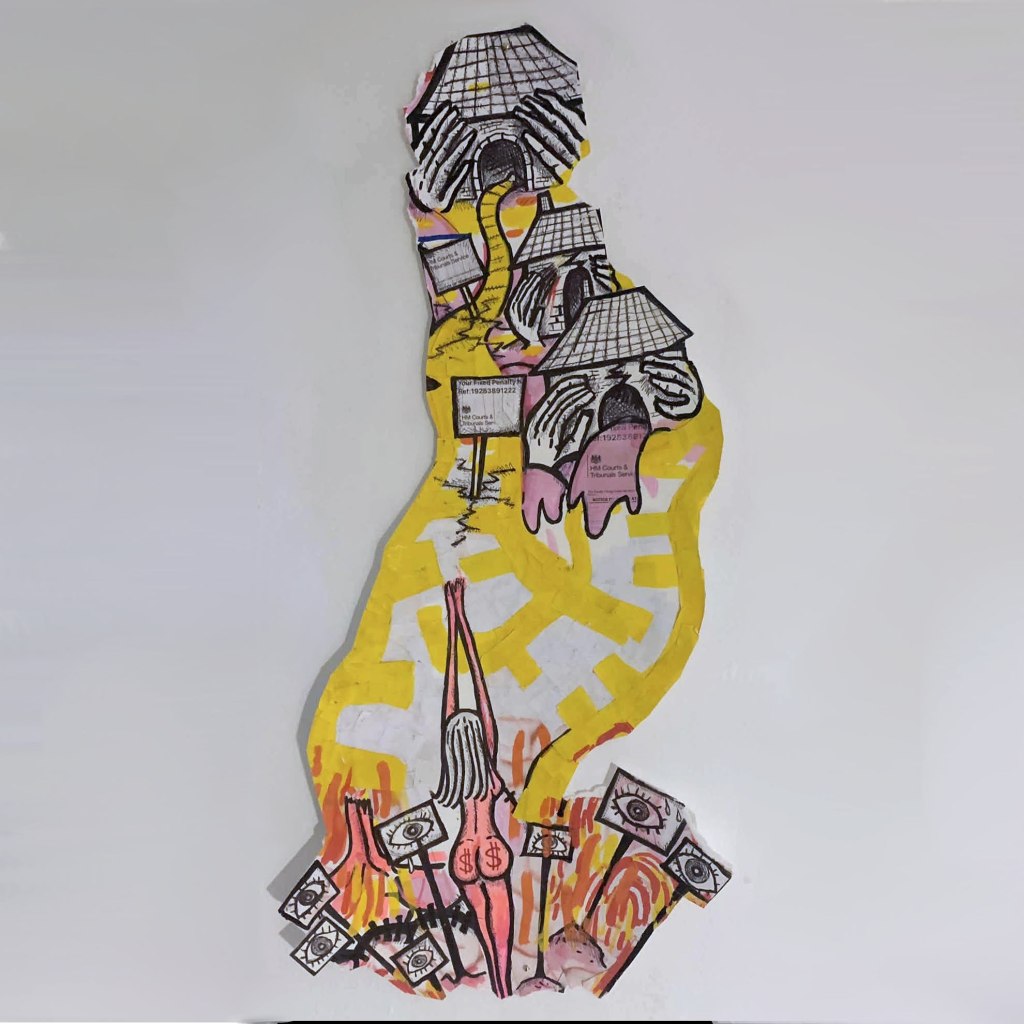
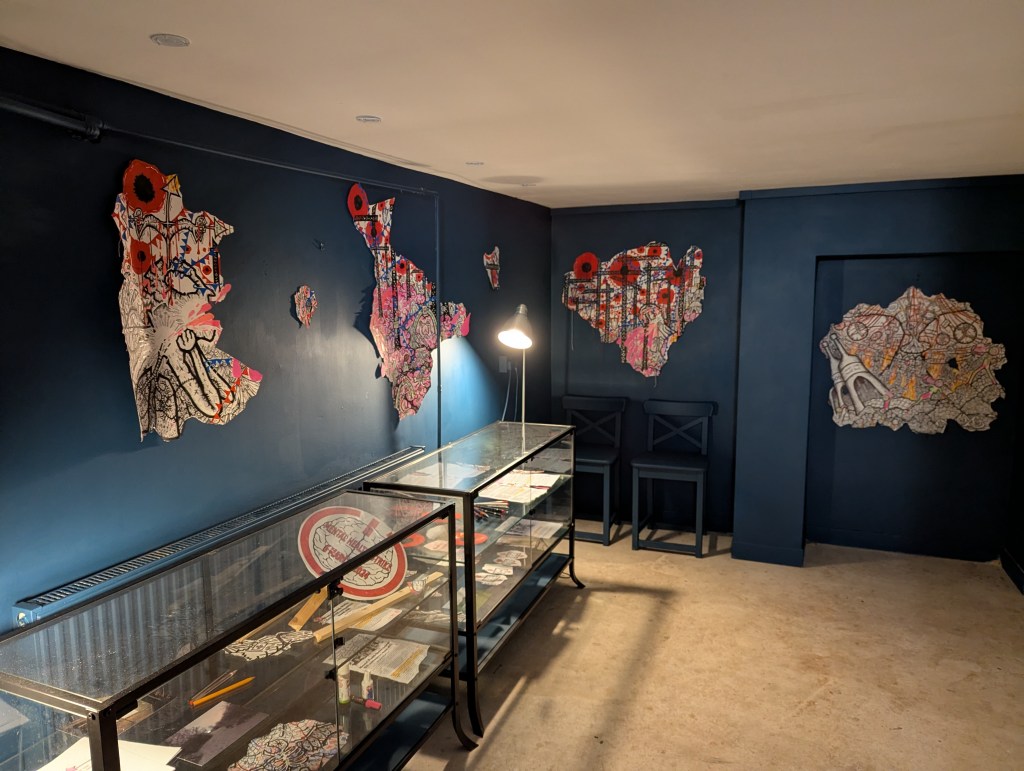
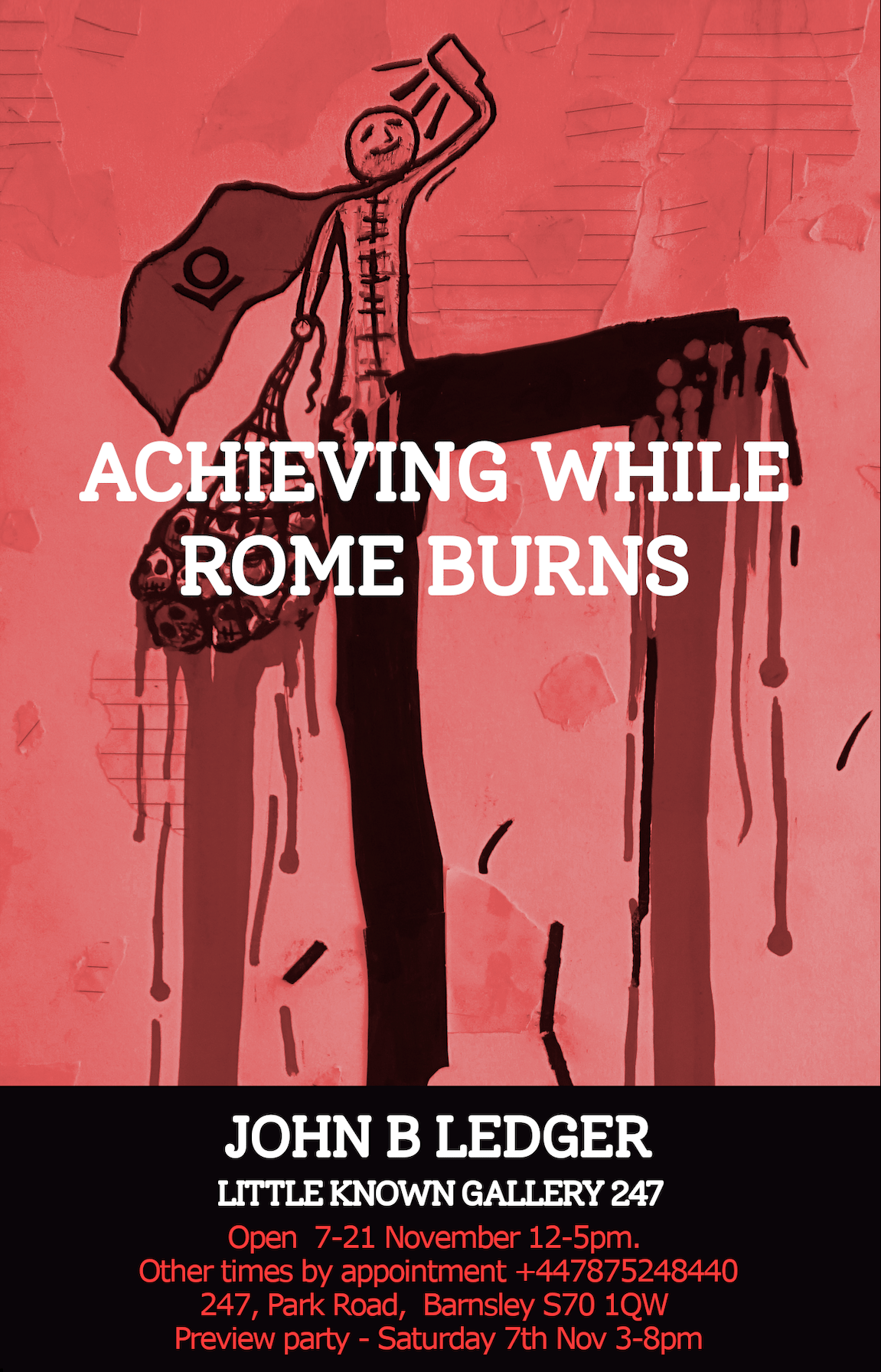
‘Achieving While Rome Burns’
John Ledger
The Little Known Gallery, Barnsley.
The exhibition has been inspired by one of the many unrealised projects pitched for the artist collective ‘the Retro Bar at the End of the Universe’ – this one in particular built on the theorist Byun Chul Han’s argument that in last few decades we have come to live in something he calls an ‘Achievement society’.
Han argues that we have begun to see our lives, and everything that circulates it as a project to achieve. Not only have we internalised the external oppressive forces of the state, but also the meritocratic paradigm that dominates our post-Thatcher society. Further more in age of social media we are all arguably ‘achievement’ subjects, perpetually stuck on project-building treadmills… and nobody more than the artist in the age of Instagram.
‘Achieving While Rome Burns’ came from my own understanding that whilst ever in an achievement society we never can truly reach towards our own humanity, and although we may desperately crave to connect with that which is beyond ourselves, to truly come together and help fight for the things that truly matter on this earth, we find ourselves locked inside achievement loops.
What was your first ever videogame?
View all responses
My parents didn’t have much money in the late 80s/ very early 90s, so we could only borrow the very basic Atari console from friends. I can’t even recall what game I liked, only that I definitely use to play it.
In 1991/1992, before we had a family car, we’d go to my grandparents’ caravan at Ingoldmels on the Lincolnshire Coast (for anyone not from the UK, this is a quite typical kind of working class holiday pursuit). At the Arcade there was a game called ‘1942’ by Capcom. It was a shoot-em-up based on the battle of the Pacific in WW2. I loved this game.
Xmas 1992: my parents could finally afford to by me my own games console. I was given the Sega Master System. The Platform game Tom and Jerry (based on the famous cartoon) was the first game I ever completed, which felt like a significant moment in my short-lived time as a computer games child.
What’s something you’ve done that you never thought you could?
View all responses
When I was 21 I began writing my first ever songs. Before this point I’d put down words, lyrics, and unfriendly chords, and believed songwriting was a magic I’d never reach. By 2008 I was writing songs for fun. And although this is also this the time I gave it up to pursue visual art, I now realise I was in a road which, if taken, would have lead me to have been a great crafter of songs. I recently put this ecclectic song selection together to remind myself of this https://john-ledger.bandcamp.com/album/my-imaginary-noughties-indie-life
I’m glad I pursued art instead, but I also miss music-making every day. Hence, why I keep on returning to it via art.
Have a WordPress.com account? Log in now.