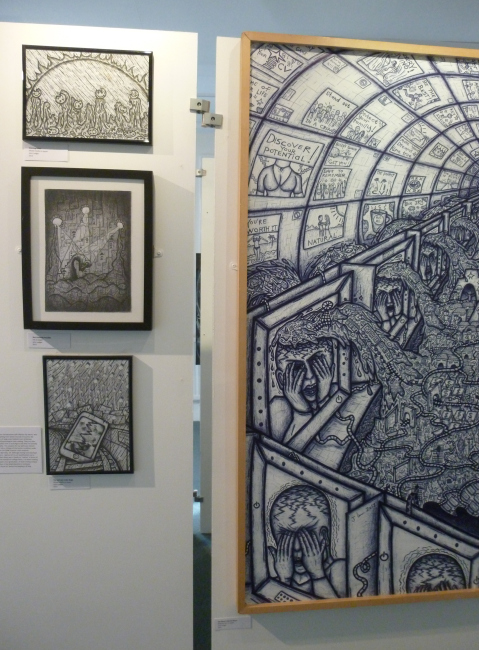
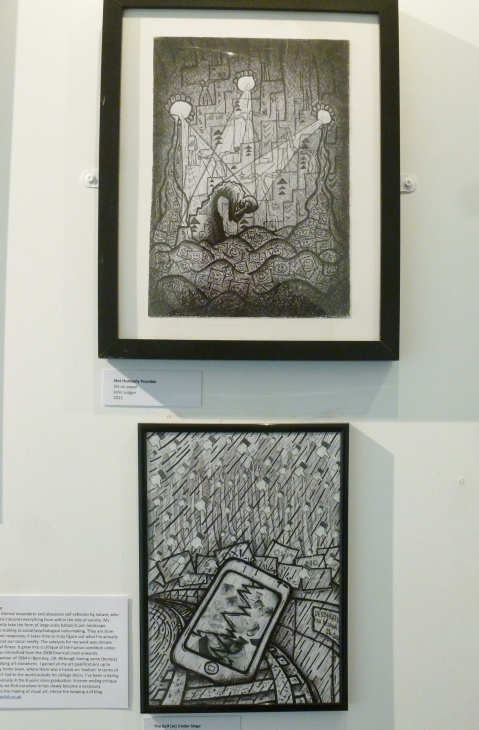
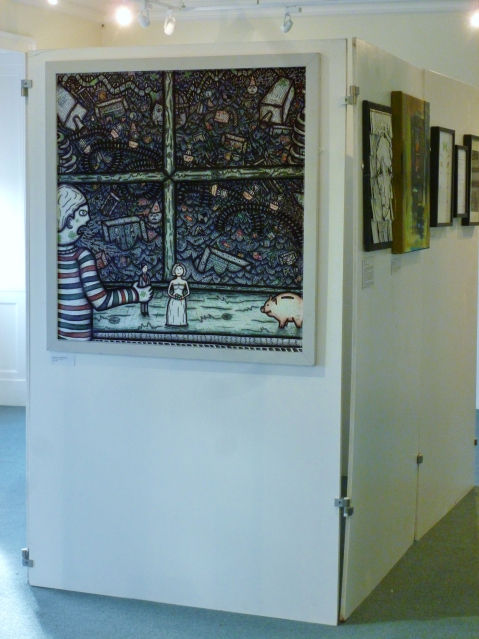
Although Dewsbury has always been a nearby town, the exhibition I was part of allowed me to discover parts to it I hadn’t seen before, as I climbed up the hill from the train station up to Crow Nest Park. I got a view that stretched back over to Woolley Edge, reminding me of the strangeness in how the industrial towns of West/South Yorks fold into different valleys from where transport connections and communication are almost non-existent in relation to their general proximity.
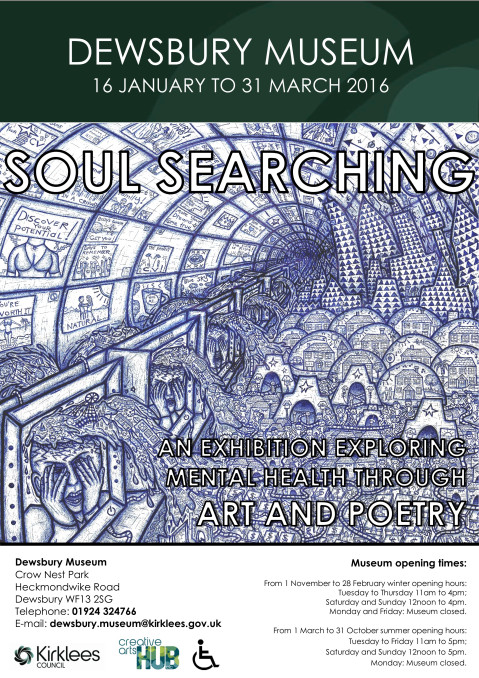
An exhibition of mental health related artwork, on display in the 2nd floor galleries at Dewsbury Museum throughout the first quarter of the year.
The exhibition has been curated by Mark Milnes, of Creative Arts Hub. From a large number of submissions received via curatorspace and by email, we have selected a wide range of approaches to the subject. Work has come in from across the country; and we also have artwork from Canada (Emei Ma, nascentscienceart.org), and from Austria (Klaus Pinter).
The work is broad in scope, some of it exploring the dark recesses of the mind; others focusing on the transformative power of art, used as a means to overcome mental health problems. Featuring work from individual practitioners, and from organisations – including Women Centre Kirklees and Calderdale, Hoot Creative Arts & Glenside Hospital Museum (Bristol), the exhibition offers a serious exploration of a challenging subject which visitors will find to be raw and thought -provoking, and equally positive and energising.
“For there are brighter sides to life, and I should know because I’ve seen them, but not very often” (Still Ill, The Smiths)
I wish the diagrams of carbon footprints and three-planets-consumption-rates would give up traveling through my mind in the form of guilt-trips right now, as I’ve only ever flown one other time in my 32 years on the planet.
Anyway, it must be said that I’m far less bothered about seeing every corner of the globe as much as I’m bothered about seeing the only bit I know well from another perspective: thousands of feet above the land as the plane flies over Northern England.
I’m seeing England for myself as I’ve seen it all way through my life on paper and on a computer screen. I’m a map obsessive, but maps of the land I live on, and the towns and cities so near to me that I can see their light pollution as the night closes in (Surely one day we can leave behind this civilisation built on competition, envy and power, driven by fossil fuel addiction, and find ways of allowing such sights without making us complicit in destruction at the same time?).
not my image – forgot my camera
I appreciated my work friends asking me if I wanted to meet up with them in Amsterdam. I took them up on it in an instant. As I’ve said, time and time again, although I travel often, 90 percent revolves around the former heavy industry heartlands of the West Riding of Yorkshire, and 9 percent traveling to and from cities such as Manchester, Liverpool, London etc. I’m not a great planner for the far-flung, either in time or space.
The here and now seems so claustrophobic in an England too socially-fragmented to truly convince itself that the age of endless austerity can end, that the far-flung other seems to refer to another dimension rather than another place. But, granted, I seem affected by this inertia to the point where claims of self-fulfilling prophecy aren’t unjustified.
The compulsive comparisons of Amsterdam’s size to English cities made it clear to me that I have an indelible relationship to the landscape of England. The land clearly means a lot to me. This is why, even as I constantly refer to it as an unhappy and sick place, I can’t see any point in fantasising about (or even planing) running away to some scarcely populated wilderness, or somewhere lacking our horizontal winter rain. The view from the plane as we flew back over to Manchester Airport was a sight-seeing far more appealing to me than the world-famous layouts of historical European cities.
again, not my image
A family with the wrong members in control
George Orwell famously wrote that England was a family with the wrong members in control. A seemingly somewhat reluctant but necessary text he wrote in a punch-drunk manner as England, along with other old imperial nations, had stubbornly and clumsily walked into a war with a Germany that had been turned into an insane war machine.
The text has been massively misused ever-since for jingoist aims. The English people haven’t faced anything like the threat they faced when the Luftwaffe was conducting bombing raids over towns and cities. The biggest threats we face are subjective, not objective – climate change is clearly being lived through, and the madness of Fracking is in our midst (for example), but no effective action can be taken on this until we ask ourselves what type of society we want.
But this is exactly what Orwell was arguing we needed to do in in the 1940’s, a time where all the classes had to work more closely together out of sheer necessity. In the midst of such a turbulent time Orwell was asking if 1940’s England really wanted to go back to a stuffy and backwards class system. To some extent, after the conflict ended, such alterations were attempted.
A similar coherence is demanded today. We have reached the point of the 1930’s levels of inequality; power seems unaccountable as wealth is sucked into fewer and fewer hands. I don’t think anybody actually thinks this is a good thing, but we just seem so locked in a claustrophobic here and now – compounded by the cyberspace technologies we cling to – that we don’t seem to be able to effectively communicate as a whole, and ask the necessary questions of where we would rather be. A sharing of cynical postmodern humour seems all we’re capable of.
The 20th century Artist Isamo Noguchi said “we are the landscape of all we have seen “. The landscape of England is what I have seen, come of age in, and wanted more from. I’m not sure about ‘the family’ notion altogether, but as 2016 begins England is most certainly a place where wrong the ideas, institutions, and people are in control.
The view from the plane brings everything together. Suddenly the coast of Lincolnshire is connected to the Ferrybridge powerstation, which is connected to the mill town of Huddersfield, which is literally a stones through away from the sprawl of Manchester, over a pennines that looks like a few small hills. Pretty much similar to how the planet as a whole must feel from space, but let’s rearrange the house of England out before we go there.
As we leave Manchester Airport our train home takes two different routes through the city , cutting through the quintessential claustrophobia of ‘Cottonopolis’. It takes us past the areas that fostered some of the best pop music albums since pop music began. I’ve only been out of England 3 days, yet feel a renewed perspective as we cut through the light-green peaks that separate Manchester and Sheffield. I can’t get away from this place – and when I’ve been elsewhere I realise that I don’t want to get away from it anyway. Perhaps when Manchester’s Morrisey sang “England is mine and it owes me a living” it wasn’t one of is odd jingoist quirks, but an recognition that the place he knew as home could be a far better, sharing, happier place to be within.
Spending time elsewhere and then seeing England from above made me realise I have never wanted to leave this land I just want all that is upon the land to be rearranged into what it could, and has always promised it could be.
I’ve received my copy of Prisoners of Reason: Game Theory and Neoliberal Political Economy Author: S. M. Amadae,which features my artwork ‘The Logic of Neoliberalism’, which I made back in 2010.
I’m really pleased for my work to be part of this publication by S. M. Amadae and now look forward to reading it. The book can be found at the Cambridge University Press.
I Just haven’t got the resistance to comfort-seeking I used to have in aid of achieving what I had to do. Every day 5 years back, at the back end of 2010, I would go down to my studio (Elsecar, South Yorks), straight after my job, 2 train stops or 2 bus rides from where I live, in the one of the coldest snaps I have experienced in my life. In aide of what? I was working on 2 drawings that were meticulously thought on about how to describe the world we were drifting into; I knew already that Tory rule would mean a intensification of all the things we needed to veer away from to avert future disasters, socially and ecologically. It really did feel like the dawn of a winter, and on the eve of 2011 I felt like I had to be prepared for this more than at any other point. This more intensified slotting of work-making between job and sleep, felt almost like a drill, or something compensatory for the coward I always feared I’d be when pushed came to shove, for whatever one may be shoved into. The studio was so cold the pipes froze and burst around Christmas time, and with my finger-less-gloved hands I’d have to hold my pens with one hand whilst holding an hot water bottle with the other. I miss the sincerity of the devotion to getting these works done, I really do.
This is a rarity when it comes to my way of making work, but T-shirts are up for grabs featuring a piece of work Ive made for this Friday’s (27th November) gig at The Underground, Barnsley, South Yorkshire, as part of Wear Your Band T-shirt to Work Day.
Gig info below…
“This Friday live @ The Underground we have The Kitson Trio, a rock & blues band who recently reformed after a six year hiatus. Fronted by popular local singer-songwriter Richard Kitson, the trio will play their last live date of 2015 at The Underground with support from The Rolling Down Hills &New Road Kings, SPLND BSTRDS an acoustic duo that usually make up half of The Black Vines – Indiemand Barnsley.
Making art about bands isn’t something I have done since college, so I thought it was due time to take this challenge in a town where music has a bigger place in peoples’ hearts than visual arts. I tried to make a work that looked at how music has been a back bone to my art making life, whilst also looking at music in relation to the experiences of contemporary life that my art deals with. Hence the usage of The Stones’ song title Gimme Shelter (although I am not a huge Stones fan) and the Smiths’ song title Rubber Ring (i.e “The songs that saved your life”). The drawing features a patchwork of both recognisable albums, and albums that have meant a lot to me.
This is a spoken word/video version of notes and mapmaking from earlier in September this year, over the weekend the Labour election leadership was decided.
It is part in a series of map-making’s of meanderings and musings that coincided with decisive events for the wider society in 2015. My thoughts on the past (my past), present, and longings for a future decisively different from the present loosely congregating around these events. This part covers Manchester, Barnsley and London.
Walk out of the Barnsley area, through Staincross down to Woolley, seemingly stalked by two young men in a car, driving around beeping at me. Game playing. I’m sport, basically, for their boredom. But there’s nothing you can say or do. I’m in a cloud of enough unlocatable guilt and paranoia making me sheepish enough, without dealing with those you can’t deal with. I hate the phrase ‘you can’t educate pork’ spouted from the ‘enlightened’ ones in any given town. I hate having to take the position of seeing folk as irredeemable tossers. But I’m not the one making it hard, I’m happy to get a long with any one if they agree not to give me grief. It doesn’t seem like such a hard deal to make. Most days you can brush it off, but there’s always that day when you don’t stand so tall, and then it hits you hard. My only response is to keep walking and walking indefinitely.
As a male and female duo jog up and down a lane that stares down at the Vale of York, I come to the conclusion that all there is save total burn out, is stability, a rock in my life, of sorts. Think about my age. Yeah time’s have changed, but I remember how my grandparents got together at the ages of 14 and 16 respectively. Tomorrow when the shame of another heavy night wears off, I know I’ll be back in strenuously independent mentality. It’s no good though, always burn out. Maybe hastening the burn out by walking as far as I can is a good plan right now.
Long road into Wakefield, things feel on top of me. It’s make or break.
Despite the world feeling so cold, and ‘the good life’ seeming unimaginable, there’s still an interest I give to areas that have a nice shape to them. Sandal, with its mix of old houses, and tree lined avenues has the look of a place a me, a different me, of futures and pasts, would like to be a ‘proper’ adult in.
Decide to carry on past Sandal Agbrigg station, and try to walk on towards Outwood station. I may as well.
The footpath vanishes alongside the trunk road that connects Wakefield and Bradford. I realise I’m in one of those types of zone that could only exist in the country in its current sad and bitter mould; a place made for people only if they are inside a car to begin with. For this reason I try to find a cut through to Outwood station via an ‘enterprise zone’. Why do my thoughts become occupied with the notions of what it is to be mean-spirited when the roads all lead to dead ends monitored by cameras meaning I have to cut through a blackthorn bush in order to get back to the road I originally tried to leave behind? Our country has been structured around meanness. Common humanity helps us break through it, but in times like this at one side there’s a sense of being the weakling, the visible tradegy straggling at the side of the road, and a potential criminal looking up to no good on the other.
“Get down sucker”
I’m that tired, and spaced-out by the motions of walking, I almost stumble into a passing car. As I approach the junction 41 industrial park I realise this too is not a place built for human scale route -finding; these distribution centres hold possibly nearly everything I eat and drink, and more. Yet they are also deserts, vast areas of emptiness with no signs of how to get out. I have no idea to exit, so have to take the long road, as i walk past the heaps of rubbish, likely thrown into the bushes from the thousands of lorries that pass through here, I decide it isn’t worth going backwards to Outwood station. I’ll head to south Leeds, and catch a bus from there. My legs never ache these days, they are numb.
Not many roads are made for walking down. Not in the winter. My tired legs are finding it hard to climb onto the verges as the coming dark night makes it hard for drivers to see you. After crossing the M62, and a small road’s walk, it is literally a single field that separates the sprawl of Leeds from here. There is something disturbing about the lifelessness of the housing estate I enter, regardless of the cold of winter. It feels like a stage set from the near-dystopia drama Black Mirror, precisely because things feel that grim at the moment. ‘Britain is a country in the verge of nervous breakdown” – so said the narrator of the Sleaford Mods orientated documentary Invisible Britain, which I saw recently. These words have since narrated my walks through Sheffield, Barnsley, Wakefield and Leeds over the past 2 days. I wonder why…