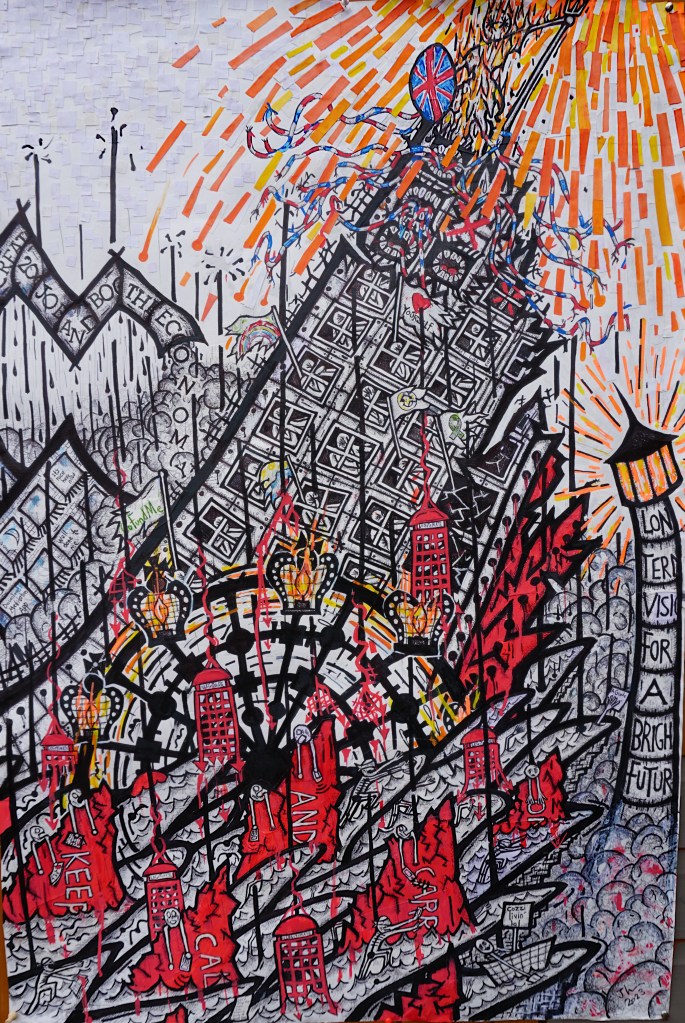
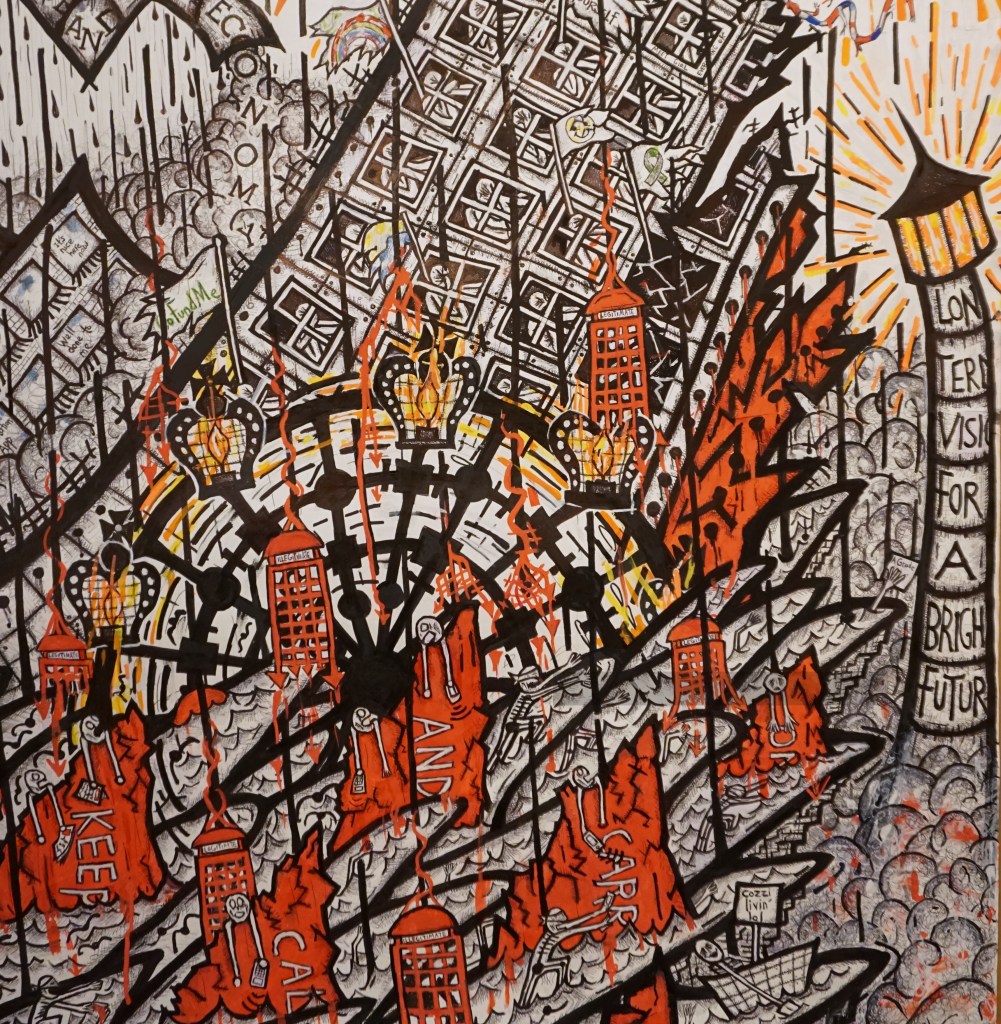
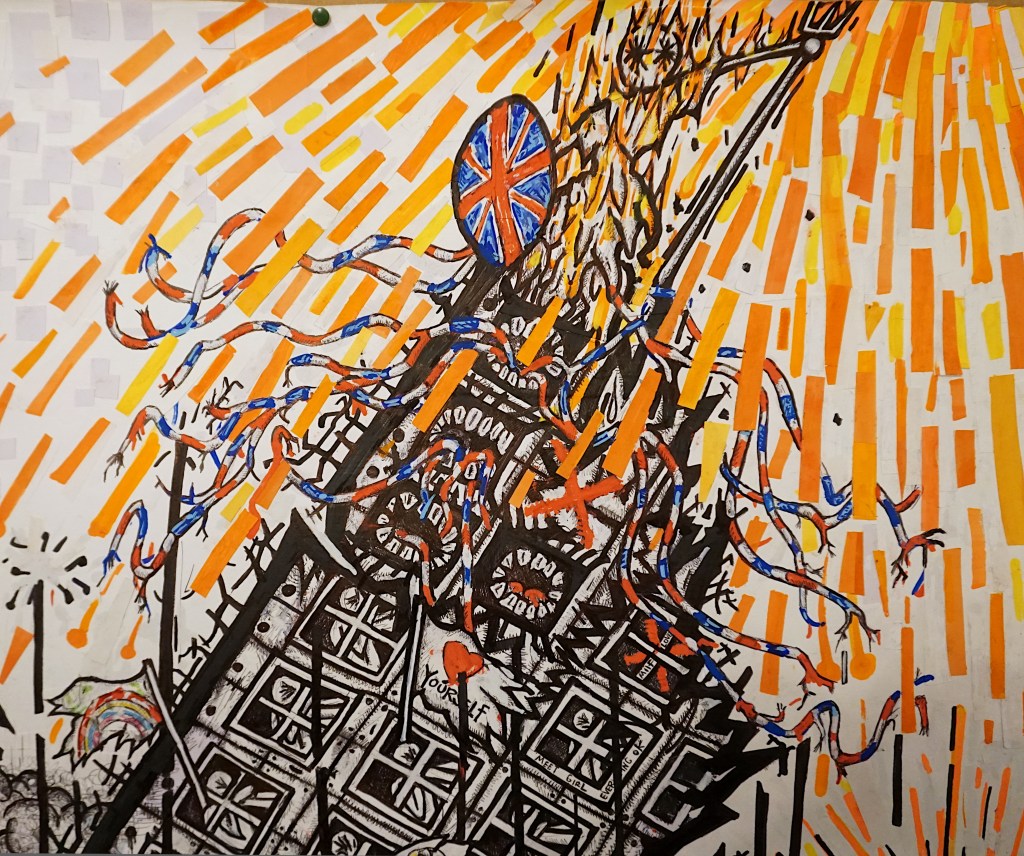
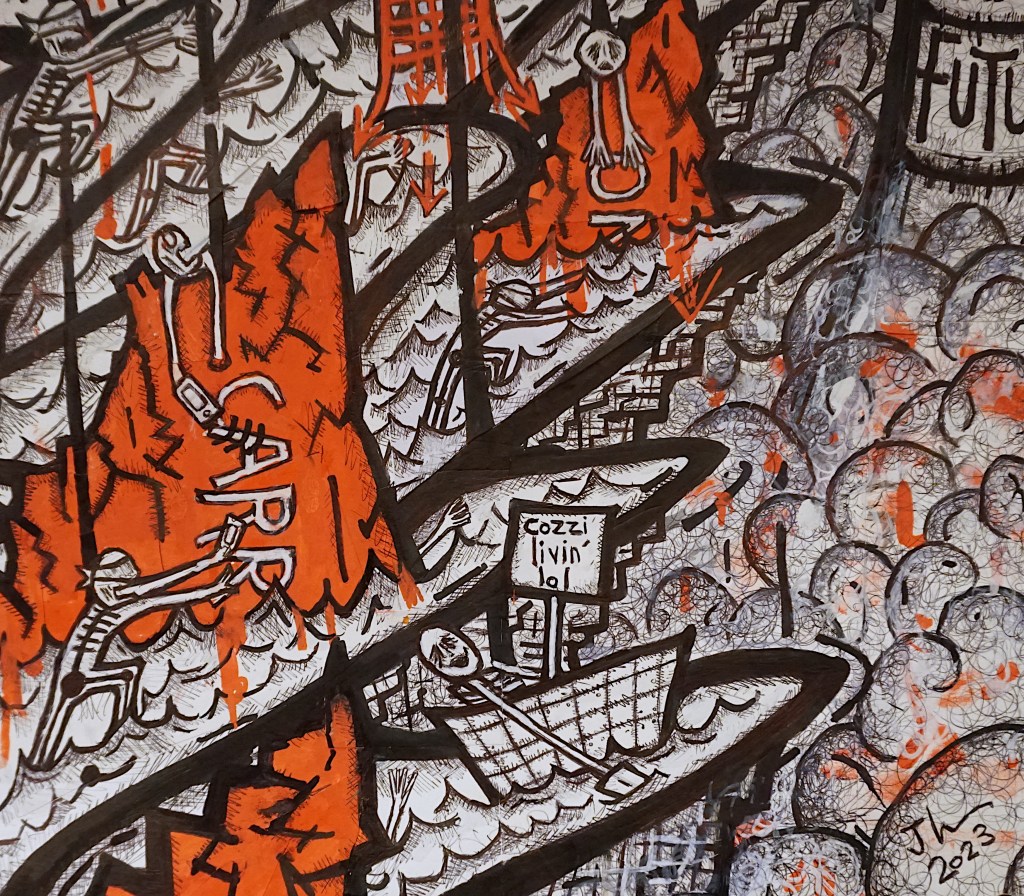
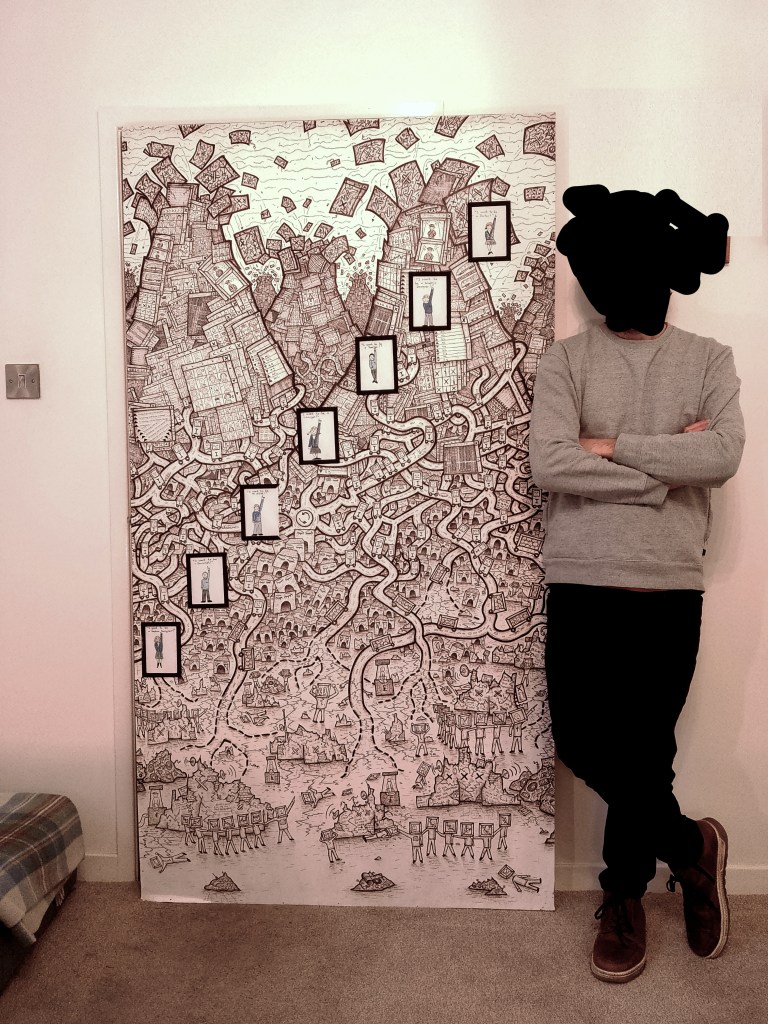
Running on Gaslight is my most recent drawing. Been working on this idea for most of the year, so it was nice to finally execute it. The work is around 80×130 cm, but I can’t be certain, and it’s mixed media. No further explanation needed.
(ps. why does WordPress make a dog’s dinner of photos that look fine pre-upload?)
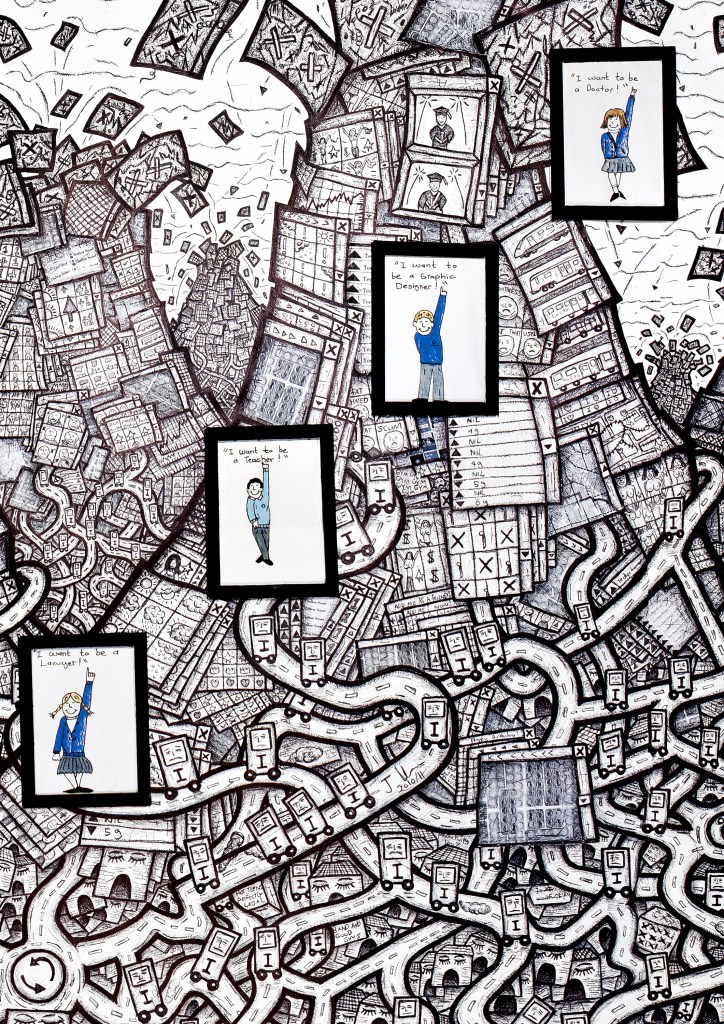
I’m fully aware that buying back a work that you sold to somebody, when you don’t have much money yourself, still looks like more money than sense. But long story short, “I want none of this” from 2010/11, is one of my most important works, and also a work that the now/then-owner had no real space/use for. And for a much smaller fee, was willing to sell it back to me. This probably sounds ridiculous to most. But with my bespoke fuzzy logic, it made absolute sense. It’s so good to have it back.
The work will most likely feature in a large show I’ll be developing shorty… But I will explain about that later on.
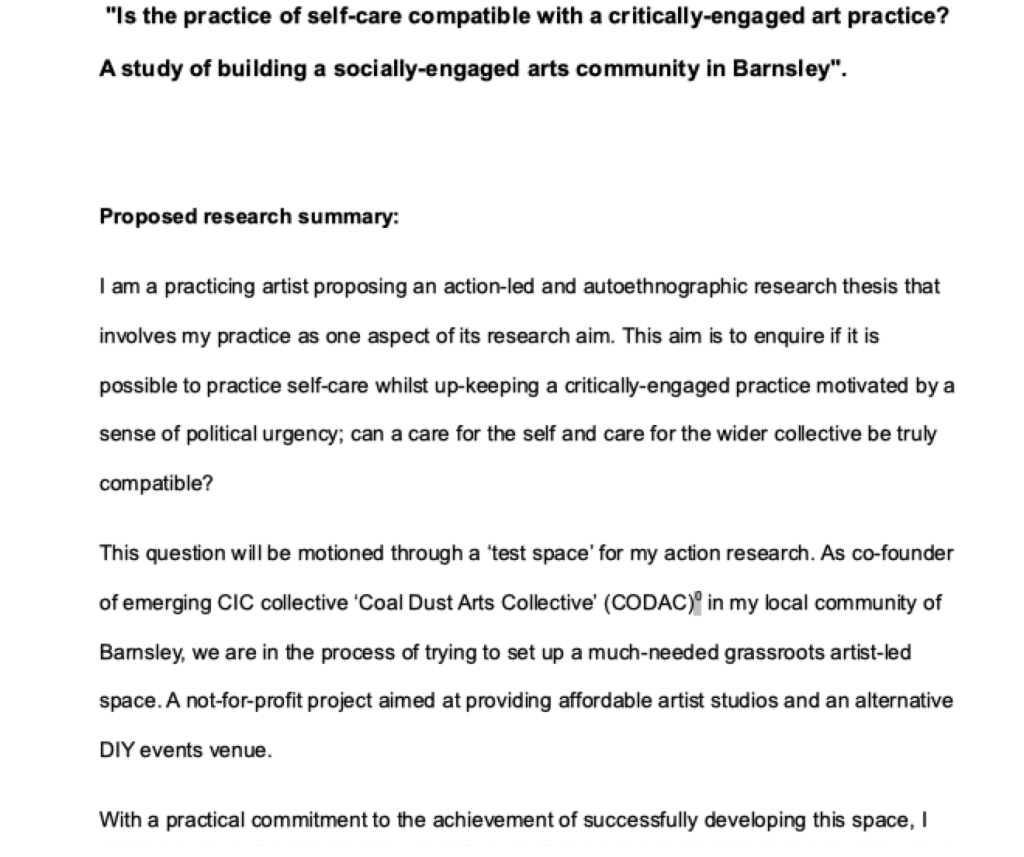
As of 13 October 2023, I should have been just starting a PHD – right now.
In Autumn 2022 was just in the final stages of submitting the proposal to the University of Leeds.
The proposal would be unconditionally accepted, but the idea began to fall apart in early 2023, when I was trying to apply for the absolutely necessary funding. It wasn’t just that in the gap created by the Pandemic, my stamina and capacity to take in the necessary academic literature had contracted almost entirely into my go-to theorist; Mark Fisher, it was also that I was trying to create something so unbelievably impossible to pull off, that I’d convinced myself I needed to create ‘genius’ to get myself out of hole I’d found my late 30s self in.
I began to see holes appear all way through the idea, and could see that my potential supervisors could see this too. I ended up admitting defeat. It was too vast a project, and I decided I needed to get away from things for a bit, winding up working 6 months away in Cumbria.
I’m now glad I didn’t do it. No disrespect to anybody who undertakes a research-led degree, it’s just that I have realised that what I do is a compulsion, arguably an aspect of a personality disorder, and isn’t applicable to structures of research culture, no matter how much I try to twist it into a ‘lived in’, autoethnographical project.
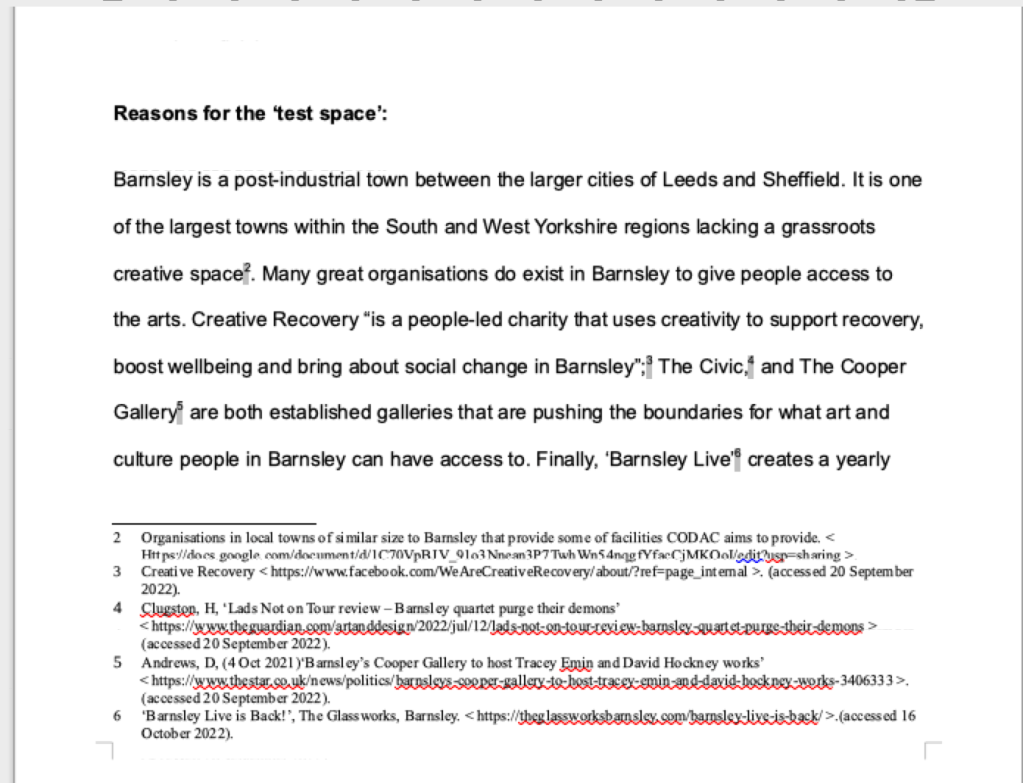
A big part of this project, was setting up a conceptual basis to argue for the need for a grassroots space in my home town of Barnsley, and to work with @codac_community to create this, for people in the area to continue their creative pursuits in a supporting community, with the all aspect of having the bloody space to do it in!
Nothing is lost. At the least, my ideas and work in creating this will be really useful for @codac_community going forward. I have learnt a lot about myself as an artist, and am working on developing new projects for the foreseeable future. Now this break is ending, it’s time get ‘doing’ again.
Sometimes the kind of space you need to flourish doesn’t exist the world as it is. The task is to create what isn’t there. This was the shared dream that got CODAC going. Let’s hope it comes into fruition.
“You wanna go home”; a stirring moment in a song by Pulp defines my wish as I hover around a confectionary store between my train connections.
But home has long since merely been an idea, indefinitely dislocated by the dread and anxiety that pursues me.
I gave in, badly today. Binge eaten on Flapjack, about 7 now.
I feel free, free of the world when I’m stranded in transfixed excitement at all the flapjacks I can finally fail myself with.
A decision-making paralysis is a welcome break from acting in this world. Until the shopkeeper starts to follow me, believing I’m shoplifting, presuming I’m stealing to feed the whatever emaciated me.
Ample evidence here. Avoided in the streets by hooded-gangs who think I offer them nothing, and beggars who think I’m one of them.
I’m an addict. My addiction is embarrassing.
It’s my little world, but here is where it must crumble, on this final train trip…
…In the final crescendo of the year, the Vortexual allure in the hook of a pop song on all TVs. Hey Yah by the Outkast is the end of years’ desire to race to the finish line, hoping to make the arrival. Chiming with the startled transfixion of an addict’s state, caught between commands to act, and do, but preferring to remain frozen between moments, because if I freeze still, the life I do not want cannot spot me.
To relapse into my pre-2015 premonitions. The rise of what felt like a workable hope in-between 2015 and 2019, now mysteriously absent. But the way things are accelerating at the moment it feels like it has been wiped from history altogether and we are at the the other end of line of reality stitched back together – one of hopelessness.
The dominance of the political despair that defined the late Noughties and early 2010s is now characterising our current moment, but in a more advanced stage, and despite many good deeds, many good people, nobody really knows what to do about it again.
Listening to Tory party conferences, seeing interviews from the attending Nigel Farage, was a form of torture made more horrificly so because they, those attending the conference, seemed to like all of this so much that you felt like a different species separated by 400 million years of evolution, and not just mere difference of opinion (also, why are these people drawn to such terrible music?).
Difference of opinion, as a term, is just one example of the dead language that still floats around dominating our tongues, as we engage in polite conversation. Few words strung together to make a workable the late 20th century term, can affect the living any longer, without experiencing their deadness chip away at our fake smiles.
I hate writing like this. I hate that 4 years ago, I was at the tail-end of a quasi-Millenarian sense that a better world would manifest itself through the force of its own sheer necessity. This lift, encouragement, was absorbed into my daily undertakings, I perhaps wrongly, sensed its atmospheric presence, within out shared breaths.
Ironic then that it vanished during an airborne pandemic. But it’s taken a couple years afterwards for the void to be filled by a government within governments who seem to have no depth they cannot descend into.
I hate to say I told me so.
I hate that what in the late noughties and early 2010s felt like the mid-point of a self fulfilling prophecy, was interrupted by a hope so thick that it enters the bloodstream, only to vanish into a void.
(Part of a series of ‘Noughties’ excavations that will eventually be worked into a much larger project).
I’ve been a doing a lot of ‘unearthing’ of late, most likely because I turn 40 in around 3 months.
I’ve been trying to do a bit of excavation and salvaging of works and creative former selves, that became subsumed under other creative selves. To own what I used to do and be, without feeling that somehow they were errors in direction that needed to be buried. It’s been an act of reclaiming and redeeming my past.
Over the course of 20 years I have invested an incredible amount of time to making and thinking about making.
I wrote a stupid amount of songs in a four year period right in the middle of noughties, and coincidentally stopped making music more or less around the same time as the financial crash in 2008. We all knew something big was happening, but nobody could foresee how it would pan out. But I could sense a change in the wind, and decided that my visual art was more equipped to blow with the new wind.
Perhaps if I’d had carried on I’d be in a different position now. Although I suspect my lack of self-belief at a level that has caused so much self-sabotage would have caused identical issues of inertia.
Also, because the wind was changing in September 2008 – the time when I decided to stop being an aspiring songwriter, I encounter these songs as a time-capsule for the Geist of the Noughties.
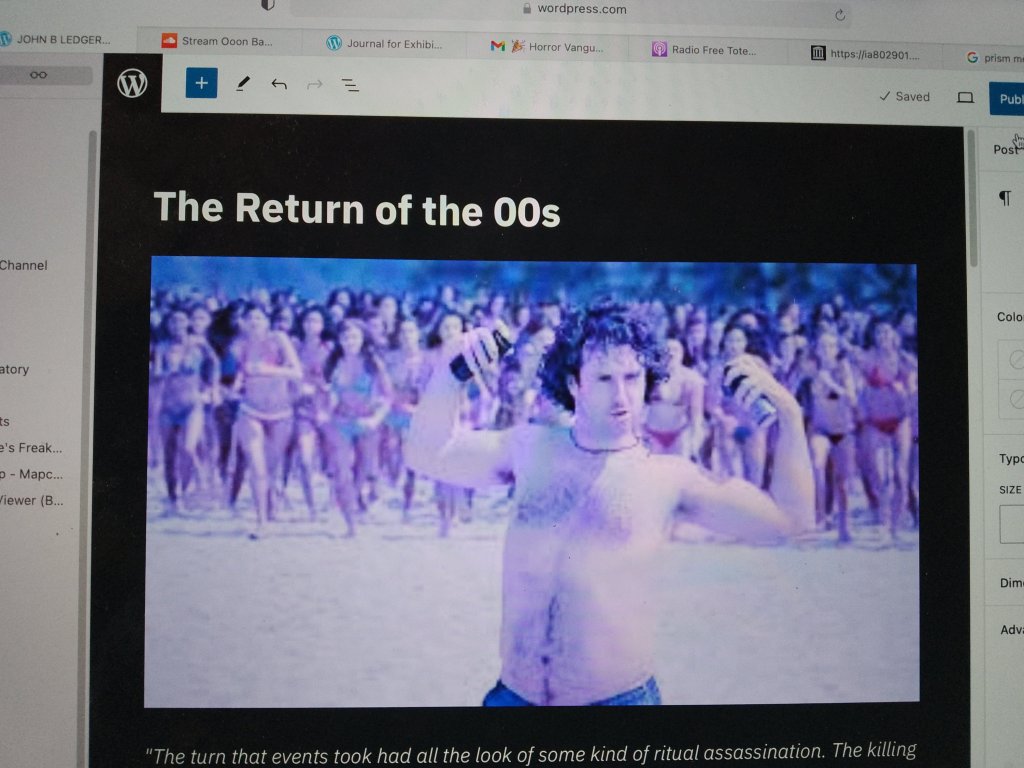
Now, the Noughties are going through an excavation of their own at the moment, largely precipitated by the sudden rush of allegations being made about celebrity Russell Brand, who, in the mid-noughties was every bit a personification of the culture and norms of that time, especially in the knowledge that he pushed the ‘norms’ to their extremes.
These songs remind me of writing specifically about trying to function with depression, anxiety, fluctuating in a moment from self-disgust to self-obsession. They remind me about what mental health meant in the noughties, when it was certainly an issue on the rise, but wasn’t to the level of near-universal acceptance that it is at now (responses like “needs to pull him/herself together” or “he’s/she’s making it up” were still very common responses).
But the songs also remind me of then-unexamined attitudes that I sometimes expressed in my songs, which have since become socially-unacceptable, and thus self-scrutinised. Passive mysoginy, attitudes now ascribed and ghettoised into the ‘incel’ culture. And a ‘punching down’ culture aimed at those who made you feel uncomfortable in an age where it was harder to physically avoid those you didn’t want to associate with.
The noughties were the ‘after-party’ after the last party of the 20th century – the after taste of 90s hedonism. The new century hadn’t yet found itself, and was populated by attitudes and actions of a previous one, but with emerging technologies that was allowing them to spread like never before.
Insulated into my home town’s reverberated manifestations of the noughties white boy indie scene (as it was almost entirely white), when I look back I see a distorted sense of my place in the scheme of things, which is also possibly an outcome of youth. I recall having a sobering moment of realisation in 2013, after enough things had gone wrong in my late 20s, and I realised my total insignificance: I wasn’t special and nobody really cared if I was an artist. In my 30s I encountered people who said they didn’t dare come to speak ‘us’ back then – our ‘group’ of young scenesters. The attitude is reciprocated by those in their early 20s now, who can see your desperate strain to stay young and relevant a mile off.
The Noughties feel like this wierd time capsule sandwiched between 9/11 and the financial crash, in which I became a young adult. Their last whimper was stamped out by the time the Tories began asserting their reality agenda on us in 2013.
It must also be added that I am excavating to repurpose many of my life-relics for a personally large show I’ll be doing in a couple of years – so vague in detail as of yet that I can’t even begin to give any detail.
That these songs touch upon personal and socially problematic subjects makes them important to the story/projects I intend to develop over the coming years.
One song, for example, the first on the ‘Ooon Badger’ set of songs above, would probably get me cancelled these says (although I think the song is just too ridiculous to be taken seriously tbh!). But, to be honest, the song after, about living in a perceived Nanny State, shows that I had swallowed some of the kind of right wing opinions on the welfare state, the kind of shared attitudes that would go on to justify the absolute criminal damage the Tories would do to society in the 2010s. It’s uncomfortable to hear passive attitudes that would be weaponised in the forthcoming decade to roll out austerity, for example.
I slotted into the ‘arty oddball’ persona, an acceptable masculine archetype of sorts in the noughties, with beta male meditations on women of interest. Expectations no less problematic than more violently expressed ones, ones that are currently being interrogated as we pathologise and scrutinise our behaviour and the behaviour of others like never before.
The Noughties were like a ghost dance of 20th century icons, wishing our boring semi-detached upbringings would be possessed by dead rock stars of previous decades. I thought I was a star, but I was merely the dust of its aftermath. Yet, this conviction drove me to to create at a rate I could never achieve now. An impulse that resulted in many naive mistakes that I find it hard to retake. But the last thing I want to do is pretend it never happened.
Anyway, for now I’ll leave it there. And leave the YouTube videos up this time!
I walk down Eastgate, and cross Regents Street, towards the back road down to the bus station.
It’s a grey October, and I’m porous to this greyness. Any deeper colours are reserved to the warm cosy culture of comedown 90s TV. It’s like the decade has put its winter coat and gloves on – taking a break from its hedonism.
Yet, down here, right now, it remains a distant promise of ‘ok-ness incorporated’, which I do sincerely expect the coming Millennium to deliver.
I have the line from a pop song in my head. As is always the case. With every coming month, sometimes every week, a lyric from a song with enough airplay to pursue you will proceed to momentarily define what you’re going through.
#Nothing really matters. Nothing really matters.
The lyric delivers legitimacy to what I really want to do: resign.
I’m too young to resign. Yet I want to. I want to resign, and retreat for the bright lights of having to show up, of being a body that must compete. I want to hide in the big cosy coat that 1999 has promised, until the world changes and it’s ok to come out into a less abrasive daylight.
Nothing is fun. Everything is routine. Routine is the coping strategy. Restrictive eating habits.
Nothing to excess, except exercise that is. Routine keeps me protected from internal condemnation but not from external exposure.
I’m 2 weeks through work experience. I was part of a group who got sent on a college construction training site. None of us fit in with this life role, but this has been dealt as a kind of punishment for what, in 2023, could be seen as a group of teenagers with ADHD.
It’s been 2 of the longest weeks of my 15 year old life. I’ve become the target for the boredom and displeasure from the rest of my group.
In the 2020s, the language I’m about to use would sound like I’m victim blaming myself. But, Somehow I’ve allowed this to be. Somewhere along the line, I’ve learnt how to be the whipping boy.
Perhaps I deserve it, perhaps it’s part of larger narrative I have that develops this relationship dynamic with other folk my age.
Perhaps it’s part of a story I’m developing where I HAVE to be the ‘good person’, and in order to maintain innocence in an already consumer-weighted world where one is inherently complicit, one must thus become a victim.
Who knows where it all began? The story feels like a thinly-vieled one of Christian reward.
“Once this new Millennium comes, and I leave school, the threats will dissapate and I can finally ‘be myself.”
“I have done well, I haven’t indulged, I haven’t been bad, so I DESERVE my reward, of nice easy life and beautiful woman.”
The seemingly innocent seeds of this relation to what the world is what it owes me will come back to bite me one day, surely…
However, the atmosphere of the moment tells me I’m in my right to feel this way.
The whole culture is autumnal, not just the weather. The whole culture feels like a solemn walk around a duck pond and a bench with a grown up Ronan Keating.
“Indie bedwetting” music is in vogue. It’s the age of feeling sorry for yourself with impunity. It sets an unfortunate precedent of expectations of an easier world to come on the eve of a new Millennium.
With a sense of relief I get on the bus by myself, still young and unknown enough in this town to feel safely anonymous.
I’m happy to resign from 1999. I’ll sit this one out now, please.
I won’t be prepared for this new Millennium for another 20 years.
“The turn that events took had all the look of some kind of ritual assassination. The killing not of a body – the body was already dead – but of a name.” – Mark Fisher, ‘The Return of the 70’s’ from Ghosts of my Life.
The turn of events Mark Fisher was referring to in above quote were the allegations that broke in September 2012 about the late ‘former DJ and children’s entertainer’ Jimmy Savile’.
For Fisher, these allegations that accused Savile, posthumously, of serial sex abuse and pedophilia, that started ‘come up…like a build-up of effluent that could no longer be contained, first seeping, then surging out’ were a return of the 70s ‘no longer as some bittersweet nostalgia trip, but as a trauma.’
Or could we also suggest ‘as horror’?
It took almost 40 years for the 70s to be reckoned with in public discourse. Savile ‘the nations favourite grotesque’, as Fisher puts it, was not only most prolific with his abuse during this decade, but his posthumous assassination in 2012 became a symbolic reckoning with a more generalised horror that was permissible in that decade – attitudes and behaviours in wider culture that enabled the monstrous meditations of the Yorkshire Ripper, for example.
Indeed, for Fisher one of them most ‘unsettling aspects of the whole [Savile] affair’…was ‘how out in the open it all was’. That, basically ‘we all knew, or felt that we knew’.
For a culture to persist it must be able to operate it clear daylight, so long as nobody speaks its name.
It took until the early 2010s to speak of the 1970s in this way.
It’s taken until 2023 to reckon first decade of the 2000s.
I believe we live in an age of accountability, of holding people, groups and countries to account for past acts of injustice. I have previously argued it is potentially dangerous not in the justice it seeks, but because that in an society that has lost sight of a better world ahead, it becomes an endlessly unfolding end for its own ends, and creates a culture of distrust and paranoia.
Perhaps because it seems so historically bound to the advent of mass social media use, a technology that has has accelerated and intensified the way in which we receive information and engage in debate, our reckonings with the past are accelerating the past ever closer to the present, in a process of ethical flattening(?). This could explain why our reckoning with the ‘noughties’ is happening closer to the present than with that of the 70’s in 2013?
Nonetheless, it is happening right now. And as guilty as he may be, Russell Brand is most certainly the sacrificial lamb in this exorcism of a decade’s wider crimes.
Today I was speaking to a friend about the “punching-down” nature of the of the noughties comedy Little Britain, which despite not being particularly funny, even back in 2004, was very popular at the time. Little Britain was like a group of school bullies trying to recreate the humour of the 90s sketchshow The Fast Show without realising that The Fast Show’s genius was that you endeared to, or laughed with, the characters, rather than purely at them. But Little Britain was far from unique, “punching down was endemic”.
In 2011, Owen Jones’s book ‘Chav’s’, which propelled the writer and commentator to a minor celebrity role, was perhaps the first attempt at bringing the culture of the 00s to justice. Identifying what until then had been a far more normalised habit of showing contempt and disgust towards those elements of the working class who were left behind and ghettoised after Thatcherism. ‘Chav-bating’ as it became known, was daily viewing on the then popular show ‘Jeremy Kyle’.
The Russel Brand of the noughties was a sniggering endorsement of this ‘kicking downwards’ style of comedy. But it had a more mysognistic twist to it.
First off, I admit that I liked the 2010s incarnation of Brand. I liked his ‘honesty’ about his flaws, his honesty in having been ‘fucked up’. Now, it seems that he was being honest about things that even he was too scared to dig deep into the details of. But this isn’t abnormal – ‘recovery’ is a very present aspect of 2020s culture, and a lot of that is people my age recovering from a lifestlye that was broadly ‘normal for the noughties’.
And who knows what did and didn’t occur on ‘3 for the price of 1’ indie discos all across the land?
When it came to sex, the noughties was like a manifested overspill of 90s ‘lads mags’ culture. It was the coming of age of those who’s formative perceptions of sexual relations were influenced by this idea that all women wanted to appear semi-naked in the very public-facing presence of the likes of FHM, Loaded, and Nuts.
It was also the age that celebrated unbridled ‘beta male’ lairyness. ‘Indie’, the safe musical space for quiet lads growing up, had gone overground and merged with old school lad culture. And as we know it created it’s own beta-celebrity horror stories in the likes of certain indie musicians of the age now being exposed as sex offenders. But none as decade-defining as Brand himself.
The disturbing aspect in this is that as many women my age are now discussing, it was presented as just part of life.
No male looks back on that age with a purely clear conscience, as even if they didn’t do anything, they said things, expected things that enabled its normality, even those of us who saw ourselves as ‘sensitive types’, politely-feminist. And even if it wasn’t called out then, there’s always that paranoia that it will be today. Noughties comedy ‘The Inbetweeners’ has dated so badly because of being an expression of this, that it is now better seen as an historical document.
The 00s was the ghoulishly overground offspring of the 1990s, it was the ugly unleashed without the contexts of the 90s that kept it in check. It was white boy decadence, as we had one ‘last party’ as the twin towers fell and the stock markets crashed.
In my opinion, the noughties officially ended in the fall of 2012, right at the moment that the 1970s were being publicly exhumed. They ended with one of the final scenes of the BBC satire series ‘The Thick of it’
Malcolm Tucker, as an high powered head of communication in a government, faces a panel for an enquiry investigating a culture of info leaks and corruption between government and media, which Tucker was the lead actor in. Tucker, realising he’s a done man, gives in to one tirade, returning the gaze upon him to the judges and nation alike:
“You come after don’t you, because you can’t arrest a land mass, you can’t ‘cuff a country”.
“I am you, and you are me!”
You can’t arrest everybody of adult age from the noughties. You can’t arrest everybody who indulged in the daily thinly-vieled misogynist and chav-beating hatred towards Jade Goody (for example), the stress of which must surely have contributed to her young death.
Russell Brand may indeed be guilty of all the horror stories that are now oozing up from the past. But, he is also in the position of the fictional Malcolm Tucker, a big player in an age that enabled it.
Chasing the idea. An idea that The idea might finally manifest itself. Chasing it for 20 years.
The infamous accusation aimed at Millennials is that they can’t afford their own homes because they spend all their money on avocado on toast – a distorted presentation of reality, so to ignore specific generational struggles.
I’m not really even a millennial. Well, only just. I turn 40 in 4 months. I was a ‘proto-Millennial’. I spent enough time in a pre-internet, analogue age, with enough time to anticipate what a post-2000 world would look like before the lived-reality.
Perhaps what I’m about to explain has something to do with this anticipation of the arrival of something. I turned 16 just days into the 2000s, and thus its arrival was deeply wedded to the anticipation of what adulthood would be.
Since then, I, reduced to an economic agent, have been a waster, wasting my future property-investment funds in a manner maybe more despicable in the eyes of cartoon-character Baby Boomers than that of the avocado eaters of Hoxton.
I’ve spent most my adult life having nowhere to head to, but no place I wanted to remain in.
I’ve always been to drawn to public spaces where I can sit without reason for being there. Their transience would sooth a deep dread of descending further down the one-way descent into adulthood, whilst simultaneously going nowhere.
Train journeys always lifted my spirits. Or, at least the idea of them; of perpetual, rhythmic motion, cutting through a society alive by daylight – occasionally the journeys would even live up to the ideal. There was never a big reason, an important journey that warranted paying the price to more far-flung cities.
After all, no matter how far I travelled I always realised what I was trying to find wasn’t located in space, and if anywhere at all, in another time. Liverpool was just another city of more shops and cafes, London had infinitely more options, but in reality every single establishment felt just like the ones in Leeds or Sheffield.
And situated 20 miles between them both, Leeds and Sheffield would become my go to cities. As long as I could find a cafe here where I could sit, and remain relatively anonymous, I would be at ease. To become overly-familiar with staff and other customers would potentially make the space feel more like the kind of space I have perpetually tried to escape: one I have to be present in.
Presence has always been what I cannot face, because I have never known how to be a body, present in a society.
All societies ask that one ‘shows up’. In older societal structures a man must show up for tough, dangerous work; for war and, to some extent, to the ever-present potential of violence descending on his family/community. A woman must show up to be enslaved to their role as a wife and child-bearer.
I spent many a childhood day peering towards the coming Millennium, relieved that this world had gone, and I wouldn’t have to go to war or work down the pits, and live a hard life.
But how does one ‘ show up’ instead?
They ‘be themselves’.
‘Being yourself’ was the golden ticket that all early Millennials were given, en-route to the Millennium. It was sold as the ‘get in free’ pass.
How did that go?
The cynical eye may argue that all that has happened is that disciplinary structures have simply been internalised. We no longer have to be forced into jobs and social roles, we must now do the forcing ourselves. Strive, push, and carve ourselves into a go-getter, go-getting a job that we may have had been made to get previously without half the stress. The despairing eye would go further, and argue that we become perpetual sculptors of our own flesh for our value on the market, be it intellectually, or physically (in the gym, in having the perfect diet, perfect sleep regime etc).
I saw no role for myself in this adult world, I was too aware what would grind my soul down in no time. And as adulthood decision-making hurtled towards me I developed eating disorders, a way of trying control the flesh’s descent towards the earth.
Not only was this a side-step from not knowing how to ‘show up’ in a world where I couldn’t see myself, it was also a side-step from the handshake with mortality that arrives in adulthood. Most adulthoods make this handshake through rites of passage, most obviously through marriage and child-rearing.
To some extent I’ve been in the waiting room for life since my late teens, wondering when it finally happens.
I’ve never been able to deal with ageing. I now frantically pluck wirey white hair from sides, because mortality can only be accepted by those who are truly in life, and not its waiting room.
My dad would on occasion express bafflement at my inability to be at ease in the domestic space. And if I’d had found ease, I’d had found life. I probably wouldn’t be regrettably still in that same domestic space as a 40 year old (despite an overarching economic reality equally playing a part in this for many).
An insect doesn’t understand the concept of glass. On a hot day it will repeatedly fly into the window trying to get out, to the point of exhaustion and death. Like this insect, I haven’t understood what I am stuck behind, and have been banging against it also to the point of exhaustion.
A little less self-awareness and a heck of a lot more self-assurance and I could’ve been an activist, fighting that which reproduces a reality I see no place for myself in. And lacking a bit of self-awareness in favour of being more self-assured, I’d keep on fighting even if my vision was flawed.
I don’t really know what will come of the next decade. All I know is that I’ve written this before, probably on this blog, as I reached 30.
I have held back on writing for a bit, because I became embarrassed at how self-consumed my writing was. I stopped commenters wading in. But this is my predicament, and this is the predicament I need to the story of.
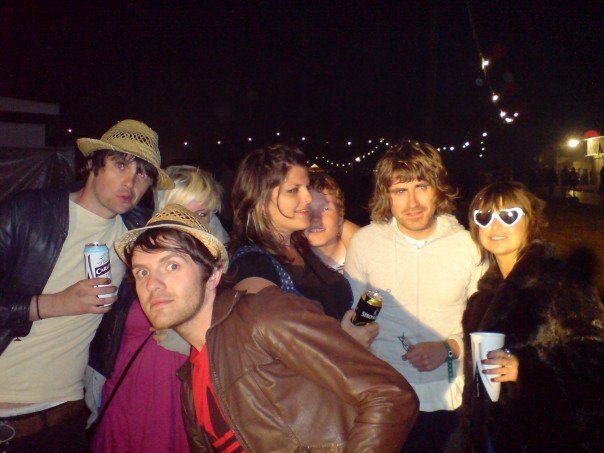
Very typical ‘Noughties’ image. That’s myself, second from the right.
“How the fuck do you know if that’s in your head or not?” Prez Pryzbylewski, The Wire.
Before I even begin to scrawl these admittedly conceptually disjointed thoughts, I realise I could be acting recklessly.
I, in no way, intend to speak in favour of abusers, but such grey areas of consideration must now be forced to bleed either black or white, with the haste of our compressed and high speed swarm-debates transforming everything.
Ultimately, I’m a white heterosexual bloke, and none of us can fully visualise and encompass what we are not when amidst projecting ourselves into this world. Our words and their consequences always have an underbelly that only certain others can see, but rarely we – and perhaps only in then in aftermath. So, if I’m speaking in favour of abusers without knowing so, I apologise beforehand.
The above quote is from an episode of the US drama series ‘The Wire’. After accidentally shooting a black colleague, white cop Prez Pryzbylewski, who consciously doesn’t identify with having racist thoughts, begins to wonder if those very thoughts might be ‘inside him’ on a subconscious level.
I grew up when sex and gender relations were being reconfigured. My formative years were in the 1990s, which was still under the long shadow of the 1960s – specifically the individualism and sexual liberation of that decade. But since then these cultural ideas had merged, and been warped by the combination of individualism with the arch-conservatism that followed it in the Thatcher and Reagan 1980s. To put it crudely, female liberation was bastardised into the transformation from domestically-enslaved Victorian Nora Batty-types into self-empowered sex symbols, with no sense of contradiction. And to young men it looked exciting and enticing and required no self-reflection at all.
I became an adult male in the 2000s—a very important decade to talk about. The 2000s, or the noughties, were truly the last party, an exhausted and decadent last tango to the hedonism of 1960s pop culture.
We all know it ended 15 years ago with the financial crash, almost exactly to the day. Since then, everybody has a smart phone, everybody has an ever-present camera – everybody is tethered to something that we idly call “social media”, mainly because we don’t yet have the distance and hindsight to give better definition to life locked inside this madhouse.
It’s so fitting that Russell Brand, who, not being an actual noughties’s rockstar, but a walking fever-dream through which we recall every indie disco we went to, has finally been ousted for what, if you read between the lines in his earlier YouTube presence, he was already indirectly admitting to and anticipating retribution for. So many of his references to the behaviour of other addicts were also clearly references to himself.
If he is guilty of all that he is accused, like Saville before him, he expressed it all in clear daylight. However, unlike Saville (and the 70s ghoulishness of Saville was infinitely Other to the 00s sex-addiction of Brand), Brand was trying to publicly rehabilitate himself in a cultural moment that eventually he knew would come for him, which is, in my opinion, why he became so conspiratorial – I believe it was a coded (perhaps unconsciously so) series of accusations towards a ‘liberal elite’ that he knew would eventually ‘get him’.
I do not think there’s one man who became an adult in the noughties who doesn’t recall saying, maybe even doing things (minor or major) in that decade that now would be both unacceptable and called out. I think anyone who says otherwise is being creative with their past.
Many of us passively participated in the idea that we should find joy in attitudes towards women and getting laid that in truth felt like disembodied endevours. The weird thing with a dominant culture, such as that of the noughties, is that you perform as if you enjoy it, even if you don’t. Just watch any episode of the noughties comedy ‘The Inbetweeners’ and cringe at what was culturally expected of young men, and then watch the more recent series based around a group of men of a similar age and era, ‘Ladhood’ to see how patriarchal male roles had to be made, often through displeasure and alienation.
Sex is fundamentally anarchic, it is the Mr Hyde to Dr Jekyll, and we daren’t look it in the eyes, because at heart it abides by no laws, no codes of conduct, it exists outside society but inside it at the same time.
However, what we are living in, in the age of #Metoo and the ongoing almost daily celebrity ‘exposures’, is the fallout of the hedonistic ideology of the last 60 years. You could call it a set of ‘implicit instructions’ that one feels rather than knows, and these instructions under the long shadow of the 1960s were that everyone must have fun, and if one isn’t having fun, they best find some fun pretty soon, in whatever form that takes.
Now we are living in an era of schizophrenic temporalities amidst the ruins of any overarching cultural consensus. We simultaneously exist in the aftermath of our current society whilst still living within it. This situation has been created by the collective haste to seek justice that social media generates. We live in a post-patriarchal, post-racial, post-inequality aftermath where justice is dealt out, whilst the aforementioned oppressive structures still exist, arguably stronger than ever.
But our current desire for retribution has a terminal nature to it, the outcome of the progressive energies of a society knowing nowhere to progress towards.
What I mean is ‘we’ (the progressive church of ‘we’) no longer have a future vision. Individual accountability for acts of injustice becomes magnified into a place of hysterical haste, precisely due to the lack of the vision of where collective justice needs to move into.
Climate change, or ‘global boiling’ as one European minister recently called it, is the most symbolical feature of our near future. Indeed, a future without a future that feeds into every aspect of our zeitgeist. This terminalism in progressive energies exists alongside a moral haste to seek justice, and it creates a culture of accountability for its own sake.
This isn’t to say that what is being held to account shouldn’t be, it is built upon strong ethical principles of justice and equality. But a movement without a vision begins to look like an anarchic free-for-all of individual call outs, which, in turn, encourages us to point and call out in fear of being called ourselves. The void in vision and direction is a fuel to the wildfire of holding others to account.
Whether one can blame social media or not, it has certainly produced an online world split between two opposing camps. For all of life’s social, political, and individual complexities, in our social media lives we have to become either one or the other: progressive on all counts or reactionary on all counts.
If we are caught out ‘liking’ a post that is a bit ethically ‘dodgy’ despite being largely progressive in our ideals, there grows a suspicion about our ‘true nature’. We have to be all or nothing. And in truth no human being is 100 percent ethically progress down to the bone.
That Russell Brand is an extreme case of this (a man who, on one hand, publicly supported the Metoo movement, and who deeply supported a fair and more just world, but was haunted by his former lifestyle that was once merely seen as promiscuous hedonism for white blokes with an ability to ‘get away with it’) means that enough people who feel burned and ostracised by the progressive camp already could begin to see in him a martyr,
That legitimately awful people like Andrew Tate and Tucker Carlson are already showing solidarity with him is a warning sign we need to pay attention to. I have friends who are genuinely decent people, but with flaws, with cultural muscle memory that makes them imperfect for the progressive camp, and they are drawn in by such influencers.
I admit that like Prez Pryzbylewski of The Wire, I have been horrified to find out what might be lodged in my own head. I tend to internalise. I self-monsterise, often to the point of seeing my lowly self in big stage celebs who have abused their power to extreme ends. Others, perhaps less hyper self-critical are retreating to the fake safe-houses designed by the likes of Jordan Peterson and Andrew Tate, the kind of houses that merely radicalise you as opposed to re-conciliating you with your shadows.
This is why I somewhat recklessly suggest that perhaps we don’t just need a Green New DEAL, but a New Deal for Sex.
I apologise it this is sounds like a flippant suggestion for something so triggering. I haven’t any experience of sexual abuse, which I understand most women alive today have, in some form. But the road we are currently on seems to be only making us more distrustful and divided and, most worrying of all, it lacks any vision of a world beyond this collapsing one.
Our sex culture lay in the ruins of late 20th century lassie faire hedonism, patriarchy, and ideas of equality of justice that are deprived of a cohesive direction forward. Sex is the de-facto Jekyll and Hyde within a species that, unlike other species, is both conscious and unconscious in its search for copulation. We are removed from other animals, but not far enough. This has always been our problem, but most notably when it comes to sex. Unlike racial and political injustice it is much harder to shine the torch of injustice on it and come up with a clear idea of an clear solution of how to do things better.
In it’s anarchic, accused, and paranoid state, the spectre of late 20th century sex hangs over us in a way that requires a debate as big as that about 21st century capitalism and ecological collapse.
Maybe Brand, Weinstein (although I think both cases are vastly different) are mirror images of reckless financiers. Maybe a new social contract for sexual relations, neither harking back to more rigid, straight-forwardly oppressive forms of patriarchy, nor like the hedonist, sexual liberation of the last 60 years, that has often merely allowed those high on power to abuse.
This isn’t a cohesive plan, and I have nothing else to add. But I think something along this line needs to start being debated more often.


 John B Ledger