I had to trawl through all the old household photo collection to find what I wanted; you know, photos from a time when they actually meant something, before images of everybody from every place at every time where splattered upon the social networking sites; you know, the times when it took a couple of weeks before you’d see the photos – not just the next morning when you check your online accounts to finds photos of your drunken self from only 6 hours previous.

These are images of Woolley Colliery in the 1990’s – before it was demolished and whilst it was being demolished. (apologies for their poor quality).

img053

(Woolley Colliery – in the background – in the middle of being demolished by explosives, in 1993)

img054

(Woolley colliery – the left of the picture – before it was demolished and before the factories were built in the foreground)

Within the valley (upper Dearne valley) I grew up in, these were the last traces of a landscape and meaning of the place I was born into disappearing and making way for something else. I’ve been interested in my family tree a little more of late also. It seems sensible enough to assume that I do this at times when I do not see much of a future, and if one takes into consideration the full scale of the ancestry websites, making money out of people also looking up their family roots, then one can see that as a society we don’t seem to be able to see much of a future at present.

For me, personally the expectation of already irreversible (to some degree) environmental problems is what drags a landslip over a doorway to a future which I once expected to walk into. But for many it may be a realisation that the liberal-democratic order has failed us, after it wiped out any suggestion that there may be another way to build a better life for us all. Whatever may be the case, there is most certainly a lot less optimism than there was even 8 or 9 years previous. Something has to change.

The landscape in which these photographs are situated is an interesting one to point to especially: as the old coal mining towns/villages themselves suffered incredibly from the destruction of the sole meaning for their existence in the first place, the landscape improved and greened over massively during that same period, and although much is being leveled off for housing developments, it is still a much greener place than it used to be. Now, I do not for one moment intend to suggest that this is compensation for the heartless economic decisions made which destroyed so many peoples’ way of life, but it is a good in its own right – if it stays that way, that is, and developers do not run amok (which seems likely under the ultra neoliberal capitalism the current government are bringing through).

However, more than anything, I am making NO real point here at all – I’d be lying to pretend that I have any over-positive thoughts up my sleeve to finish this blog off with, so I will just idly try to relive the past like everybody else seems to be doing.

The Social Media Fat-Face application – a real cultural low point

fat-booth

So, yet again I find myself in a personal battle to abstain from the technological dictation of communication. Caught in a dilemma, knowing full-well that abstaining from the social networking sites will sever many social contacts but also never ever forgetting the miserable state of mind I sink into whilst scrolling up and down my profile page (although this blog title is assertive the real me sways like a Silver Birch in a strong wind). However, a recent Facebook FAD has reviled me to the extent where I simply didn’t want to have any presence on the site full stop. To many this revulsion may offend, as it is all too clear that most see this application as nothing but harmless fun, but I sense a massive underlying sinisterism. I am talking about the ‘Fat-Face’ application which allows Facebook members to manipulate photographic images of their faces to see what they would look like if they were considerably more overweight than they actually are. Thus, people post these pictures on their walls, for digi-friends to hoot and howl at how they’d look if they were 7-8 stone heavier. What nobody seems to mention is that, because the program’s manipulations are convincing, it actually makes the enlarged faces look like real people in existence – you know, people who may actually be on facebook, like? friends of yours, like? On Facebook to try to make a better social life for themselves, like? As a former anorexic I take a severe dislike to this new FAD. Anorexia, you see, is a fear of being fat, in fact it’s more than that – its a terror of being fat. And this kick-starts an obbsessive disorder in a drive to become what society informs us is perfect; ultra-skinny. I wasn’t born seeing fatness as the worst thing possible, it was learnt behaviour which I became fully concious of in my teenage years. To be fat, although it is never stated in such a clear-cut way, is the worst thing to be in this advanced consumer society (the explosion of eating disorders no doubt runs side by side with the beginnings of Neoliberal Capitalism in the early 1980’s). I never knew until recently that the anorexia-causation-model-Barr-none Kate Moss actually once said “nothing tastes as good as skinny feels”. If one couples this quote with lyrics from pop-culture’s polar-opposite, The Manic Street Preachers “I am Twiggy and I can’t see the horror that surrounds me” (late lyricist Richie Edwards suffered from anorexia) you can easily see how when one is really skinny in a mass consumer society, it basically lets you off the hook – “you’ve no need to feel guilt, shame etc”. To be fat in a mass consumer society is to expected to feel like a nobody, a dis-likable blot on the landscape of desirable’s (even now, when I wake up feeling fat, I feel irredeemably depressed for most of the day). So, if you then go back and observe the jokes and hoots at the fat versions of people, you can see that it speaks as a mass denunciation and humiliation of overweight people. And I know that most people who have made a fat-face picture of themselves will be offended by this, but I’m not here saying that you intended for it to be an attack on the very overweight. Nevertheless, this is what your collective fat-faced images convey. I’m sorry, but when you’ve studied the societal hounding of physical imperfection for years due to the very fear of being hunted down, this is the conclusion that one arrives at.During my flitting on a off Facebook during that past 4 years it has, at times, appeared to be more of a Facebully. Its programs, add-ons often encourage users to attack those who society sees as the undesirables, those too ‘ugly’, too unpopular to be able post pictures of themselves on the site – an older application named ‘Compare your friends’ was equally as bad, as visuals appeared documenting the disparity between those who nobody cares for and those who everybody adores. Obesity is as much a symptom of late-capitalism as anorexia is; the incidences of each rising simultaneously almost in a sadistic compliment of each other as the system’s jaws open wider to unveil the dystopic beast. One of my favorite ever sayings is “it is no measure of good health to be well adjusted to a profoundly sick society” and when the desirables who light up the aspirations of the population include people like Kate Moss and Pete Doherty this saying becomes ever-more pressing. If anybody with a Fat-Face App image of themselves on their Facebook account is reading this, try not to dismiss this post as an overblown reaction (I am in fact calmer than usual as I write this). Likewise, don’t dismiss it as an attack on you personally for your decision to use this application. All I’m saying is that the bigger picture of all the Facebook Fat-Faces, amongst the even bigger picture of society’s denunciation of all people without the perfect face and body (and personality, if you want to complete this picture) is one of a mass undetected discrimination. Thus, all I’m asking is for you to find fun and humour amongst yourselves without using this program, as it is a signifier of downward discrimination, which, because it has become a normal thing to do in society, few realise they are partaking in.

One of the reasons why there is more writing on this blog than artwork at present is ecause the place where I make my work is so cramped with old works that I can hardly move. I have provided truthful photographic evidence of this, for anyone bored enough to be interested in such A NON EVENT of me telling you that “nothing is happening”. There again, I kind of like the look of the studio when it looks like a trove of all the stuff in my head – but there again I would wouldn’t I? because it’s my head. So here it is a post about NOTHING IN PARTICULAR. But at least I’m not posting pictures of my every last carbohydrate being used up,to put on Facebook. If my studio continues to get more cramped – I’ll probably turn to this in a week or so. Sorry to waste the time of anyone who’s time is actually important.

IMG_5194

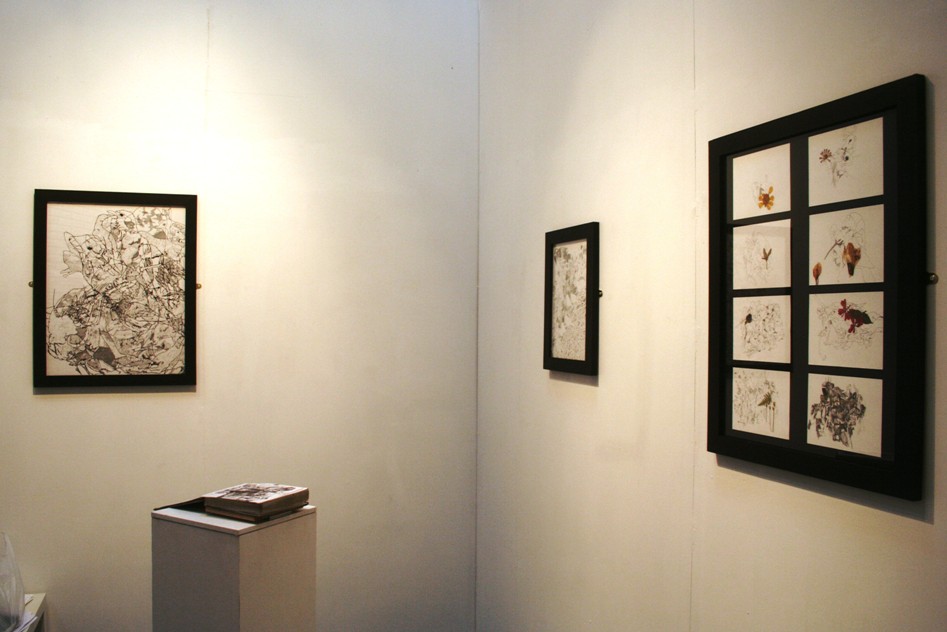
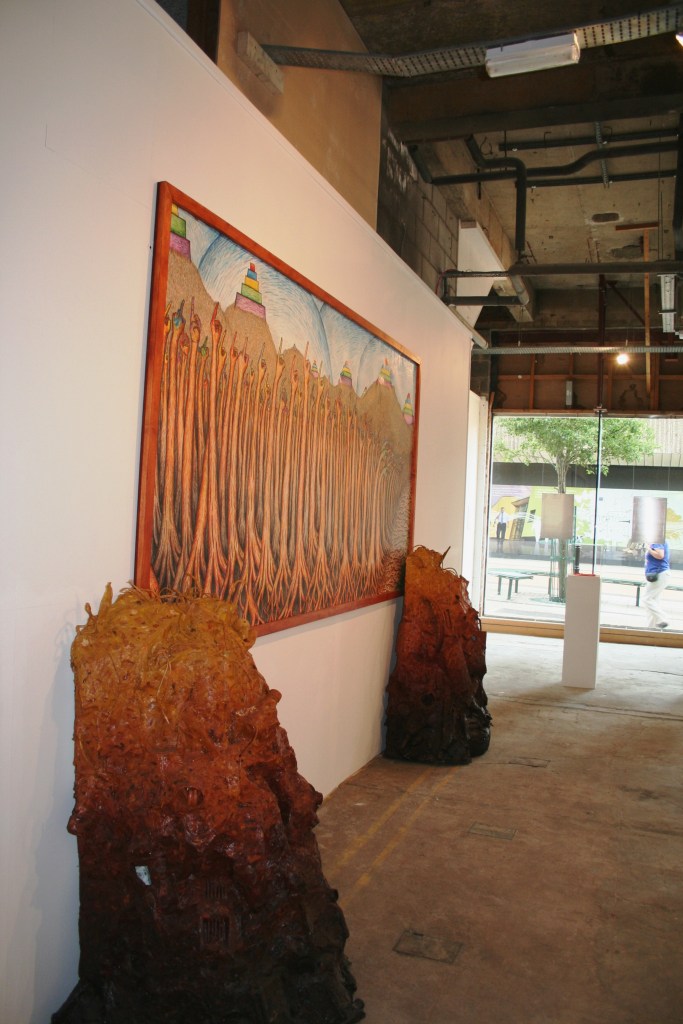
Re-generate, at the Creative development space (CADS), Sheffield

This exhibition was held in the Shalesmoor area of Sheffield, October 2010. The works I made for the show had been shown previously (I usually try to show new work for each exhibition) but my current work takes me so long to make I sometimes just cannot manage this. Anyway, thanks to those at CADS for inviting me to be part of this show. There was some really high quality work in this group show..(some humans looking at a picture)

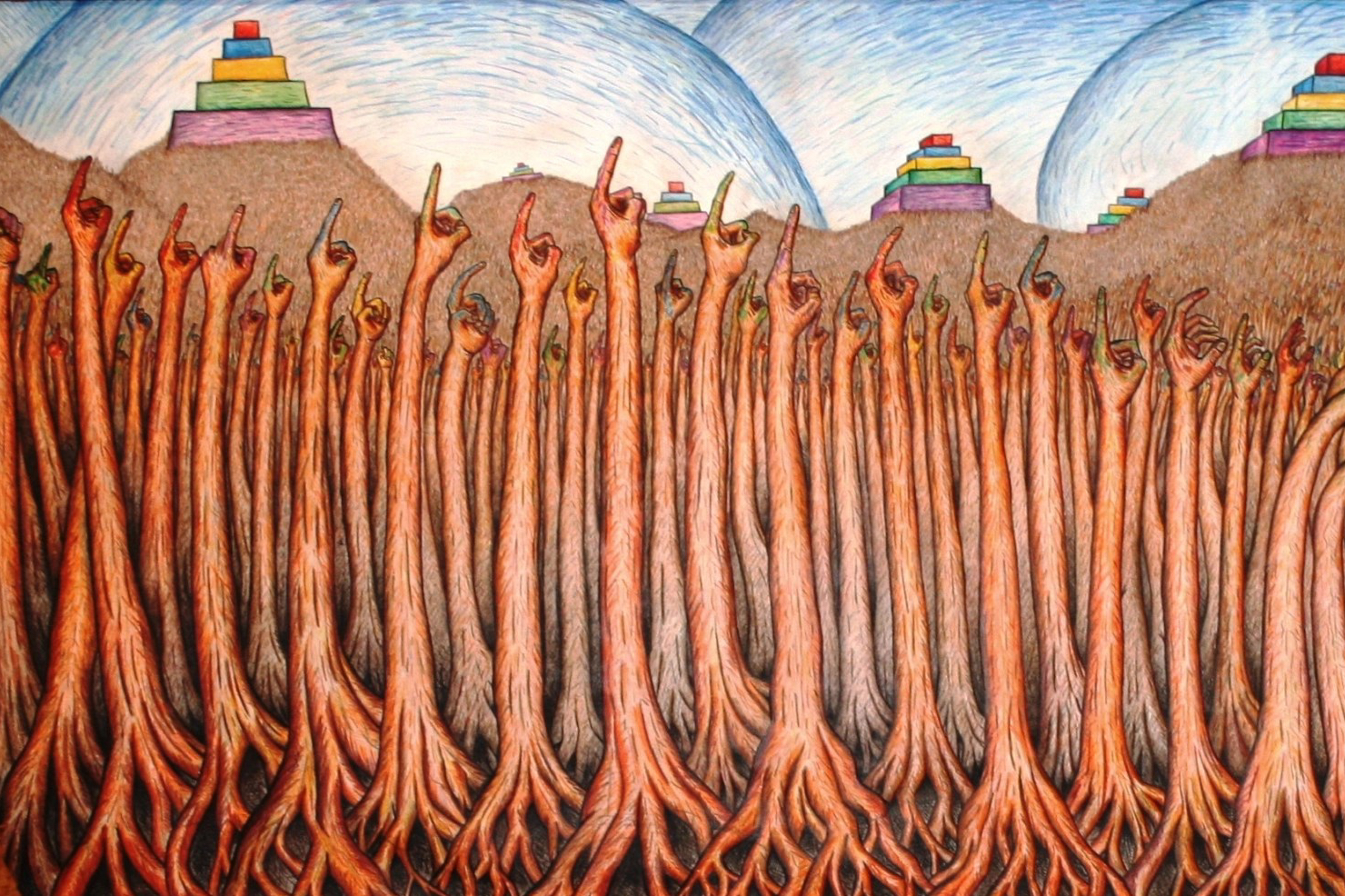
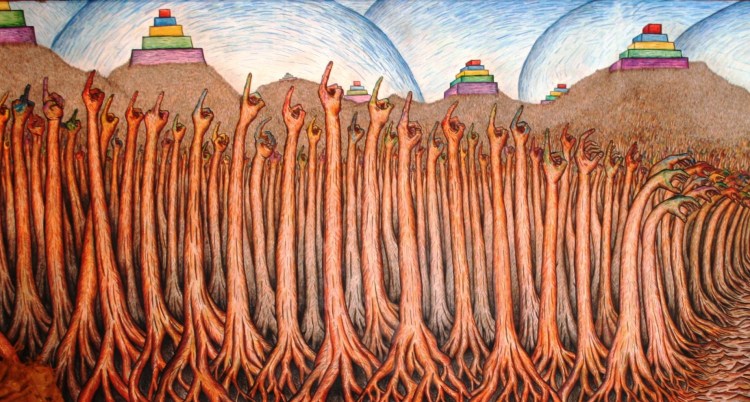
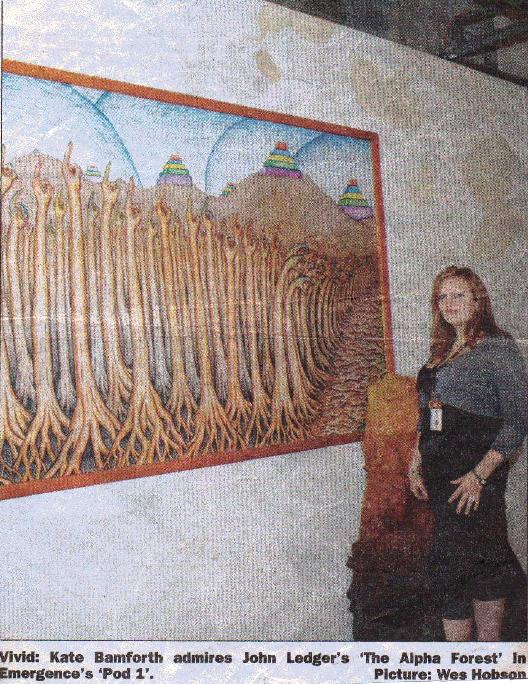
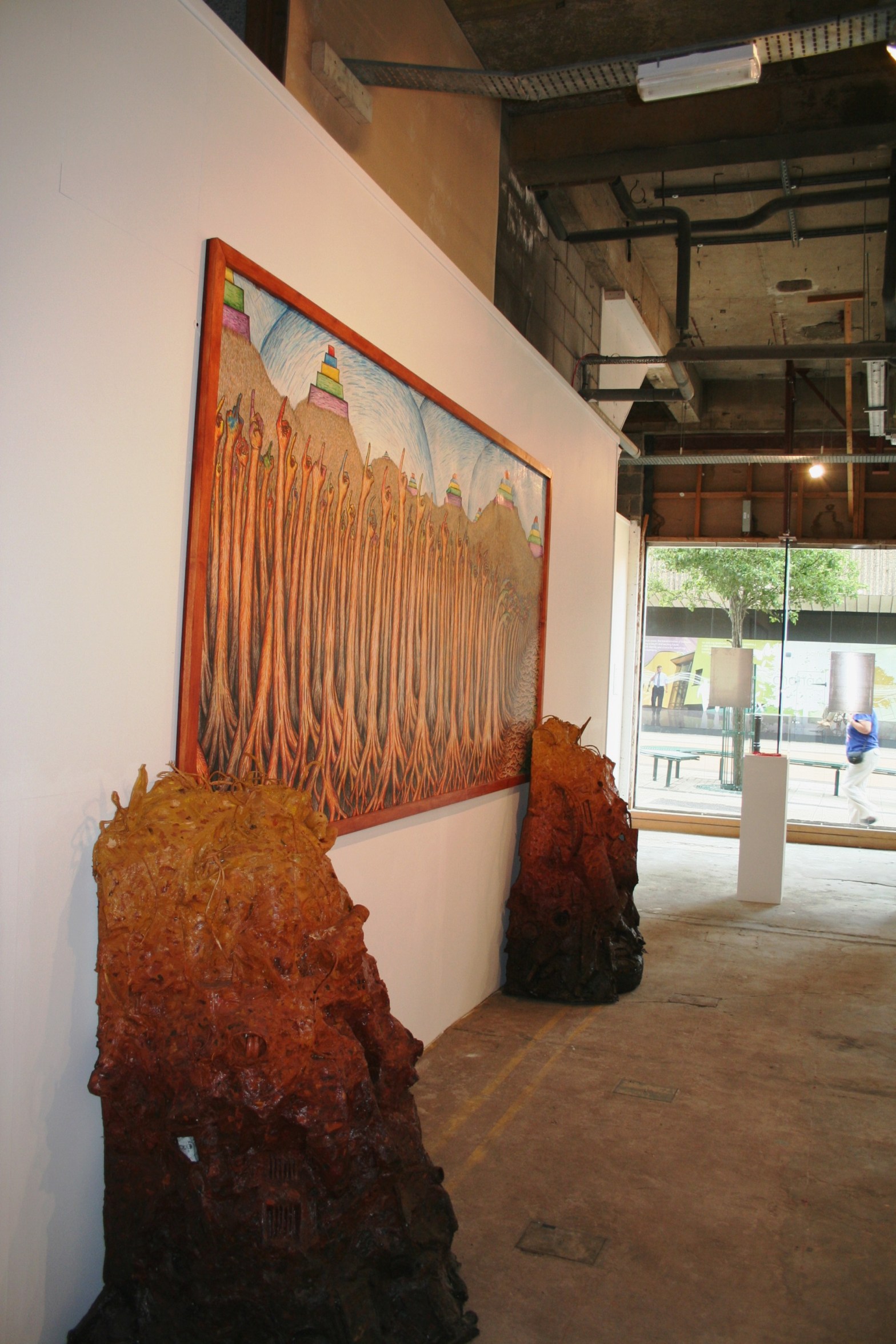
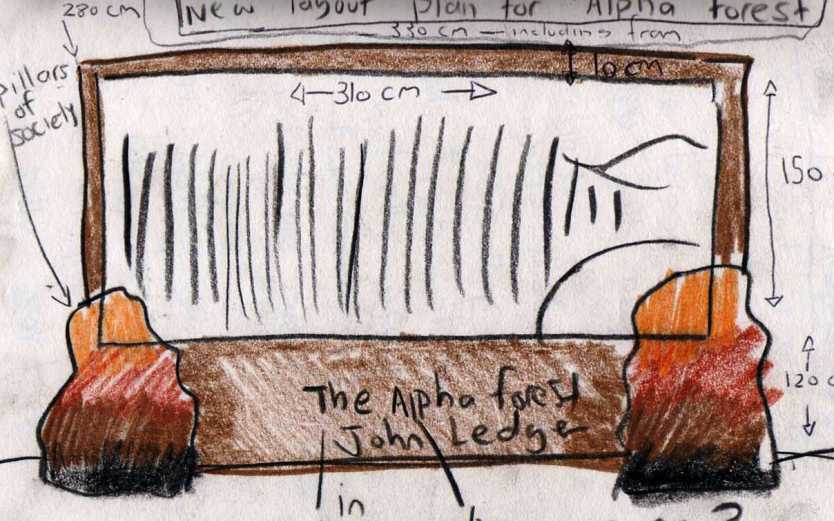
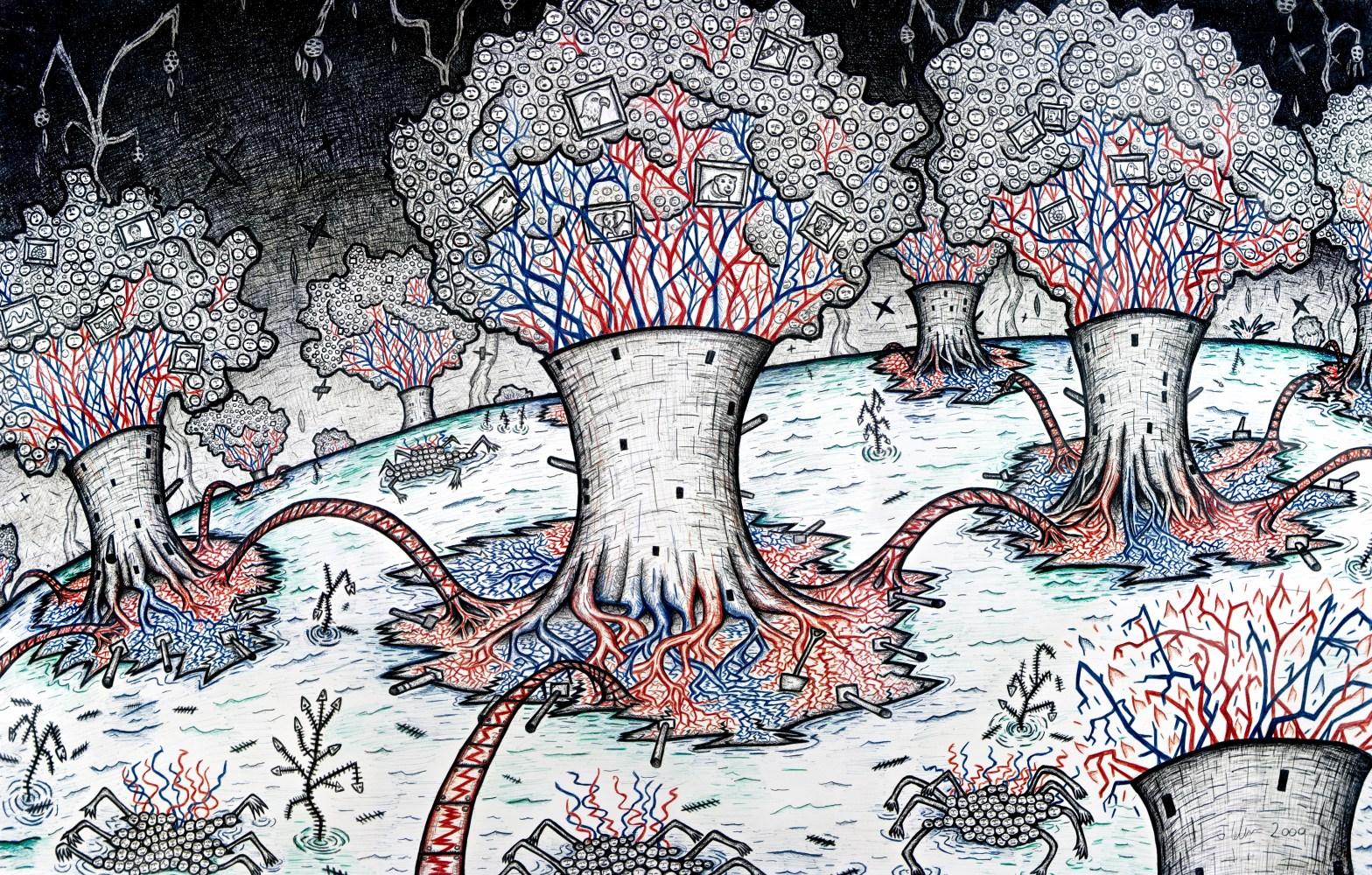
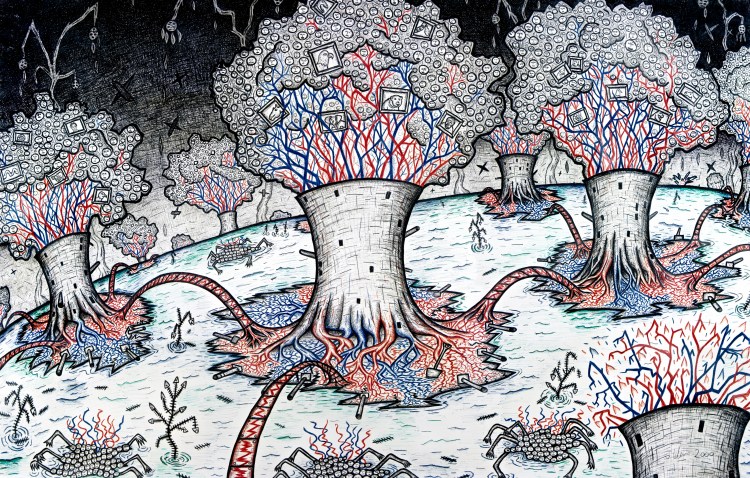
The Alpha Forest, 2009, pencil crayon on paper, 10X5ft

CRW_0030

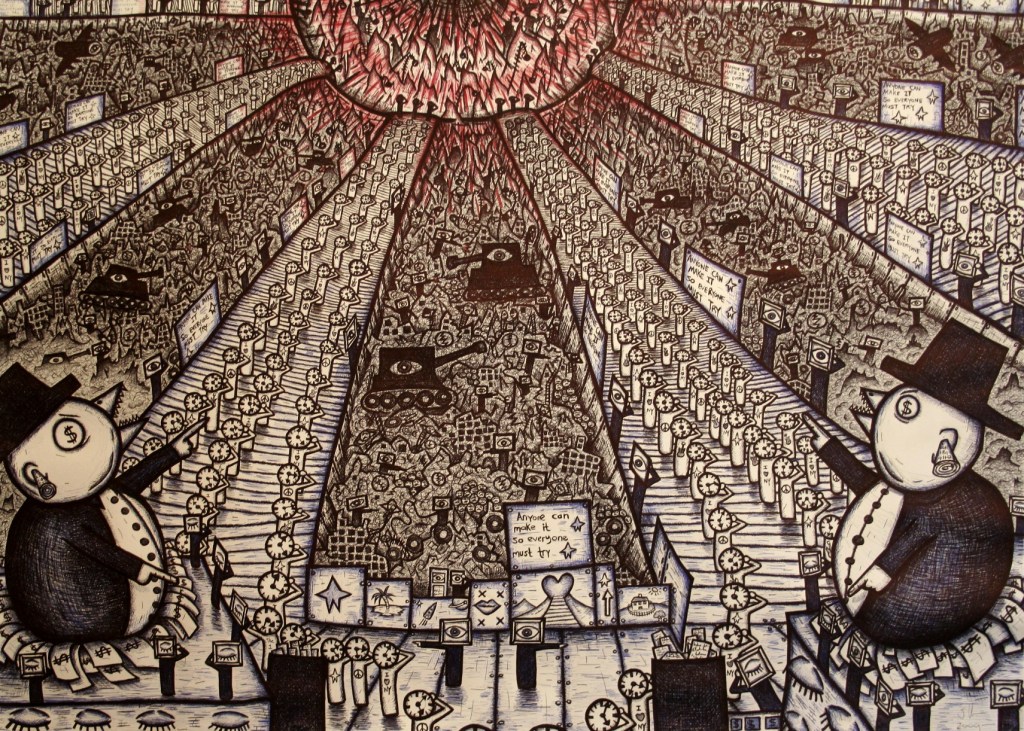
“I Believe in Capitalism”, 2010, biro on paper, 120X160cm

The Tide of Society – Virtual exhibition tour

The Tide of Society

The Tide of Society is an exhibition of works central to the battle to retain a sense of true self amidst the mental bombardment from mass persuasion and systematically imposed duties. Trying to swim upstream is the only option for one who is subjected to this, if they wish to retain a true sense of self.

Although I created some ideas and imagery based around a tide of society whilst I was still a student, the majority of these ideas have been prompted by an unavoidable (due to position) 9-5 working life undertaken afterwards. The looming domestications, brought on by these duties and expectations of one, team up with the (already present) pressures of living in a consumer society. Indeed, for the first time I am beginning to understand my subjection to both ends of Capitalism: pushed into a job to become a wage slave, and pushed into the shopping aisles to become a participative consumer (“amusement under late capitalism is the prolongation of work” – The Culture Industry: Enlightenment as Mass Deception). Work and leisure time, alike, are confronted with the fact that “it’s much easier if you don’t think about these things too much” and so comes the lure to consent and conform to all that seems to be being suggested to you.

But where is this tide dragging society towards anyway? The ultimate compulsion within my work is to link every issue tackled to an ultimate concern: that of our predicament upon this planet in the 21st century. This fear has always engulfed and incorporated all other fears. We are pressured to increasingly consume more on a planet of drying-up resources; pressured into seeing that continuous growth is “the only way” on a planet which cannot afford our species much more growth; and then we are pressured to live our lives through digital devices, prompting ever-more isolation, hence more need to satiate ourselves via consumer outlets, whilst also becoming more separated from the ‘terra firma’ on which we depend.

The list of ways in which the tide of society is flowing to a place from which the earth can longer give us what we require goes on and on. This exhibition is mesh of global, social, and personal concerns, as we leave the first decade of the 21st century behind us: a fear of a possible ‘shared downfall’ of my own life, humanity and nature.

TV TALK
(see also – http://johnledgertvtalk.blogspot.com/)

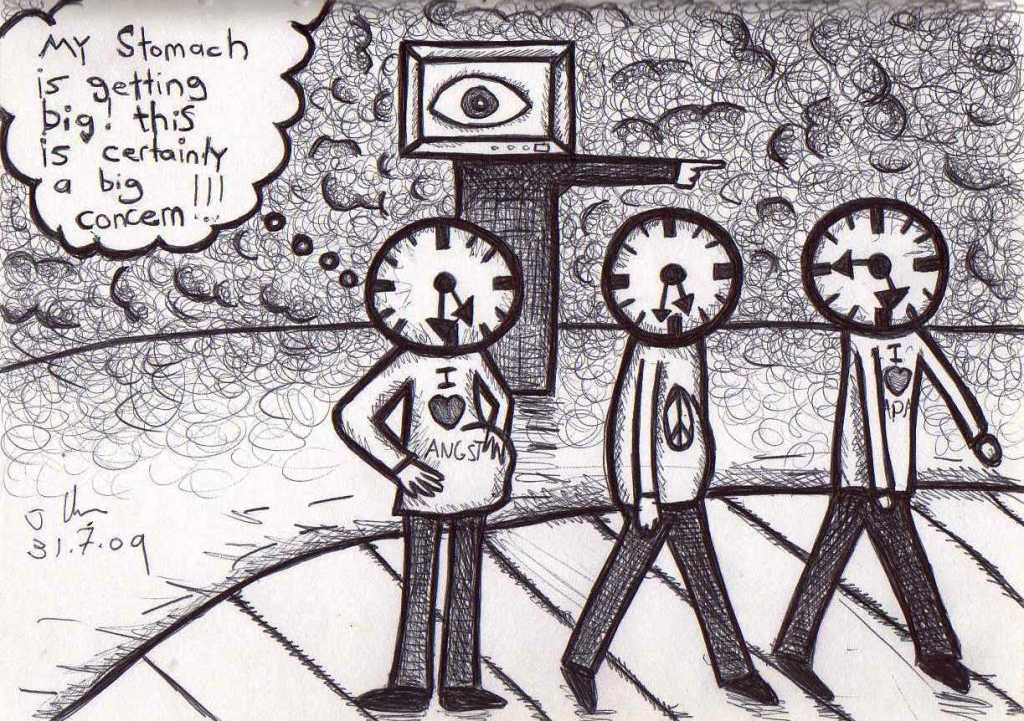
The isolated human figures with television boxes over their heads are named TV talks. They document moments when I have reiterated society’s directions/persuasions as pure reaction (my own TV Talk moments). I’ve used them to depict lonely, entrapped figures, eternally subjected to an indifferent larger power’s directions and diversions, rendering them into walking televisions sets: the self has been compromised for the rhetoric pushed along by the tide of society. They utter the social anxieties of a people reared to be self-obsessed and ‘bleakly’ individual; indifferent, and too self-concerned to pay attention to the collapsing world around them.

The Sprawl

The Sprawl is incorporated around the shape of half of my bedroom, colonising all workable surfaces in the manner of the ever-expanding city. It is an expression of a how the city has become one giant super organism (although separate and hazardous towards the Earth’s working life systems). To realise that we (humans) have become like termites – economic slaves, acting for the benefit of this super organism, which is a completely unnatural way for humans to exist – is a necessity when one is finding modern life stressful and pointless, yet cannot figure out why.

The Sprawl is closely related to my obsession with maps. I have always been transfixed by the urban environment, perhaps down to an unwanted feeling of detachment from the rest of the human race. I am also transfixed by dates, the importance of dates which have shaped my perception of what is going on around me, and also the melancholy musing over what we are always losing as time passes. It seems highly probable that we will all become embedded in sprawling mega-cities, and amidst the life it dictates, as urban areas continue to expand.

THE HEALING PROCESS

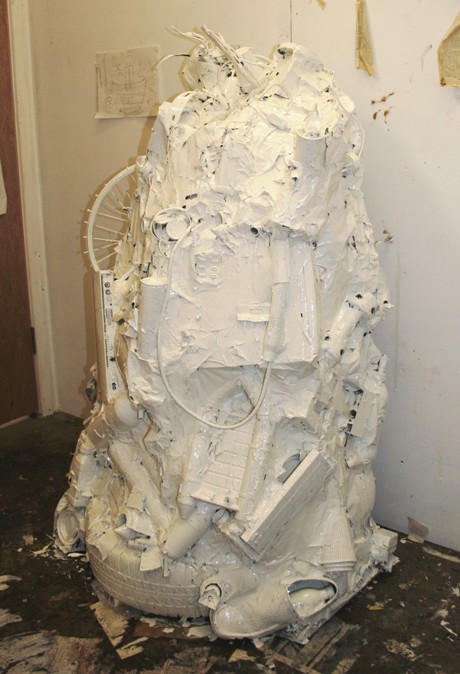
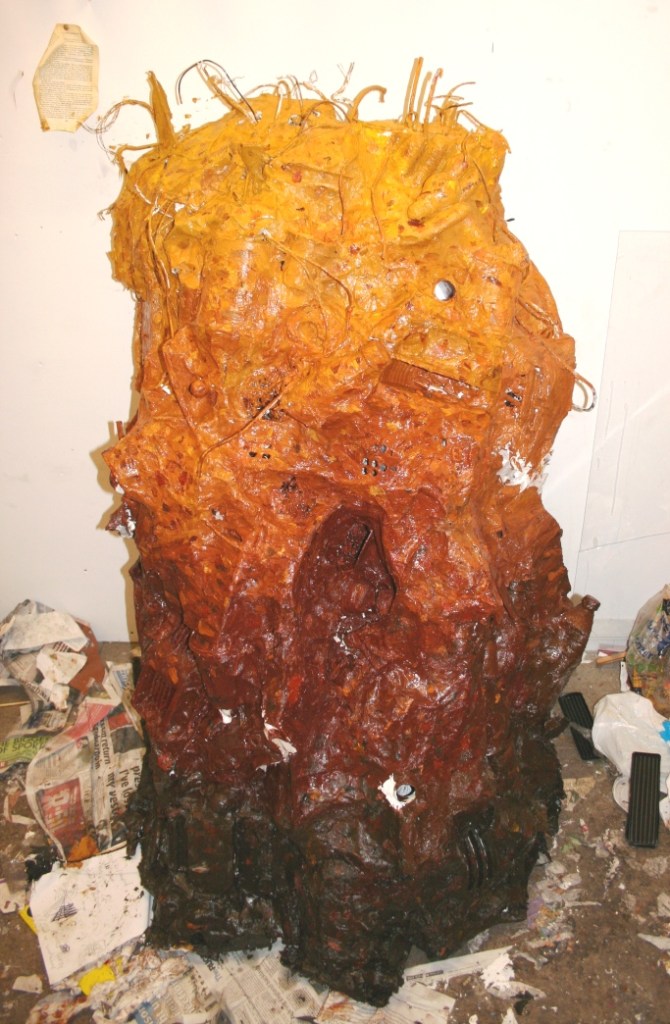
These mounds have an unwanted and heavy presence, and even slightly obscure my drawings. The sculptures are piles of man-made rubbish, the guilt of an artist in a consumer climate that is piling up to obscure the things he feels most proud of (his framed drawings). The fossil-like traces of man-made objects are like the traces of a species now extinct. I realised the mounds took on an almost pyramid shape and they started to look like monuments to a species that had died out. They have both a positive and a negative suggestion: the positive being the individual appeasement I find from using at least some of the junk material made by the society I am bound up in, and the negative being the extinction of our species and natures resilience in regaining a ‘firm-footing’, leaving only traces of our species, which no other species can even acknowledge.

A FINAL ACCEPTANCE

The implications of living in such a commercially driven society are that one’s personality is chopped, diced, and edited, until it is able to fit in to the slots created by a society that has become more and more homogeneous as commerce prospers in a global community, where the means to distribute information are owned by so few: the pressures to conform to a whole manner of conventions are immense. My capacity for developing, re-learning and growing is massively constricted as the domestication into a system-friendly, ‘able and flexible’ adult, takes up more of the free mental spaces which allow my development as a human. The intensity caused by trying to resist a barrage of pressures causes a mental debilitation, which ‘hammers one down’ weakening them into submission. A final acceptance, in order to stem mental debilitation, seems like the safest option.

(8x4FT, Mixed media on board)


Title names:

A Final Acceptance: mixed media (2010)

TV Talk: biro and cable (2010)

The Tide of Society: book (2010)

Central Bombardment: biro on paper (2009)

The Sprawl: biro on paper (2008)

The Healing Process: mixed media (2008)

This Hole Cannot Be Filled in a Car-Park overspill: biro on paper (2008)

Tomorrow I will do the same as I did today: biro on paper (2008)

The hole in my stomach is making the hole in the sky: mixed media (2008)

exhibition details as follows:

 August 23 at 10:00am – September 19 at 4:00pm
Four Thirty Three49 Mowbray StreetSheffield, United Kingdom

Thanks to anyone who has been down to the show, or is planning on going.

The book I made which accompanied this show can be previewed here

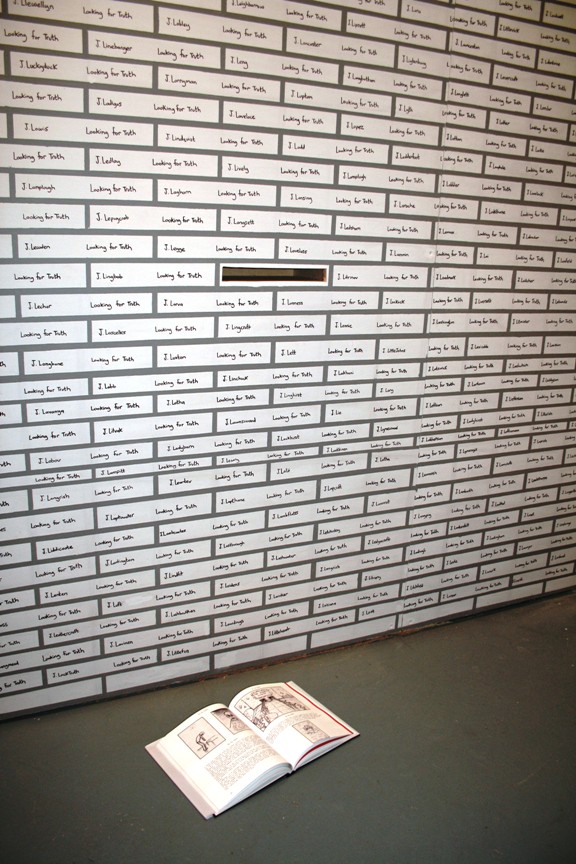
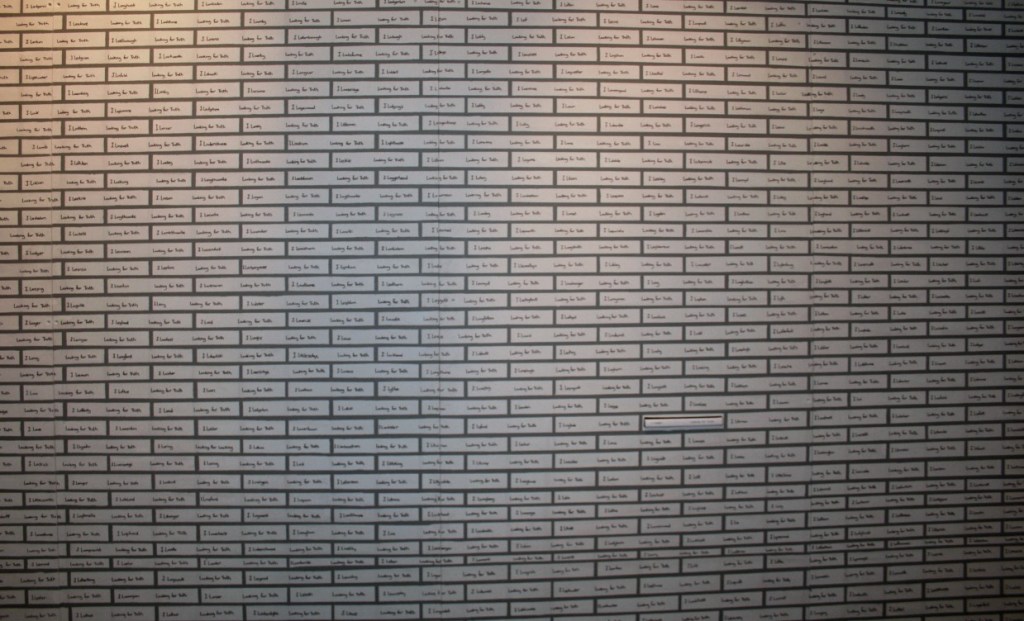
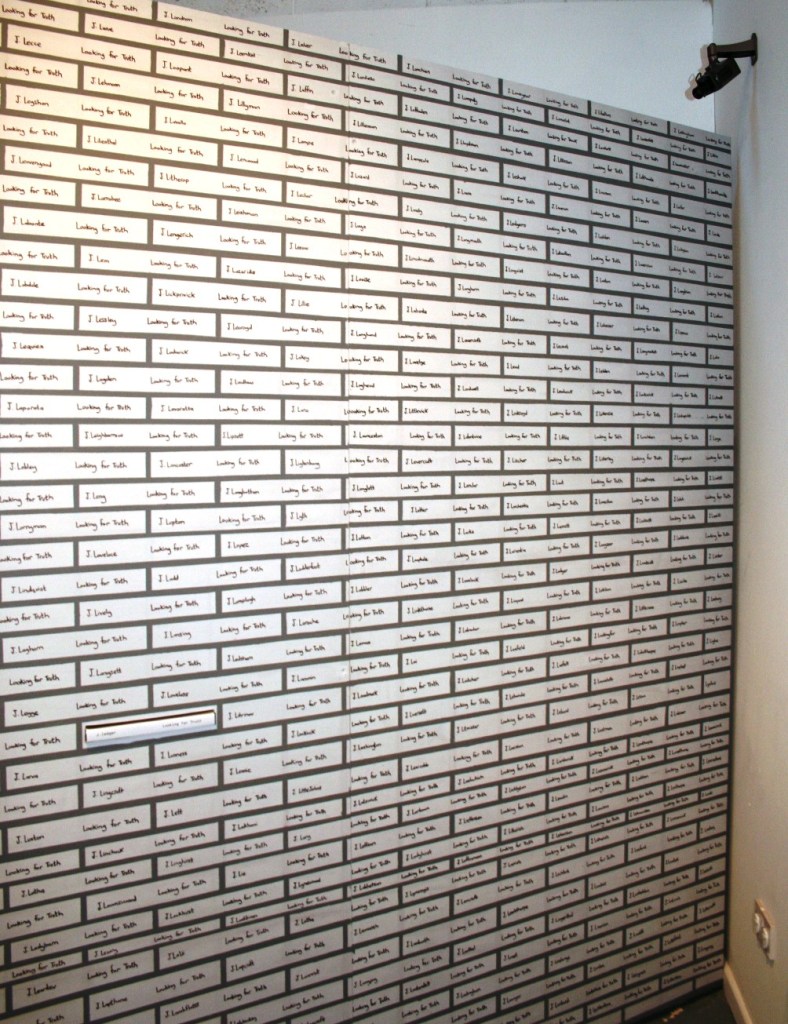
“I believe in Capitalism” Exhibited in The Working Artist exhibition

“I believe in Capitalism”

It is hard to explain the motives behind my work without dragging the explanation into an intensely political and, sometimes, personal debate. My works are the tip of the ice-berg of my thoughts, and they take time to emerge in my mind; resulting in a feeling of great relief. My doodles have no choice but to become murals, as I try to match the size of my concerns. The act of creating for the sake of creating used to be enough to de-throne my looming concerns, but over the last few years, my work has taken a much more direct and polarised stance; as the act of creating, by itself, ceased to be enough.

The work for this show represents what I see as a realisation, and finale, of all my sketches and writings, from the past 10 years, becoming more direct and solid as I reached the decade’s end.

I believe in Capitalism” is almost a showcase of what I have become during the past 10 years. The large drawing piece is explicit in how direct it is, as it organises and crystallises the ‘budding’ of my thoughts and ideas from the past decade.

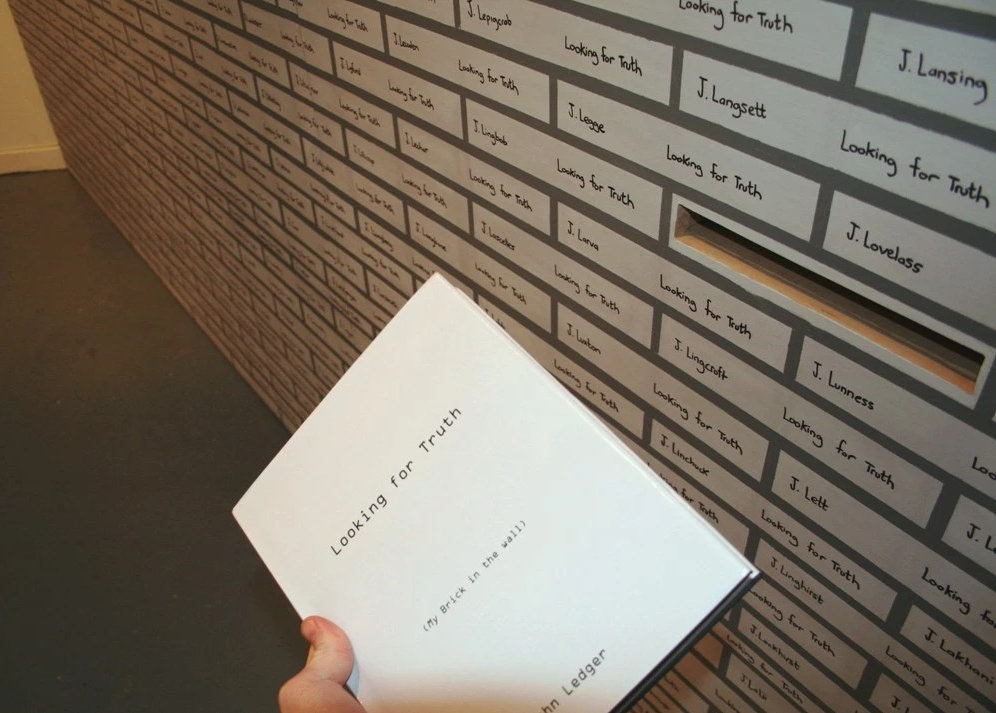
The title quote was taken from an interview with a banker on the BBC during this recession. Its usage is ironic. However, there remains a suspicion that my inner drives still do believe in Capitalism. Thissuspicion is consistent throughout the book Going nowhere, writing letters to nobody, which forms part of this piece of work. Nevertheless this accumulation of drawings and writings, which go far in explaining my becoming during the past decade, also leads to a conclusion of an apparent massive dissatisfaction with my life, and society as such, under this system and an urgent desire for a massive societal change; in doing this the book has become a manifesto of my life so far.

The School desk, the chair and the book, face the drawing as if it was a teacher’s blackboard. This suggests, an education system which rears a society’s children for the benefit of the growth of Capitalism, but it also suggests the possibility of re-learning; being educated to perceive the world differently; which, judging on humanity’s predicament in the early parts of the 21st century, may be essential for forthcoming generations.

On the drawing

My drawings require me to undergo shifts of manual labour; seemingly endless daily repetition. I could be almost undertaking a factory duty, and sometimes I feel like I am using a production method which rivals, in scale of input, that of the mass produce of the system I am trying to stand up to. For this task, the sturdy, bog-standard, office-like nature of the ordinary biro seems fitting.

The landscape of “I believe in Capitalism” shows the insanity of proceeding with a system which is only 
sustainable in the kind of dream-like world actually fabricated by the system to keep the masses as

“Glazed-eyed passive citizens”. The conglomerate of the richest cities’ skyscrapers looks for this very world.

Reaching into the sky, its searchlight looks out for a place that doesn’t exist, whilst destroying the only thing

we humans currently do have: a life on this planet. Directly below the skyscrapers, The Alpha Forest - a

habitat of rampant materialist individualism of a million voices all trying to be heard like a million trees all

vying for sunlight - blocks out any alternative, making the citizens willfully accept that “this is the only way”.

Below The Alpha forest, the advancing consequences of this all-consuming system become more and more

tragic, until we finally find the doom-laden waves which carry the Easter Island heads, reminding us of the

tragedies that befell their island when its inhabitants outstripped the island’s resources, resulting in conflict

and a deserted island. Are we recreating the Easter Island Catastrophe but on a global scale?

Trying To Swim Upstream

Essential moments… My easiest, most content, moments arrive when I look at my arms and legs and see myself as just a mere animal, a highly evolved ape, as opposed to a needing-to-be-seen-as good-looking, productive, clever and popular person. Nevertheless it is difficult to retain these thoughts whilst in the company of other humans; in fact I find it impossible. I am not comfortable enough around any human being to ‘just be’, and I find it more than tiring. I find that I naturally begin to mould myself into something which feels wrong, something which is a compromise of all that I think I am. 

However, today I feel more content that usual. Monday is my Friday and my weekend is Tuesday and Wednesday, and today is Monday today. I feel more content with who I am today. I am not feeling compelled to scrutinise myself when I catch a glimpse of my reflection in the gallery windows. Somehow I am seeing myself as ‘another human’ rather than a ‘ranked’ being in a hierarchical world, where I have to be constantly proving myself. Therefore, I am less frustrated than usual. Maybe this is because I am feeling less strain in trying to swim upstream today? Or maybe I have always been carried by the tide of society, and today it doesn’t bother me too much?It usually bothers me immensely; I have found it massively difficult to retain what I regard as me whilst living in the human world. Since, high school, It has been a great difficultly to retain myself from the forces of mass persuasion; the times when I have conformed the most have been the times which have been most personally damaging, but the conflict in trying to retain ‘me’ has also caused me significant social anxiety. There was a brief spell in university when I felt I had strength against the compromising – university is a great deluder of what an individual will experience in the real world – but since then the struggle is on again to retain the aspects of me which are essential to my being. I fear what would become of me if I made this final acceptance. Part of the disease: John ledger the brand

I have to live in denial of certain things just to keep myself ticking over. In fact quite a lot of my breakdown periods are part-caused when my morale isn’t strong enough to pardon me from the aspects of my life I am in denial about. The denial is there because deep down I am aware that my need to be active and productive is far more resource-consuming and counter productive than if I was to sit in a chair and not move, but to write and draw. Nevertheless I scurry up and down trains on the Hallam line (Sheffield to Leeds, via Barnsley train line), buying coffee’s, bottled drinks (if I forget my own bottle, it appears that only safe water can be found by buying a another bottle of water), newspapers to keep me ‘informed’, just to put a couple of hours in on my drawing-work which, in theory, I could do at home. Countless times I have been sat on a train seat coming home thinking to myself “what have I done? All I’ve done is scurried up and down and I’ve hardly done anything”
However, my deep seated doubts about whether my efforts are counter-productive aren’t just there in the physical world (which is largely in terms of my carbon footprint) they are also there in the virtual environment. I have great doubts that my work, and everything else I post on the internet (no matter how anti-consumerist the message is) only adds to the consumer mindscape; adding power to its language rather than attacking it. After all, having your own profile on social networking site’s, no matter if it’s pictures of me with a new hair cut, pulling my prettiest face, or it’s a online gallery of my finest artworks, is just an advertisement of one’s self to the rest of the world before it is anything else.
Although I cannot complain about the mass migration to social networking sites over the past decade whilst I use them also, they are not how I’d wish to communicate, nor would I be advertising my work as such, if society allowed an artist the freedom of not having to fight it out in a sea of people all wishing to be seen/heard – which is, more or less, what the internet is now. I always upload more images of my artwork onto networking pages when I feel less secure about what it is I do, and when I feel under the threat of being slightly devalued as a ‘talented person’; this happens especially at points when I am low on money; these times are when the voice of capitalism speaks louder than one’s own voice. I become part of the mess, part of the ‘Alpha forest’; sticking my hand up into air, desperate to be the one who gets noticed, the one who has something to say; when, in reality, I have possibly discarded my voice by consenting to the global hegemony of rampant individualism.Perhaps I am not as counter-productive as I used to be; I no longer make t-shirts, art and music under The John Ledger package, but I still am essentially a brand. Maybe more reluctantly so than most, but reluctance is a foil for one’s disagreeable inner motives; if some part of me wasn’t stimulated by the chance of receiving a positive comment on Facebook, I wouldn’t even need to be writing this now!
The most inspired works I make, containing explicitly anti-capitalist, anti-authoritarian messages, still carry the logo (hidden from view) of one’s self. The leech of stardom/heroism is always present, gripping on to one’s mind, hurrying them on with their urges to make work and “get out it out there (on the internet)”. We cannot bear to make, say or document anything which isn’t intended to be put up before our expanding internet community; and the very nature of using the internet is one of copying and editing our virtual selves in a branding manner with which we have been shown to do from years of viewing the advertising of consumer brands. In light of this is it at all possible for my artworks’, or anybody else’s, messages to be beneficial to their intended causes amongst the virtual crowd?
I managed to quit Facebook in September 2008 after well over 2 years of being largely sceptical about whether there was any benefits – both in terms of being an artist and a creature dependent on social interactions – from using social networking sites. What followed was a period in which I tried to battle what I saw as ‘irrational thinking’. I attempted this by taking my time more, in all walks of life. This included persevering with focussing my attention on things more greatly, instead of flitting around trying to do everything at once, which internet usage encourages especially. I began to read more, and reading it so that I understood it, rather than merely accumulating it in order to stamp my ‘been there; read that’ sticker on it. I could not do this with information on the internet; I find it impossible to focus on anything on the internet.
All seemed to be going to plan; I was contemplating things more, for the better, even furthering the intensity and strength of my artworks. However, then came spring and summer time of the next year, a time when I always feel an aura of social pressure to be “more productive” to show to the world that I am productive, hardworking and deserving. What calmness and composure I have in autumn/winter evaporates as fast as the summer rain. And, in July 2009, I walked back to Facebook; lying to myself, saying that it was just quick peep at what my friends had been doing in the virtual world without me. It wasn’t long before I was feeling the urge to check it every time I was in the house, and it wasn’t long before I was advertising my opinions; “look at me, look what I think about. Aren’t I clever!?”
So here I am now, glued to it again. Will I have the strength to leave again? Well, the voices of doubt in my head say “you can’t leave right now; it may be helping you to get your artwork out there, and in times as financially difficult as this, it is essential that you do that!” Then I get the voice spouting the social benefits, which I am sure everyone gets when worrying whether being on Facebook is a good thing “You’ll lose contact with friends if you quit, people won’t bother to contact you because everybody speaks on here now. Come on! It’s not that bad, you don’t use it that much!”
After I wrote the last paragraph, my train of thought was interrupted by the urge to open up internet explorer and have a quick check up on what’s happening on Facebook. That’s a reaction, not a rational decision, and it confirms that I may have unwittingly found myself caught up in this Facebooked way of thinking again. And this isn’t good, I am compromising what I do and think which is aimed at the real world, and diluting it into virtual miss-mash.Can’t let my art become like my music

I have learnt to never give in to the pressure to conform, in the hope that it will fulfil the ambitions and desire to be respected. By doing this one loses that small token of freedom they found in that long struggle they went through with the searching they did to try to understand why it was they had these feelings of inadequacy in the first place! – you have gone away, re-found some self-worth but now feel pressured to have it valued by those who actually stole it!
I have to keep telling myself not to feel that I am a lazy artist because I don’t push myself commercially, because I don’t liaise at every art event I can get to. I have to tell myself that deep down I am as artistically equal to them, even as they exhibit in new city spaces as I exhibit in cupboards in the wrong kind of town. The entrepreneur has infected the artist and he is telling him/her that they aren’t good enough/are failed artists if they don’t chase the curators around gallery spaces with red wine in one hand talking over-enthusiastically about works of art which they have no real love for.
I have to tell myself not to feel pressured into become this, as what I am saying, in my cupboard in the wrong kind of town, speaks as confidently about our current era as any other work does. My work shows a massive disillusion with the minimalist post-modern ‘cultural’ spaces, desperate to look ‘professional’ that oil the wheels of enterprise, as if the two (art and business) were the best of buddies. Deep down I know that if my work is rejected by these places, it is a rejection by one infected cell in a hugely ill system, which is looming dangerously close to its own destruction. This is not to say that all artists who ‘make it’ in this society are phoneys, but it also needs to be remembered that those who don’t make it’ aren’t inferior to them.A final acceptance

The implications of living in such a commercially driven society are that one’s personality is chopped, diced, and edited, until it is able to fit in to the slots created by a society that has become more and more generic as commerce prospers in a global community, where the means to distribute information are owned by so few; the pressures to conform to a whole manner of conventions are immense.
One becomes more fearful of being without money, not for the means of survival but for the means to be an active and participative consumer. When money, the lack of it, starts to be a real worry, one finds their minds crammed into the tin can of capitalist thinking. When so much emphasis is placed on personal appearance and one becomes convinced by the illusion that he/she is surrounded by seemingly confident, beautiful, consumer kids, who appear to be better than him/her -no matter how fabricated their new-found persona image may seem – they too find themselves pitch-forked in to the shopping aisles.
High culture, as well as low culture, is advertised in a manner which aims to persuade us that we should be fearful of ‘missing out on an event/being left behind’. Cultural experiences have become a commodity. Those bookworms in Waterstones, (I include my own book hording moments) even those backpackers setting off to tour the great European Cities (and I include my own Berlin trip), are no less immune to the system’s mass persuasions than the boy racer, with his large car exhaust, blue lights and loud speaker-systems, is.
Many who try to find individual empowerment over the suggestions of the system can easily fall short of the mark, as even the accumulation of knowledge/current affairs can become a rat-race. We think we need to be informed about everything, but by setting off on this chase for info, trying to find shortcuts like car drivers in the 9-5 rat-race, a feeling emerges of never knowing enough to feel empowered. We perpetually hand over the reigns to a non-existant leader-like person, who we assume is the worthy possessor of the bigger decisions, and we then channel-in on our own limited choices within. And, yet again, we find ourselves accepting the ruling ideology’s fundamental suggestion that we are powerless little children who need to be told what to do all the time – if we haven’t been told that it’s what we should do, we shouldn’t do it!
These are but a few ways in which freedom of thought is suppressed by the ruling capitalist ideology. The system is against the thinker. Its advances make it increasingly more difficult to have the space to be one. Someone who tries to resist conformity (a conformity which I believe most are troubled by, at some unspoken level of consciousness) can, at times when – as the Joy Division front man Ian Curtis put it in the song Love will tear us apart – “routine bites hard and ambitions are low” feel like they are on the verge of a final acceptance. A place from which they know they will have to put their head down and accept commonly used remarks as truths, in order to save themselves from the despairs, and mental illness’s that trying to swim against the tide of society often inflicts.
The only thing that truly keeps me going, in the long term, is my spells of creative output, whether writing, drawing and painting. ‘Getting it down’ on paper is essential for my well being; in fact I actually feel more myself after doing so. This is because it has become my one method of resistance against the looming despair and final acceptance, and this is due to my years of art college being the years when I began my journey from being a shy, but sentimentally-padded, Stone Roses-loving boy, to a young man, who couldn’t forget the visions of our fragile-civilisation, whilst feeling ever-more socially isolated. This is why creative output became a necessity rather than a hobby.
For this reason, I struggle immensely, and constantly muse over the Love will tear us apart lyrics, when my day job requires all of my time, and I have no time free to do this. I find it very difficult having to follow someone else’s rules, without having the space to exercise my own thoughts. I can only follow someone else’s path if I can make my own rules up as I go along, if I cannot do this I start to lose respect for the person I am, and my eyes start to sag to the bottom of my face, collecting grey mist, and wishing to be excused from the sight of things that could cause friction.
To be able to just pack a bag, and work in a small sustainable community, far enough away from the billboards of the major cities to feel the pull of them would be the best way to avoid a final acceptance without the immense difficulties of battling amidst the thick of it. It has taken me the best part of ten years to turn my paintings and writings from mere splashes of things (of which I appreciate –when done well – by others, but just aren’t me anymore), to the politically direct pieces of work they are now, but I am still not a stage from where I could leave ‘all this’ behind. As I mentioned in my comparison with Brave New World’s society, the ruling ideology’s creation of feelings of powerlessness and vulnerability, if we were to live outside of it, coupled with consumer daydreams, of Disneyesque happy endings, and beautiful non-existent lovers, make it so hard for those of us who even want to leave to be able to do so. Even though it may deliver us more misery than content, it is very hard to think “stuff this, I don’t need it to be happy and safe”. I am finding the idea of ‘letting go’ of these illusions very difficult which is why, for now, I must carry on trying to swim upstream.
So, trying to get through, day to day, the track which I seem to have placed my life on is intense. The only outlets from this intense and over-serious path seem to be dead ends (quite literally, in the corners of a pub or in the refuge of my house, which is on a sleepy cul-de-sac). The intensity comes to a head at countless points within a year, from which the only remedy is a very very early night (12 hours sleep). This is possibly not a route to a final acceptance within itself; it is more a refuelling of me; I am no use for anything whilst I’m sat on train, internally screaming, and externally twitching, from all the noises going off on the train. A point from which everything becomes evidence of ‘the tyranny of Capitalism’ – mobile calls, I pod sounds, even conversation about domestic subjects, causing obvious friction with all around me. The rest-bite possibly helps me reground in sense.
From the rest-bit I will find sense again, but this process will build up and build again and again; (to use the treadmill again) it is like getting on treadmill at a slow jogging space and, very slowly – so slowly that the difference is tiny – upping the speed, until I find myself sprinting so fast that I fall off.
It goes without saying that I have a compulsive personality which, at points during a year will completely take over my life. Compulsive disorders are perhaps unique to people living under a giant global system, which inflicts a feeling of powerlessness onto them. My obsessive patterns really began to take control over my life, when I first started to ceaselessly worry about our (humans’) place upon the planet.
This was in the summer of 2002. I was 18, and there was a story on the news about an asteroid (NT7 2002) which was possibly on course for impact with the earth in 2018. I was on my summer break from college, and I had been a very solitary teen since August 2001; I had decided that solitude made a much more comfortable ride for my teenage self who had constantly found himself the butt of jokes in his groups of friends, because of his low self-esteem, and tendencies to leave himself ‘wide open’ for ridicule (these things happen; all young people do it; if there was somebody more lowly than me, I’m sure I’d have had no quarrels with him being the whipping boy – the friends I fell out with are now some of my best friends again; we’ve all grown). The solitude was an important factor, because you think differently as a loner than you do when you’re a social creature – you contemplate the ‘point of this’ and ‘the point of that’ far more, because you’re completely free of suggestive words from piers.
The news of the asteroid flung open a door to a new way of looking at things, a door which the New York terror attacks of September 11th had previously unlocked for my new-found solitary-self to peer through: Although both were not directly linked to environmental concerns (although I do think that our missiles should be aimed at incoming asteroids rather than at each other) the fear of humankind’s ignored fragile existence on this planet become dominant in my mind. I was possessed by a feeling of utter dread, and there was still no outlet for this fear at this point in my life – I was a massively shy and embarrassed person, with a poor vocabulary. I couldn’t have talked about them with anybody; I didn’t know anybody who thought about these things, I was still in fear (all-be-it irrationally) of the ‘High School mentality’ which would have seen someone who thought about such things as a “weirdo” “pussy” or “gay boy”.

What came were the feelings of utter powerlessness and uselessness in the face of these huge worries I had. This resulted in the ‘revving up’ of a 3-year-old relatively obsessive eating and exercising routine, and turned what had previously been merely a rigidity, which hampered certain social aspects of growing up, into a physically destructive disorder. The ultimate control I tried to inflict on my life was protection against my feelings of powerlessness; the world around me went from being a nice-sounding pop song, to being a whirlwind of chaos. What I did was what countless other people do who develop an obsessive disorder: in order to forget the mad world outside they impose maximum control on their own little world.

My eating disorder took me to a place from were I could physically go no further. I had to go back, hating the fact that my perceived triumphs in my quest to lose as much weight as possible, were all being undone again as I began to put it back on. When you are stood on a weighing scale, observing the fact that you are 8.3 stone, when the machine tells you ‘you are 3 stone under weight, and your mind is saying to you “well done: you’re winning”, you have put yourself under such a controlled mindset, that the possibilities of becoming seriously ill don’t bother you; the mind has closed itself off from the exterior fears, and any walk back into the real world is going to reopen those bad thoughts again.
When the weight was appearing back on me, the only thing to I could do, because it wasn’t possible to go down such a dark route again, was to look for things to blame for what had become of me; and what started out as small sources of irrational finger pointing, such as individual High Schools, eventually grew to associate larger sources as being to blame for my problems. It soon became apparent to me that my Eating disorders were partly caused by advertising, and that soon grew into awareness that the entire system of capitalism was causing all the social and environmental issues which were filling me up with this dread. The asteroid NT7 2002 was not a man-made threat to the planet, nor did Sept 11th have a direct link to climate change, but they had kick-started my visions of the ‘bigger picture’ and the western way of life’s fragile existence within it.
My art work follows this progression like a mirror image; what started off as pictures of unexplainable fears soon became direct pieces of opposition to the system of capitalism. My manic anger with this system, my tendency to bring it into all conversation, is a direct descendent of my control-freak manners which ‘came of age’ when I was 18. It is a voice saying “hey you fucker! You’re trying to kill me!”
I’d like to point out that Eating disorders are as institutional to Capitalism as acorns are to Oak trees; they will only cease when this system of all inequalities ceases to be.
It’s taken me eight years to be able to talk about my eating disorders, in such a casual manner (well except when the jaw-bridge has been down when I’ve been drunk in my early 20’s) and this is because I now see it has just one small part (my life) of the macrocosm of effects caused by the wholly-destructive capitalist system.
The periods of solitude gave me chance to find out my own mind. However, not enough to secure me from the feelings of fear and inadequacy that the mass persuasion, dealt out by the ideology, imposes on me. It is a battle to stop them winning. I can’t go back to being the sentimental teen that I was, but I can still be beaten into submission, and every long spell of depression sends me closer to the final acceptance – as a means to stop the mental suffering of trying to battle against the tide of persuasions to retain my real self. I’d describe the final acceptance as a point where one feels that they can’t fight anymore.
I find that this moment is perfectly summed up within Radiohead’s album Ok Computer; it is combined in the mood of tracks 9 and 10 – Climbing up the walls, and No surprises. For me, Climbing up the walls depicts the build up of one hell of catastrophic breakdown, ending in what sounds like a big machine shutting down – the plugs being ripped out of the ‘paranoid android’. The shut-down, is followed by the soft but fragile and morose melody of No surprises…. “A heart that’s full up like a landfill. A job that slow kills you…………I’ll take a quiet life a handshake with carbon monoxide”. All hope has gone; all that can be asked for is a life mute to all outer-possibilities, ambitions and worries, and just hope for a slow-painless ride until death. The system has won over a possible dissenter, not by direct force, not by a threat from the secret police, but by a life-long mental bombardment, which he has finally succumbed to.
The transition from the giant breakdown in Climbing up the Walls to the final acceptance in No Surprises is, for me, one of the greatest ever musical moments, and it speaks about the difficulties of life in our modern urban/digital worlds solely. On a personal level, this moment, possibly speaks to me about my life more than any other piece of music. It describes how my own last stance as an individual would feel, before I was finally ‘nailed down’.
I suppose one possible reason for the larger and more cataclysmic crashes of my late 20’s is that I have become a much more complex and questioning thinker than I was when rushing about in my endorphin-hooked teenage years. What I have tried to do since is to run a far more complex and intricate machine at the same speed as a much less intricate, much simpler, machine. Sometimes it can cope. But if the heat is kept on far too long, it is only a matter of time before a mind trying to be deep and complex, whilst running at express train speed, will shatter into small useless pieces with no energy stored left in them. After a crash, I pick my body back up again by running, getting the blood flowing again. This encourages a ‘fresh start’ with my art, my reading and thinking. But the treadmill only ever gets faster, and another crash is as inevitable as another economic crash under Capitalism.
However, this process can’t go on for ever and the main worry (which my denial methods are usually good at forgetting about) is that a final acceptance is inevitable to stop me having the energy bursts (“No alarms and no surprises please!”) and the questionings arising to which I try to commit myself. This would be a life where I would have to be vigilantly cautious to make sure nothing but society did my thinking for me. I’ve had my 5 fruit and veg today! Well done; I’ve worked five days this week. I can enjoy a drink now! Capitalism is the only way!”
Here, I am almost beginning to repeat the words from the computerised voice of Fitter happier another Ok Computer track. But if I cannot retain my resistance and I begin a final acceptance, an android is what I’ll become; a body free of independent thoughts, who only acts to orders made by others. I naturally refer to Ok Computer by Radiohead when I ever have thoughts on my final consent to conform to what I perceive to be the norm. Strangely, I bought this album in May 1999, the same springtime when I first began to have immense feelings of social inadequacy. I adored the music of Radiohead in the spring
of 1999, but I left it alone for some time after in favour of bands which didn’t conflict with my then prevailing rose-tinted optimism for the future; a pre-millennium optimism shared by the majority. The Stone Roses, Doves, The Verve, Oasis – your typically ‘indie’ melody-makers – kept me singing “everything’s going to be Ok” and I believed it would be. Ok Computer, accompanied by the bleak 13 by Blur reminded me too much of the sour and anxious spell of spring/summer 1999, and I wanted to keep that door locked. Nevertheless, the post Sept 11th, NT7 2002 me returned to Radiohead with a stronger connection than before; I now felt aligned with the troubled-messages within their songs, rather than seeing them as a threat. After I regained my weight in 2004, I knew there was no way back; I had to try and ride the storm rather that stick my head in the sand and deny its existence.
Will I ever have a No-surprises-style final acceptance? I am not sure, no matter how low I get and how consenting I become in order to relieve the pain, it never seems to happen. The totality of what makes me seems to be ill-fitting to conformity under Capitalism and I hit so many brick walls when merely trying to just ‘get along’. But if don’t finally accept where do I go? I’ve also been spoon-fed the consumer drug from the first moment I set eyes on a TV commercial. The only way I can think of to be cured would be for me to be sent to rehab in some mythical socialist bloc. I constantly (much to my friends’ annoyance) re-iterate the The The lyrics “I was just another western guy with desires that can’t be satisfied”, as these lyrics highlight my constant dissatisfaction caused from having a consumer diet on drip feed from an early age.
However, the compulsive methods of defiance against capitalist conformity I find myself propelled into after spells in the doldrums are very heavy on my body, so heavy that at 26 both of my knees, my back, and my guts are getting to the point where they’ve had enough – they are worn out. There may be a day, not so long from now, when I literally cannot move. People may say that it is my own fault that my resistance comes undone so easily most days, because I don’t eat for hours on end, therefore I am low on energy, so closer to breaking point. But it is a systematically induced parasite that attacks my persona from both sides, leaving me no alternative but to go forward, in a search for a way out of the only way I’ve known, down the only route I’ve known: the contradiction is massive, which is why I fear the final acceptance so much.
A viable alternative to this life really does seem far off. Maybe it will arrive? But in what state will my resistance have left me in at that point? I really do not know. If I find myself permanently worn-out I am unsure as to how I will manage. But like humanity as a whole, which puts off the issues of climate change/peak oil, until one day it may cause our downfall, I am doing the same for my own little, insignificant life. More than anything I am dreading the possible ‘shared downfall’ of my own life, humanity and nature.A happy final acceptance?

Arriving at my studio today after work, I initially felt an uneasy feeling. “What am I doing going this way, when everybody else is going the other way?” Today is a big day for the country of England: the England football team play their first match of the 2010 world cup, against, of all teams, The United States of America. The land is draped in St George, and union jack flags. Is this good? Is this bad? Well, it isn’t important to me right now.
What is important for me is the feeling of inner strength I felt whilst walking the other way; Yet again “ploughing my own furrow”. Maybe, after all’s said and done, my final acceptance will be actually be an acceptance that I will always be the one walking the opposite way – even if the consequences are long term solitude.
I used to think that all true artists are depressives, and this is what makes them kick against the conformity washing over them day after day. But actually, true artists are outsiders, and if they become depressed it is merely a symptom of this. Outside of the crowd is their place and they should be proud of it!
We are of value. If we didn’t take a walk out of the crowd, and look back at it, then who else would do but the tyrant wishing to control them all? The outsider must, if he/she is to survive, become an artist, of any sort, as although he/she may find that they are stood on the margins with a dictator, they are the crowd’s last bastion of hope against the ways of the dictator. Maybe I can never slip into the abyss of the other final acceptance without losing my life. So, as long as I am I, I will only be able to accept the more ‘positive’ final acceptance.
Now as enter my studio with, what appears to be, the entirety of England singing to the tune of football behind me, I feel strong in my studio, swimming upstream – with a free run for once! Nothing is around to try and shape, twist or wear me down: the streets and, especially, the trains and buses are empty of the scrutiny, mocking and cyber-space interactions that usually roll down the carpet for me to succumb to the resignation of me for the day. The train home will be empty. I, if only for 2 hours, have almost free reign over myself. I should cherish these times and not feel excluded from the football mania!

The Logic of Neoliberalism

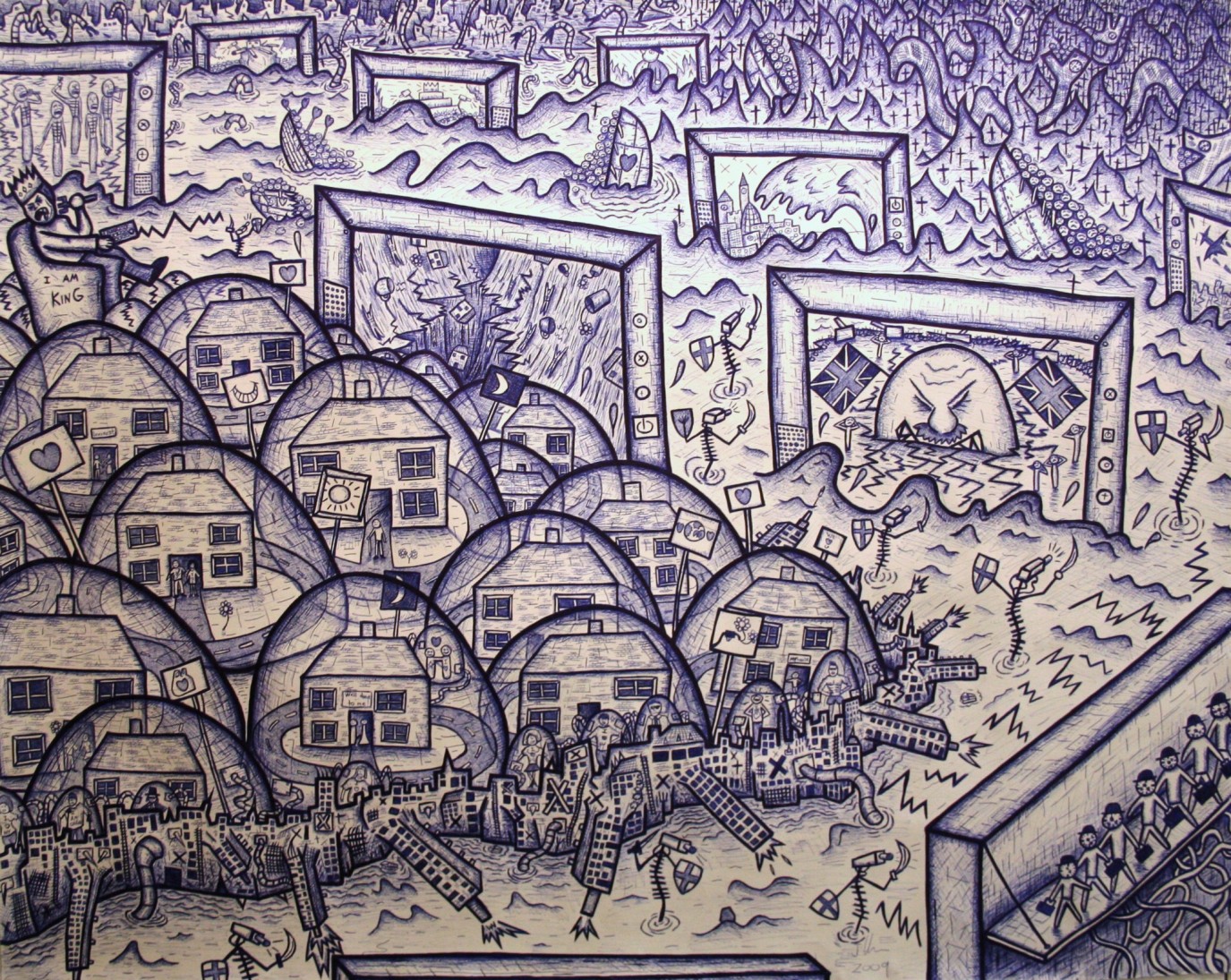
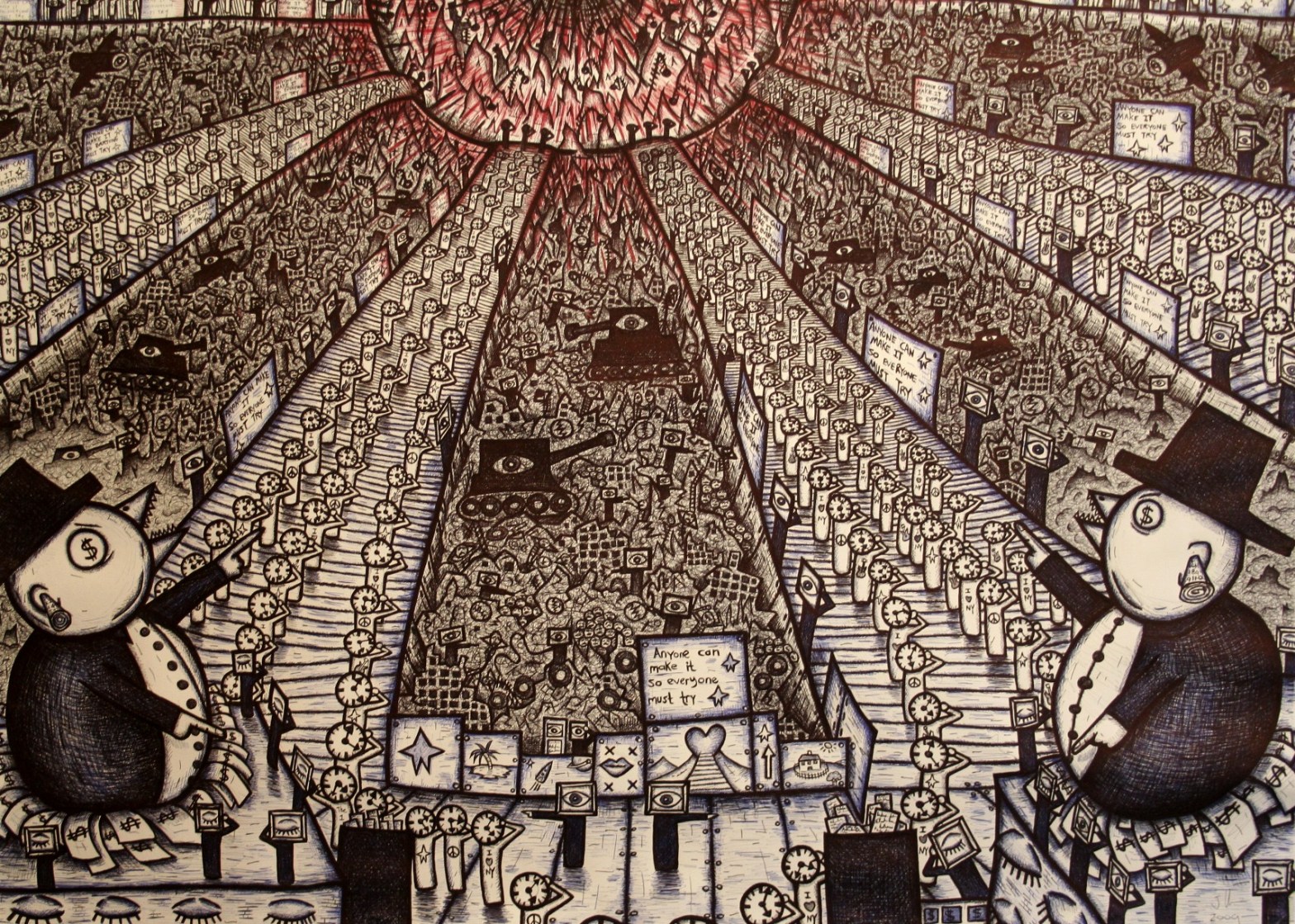
The logic of Neoliberalism (2010) biro on paper, 70X110c

   I wanted to depict my deep concerns about living in this type of world which has become even more neoliberal since the economic crash, even though it was neoliberalism that caused the crash. I am deeply concerned about the suffering I think this system is causing, and the further suffering I very much believe it will continue to cause. As always with my artworks, all my concerns relate to the environmental destruction of the world. This is caused by the same system, because it is one that so rapidly consumes and destroys the planet’s resources for reasons of profit. I wanted to depict a system that I think is disastrous for the human race and the planet

The landscape in The Logic of Neoliberalism is dominated by these massive human-like figures. I suppose these figures are supposed to represent a mixture of things. They do have a slight similarity to the way the rich, or capitalists (those who become powerful through the market competition) were caricatured (or drawn) in the 19th and 20th centuries, and although they are supposed to represent the centre of the accumulation of the wealth, they aren’t so much supposed to be individual people, but more representations of the individual.
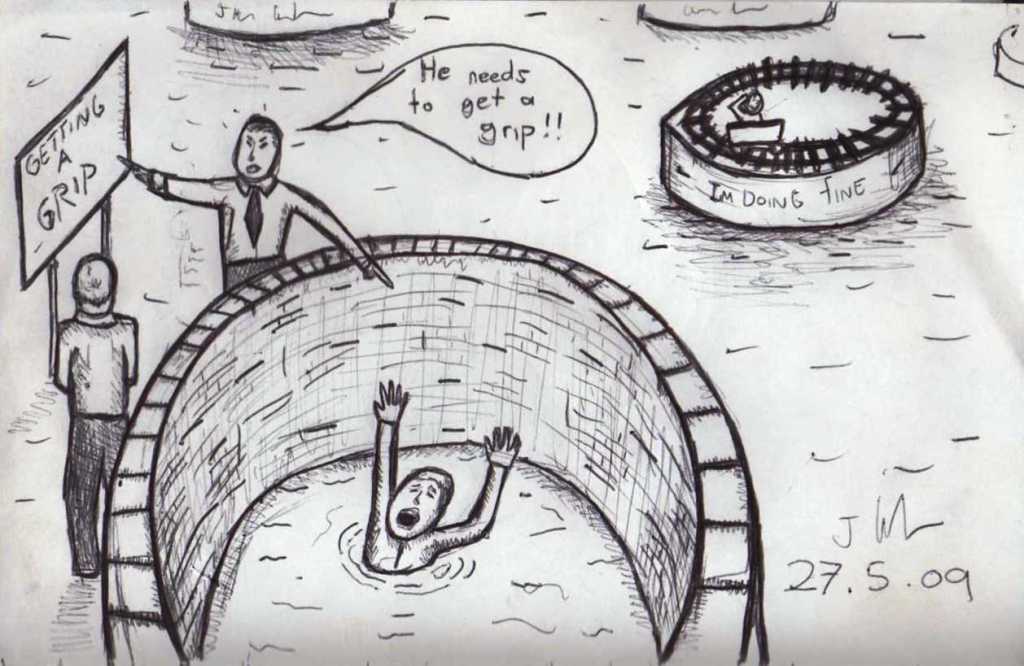
This is because basically, we live in a society which doesn’t just encourage, but forces us to compete against each other, in a time where there is no longer any emphasis placed on solidarity/togetherness between people, and communities, whilst at the same time all that used to bring people together is taken away from us by companies and sold back to us. What rises up in such human environments is the power of corporations under the disguise of the individual person’s pursuit of economic success. And in a way, this is what these human-like figures are: corporations; like institutions with no one person controlling them and justifying their actions, but based around the idea of the individual having the right to aim for economic success/the right to be wealthy. And this is why they look like empty shells of human figures.
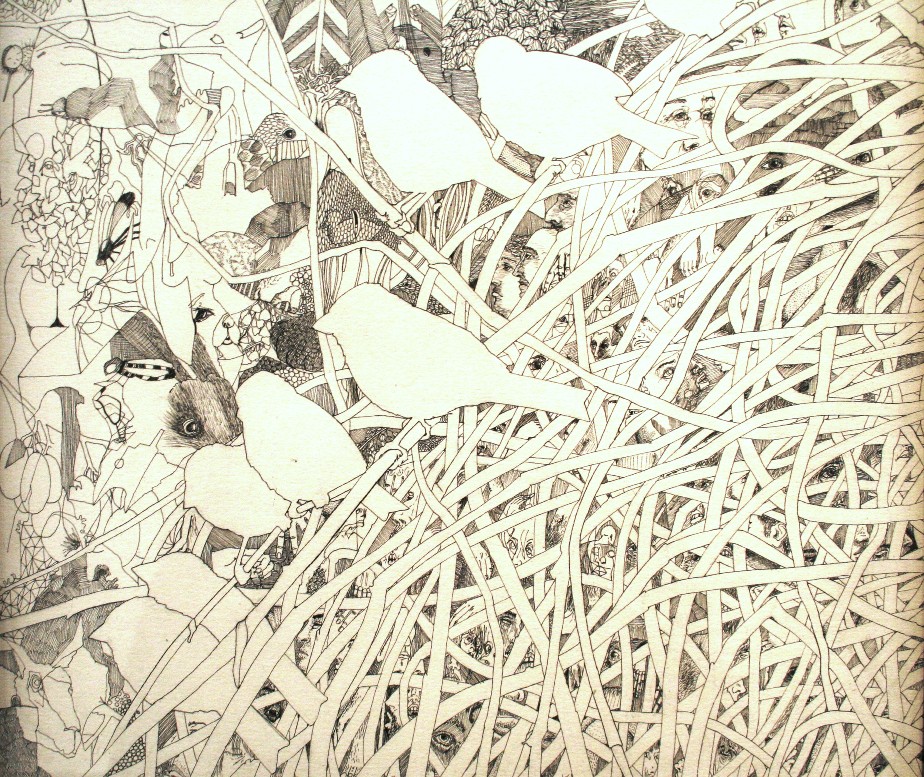
Wrapped around these large human-like bodies are individuals trying their hardest to make their way through this world; trying to achieve a comfortable life. But they look so tired and fed up. This is because they are getting nowhere no matter how hard they try, because only these larger bodies which contain all money (the corporations from which only a small amount people on the planet benefit) continue to soak up the rest of the riches of the world, and expand and expand. These figures are travelling up and down these roads in their isolated vehicles (which I tried to make look like something between a car and an I Pod; which I would argue are two devices which isolate us from our surroundings). They are all alone, in their ‘daily races’ trying to compete with each other in order to just stay afloat, rather than climb up. Below them are small green areas that are fenced off from the places which are even worse off in these times; the people inside want to be secure from the outside; they don’t want to reminded about it because they know that if they don’t keep trying and trying harder, they too could end up at the wrong side of this fence. Also they don’t want to feel threatened by it, knowing that the people on the other side are in much more desperate situations. The people inside have been made very lonely. But these are the people who have at least had the chance to be in the neoliberal game. They are more fortunate that the ones outside these gated areas. The crueleness is captured within the contempt and condescending stance the heathly-looking plant on the right side of the fence has for the battered, dying plant on the wrong side.

Outside, people are even more desperate, they migrate long long distances in search for a living, and security, and the chance to support themselves and their families. These people can either be seen as migrants trying to escape desperate situations, or they could also be seen as the unemployed in richer countries who have little hope of finding work to sustain themselves; either way, the plights these people find themselves in have been caused by the logic of neoliberalism. They are the biggest losers in this world based of competition. This area is also an area environmentally damaged by the logic of a system that exploits and consumes anything and everything in search of profits.

My concerns that not enough was being done to challenge the threat of climate change, brought me to realise why this is as much a socio-political issue as it is an ecological one. Climate change used to be at the foreground in my drawings, but the more I questioned why it was happening, and what little action was being taken, the more the peculiarities of the human world under this system took centre stage in my drawings, and climate change began to loom, threateningly in the background, whilst we humans carried on making our mistakes.

The Working Artist (Exhibition)

Artists:

Jessica Jones Carys Bryan
Fiona Helen Halliday
John ledger
Kate Burton
Lisa V Robinson

Sophie Littlewood

Exhibiting in the heart of Barnsley town centre, the exhibition is within easy reach from train, bus and car


Exhibition details
:

Monday 16 August to Friday 18th September

(preview night Wed 18th August, 7-9pm).

Open Monday to Saturday 10am – 4pm

POD exhibition space 1, May day green, Barnsley, S70 1RD

Free entry – please come down! all are welcome on our preview night too!

The Working Artist brings together seven young contemporary artists, all of which engage in disparate practices and media: painting, drawing, photography, artist books and sculpture.

The title, The Working Artist, suggests a dual connotation which interacts with the work on display. The phrase immediately conjures up the artist physically in the midst of creativity and production. Simultaneously it suggests that in order to satisfy the artists’ desire to create, and for their practices to continue to grow, they must support themselves by working a job. It is this necessity which brought the artists together, as they gravitated to the same place of work.

Time, as well as energy, is a crucial factor within the game of work and art. However, overall, passion is the key which drives each of these artists to continue to create.

http://theworkingartistexhibition.blogspot.com/

On a virtual existence

 What is becoming of us as we spend more of our lives in the virtual world?

The conversations which we may have shared between a few of us, the photographs which we may have shown to a few of us, are now shown to numbers that rise well over an hundred. Hundreds of people are seeing fragments of our otherwise more personal lives and they are making comment upon it, comparing it to their own lives, and, likewise, we find ourselves doing the same.

Why do we do this? Even those who are aware that something here isn’t quite right, and fear an alteration of perception, still end up explaining their lives away.

One gets reactionary thoughts in their heads at moments during the day which translates as “hey, that’s quite clever/funny; I should put it up on Facebook” or “that really speaks of who I am; I’ll post it on Facebook as it’ll give people a better understanding of the bits of me I want to be seen!”

For those who find theirselves caught between this urge and a concern about living our lives out on the internet, this thought is usually followed by “Is this all that my life is to become? Just an attempt to write something clever/of novelty value, to grab the attention of my fellow networker’s, whilst meanwhile my output into the real world diminishes?” It is a feeling of total negativity that, by getting caught in the mental environment of trying to prove oneself a valuable person on the internet, they are actually doing very little in the real world.

The life of a visual-artist, like me, fares no better on the social networking sites than any other individual vying for attention. The importance of being noticed online, and getting artwork online, suddenly seems to become one the prime motivations to make work in the first place. I become my page; just like others, except I am using my artwork instead of images of myself, to project what I believe is the best version of me, but by doing so I am placing my hopes onto the virtual world, loosing incentive for action in the physical world.

The paragraph below was something I wrote when this particular concern seemed highly probable.

I hide behind the veneer of the works I have made, which I am most proud of, but the veneer begins to crack from the day that the production of work deceases as I become ever-more dependent on online interaction as my real life becomes more solitary. My works of art, which I hide behind, become an empty shell; a creature once lived inside the shell but is now long gone.

However, a sense of urgency to act more-so in the real world can be massively demoralised by empty feelings encountered when stepping out into physical human environment, luring one back to the ‘dreamscape’ of the virtual world. The physical version of world is never adequate after an immersion into the virtual; the virtual produces a much better vision of the world; continuity between events, with no empty spaces; an edited version of the world, all glitzy and free of discomfort. One looks up at the tops of a city’s tallest and most flashy buildings, from the train station as they head home feeling unfulfilled by the physical human interactions within the city, and one imagines that the people who reside in the top of these towers are having a better, more wholesome, more meaningful existence; an experience that we can only believe we can reach when in expectation of what we will find when we next log on to the world-wide-web.

However, it can never provide that human need for something more wholesome, no matter how much its promise continue to delude. The odd elations one may receive in their virtual lifetime, as one shares an online ‘intimate moment’ with another, are but grains of sand in a vast desert of disappointments and demoralisations caused by the futility of trying to express one’s self, showing one’s individuality, via novelty groups, novelty quotes and novelty applications -even the artist finds himself to be nothing but a budding novelty amidst this desert, which could never quench our thirst for satisfaction.

This is the triumph of absolute pointless pap over the human soul!!

A pointless pap which has also triumphed over important current affairs.

One finds ‘Networkers’ joining novelty Facebook groups en masse, stupid groups like ‘I once lost my phone up my arse!’ Groups which they’ll never ever go back on to, because they’ve joined so many of these it would be impossible to do so!; all this virtual novelty whilst the physical world carries on out there, getting more troublesome by the day, as it slowly veers into the abyss that the 21st century threatens to be.

Ok, distraction, novelty, stuff that serves no purpose but to give us a brief 2-second smirk, has always been around and has always been needed, but never before the internet has it been so omnipresent, so triumphant over all other information.

Fact: post a link on Facebook about something serious – i.e. a link to Naomi Klein’s The Shock Doctrine, or a George Monbiot blog on the issue of climate change– then post a feed about eating a big wedge of cheese before bedtime; the cheese will be triumphant, with many more replies and ‘likes’.

I read an interview recently in the magazine Adbusters with one of the main architects of the 1968 Paris uprisings Raoul Vaneigem; one sentence really stuck with me; “never in Europe have the forces of repressions been so weakened, yet never before have the exploited masses been so passive”

This is the result of a Europe indoctrinated by consumerism, but for me it spoke clinically of our collective mindset from the moment it was propelled into the virtual sphere (a moment which probably collectively happened after 2005 rather than before); one where an immersion in ‘quirky’ titillation seems to bubble-wrap our minds as if they are still on-course to be posted to the ‘better-world’ Millennium that was anticipated in the 20th century, before the sobering possibility of a millennia bleaker than the last one made itself known. But by ignoring this reality, we also ignore the opportunities to overthrow the ruling ideology that is directing us to this bleak place. But “the forces of repression” will not be “so weakened” in a future as bleak as our current ‘millennium-route’ seems headed.

Our desire to retain this passiveness, so not to notice the ‘grim expectations’ may be indirectly due to the bleak entrance into this new century, and the internet social networking site is providing our passivity, constantly, so we may waste time which may otherwise have been used to show us something we did not wish to be shown: a world outside that isn’t doing that well by any measure.

The passivity helps us imagine that “all is good”. “That I hate Jeremy Clarkson page really speaks for me, and it has lots of other followers too! All is good!”

The takeover of the social mind

As there ever been another moment in history where the private lives of individuals have been so non-private; transparent, as if we are looking down on each other, sat in roofless buildings, like looking down on a Lego toy-land or a computer game simulation of a town?

There has never been a moment like this. The dystopian fantasies, such as George Orwell’s 1984, depicted the terrifying scenario where the individual cannot escape the all-seeing eye; and this fear persists, and we recite it whenever there is in an increase in surveillance cameras in the area in which we live. However, perhaps such novels have encouraged us to look in the wrong places. Do we not all now feel actively encouraged to tell everyone about what’s on our minds/what we are doing by the means of social networking sites? The ‘big-brother’ eye, which we fear, is not the main concern, and this fear has distracted us; the biggest concern is how we are actively explaining our private lives out to a large community of people on social networking sites on the world-wide web; we are walking towards the all-seeing-eye, and we are beginning to live inside of it. We are all following like zombies, transfixed by a dream of a virtual utopia, being drawn-in by the buzzing sound of our computers; a scenario which seems to draw similarities with that of the fate of the Eloi at the hands of Morlocks in H.G.Wells’ The Time Machine.

Recently, sat next to a friend on a train, we were talking about cinema; a conversation subject I struggle to contribute anything to because I hardly ever go to the cinema. She was telling me about 3D film, where “you feel like you’re inside of the film” and how she believes it will become the norm in future cinema.

I’m hardly a technology know-all, I don’t know much about new gadgets and product names, but I am aware that there has been a massive shift in the past 10 years, especially through the way we communicate with each other, which as altered our perceptions of what is around us and altering what we take for granted.

At some point during the last ten years, I became somewhat more of a techno-sceptic than I had been (I think this moment came at the same point at which I started to become cynical of modern popular music and youth culture trends – this might just be when I became a miserable bastard, but I think it’s more likely to be an element of both aspects). More accurately, it was at a moment when my dependence on the social networking site ‘grandad’ Myspace grew. Since this moment, I have been alarmed by any further advancement which allowed further immersion into these sites in particular. My ‘environmental woes’ were alive and kicking by this point and I was probably feeling that further immersion could only have negative consequences for a species which is constantly loosing its connection with the terra-firm upon which it depends.

Whilst musing the idea of 3D cinema on the train, and before I could get on my usual ‘ranting box, I noticed that a man sat opposite us had flicked open his lap-top computer. The familiar crackling noise and the Windows load-up screen reminded me of my contradictory feelings towards technology. In the most explicit sense, I have a love-hate relationship with the computer world. The loading-up of the windows screen, and the crackling remind me of warm memories of my very early teens, when my dad brought the college lap-top home for the weekend; it evokes a feeling which is similar to the noise of running an hot bath on a cold winters day; and, of more recent times, comfy visions of socialising without the uncomfortable situations involved in the real world.

The song ‘Computer Love’ by Kraftwerk remerged in my head again, at this moment. The ambiguous yet prophetic voices, calling from way-back in 1981; a song which, towards it’s ending, evokes a feeling of submersion – the inevitable of a possibly doomed-species (like the Reptilian calls in the depths of the brains of the humans in J.G. Ballard’s Drowned-world voices, calling us ,mammalians, to go back into non-existence and let the reptiles rule once more). The lyrics of computer love could not have better described this era of virtually transfixed individuals.

Another lonely night
Stare at the TV screen
I don’t know what to do
I need a rendezvous
Computer love

At this moment, on the train, we started talking about whether 3D immersion computer interaction will be the inevitable next step after 3D cinema. In a capitalist society, if such a progression is possible then it is inevitable. 3D immersion would create the possibility for us to be sold to from all angles, without leaving our homes; imagine shopping mall, white walls, logos, a simulation of a real friend behind each doors, regularity, cleanliness, no uncomfortable moments. (Then imagine the outdoor world as this point, taking into the account the likelihood of a increasingly volatile world, due to arrive at some point in this century. Will capitalism go full-on virtual in order to survive the diminishing real world in which nobody wants to spend anymore?)

One only has to look at how closer technology has advanced towards this vision in just 10 years, to see the huge possibility of this happening; the web becoming permanently attached to people, just as it has attached itself to mobile phones – another relatively recent phenomena which the majority of humans cannot function without, although they have only been widely available for just over 10 years.

A 3D internet immersion would disconnect us from the ever-encroaching noisy urban environment. We would ‘switch-off’ from the noisy buses and trains, not by just putting our headphones in, but by talking to simulations of our buddies (a process which couldn’t really look much less schizoid than those who already use mobile phones with headphones) on a ‘walk-in’ Facebook-of-the-future.

This disconnection from the real world is exactly the kind of future which exists in the novel Feed by M.T. Anderson. This novel, which is categorised as ‘teen-fiction’ but is so much more than this, may actually be a prophecy. As well as the social and environmental consequences described in it, it also describes a future people fully disconnected from reality to a virtual land of distractions, created by internet corporations, who know how to tend to everybody’s personas. (Amazon and Facebook are already serving out adverts aimed at our personality descriptions, and Google is already attempting to transfer the entirety of the real world onto a virtual plane.) The real world is falling apart in Feed, but the consumers couldn’t give a shit. They are constantly satiated by a personalised virtual fun-land.

Does this sound like a far-fetch fictional novel? Does it sound like an unlikely scenario for our world? I am not so sure; I fear the worse under the current procession. The deterioration of the planet’s eco-systems is increasing at, what seems to be, a pretty much consistent level to the increasing technological advancements: as the world is getting more and more volatile and the waters rise, we are climbing into monitor screens, hoping to sale away into a virtual utopia. However, we are still made of skin and bones.

An increasing isolation

The major alterations, during the last decade, to the way we communicate – cell phones, internet communication – have, by their nature of requiring the user to contact the rest of humanity via their devices, perpetuated isolation. We are increasingly required to communicate with people without coming into physical contact with them. This creates an inevitable lonesome outcome, which prompts the individual to search harder, speaker louder, within the only places he/she can find an audience – which are in realms of cyberspace; thus further escalating the usage of these places to communicate, thus further escalating isolation.

When I’ve over-tired myself to the extent that I cannot join in, in the disconnection, and switch off to “that space cadet glow” on my MP3 player, I find myself ‘people-watching’ whilst on the train back. The people are not looking at other people they are tuning in to little boxes, with their gazed fixed on little screens of options. There is noise – babies crying etc – but most noise is from isolated sources; sounds from I pods, mobile ring tones, conversations through cyberspace with people miles away that we (the passengers on the train) can’t see.

There is a link between the reasons why I seem to spend my ‘days off’ solitary travelling up and down the rail-line, and the increasing amount of time I, amongst most others, spend contacting the rest of the world from behind a screen. I could spend an whole day behind a screen; not an happy day, certainly not a morally uplifting day, but certainly a day eternally finding ‘tasks’ to be done.

It is easy to feel captive to the computer room when more and more of one’s life appears to be channelled through the computer. Whilst in this captive-like state of finding endless cyber-space requests made of you, one is also a captive audience to the impression of the world that the world-wide-web conveys: it creates an impression of the world whizzing past you, succeeding, accumulating, producing, and leaving you, who is sat gathering moss on the computer seat, behind in the process.

The internet is a forest of people, all vying to be heard. The social anxiety, the pressure to be noticed, revered as someone of worth, is massively claustrophobic. It is a pressure that forces one to think “I need to be more productive, I need to show that I am a hard working and individual”. But equally present, no matter how much one ‘networks’ their perceived talents, are the feelings of malaise and uselessness whilst sitting, captive, in the computer room, urging one to go out and do something un-lazy and productive in the real world.

The urge to go out is fired by an urge to make the trip a productive outing, because of the feeling that all those ‘tasks completed’ in cyber-space accumulate to nothing, whilst the feeling that one still needs to prove themselves of worth in a forest of people, seemingly all doing likewise, persists. So, outings become a race to make a day productive; a productiveness which can hardly be guaranteed by a stroll in the countryside or meet-up with friends. Hence, one finds themselves ‘tasking it up’ in the physical world; organising their life around a train route (I don’t drive a car) to fit enough in, so “today can feel like a success and a day well done!” This is why as soon as something productive is achieved (in my case, a new piece of art made, or a thought written down) one feels an urge to “get it up on Facebook!”

After a morning, on a day off from work, of fruitless task-completing on the computer, I have a list of things I ‘need’ to do in order to feel that I have been productive. They are all solitary, because the ‘fast and productive’ world I see before me on the internet, and the feelings of idleness created whilst ‘task-laden and ‘captive’ to this impression of the world, pressure me into believing that I have no spare time for ‘chit chat’ and fun, as I need to be breaking my back, physically. this creates the social void, from which there seems to be no way out of but to venture back onto the world-wide-web, in search of a dream-like collage of long-lost friends, all waiting for me to restart the ‘good times’ – those times which have only ever appeared to exist on other peoples online photo albums. The realisation that I have isolated myself only becomes apparent when I’m knackered on the train home; when the opportunities for the day (except the opportunities to get ‘pissed’ in my home town) are all but gone, and I look to my surrounding environment for an answer, only to see that its answer is to talk to people I can’t see, listen to things I can’t hear, via the gadgets which I suspect prompted my own isolation. And who is there to speak with about my despairing isolation but to voyeuristically tell the entirety of my online community, as there’s nobody here in the physical world to speak to!

Perhaps the ‘need to be productive’ and the ‘watching of people drifting-off into cyber-space after their days work, on the train’ are tendencies/habits which are more peculiar to me. However, what I am trying to explain through my own experience is that the environment created by the increasing presence of cyber-space (computer/internet, cell phones) in our lives doesn’t just create isolation within our domestic environments, in which we dissolve into at the end of the day, but it also creates it within the life we seek to lead in the outer-environment. It does this by both constantly interrupting an escape from it, reminding us of ‘what we are missing’ when someone on the train/bus seems to be getting more attention through it than we are, as their phones ‘bleep bleep’ all the way home; and it also does it by coaxing out a feeling that we have no time to do anything else but task completing, because “you’ve wasted way too much time sat in front of the screen this morning, and you’re not doing nearly half as much with your life as all the others on the networking sites are”

The increasing amount of evening isolation is perhaps more apparent to spot, but cyber-space is certainly helping to create the social void within the day-time, which is wrongly catered-for by cyber-space in the evening-time, as one finds they have no alternative for a cure to the isolation but to scour the web more so, and, in the process, be subjected to the appearance that everything is happening everywhere but where they are, and everybody is pushing forwards and progressing but them. This creates the setting for another day of isolation tomorrow and so forth.

The unwritten destiny of humanity?

The invention of the Net is not a bad thing; the danger is that we will begin to live our lives entirely through the net, and this would further separate us from the outside world, a world which threatens to be ever more turbulent in the 21st century. If we ignore the world outside our doors it may evolve into an intensely hostile environment which no longer permits our species’ stay on the planet.

This would be a waste not merely for our own progress as a species, but also for the progress of the entirety of life. The evolution of a conscious creature is an incredibly important step for life. Despite our fragile existence as a species, and despite the fact that the rest of life would carry on, probably more triumphantly, without us, what we contribute to life on earth is unique. We (humans) are the earth’s brain, in every sense but that of a religious destiny.

The internet has the ability to connect citizens of the world providing a combined empowerment to stand up to the undemocratic system of capitalism, and eventually overthrow it. Yet, under Capitalism it has become the system’s most powerful tool – the most efficient of consumer distractions – distracting the bulk of its users with a barrage of novelties, badges of nonsense, which speak to ones claims for individuality, to mark out their sense of social status amongst the forest of others all doing the same (one may even actually join a group page for a democratic activist organisation for entirely this purpose!).

The net has just become the virtual equivalent of advanced consumerism in the physical world. The virtual form may not directly drain the planet of its resources, but it lights up the pathway towards doing so, like Blackpool illuminations. And It is equal if not more successful in draining individuals of their vigilance, awareness, making a nation a consumers who are indifferent to acts of global injustice and national injustice by the corporate state. So much hope was held for the internet to be a bringer of true democracy, providing information to all and eventually becoming a force to bring global Capitalism to justice Capitalism, however, had other ideas: It wasn’t going to give up so easily. It can consume anything and turn it into tool for its own benefit. These hopes were ‘so 20th century’. If an image could sum the first decade of the 21st century it would show a snidey grin on the face of capitalism, self satisfied with having taken democracy’s ‘bright new hope’ and turned it into its own ‘bright new star’

It seems apparent that Capitalism, left to its own devices, will seek to turn every aspect of our lives into a profit making venture: dependent on doing most of our communication via the internet and mobile phones means that we are always paying chunks of our wages to internet and mobile phone companies, to ensure that our connection to the world isn’t cut off; we are now basically having to pay to communicate, which makes the early mobile phone slogan ‘pay as you talk’ seem much more sinister. If they could they’d charge us for oxygen, in fact they probably will do if we end up having to breathe it via tanks.

Communication through cyber space, although a creation made under Capitalism, would be put to better under a more democratic, and less socially anxious society – a bringer of doorways rather than the walls of an lonely room. All technology has the ability to be a benefit, and if it is actually doing us harm then something isn’t right with the way it is being encouraged to be used. It is yet another indication that although Capitalism may have propelled us this level of advancement, we need to abandon its voyage and head for another, as Capitalism is mesmerised by the siren “singing it to shipwreck” (more lyrics taken from Radiohead – THANK YOU). Capitalism is dynamic, and the world now needs stability not dynamism, we now possess the tools to create a much more harmonious and equal order, if only it could abandon the capitalist ship. It is a tragedy that we are still aboard this ship, looking for treasures that will forever elude us.