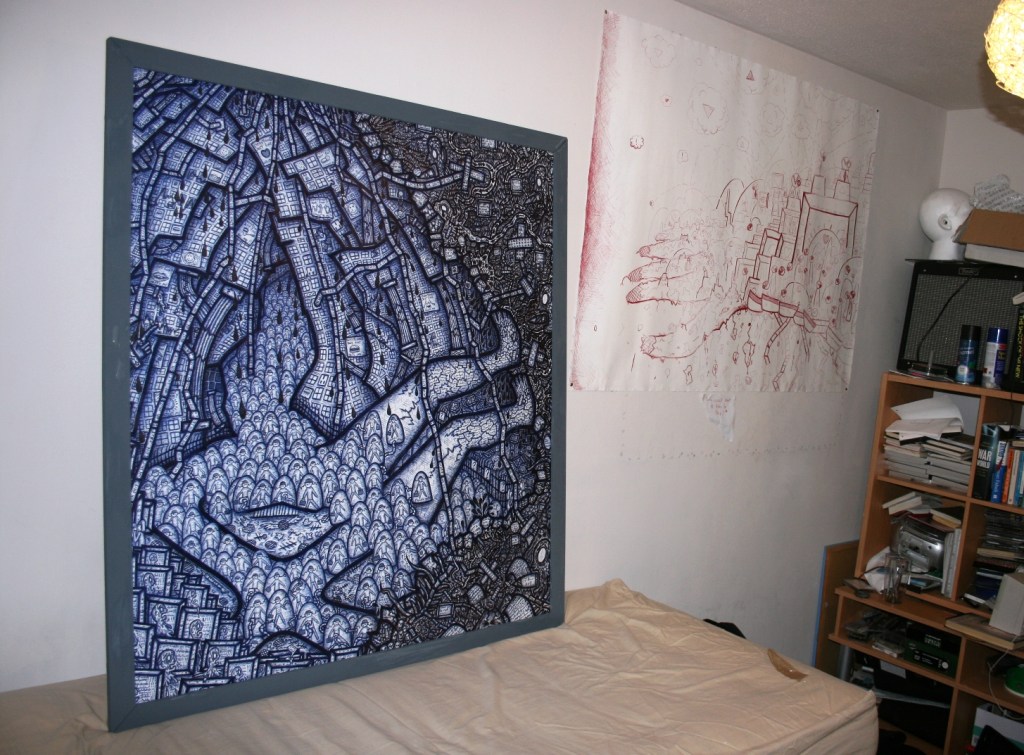
Images from my and Lee Gasgoyne’s exhibition at Heartbeat gallery, Sheffield, April/May 2012John Ledger


Lee Gasgoyne


Images from my and Lee Gasgoyne’s exhibition at Heartbeat gallery, Sheffield, April/May 2012John Ledger
Lee Gasgoyne
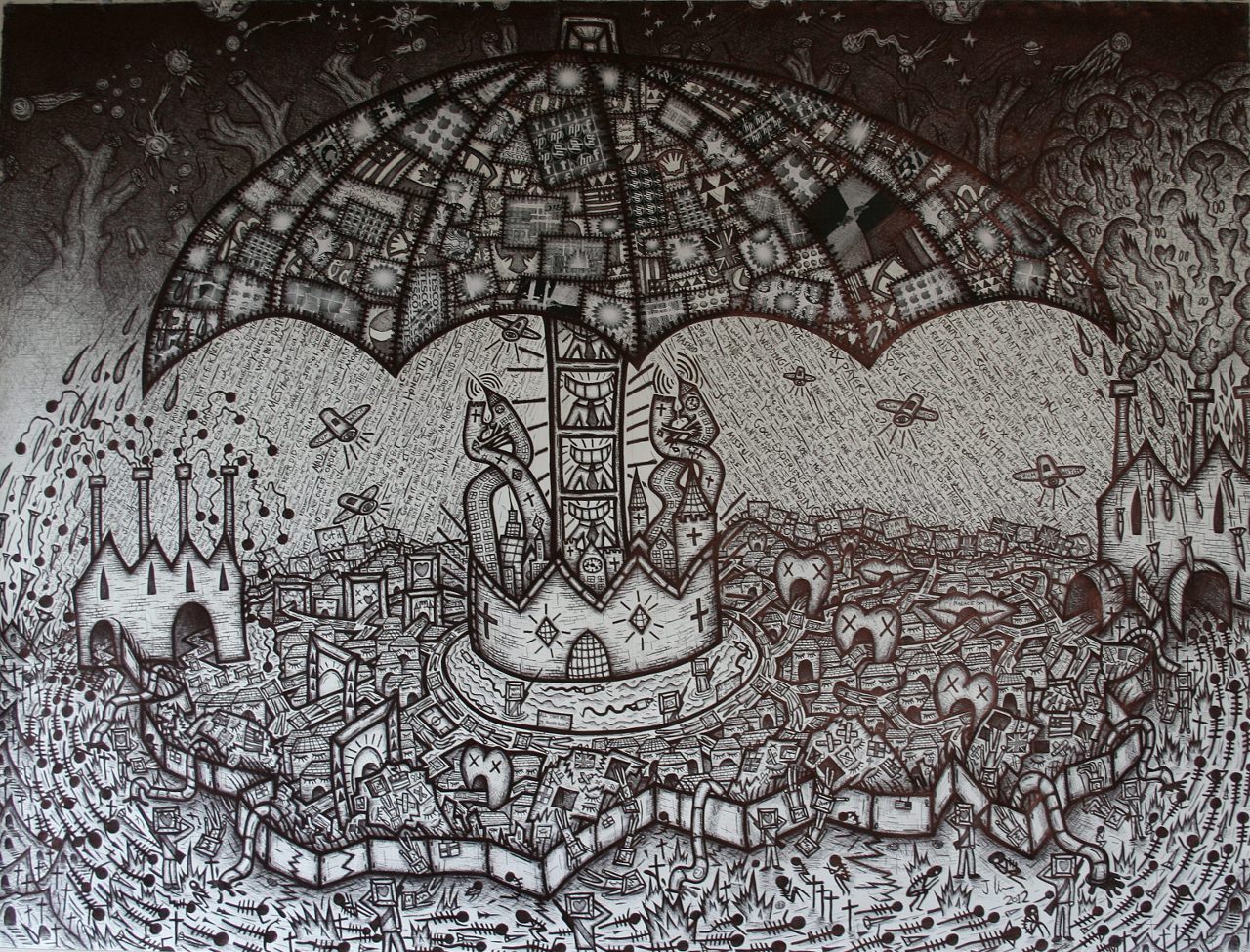
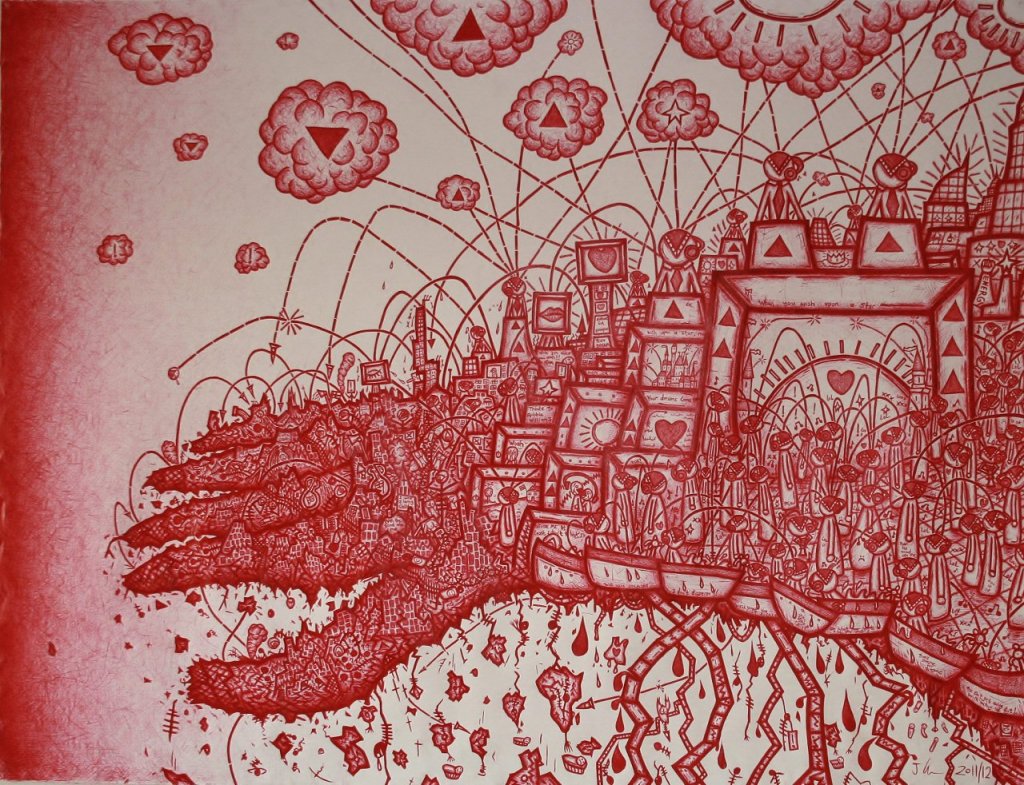
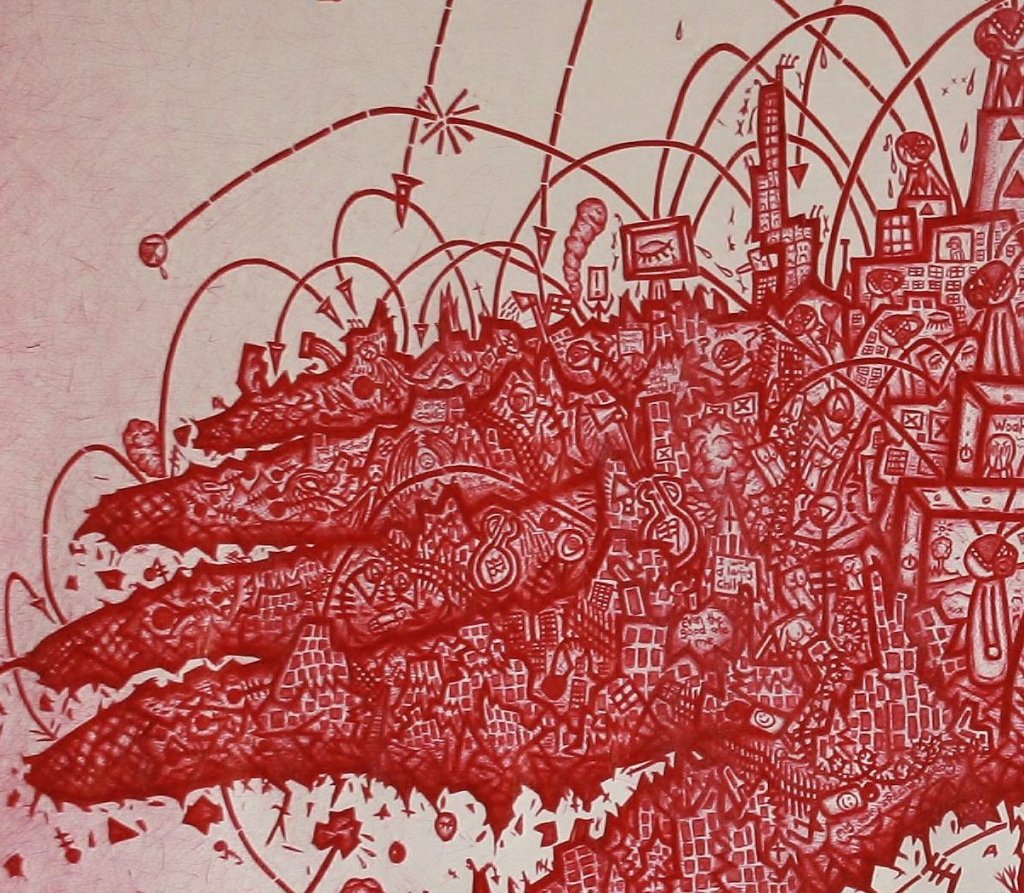
The Democratic Umbrella – 2012, biro on paper, 100x130cm

Why Eating disorders are caused by the totality of global capitalism, not just advertising
The distorted perception of my body that occurs often when I catch a glimpse of my image reflection in a window, always drags me backwards, drags me toward my teenage years; the existential fears of those years. Once here I am under an increased subordination. The anxiety it (re)creates takes over my pressing thoughts, and is infantilising, because I become so insecure again that it perpetuates the need to be asking others for reassurance. I am asking others to tell me what the Truth is: I do not trust my own thoughts; I want to be guided again. But I cannot be..Maybe this ‘shove back down’, the momentary levelling of me down to my 15 year old self, is necessary in order to remember what were the main factors that put me on a one way street of a necessary scrutinising of the totality of global capitalism, precisely because it reminds me of why I cannot find any other comprehensible way of existing. It’s certainly allowed me to further my critical thinking surrounding obsessive disorders, and to see that, for all its damage, advertising alone cannot be seen as the sole causer of these problems in our disorientating times. Some time ago I began to realise how the development of obsessive/destructive patterns in one’s life is as much to do with observing everything environing as being out of control, and feeling powerless to do anything to alter this, as it is the advertising industry. I knew these two were part of the same process, but describing how and why could become muddling…
In his book Liquid Times (2007), Zygmunt Bauman talks about how we live in times of endemic uncertainty under a negative globalisation, a movement of mainly money and goods, where there is no real outside to it, so nowhere to escape it, and no given alternative to the endemic uncertainties to individuals’ lives, and how this makes us “…seek substitute targets on which to unload our surplus existential fear that has been barred from its natural outlets, and we find such makeshift targets in taking elaborate precautions…”..
Whilst reading the above sentence I couldn’t help but look at my own life, realising that my rigid routines, and almost militant approach to small tasks, mainly in times such as when my eating disorders where at their worse, were attempts to “…unload () surplus existential fear that has been barred from its natural outlets…”. The increasing cases of obsessive disorders centred around our bodies (still mostly affecting females – obviously, due to the commercial necessity for the eternal objectification of women – but increasingly affecting males too) is fundamentally a problem related to the totality of experience under the uncertainties of global capitalism, and the fears this stokes, and isn’t caused merely by advertising’s’ manipulations and commodification of body-image – which, although playing a massive role, is only a component, which flourishes under a globalisation that worships the globalism of commerce and nothing else. I often think the best way to understand the world global capitalism has created, isn’t to first look at how it makes the world act out, but how it makes us act out our own lives.
“I wanted to know the exact dimensions of hell”“Does this sound simple?”“Fuck you”“Are you for sale?”“Does ‘fuck you’ sound simple enough?”
.I found my way (half way) out of my self-made internment camp by becoming aware that the global capitalist system, it’s disenfranchising of any self-determined future, and its commodity-cultural expectations that it mummifies you with, has it imprints on every component of my own disorders, and the ensuing misery over the meaningless of things whenever I tried to ‘enjoy like others’ and postpone ‘job well-done’ routines. I’ve been building a picture of how this world works: I’ve become obsessed with dissecting the entire beastly system, because I can locate my own problems firmly at the doorsteps of the system’s components. It is probably true that this is merely a redirecting of my obsessive disorders, but if so, it’s a redirecting of them towards the only thing that gives me purpose and meaning and hope: dissecting what has taken away all other possible ways of living.
I revel in the above lyrics from Sonic Youth’s Track The Sprawl (Day Dream Nation) because they describe this very assignment. “Does this sound simple?” Of course it isn’t fucking simple, but finding yourself unable to find a path of least resistance, what else can you do? A lot of friends say I don’t do myself any good by focusing on ‘hell’, that I “worry too much” and “need to relax more”. They mean well but don’t realise that doing this is the only thing I have found that there is left for me to do; and as much as I often get dragged along by cultural fictions (ones that lure me and look so much easier from the outside) I soon become too despondent. If there’s no getting away from this, one must “set the controls for the heart of capitalism” even if, in real terms, it has no heart..
I look for things that could give me pleasure/meaning, but apart from the instant obtainment of these through consuming food or drink (which the fear and guilt that generated the unusual-for-heterosexual-males disorders, centred around eating and body image, originate from ) I can’t feel anything else. When I have friends who can show unabashed adoration for new-born lambs, and have hobbies that keep them smiling all way through their 20-something years, it feels like there’s something wrong with me. But there seems to be no escape from this world, there is a totality I struggle to speak of in day to day conversation that I feel in every inhalation and exhalation..
“(C)apitalism…must now remake the totality of space into its own setting” (forewarning from Guy Debord, Society Of The Spectacle, 1967). In Liquid Times, Zygmunt Bauman quotes novelist Milan Kundera, to elaborate on the totality of global capitalism’s interpenetration: “Such ‘unity of mankind’ as has been brought about by globalisation means mainly ‘that there is nowhere left to escape to'” (2007). This is the conditions under which increasing numbers of us cannot invest ourselves any longer. And once you’ve suffered a disorder at the hands of the endemic uncertainties under this system, ‘there is nowhere left to escape to’, you have to turn around and try to hack away at this “visible freezing of time” (Debord)..I am certainly not the only one. There are many, and the numbers are growing, who can’t exist within capitalism’s drainage of meaning, and are feeling hopeless when they attempt to look through its telescope at the future. They all find different ways of dissecting global capitalism and spitting back out what it’s been pumping down their throats for years. Arguably this is the only genuine hope of these times. Some organise action groups; Some aim to create ruptures. More than anything else, I want know everything I can about it; I want to know what it does to everything, what it has done to everything. “I want to know that exact dimensions of hell”..
“I am Twiggy
And I don’t mind the horror that surrounds me” 4st. 7lbs, Manic Street Preachers (The Holy Bible, 1994).
Why can’t I eat sensibly still? Why can’t I accept myself? Why do I still worry about body fat? Why can’t I enjoy things like a lot of those around me still seem to be able to do? Why can’t I relax? Why can’t I sit still? Why can’t I get close to anyone? Why when I drink do I do so like there’s no tomorrow? Why don’t I have any real plans for the future? Why can’t I just get on with life? Why, why, why..
On this blog over the years I have kept on going back to the issue of eating disorders, because as I grow older I am gaining more and more understanding of both my own dealings with them, and the reasons why they are rising at a frightening rate under global capitalism (“since 1999, there has been an 80% rise in the number of teenagers admitted to hospital with anorexia nervosa” Laurie Penny, Meat Market: female flesh under capitalism, 2011, Zero Books). The issue, coupled with the issue of pending ecological collapse, is what put me on this aforementioned route first and foremost. Ecological collapse scares the shit out of me, and my writings on it seem to fold in on themselves precisely due to this. Eating disorders have helped me build up a controlled rage, because unlike ecological collapse, this is personal. Because I often feel that having eating disorders (and its smaller versions) has killed off so much of my life, it’s an issue I will reuse as weaponry..
This is the reason why I much appreciated Laurie Penny’s Meat Market: female flesh under capitalism. Laurie seems to have ‘set her controls to the heart of capitalism’ from the very same spot. Once would be misguided to think that her book only deals about anorexia experienced by females: the descriptions of its affects, although experience more so by females, apply to both sexes. However, there is no doubt it is still a problem affecting women more than men; male obsessive behaviour is usually played out in other ways. But it is certainly not only a disorder affecting males of a Bi or gay sexual nature. As I said above my own eating disorders may have partly originated from the fear and guilt affixed to the knowledge that I only really found meaning/pleasure in quick fixes consuming food or (later in life) drink..
Laurie refers to a very insightful experiment that seems to show that the effects of anorexia, the obsession with food and ritualistic behaviour can actually be induced through starvation not initiated by a disorder. An experiment undertaken at The University of Minnesota in 1944, “enlisted and systematically starved 36 conscientious objectors (to the war)”. These subjects “developed bizarre rituals around eating, collecting recipes and hoarding food obsessively – not just during the experiment but, in some cases, for the rest of their lives”..Laurie Penny quotes an individual account, which served to me as a vivid reminder of a state of being that is quickly forgotten, once one is above merely-surviving body weight, despite the persistence of the routine-controlled lifestyle. Describing how starvation affected his life, this man recalled that “…if you went to a movie, you weren’t particularly interested in the love scenes, but you noticed every time they ate and what they ate” (The Great Starvation experiment: The heroes who starved so that millions could live, Free Press, 2006). I know this situation well: an all-consuming obsession with food. You’d notice what the TV stars were having for dinner, or how often they ate. As well as salivating at the sight of the on screen consumption of fatty foods, you were also compairing yourself to these spectacular role models, and if you were eating less than them you were ‘winning’; winning a war not with them but with yourself, victorious in the flight from being a human. There were points when I was at my lowest weight when I’d go on visits to nearby towns and cities, literally to go to food shops and stare at food, but ‘controlling’ myself, saving myself for my ration of what had become utterly sacred at dinner time. (I still frequent these towns/cities with the routine still remaining, but now the emphasis is with reading and writing about the system I have trying to investigate with intense scrutiny)..
This is the point where you are no longer a human being with sexual desires, but merely a body wired to the pursuit of food, whether to eat or just worship. I only suffered from anorexia proper for little over a year. But the controlling and routine behaviours around eating and body image haven’t really had a break for 13 years. The period where the intensification of this control over myself resulted in anorexia proper was triggered by frightening ruptures to the normality of my surrounding world, that dropped me, unprepared, into the perpetual uncertainties and ensuing fears that define life on a planet swivelled on its axis by global capitalism. These moments were really existing moments, mediated to me by news channels that in both in content and mediated-form were like the most spectacular movie scenes..
The events were the September 11th 2001 terrorist attacks and the warning on the BBC news on a summer’s morning in July 2002 of a likely asteroid collision with the earth in 2018 (Asteroid Nt7-2002). It felt like the spectacles I had absorbed in the youthful years previous to these close-together events were coming true, but without the usual happy endings. This was a time (at the beginning of the new millennium) when the rolling news format was beginning to be used more by most television broadcasters. Rolling news stokes any unease about what’s happening on the planet. It is almost an avatar for the relentless flow of capital under globalisation: both make reality feel like it could be restructured at any minute, but in an autocratic manner, where we have no voice to negotiate with the dialogue spoken at us. Basically rolling news brings the feeling of having no power to change a world unfolding scarily into our homes: it is very distressing to be in the same room as the world under global capitalism..
I went in on myself. The world began to terrify. With all these seemingly terrifying things all waiting to happen, and completely beyond my control, I, by a mixture of design and accident, began to insert maximum control over the only thing I could: my own life. Such an all-consuming control system over my life took up my entire mind allowing me to hide from all that seemed terrifying out there. I would make sure those fears of being overweight, of giving in to food, of being lazy (all the things the system’s spectacular imagery had told me were unforgivable), would never be allowed to detract me this victory over myself again. The weight began to pour, and the hunger simply exacerbated the control-system. Laurie puts this perfectly by saying “when you are anorexic, your world shrinks to the size of a dinner plate”.
There is certainly a lineage connecting the Protestant work ethic, capitalism’s ‘moral’ ethic, with the feelings one gets of ‘doing very well’ and ‘working hard’ when they succeed in maintaining their body weight at merely survival levels. So in a sense it is an intense effort to impress the system. “Look at me I’m trying to be all that you’ve told me is best, and I never cause any trouble; I don’t indulge, I don’t enjoy; I just work harder all the time”. All the system’s Mores pile in on you and completely subsume you. You daren’t even question anything anymore, because it causes too much upset to your daily victories against yourself. Just keeping running, “you’re doing well” you tell yourself, “you’re winning”.
Laurie Penny writes “the triumph of self-starvation represents a major defeat for feminism in the west”. Regarding male self-starvation, I would like to elaborate on this by stating ‘the triumph of self-starvation represents a major defeat for our minds and bodies to the total “subsumption” to capitalism in the west’. Although I would argue that over the past decades there has also been a systemic need for a male to see himself as an object to be viewed by others, it is nothing to the pressure of this sort placed on women. However, being as heterosexual male obsessive disorders seem to play themselves in other ways, I need to emphasise the case of eating disorders for males. Why? because it is the ground zero from where I had no choice but to fight back. Laurie Penny’s words speak volumes to me because they seem to come from the same ground zero point. From this point onwards the only reasonable solution is to find “the exact dimensions of hell”.(p.s. Why do so many other ‘anti-capitalists’ seem to despise her guts?)
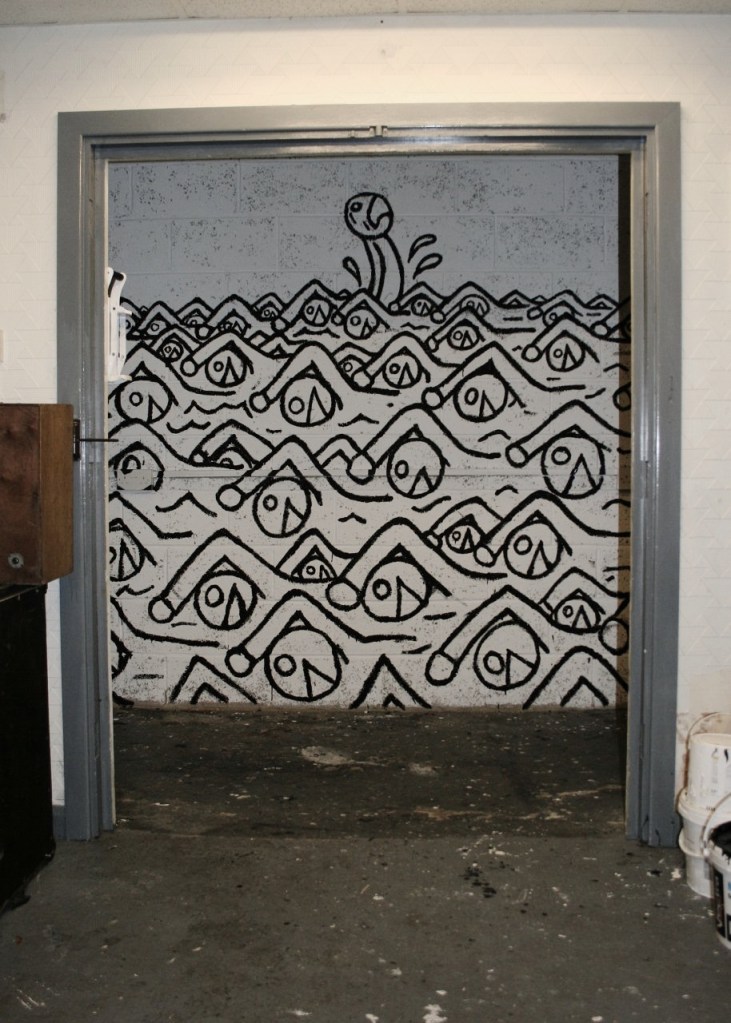
Some of my work is showing at The Audacious Art Experiment, Sunday 18th March
Audacious Space, Harwood Street, Sheffield, 2pm – 10pm
FEATURING::
John Ledger Exhibition
Ben Nash
Former Bullies
Jack Allett
Irma Vep
CKDH
£4 Donation
BYOB


WORK WILL ALSO BE UP FOR THE MARCH 31ST EVENT…….

Alongside the inner ring road in my home town is a skeletal structure which, to a visitor to the town, looks like a building on its way to completion. Yet to anyone who who isn’t just passing by they know that this structure has been in its current form for nearly 4 years.Its skeletal state gives it a ghostly look of something that is dead but haunts on not realising this.
Even over 2 years ago this ‘Mary Celeste’ looming over the town centre brought concern, even if this concern was more about practicalities; a friend of a friend told me about the huge daily cost of crane hire; the accompanying crane is still there, waiting in vain anticipation.But the costs merely seem to add to the farce of the world that left it stranded. The building is a haunting from the world that was before the economic crash. Stood there, waiting to be clothed with walls, furnishings and busy busy people. But just like the
uneaten breakfast on The Mary Celeste, it doesn’t look like the builders are returning to finish off, as if they also vanished when that pre-collapse real was shattered.
It’s strange when thinking about how the crash happened nearly 4 years ago. It doesn’t seem that long ago; when we are wrapped in a mediated-sensibility that is forever anticipating the return to this reality, for things to ‘get going again’, it feels like that event has never ceased being ‘what happened yesterday’.
Of course, back in ‘The Noughties’ things were far from being easy; it didn’t take much to notice the transparency of the business ethic that was draping all institutions in its shiny vacuity, and it didn’t take much to notice how many were excluded from this all smiles world when one walked around their town centre after 6pm and saw the distinct lack of smiles there. It also didn’t take much to realise that wars for oil and stupidly hot summers were clear indication that the finite planet would put an end to these capitalist fun and games.

Of course, I wouldn’t be making the point that it was OK back then anyway, and this isn’t the point of this bit of writing. However, before the crash, if you squinted hard enough, to only see the lights of the brightest/tallest buildings, and smiles of those able to afford teeth whitener, and also managed to squint hard enough to squeeze out the truth about your own alienation, one could momentarily lie to themselves and think “yeah, it’s not too bad yet, and I’m sure things’ll get sorted”.
This world is very similar to today’s, yet at the same time it also feels a million miles away. We know that things are going to get worse under the same set of rules, and we know we are going to have to fight really hard to make for something better – and this is really really daunting to people who can’t quite fully believe what they know: that they have nothing left to lose (at present I am still one of these people.)

When I see this Skeleton and its crane I am reminded about the sadness of the passing of time, and the utter strangeness, the other-worldliness that can hit you when you give something like this building more than a fleeting glimpse. For this skeletal structure time seems to have frozen, allowing us to glimpse back at a place that is over 4 years from us now, a place made to feel closer to us through the ominous anticipation of its return, but the sheer oddness of thing frozen in time makes this place seem more like another world away, and I think this is closer to the truth.

Do you feel like an angst-ridden teenager at 28? Which no confirmation of true age, when confronted with an ever-more aging face staring back at you from every reflection, can eradicate? With the ever-mounting pressure to remain young, to be hip, adventurous and to be eternally striving to advance oneself and be ‘living’ the high times, that is mediated to us by young-looking role models (whether they are actually young or incredibly well photo-shopped), the effects of alienation and discontent that traditionally by-and-large affect teenagers, now affect people further and further into their adult lives. The size 30 waistline is truly strangling us right into our 30’s. Yet there’s never any talk of this – alienating those caught in this existential no-man’s-land furthermore.
Doing my artwork from home, and having a job (when I have one at all) that gives me days off in the middle of the week (which no friends usually have free also), a much needed escape from my cul-de-sacked-residence is usually destined to be relatively solitary one, estranged from the friends who I don’t have the confidence to call until the time of day when English towns have become alcohol-gated communities. I’ve got into an early-afternoon habit, once my hands can’t take any more biro-gripping and key typing, of heading to towns/cities within the 20 mile affordable-to-travel-to radius. But once I get there I am suddenly confronted by an attack from conventional reasoning as to why I am in this place. Amidst the races of individuals trying to get places from the station terminus, I begin to stall, getting in peoples’ way. They seem to have purpose; a life which they are in such a rush to resume. I don’t. Just what am I doing here?

I start to feel a sense of not belonging, an estrangement, and an eagerness to find a place. An uneasiness I expected to be way beyond by now. My mind starts repeating “I’m 28 for god’s sake!”, desperately trying to make it feel true in the physical world. But no matter how I try to rush off’ trains when I’m meeting a friend, or arranging a van to pick my artworks up from an exhibition, my life seems to stay put. Nothing has really changed since I was the shy 16 year old school leaver who would avoid people he went to school with in the street, rather than have to walk past them, in fear of being ignored by them all together.
Many thougths and sights gather and congeal during the course of day that make me look back from these ‘post-Fordist’ times to the lives of my ‘Fordist’predecessors (the previous generations) in shame and embarrassment. Families, homes, ‘proper’ jobs in their 20’s. These societal changes don’t seem to register on the tips of most tongues, and whether possible to do so or not, there is boding expectation to make your way through the world, which hangs heavier around ones neck every time their age hits a higher twenty-something. But what’s there to be made, doesn’t make for this, and what lies in wait just perpetuates your past doings.

If we stick to the core meaning of alienation – to feel that you don’t belong; to feel not at home in your own surroundings – then this alienation may be behind why, after getting off the train, I then make my way to sit in the very chain cafes that I am often critical of for driving small businesses out of existence. In towns/cities which aren’t ‘my home town’, where I am at for no real reason, I feel out of context with the surroundings, with an imaginary person whispering “you don’t belong here” in my ear. And these coffee shops are out of context because they are everywhere and are thus nowhere; a place alienated from its surroundings for an individual who feels alienated (which in no way exempts me from the guilt of frequenting such places). And after that where? For, when I’ve done sitting in the cafe, I don’t really allow for anything much to ‘happen’, because I’m too eager for the feeling of at-least going somewhere, which the train back home-wards provides, and is this the underlying spur for the endeavour.
Regarding those who meander in solitude up and down streets, cultural discourse would have it that it’s a 15-19 age thing, circumventing the age of The Catcher In The Rye’s socially lost protagonist Holden Caulfield. And this holds true for musical tastes also; where bands dealing with discontent and alienation (a prime example being Nirvana, but I also the likes of Radiohead, The Smashing Pumpkins, The The, Joy Division) are neatly categorised as “angry young man music/the sort of music I listened to in my teen angst days” (yes, I have actually heard these said), as a call to get rid of these feelings of not fitting into society, as if it’s an ‘age thing’, to find your seat within the big arena, something many seem depressingly able to do without any noticeable painful transition.
Well, the said bands are still some of my closest audio companions, and I first read the Catcher In The Rye when I was 25 years old, yet felt utterly in tune with this teenage protagonists aimless journeys to places in a city, that he realised he had no reason for being at once he’d arrived. Consequently I feel offended by the usual back-cover reviews describing the book as ‘the quintessential book about teenage-angst ‘, to paraphrase the many.
What does this mean? Does it mean completely shelving everything I have just said just in order for it to be fitting to say “you need to move on (grow up)”? Well, if that is so, please fucking show me how to! Please show me how to move on from this junction-less ring road. If my brain was made of nuts and bolts rather than organic tissue I’d gladly let you tinker around with a screwdriver if there was any hope of lifting the veil of grey mist blocking sight of progression into an ‘acceptable’ place to be for an adult. But it wouldn’t work. Plans are being made now, but if you see me still looking vacantly at train departure electronic boards in 1 year’s time, don’t be surprised.

But is it just me who cannot grow?
Weekends seem to actually induce mini-crisis points, from where I wish I’d never asked my boss for them off, because it seems so much easier to be working. At least on weekdays I can at least be functional in my usual doings, and not feel bowled-over by omnipresent ‘evidence’ to a uncertain self of people having purpose to their weekly working as they are meeting up during their shared time off with friends for a much earned rest.
At least on weekdays, I see others as being in the same boat as me, as equally struggling to deal with the cultural norms subjected onto them. And I see other reasons for the causation of alienation. Looking at every lone person on a bus, every lone person with time on their hands, I’m seeing others who are alienated and needing a place also. Everyone’s looking for contact via their mobile phones. Perhaps it isn’t just directly the propagation of youthful imagery that perpetuates the teen alienation into adulthood, but the rapidity of the amount of electrical communication?
When others contact you it makes you feel wanted, but not merely wanted in the ‘desired’ sense but wanted in existence. Someone of strong enough self certainty to avoid irrational anxieties, may not need to needed/wanted by others in order to make their existence seem of worth, but for others, lost in the blur of a fast-paced life, lack of contact with others, when all you see around you in the street is others texting/talking on phones, can make you feel anxious about your own worthiness of existence upon this planet. Thus you begin rapidly texting people, and the desire to get (back) onto social networking sites, such as Facebook, hangs like big tangled branches from every inhalation and exhalation. I tend to text with more ferocity the more I feel like the spectrum of life is passing be by, and also when I’m places where I feel like I don’t belong, and regardless of what they text says, the real message is ‘Hey, I’m here! Don’t forget me”. And of course it is for everybody else.
The link between why we are a society both equally hooked to high-tech forms of communication and the pummeling from youth-obsessed imagery, is what I’d argue is also the link between my inability to move past my alienation and the social system we live under. We never feel complete, thus we never feel like we belong.
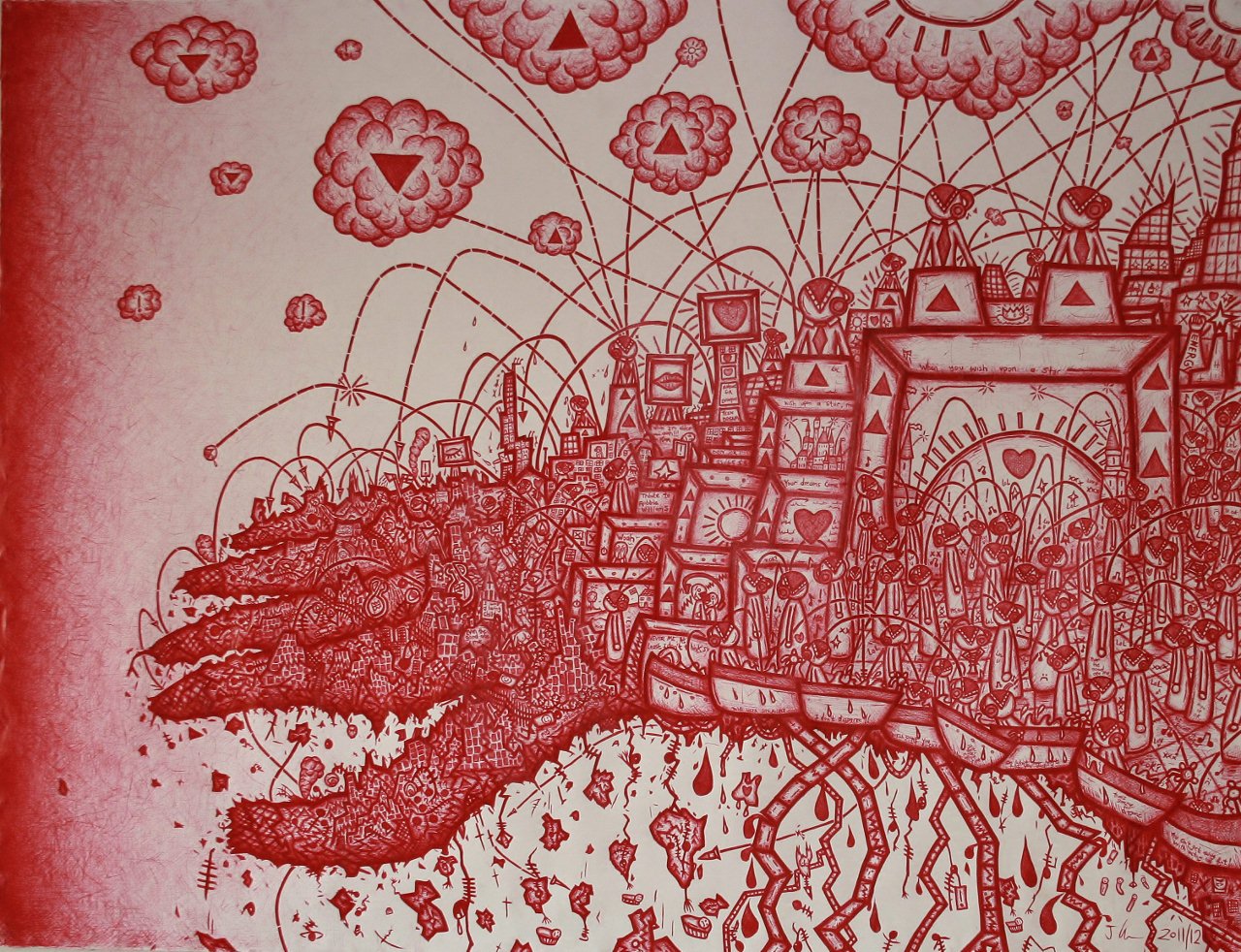
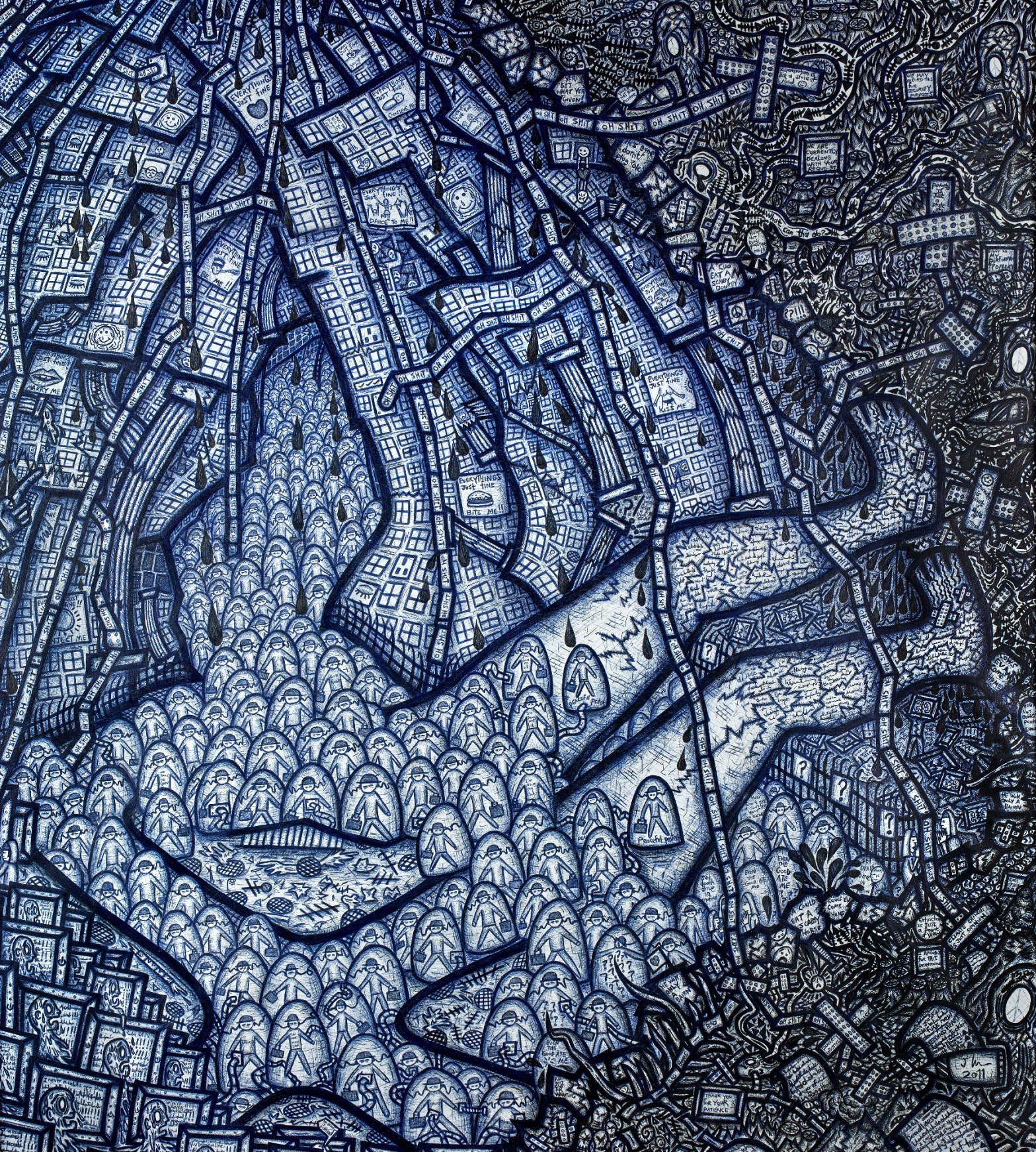
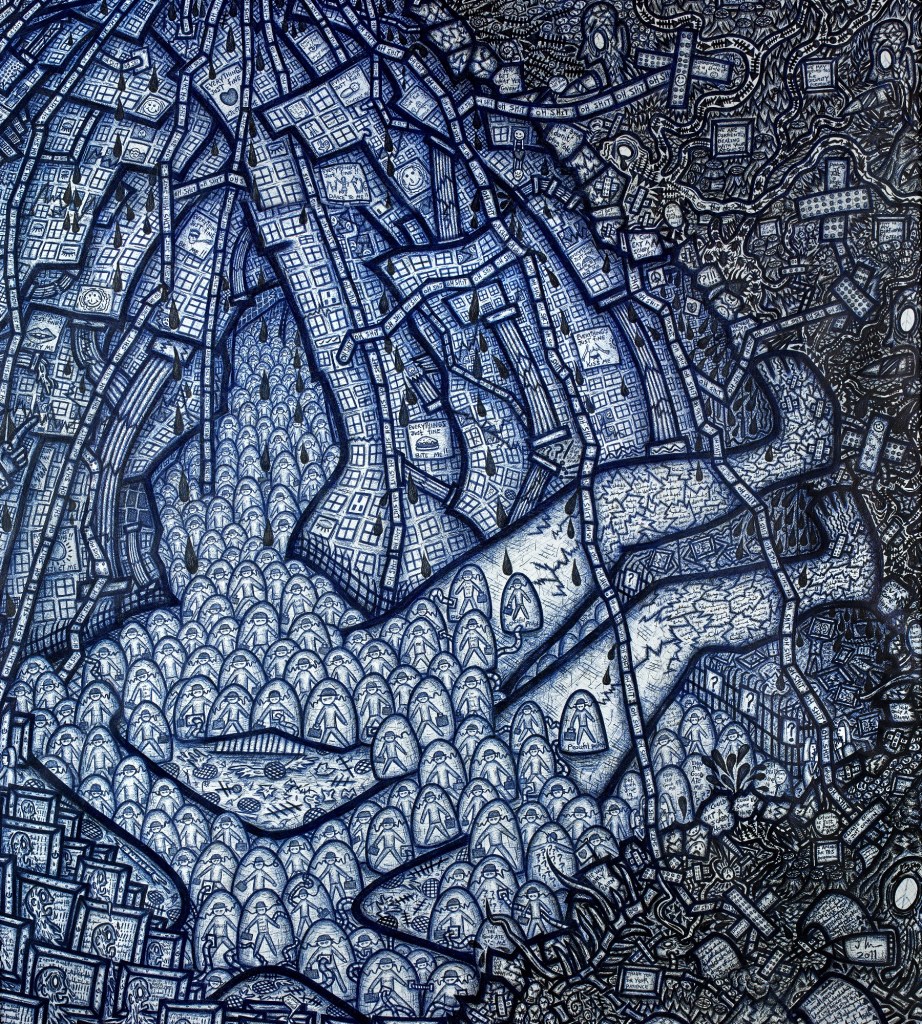
Who Would Want To Listen To This? (2011/2012) Biro on paper, 130X100cm

The piece is called ‘Who would want listen to this?’ because such big threats of an ecological collapse which would cause unimaginable disruption and destruction are often too frightening for us to think about (only previously seen by our eyes on cinema screens), so instead we pretend that ‘someone will sort it for us when push comes to shove’ or we even coax ourselves into believing that it can’t actually be happening (I’ve heard people, who once agreed that climate change was being caused by humans, go back on themselves saying ‘how can one species do so much damage to such a big planet?’ – comforting lies). We would rather not listen to it when a friend in our company starts talking about it, or when it is on the TV.
But we are not to blame for feeling so powerless to do anything.
As well as causing this problem, the human system of capitalism makes it seem impossible for us to do anything to stop climate change. It relies on competition between the most powerful nations in the world, rather than cooperation. And these nations are sewn together with the biggest corporations in the world; and corporations, by and large, don’t want us thinking that things such as climate change are happening, because to take any action to stop it would be bad for their business. And being the richest most powerful in the world, they get their way. As things stand THEY are in control of the direction the human world takes.
So we feel powerless, and try to focus on smaller thing instead, we try to forget. Climate change just adds more and more weight to the feeling that everything is out of control and feelings of powerlessness to do anything about it, which is the reality of living under the global capitalist system. So focussing on smaller things, focussing on how to get through life, day to day, in the most bearable way is what most of us find is the only thing we can do.
In the drawing every figure is wearing headphones. This relates to trying to block out the sound of things that are upsetting to us. It also relates a lot to the living in a time where we have access to so much technology to keep us entertained, or distracted, from the real world. I have mixed feelings about technology; I think what the internet offers to us as a species is amazing, and it could be said to be one of the greatest inventions ever. Yet accessories such as mobile phones, Facebook can throw us into a continuous detachment from what’s really happening in the world around us, distracting us, as we are constantly in trying to get other people to speak to us and like us through them, as the popularity of these accessories means people are increasingly alone, communicating from box rooms and lonely bus rides, and lonely people feel insecure and continually seek company. These figures, who are blocking their eyes to the problems around them, aren’t bad people, but are finding themselves more and more consumed in a technological world, that promises so much but never really fulfils.
The people behind the speaking booth-like things are the political/capitalist class. They are equally wired up, with head phones, communicating through cyberspace. They believe in the fantasy that capitalist ‘growth’ can go on forever, and they chase growth like addicts, smiling with Cheshire cat grins when they say the word ‘growth’. They are ‘supposed’ to be the people to lead the citizens to safety and better lives, but they are desperately clinging on to hopes that become more impossible every day. Feeling powerless, we leave it to leaders of governments and capitalism to guide us, but they are even more detached from the real world than everybody else, and they guide us towards a dangerous future. The need for distraction and denial of the truth keeps growing.
I wanted the entire landscape to look like a rock in an empty space, a bit like planet earth in space. But I want this rock to look to have a similarity to a human hand; a human hand that is veering into the dark, into a void, into non-existence. The closer one gets to the fingertips of the hand, the more the landscape is being destroyed, being torn to pieces. This represents two different moments in time; the moment which are at now, when it is the poorest people in the world who suffer the most from the effects of climate change, largely caused by the richest parts of the world (and the most power institutions which come from these places), and a future moment when this becomes the reality for all of humanity, if we don’t change course – direct the human hand away from its route into non-existence.

I used to find In Rainbows the most difficult album to listen to by Radiohead. Not because I found it a worse album than the rest of the (post Pablo honey) albums, just because there was something I found deeply uncomfortable about it, a truth in it that I couldn’t/or didn’t want to acknowledge right then. I didn’t know what was behind all this, until I read some essays on the album in Radiohead and philosophy. There is a truth in the album which is fought against to stop it happening in the previous albums, but ACCEPTED in In Rainbows: that of a looming mortality, an end, and not just to oneself but to our species. This truth is at its most emotionally heightened in The Reckoner and in House of Cards (the first synth entrance especially). This is why i still usually find myself listening to the 4 albums previous to this one, where the fight with bleak nihilism and against the erosion of democracy is still on going, as this is the fight that is waging in my mind most daytime periods. But In Rainbows has a fragility to it, when one can fight no longer, a coming to terms with the self also. In rainbows is about death, but coming to terms with it, like someone with a terminal disease must do. It makes it too beautiful for me to be able to listen to as I make my way through each day, and it’s only when i have my days when truths about myself and the world are face to face with me that it becomes the album I choose to listen to.“Dedicated to all humans….” The Reckoner
Event of great importance ‘beginning’ in Sheffield this Nov 5Th.”Reclaim reality reclaim space!”


Here is some information regarding the reasons for Pandemic, and it’s aims.
PANDEMIC!
Pronunciation:/panˈdɛmɪk/
adjective – (of a disease) prevalent over a whole country or the world.
noun – an outbreak of a pandemic disease.
Origin: -mid 17th century: from Greek pandēmos (from pan ‘all’ + dēmos ‘people’) + -ic
We are organising an event in Sheffield starting on the 5th of November this year – going on for 1 week (but will go on for longer if you wish). It is a socially inclusive art event based on the Situationist International and it’s political ethos. Particularly “The Society of the Spectacle by Guy Debord, and the ideas of reclaiming space, reappropriating images and the concept that in an advanced capitalist society we experience life through a representation of reality in the form of advertising, prescribed gender and social roles via media manipulation which leads to the population living in a substitute for reality instead of living reality itself. Via television documentaries we have armchair tourism, via royal spectacles we have emotional tourism (see funeral of Princess Diana), via soap operas we have drama and intrigue, via reality T.V we are given “reality”.
PANDEMIC incorporates a continuous programme of visual art – along with events every evening for 2 weeks which consist of a combination of experimental music, film, lectures, talks, workshops, readings and performance. We have several spaces already including gallery spaces, lecture rooms and less conventional spaces – we are going about it in a very D.I.Y way with no money changing hands There are significant gaps between performances for discussion/socialisation/screeching as well as a bar/cafe to lubricate this. We also have a 1 day warm up event on Saturday, October the 1st.
The purpose of the event is to inspire as many people as possible, to advertise the project in some unique ways to bring in a crowd who are not just the usual “converted” art types (we have some interesting advertising/marketing ideas). We want the project to continue in Sheffield as a continued and evolving social and creative platform once we have finished the residency (we are currently approaching other like-minded spaces to spread into and continue our work.) It is a political event in so much as it is designed to go against the prescribed nature of the artworld as well as outside the government funded stuff (which is often only commissioned because it ticks the right agenda boxes) – so truly independent.
It is in direct reaction to the artworld, in that it is incredibly elitist, and is often a series of cliquey institutionalised in-jokes, and fundamentally it’s controlled by rich buyers and investors. As well as this see how the media (particularly the tabloid media – or bluntly the media aimed at the lower or “working” classes) constantly dumbs down art, or mocks it with a “my 5 year old could do that” mentality. and so art is kept this way a) to make said elite feel culturally superior and b) to disenfranchise the “working” classes from culture and thus developing critical thinking and broader ideas – to maintain the status quo by suppressing the ability to question authority. This is particularly important right now with all of the unrest over cuts, the rich/corporations getting tax breaks, censorship of Social Networking sites, banning legitimate protest, the cutting of benefits – we wish to maintain the momentum of the recent political unrest, university occupations and protests, but via a cultural and creative shift – and include as many people as we can in doing so.
As each performance/musical event/lecture happens it will be recorded and put on a continuous showreel in one of the gallery spaces, which will grow as each evening’s performances are added every day. Any members of the public who come along and who are inspired to do something can also be written into the programme, be it music, performance, visual art etc.
We already have many visual artists, writers, activists, lecturers, dancers/performers and musicians involved – and there is room for more.
It is getting to be a big, excessively immersive – as we will be there everyday and night for 2 weeks. I understand that this is pretty all over the place, if you have any questions then do ask.
I guess from you we are looking for support, promotional help, for you and your friends to get involved too – and any other groups that you know of being made aware. Particularly we are looking for spaces to utilise during and after the event itself as well as people to take part in whatever form.
We need as many people involved as possible – we need momentum as the main aim if for the idea to start something more permanent in Sheffield, PANDEMIC, like the great plagues that inspired it, will spread like a disease that does not discriminate. It can and will affect anyone, no matter what superficially constructed group they may identify with, no matter what class, gender, race, sexuality and income level. It is an ever changing vehicle for discussion, ideas and dissent.

 John B Ledger
