http://www.blurb.co.uk/b/4875883-west-riding-of-yorkshire-a-psychogeographical-acco
New Drawings
Upcoming Exhibition: An Unofficial Alumni

We were all incredibly pleased with the way the exhibition came together (and would still be very thankful to any more visitors to the show).
The exhibition tried to bring together a rather interesting mixture of work from working artists from the area around Barnsley, aware that after 9 years running, 2013 marks the end of degree courses at University Campus Barnsley being run by the University of Huddersfield. An Unofficial Alumni is a showcase of working artists who studied or taught at the campus during these years. These artists have go on to work in a diverse range on medias, including painting, photography, ceramics, design , installation art…and robots This blog shows examples of each artist’s contribution to this exhibition. (The exhibition continues until Friday 4th October, Mon-Fri, 10-4pm, Unit 1F, Redbrook Studios & Exhibition Space, Redbrook Business Park, Wilthorpe Road, Barnsley S75 1JN)
Linda Betts

My current practice explores the theme of memory and more specifically, memory loss. Some of my most recent work aims to observe memory from a more scientific point of view and examines the causes of memory loss, and more specifically Alzheimer’s disease, within the brain.
The piece ‘Memoriae‘ draws on my own experience and knowledge of Alzheimer’s disease and aims to convey the feeling of watching a person disappearing, vaporising and fading away in front of our eyes, whilst also wanting to piece together the fragments of that person and save them.
I am captivated by light and its use within a space and as such my work is greatly influenced by light artists. I use artificial light as a raw material within my own work to show how memory alters and fades over time.
Linda graduated from the University in 2013.
Gemma Brookes

Since I left University in 2011 I have continued to produce art work in some shape or form, when I have the time I like to work on printmaking but I am currently producing plastic jewellery with hand drawn images on them. I have been concentrating on buildings as I think these are the things that people remember most about a place, as I know I do, I also like the detail you can put in to them. So I thought it appropriate to show works similar to this for this exhibition as it would relate well to the point of the exhibition being about people continuing to produce art after graduating from Barnsley Uni. I have a few pieces I’d like to include as well as some new ones I am working on, I am also planning some watercolour paintings to go alongside these pieces. Some of my pieces are scenes from in and around Barnsley, some include buildings and some are more nature based, others are from further afar but my theme is to show the appreciation people have of their hometowns and how this should not be forgotten as every place has it’s wonders that you can remember and be proud of. I want to show with my art some key areas from places that I find memorable and beautiful. I think sometimes people forget how lovely the places are that we live in, I have seen people doing this with Barnsley a lot recently and so this is what encouraged me to do this project. Gemma graduated from the university in 2011 Gemma Brookes Designs @ Facebook.
Steve Ellis


New Concepts, Re-visited, Diversifying, Un-groundedSteve Ellis worked at the university from 2005 to 2013.
Lee Gascoyne


“I graduated from University Campus Barnsley in 2011 with a first class honours degree and was awarded the Chancellor’s Prize for Outstanding Achievement. During my studies I was involved in various exhibitions, which I’ve managed to continue in one form or another since my graduation to the present. I’ve also been commissioned on a couple of occasions, one privately and the other for Barnsley Museum’s first exhibition. I have also collaborated with other UCB graduates, both on artworks and exhibitions. I now live in the Lake District, which is where I work and make art. Lee Gascoyne graduated from the university in 2011”.
Rachel Guest

Rachel Guest’s work has focussed on the themes of pain, struggle and confinement, and the destruction of dreams.
Rachel Guest has sought to explore these themes through textiles, print, collage, installation and photography. Where possible, she has tried to combine more than one medium to create interest on several levels.
This piece is a culmination of separate pieces all collaged together in one design. Her work aims to address the myth that art should always be comfortable to look at. Some of the pieces are confrontational, making them difficult to view or ignore, like pain, for her.
The print is an example of how pain can envelope and restrict a person, crushing dreams and ripping aspirations to shreds.
“Pain can drag you down. When you have a brain and spine infected with cancer, it literally drags you down. I’ve lost my hair, my fertility, my memory, and my dreams. Only infection and pain remain by my side, keeping me from sleep, reminding me that I am still alive. Life is not make-believe and it does not always end fairly”.
The folk art of Latin America inspires Rachel for its embodiment of passion, endurance and freedom. Rachel aims to encompass these ideals in all of her work.
Rachel Guest graduated from the University in 2013.
Fay Holmes

Cat-alogue was created using a mixture of watercolours and inks. The painting is a previous series of speed drawings and monoprints, the inspiration for the piece is T.S Elliot poem named ‘Growl Tiger’s Last Stand’ and my love of the not-so-domestic pet.
Fay graduated from the university in 2011.
David S Jarvis

My work so far can only be described as an eclectic mix of painting and sculpture in many styles such as Abstract, Abstract Expressionism, Outsider, Realist, Pop and Conceptual art. There is a reason for this mix, and the reason is; that I simply have not yet discovered a singular or particular way of working that fully suits me comfortably (I perhaps never will). A singular or particular way of working is difficult for any artist to achieve and is even more difficult to implement in the long term into a consistent visual art form, I like to think of this problem as in terms of a Where and What dilemma? This dilemma or question of from where and what does the contempory artist take his or her inspiration from to create beauty is one that I find particularly challenging. Firstly; where dose the artist create from – the world around him perhaps via simple direct observation, or the inner world; the world of the mind and emotions or maybe a mixture of both? This raises the second question of what the artist creates, and by what I am referring to the wide range of possible artistic styles that have been developed over the history of art and that are now available to the learned artist; as well as the seemingly infinite number of sensory objects/subjects available in the world for the artist to draw upon. Of course you may just simply say that the artist creates and draws inspiration from his philosophical, religious, moral and political view points; and it is in this that answers the where and what questions. This cannot be denied but I feel it misses the wider point, for everything it seems is perhaps in the flux of change including all view points and therefore artists in my opinion need to communicate through a deeper and more meaningful language, that of beauty, but how do we achieve and recognise beauty? We must search the where and what. The fine artist therefore must be resilient to these facts. He or she must face this problem almost on a continuous basis even when they feel that they are on a good and true creative path; these questions need continual attention. The artist is bound intrinsically and inexorably to the questions of where; do we create from and what; do we create from? David S Jarvis – Visit my Blog to find out more: theartistdsjarvis.blogspot.co.uk David graduated from the university in 2012.
John Ledger


John Ledger was born in Barnsley, January 1984.
He graduated from the university in 2007.
Julie Newton


Julie Newton is an emerging artist who graduated with first class honours from The University of Huddersfield (2013) she has increasingly exhibited on both a local and national level in numerous group shows and most recently undertook two sizable commissions. Newton’s working practice is predominantly involved with the reciprocal relationship between home and identity; the vernacular role of domesticity forms the context from which the work is created.
Questioning notions of acceptability, in regards to the female form, raises issues of idealized norms; the familiar is often paired with the uncanny, creating a sense of both presence and absence. Newton is fascinated by the way the human mind can be lured into making assumptions based on very little, especially focusing on how remembrance compresses both time and space creating a new reality. Symbiotic repetitious behaviors manifest throughout her practice, alongside ongoing phobias and fixations, inherent anxieties’ reveal themselves to the viewer, through the defamiliarisation of the seemingly banal.
Julie graduated from the university in 2013
http://julie-newton.blogspot.co.uk/
Rob Nunns
Street Photography
Curiosity is everything.


Rob’s photographic work is documentary based with a strong emphasis on capturing life’s idiosyncrasies. He has a Preference to using an iPhone and its basic camera software over a conventional SLR camera. He Believes that the truth can only be captured when his subjects are not aware they are being photographed. It is for this reason he prefers using the less obtrusive iPhone. Curiosity and remaining inconspicuous, almost invisible to the subject is everything, searching for the moment when the magic that is human nature and fate collide. The photographs being displayed are all recent examples of his work, having been taken in Europe over the past 12 months. The work forms part of a larger on going Street Photography project.
Rob is a Yorkshire based photographic artist, living and working in Leeds and Barnsley. He is also an official photographer for Barnsley Football Club.
Rob Nunns graduated from the University in 2009.
@PitchsidePro – Twitter
Andrew William Parker
Care?


This series of work aims to capture an essence of the individuals within it. A care home can be dark place at times, a real final resting place, a culmination of life experience, emotion, pain and memory, a place where raw, solid, emotional imagery can be seen on a daily basis. These people all shared their penultimate years together and for some this maybe their only legacy. These are just a few of the faces that will soon be forgotten by most.A.W.Parker @ FacebookAndrew William Parker graduated from the university in 2013.
Michael Steer

As an abstract painter my work focuses on the relationship between
hard-edged geometry and gestural chaos and how the interaction between
these elements represents, for example, the interplay of man and
nature or reason and emotion. Most of my paintings also feature
heavily abstracted references to landscapes and these two pieces are
no exception.
Michael Graduated from university in 2012.
Richard Turner
‘Walter’ – Richard Turner/Lee Gascoyne


Richard Turner, Art Technician at the University Campus Barnsley, graduated in 2003 with a BA (Hons) degree in Combined Studies (Art & Design). He has completed many private commissions for clients including Kirklees Council and the University of Sheffield.
Richard Turner worked at the university from 2005 to 2013.


Upon leaving school in 1996 I enrolled on a Performance art BTEC at Barnsley college. I enjoyed the creativity and freedom that the course provided but being quite an introverted child, I found the exposure of being on stage a little too over powering and by the time that I completed the two years of education, it had become apparent to me that performance art wasn’t right for me and that I didn’t want to continue it at a university level.
Throughout my education I had been working in a town centre pub and had grown close to the family who ran it. On deciding to take year out, I was offered a full time position there. During the year I went to see a careers advisor who was adamant that I should go to university. Still not knowing what I wanted to do I decided to return to education and increase my points score in order to qualify for a degree.
In the summer of1999 I enrolled to do an English Literature, Classical Studies and Modern History A Levels at Barnsley college. I enjoyed being back in full time education And worked hard in order to gain the qualifications that I needed. Although, with hindsight, I was defiantly missing the creativity and freedom of art.
In the summer of 2001 I decided to apply to Sheffield Hallam University to enroll on the degree course titled “The History Of Art And Architecture”. My hope was that I could combine both my academic skills and interest in art and enjoy the experience of being a university student. Unfortunately, this didn’t happen. I found the Architecture side of the course incredibly tedious and realised early on that I had no passion for what I was doing. Ironically, my fondest memories of that time was hanging around the art studios.
After dropping out in December 2001 I returned to full time work. The experience severely knocked my confidence and I resigned myself to a life of pub work.
By the time I was 27 I had trained up to the level of Manager and was working for a Management company who took on failing pubs and attempted to build them back up into viable businesses. I had not done anything creative for the last seven years and new that the life I was leading wasn’t for me. It was well paid job and I was my own boss and was provided with free accommodation but I still felt empty.
On December the 6th 2009 I gave up the pub, my home and my income and moved back to my parents house in Barnsley. I attended an opening day at UCB and was accepted onto there Interdisciplinary Art And Design Degree and new instantly that I had made the correct decision. Rediscovering my love of art and creating has changed my outlook on life and me as a person. It is something that I will do for the rest of my life and I feel very lucky to have something in my life that I am so passionate about. Corinne graduated from the University in 2013
Corinne White Art @ Facebook
Shane Wogan


This series of ceramic work explores body image and people’s perception of the human form. The idea is to play with the viewer’s perception of what they are looking at. Using innocent parts of the body and joining them together in a mirror image way distorts the original part of the body and can sometimes appear to be rude, even though they aren’t
Shane graduated from the university in 2013.
Louise Wright

I find that drawing is an aid to tap into the subconscious and download thoughts and feelings in the form of detailed obsessive drawings. I am fascinated by the natural world; captured by the way fungi, spores and micro organisms multiply and spread through their environment mirrored by the way my drawings spread across the page. I have an obsessive need to draw and document my existence. Drawing is proof of my existence and will remain the embodiment of who I am, long after I am gone.
Louise Graduated from the University in 2009.
Emma Wroe

I have used different processes to achieve different outcomes with my work. My pictures are the consequences of a series of thoughts and actions. I begin by finding an image that I would like to use and then I make drawings from the image. I repeat the same drawings until the lines and shapes of the figures start to become as fluent to my hand as writing a sentence in my own handwriting. This process helps the drawings to ingress more freely into paintings. When I begin to paint it is the quality of line and composition that act as good foundations to be able to let the picture grow in a fluid and eloquent way without being fabricated. When I begin to paint it is color that acts as a serious denominator that seems to decide in a helpful way the route of the spirit of the picture.
Emma Wroe graduated from university in 2013
Emma Wroe Fine Artist @Facebook
My work for An Unofficial Alumni (a Cognitive Mapping of Now)
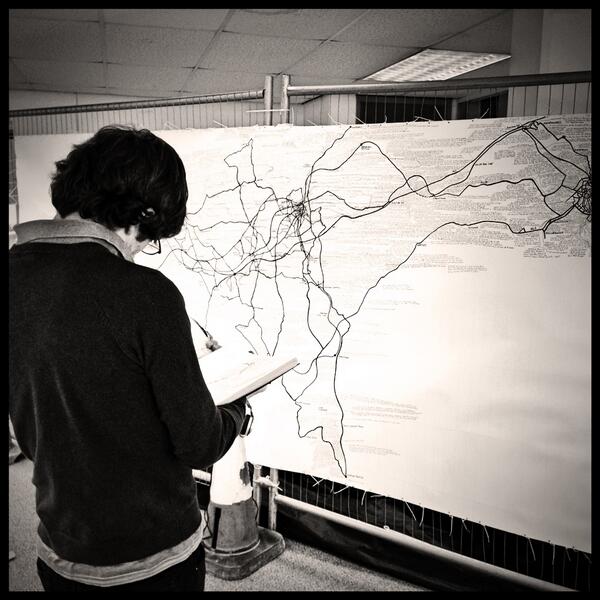
Image courtesey of Rob Nunns
Within this exhibition is basically my full year’s expenditure of energy that didn’t otherwise go into earning a wage, maintaining social bonds, our down the plug hole mixed with alcohol. So obviously it’s something I deem worth sharing, alongside the blogpost cover the entire An Unofficial Alumni exhibition.
The crucial work for this exhibition was my Psychogeographical account of an area I still see worth describing as the West Riding of Yorkshire (because the base point for most of my 29 years living here is more or less on the border between South and West Yorkshire, to cover just one of the counties would be insufficient to my experience of the landscape I inhabit the most). Having come back from London, after only 3 months, after failing to manage the pressures of doing a masters, whilst supporting myself financially, it was essential that I rebuilt things, from what largely felt like a wreckage, developing ideas that were at least thrown my way down there, and using them ‘back home’.
This isn’t to make out the 3 large drawings I put in this show mean any less to me.
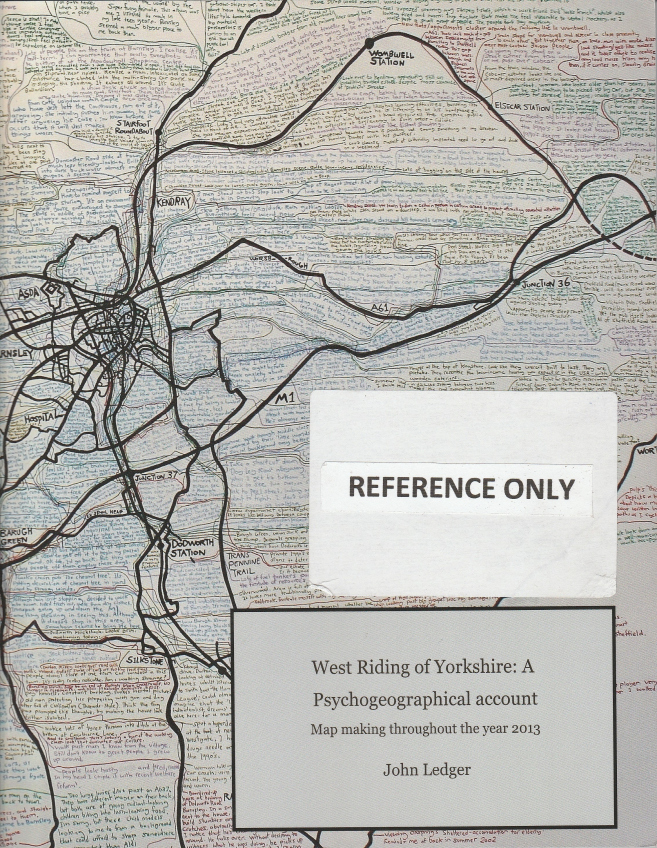
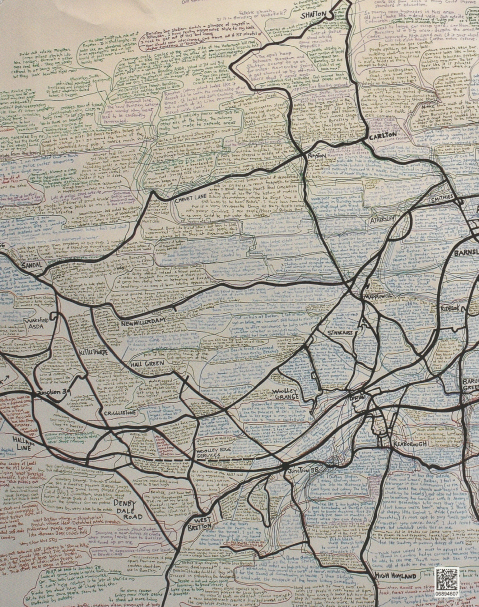
The West Riding of Yorkshire: A psychogeographical account.

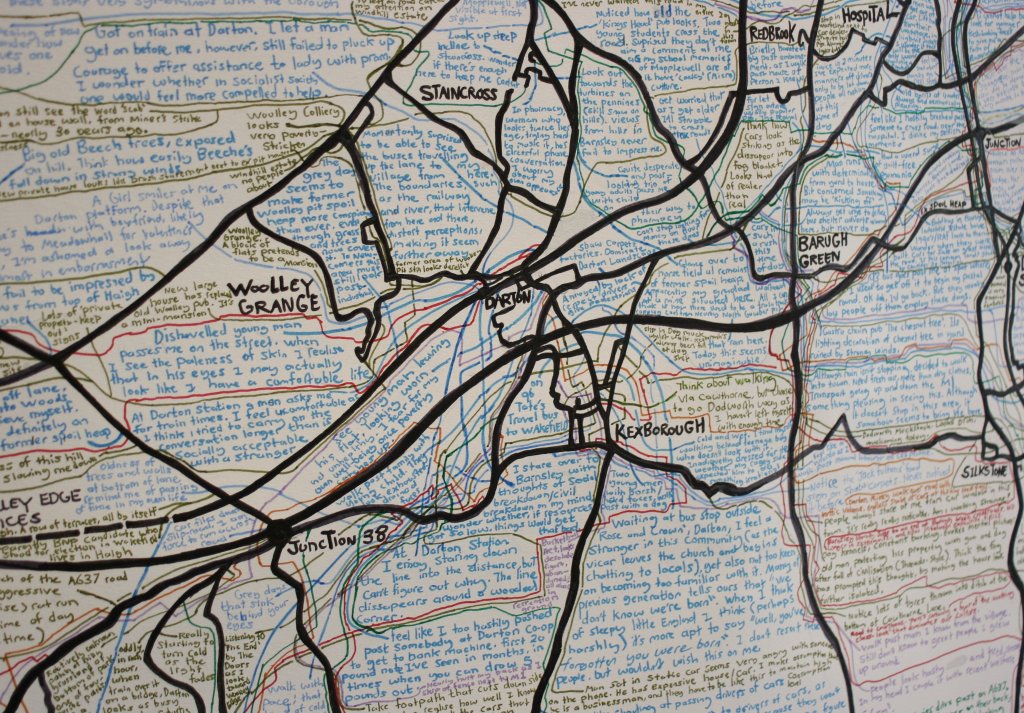
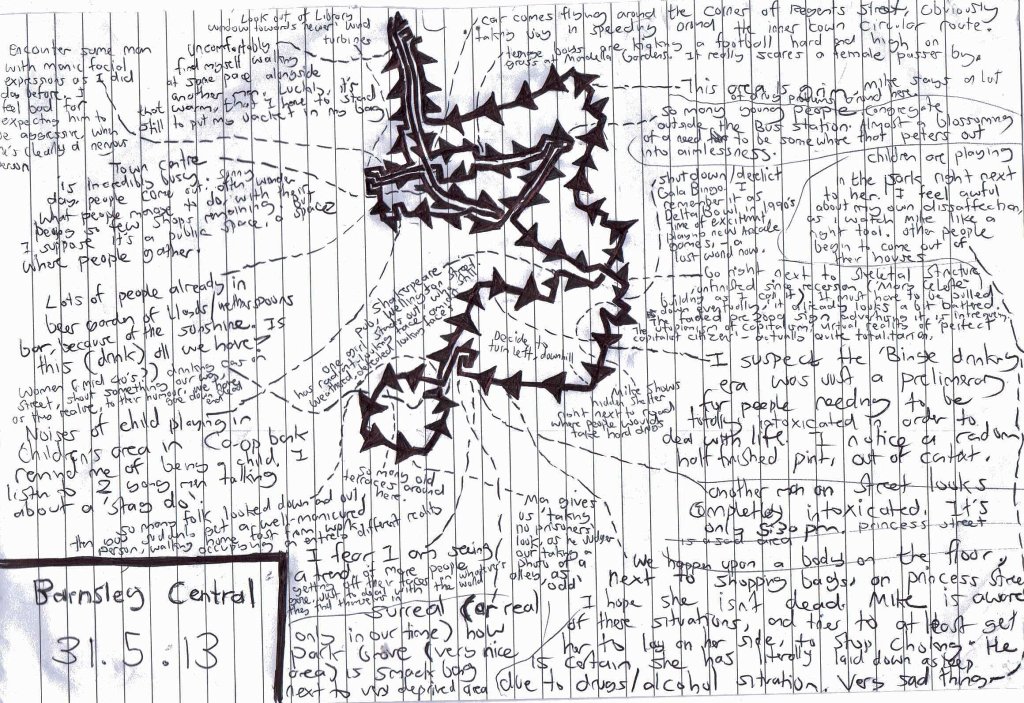
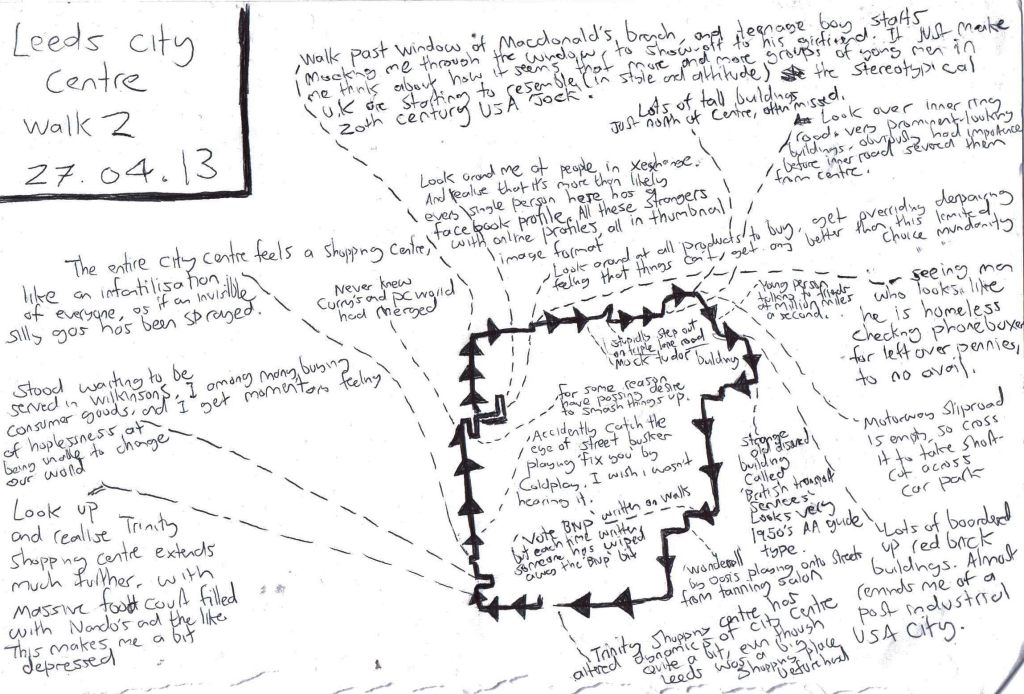
I aimed to conbine all memories/experiences from a year of walking/train/bus and car journeys through 4 areas that span the old West Riding of Yorkshire. It has culminated from years of wandering and musing around an area loosely centered around Leeds, Wakefield, Barnsley and Sheffield. I’m trying to show what inhabiting these places /walking through these human landscapes feels like. All too often I find reality is massively cropped to take the more picturesque; but I’m also trying to show that the issues the world faces today can be observed on a local level as much as in any international city.
I have chosen this area because it is a landscape I know better than any other.
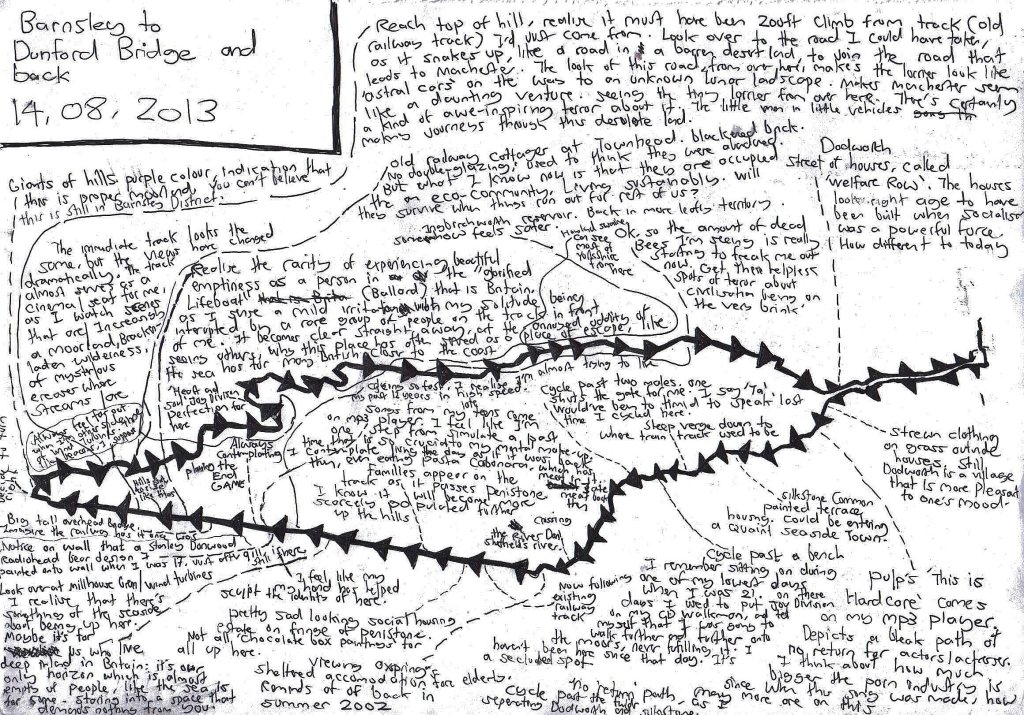
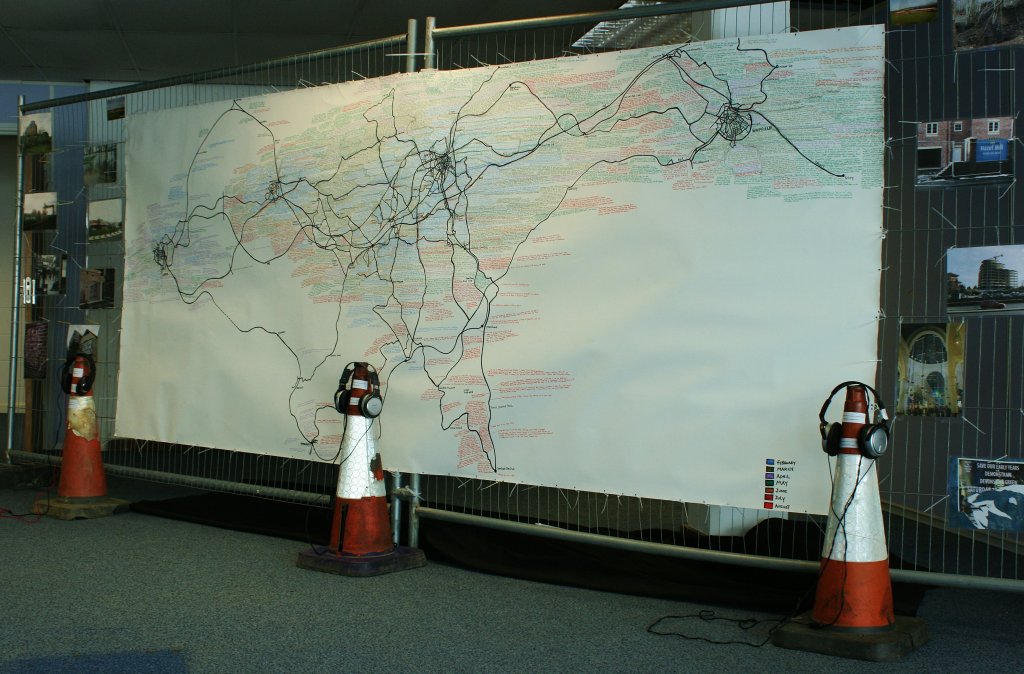
(I intended the map to be a culmination of all the ‘Mind Maps’ I have made of this area during the past 7 months. I wished to exhibit it using objects such as mesh fencing which, whilst being largely ignored as we make our way through our day, feature very heavily in the urban/suburban landscape)
I’ve found this project deeply helpful. I look back on what I have written and the landscape reveals its true identity to me; something an A-Z or Google map could never do. It also made me realise that there is potentially something to be gained conceptually from any walk. Not just a walk through the most tourist-friendly spots on earth.
But I must ask myself why do this here and why now? Well, disparate issues seem to have come to a head and collided; personal reasons, such as memories, lost dreams, a coming of age that are all embedded in this landscape, are becoming entwined with deep concern about the changes to the world happening at the moment; an increase in poverty, homelessness, mental illness, and recent weather patterns that go far to suggest we are amidst a rapid transformation of the Earth’s climate. These changes are very noticable at a local level.
‘Mind Camp’
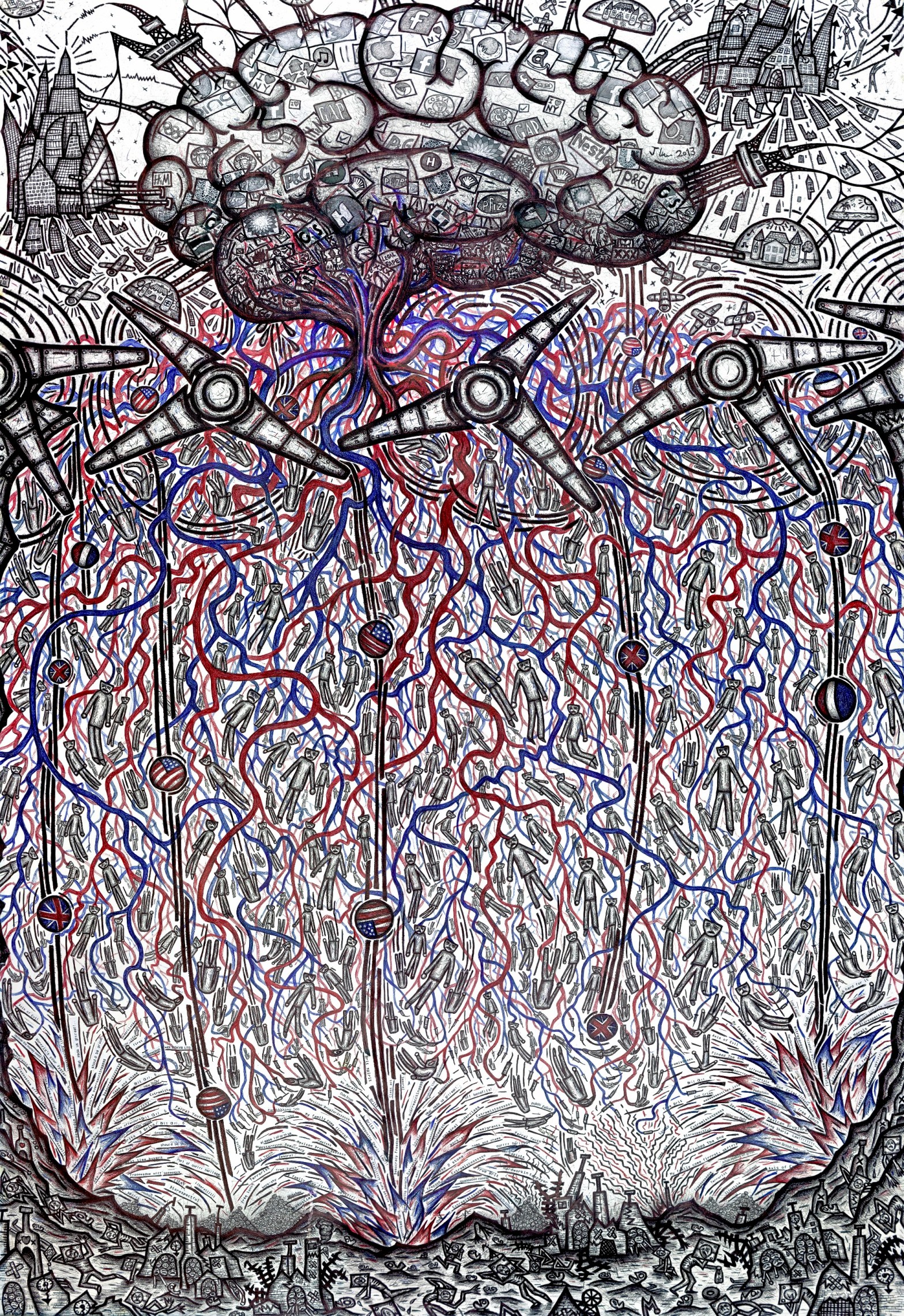
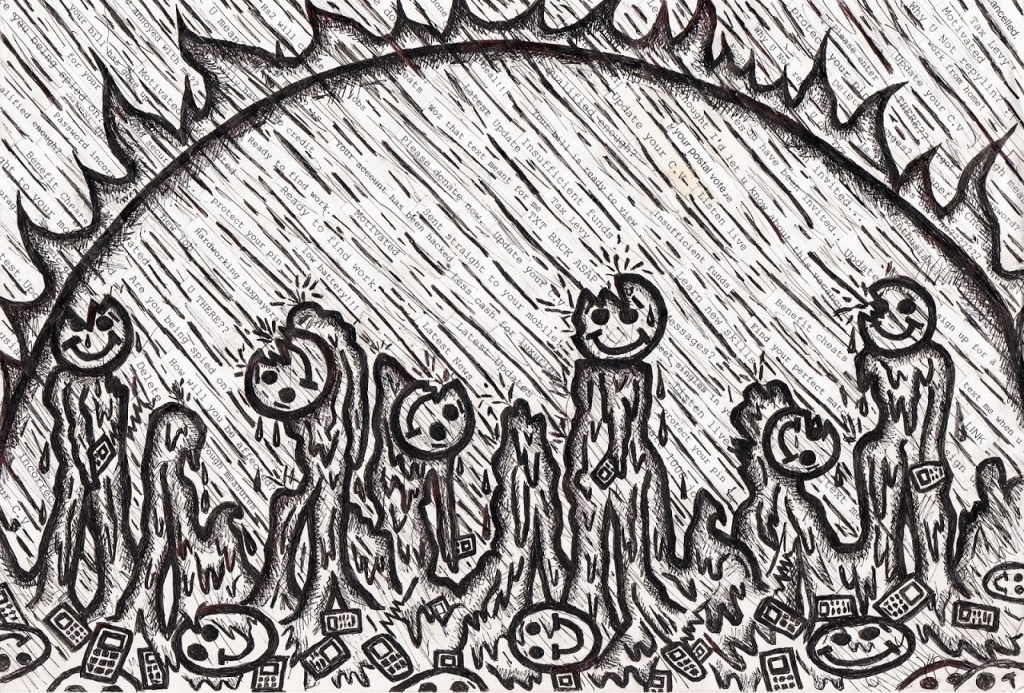
Mind Camp (2013), mixed media on paper, 100x140cm
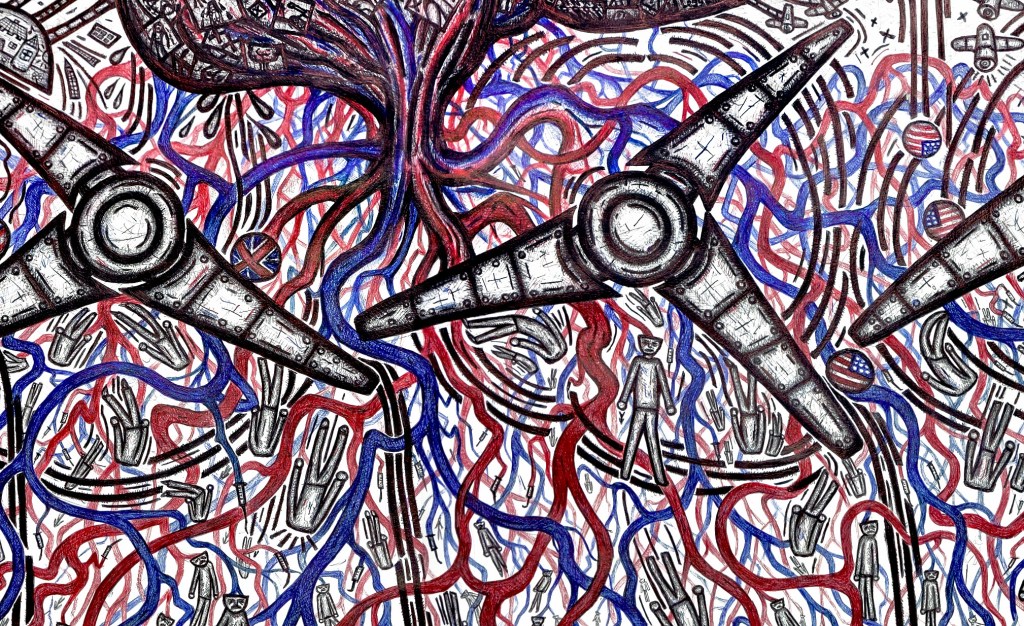
The title of Mind Camp is taken from a very ignorant error I made when I was somewhat younger; believing it to be the English translation of Mein Kampf, Adolf Hitler’s notorious book. Of course, Hitler’s book is actually translated as ‘My Struggle’, and the remaining connection here is that which I always thought my interpretation of the title referred to: the occupation of the human mind by ideas, doctrines, logic, as a means of making them socially compatible with a system of power; that is, power that doesn’t only (or doesn’t even need to) insert its influence externally, to make sure we are compatible entities within a system, but internally (what I would later understand as what philosopher Michel Foucault termed Biopower).
The theorist Franco ‘bifo’ Berardi refers to the current stage of capitalism as ‘semiocapitalism’: a system no longer driven by mass industrial production, but by signs/communication, which is all the more evident now human life is almost completely orientated around digital communications. Berardi writes that “semiocapitalism puts [our] neurophysical energies to work, and submits them to the speed of electronic machinery. It compels our cognition, our emotional hardware to follow the rhythm of net-productivity” Capital has synchronised itself with our conscious and subconscious. It is proliferated by the “digital web…” which “…spreads and expands by progressively reducing more and more elements to a format, a standard and code that makes different segments compatible”. In such a world, brands/logos have a seemingly unlimited reach over the imagination – as we can now see all too well. , Precisely because it is internalised, Capitalism is so culturally extensive and intensive that it is hard to consider that anything may be outside of it, so that “when we sleep, we even dream of capital” (Mark Fisher, Capitalist Realism).
But this means new styles of exploitation for a new organisation of power. Franco Berardi believes it is important to see the global worker no longer a proletariat but a cognitariat, as capital puts more and more of our neurophysical energies to work. Michel Foucault’s reference to the Panopticon (an architectural structure built to allow total surveillance over the ‘inmate’s to maintain order and control) as a analogy for a whole form of maintaining obedience to a power structure, is still alive and well, but perhaps need only now be used in certain circumstances, when the internalisation of power fails to work. Most of us are now governed internally, a biolpolitical intrusion of all the flows and anxieties of the political economy, depolitising us in the process, as we become the guard in the watchtower of our own lives.
Franco Berardi describes the Life of the cognitariat: “labor has become fractalised. With the end of large industrial monopolies, new workers, now delocalized in the global peripheries, start resembling computer terminals, cells in the circulation of the commodity-sign”. The worker is condemned to be a component in the constant production and consumption of signs/information.”Each individual is a cell put in constant productive connection with others by the web, which ensures a deterritorialized fractal, and fluid sociality. The cellular is the new assembly line, deprived of any carnal sociality”.
Precisely because total competition is the name of the game, social mobility has actually become harder in societies more saturated by neoliberalism, and the more we partake in our ‘daily races’ against one another, the more we exacerbate the dynamics of an every-man-for-himself system where the winners have already taken all. Yet, because of the “non-stop inertia” caused as the cognitariat’s libidinal energies are constantly wired/re-wired into the digital matrix, the anxiety of this enforced competitive state of being makes it sometimes feel impossible for us to withdaw from these dynamics; indeed Berardi speculates that only when we crash (depression/mental exhaustion) do we withdraw our libidinal energies from the reproduction of semiocapitalism. Alone together, protesting through inactivity.
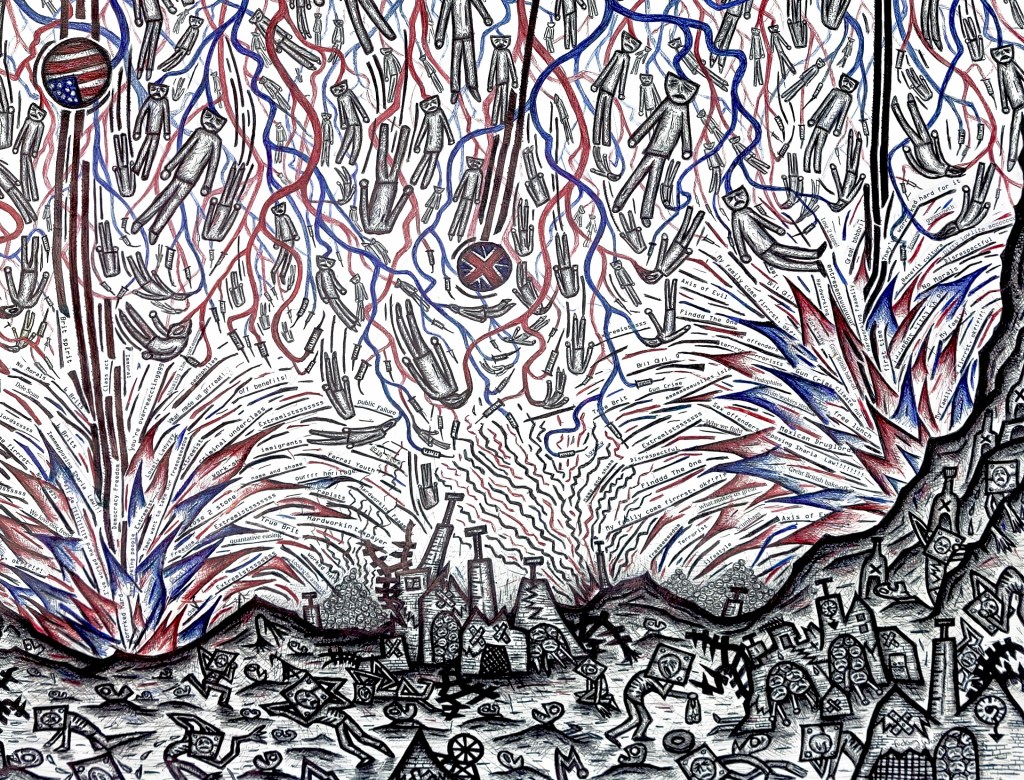
Within the drawing I wanted to try to visualise mechanisms that function by appropriating these ‘neurophysical’ energies from the cognitariat, but then merely dumps them once the required labour process is over, as the wealth accumulated by semiocapital becomes the preserve of a small section within the social system, who own the rights to the sign language as “intellectual property”. The ‘cognitariat’ is in a state of constant becoming; once their mental energies have been used, they drop (perhaps mentally exhausted, in what Berardi describes as a state of depressive withdrawal), only to find themselves reattached to the constant and futile ‘career-climb’ (the prospect of falling out of reach is often unthinkable as the welfare systems there to protect the financially vulnerable becomes less and less existent).
It often seems the case that the more one sends cell phone texts, posts images/links on their Facebook/Tumblr/Twitter wall, in the aid of becoming more (more financially, socially, and identity secure), the more one actually dissapears/becomes less, as they invest mental energies in an infinitely expanding information web, whose increase in size means increasing fragmentation of identity and of communitiy, as media wedges itself between more pockets of time/space; also this expansion not only engenders further exploitation of our psychic resources, but of our material conditions, as an increase in connectivity for the financial plutocracy means a greater reduction in labour costs for profit maximisation.
As the system refines its mechanisms in this so-called recession (the global 1% highest earners have seen their profits surge during this ‘recession’ period), jobs become so scarce to the extent that more mandatory, low paid jobs are absorbed more and more into the competitive, ‘careerist’, ‘life-as-a-CV’ job market, which was initially only the reality of those who were willing the work the career treadmill in the hope of a top salary. You stand still in a world of unrestrained ruthless capitalism and the fear is that one will be wiped from the game. It is evidential that we are witnessing a race to the bottom for (to use the now-common terminology) the 99% of us, as the concentration of wealth/power becomes more refined, with a logical conclusion that renders the fiction of films such as the recent Hunger Games imaginable.
The bulwark of information that is disseminated from the concentrated power is structurally designed to divide and confuse the population it relies on to utilise mental and physical energy from. This is the the only source that passes from the top to the bottom within this piece of work. The mechanism appear almost like pinball games levers, knocking all that is below back down, whilst only allowing these ‘media bombs’ to drop downwards. Sometimes I find the mechanisms visualised in games, especially early computer games, useful metaphors for the procession of power relations in the world, especially in the digital age.
Within the brain-like part of the work (which also attempts to refer to something inflated, and still inflating; a bubble of the logos of semiocapital) all signs, all logos, all companies, all sections of capitalist reproduction are shown to be connected/dependent on each others’ existence. Just as no individual is exempt, no sign/no commonly-seen logo is exempt from a network of images that descends into the darkest networks of reproduction; some brands seem to float like little fluffy clouds in a guilt-free cyberspace, but they are just as much as part of the system as the most destructive corporations wreaking havoc to the social/environmental, and also the darkests forms of image production from violent pornography to the filming of murder.
It’s an uncomfortable truth that the language of our times that often seems innocent on face-value is part of the same logic that allows the most brutal forms of exploitation in the world. Within this drawing there is no solution, I admit this (although there is cracks appearing in the super structure). But, to quote Franco Berardi again, because I largely agree with his opinion here, “The task of the thinker [to which, in my understanding of art, would include the artist] – if thinking has a task – is not to breathe hope into hearts, but to help in understanding reality, because only understanding can bring forth new possibilities”.
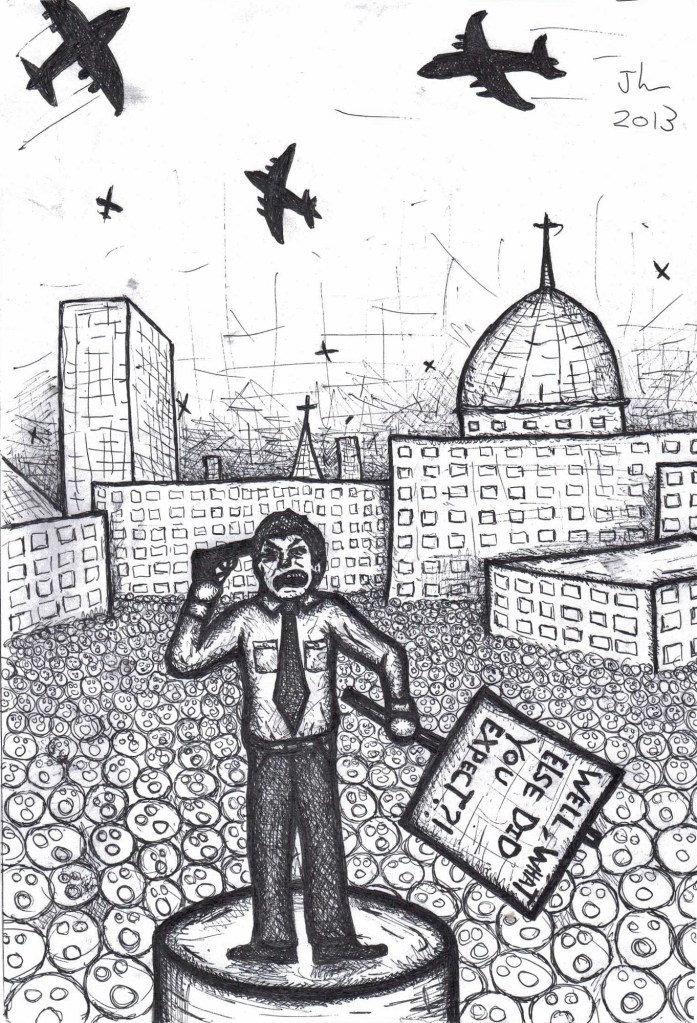
‘Untitled’
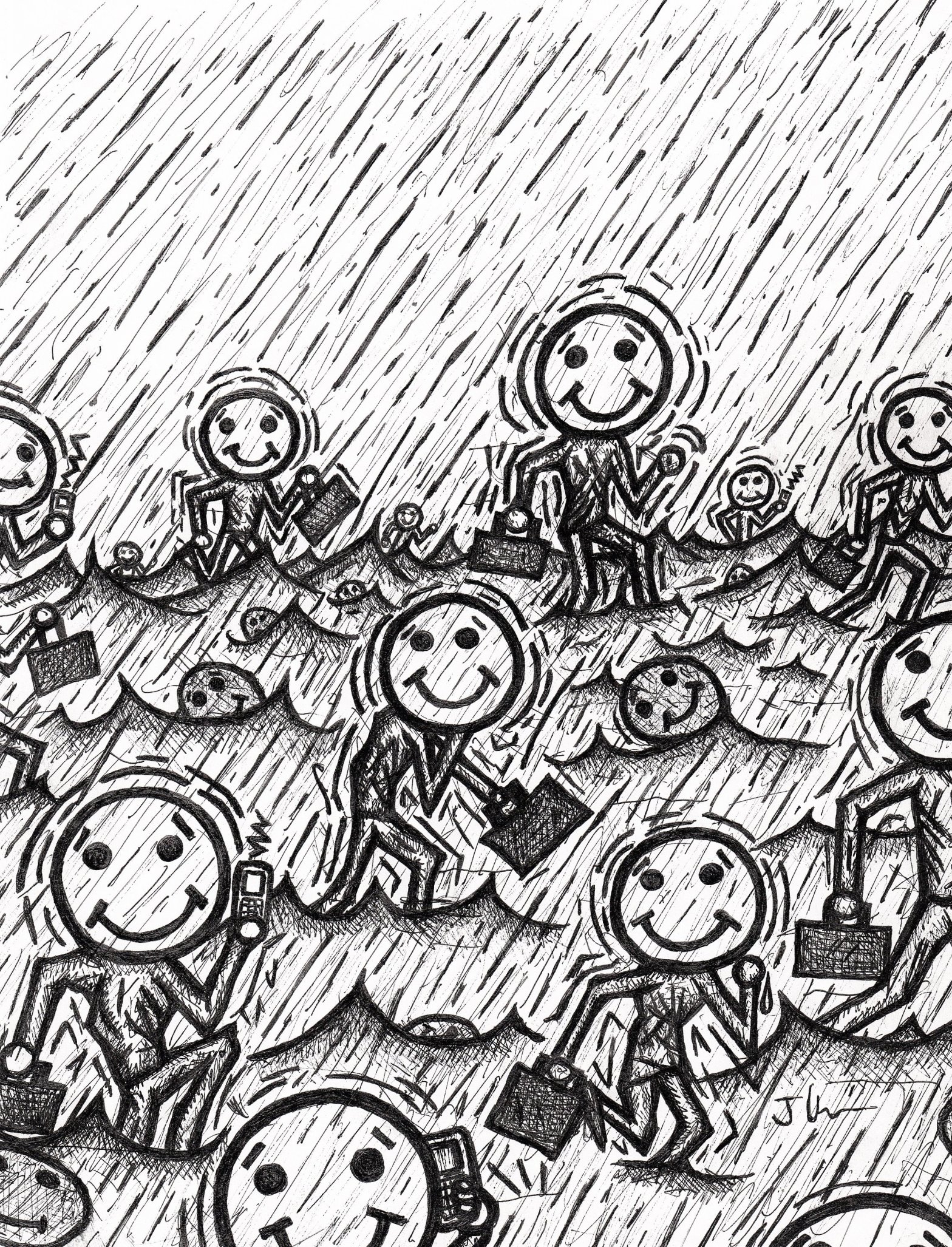

‘A Psychic Timebomb’

A Psychic Timebomb’, A4, mixed media on paper

The Barnsley Artwalk 2013 (Thursday 27th/Friday 28th June 2013)
Next week I will have works featured in an Open Northern Young Artists exhibition, Redbrook, as part of the Barnsley artwalk 2013, the first of its kind (to my knowledge) in the borough to date. A (art)bus service will transport visitors between Redbrook and Barnsley town centre. For more information visit http://www.alternativebarnsley.com/
Below is a map and list of places featured on the artwalk, which I have taken from the Alternative Barnsley site

Key to Barnsley Art Walk 2013 Map
1 NUM Statue. 1993. Victoria Road
2 Barnsley College Art Show July 2nd to 5th Tel: 01226 216216; Email info@barnsley.ac.uk; www.barnsley.ac.uk Old Mill Lane.
3 Dickie Bird Statue. Artist Graham Ibbeson. 2009. Church Lane.
4 Tree Sculpture. Churchfields. Created by Bryan Proctor in 2010 using a diseased tree. Funded by Residents’ Association project.
5 Cooper Gallery 10am to 4.00pm for exhibitions. Tel: 01226 242905; Email coopergallery@barnsley.gov.uk. Church Street.
6 University Campus Barnsley 27/28 June 4 to 7pm Ceramics by Artist in Residence Steve Ellis, permanent exhibition Voices in the Stone with photographs by Chris Sedgwick. Tel: 01226 606262; Email barnsley@hud.ac.uk; www.hud.ac.uk/barnsley Church Street.
7 Experience Barnsley Museum. Tel 01226 773950; Email experiencebarnsley@barnsley.gov.uk. Barnsley Town Hall.
8 “Crossing (Vertical)” by Nigel Hall 2006. On loan from Yorkshire Sculpture Park. Town Hall community square and gardens.
9 Lamproom Theatre – Permanent exhibition in the bar area of theatrical posters and plates from years of productions. Tel: 01226 200075; Email enquiries@barnsleylamproom.com; http://www.barnsleylamproom.com. Westgate
10 The Civic Graduate Art Show (31 Degrees) 2013. Tel 01226 327000; Email enquiries@barnsleycivic.co.uk; http://www.barnsleycivic.co.uk. Hanson Street
11 “Create” project at Joseph Bramah 27/28 June – 4 to 7pm. Come and get involved and add your ideas to the mural, all ages welcome. Market Hill.
12 Barnsley Building Society 150th Anniversary – Graham Ibbeson relief sculpture 2003. Cheapside.
13 Graffiti Wall 2013. Albert Street
14 Child sculpture. Kenny Hunter 2012. 6m high. Symbolising the past and future of the town. The column represents the Barnsley coal seam. Interchange.
15 Digital Media Centre. 01226 720700; Email dmc@oxin.co.uk; www.barnsleydmc.co.uk County Way.
16 27/28 June – Art Bus to Northern Young Artists exhibition at Redbrook Business Park. Departs every 30 minutes from 4.00pm, last buses 6.30pm from College, 7.00pm return. Huddersfield Road”
I get it, but always forget it.
2:30pm, New Cross, 18/6/13. Back in South East London. But it doesn’t feel like I’m back in London. Yes, South East London’s atmosphere, look and attitude seem far removed from the areas seen as quintessentially London (North and West London), and New Cross often feels more familiar to those raised near Northern English cities, because it has a look of industrial decline to it. But this doesn’t account for why it doesn’t feel I’ve arrived 200 miles south of where I live!
.
It’s interesting to observe, when you return to a place that you once spent a certain time-span in, how we experience time in a very non-linear way; that, when you return to a given place after a lengthy gap, all periods of this reality seem to merge together seamlessly, as if every geographical space was instead a reality that you can just simply walk back into. Like time/space can be moved around, cut and pasted with a simplicity of editing tracks on a modern sound recording computer program.
.
London, and especially New Cross now feels like one of a number of stage sets that make up the entirety of my mind, as if it were a building with different apartments/levels in. I don’t really mean ‘stage set’ in a sense that it feels like a simulation, that is, a place made Hyperreal; what I actually mean is that my mind is made of the many places, social and geographical spaces, that I can seemingly moved in and out of without really moving through time and space. Stage set as in the scene ends abruptly once I step out of the familiar zone.
.
This sensation can often be quite discomforting, as it makes that task of keeping a grip on a reality that we know we must understand and abide by survive feel like trying to walk in a straight line whilst very intoxicated. 4pm, 18/6/2013, New Cross, the A2 trunk road. There’s noise volume and there’s noise volume. When I say that a road is noisy in Yorkshire, and that I can frequently hear Emergency service sirens, the words have much less weight to them than if I was to say the same whilst sat outside a cafe next to this section of the A2 trunk road that connects London to Dover.
.
.The intensity of the noise volume here may be comparable to putting your ears next to a functioning pneumatic drill. The city is itself one big factory, even just through the likelihood that the noise volume damages one’s hearing like the old steel and cotton mills used to, before this world left the shores of these Islands in search for workers who could be paid less. Is it just a fitting analogy to conclude that with the internalisation of power during the final 3rd of the past 100 years (so that obedience to the designs placed on us by the system appear to emanate from ourselves), work itself has externalised/deteritorialised and spread itself onto everything, as public space (with the aid of the gradual increase of road traffic during the same period) has diminished under neoliberal privatisation logic? Thus the road is the factory; as are we.
7pm, Deptford. It often feels like London has stolen the Lion’s share of young adults (roughly aged between 20 to 35 years) from the rest of country (and other countries), leaving the remaining young adults to be massively outnumbered by other age groups, like Robinson Crusoes, shipwrecked, waiting to be rescued by a crew made up of people their own age.
And what exactly does London do to these people, once they enter this over-active stomach of humanity? Well, it seems to suck these ‘best years’ out of many, using up their youthful energies to fuel the ever increasingly flow of capital, that thrives on young naive juices; spitting them out, withered, pessimistic, faces old before their time (not the bodies; these are dutifully kept in trim), from where they discard themselves (like intelligent used crisp packets) on their home towns, settle down into the type of anti-social, middle England quagmire that breeds conservative thinking, and Fleet street Newspapers. …Just a thought, mind.
.
10am, Crossing London Bridge, 19/6/13. I don’t dream any more. I have no investment in a graceful coming into being, I just get pissed up. It wouldn’t be so bad if drink didn’t act like chloroform on my constructive anger and scrutinising; the only things left for one who no longer dreams.
.
10:30pm Central London, walking towards St Paul’s, 19/6/13. Seen as much discussion yesterday was over the internalisation of power (meaning systematic means for dominance work at a ‘neurophysical’ level), debating whether this is what the philosopher Michel Foucault specifically saw as biopower, I was now observing the more manicured, sleek/toned human being of the busy city districts through a biopolitical lens. There’s seemingly a connection between the importance of a geographical area to capital flows/their semiotic gravitational pull (as in their importance in the network of signs/information saturating society with capitalist dreams) and the pressure placed on human beings synchronised to these spaces to be ‘physically perfect’, because you cannot have success without being so within this current stage of capitalism.
As if a military fitness instructor is buried inside of me, out of view, I respond to the sight of seeing others who, to my eyes, are signifiers of ‘the beautiful people’, by tensing my muscles, grinding my stomach muscles, unconsciously trying to adapt, not the ‘the norm’, but to the expected/the accepted. Yes, this is an idiosyncratic reaction, but it has its cause in a culture-wide phenomenon.
.
The internalisation of power doesn’t just mean that we are obeying codes to the benefit of the reproduction of capitalist relations the other side of our skin, it also means the automatic obeying of codes to the benefit of capitalist relations this side (I prod my stomach) of our skin; the ideal body, lifestyle, fashion, to adapt to social groups that are beneficial to this reproduction.
.
Last Saturday I went to see a collaborative sound and video performance (two of the musicians were friends of mine) in Sheffield. The music was pure noise, machine-like, industrial and post-industrial. Picture then how this was juxtaposed with fitness videos, all VHS videos from the exuberant ‘new economy’ geist of the 1990’s. In the context of sounds that had a sinister tone, certainly a world away from the music from ITV’s Good Morning Television, the infamous fitness classes by ITV’S Mr Motivator look, if anything, totalitarian. Figures on our screens demanding that we follow their lead, and keep ourselves trim and healthy, a visual that here began to look scarily like the compulsory exercises 1984’s protagonist Winston Smith, and all the other constantly surveilled population of Airstrip 1 do every morning, whilst the gym teacher watches them on an all-seeing screen (1984, George Orwell).
.
For whom are we keeping ourselves as ‘perfect specimens’ for? For power, for it’s reproduction of course. Power in Orwell’s 1984 and power in Mr Motivator’s (I’m using him as an exemplar) world function quite differently. Mr Motivator doesn’t make us do exercises through the promise of punishment if we don’t (Winston Smith is literally forced to join in with the exercise). Yes, Orwell’s 1984 did pick on power’s ability to invade our minds to control how we think, and although this was already occurring to some extent with the rise of nation state power in the early 20th century, 1984 was still ahead of its time. However, it was also a product of its time, and largely deals with the power’s dominant form in the first two thirds of the last century: external dominance, what Foucault called the ‘Discipline and Punishment’ society, where, using the architectural example of the panopticon (a structure built to allow total surveillance over the ‘inmate’s to maintain order and control) showed how obedience to the codes beneficial to social reproduction worked.
.
Mr Motivator, and his gang of flexible and toned young female adults, aren’t literally forcing us to to join his exercise regime, but we have, instead, an anxious feeling informing us that we really should do so! That, if we don’t join Mr Motivator, we should at least do something else to help us maintain a socially accepted human body. What was so scary whilst watching these videos under dark electronic noise waves, was realising the finesse of a totalitarian force that doesn’t need to shout at us and tell us what it will do to us if we don’t comply, because it’s already inside of us; it is part of us. Despite the increase of state/corporate surveillance in society, we don’t need to be watched to comply with the codes.
.
But with 24 hour media making examples of the ‘best choices’ of how to live our lives (which are then internally digested into orders), thus bombarding us with a world of people, moving so fast that they begin to look like they aren’t moving, but are static/solidified into perfection, well isn’t it obvious why cases of psychological disorders relating to the body and obsessive compulsive disorders continue to rise? Isn’t this the malfunction of the human, unable to keep up with (or figure out) biopower’s ‘requirements’ of them?
.
11:am, walk past St Paul’s Cathedral 19/6/13. “So What?!” I thought. I initially feel like a bit of a dead soul after I think this, because it is a self-defence mechanism against a discomfort due to being unable to find any emotional investment/intrigue in places deemed to be very important/iconic/”must see!” places. Whether it’s Victorian, Medieval, Roman or Dinosaur bone, it all leaves me with one overriding sensation; the awareness of my general indifference.
.
But I have seen these buildings and famous streets countless times on Newspapers, Television and cinemas and train station billboards so many times that by the time I am stood in a place where I can view them with my own eyes, they don’t even seem real, and certainly don’t seem more important than another photograph of the place. It remains a picture, yet a picture my culture expects me to be moved by far more than any of the other pictures (this is why I have so little energy for traveling to destinations). I remember going past the Houses of Parliament on a bus last year and observing our unreal they looked; like I was looking at a photo or a model of the building, seeming no more of a genuine article than the photo masks of Kate Middleton in the tourist shop across the road.
.
Of course, this is this hyperreal, where references to the original become more than the original, which ceases to exist because it is seen as just another reference to itself. The philosopher Jean Baudrillard has already brought the concept of Hyperreal, but it is a process that still needs our full attention today because there is a continual process underway erasing the original ‘real world’ from which replicas must draw on. 30 minutes later I was walking past Westminster Cathedral, traffic islands were full of tourists with cameras taking more images. I just thought, “oh dear, the world is being made less real by the second” Every photo pumps a little more of the residues of an original away from its origin, until nothing but references to references can exist.
.
Tourism and holidays often seem all so worthless to me, a feeling I struggle to ignore when ever I do these things. I’m no ‘killjoy’; I want to be happy, be fulfilled without the usual substitute for satisfaction, alcohol (or intense scrutinising/analysing of things – which usually tires one out, leading them again to a slight need for drink). But I just struggle to experience. I struggle to be convinced that others do when they tell me they do; often wondering whether in our times we just instantaneously reference the feelings of joy and satisfaction, rather than actually experiencing them. Is it not the most uncomfortable feeling when something truly upsetting has happened involving yourself and all you can think is that you’re referring a tragedy or series of tragedies you’ve seen references to before?
.
11:20 am. Look out onto the Thames. There seems to be a crazy amount of skyscraper development along the Thames right now. Yes, buildings are always doomed to be in a cycle of construction and demolition, but the amount of concrete skeletons and cranes occupying the London skyline right now must surely not have been since the postwar construction boom. I can’t help thinking about something I heard once about how civilisations/or ruling system’s build some of their most pompously grand and powerful-looking architecture on the brink on their collapse. Is this a view one of extreme cultural denial then? That the dominant ideology is doing what most of us are individually doing; trying to cancel out the doubt that this whole way of life and the dreams that sustain it are about to collapse in on themselves, by believing in those dreams and this way of life more defiantly.


 John B Ledger