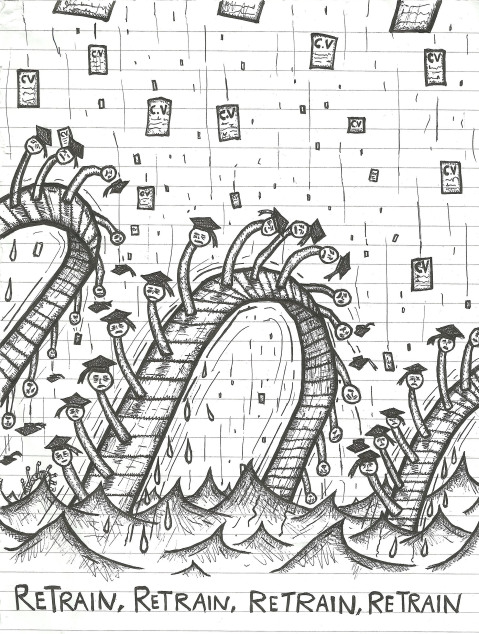
“…today, I see within us all (myself included) the replacement of complex inner density with a new kind of self evolving under the pressure of information overload and the technology of the “instantly available”. A new self that needs to contain less and less of an inner repertory of dense cultural inheritance — as we all become “pancake people” — spread wide and thin as we connect with that vast network of information accessed by the mere touch of a button. Will this produce a new kind of enlightenment or “super-consciousness”? Sometimes I am seduced by those proclaiming so — and sometimes I shrink back in horror at a world that seems to have lost the thick and multi-textured density of deeply evolved personality.” 1 – Richard Foreman
Over the past ten years, the speed of information and the amount of it flowing around, and in and out of us has increased dramatically, and it shows no sign of slowing down. In agreement with Richard Foreman, sometimes I am excited by this new reality, but just as often it gives me a sense of cold “horror”. The dominant belief in our culture is that the more we find out, the more of an understanding we have of our things that matter to make a safer, democratic world. But is this happening with the current way we receive information, where our points of contact with the big issues around the world become mixed up with the points of contact with friends, employers, titillating-trivia and everything else imaginable, until what matters and what doesn’t can often seem undistinguishable in what can feel like living under a waterfall of information?
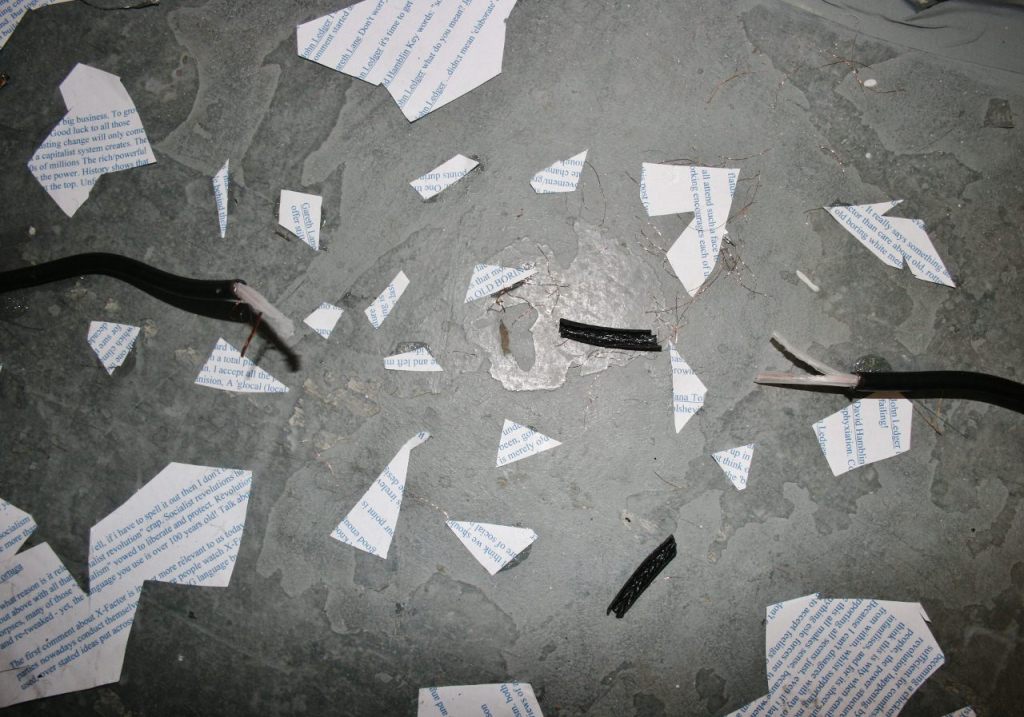
Rebuilding The Flattened, deals specifically with Twitter. It reels in everything I have ‘Tweeted’ as John Ledger since I joined in March 2012. The aim is to re-imburst them with substance, by bringing all the sentences together and placing them in a space where text isn’t constantly in flux; to reinvigorate them with memory that has a continuity to it; and if it merely reads a pocket-sized riot of random sentences strung-together to other people, it certainly tells a story to me, reminding me of things I was feeling, and things that were concerning me, that would have otherwise remained forgotten in a cyberspace graveyard.
For me, the prospect of a society of ‘pancake people’ poses an overtly political dilemma: how can we make sense of things, and get keep hold of an understanding of what is the root cause of the problems in the world when, as Franco (Bifo) Berardi says “Subjected to the infinite acceleration of the info-stimuli, the mind reacts with either panic of desensitisation”? 2. Can we really act collectively to counter anti-democratic forces, extreme economic injustices, and climate change whilst we are subjected to this? The problem here is that disconnecting ourselves from cyberspace is neither the solution nor achievable for for most people.
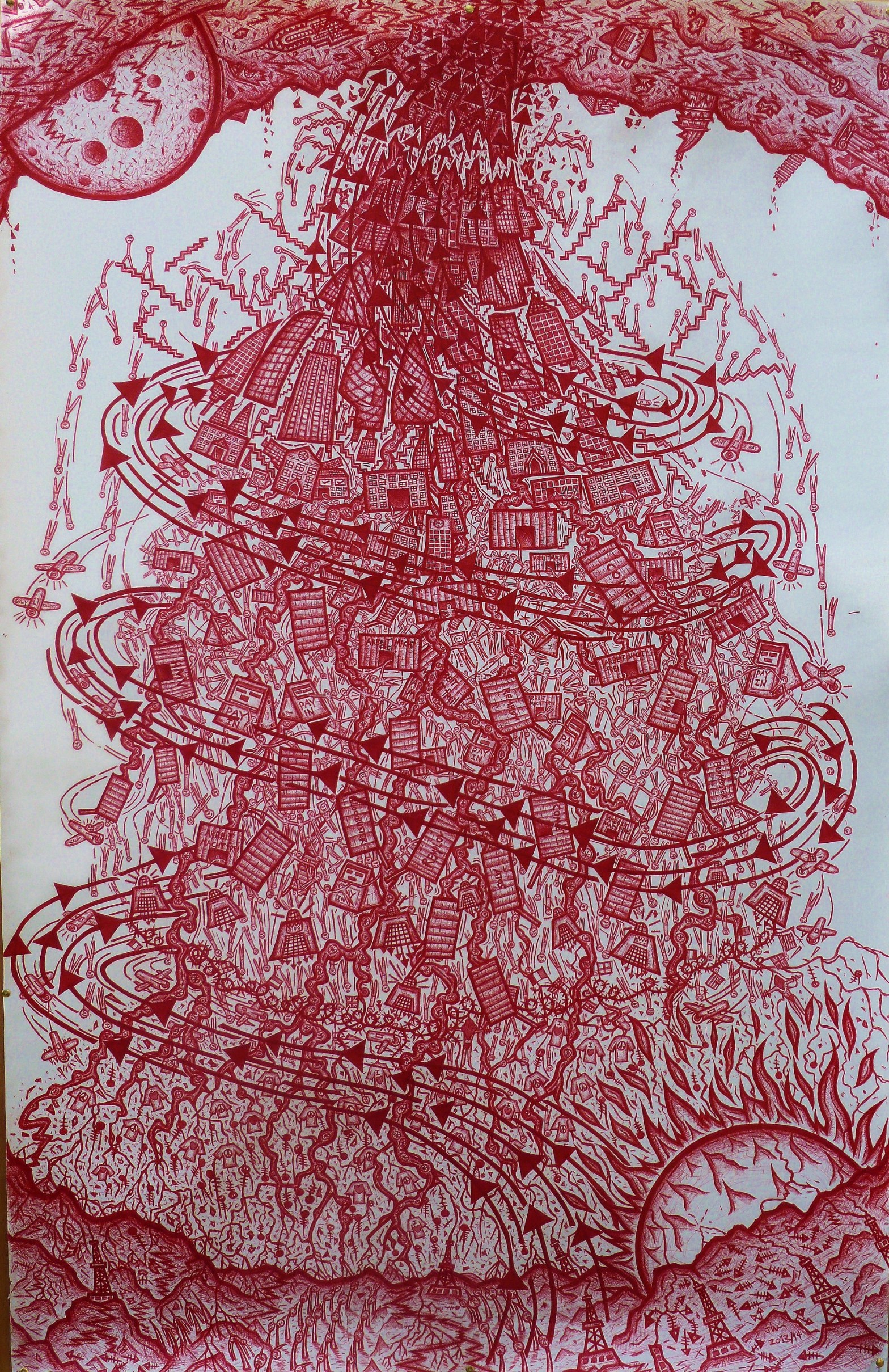
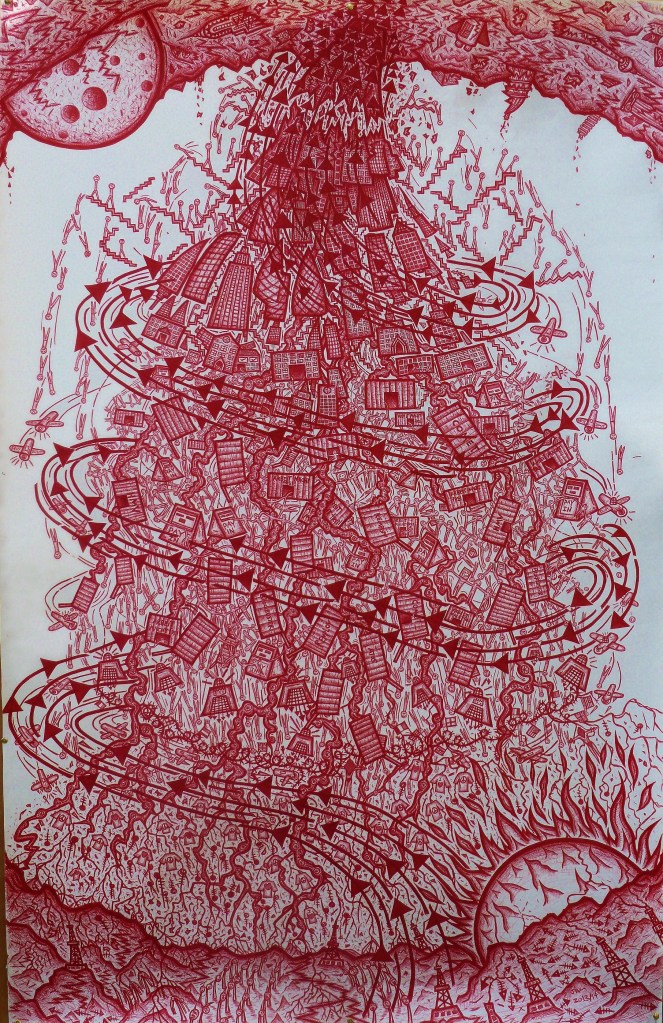
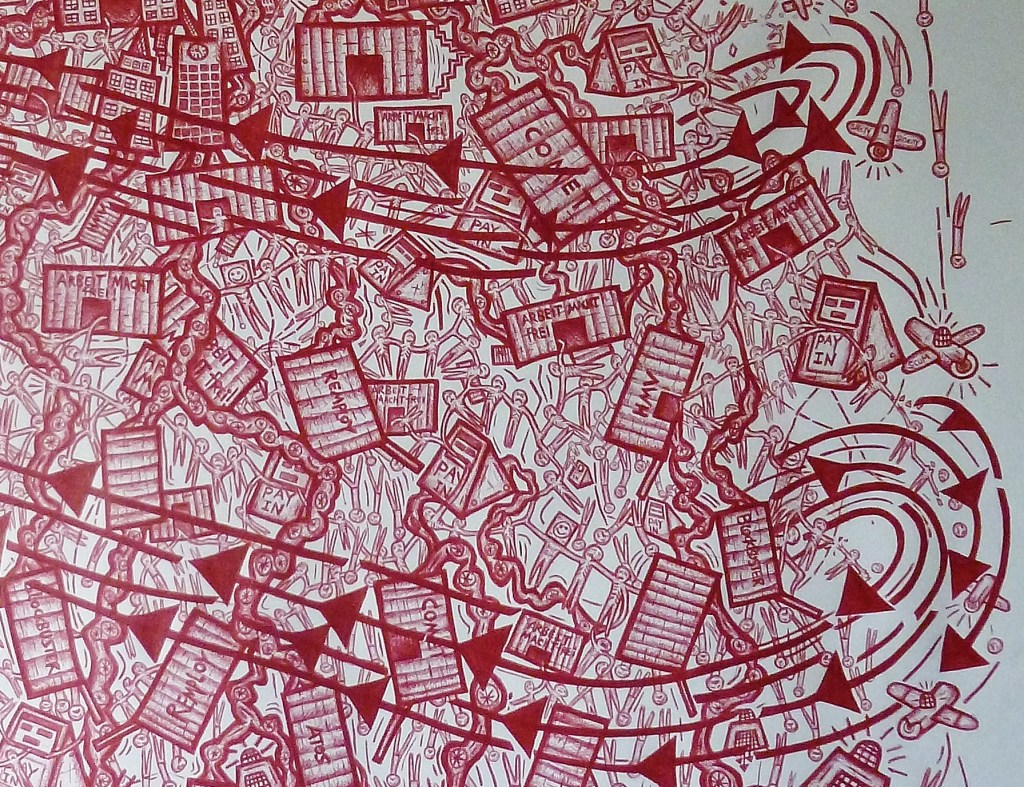
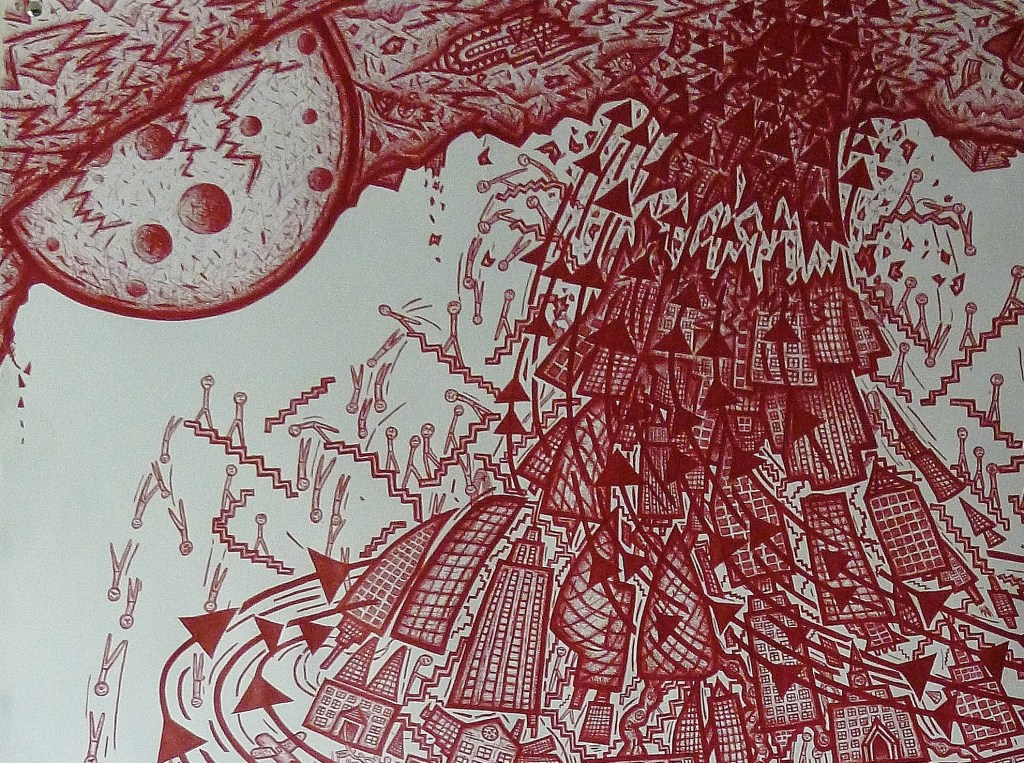
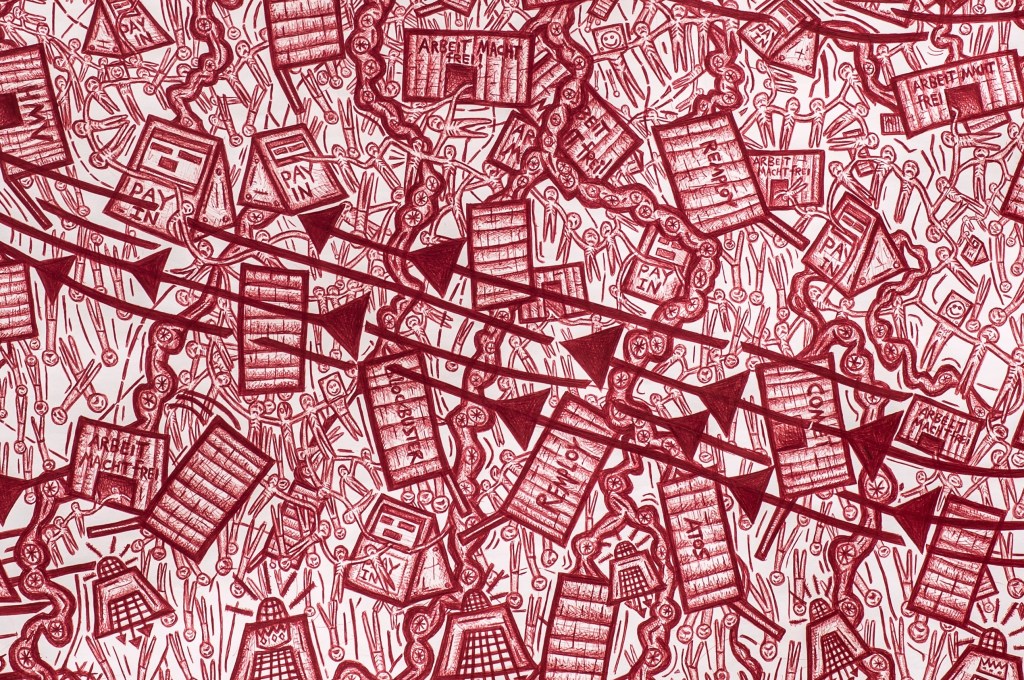
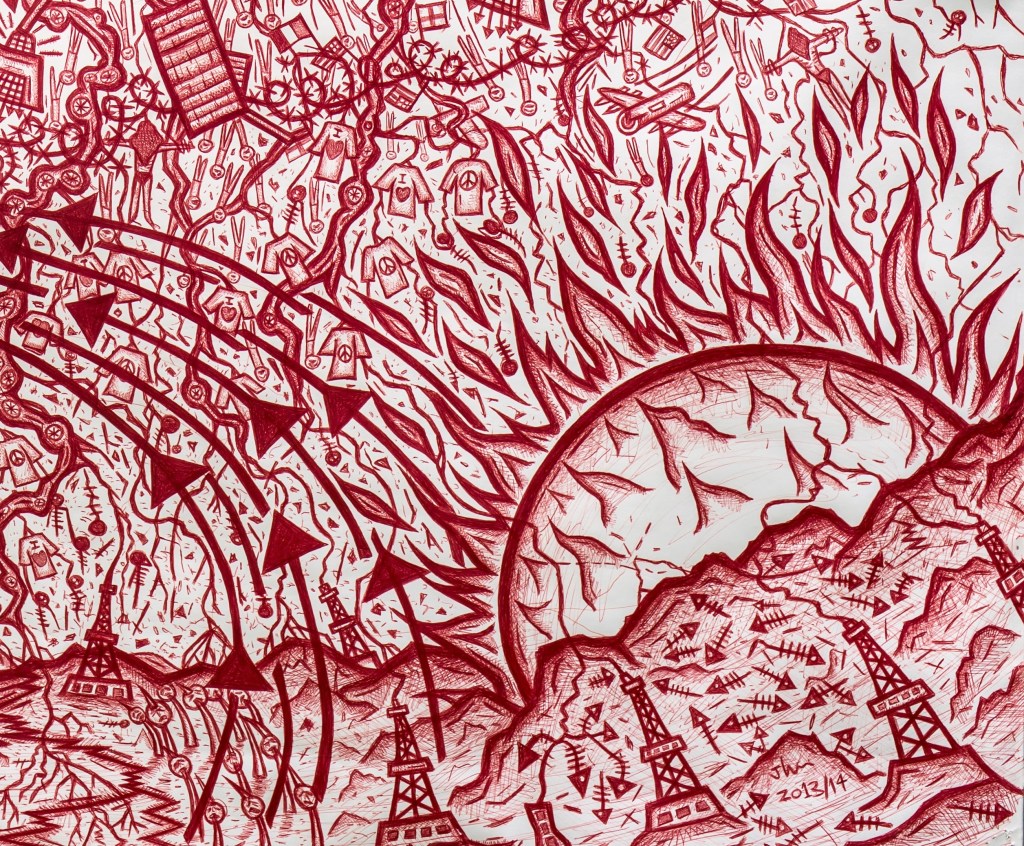
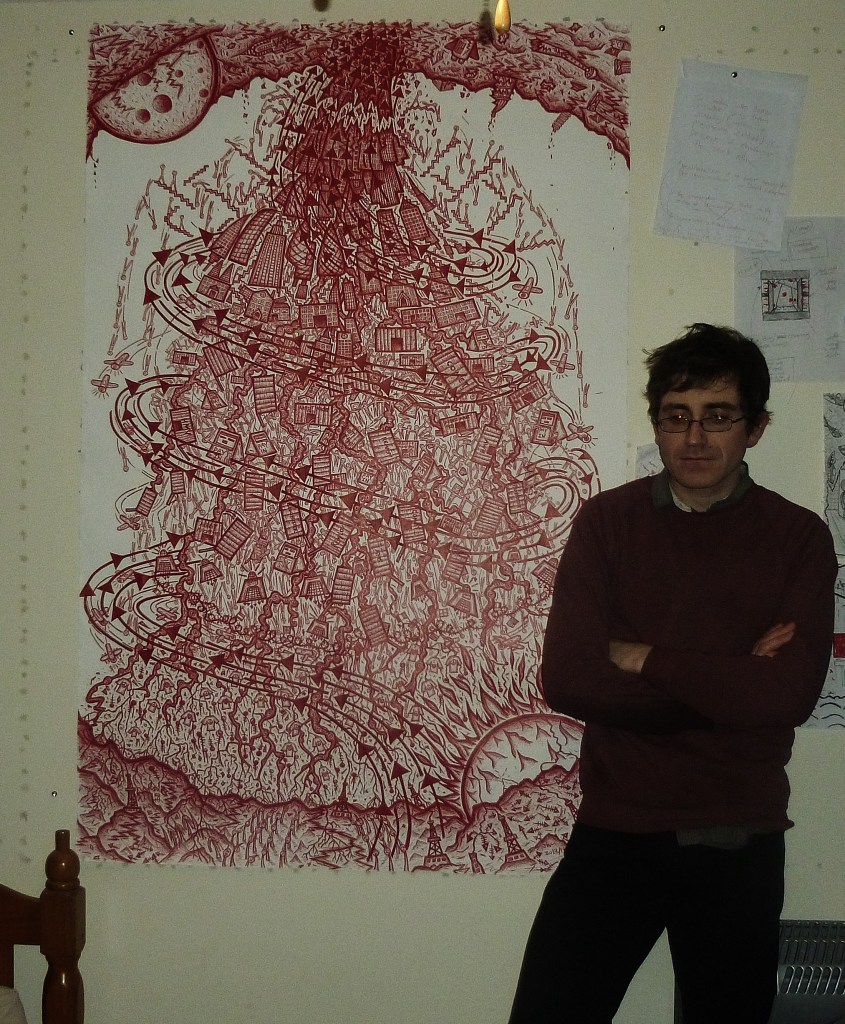
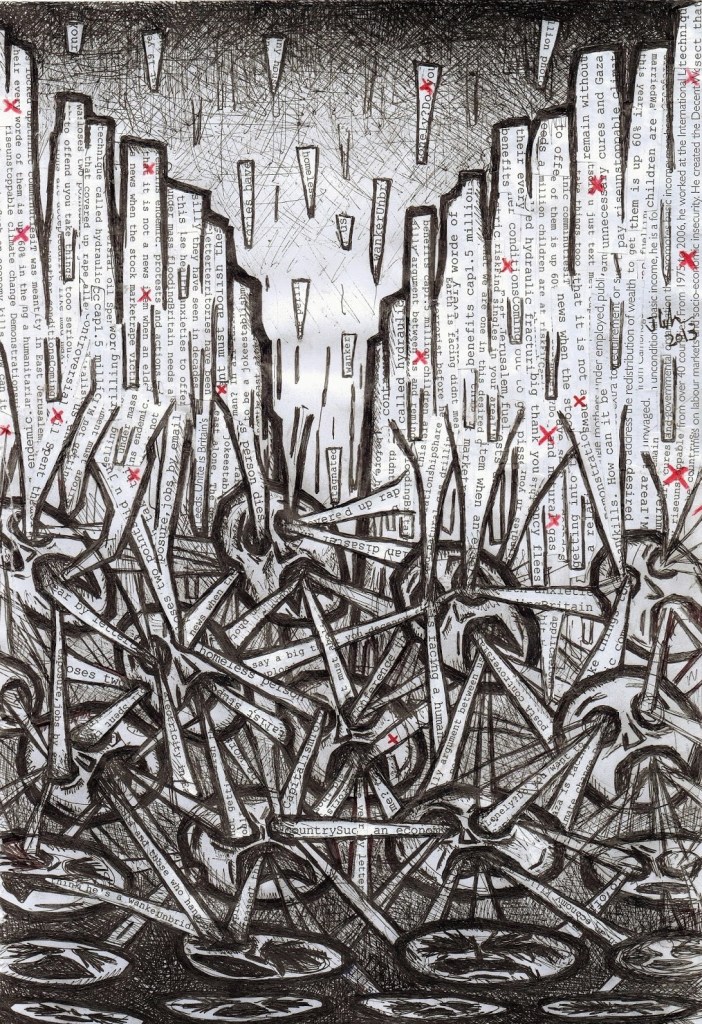
Thus, there is certainly a political motivation behind making this book. A ‘cognitive mapping’3 (Fredric Jameson) of an info-drenched landscape that pulls us all into points of panic and delirium, with the intention of constructing a larger picture of these past years. In many ways this desire is what also motivates my large scale drawings, a way of working which also more or less spans social media age also. A consistent hope that artistic endeavours contribute to helping us transcend the huge deadlocks civilisation has come up against in the 21st century.
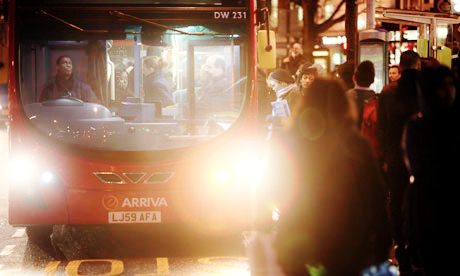
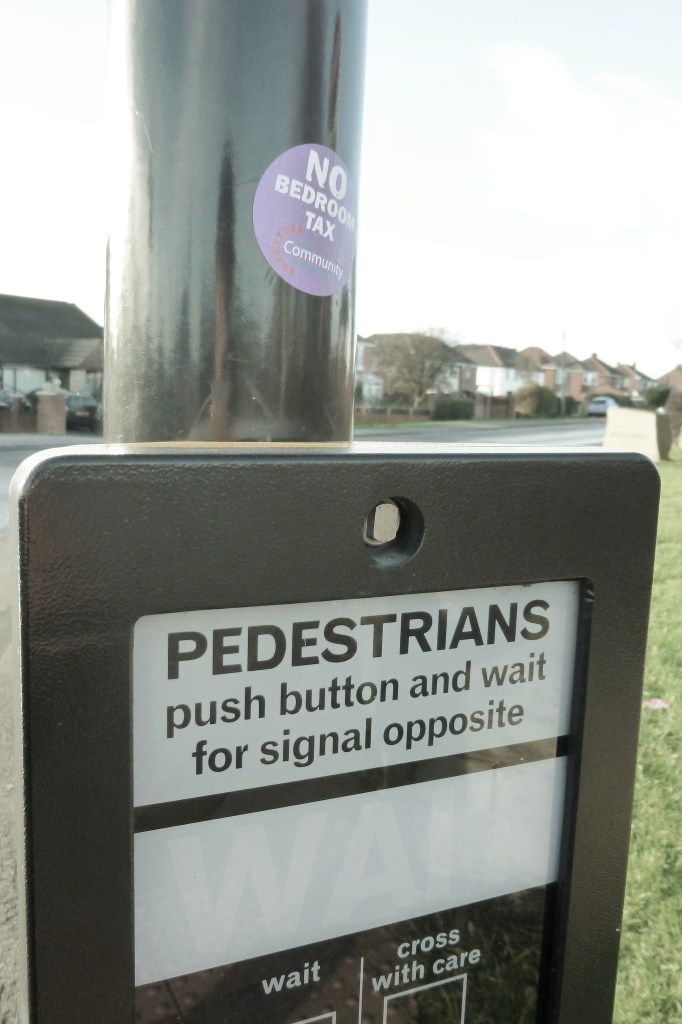
The outdoors has become the factory. It has become that inhospitable environment that people were once relieved to clock off from. A few straggling pedestrians are battered by the production-line-motion of road transport noise, violent to the senses; repetitive noises once the preserve of the heavy industries and 20 century-style wars; floodlights that obliterate all vision on poorly lit streets; a ‘get-out-my-way’ speed that keeps the pedestrians obediently on their toes; and warning signs/CCTV cameras (that may or may not have human eyes behind them) instilling into them a need for even more obedience – “don’t loiter; get on with what you should be doing”(usually consuming).
People, mainly in cars, or zoned out from others on express train commutes with all sensory organs focusing on screens/plugged into machines. The social/The outdoors: a gauntlet, a place to spend minimal possible time in. People so inconvenienced, anxious, exhausted and alone, from living in what Will Self calls ‘the Man-machine Matrix’ (which requires increasingly more energy, enthusiasm, commitment from them) react to such circumstances by attempting to build private spaces of maximum available satisfaction. Private bunkers proliferate as hasty attempts to close the door of the outdoors in order to cling onto spaces of lonely enjoyment abandon the outdoors to the human waste of noise pollution, light pollution and the frustration from unsatisfactory private bunker moments that overspills into threats of violence on the streets.
Headphones, that damage the ear drums with ‘chosen’ noise, block out the otherwise inescapable noise of traffic. But the pedestrian can’t escape the horizontal-shower of blinding lights in a wintertime rush hour. Watching a road at rush hour is like a process in a production-line or automated factory. All of us, frustratingly one at a time, in an urge to get to the master private bunker; our home. Everybody is out and moving; moving alone. An army of ants who have all been coaxed and conditioned by the religion of self.
People increasingly stressed and short of time, are constantly fighting against the rising tide of ‘inconveniences’; they are constantly thinking “don’t take away my valued private space for enjoyment; don’t infringe on my little moment of leisure time” and you witness adults kick up a child-like fuss when their private moment “to do what they wish” is subjected to a gate-crashing. (but yet a child-like response is expected from a people who have no collective/or social space, but only their private bunkers).
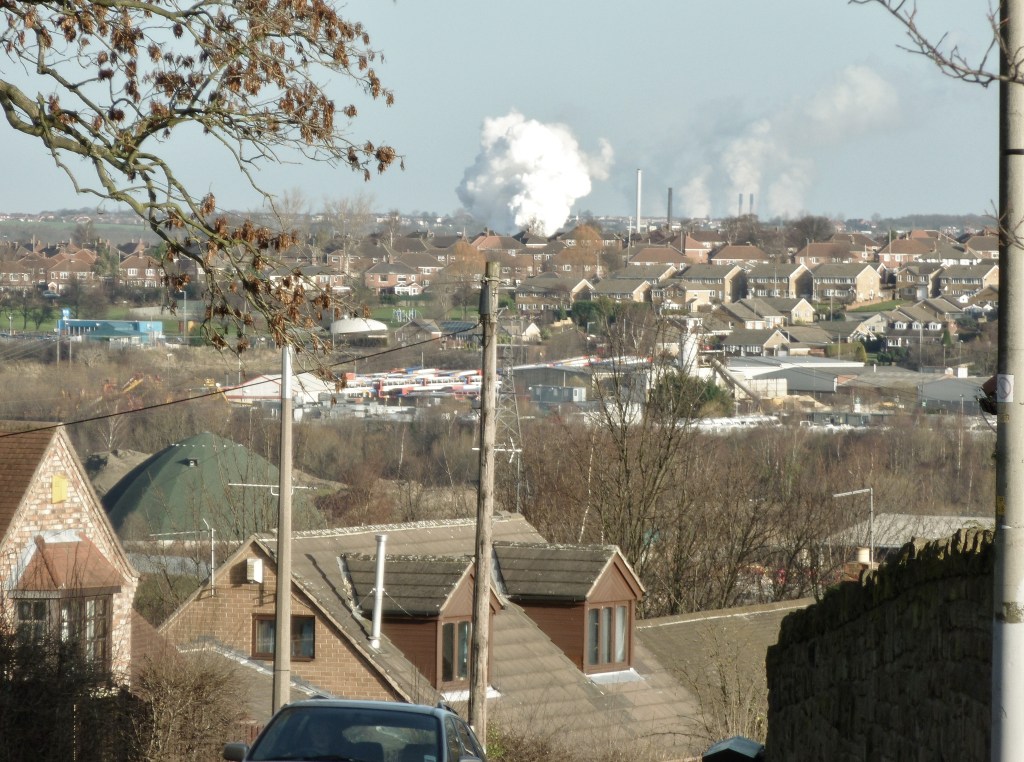
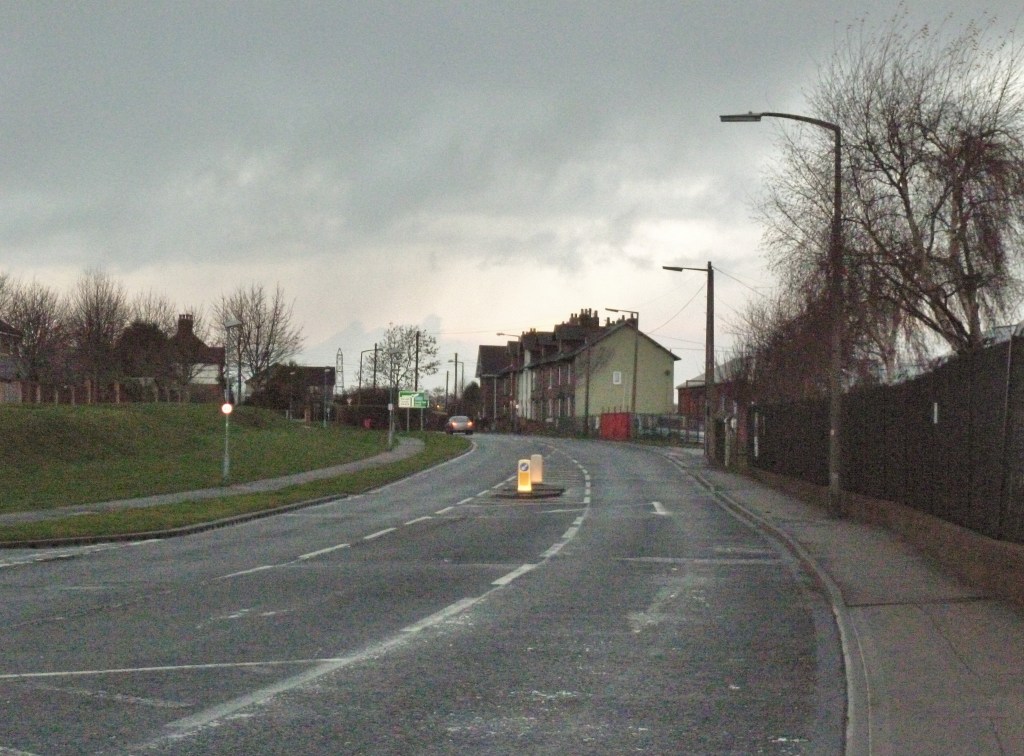
The pedestrian’s experience of this noisy and thankless environment is probably more specific to the outer-city road networks and the sprawling sleeping suburbs that bleed off them, than the central zones of the country’s largest city sprawls. Few spaces outside our front doors in the sprawling suburbs are places you’d want to remain static in; constantly experiencing the hasty gust of traffic, whispering “come on, move on, hurry up!” in your ear.
Social space becomes more arid and desert-like under this prevailing viral logic. The seed of ‘market individualism’ planted by ideas under the umbrella of Thatcherism and Reaganism, grew like a tree seed between the bricks of socially-progressive modernism, shattering the old ideas of a better world; it’s branches extending and its roots sinking into more and more aspects of life. But here I wish only to think about one aspect: how the factory-like environment of harsh and relentless noises and sounds, and the violence of disciplinary impositions dealt through surveillance (historically situated in workplaces and prisons) have filled the streets. That they have filled the streets due to our only use for them in the past quarter of a century being ‘rat-runs’ to and from our private bunkers.
However, there is now a net hemorrhaging of people from the comfort blankets that the private bunker provides, and it just cannot be ignored; the comfort blankets posses people with a sense that it is safer and surer to stay tucked inside this dominant ideological model (as if it was a spaceship promising us safe landing if we stay on board). Without this blanket maybe there will be a changing use of the outdoors again. But it is too soon to say if this will occur, or whether those decreasing few who still feel they have an investment in this system will increasingly make the outdoors look more ghetto-like, as they make fortresses out of their homes and cars, protected by state mechanisms increasingly hostile to the outdoors as the state itself falls deeper into crisis. But this particular blog isn’t the place to discuss this in detail; I’ve already said what I needed to say right now.
Even though I intend this blog to be about my own responses and reflections on music that has informed my understanding of life during the past 20 years, I have been motivated to write it in the first place due to being captivated by the thoughts of many cultural theorists ; in particular, Mark Fisher and Franco ‘Bifo’ Berardi. It is very likely that their thoughts on popular culture within the past 60 years have prompted me to internally revise my responses and reflections on music that has made an impact. But also, as in the case of Fisher’s writing on Joy Division, it has given courage to previously ‘unsure-of-themselves-thoughts’, realising certain drug-like-dependency-responses to the music (of Joy Division) weren’t an oddity, and immature as I’d previously dismissed them as being.
So… Here I have attempted to gather together songs that evoke in me a sense of a world once imaginable. A sensation that is both personal and social, because it is both within my lifetime and also stretching back beyond my life, fed into my understanding of the world as a young child, even as these ‘alternative worlds’ were fading and dying by the time I was born (1984). Sensations that once felt alive and now just have an haunting presence.
When did things begin to feel like they were no longer alive? And are wider cultural impacts internalised and lived by individuals acting within that society? I believe so, and I am convinced that I have indeed absorbed the wider mood into my own character.
During the past 35-40 years society has gradually become almost-totally saturated with the postmodernist logic. However, a term I find far more appropriate to describe this process would be Mark Fisher’s term ‘Capitalist Realism’: a cultural infliction that sustains an inability to be able to imagine a world beyond this increasingly stale, yet frightened, ever-present .I’d say full saturation happened somewhere between the late 1990’s ,the 9/11 horror spectacle, the damaged done to the belief in democracy due to the ineffective 2003 anti Iraq-War demonstrations, then to be compounded by the farce and global insult of the 2008 financial fiasco. This is certainly the case here in the U.K, if not most of the world.
I say this because even after Thatcherism’s ‘There is no alternative’ agenda (TINA) reigned triumphant in the 1980’s (that precipitated the dictatorship of individualism that began to make people ideologically blind to all things but their own reflection) there was still space for a rejuvenated feeling of a better world on its way in the late 80’s to mid 90’s. I think it is safe to say that this was largely instigated by events such as the fall of the Berlin wall, that symbolised the end of a globally disliked Soviet order/the cold war, and then a few years later what seemed like the end of Apartheid/the freeing of Nelson Mandela. But it was also instigated by the utopianism surrounding the beginnings of the digital/Internet revolution (before the very troubling realities became a spectacle spreading disbelief, from where nothing shocking could shock any longer). Basically a culture-wide naive optimism (blindness to the vacuum behind the big new brands that were promoting a golden new dawn; New Labour for example) led us to imagine and put expectation in what would slowly crack, break apart and melt away as we passed through the first decade of the 2000’s, revealing the cold and harsh real in ‘capitalist realism’. Now we are surrounded by the ghosts from these times; a faded colour, like the advertisement holdings left behind after the 2008 meltdown, fading away in the sharp light.
Basically, I (and probably nearly everybody else alive today – if they truthfully asked themselves) would wish the world to be different to how it is now – very different. I firmly believe that it shouldn’t have to be the way it is. And I will never be truly satisfied until it is no longer how it currently is – if that change occurs in my lifetime. Music that makes an impact on us can enable us to imagine the world as a different/better place, but for me at least, these days music is much more an enabler of a feeling that it just shouldn’t be like this (as it stands now). Thus music from a time in social or personal history (and I do my best to stress that both are infinitely interconnected) that evokes a feeling of the world being a different one, from the decaying social structure under capitalism that we feel stuck, haunts us, fills the space with these ghosts from the past. I suppose, before I go on to list the songs, the that this leaves me little choice but to stress the importance of popular music can play in our wish for a better world. Music cannot start a revolution (and in our times when we feel trapped in inaction, music that is angry with the state of things can often be merely cathartic; providing the feeling of action,rather than action itself), but it can, and has before, been a way of enabling an awareness of the possibility of change in society.
These songs either evoke a feeling of something lost, that seems irretrievable, or of a time in my life when I had optimism for a better world, that eventually dries in the successive vitality droughts brought on by let downs/disappointments. I have attempted to club the songs together where they relate to experience
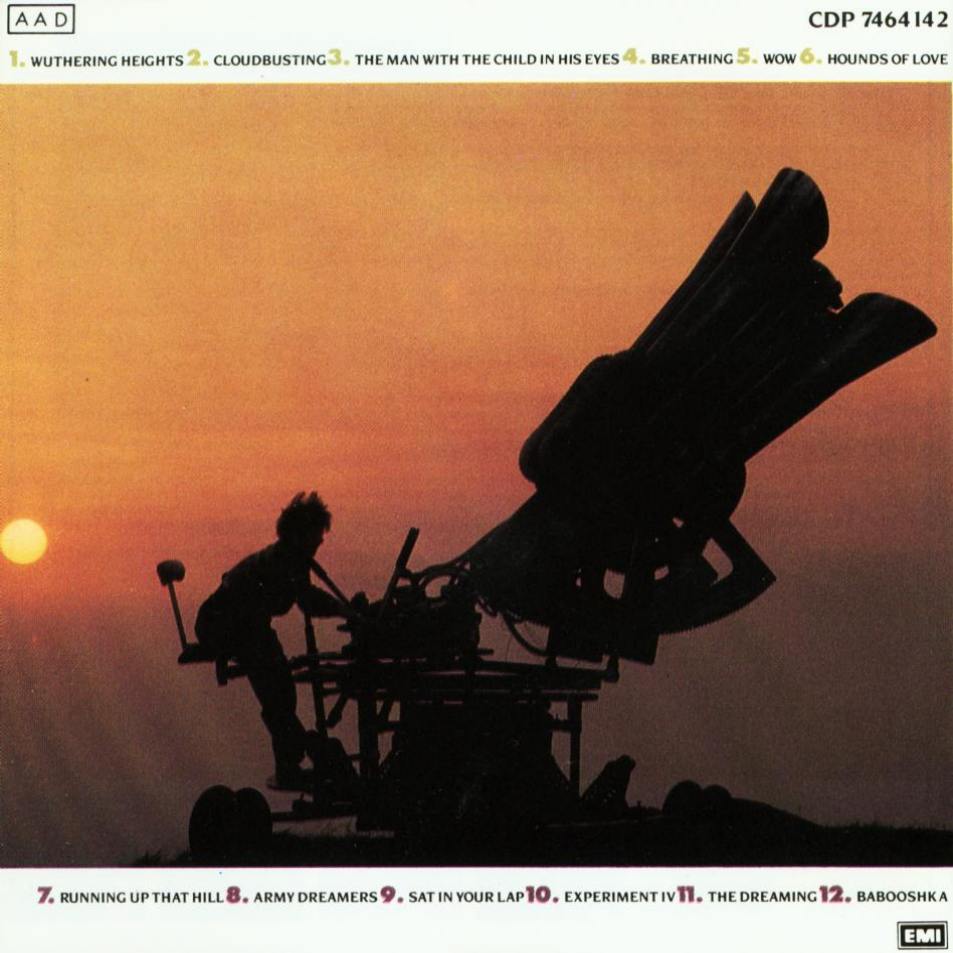
Kate Bush: Wuthering Heights.
On Youtube there exists a digitally stretched-out video of Kate Bush’s mystical-masterpiece Wuthering Heights – slowing down the track so that it lasts 36 minutes. I have never listened to all 36 minutes of it (I think I found the time to get 30 minutes through), but 4 minutes is enough to experience a strong hauntological presence in Kate Bush’s music – a background element that the stretching out of the song brings to the foreground. There is something of the uncanny about Kate Bush’s (specifically early) music, how it seems to be very much at home amidst the then-contemporary music of the late 1970’s/early 80’s, yet how it also seems to expand into a mythological England of yesteryear, whilst also seeming to stretch into a utopian future; a ghost in the machine/the record player.
I’ve heard the original record so much. It has been etched into my mind that it is a song I love. Yet the reasons for this are no longer conjured up by listening to it, as if repetitive playing on personal music players has drained these connections of vitality. Unable to access what made it sound so good all those years ago, I find this slowed-down version, whilst not being incredibly ‘listenable’, has hauntological traces of the impact the original record had on me, first as a very young child, when it became woven into my understanding of what good music is, and then aged 19/20 when it (and the rest of her earlier recordings) synchronised itself with a rejuvenated sense of vitality within me, largely based on the confidence making art gave me, and a naive belief that I had overcome the heavy negatives within me. Hauntology – as traces of something no longer present: I can no longer access what made the original sound so good to me, because they clung to a vitality that belongs in the past.
Some chart-moulded, nightclub-driven, songs accidentally reveal what they most commonly try to blot out of the audio-visual horizon: real melancholia, real loss. Informed by the hauntological revelations the stretch-out version of Wuthering Heights gave me, and the presence of (what sounds like) samples of upbeat songs from the (surface-level) upbeat 1990’s in the music of Burial, I wanted to play around with certain songs to unlock the hauntological ‘particles’ I was certain were present within them. With Every Heartbeat was one track I has been eager to stretch-out.
I recall hearing the late 00’s chart song some months after its release. It struck a chord with a peculiarly satisfying point of sadness/let down that came over me whilst I was waiting for friends returning from the bar in a expansive chain pub in Barnsley. The video for the song was playing on large screen whilst I sat, strangely captivated and moved by visuals that were incredibly ‘production-line-pop-music’. Yet it stuck, as it isn’t supposed to for a person who (at least then) still dressed and wrote music as if there was still a genuine oppositional alternative culture to a conservative mainstream.
Hearing it thereafter, it strangely became synchronised with the 2008 financial collapse and the resulting reality just a few months down the line from the aforementioned moment in the pub. It became a sound to represent a party that was just about to end, a party that had nonetheless frustrated most of its attendants (UK society), by being the only thing that there seemed left to do in a public-space-deprived, capitalist realist, credit-sustained existence, which often ended in tears and regret. It frustrated because during this period, the big night out had become the unacknowledged ‘dream-keeper’ of society; promising to fulfill or at least find us those human needs of love, happiness, meaning. Even before the crash this song felt like a sad wave goodbye to all this, as if you could sense it was over; “at least you gave us dreams, but I know now they’re about to go“. Of course, most UK towns still exist as the heavy-drinking wild-wests (at least to the sober) after 6pm, but it’s with an intensified bleakness, as if an entire scene could resemble one person’s drawn-face and lifeless eyes; we’re now just ghosts of our past reveling-selves, even more future-less than before, haunting places that once at least promised something, just going through the motions. With Every Heartbeat thus becomes very painful in this light.
.
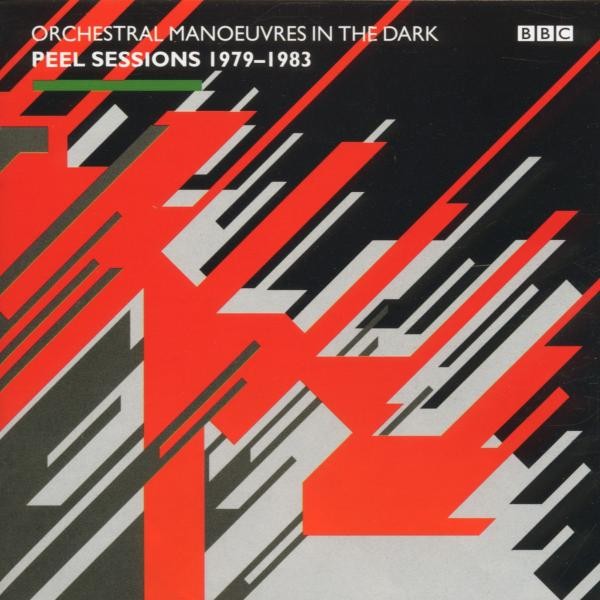
Annex and Genetic Engineering – Orchestral Manoeuvres In The Dark [OMD] from the Peel sessions recordings
Jacques Derrida describes hauntology as “the accumulation of ghost-like traces of the past as we move further into the Future”. These Peel session recordings already sounded like a past I remembered from my early childhood when I heard this record in 2009, even though they are sounds that evoke an era that was more or less ending by the time I was born (but there again why is it that childhood memories seem to absorb things you can’t possibly remember because you weren’t born then? It is as if the preceding years come pre-packed in you, from your family and the surrounding environment). The sonic structure, the synth sounds that evoke a future which often feels like it lost the will to materialise, remind me of a 1980’s I was in reality too young to remember.
“These are the lies they told us, that this is the only way” – Genetic Engineering. “This is the only way” is more than certainly an highly concerned ‘NO’ response to Thatcherism’s “there is no alternative [to capitalism”] assertion. Back then, however, it was an assertion, now it has become a cultural reality. In the summer of 2009, I was listening to this record whilst making my drawings in a studio in South Yorkshire, mixed with day trips to the nearest big financial and consumer centre, Leeds. I regret what happened that year, I regret what was probably inevitable in my life as if it wasn’t inevitable at all: the loss of the last bits of my early 20’s vitality, as I forced myself to take the issues seriously that has been running around my head for years, which forced me to look deeply into capitalism, climate change, and thus having to face the harsh truth that life will get less and less bearable by the year, unless something drastic changes.I am certain that the ghosts in the OMD-machine from the pre ‘capitalist realist’ gravitated towards the ghost-in-becoming of what died in me in 2009, and now listening to Annex and Genetic Engineering from the Peel Sessions is an haunting of both of these things as if they were the same thing.
.
Trans Europe Express, and Autobahn by Kraftwerk
Despite the Middle East oil crisis of 1973 – the impact it had on culture that would now have to take seriously the fact that resources and material advancement may not be infinite after all – Autobahn from 1974 seems to evoke a time when those things were firmly believed. The lush, superrealist album cover, and the bold step into ‘synthesiser-world’ look forwards to the future with wonder and excitement. Kraftwerk’s 1970’s work oozes the modernist impulse, and sometimes feels like music that could accompany modernist painting from 50 years prior to Kraftwerk. More than anything it sounds like a future that never came. Listening to Kraftwerk is (to paraphrase John Berger) nostalgia for the future. In current times, not even cultural products labelled ‘Science Fiction’, pulped into cultural white noise by an over-emphasis on CGI graphics, can generate a feeling of a future.
Kraftwerk’s music is music that carries ‘the new’, and, like the darker-underbellly-of-progress synthesiser music of John Foxx, it still maintains the essence of something new now. It has almost remained frozen, in radiant youth, in the age of retrospect and re-hash that came into being afterwards. I heard both of these albums at different points of ‘fresh feeling’ within myself. Stepping onto one of few the trains that arrive on time, and listening to Trans Europe Express I could half convince myself I was in a future that took a different track (no pun intended). In a similar way to the aforementioned OMD tracks above both the idea of a an era of new, and a feeling of the new within me, became attached and synonymous: the music now evokes the traces of them.
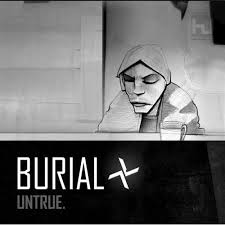
Dog Shelter and Unite by Burial
If I am to use Burial’s music here, it is to state with honesty, that my a lot of interest in hauntology was inspired by reading Mark Fisher’s thoughts on Burial, and my subsequent interest gained in the music itself. But the haunting feelings I had when I listened to the music were quite specific to my own personal experiences. Dog Shelter, a track from the Untrue album, particularly evoked this feeling. It now evokes memories of sat waiting for train in Sheffield train station, early summer 2012. Trying to think about whether or not I can make it to south London to go and study a masters. Burial is from South London, apparently. This made the music stick more.
Was thinking about my past, my memories of my ‘worldly-outlook’ in the early 1990’s; that this song seems to have ghostly traces of certain ‘feel good’ songs that remind me of the early 1990’s, even if what I remember was mostly the mainstream music from this period. It’s My Life/Rhythm is a Dancer/No Limits/The key The Secret; a chunk of early 1990’s optimism poured into the mind of a 8/9 year old, for whom previous to that remembers all people projected into the living room from screens as stale, white, head-teacher-like people (in hindsight, probably Tories on the Sunday politics shows of back then). Whilst also these projected music videos seem to include mixed-race, exciting-looking (largely) females, especially from someone coming from a town where there must have been only 1 non-white person for every 1000 inhabitants. It was an exciting future, that slowly dried up, not least down to (what is clear in hindsight) the white public schoolboy culture-coup ‘Britpop’ that basically banished all that wasn’t white boy guitar music, that (again in hindsight) belonged in the past, to ‘towny’ (soon-to-be ‘chav’), ‘degenerate’ music, and helped tear up a future Britain in exchange for a Britain based on an idyllic collage of its past. Burial, two decades on, seems, for me to be a ghostly ‘what-the-hell-happened-to-that-early-90’s-vitiality’ ode, mixed with the dangers of an uncertain age of climate and political uncertainties. Listening to it before I went to London made me feel really solemn about the past, and how all that feel good optimism has vanished. But that a new start was needed, maybe to leave the past behind now; stop letting it haunt me. The plan to go to London was not successful though, and Burial’s music has subsequently taken on another layer of traces of a lost energy.
Unitespecifically evokes a chilling feeling of the near future, regarding the threat of climate change, political/social chaos in the near future. Memory of song: early Spring 2012. An haunting sound,(like sound of long-gone city rippling through time) that gave me image of people finding love, as things begin to fall apart – gave me the chills. Like a musical response to JeanBaudrillard’s ask, specific to our postmodern time, to see apocalypse as something that has already occurred. Faint noises,like trains at night,are like the memory of having dreams, having a future. As if we’re now just going through motions until it peters out.Music that is in its essence brave, the noise of facing the storm not burying one’s head
Coming from someone who’s life lived has bared witness to the slow decline, stagnation, and retreat of progressive dynamics in pop music, this song almost seems to sound as if it is a vessel carrying all the break-neck-speed at which pop music progressed from the 1950’s to more or less the date the album Dare (which contains Seconds) appeared (in 1981). It is powerful, energetic, yet strangely tear-jerking at the same time. The sadness doesn’t lay with the song’s subject matter because of a famous president (John.F.Kennedy) being shot, but because the assignation itself is one of a few 20th century horror-spectacles that seem to capture the tragedy that befell the century, as the expectation of progress (that a “better world is around the corner”) collapsed.
Franco ‘Bifo’ Berardi writes about how “in the last three decades of the [twentieth century] the utopian imagination was slowly overturned. and has been replaced by a dystopian imagination”. Although the assignation of John.F.Kennedy was in the early 1960’s, still a point of ‘high modernism’, retrospectively it literally appears as one of a few bullets that eventually brought the belief in a future crashing to the ground; and I am in no way arguing here that John.F.Kennedy himself was a man who would have been a major player in this, if at all, just that his killing was one of civilsation’s ‘disaster spectacles’. Pop Music’s progressive, modernist impulse was a short-sharp surge in comparison with the rest of modernism. But, again retrospectively-speaking, Seconds by the Human League is a song that visualises something like a bullet fired into the heart of a past world that believed in a future.
In his recent film ‘A Perverts Guide to Ideology’ Slavoj Žižek ends the film by quoting Walter Benjamin from almost a century ago, saying that “every revolution (if authentic) is not only directed to the future, but it redeems also the past failed revolutions. All the ghosts…the living dead of the past revolutions, which are roaming around, unsatisfied, will finally find their home in the new freedom”. To return to what I said earlier, I would not consider for one moment that music could play an active role in a revolution (that in our times when we feel trapped in inaction, music that is angry with the state of things can often be merely cathartic; providing the feeling of action,rather than action itself), but isn’t Žižek’s above use of Benjamin’s quote most noticeably happening right now in our times through our audio/visual culture, the still mainly consists of cultural products made 30-50 years ago? Are we not at this moment surrounded by most ghosts from past failed revolutions that any other time in human history? The question is then, will these ghosts “find their home in [a] new freedom”? Or will this state of long decline just continue to be a dumping ground for them?
The most lasting sensation from my late twenties right up to the early days in my thirties is one of being out of time. Like the gaps in which to pursue all the things that make me Me have been narrowed into very skinny pavements on which to manoeuvre next to a massive, busy and noisy road (the secondary sensation thus being the result of the difficulty of pursuing what makes me Me; a painful sensation of trying to preserve a bit of what I think is me, which usually feels like the front of my face is slipping off my head).
Maybe I always had this sensation, on some level of intensity. The words “it’s getting late”, pasted onto my mind from a P J Harvey song, were very present at the beginning of my 20’s; the way that song lyrics often identify with the dominant sensation you are having, even before you have been able to consciously acknowledge the sensation. Regardless of what the original lyric was referring to within the context of the song, the impacting lyric soon disassembles itself from the song and gravitates towards your own story.
The feeling of it getting late/of not having much time left certainly bares testimony to the first time I truly acknowledged the extent to which we had already made the planet less human-friendly, by carrying on with business-as-usual under the umbrella of short-term-thinking-idiocy. It was indeed getting late, yet I was within the 18-21 age bracket and supposed to have my life ahead of me.
But I believe that the feeling of being out of time isn’t just ecologically concerned. Growing up in a house (and here the notion of ‘house’ is meant to be something that spreads into the wider environment you grow up into) where the music, the focus of documentaries, and the general mood carried was from the decades before I was even born, gave me a feeling (one I only relatively recently began to locate with language) that history had already happened; or, more crucially: that it was more or less on the verge of wrapping itself up. Basically then an emergence of a feeling that I’d better rush out and do what I have to do/ say what I have to say before time is up. Furthermore, much of what had ‘already happened’ was in decades dominated by a culture of youth; the 1960’s, the 1970’s and even (in the counterrevolutionary form of the ‘yuppie’) the 1980’s. You could argue that the counterrevolutionary political economy agenda that came to fruition as the 1980’s began(that has remained dominant since) sent real popular culture back to where it came from, and gave us a bastardized form in its place.
The melancholy predicament I (and possibly others) experienced from our late teens onwards was that of being a spectator of an onslaught of energies and excitement from yesteryear, energies that had been and gone, tried to win, and eventually failed, leaving only their fashion styles, like shedded snake skins for us to mix up in a desperate but futile attempt at something new (to some extent we are all the tragic comedy character Nathan Barley). So, here was a sense that if you were to do anything in life (from finding love, finding success, generally being someone) it has to be whilst young (the unspoken message being revealed through the increasing marginalisation of older people), and it was compounded with a sense that there wasn’t much left anyway because what matters in our culture has already happened!
I’m not really sure though how I can locate the source of my obsession with the passing of time on the doors of these massive players in general cultural experience. There has to be some other reason why I watch the hour glass of my life, and civilisation itself, like a starving man watches food. So what is it? And do others feel it? I have just turned 30, but people have commented on how I discuss my life in a way that suggests that it is already over. Why is it always a feeling of something slipping away, and never of something growing? Is it just the reflection of a negative person, or is this sensation more widespread? An age of widespread negativity, that ‘things are only going to get worse?’ Maybe it’s as simple as somebody who’s constantly-renewing essence is a ‘glass half empty’ one. Am I confusing wider experiences with personal experiences? from what I observe in the world I’d say No, but maybe that’s because all I see in the social landscape is the things that confirm that my sensations are true. But surely they are true! …? I do have a tendency to place the overly positive people in life in either the category of ‘bullshitters’ or ‘the deluded’. But am I right? To quote Slavoj Žižek, surely “we are living the end times” of a 2 millennium old civilisation aren’t we? I crave not to be haunted by the passing of time; I have always envied friends who aren’t so. But I can’t shake the feeling of running out of time. That I, as male human (born to end), am running out of time, within a world (also born to end) which is also running out of time.
What is it that I feel I am running out of time to do? Well, some of my piers/contemporaries would say “to lose the obsession with time and the conventional expectations of having had to do certain things with your life”. I, being me, having to guide me to work every morning, having to eat for me, and find meaning for me; well, I would say I am running out of time to find emotional wellbeing, emotional unison with another(others), and an end to certain discontents that I once thought were the conventional ‘teenage existential difficulties’ until they never ended. And that this time is slipping away faster in a world where billboards/publicity increasingly demand youth or marginalisation, and the economic logic increasingly demands a ruthless career-driven orientation, or destitution.
What is it that I feel we are running out of time to do? “It’s make or break” is a thought that passes through the mind like an alarm clock that goes off every hour. Is it a feeling of running out of time to change the world before it is ‘too late’. 2009; the Copenhagen Summit, “oh no, what the hell are we doing?”; 2010, “voting Conservative will lose us ground on challenging the big problems we need to…..NO NO NO NO NO!”; 2011, The riots, Arab Spring etc, Occupy, all invested in a man knowing that ‘things can’t carry on the way they are’ equated to “something HAS to happen, just HAS to!”; 2012; bad year, too many flag-waving frenzies, so much energy trampled until it was just dust on the ground; 2013, a year of ghosts haunting the present; OUT OF TIME!. And Through all this “just don’t even get me fucking starting on our climate-fucking-up!”
So, a well-meaning friend, may suggest, for my own well-being that I “shouldn’t get hung up on time” that I should “just be”, and I appreciate it. But I am time. I consist of time as much as the Internet consist of porn and photographs of cats. You can’t stop getting hung up when you are the hung up; I hang up the coat I hang up myself too (which is probably why I never get invite to dinner parties). But what matters is whether it is just me who’s life is dominated by this sensation or whether it is a general feeling. And if it is a general feeling, what are we going to do about it? Because I think the supposed-novelty of being able to waltz around in the shedded snake-skin-fashions of any decade we wish has really seen its day as much as the decades have from which they fashions came from.
Here is a jumble of songs that defined by 20’s. In order of the years I have tried to list the ones that super-glued themselves to those times in my mind. Thanks to Lee Garforth for providing probably almost half of the CD’s from which these songs stuck themselves to me. Music has a phenomenological potency; often you find lyrics and sounds creep into your head from certain time periods just because you’ve looked at something totally unrelated that is listed as being from that year. Remembered lyrics cut loose from the original song meaning and begin to mean something to your life at that time and place.
Summer/Autumn: “I’ve got a ton of great ideas, I’m really worked up, I’m on a good mixture, I don’t want to waste it…..I wait for the click. I wait, but it doesn’t kick in”
Winter/Spring “Do you think there’s someone out there? Do you think that they might know? And if they don’t do you think they should be told? Cos she’s living in a nightmare”
Casimir Pulaski Day – Sufjan Stevens, Body Snatchers – Radiohead, House of Cards – Radiohead, Unravel – Bjork, One Day – Bjork, Friendly Ghost – Eels, The Sprawl – Sonic Youth, Dirge – Death in Vegas, Soul Auctioneer – Death in Vegas, Acrlliyc Afternoons – Pulp, Joy Riders – Pulp, 100 Years of Solitude – The Levellers, The Likes of You and I – The Levellers, Happy Endings – Pulp, Garden – The Levellers, Nothing Left – Orbital, Impact – Orbital
Summer/Autumn
“The artist fell in love with the reflection of himself, and suddenly the picture became distorted”
“But it was only fantasy, the wall was so high as you can see. No matter how he tried he could not break free. And the worms ate into his brain”
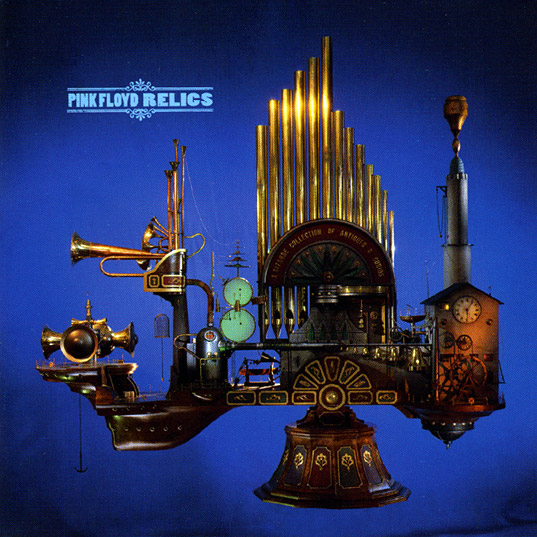
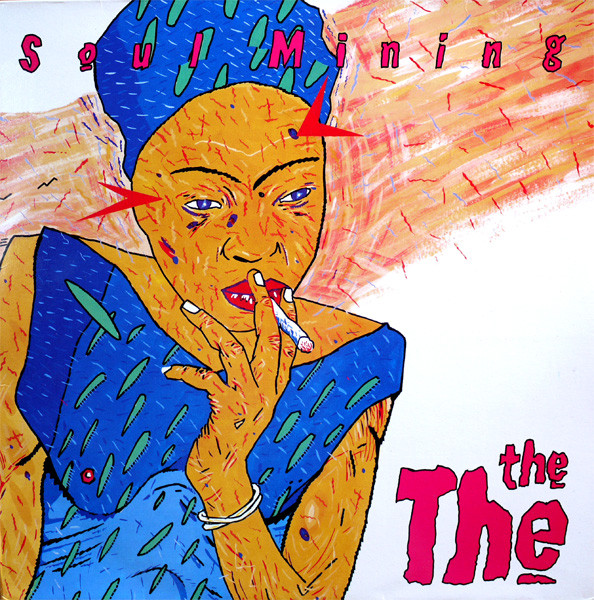
Burning Wheel – Primal Scream, Stuka – Primal Scream, Long Life – Primal Scream, Perfect (Original Version) – The The, Hit The Hi Tech Groove – Pop Will Eat Itself, I Think I’m in Love – Spiritualized, Stay With Me – Spiritualized, Come Together – Spiritualized, Kraftwerk – Trans Europe Express [FULL ALBUM], The Wall [FULL ALBUM] – Pink Floyd, John Foxx – Metamatic [FULL ALBUM], Gustav Holst – The Planets, Glimmer – John Foxx, Ohm Sweet Ohm – Kraftwerk, John Foxx – Miles Away, Computer Love – Kraftwerk.
25 (2009)
Winter/Spring “They promised me paradise if I fell under their spell….they are many, we are few (is there no way out?)”
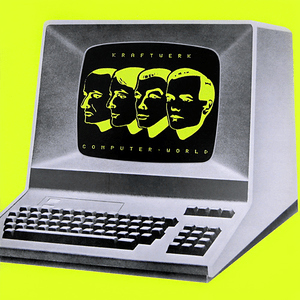
Computer World – Kraftwerk, Numbers – Kraftwerk, Me I Disconnect from You – Gary Numan, When The Machines Rock – Gary Numan, Are Friends Electric? – Gary Numan, Well of Loneliness – Mccarthy, Keep an Open Mind Or Else – Mccarthy, I’m Not A Patriot But – Mccarthy, Speed of Life – David Bowie, Sound and Vision – David Bowie, Babasonicos – Ian Brown, Green is The Colour – Pink Floyd, Cymbaline – Pink Floyd
Summer/Autumn “These are the lies they told us, the future’s good as sold”
Julia’s Song [Peel Session] – Orchestral Manoeuvres in The Dark, Electricity – – Orchestral Manoeuvres in The Dark, Dark Side of The Moon [full album] – Pink Floyd, Pretending To See [Peel Session] – Orchestral Manoeuvres in The Dark, Genetic Engineering [Peel Session] – Orchestral Manoeuvres in The Dark, Of all The Things We’ve Made[Peel Session] – Orchestral Manoeuvres in The Dark, Animals [full album] – Pink Floyd, 4st 71b – Manic Street Preachers, Computer Love (again) – Kraftwerk, Let Me In – R.E.M
26 (2010)
Winter/Spring “I want you as the dream, not the reality … and I know that this will never be mine”
Winter/Spring “you have tried your best to please everyone but it just isn’t happening… this is fucked up, fucked up”
High as You Can Go – The Chameleons, Black Swans – Thom Yorke, Failure – The La’s, Looking Glass – The La’s, Harrowdown Hill – Thom Yorke, I Walked – Sufjan Stevens, Atoms For Peace – Thom Yorke, Beverley Hills Cop Theme Song – Axel F (this is due to spending hours working in an exhibition where this was played over and over, Black Dollar Bills (again) – Hope of The States, Motorcycle Emptiness – Manic Street Preachers,
Summer/Autumn “…a powerful feeling that the American system is failing to deal with the real threats to life…”
Summer/Autumn: “But as the world turns I learned life is Hell .Living in the world, no different from a cell… I guess that’s the time when I’m not depressed, But I’m still depressed…”
A General disappointment with Charlie Brooker’s Yearly Roundup
For somebody who highly values Charlie Brooker’s contributions to a post-millennial-television-palette in continual-deterioration (and as somebody who tunes into his television programmes with an unexamined ritualism you’d expect in well-trained church goers) I have slowly had to face the truth that his weekly and yearly Screenwipes have become incredibly uninspiring. It left me thinking that cynicism about absolutely everything is the opposite of what we need or want right now, and I think this is why I found it so difficult to watch. When cynicism is the only response it quickly becomes very unintelligent, becoming no different from the rest of contemporary Television (which is the original reason so many viewers turn to the Screenwipe format for solace).
Maybe in the pre-2008-crash age, cynicism for its own sake had greater appeal. However, it now feels like a very poor joke that’s arrived way too late in the day – the same feeling that the arrival of a new white boy indie-rock band in the midst of ‘Cameron’s Britain’ (to quote Brooker) gives us. But am I guilty of cynicism? Of course I am – in many social environments where openly critical debate about the current state of affairs is implicitly frowned upon, cynicism is the only tool left in the bag.
The cynicism of the Yearly and Weekly Wipes has slowly eclipsed the subversive nature they once offered to the disenchanted media-frazzled subject. Of course, such a subject still tunes in – after all, the still-dominant position the Television Screens that Brooker still promises to wipe for us take in our living spaces means we still resort to them as surrogate guides at points of damaged self-awareness (such as around Christmas). But the feeling of relief that “someone actually sees things like I do” that Brooker’s dissections of television used to give us has vanished, it has for me anyway. I can can stand outside a pub at 11 o’clock with the marginalised smokers if all I want is somebody convincing me that “the world’s fucked, and there’s nothing you can do to change that”.
I thought the part given over to documentary-maker Adam Curtiswas genuine food for thought. This section seemed to be on such a different wavelength that it seemed to belong to an entirely different type of program. Curtis speaks of a new form of political control systems emerging across globe with the intention “to undermine people’s perception of the world, so we never really know what is happening… a strategy of power that keeps any opposition confused. A ceaseless shape-shifting that is unstoppable because it is indefinable” (making George Orwell’s ideas of double-think look both prophetic and weak in comparison) meaning that “we as individuals feel powerless to change anything because we live in a state of confusion and uncertainty” Curtis’s conclusion is arguably just a different take on Gilles Deleuze’s conclusion on the emergence of Control Societies or even Sheldon Wolin’s notion of Inverted Totalitarianism, and it is certainly a pessimistic conclusion. But it didn’t just leave the viewer feeling “what’s the fucking point…?”. I’d argue it engaged the viewer in a way that makes them want to question and delve further more into the fabric of contemporary life, but the rest of the show seem to promote the very “oh dearism” that Adam Curtis was gravely warning us is the intended outcome for those subjected to this political control system he describes. In this light Screenwipe just became an example of what Curtis was diagnosing.
There is a growing social pool of discontent that turns to Screenwipe, hoping for populist coherent sense, that isn’t just wanting cynicism. It craves that which was present in his brilliant series How TV Ruined Your Life, and was maybe present in a Screewipe format that corresponded with a only-slightly-less fucked up Blair/Brown era. Thousands of (mainly) 18 – 30 year olds have found themselves, financially and existentially, with no option but to become politicised and both mentally and socially engaged in wrangling over how the world doesn’t (and shouldn’t) have to be the way it is. The yearly wipes dismiss this by ignoring this hidden-away labouring of collective souls, and instead gives us the fading-of-novelty-acts Philomena Cunk and Barry Shitpeas, who’s comedy-act-stupidity and naivety over current affairs, accidentally-on-purpose stumbles onto the faux-intellectual cynical-apathetic position – Screenwipe’s default position.
For example, the bringing down of Russell Brand with cynical-outlook–posed-as-stupidity opinions seemed utterly pointless, and showed a lack of will to engage with the important issues he at least brings to the limelight. Not everybody likes Russell Brand, but even those who charged him with the most heretical of sins of the opinionated – hypocrisy – cannot deny the energy he puts into his arguments for change in the world. Maybe this shouldn’t be expected, maybe the “everything’s just a mess, lets at least sit back and accept it” logic is the limit of this program. But, despite the possibility of Brooker merely ‘playing it safe’ within the increasingly restrictive and conservative cannon of the BBC, many people have come to expect more from him. This is because he has been genuinely subversive at times, and has also proved himself a brilliant social pulse-finder in certain comedy and drama show’s he’s helped create.
In a recent New Statesmen article, Will Self writes about the prophetic vision of the Charlie Brooker and Chris Morris co-creation, Nathan Barley: a brilliantly done satire on the rise of the hipster in the more fashionable alleyways of postmodern society, brilliantly summarised in the introductory prose ‘The Rise of The Idiots’. Even though Nathan Barley was made ten years ago, any suggestion that he is past it is completely debunked by the frighteningly contemporaneous dystopic comedy-drama Black Mirror. Nothing on television gets as close to visualising the dystopian tendencies of the present than this does. Perhaps this is the problem, Charlie Brooker has proven himself too intelligent and too disconcerted with the current state of affairs to be able to put out shows such as the 2014 editions of Screenwipe without causing mass, and deep-seated disappointment.
But, there again I am not critical of the man himself. I like him, and using the common logic of how things work in the era of Nigel Farage, I’d quite like to have a pint with him. I just that I don’t think the Screenwipe format has any real function anymore in a world saturated by clever cynicism, when what we need in the limelight is, dare I say it, hope, ‘or at least something to galvanise people. For example, I find Charlie Brooker far far funnier than Russell Brand will ever be, but as in the only bit worth watching from the Yearly Wipe – Adam Curtis’s conclusions on the apparatus’s of social control – we cannot deny the “long-night of humanity” that 2015 seems to heading further into, and detached armchair cynicism (which Screenwipe makes look desirable, as long as it’s done with ‘intelligent’ wit) seems utterly without pleasure never mind unhelpful. After-all, armchairs may soon be a ‘luxury’ of the past for many of us in the race-to-the-bottom-reality neoliberal fanaticism is putting us through.
However, I also know that it’s massively misguided to ask too much of an individual, and he (Charlie Brooker) knows this, and there have been times when this knowledge has resulted in brilliant television rather than mere cynicism. For me, the most intelligent summarising of both our current social reality and his own limitations as a mere human caught in the media machine is the Black Mirror episode he wrote called ’15 Million Credits. In a blog I wrote almost exactly a year ago, consisting of a similar foreboding for the then coming 2014, I said how it was “clear that the episode’s protagonist is a cipher for Charlie Brooker himself” – I believe this episode to be a sort of fictional autobiography “In ’15 Million Credits’ After the girl of the protagonist’s dreams has her soul destroyed in front of an X-factor-like-show panel (the crucible of the entire society – where the panellists begin to represent the judges in Stalinist-like show-trials) when they crush her hopes of being a singing and more or less force her into a choice between being a hardcore pornstar or having a miserable end to her days, the protagonist gets himself up in front of an entire population of a eerily-familiar dystopian society, to tell the X-Factor-like judges, and the rest of society, that it is all fucked up, and they are all fucked up, and fuck you all, whilst holding a shard of glass to the main vein in his neck. The judges outcome being: “this is surely the most heartfelt performance I’ve seen on here since Hotshot began! [to which to crowd goes wild]” and the protagonist ends up having a weekly televised slot shouting about how everything is fucked up, whilst living quite comfortably. This is obviously how Charlie Brooker sees himself; that his despair, and abjection, tinted with great wit, over the state of society, is destined to be merely another form of entertainment.”
I then wrote that “The thing is, as much as I enjoy and value Charlie Brooker’s contribution to popular culture, there are a hell of a lot of people who feel exactly the same way about society (hence his popularity), who aren’t sitting as comfortably as him; I.e. he’s one of the few of us fortunate enough to make a decent living for himself out his feelings of hopelessness and despair. This isn’t a criticism of him, by any means, it’s just observing that this escape route isn’t an option for the rest of us, and in 2013 [now 2015] it’s increasingly evident on peoples’ faces that their options are running out full stop.” .
I suppose the problem with Charlie Brooker in relation to the viewer is analogous to the problem of the Screenwipe derision of Russell Brand. The media/or the spectacle performs reality/the truth for us. We, as mere minions, are compelled to crave a voice that represents/and guides us within the high echelons of the media/spectacle. And rightfully so; because I am sure that within the current social reality, ‘going underground’, as in attempting to ignore the omnipotent media/spectacle, is impossible and thus a waste of increasingly valuable time. As theorist Mark Fisher argues in his K-Punk essay ‘Going Overground‘, the essential task is to try to take it back ‘genuine’ popular culture; saying that this platform in such a world cannot be dismissed, and should be treat as a crucial platform for politics (as his convincing arguments in his recent essay-filled book Ghosts of My Life convincingly argue). This is why, whether you like Russell Brand or not, as a person/TV show that has without doubt become a guide for the ‘against the grain’ need most of us have, for Charlie Brooker/Screenwipe to merely mock Russell Brand does nobody any good. Cynicism has had its day.

















 John B Ledger