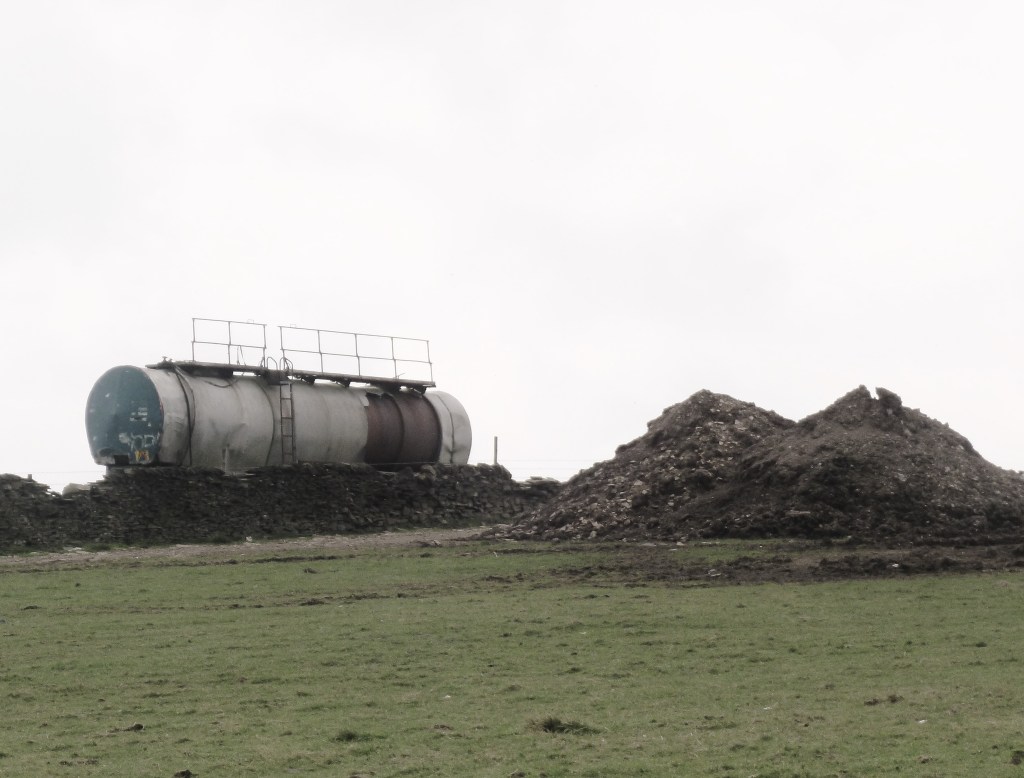
Thurlstone Moor, May 2014 (John Ledger, Michael Hill – part of West Riding of Yorkshire: A Psychogeographical Account)
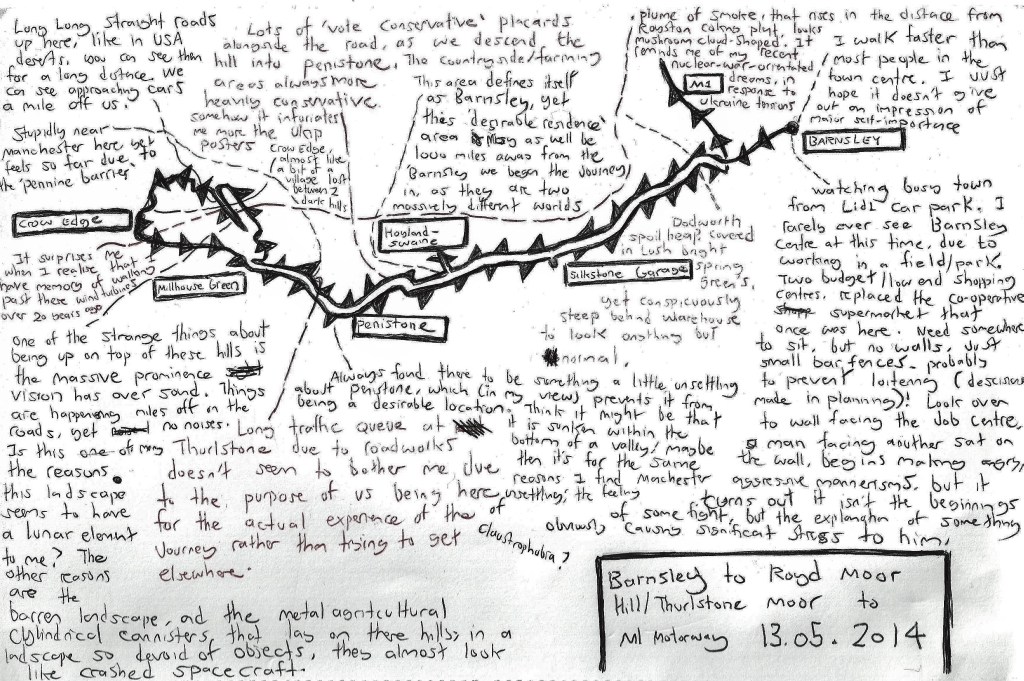
eaufitul emptiness: our (mild) equivalent to the US deserts, empty, barren, ‘lifeless, open space, where objects take on a monolithic presence. A place of long straight roads that exhaust a mind put into turmoil by the world down below.


Some of these monolithic objects take on a lunar-like feel. The desert and the moon have a huge connection, both in space stations and being frontiers. There is a frontier feel up here, often. Though we may not register it as being so. Escaping to a barren land, that requires no emotion from, this world below
“Climbing up to The Moon” – Eels – a song from my early 20’s
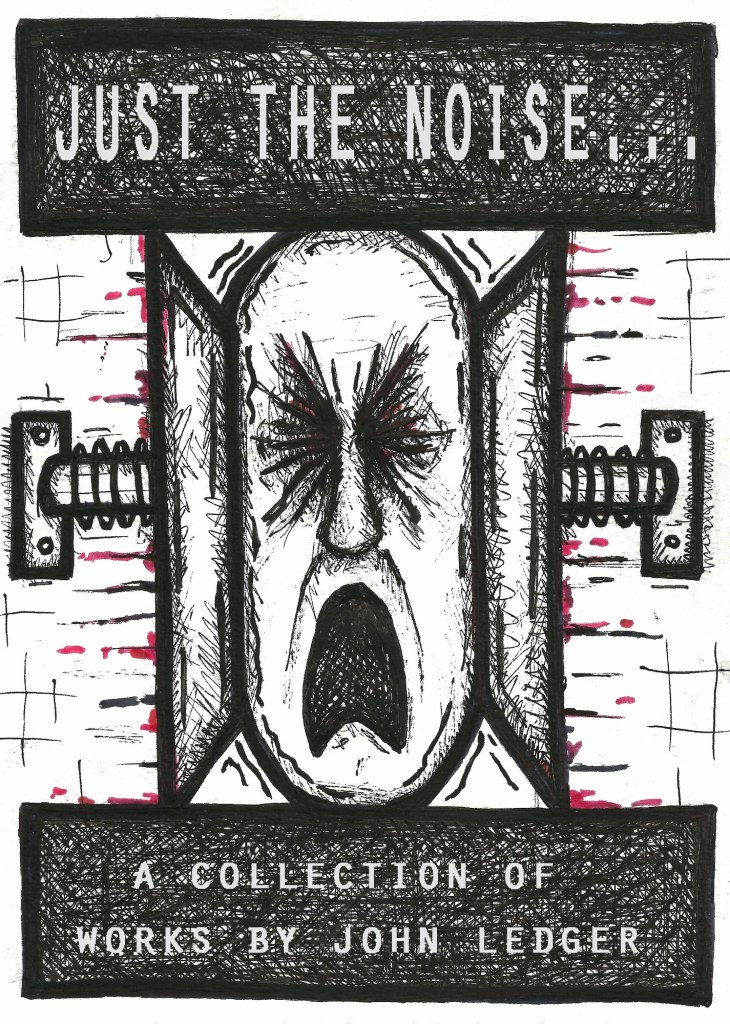
Just The Noise… solo exhibition
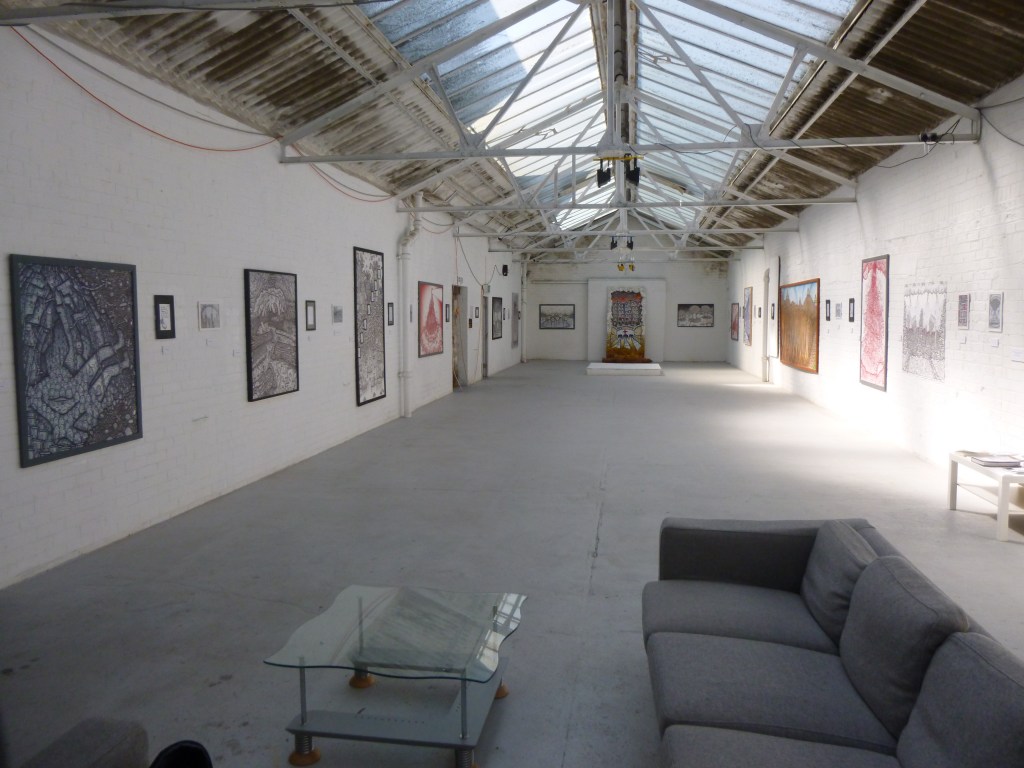
It’s been really good for me to get the main chunk of my work (with the exception of the installations from previous shows) into one big space. But it was especially good to show smaller works next to the larger ones, as I feel doing this helped map out the last 5 years quite well. I did an interview with Alternative Barnsley explaining the motives behind staging this comprehensive account of the past of years of marking work.
The exhibition is on until Thursday @Gage Gallery, KIAC, The Lion Works, 40 Ball Street, Kelham Island, Sheffield, S3 8DB
10-4PM.





This table includes all the books I have made during these years, including a the artist book Remedy by Victoria Lucas, for which I wrote a small piece. My books can be found here http://www.blurb.co.uk/user/ledgefromkec 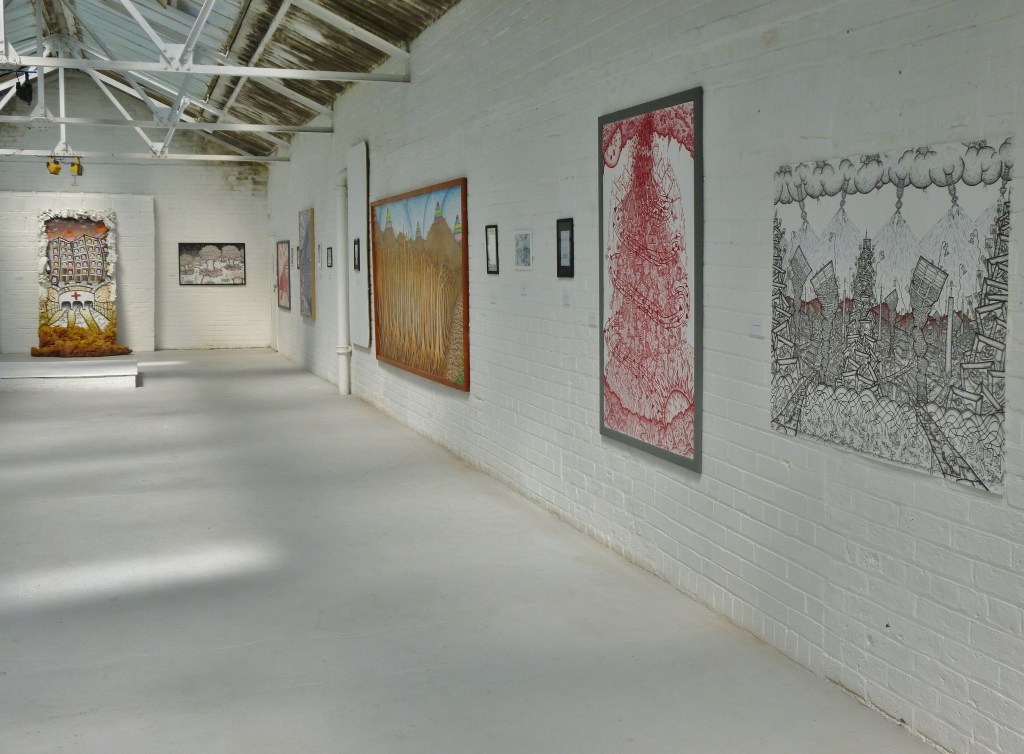

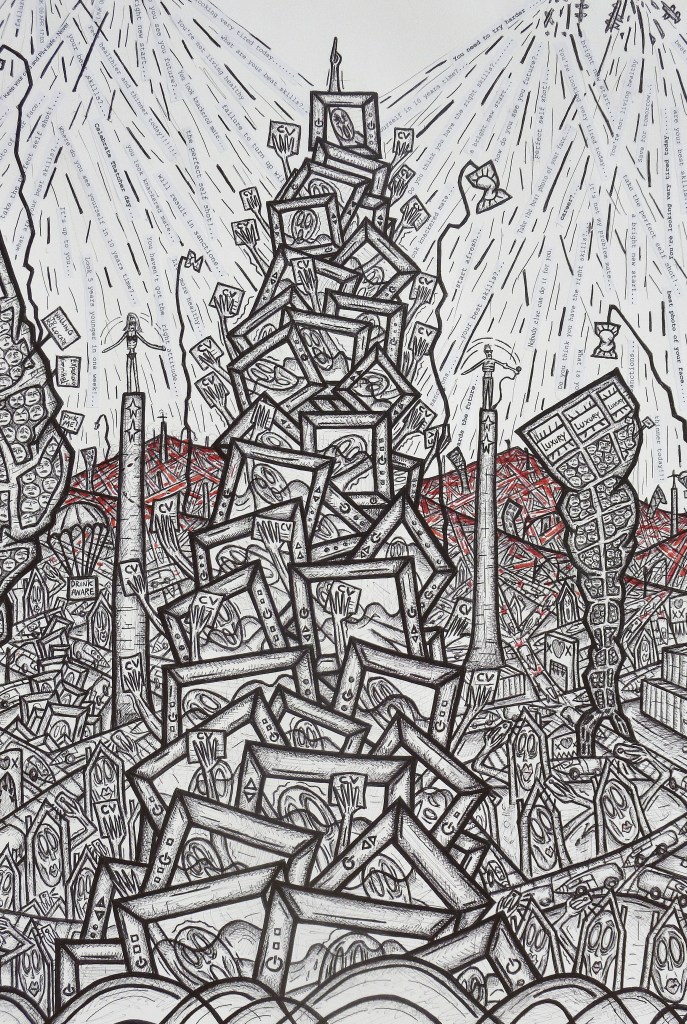
‘…Coils Tightening’
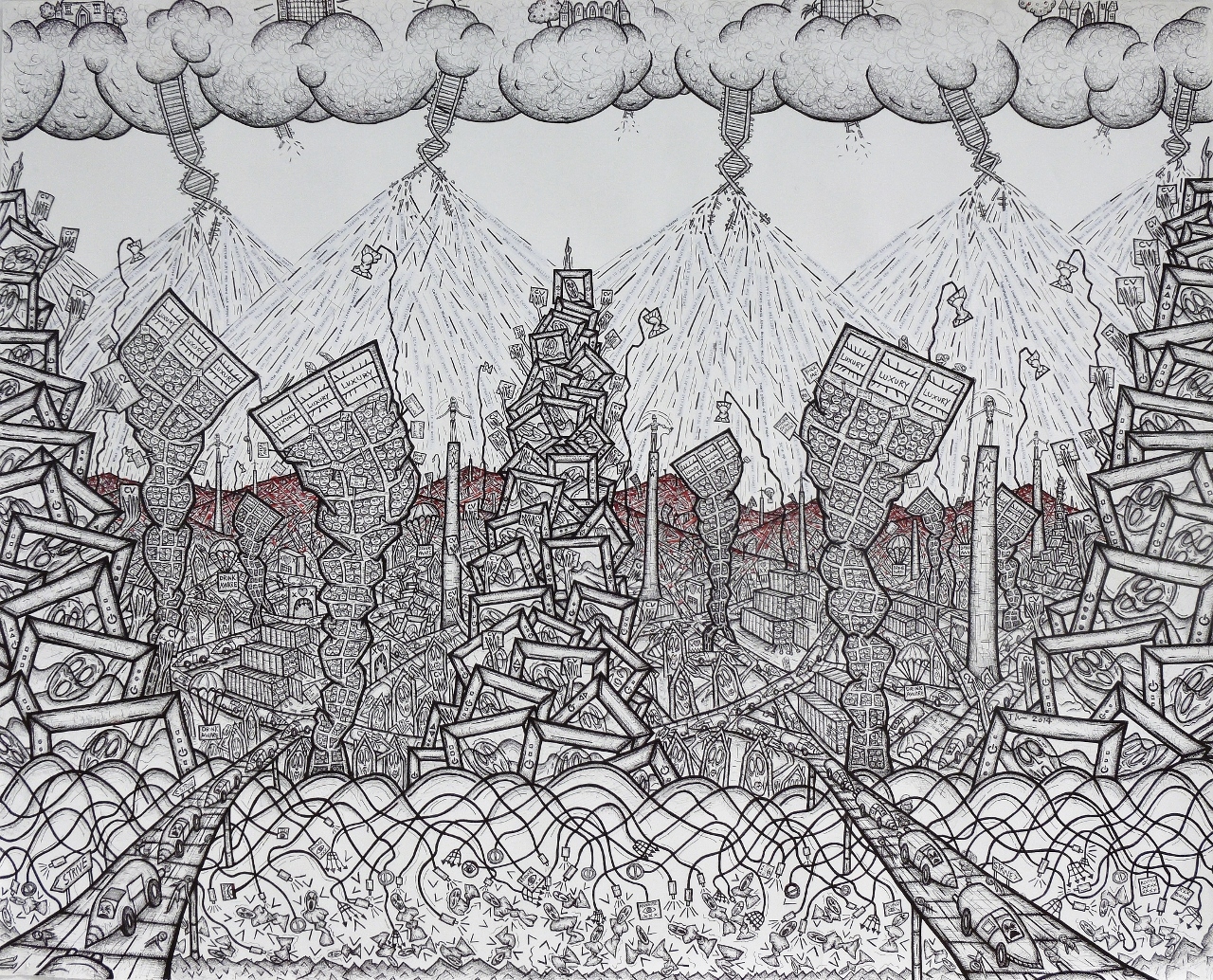
…Coils Tightening (2014, ballpoint pen and collage on paper, 80X120cm)

A lost gem (intelligent constructive criticism of Barnsley)
I’ve finally found out who the narrator of this lost gem was. Ian Douglas Nairn “a British architectural critic and topographer.” Although I come from an art, and ‘that bloke who walks everywhere [in the age of cars]” background, I find a lot similarities with this video and the documentation I’ve been doing of this area 45 years later. Many of the problems are the same, just with different buildings; the urge to tell the people of the town to “wake up”, and demand better is still a common urge. If at times it sounds harsh, it becomes clear it is constructive criticism from something he really wants these places to be more than they are. As for me, being from this area, and still living here, constructive criticism is all one can afford to do – simply slagging a place off does nobody any good.
Within this video, although he has doubts that the plan for the new concrete metropolitan complex (market place, car park) would be satisfactory in reality (and most would probably argue time has proven him right), there is still a evidently massive modernist impulse within his desire for better urban spaces, because he “likes the people [of Barnsley]”, and feels they deserve(d) better. He is a man who believes in progress for the benefit of all, a rare sentiment in our current times where many are fooled into believing archaic ideas would benefit us. Ironically, it seems likely that Nairn’s accounts may actually have influenced New Labour’s regeneration of UK towns/cities, which took modernist ideas on a surface-deep level, largely using them to redevelop cities for the wealthier citizens, to the exclusion of the rest, something Owen Hatherley referred to as ‘pseudo-modernism’ in his highly recommended book ‘A Guide To The New Ruins of Great Britain’. This is certainly evident in Nairn’s account of the then wasteland canal-sides in central Leeds on a documentary he made traveling by canal – as anyone who knows contemporary central Leeds will know, this area has been regenerated into a area of highly expensive city living (posh restaurants, luxury flats, and finance). Regarding Nairn’s account of Barnsley, you can almost see Will Alsop’s overly colourful Blair-years virtual-impressions of an ‘haloed’ Barnsley rising up from the wreckage that he stands amidst (although this isn’t really a criticism of Alsop himself, I do think some of Alsop’s ideas, if separated from the Blair year misuse of modernism/urban regeneration, had much promise).
Also, in the light of the confusion and discontent surrounding our relationship with the rest of Europe, being exploited by parties such as UKIP with worrying results, I find Nairn’s belief that we should look at (the then 1960’s) Europe for possible answers, very refreshing in deed. Nairn concludes by saying “I’m a European person, it’s all one to me”.
New books
A Walk Down The Hallam Line: a personal account of the West Riding of Yorkshire
A Walk Down The Hallam Line@Blurb.com

http://www.blurb.co.uk/b/5273100-a-walk-down-the-hallam-line-a-personal-account-of
This account has culminated from years of wandering and musing around an area loosely centered around Leeds, Wakefield, Barnsley and Sheffield. It has been displayed in an arrangement of photographs taken between 2008 and 2014, that roughly span the time that the thoughts that make this personal account came together. Yet, always being somewhat concerned with the notion of place – what is urban, what is rural, what is home, what isn’t – it is probably more accurate to say these thoughts have grown over 30 years.
This ‘walk’ through 4 districts that span the old West Riding of Yorkshire is foremost a personal account, yet it also aims to serve as a psychogeographical account. I know psychogeography is a term that is often said to be thrown around carelessly. So, to my make my use of it more clear, I see it as a means of mapping ones experience of a place. I’m trying to show what inhabiting these places/walking through a human landscape feels like, because I believe doing so has much-overlooked potential for understanding a 21st century world that few would argue is working for the majority of us. Thus the accompanying photos aren’t the type to make pretty wall-hangings; all too often I find reality is massively cropped to take the more picturesque. I have chosen this area because it is a landscape I know better than any other. My time remaining on this earth as John Ledger will be indelibly-coloured by this area, whether I am in Barcelona or still in Barnsley.
http://www.blurb.co.uk/b/5273100-a-walk-down-the-hallam-line-a-personal-account-of
Let the Lyrics Talk (new book)
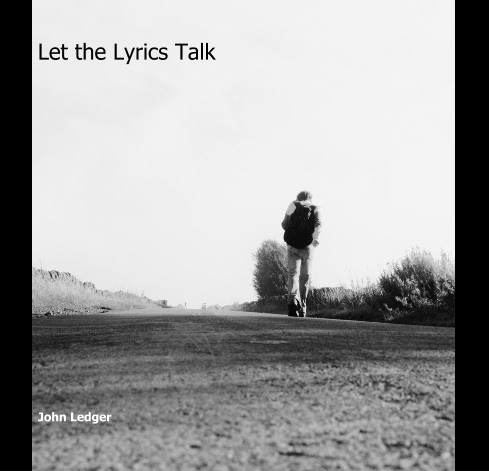
http://www.blurb.co.uk/b/5262007-let-the-lyrics-talk
This image and text book is about the phenomenological impact lyrics have on you; where they ‘philosophise’ for you, whether you want them to do so or not, by emerging in your stream of thoughts, articulating your unconscious, at least a long time before you find any other means of articulating it
The lyrics aren’t always from favourite songs; they’re just ones that can somehow identify with your life, and tell you things about your life, that would otherwise unlikely be recognised. Personally, pop music lyrics often haunt me as warnings of things going off in the world I am only half-aware of (half asleep to) or they reveal something I had thus far been unable to put into sentence.
Often the lyrics heard cut themselves from the rest of the songs lyrics and become specific to your own life, and your relationship to them bears no meaning to the lyrics of the song as a whole.
Regarding the images, there is no intention for them to be picturesque. They are more to do with the mundanity and psychological grind of much of life. The existential frustrations and longings such mundanity prises out of our souls is largely a response to the very opposite of that: the exciting, aspirational imagery of a capitalist culture, beaming from every poster and screen, that makes us feel that something is wrong if our lives are not always dynamic and exciting.
The songs are part of this culture and possibly evoke the dreams laden within it, even whilst they are often critical of the inconsistencies and injustices of this culture.
The Strokes, and The Retrofication of 8 Bit
At least until the time of their breakthrough, The Strokes were the most Self-consciously Retro band. However, is it just a self-conscious retrofication styled on past bands, and the accompanying fashions? Or is there also a massive absorption of other now-retro cultures, such as 8/16 bit computer game tunes? Games which were beginning to be seen through the retro-gaze roughly at the same point (the early years of the new millennium) as when the strokes appeared. How can one listen to songs such as this one and not to come to this conclusion?
Additionally, I must add to the equation the timing of the coming of the Strokes both into my life and (persuasively arguably) into culture in general. Why? Because the timing of their retro-remedy was almost uncanny.
I first heard their retro-remedy Is This It? no more than a week after the ultimate horror-show spectacle of 9/11 – the event that simultaneously reinserted the horrors we (until then) 90’s-revved-naive-westerners thought were confined to the Pre-Berlin-Wall-Collapse 20th century, whilst being the genuine starting moment of the 21st century. Just as we were looking for the potential New, a seismically mediated horror-event sent us scuttling back for a perceived-as reassuring past.
Yes, a post-modernity of re-used aspects of modernist culture was already well under way before 9/11, but this event accelerated the process. When I first heard the Strokes I was an unexplainably-shy late-teenager in search of a safe-territory, in some type of 9/11 post-traumatic-stress-remedy that I believe many of us endured (which is why nothing we see after the 2003 Iraq invasion shocks us anymore). In retrospect (what an ironic word to use) they were but a jaw-bridge to a dangerously-backward-looking land. However, back then they really did feel like a god-send. Their self-consciously retro look was initially reassuring; nobody had any idea of the type of retro music frenzy that would ensue once we opened the drawbridge that was Is This It.
(Double-additionally: the fact that the band hailed from the very place where the horror-show spectacle had occurred intensified the potion; that is without a doubt.)
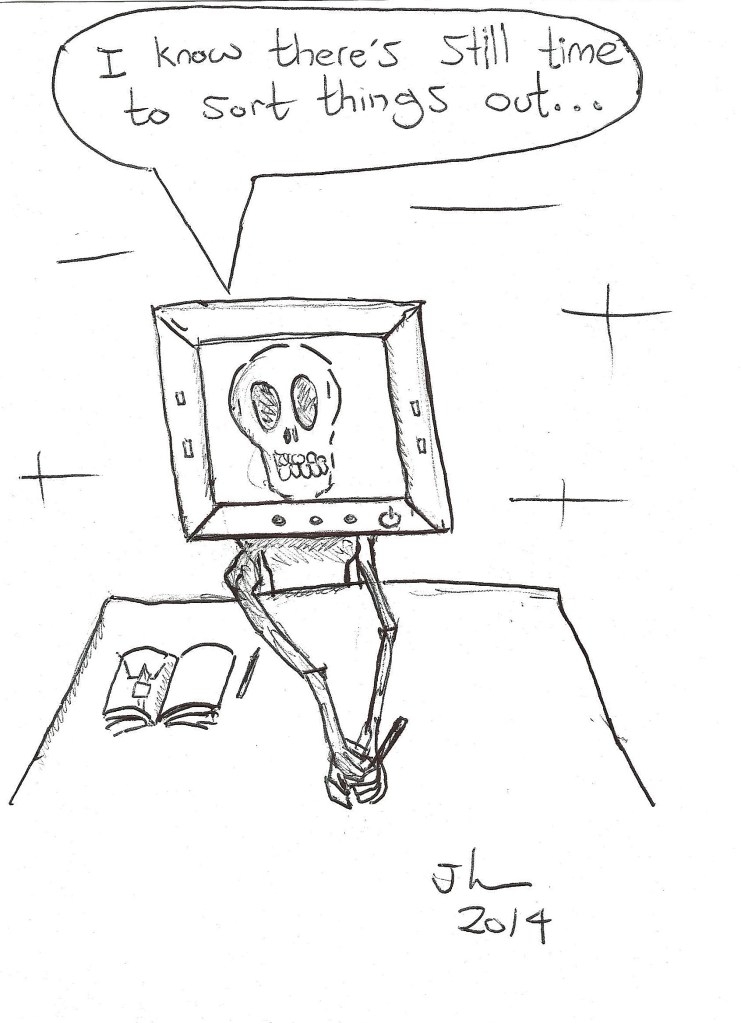
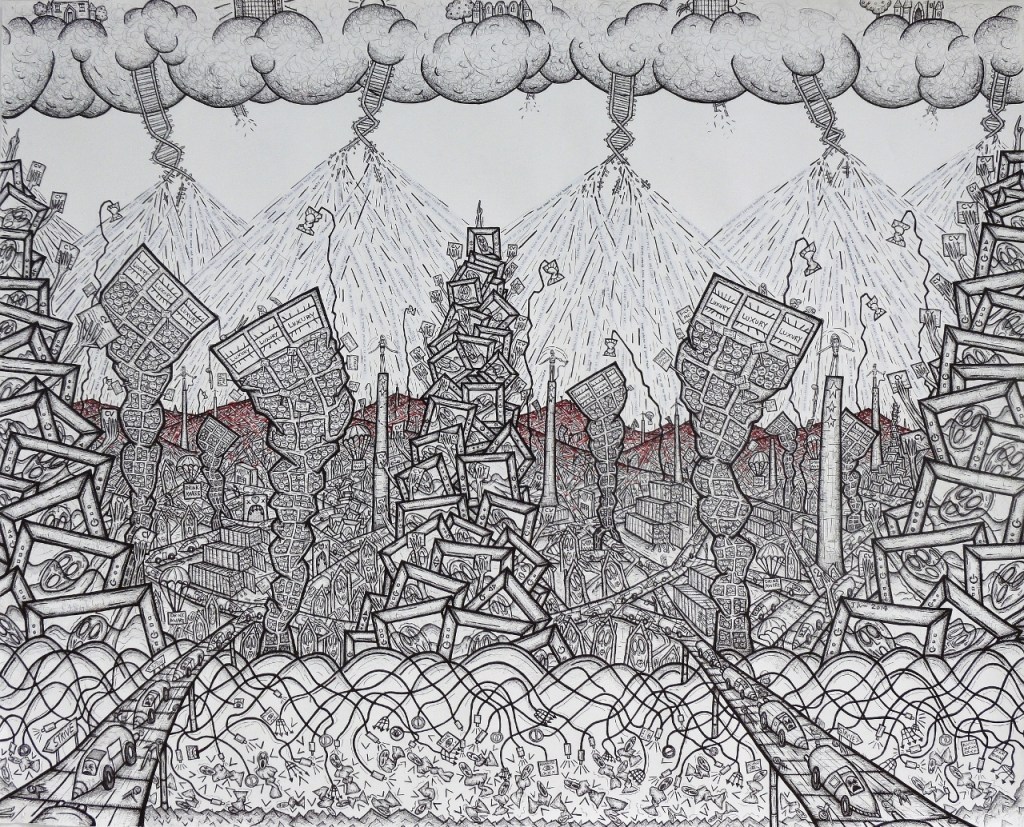
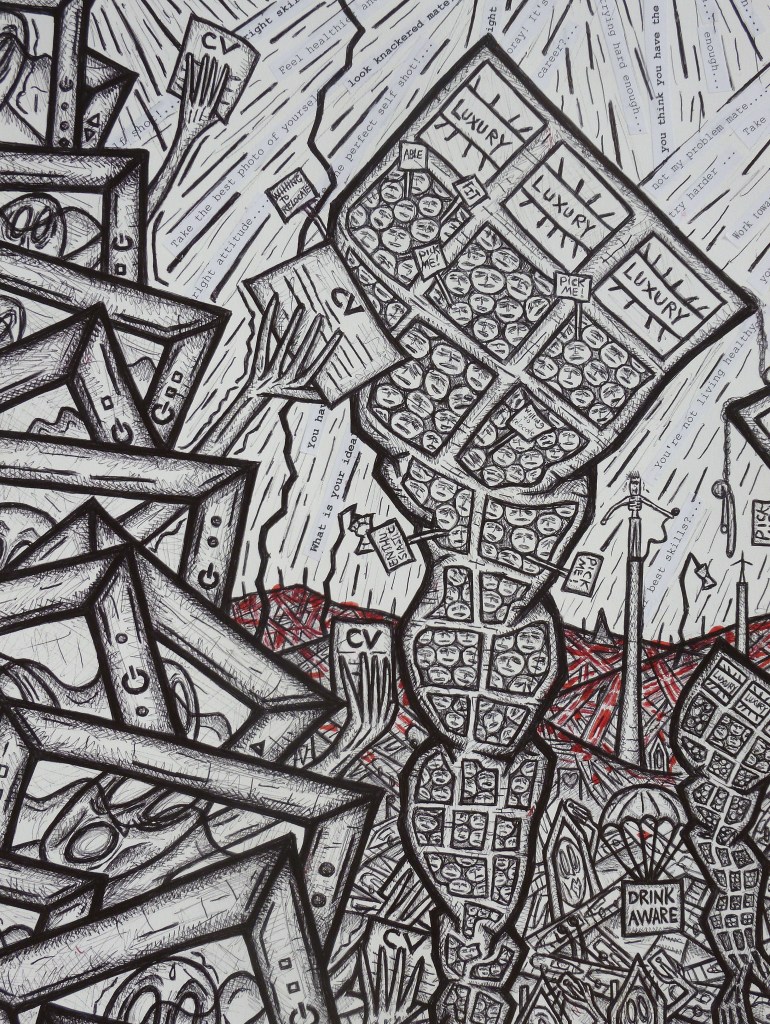
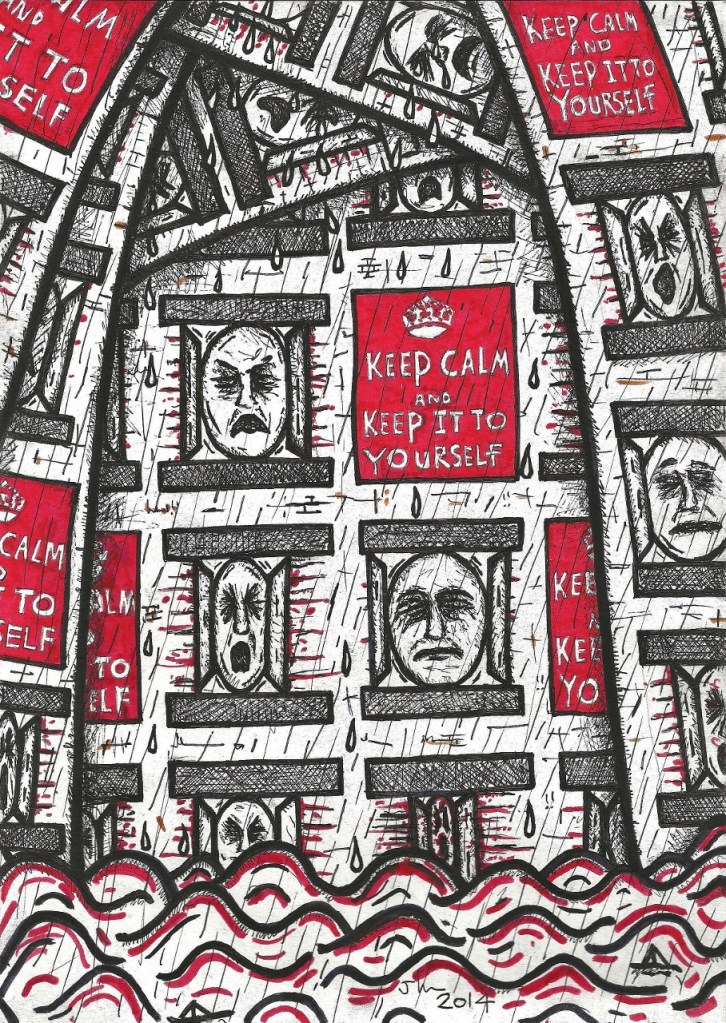
‘A Privatised Implosion’
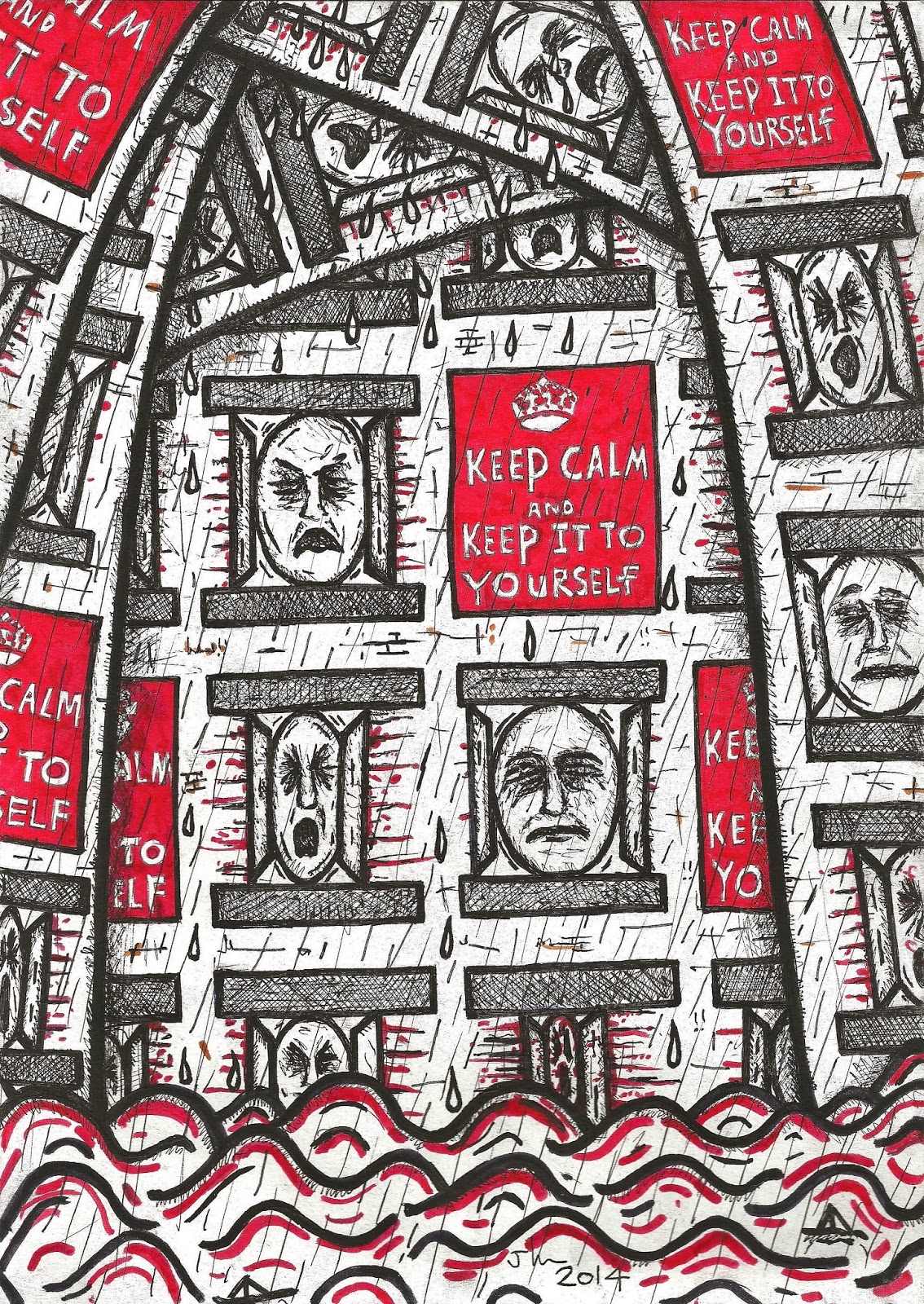
‘A Privatised Implosion’ (2014, ink on paper)
Something in The Way
There is something in the way that prevents me from reaching a wider philosophical enlightenment, and beyond what I thought was just a stage of melancholic existence; much desired (and much-needed), it feels like the inevitable next step that is forever delayed.
For some years now my belief is that the ‘something in the way’ is capital. I claim it is beyond doubt that It has an invisible, yet over-determining presence in every one of life’s equations, and thus cannot be subtracted from any given equation. Anybody who thinks this claim is wildly exaggerated should pause and try to think of any given moment in our lives that is free of conflict with its demands, or is motivated by its demands, or both.
For this reason, the philosophical approach(es), of ‘oneness’ (or ‘wholeness’), the spiritualist pleasure in seeing ourselves as part of everything else (largely associated with traditional Eastern and Native American thought), remain very nice ideas but distant and intangible, and my philosophy is bound to partisan chains. yet, I do not mean partisan in the usual sense of ‘I am against this person/group/class, etc’. Although my philosophy is naturally in conflict with interests with an investment the dominant power structure (whether delusional or real investments), it is a condition of being partisan that is directed against a something (the intangible something of capital), rather than a specific person/group/class who, after all, are also subjected to the same real of capital, whether they have it great, riding high, jet-setting across the globe, or are enduring the most brutal exploitation.
The use here of a Nirvana song title (not The Beatles!) for this blog title isn’t a random act, if you see a major factor in the front-man Kurt Cobain’s self-destruction as a philosophical deadlock which was caused by the existential-assault of late capitalism’s ability to turn any sublime artistic endeavour of his into a money-spinning turn (almost seemingly achieved faster than the artist endeavour was achieved); propelling him to stardorm whilst compromising and fucking over his very existence.
Mark Fisher, in Capitalism Realism (2009), argued that Kurt Cobain/Nirvana arrived too late, that he (Nirvana) fitted well the integrity, genuine liberatory spirit of the counter-cultural pop music of the 60’s and 70’s. But by the time Nirvana arrived, the future such a counterculture demanded had been canceled out (or, at least hijacked by other forces); “the high existential angst of Nirvana belongs to an older moment”, leaving Cobain to “objectless rage”, leading tragically to inflected rage and eventually to self-destruction.
“In his dreadful lassitude and objectless rage, Cobain seemed to give wearied voice to the despondency of the generation that had come after history, whose every move was anticipated, tracked, bought and sold before it had even happened. Cobain knew that he was just another piece of spectacle, that nothing runs better on MTV than a protest against MTV; knew that his every move was a cliché scripted in advance, knew that even realizing it is a cliche”.Mark Fisher, Capitalist Realism (2009)
But this so-called ‘end of history’ (Francis Fukuyama) shoreline that Nirvana washed up on, like a rare thing thought to no longer exist, well, maybe it did at least bear some resemblance to he realised desires of counterculture from the previous decades? I think it makes sense to say that a lot of what has constituted life, in an era generally referred to as postmodern, had at least the objective appearance of the realisation of the ideals sought-after by the counter-cultural/progressive forces prior to this age (at least in the countries designated ‘Western). Yet, inspite of this resemblance, the subjective experience of this era has had a consistent dread, and depression, that wouldn’t go away, due to the ever-faster-swimming ‘something in the way’ of capital – an invisible evil spirit that couldn’t be exorcised. And perhaps this ‘something in the way’ ruined a space in time when it could have actually worked out?
I do not think the quality of life (for most people) can be improved until this ‘something in the way’ is rooted out. For this the reason I remain highly critical of the advice (sometimes given when you’ve not even asked for it) that change can only come from within. I am always suspicious of this, especially as it can often come across as self-gratifying smugness, as if the advice-giver had found a key that allows them exist with gravity-less-ease, untouched by the ‘blockages-to-Being’ that, for me, constitute more than less of our (21st century) waking lives. My cognitive mapping cannot move beyond there being a ‘blockage-to-Being’ that remains external, and, more so, that this external thing is continuously bearing down heavier, making less rather than more possible.
Maybe my cognitive mapping has a damaged receptor, maybe it is ‘entirely subjective’. But for me this is too easy, I have always felt my subjective mapping to have been constituted by the objective situation. I feel that Slavoj Žižek is making the same point in his book The Year of Dreaming Dangerously (2012) about the disparate yet totally connected sparks of revolt around the world in 2014. Using Marx’s point that the “‘objective’ determinations of reality are at the same time ‘subjective’ thought-determinations (of the subject caught up in this reality)… Žižek says “…the limits of our thoughts, its deadlocks, contradictions, are at the same time the antagonisms of objective social reality itself…”. Žižek often criticises the use of traditional Eastern philosophical practices within contemporary capitalist culture (meditation practices for example), for the way they allow disavowal from the objective reality we exist, and participate in. For me, this simply doubles-up my conviction that such practices, that are closely tied with the advice to “just be”, at best don’t begin to challenge this ‘something in the way’, and at worst advice me to ignore the social reality which constitutes this unshifting feeling.
Maybe we have run out of time to realise the aforementioned ideal, free of this ‘evil spirit, an era that the postmodern could have been? What, with the damage done since then; the necessary carnage dealt by a system that necessitates a culture of hasty resource consumption, resulting in climate scientists confirming a global temperature rise of 2 degrees Celsius is unstoppable now, that it is really about damage limitation now, by trying to work towards making the planet as inhabitable for humans as possible. But to carry on with this something that is hastening all this, whilst compounding an immiserating existential deadlock – well, if I believe anybody is under a massive delusion if they feel they have an investment in such a world. And I think a meditational philosophical approach (to “just be”) to relieve many from this immiserating existential deadlock is practicing denial. Such a philosophy, isn’t the problem (by itself I have no problem with it, nor do I criticise though who do practice it for what it is) but if it is used to advocate forgetting about the problem, it is really no good right now.
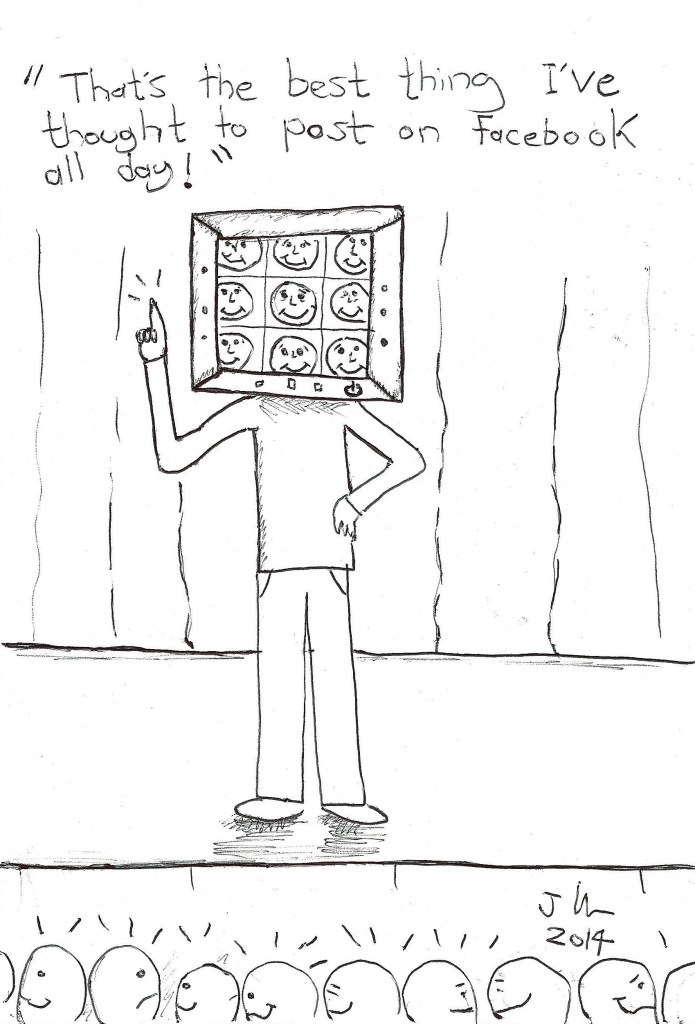
‘Hyper-Malaise’

Hyper-Malaise (2014, ink on paper)
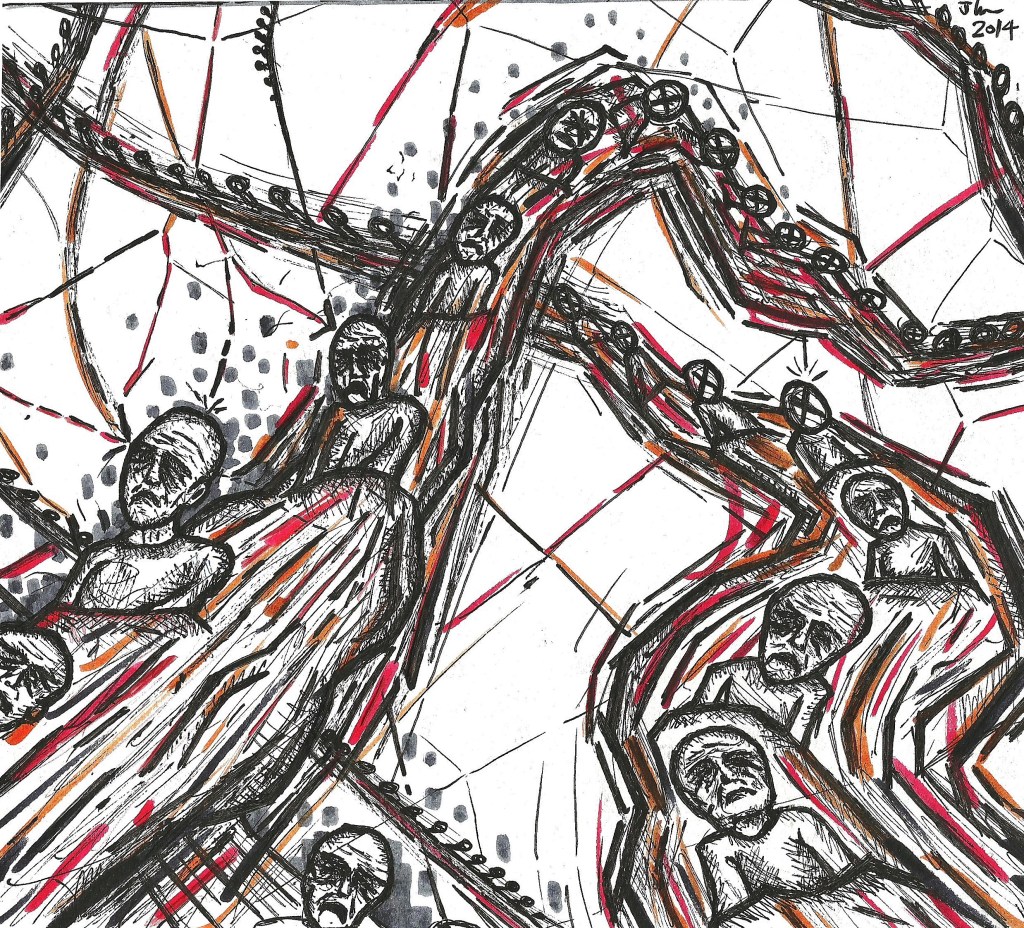
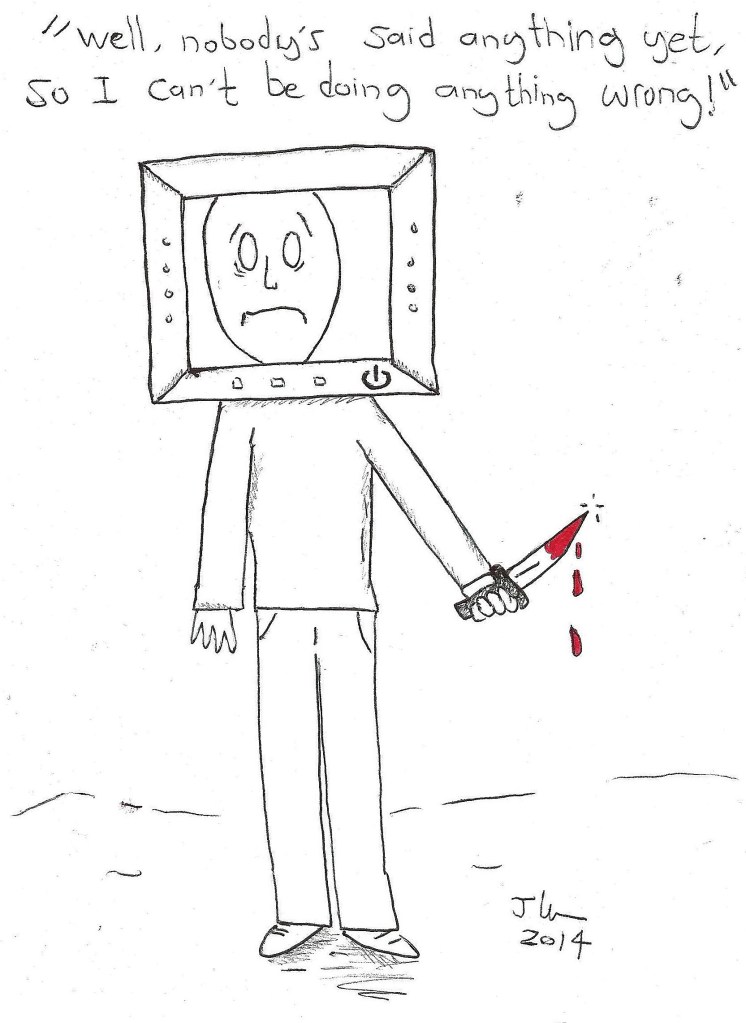
A Privatised Implosion (ink on paper)
 John B Ledger

