London walks: an anti-austerity-weekend flow.

Friday 19 June 2015


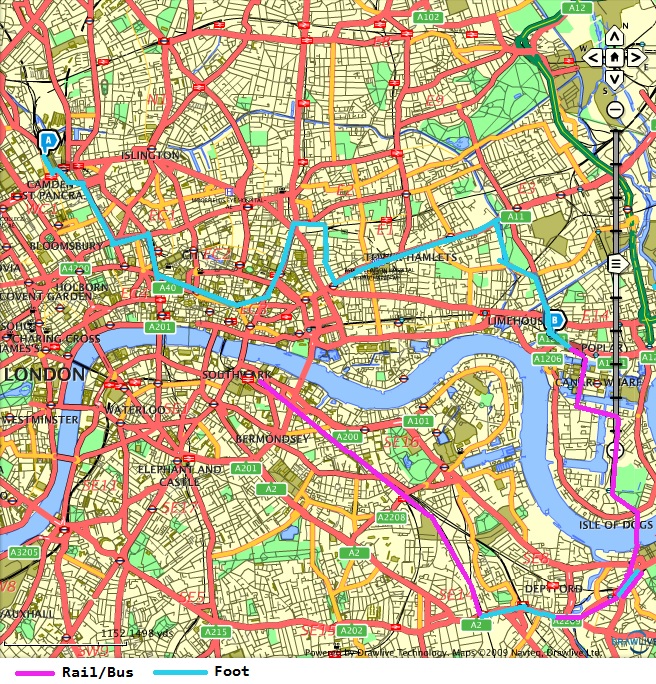
“Walking towards Shoreditch, nearly an hour into walking in the city. The self-conscious me is always looking for things to porcupine-myself-up with in a place of such beautiful cyber-people. Sometimes it seems like everyone looks like a more toned, more Photoshopped edit of a pop-culture figure from yesteryear. I pass somebody who looks like a ‘better model’ of The La’s’ frontman Lee Mavers; more like Lee Mavers than Lee Mavers.”

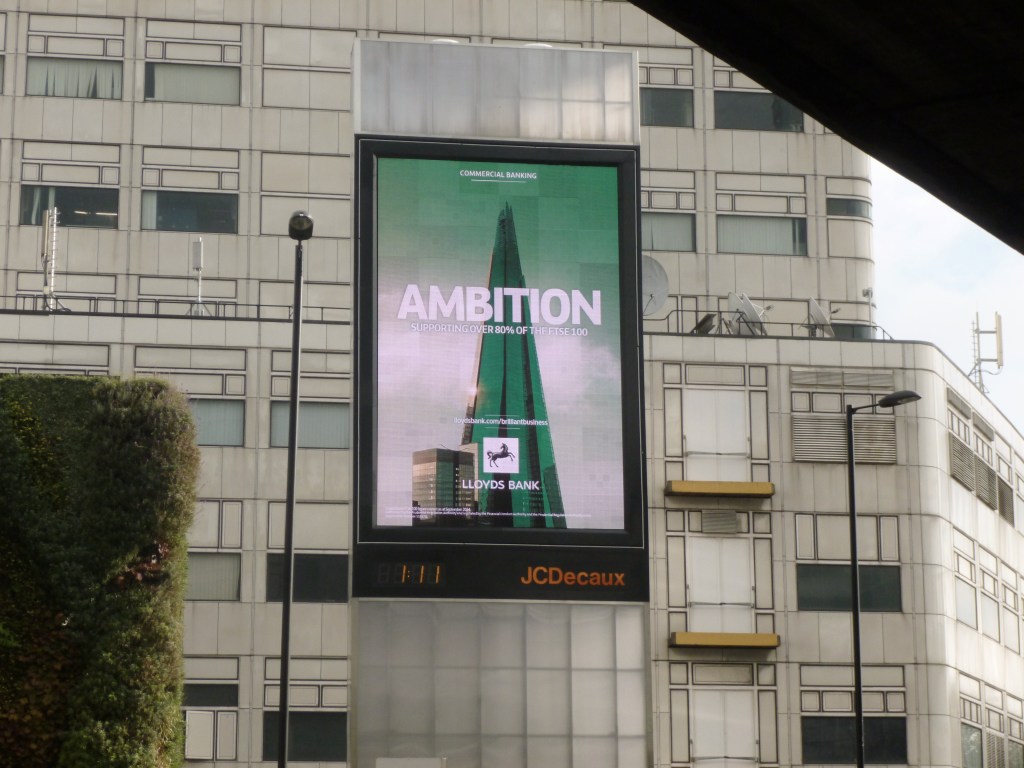
“The proximity of the DLR train to the crucible-cluster of deemed-important buildings in Canary Wharf forces their importance on you as you begin to instinctively stare up at them in wonder (only to refrain from doing so to hide from public their impact on you). I look up at 1 Canada Square (HSBC building). I give a powerless, punchdrunk smile as my eyes sink from the fluffy-cloud-skyline to the gentrified docklands below. Sometimes it all makes sense to me, and I then spend my time trying to explain my reasons that respond to this sense, only that it all fucks up when things inevitably conspires to undo that sense-making. And it is at these points that ‘the idiot’ appears.”

“Greenwich Park. Hot weather. Grass going all orangey/brown – like 95/96. Don’t think I’ve sat down on the grass since I was 12 – not properly anyway. Firestarter, The Prodigy [spring 96] is playing in my personal bubble. Feel 12 again. Want to cause shit/havoc (“Bad bad, bad bad behaviour”). All those “old school” shit-causers; they’re all knackered now, evaded swiftly by others in this anxiously aspirational age; ranting at people eating their tourist-orientated food, who no longer need headphones to be zoned-out to such a physical proximity. Head down the congested road on Blackheath; city traffic passing through summer fields. If I crop out Canary Wharf it all takes me back, somewhere. But just now I don’t need to crop it out, with rucksack on shoulder, ideas momentarily electrified, I feel Danny-Champion of Past and Present. But such a surge of self-belief is spurred on by the very thing that crushes it; the ruthlessly ambivalent city. It’ll get me, for sure it will, it always does. It doesn’t let me stand tall for too long. But right now, as I text myself these thoughts, it hasn’t.”


Saturday 20 June 2015


“Walking through the refuge of a wooded-park in the centre of Muswell Hill, after staring down at the horizon-reaching cityscape commenting on how only 100 years back New York was just beginning to take over London as being the biggest city the world had even seen. Still slightly drunk from the night before, and, thus, having  a slightly-guilty sensation in an age of “keep young and beautiful; it’s your duty…”. Especially in an area like this where the “everybody’s middle class now” 1990’s rhetoric doesn’t seem to have become like a cruel joke. They run for reproduction, perpetual vitality rather than exhaustion – no sunken faces around here. These woodlands look ancient, even as the noise from the continuous stream of London buses penetrates them. They may just be ancient; this land certainly hasn’t been dug up for coal at any point like most woods have nearer to home. The failure of the 90’s/00’s freshly-veneered/total immersion-capitalism seems to have never happened here. Or so it seems. London-based TV series’s from the politically-passive late 90’s/early 00’s, like Spaced, feel like they could be in their 10th series around here.”


“The demonstration’s on The Strand now. One of those iconic London streets that I have only just located after a few years of frequenting the city more than before. This is a big demo. Surely too big to be bypassed by the media’s gaze…? It’s as big as the March 2011 one, to which it was preemptively compared. But the feeling is noticeably different. My lasting memory of March 2011 was of hearing a succession of bangs, which I initially thought were some sort of explosive, only to realise that a group named the ‘Black Block’ were smashing the windows of big banks and tax-dodging corporations 200 yards ahead of us in the march. Moments after the bangs a masked young woman cut through the march procession, only to have her arm grabbed in anger by a middle-aged woman in a Unison t-shirt, who shouted “cowards! why don’t you show yourself?”. Although I had mixed feelings on what was the correct approach to counter the much rawer anticipation of systemic wounding, in hindsight I realised the angry response from the then-seemingly-more ‘pedestrian’ protest-approach, was due to the possibility that many who said they were in the Black Block were actually Agent Provocateurs, working in order to allow an aggressive police response, and to whip up hostile sentiment towards the wider demonstrations. And it worked. Only five hours later, on the train back to Wakefield/Leeds a thuggish male, part of a group of football fans on their way back home, had his hands around the neck of a blatantly-peaceful protestor, due to an argument between them, largely sparked by the football fans accusing him of complicity in “the smashing up of the windows of Topshop”, which resulted in the police boarding the train at Doncaster. I, for one, was emotionally exhausted as the tinderstick summer of 2011 drew to a close, prepared for a new world where one would be forced to take sides. The tide of society would consequently dampen this energy, and leave many of us feeling like self-aware-zombies in 2013, 2014. But perhaps the clear lack of noticeable ‘trouble’ on this comparable 2015 march isn’t a negative? Maybe something has changed, tactically; a different collective response is afoot, more based on duration?”


“The only negatives we receive are perhaps to be expected, due to being received as the march reaches the tourism/consumerism zenith of the capital. First off, we are subjected to a barrage of slurs from a man-woman-man-woman quartet of weekend ‘leisure-seekers’, with one of the women repeatedly shouting “get a life!” as they cut through the march to the opposite side of the road, with bottles of unopened rose wine in their hands. The fact that they clearly deemed it urgent to utter this to us seemed more telling than any general disagreement with the causes being marched for; beyond the initial feelings of “why didn’t I say something back to them?” was a realisation that the demo clearly caused them great discomfort. I think I can see why: when life is narrowed down to a singular romance focused in on the weekend ‘leisure-pursuit’ and all the promises of happiness, meaning, love it has appropriated, protests begin to be representative of possible huge ruptures to that shop-a-day reality. And I say this as somebody who has had this very anxiety about ruptures to those routines-of-least-pain we pave ourselves in the narrowness of the late capitalist world.

Further on, as we near Downing Street, we sense an hostility from groups of muscular young men in t-shirts. But their gesture (which seems to be one of showing solidarity with the coppers by standing in a line with arms folded in front of buildings in this zenith of nationalist value within the capital) looks almost comical, and the absurdity has not gone unnoticed by everybody I spoke to in the march. Everyone was just thinking ‘what the hell are they doing?”


“My friends head back for their respective coaches back North and rooms in London. I aim for some reflective wandering of the city until my train back later this evening (bad memories of Megabus coach journeys back from my failed attempts to study in London still haunt me). After 30 minutes trying to find somewhere to piss, I end up in Waterloo Station wishing to write expletives on the toilet walls over the lack of public toilets – my biggest pet hate of life in the over-commercialised and privatised UK city. However, due to there being a fault on the pay-in barrier and the migrant-worker toilet attendant politely letting us use them for free, I would’ve have felt bad giving him any extra cleaning up work to do. I head back out into South London, and look for the river. I always feel I need to see the river. The helicopters monitoring the protest are still hovering above. The rain begins to pelt down, but it’s the first time in my life I am carrying a waterproof jacket – a sign of age maybe? If my mood sinks now, and we’ve reached the afternoon it isn’t so alarming, it’s bearable. The Thames splashes against the walls as the rain falls. At least we/I have the river, the murky holder on plenty of secrets, that can’t quite be gentrified – it’s ours whether we are from Bermondsey or Barnsley. I have swallowed the world today; it’s the comforting calm before the potential storm caused by surrender to it all.”


“I have walked full-circle, all way down the South Bank and back toward the Bank of England from where the demo initially gathered. The rain that teemed down as that official demo petered out in Parliament Square has all but gone. Yet, this dampened, largely-depopulated area (it’s normal for it to be eerily quiet on a weekend) gives it an unwanted feeling of the aftermath of a party. After all, one common utterance the stands out about this 2015 demo is to not let it be a mere catharsis amidst the carnage. Fading momentum is a huge concern for all of us as we stare down the barrel of deterioration. However, like my weary, now semi-stumbling self, acquiring a slightly macho-self-defensive gate as I slowly begin to see the tailored shirts, suits and bow ties reemerge, as if they were hiding in burrows whilst the protest was ongoing (“it’s safe to come out and play now!”), there is no resignation, not just yet. I walk just that bit further towards the Barbican.”


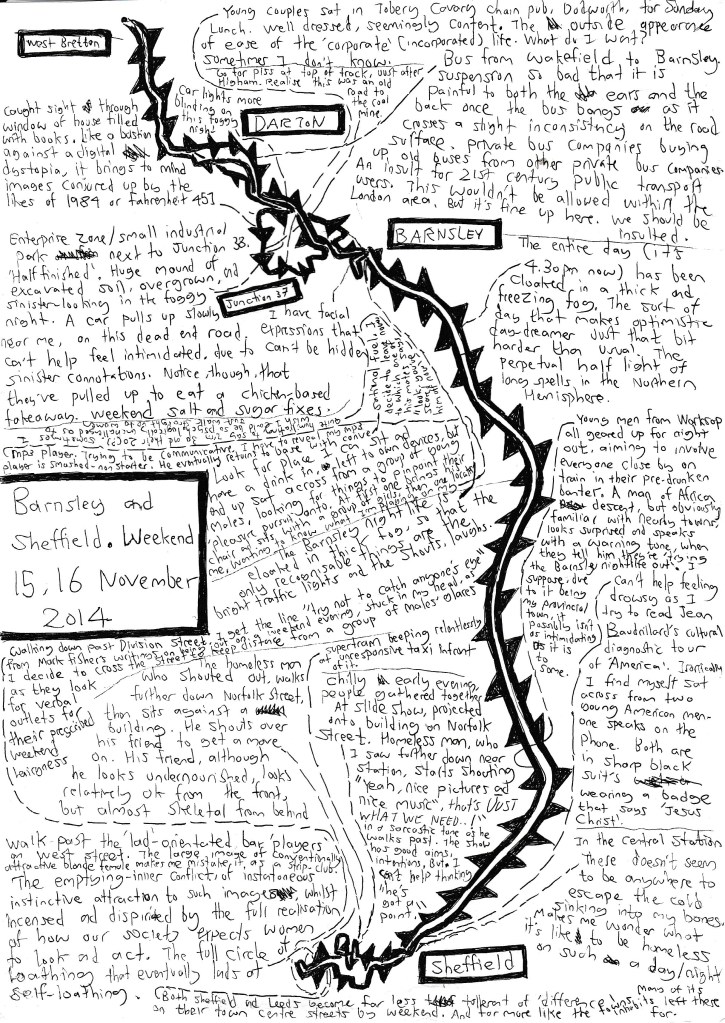
“Caledonian Street – the very name alludes to a once-felt physical connection of London to the rest of this Land-mass. Unlike today, where by crossing the M25 you almost feel that you’re in a different reality where everything you’ve come to know from your stunted Yorkshire towns/cities seems to has been given the green light to proliferate, uncontrollably. Which makes it all the more strange when I hear a Barnsley/Wakefield accent (very distinct the closer you get to them, very hard to differentiate the further away you are, geographically) coming from a man on a phone outside a takeaway, across the road. The utter weariness caused by the past 2 days (emotional as much as physical) means I literally stumble into the nearest bar that looks accommodating for a man who currently looks that scruffy that going into a more ‘aspirational’ bar would be to surely give my weary self a hard time. But my stumbling attracts the attention of four men with shaved heads, one of who’s glare is not friendly as I order a drink in a red t-shirt with a sketchbook in my hand. Once I sit down, unable to avoid overhearing snippets of their conversation, it is beyond a doubt that they are part of some far-right, ultra-nationalist organisation. There’s one, big hard-looking Ray-Winston-type-cockney (who evokes an image of more physically violent UK cities, the only aspect I don’t long for in the wake of gentrifying cleansing). Then I realise that two of the blokes are Barnsley lads. Oh yes, it’s beyond a doubt; that’s definitely my mother-tongue the one in the baseball cap uses as he drunkenly slides into chanting a bloody-thirsty appraisal of St George. And on a day like this!? A day when I wanted to feel comradeship with folk from my mother-terrain, and beyond, against capitalist onslaught. But I find myself hiding my face in case  it turns out they recognise it from town. As today, there was (by all accounts) a far-right demonstration planned for Barnsley town centre, preceding a town pubs-based music festival, which seems to pull together folks of left/left-of-centre sentiment in the town better than anything else since the mines closed. I wonder whether there was thus a consequential poor turn out for the far-right, and they decided to head down to London instead? Anyway, I drink up fast, as I’m reminded of how the threat of real physical violence can still quite quickly rear its head in pubs, even in an age where we are more likely to yell in solitude into our cell phones. I head back towards Kings Cross station. Bland but less chance of aggro.”

Stories from Forgotten Space (Lost Bus Routes and Pre-election Reflections)

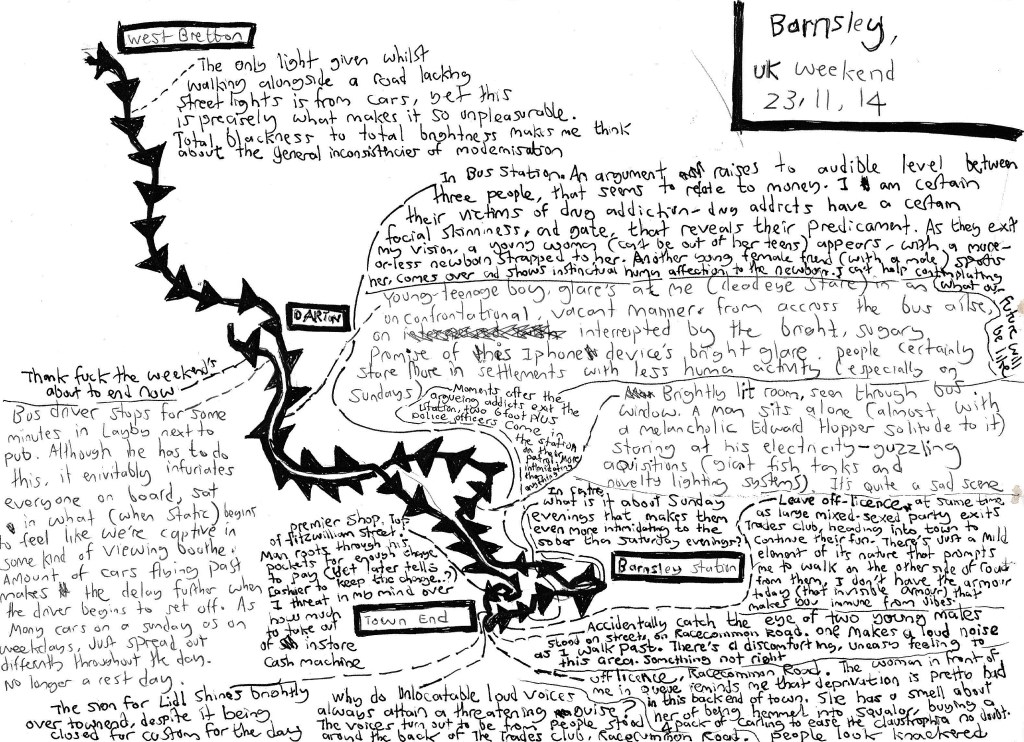
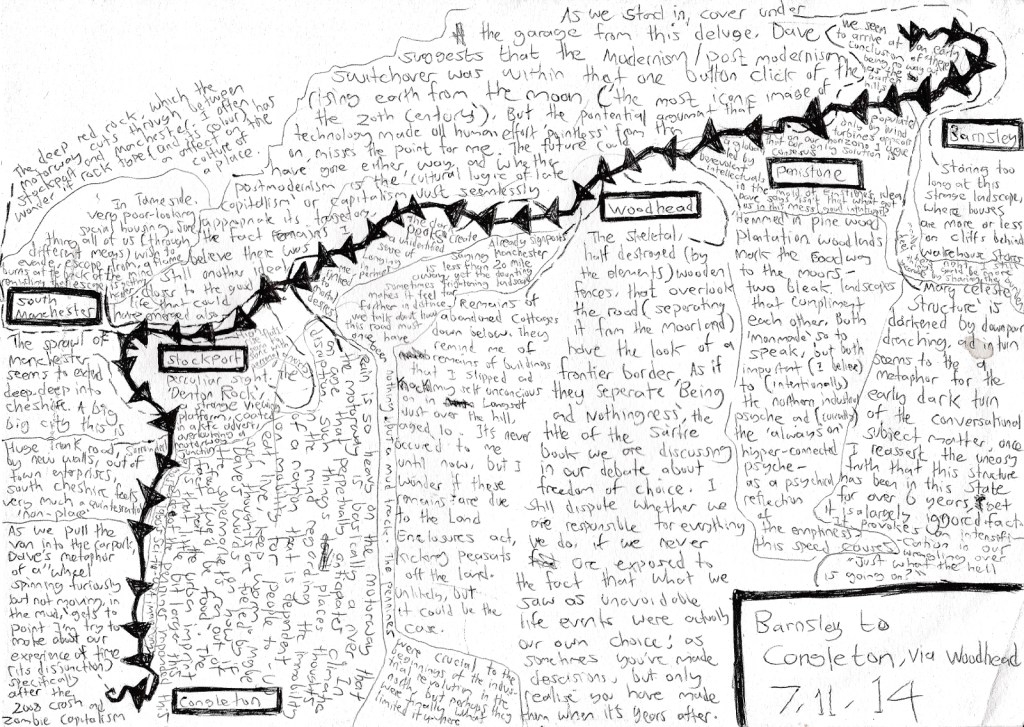
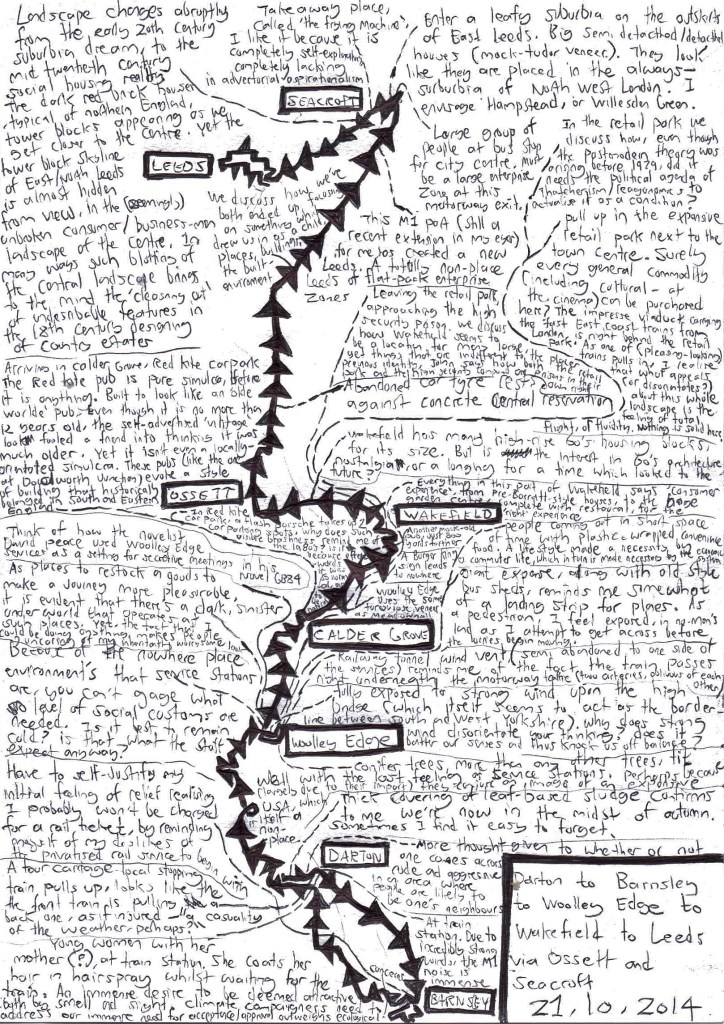
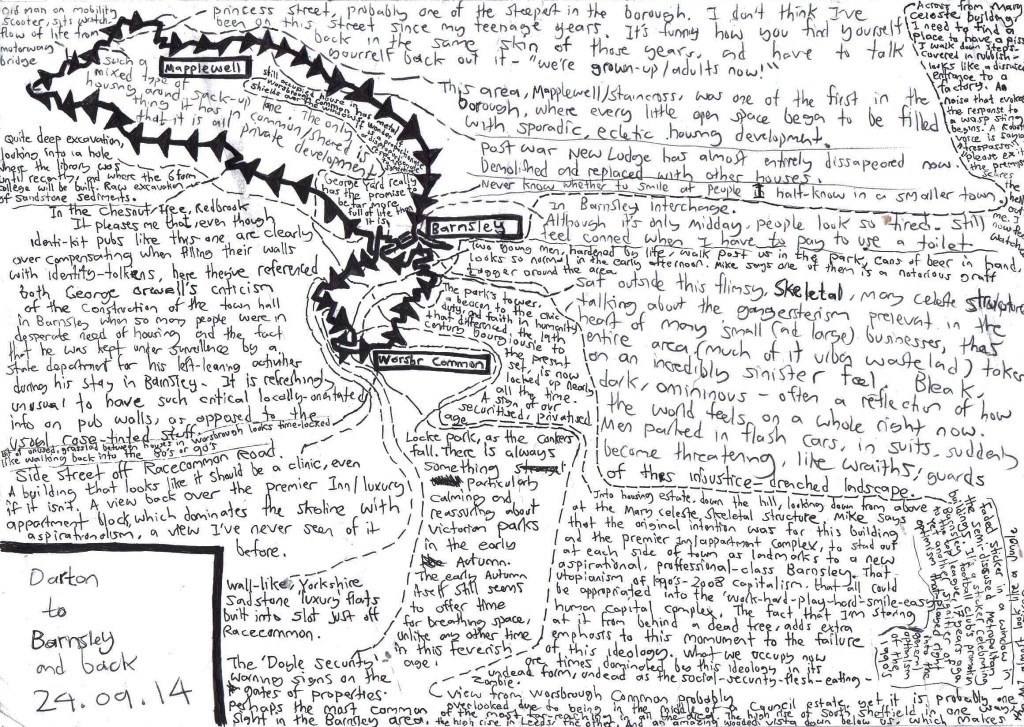
Stories From Forgotten Space builds on 2014 Mapmaking with the aim of taking the most prominent features of the project a little further. It is fact and fiction, clear analysis and emotional garbage, destructive and constructive thinking, but what it is is my truth, recollected through maps made of journeys I make. This section of Stories From Forgotten Space uses lost bus routes and thoughts prior to the UK general election to use spaces to look at what has half-vanished, and what I long for coming into being. Using mapmaking to discuss the fabric of contemporary life may not be ‘everybody’s cup of tea’ (as if that is what everything needs to boil down to?!), but I have always had a love for maps and their potential.

The previous section of Stories from Forgotten Space can be found here:


“Bump into drinking-companion from a more alive, pre-recession Barnsley night-life. He liked that specific vibe so much, he left a nearby town to move here. He tells me he is now thinking of leaving – nothing here for him anymore. You wouldn’t think that much had changed, but something’s very different from 10 years back. It isn’t a time I wish to relive, yet at least it didn’t quite feel like the permanent contraction of now. We stare all around Peel Square – expecting it to throw up a preferable answer. “Don’t drop litter, John” he suddenly adds as he butts his cigarette out on the bin, adding “I got fined £70 pound last week for dropping a cigarette butt as I was about to enter GT News [newsagent]. She [the enforcement officer] watched and waited until I’d come back out to accost me. I apologised, but she said it was too late and sprung the fine on me”. I’ve already heard these stories from cousins; “they sat in a car out of view, watching a waiting to see if I dropped the cigarette butt, and when I did they came and sprung the fine on me”. Already aware that this is a company, thus a profit-searcher, sub-contracted by the council authorities, I know full-well that the usage of ‘given’s’ such as “litter is bad”, “protecting environment”, “anti-social behaviour” is a icing-paper-thin veil over the profit-making-scheme-partnership between authority and company, which ends up punishing those who are already likely to be suffering most from the council-services-spending-cuts, which no doubt are the motive for these half-baked schemes in the first place.”

23 April 2015

“It still manages to surprise/confuse me when I can arrive, unaided by public transport into one of the designated urban hubs [central Leeds] of the UK with such ease [having cycled here]. I wonder whether it may feel amiss with my preconceived, due to urban centres still remaining as signifiers for all that I feel I want, and need, in life, no matter how much this sense gets displaced like particles scattering once I am in these spaces. This sense of displacement feels especially acute after a long day in London. Deep down I can’t admit that what I am looking for doesn’t exist; at least not in way I keep on imagining it, nor in constraints of our current social reality.”


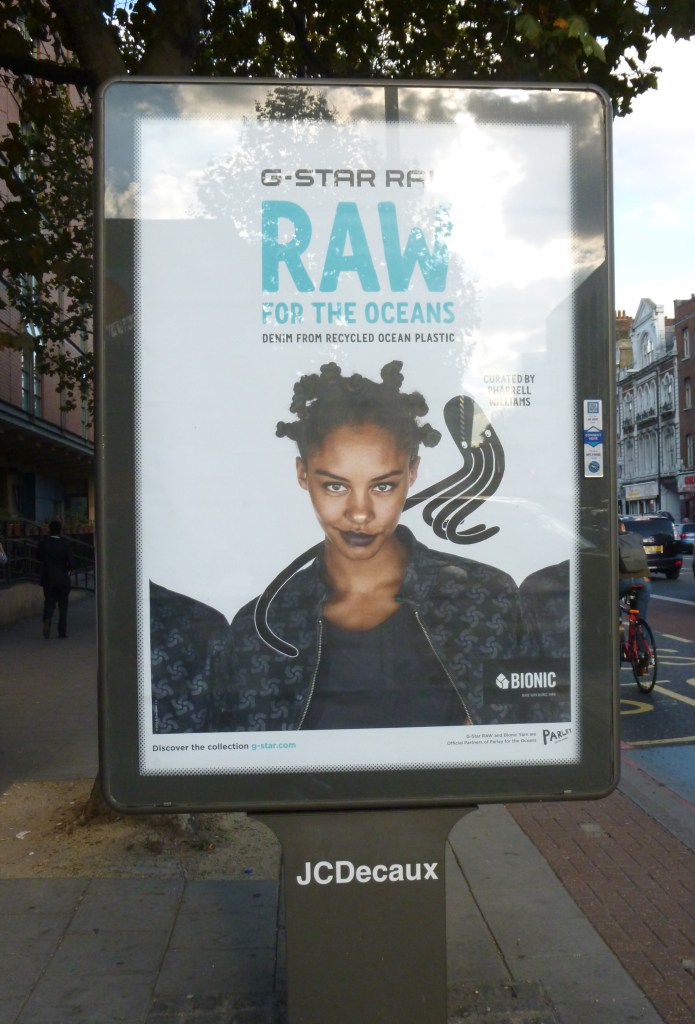
“15X15 foot Advertisement board for the upcoming Victoria Gate upmarket shopping complex. An alien imposition. A silent yet strangely noticeable assault on one’s sense of self, that beams down from Nowhere, asking “Are you up to scratch? Are you one of the beautiful people around here, permitted to frequent here once it opens?’”

.
“On the train back to Wakefield, sat behind a middle aged man and woman passing comment on the current horror-show in the Mediterranean (the hundreds who have died trying to migrate from Africa into Europe). The conversational tone is one of mild anger and resent, but, incomprehensibly, it isn’t out of the injustice of these desperate human beings dying horribly, trying to escape desperate conditions; it is mild anger and resent at the idea of these people trying to get into this country, because “the NHS is already at bursting point” [as if migrants were the cause of this]. Who would have thought that such suffering would actually do more to eradicate empathy?”


24 April 2015


“Erring (as per usual) trying to get from A to B within the commuter-houses-maze of Woolley Grange. But nobody is even there to see me take this pride-sapping uturn. In fact I’m unsure I’ve ever seen a single person whilst passing through this estate built on a former spoil heap. The odd parked car, but never a resident. It often fools you into imagining that it has never been more than a show/model village. An eerie feeling that would make sense if it was derelict, but it isn’t; it’s a new-build aspirational residential area.”

.
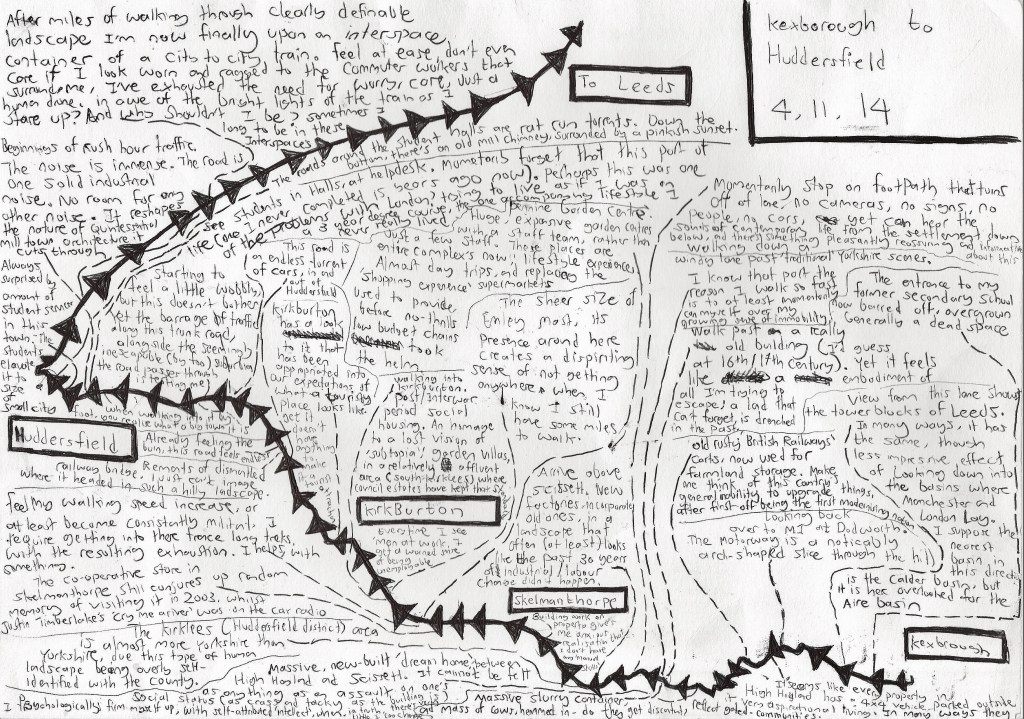
“Whilst waiting in line at a cash machine on the main thoroughfare near the [Huddersfield] station, at tall man (who could be anything from mid 20’s to early 40’s) starts talking loudly in an odd manner to a fed-up-looking off-duty postman, who stands in the queue behind me (very few postmen/women look how we’d imagine them to be when we contemplate how nice a job it would be). The tall man says something a long the lines of “ya go something to say now mate!? Eh? Hey?”. The off-duty postman, more or less bullied into responding, sayings “no mate” in a very submissive downtrodden manner. The man, now with an attitude of having won a conflict, says “good, coz there’ll be trouble next time”. My assumptions are that the postman lost his rag with somebody who made his working environment (the public environment) less pleasurable during the day (I know this from once fearing my job position, after telling a group of taunting teenagers to “piss off” whilst working as a postman 11 years back). But no matter what said in this probable heat of the moment situation, I hate to see signs of the vulnerability of all non-alpha males (such as myself) in a bully-boy culture.”


“A middle-aged woman gazes for some time at the homeless man sat in underneath a shop window one of the main shopping streets [Huddersfield], probably due to him not yet having the drained and disheveled look of somebody accustomed to such a life. He’s obviously new to this life, he still has the look of household domestication to him.”


27 April 2015

“The board at the entrance to the Cedar Court complex [next to Junction 39, Wakefield South] promotes it’s ‘conference and function suites, for weddings, meetings, conferences, leisure’ etc, etc – all the preconceived notions of work/leisure under corporate-captivity. It’s a world already made for us; fun, taste, memories, opportunities already laid out. Nothing beyond the prescribed. Small, powerless in the face of big (“this is how it is!”) signs, I silently shout “surely there’s more than this?!”‘

“The roads cutting through the fields between Wakefield, Barnsley and Huddersfield are so saturated with ‘Vote Conservative’ placards for the upcoming election, that (A) I feel ashamed of my lowly posture to be walking amongst them, and (B) undeniably relieved to see that one of them has been pulled up and placed face-down. “Not all cap-doffers ’round here!” Whatever the outcome may be come May 8, the moral humiliation of a Tory victory could prove too much to bear.”

“Travelling through a wooded area that runs through the neither suburban-nor-rural mill-town-cum-commuter-village clusters, Clayton West, Scissett, Denby Dale and Kitchenroyd. As somebody who goes out running a few times a week I have to accept my complicity in this, but me and Dave can’t help but agree, as we observe every jogger, in this post-work period, that they are somewhat the new zombie subject of our times. They have replaced the older passive consumer-mall zombie of a previous stage of capitalism. Financial speed re-channeled as undead-anxiety running through our veins. Driven, yet simultaneously passive. Going through the mechanical motions as if the levers and cogs of the long lost factories merely spilled out onto the streets after their closure.”


1 May 2015


“Looking over to the Beeston area [Leeds]. Always trying to find the core of place. But they’re just houses, or spaces in shops or pubs. Just space occupied like anywhere else. Get thinking about Paul Sykes, a Barnsley “self-made” millionaire, who is now apparently lonely and miserable in his North Yorkshire mansion. It’s never at anywhere if you’re empty. Behind me two ‘bright young thing’ males exchange information of their culturally-exciting, upwardly mobile ‘where it’s at’ lives, spent between London and Leeds. Do I feel on the defensive? I course I fucking do. 6.3ft BBC-cum-highended-student accented males, who look right through a 5.7ft, suddenly-indelibly-localized denizen (myself). Judgmental or not, I can’t help thinking ‘cyberpricks’.”
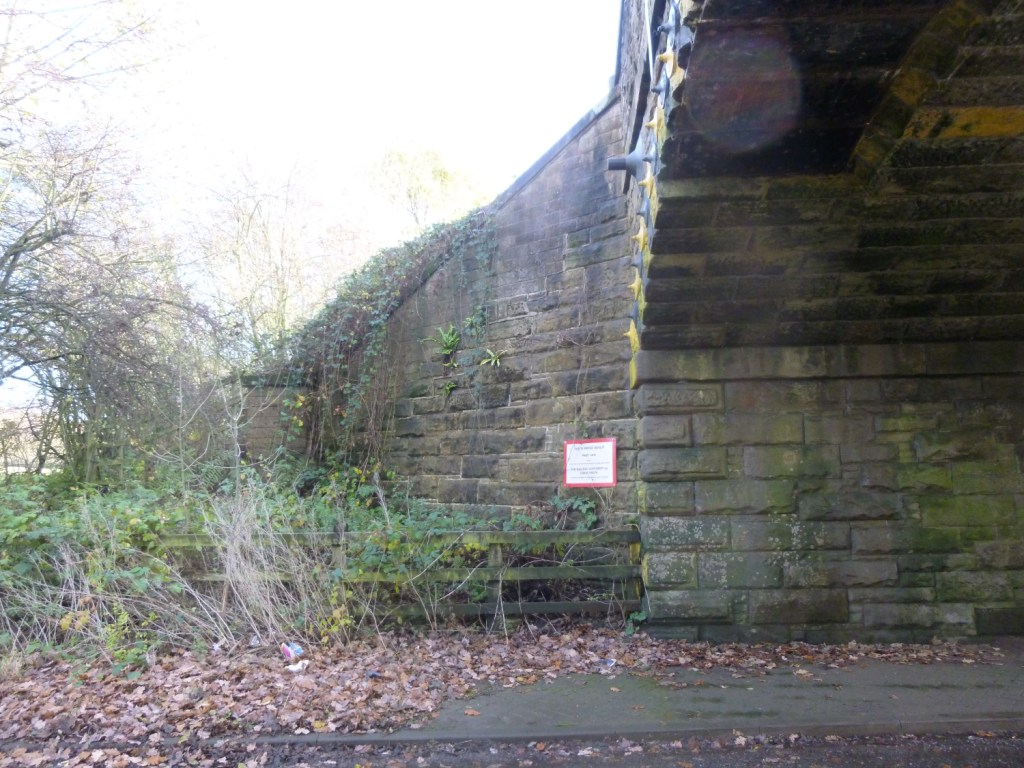
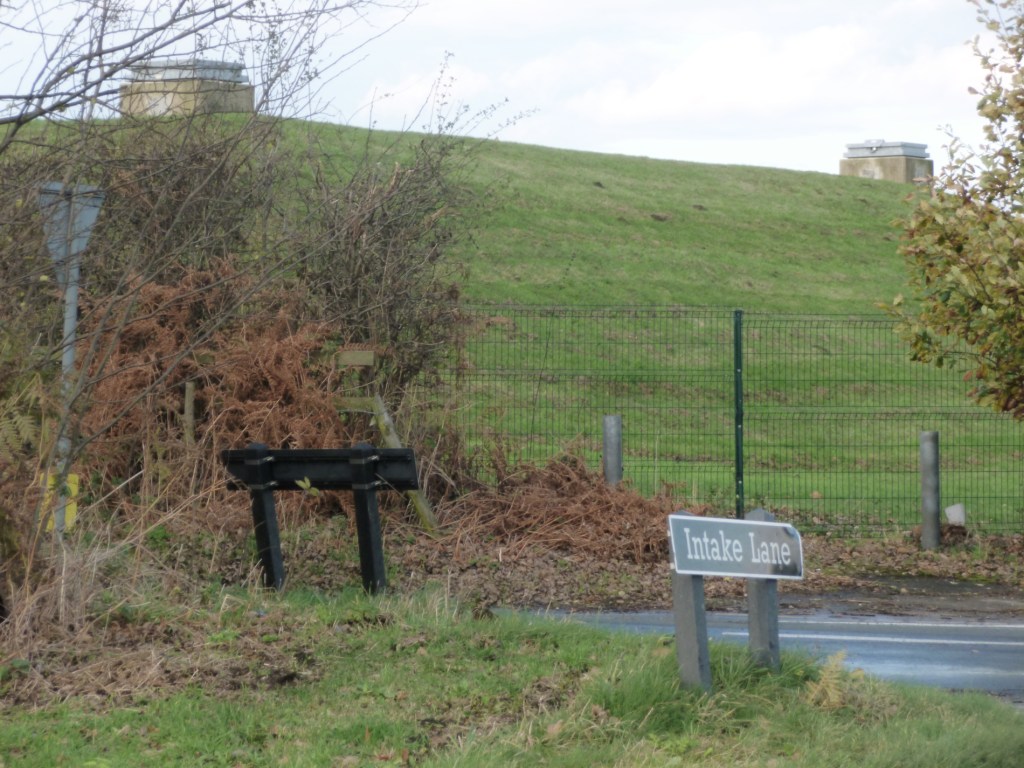

“Everybody just looks so successful-looking in Leeds station right now, as I wait for the connection train at 11:30am. Maybe their faces look different at 5:30pm, and their Lego haircuts wane a bit. But I doubt it. It doesn’t reek of Conservatism, but provokes an helpless feeling within of the Tories not only winning this upcoming election, but also the battle of ideas.”


[In Newcastle station] looking for toilets, I notice the words ‘help the homeless’ scrawled in either permanent marker or crayon on the sandstone walls of this station. It’s the mark of a heat of the moment act, potentially desperation borne out of hopelessness. Straight off, it makes me wonder if this city’s homeless problem is even worse than the other UK cities.”

“Trying to find a toilet in a city infected by market fundamentalism is like trying to find 3 different varieties of ketchup in a old Soviet Bloc city.”

“Walk into a large city-based shopping centre [Newcastle centre] in search of a toilet that I don’t have to pay to use. The big monument I passed earlier appears again, this time appropriated into a virtual-impression draped on cladding for some upcoming aspirational consumer/leisure complex. Always an incorporation of something deemed of place and character into a non-place development that seeks to attract a generic-yet-culturally-powerful aspirational quasi-intellectual clientele, who, themselves, have no real place or character to them, when I think about it.”

“An homeless half sits/half lays in his sleeping bag on steps just metres from the Baltic [Gateshead], a former flour mill now an internationally-recognised art gallery. All art gallery staff, who also look the same no matter where (including myself) walk straight past him. Can I blame them if it’s a daily experience? What can they do? I don’t have anything but 20 pence in loose change on me. Feel embarrassed, but I give him it anyway. In a strong North East accent he musters up cheer to say “Every little helps, bud”. I walk back down the river towards the bridges back over to Newcastle. The landscape either side of these two closely-knitted urban centres dips down in a way that resembles much less urbanised coastal settlements.”

7 May 2015

Lost bus routes. Crofton


“The road into Crofton provokes many memories for Michael. A perfectly sized-rape seed-covered hill that became terrain for (old skool)Doctor Who-provoked  nightmare-scenarios; catching a bus all the way to Leeds; a ten pence bus ride to Wakefield centre; memories of growing up here. We pass by a series of ‘Vote Labour’  placards, in contrast to the more countrified nearby village of West Bretton that is drenched in big, no- doubt costly, ‘Vote Conservative’ placards. I am worried that size sometimes makes a difference.”

“1960’s (70’s?) small shopping/flats complex [a similar complex in nearby Outwood], now part-derelict, and facing fenced off wasteland where a pub used to stand. Such complex’s intrigue me, evoking an urbanity of a Lost British City, introduced into these proletarian outcrops sticking out of farmland – known as former mining communities.”

“Cutting through large playing fields around the back of a council estate, a familiar experience to people born into the 2nd half of the 20th century all around the UK. Massive Gardens. One of the gardens is fenceless, merging with the field, something once quite common but now almost unthinkable. The smell of freshly cut grass, young people hanging out on a warmish Spring evening. It brings back memories of another life; a mixture of my own memories and no doubt those of my parents’ generation. This memory of council estates is far from an unpleasant one, and is far from being in line with the contemporary narrative of them. Fond memories, of world that seems to have only half-vanished do much to counter the negative, and (of course) ‘undesirable’ ‘un-aspirational’ press that council estates get. Which makes me realise that this story isn’t time immemorial. We walk towards some newer, yet never-finished, private, aspirational hovels –  no doubt casualties of 2008. They remind Michael that he hasn’t stepped foot down here for gone 30 years.”

“As I catch my breath walking up an unusually steep suburban street [Wakefield is by and large ‘flatter’ than other West Riding towns], a long-lost vitality seems to be knocking loudly at the inner walls of the half dead person I have become. I know why this is. Yeah, this election doesn’t really offer much; but the unusually-high level of uncertainty regarding the outcome has conjured an emotional fidelity to the chance of a different kind of society, one where I can look to the future again. This feeling of vitality, like a plant that only flowers once a generation, is checking the atmosphere to see if it could become suitable. In this moment I recognise just how closely tied my chances of a better life are linked to the chances of there being a better world. It was certainly not planned, but emotional stakes place on the election result seem to have grown higher over the course of this day.”


Between the villages of Ryhill and Cold Hiendley, on these windy old lanes that link up all these former mining communities. Why, after 20+ years since all the spoil heaps and slurry pits greened over, hiding the near past, do many of us still feel the urge to say “this landscape’s beautiful, isn’t it?” Maybe it constantly feels like it needs to be restated due to the nature of mining communities; they are unique amongst other former working class strongholds, because they are a proletarianised workforce cut off in the middle of fields, whilst the politics and ownership of the ‘green and pleasant’ ocean they are lumbered in hasn’t really changed since feudal times. This became all the more absurd once the pits went, making the mining communities look like somebody had literally taken a knife and sliced a few rows of houses out of the city of Manchester and chucked it into a field. The opposing interests in close proximity around here has become all the more apparent again since the political placards appeared.”


Lost Bus Routes. Mapplewell, Darton, Kexbrough. 7 May

“Memories of May 2000, on the day we left school. Walking through this pathway of gnarled Oak trees, towards an old quarry nicknamed ‘the plantings’, which mimics a mountain top’s rocky outcrop vantage point over the surrounding landscape. All of these things, alongside painted graffiti-covering of the rocks, some of which date back at least to the early 1970’s (full name tags, as if fallen from a raggy old school text book, and ‘Bay City Rollers’ testify to this), well, all of these things are that which the social conditioning of high school, which we were all secretly desperate to escape by then, had blinkered-me-through-fear from even contemplating, never mind discussing, on these obligatory school ending piss-ups that took place up here. Caught between schooled uniformity and anxieties that were too much in their infancy to realise their causation, I vividly remember throwing a full crate of Fosters lager, can by can, into the bushes when my friends were not looking, whilst walking down this very path. Today it would have been the opposite. Maybe I knew my psychological limits better back then…”

“New Road, Staincross. The long-gone 235 and 391 Yorkshire Traction buses taking me back from college in the infant years of a new millennium too young figure what it was yet. Fond memories of getting time on this slightly route homewards to let new music saturate a still-maintained-happy-ending-outlook as I waded through cassettes, zoned out from the social world, in the days before we were all lost to our Ipods. A calm point before the storms. I’m speaking of late 2001 here, and if the world momentarily stopped in the wake of 9/11, so too did my anxieties in a brief moment of art college-enabled reflection.”

I lead us towards Valley Road [Mapplewell] for a very specific reason. My most lasting memory of the 1997 New Labour general election landslide plays itself out on this road. Aged 13, myself and my school friends took advantage of the general election-instigated inset day to go on a bike ride up to nearby Woolley on what I recall as a gloriously sunny Spring day. Having just purchased plentiful icepops from the now ‘all-propertied-up’ corner shop, we laughed at the seeming absurdity of somebody driving around in car shouting ‘vote Labour’ from a megaphone, when the election had been decided last night. Today, in hindsight, it doesn’t seem so absurd, looking back on what can now be seen as ‘the mood of the mid-nineties’, which New Labour rode. Utterly different what was really happening back then, was the feverish spirit; a conviction that these were ‘good times’. After catching the back end of the Britpop virus, I was far too unclued-up and optimistic not to be swept a long. What, with Oasis, The Prodigy, Pulp, and later The Verve, it truly felt like the working class were back in charge, after what seemed like an awful 80’s. How bitterly wrong this sense of things proved to be. The mood on Valley Road is different now. A huge Union Jack moves in the very calm air, in the garden in a housing block of ‘good intentions’, built in the 1930’s to move people from the slums, betrayed by the past few decades. Will there be cause for celebration tomorrow? It’s funny how you never see any joy or celebration when the Tories win power.”

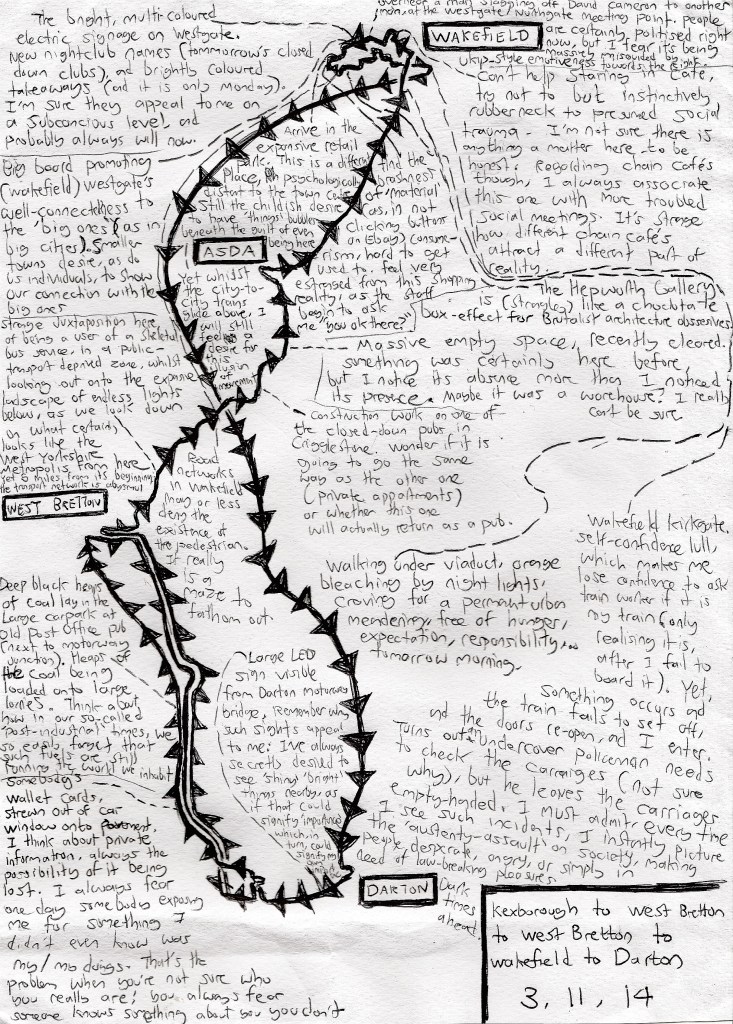
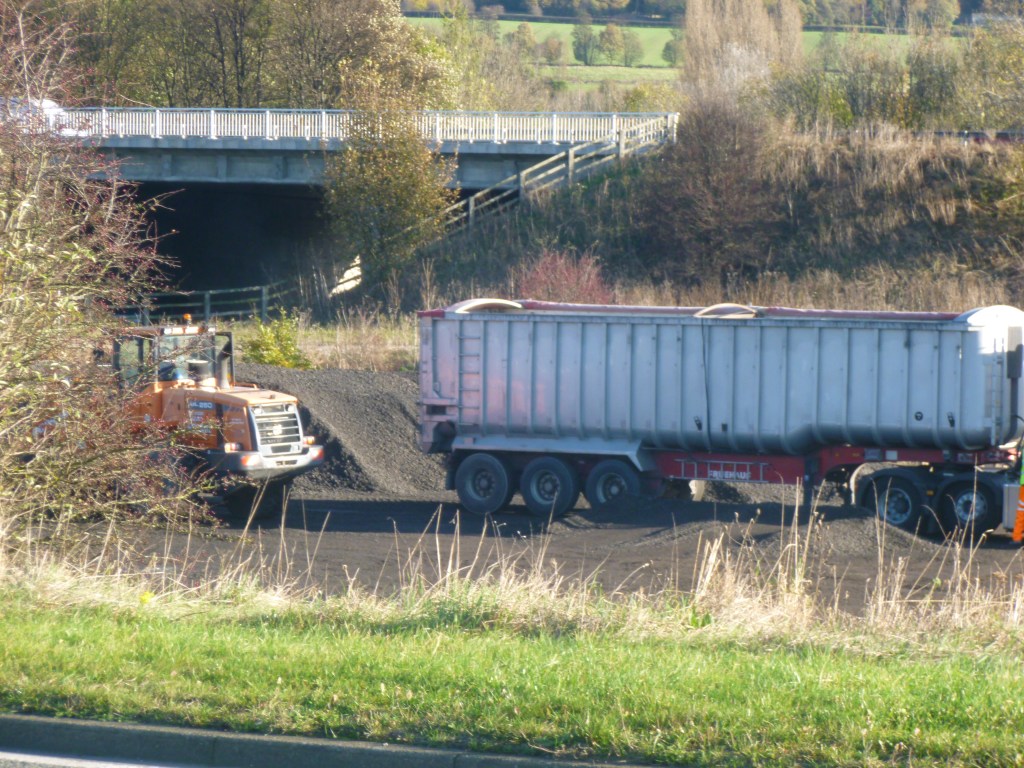
“In once-called ‘Darton West’ we get out the car and walk up towards the recreation ground, which is across from the 1970’s-built cul-de-sac, the only place I still know as ‘home’. Yet on returning it doesn’t quite feel like home anymore. Yet I do feel quite emotional as we approach the first block of council houses to go up in Kexbrough for the miners in the 1930’s. It’s different now, as when I lived here I left and entered the place with ASAP-speed, with the notion of home then being too caught up with my fears of falling into dangerously depressive states. But now I see it as I remember it before all that shit; as a child. The rows of 30’s/40’s houses, they are still here; they exist. They exist in their own right just as much as any yuppie tower block are doing right now in some place elsewhere.”

“Michael picks up on the clear divide that constitutes the area I grew up in. One road literally slices Kexbrough/Darton into 2 separate places; one of council houses built for workers in the long-gone industries, the other a more aspirational, commuter estate, built up after the opening of the M1 that slices through here. The two sides of the village have never really interacted. Yet there’s a divide even in the commuter-built area; between large detached houses with sandstone fronts (for managers, lawyers, doctors, headteachers?) with the oddly-named Roman Road area, where smaller brick-fronted detached houses cluster slightly more heavily. I can’t explain why it is called Roman Road, but it has changed much since I was young. Like everywhere really. There was a bus that came along here, an hair salon called Caesars, now just another house, and many children playing out on the street. Now there is nothing but passing cars, straggling dog walkers [the only acceptable walker in a car-dominated and paranoid estates], and us, looking weird now the sun is going down.”


“As we head back north we drive past the large door making factory at the bottom of the hill, where a pit yard once was. Acknowledging it in my vision produces a knot in my stomach, and a poker-faced defiance against a slow sliding down toward even worse work and pay conditions, for those (like myself) caught in the headlights between 40hr-working-week dependency, and a sheer lack of job-hunting guile. “I hear […this factory] treats its staff like utter shit”. Michael responds by talking about stories of fist-fights on the factory floor borne out of misdirected misery and frustration. We don’t even need to confirm to each other our sheer disagreement with working conditions having to be this way.”

Stories From Forgotten Space (March/April)


“2 miles north of Wakefield centre. Cutting under a bridge. There is a Large Yorkshire flag planted in somebody’s garden as close to the mainline railway track as possible. The railway represents the gaze of the world passing by. I see more patriotically-placed flags close to railway tracks than anywhere else.”

.
“The future, now drab. Stare out onto the M62 motorway from the bridge. I’m listening to Autobahn by Kraftwerk, with an hyper-realist album cover (always in mind, when listening to the album), and a Utopianist outlook on the still-then-new motorway systems. In this world we now have , when motorways are supersaturated into the netting of everyday life, their beauty is there still, yet it is inaccessible – whilst trapped in a series of systems that are threatening to destroy us.”


“A view of central Leeds from inside the large housing estate of Middleton. The Blade-Runner-made-real-by-Dubai effect of Bridgewater Place (specifically) juxtaposed with the style of redbrick houses council houses my grandparents, and their contemporaries, both raised our parents and dragged their parents into from the Victorian slums, creates two opposing worlds. A world of superclass and underclass, of sci-fi dog-eat-dog-dystopia actualised, contrasting with the post war working class life of mild frustration, old religious ornaments (clinging on in a Brave New World), soggy crackers and hard bread. Still inhabited houses, occupied by proud owners seem to jolt into a reality that they have been told they don’t belong in. The popular music from the 60’s/70’s/80’s still seems to echo off the buildings constituting these estates, but nothing post 2000.”

“In Quality Save in the Merrion Centre, Leeds, now a low-budget shopping centre, pushed as far from the train station as possible. The stress is always far more tangible in these shops, the children cry with a harshness and duration not witnessed in the shops further down towards the upmarket end. It is too much for my dehydrated, weekend-discontented self to deal with, and I have to drop my intended purchases and swap this ‘contained’ noise for the open-air noise of the roads outside.”

.
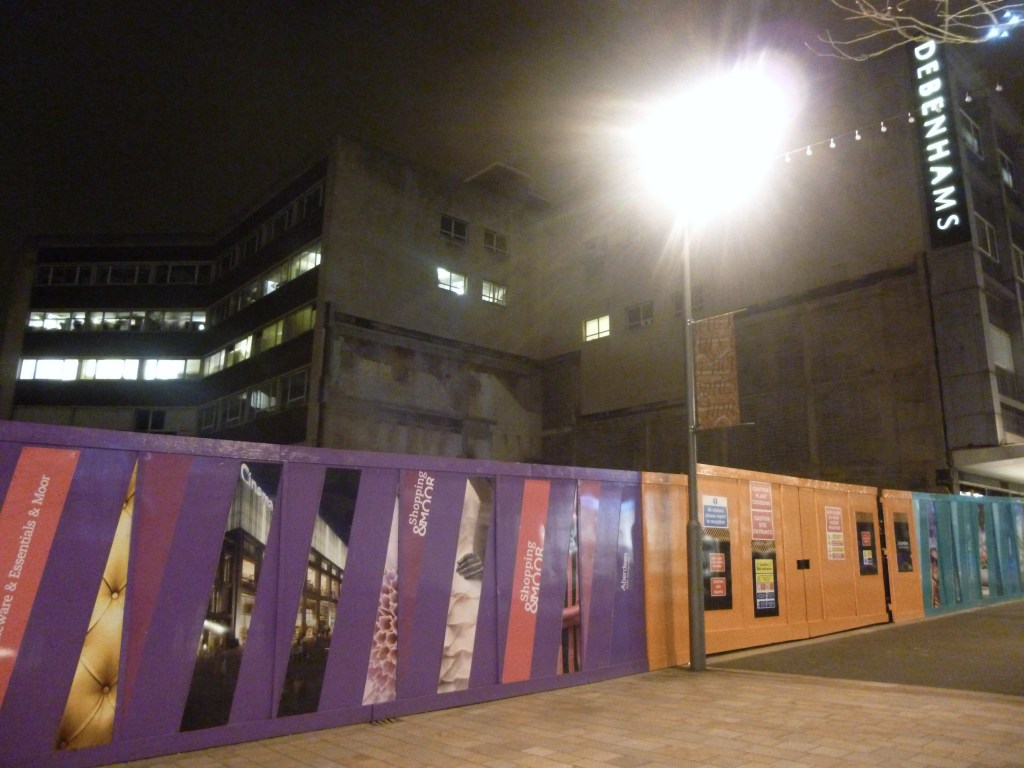
“Two men and a woman, in low-budget clothing, and drenched from the afternoon downpour (the poor never manage to evade the rain), walk down the road that divides the older working class part of central Leeds, the open air market and bus station, with the newer promotional images of glamour, posted up on the boards circumventing the construction of an high-end-consumer complex, which aims to be an appendage to the bastion-of-arrogance The Victoria Quarter – an enclave of very high end consumables, just across the road. I feel a violence from being sandwiched between a life of poverty that nobody desires, and 6 foot photographs of ‘chiselled’ and vibrant representatives of a world that shows no empathy to a hard life that wears away the such ‘modelling’ looks.”


“I walk up a side street towards Westgate in Wakefield centre, containing Mexican/Latin-themed bars/eateries. Whenever I see enclaves made for social occasions, my body throws out an instantly-vapourising excitement. It is a perpetually-frustrated excitement, borne out of factors (such as the promises, and a loneliness) specific to our times, due to a potential for social space that I neither ever tap into, or lacks the ability to be tapped into due to being nothing other than an image of socialising.”

April 4 2015

“Walking down Smyth Street, Wakefield city centre. There is a poster on the side of a club for an upcoming Heaven 17 gig – a group known for their ‘Temptation’ track. But that was well over 30 years ago. Something so distant, made near again through comeback tours. But it still feels distant, like it doesn’t belong here now, but is here nonetheless due to the void in genuine cultural production.”

.
“On Ings Road dual carriageway. Under a railway bridge that looks older than everything else on the road, a Sainsburys delivery van drives past me. I can just about make out that somebody has appropriated a phrase made popular after the terrorist killing of the French cartoonist/satirist Charlie Hebdo, (earlier this year) to write ‘Je Suis Clarkson’ in the dirt on the back of the van, seemingly in support of the plight of recently sacked BBC presenter/bully Jeremy Clarkson. The irony in using the words for Jeremy Clarkson, however, is possibly lost on the writer. As both are/were indeed alike in respect of their (arguably) one-dimensional idea of freedom of speech. It is arguable that both had aimed their “I-can-say-what-I-want/Attack-who-I want” jibes at those in weaker, less powerful positions than themselves.”

.
“A gang of young people have a air of brashness with the entrance into Wakefield bus station – the lurching search for amusement. I walk past them with the intention of exiting the bus station, but turn back on myself in usual Saturday afternoon indecisiveness. Shouts come from behind me. I notice a young male, who turns out to be some sort of ring-leader of the group, who’s hybrid style of urban/street with indie-boy surprises me, still surprised, as I am, by such hybrids in our super-saturated times. He keeps advancing towards a dishevelled-looking man, who looks to have a mixture of alcohol addiction, financial, and learning problems; 3 issues that act as weakness in a bullying culture that this young, confident man, seems happy to exploit in order to amuse his gang. The dishevelled man responds exactly how the gang wishes him to respond by lashing out manically at the young man, in the process exposing the distress that the situation is causing him. The young man capitalises on every sign of vulnerability-viewed-as-weakness to escalate the spectacle. Everybody in the bus station is staring, including myself. I look around to see if any security or police are knocking around – on the few times you wish they were every where – but there are none to be seen. And surely the police would see me as wasting their time? After all no ‘real’ harm is being done, is it? The bullies win – as they always do when the vulnerable are no longer seen as vulnerable, but as losers. And bullying is so saturated into our society, via an emphasis on competition that oozes from screens, and creeps into work places.”

“How can you feel anything but loss walking through the tree-lined suburbs (St John’s area of Wakefield)? ‘We’re all middle class now’ – more faded than any sun-bleached abandoned billboard can ever be. Of course these undead desires of a leafy, suburban, fresh-veg-eating lifestyle still appeal to me; I was at the ripe age in the 1990’s to be saturated with them, believing that it was both totally desirable, to the point where a 2.4 children, ‘happy ending’ seemed inevitable. Not any more. And I feel ashamed it still clings to me.”

.
“A gymnasium offering 24 hour access on the corner of Trinity Walk. Work never ends now. The allure of (the appearance of) productivity, of an enviable, toned, professional and industrious subjectivity is very strong, stronger by the day. But where is the room for life anymore? For happenings, chance encounters?”

.
“Michael speaks of how the non-place nature of the private/public space of Trinity Walk doesn’t quite work for him, due to its usage of previously-existing streets that he remembers from childhood, making for an odd experience where the zero-gravity effect of pure simulacrum-consumption suddenly becomes grounded in a very specific space.”


“How can you feel anything but loss walking through the tree-lined suburbs (St John’s area of Wakefield)? ‘We’re all middle class now’ – more faded than any sun-bleached abandoned billboard can ever be. Of course these undead desires of a leafy, suburban, fresh-veg-eating lifestyle still appeal to me; I was at the ripe age in the 1990’s to be saturated with them, believing that it was both totally desirable, to the point where a 2.4 children, ‘happy ending’ seemed inevitable. Not any more. And I feel ashamed it still clings to me.”


“A gymnasium offering 24 hour access on the corner of Trinity Walk. Work never ends now. The allure of (the appearance of) productivity, of an enviable, toned, professional and industrious subjectivity is very strong, stronger by the day. But where is the room for life anymore? For happenings, chance encounters?”


“Michael speaks of how the non-place nature of the private/public space of Trinity Walk doesn’t quite work for him, due to its usage of previously-existing streets that he remembers from childhood, making for an odd experience where the zero-gravity effect of pure simulacrum-consumption suddenly becomes grounded in a very specific space.”

8 April 2015


After traveling on this road for the first time in 3 weeks (that’s a long time for me not to be in Barnsley) the ‘old girls’ school’, now a compound of mildly-desirable apartments, strikes me as a stand out feature on this very leafy, suburban entrance into a town that still conjures images of ugly, northern grittiness in the minds of the rest of the country. But this leafy avenue is to nowhere, as the town in anticipates is somewhat absent. And it is to the frustration of a ‘native’ of the scattered former coal mining empire that clusters around Barnsley centre. A constant hope for a town centre that offers something. But momentum always fades, and it now seems to have died back more than any time in living memory. To the extent that the suburbs may have lost their entire purpose to Leeds/Sheffield commuter settlements. This entrance is one of those that suggests something that seems to be forever displaced.”

“Sat in chain cafe talking to Dave, 6pm/post-work, only non-alcohol-orientated place open at this time. We are in agreement, that out-and-out revolution just wouldn’t work right now, and we need to get back to a building a socially-progressive structure that can look to a future again. We are sat behind a group of teenage girls. I become aware of the inherently-pretentious-sounding nature of such a conversation, especially within a chain cafe. But their repetitive glances away from their friends are fortunately (or unfortunately) towards their phone screens and my presumed accusation of “trying to sound all clever” is proven to be false. But there again I’ve only ever had such an accusation from older generations. I begin thinking of how the possibly-intentional misconception of what it means to be ‘grown up’ in our culture usually means to become more conservative and to move away from once-held ideals. We mock straight-outta-college young people for acclaiming that “the revolution is coming”, aware of the relentless tide of disappointments awaiting them that will wear this out. But the problem is in our possibly-intentional conflation of idealism with naivety. Older people can still remain true to their ideals for a better world, a long time after their naïve expectations of the immanence of revolution are worn away. They can do this without becoming resigned to ‘the way of the world’ once they accumulate a few small comforts they don’t want to part with.”

“Post 6pm Peel Square/Peel Street. Never seen so many semi-destitute/semi-destroyed lives anaesthetised by drink. On the corner of Peel Square and Market Hill two men crouch over an electricity box, seemingly impatiently trying to see what’s revealed on a scratch-card. As we walk up Peel Street two men struggle to walk, so ‘out of it’ that I mistake their growling expressions as the beginnings of potential hostilities towards me and Dave. I look to my right, up the walkway ‘Dog Lane’, to see a drunken man sat on the steps with his head in his hands. Yeah, it’s been a rare sunny week (to the which the UK seems to always respond by drinking), but this is a dead end getting closer and closer. It can’t go on.”

“The tragedy of ‘Che Bar’. A night club, with that typical semi-derelict look during day time, which means you can never tell whether it has ceased trading or not, offering dead-end night-time pleasure-seeking on a street that (due to the premature cut off caused by the ring road) embodies a dead end. A smashed window with a Cuban flag behind it; but it’s the can of Stella that somebody has somehow managed to lob onto the lettering for ‘Che’ that strikes me and Dave as most tragically symbolic. Che Guevara, a left wing revolutionary. No one image embodies that which stands in the way of revolution/social change in contemporary times that a crate of Stella Artois.”

9, 10 April 2015


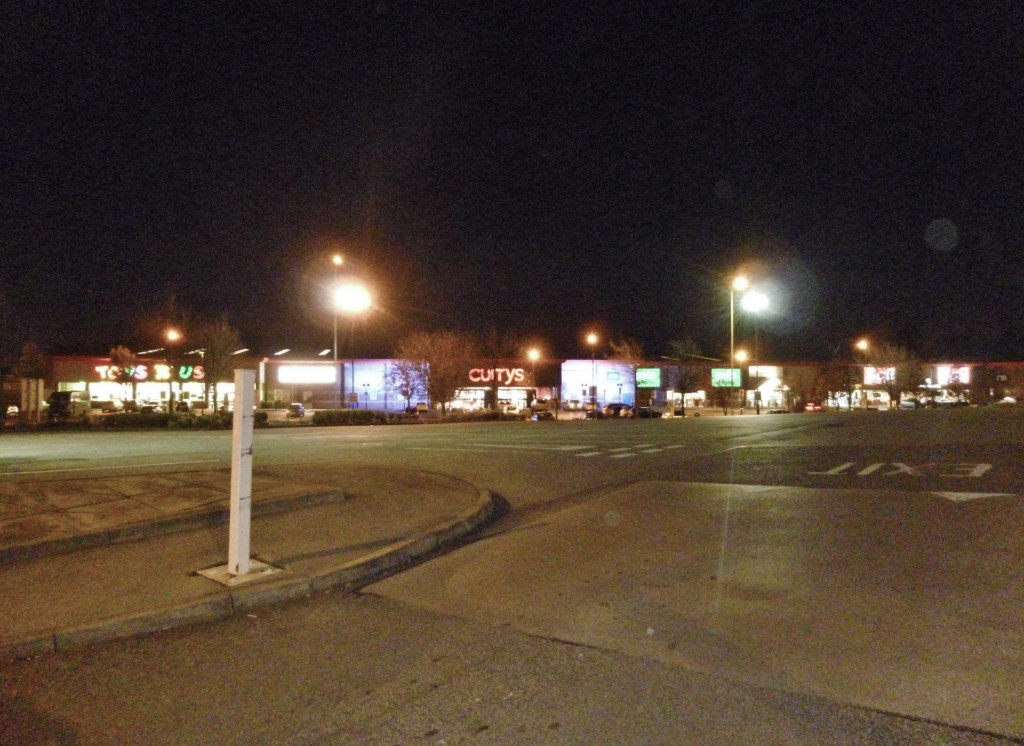
“ #I get so lonely, lonely, lonely. Got to be some good times ahead# – the Freddy Mercury dance song from yesteryear becomes haunting, and fitting, in this post-6pm, empty shopping mall [The Ridings, Wakefield]. A moment that acts as a metaphor for the wider feeling of being ‘stuck’. Aged 9, at the beginning of my life, this was one a few songs to be etched into my thinking that seemed to represent a perceived-ending of something. I become captive the song’s memory-reprising as I frantically root through my rucksack in vain for the camera I thought I’d packed. 9 years old, travelling between Cornish holiday destinations. With recently improved standard of living for the family, Cornwall looked so different from previous holiday destinations; it looked more like they did on the TV. 1993 – a new world seemed to beckon. But what else would I feel in the early 90’s? I caught the wave of cultural optimism telling me that poverty, war and misery had been eradicated by those good people from the century we were close to leaving.

This song: it felt like a closure of all of that – a waving goodbye. But it never went away, it just got stronger.”

“Unlike Barnsley (in fact, unlike any other town I can think of), Wakefield seems to have an active night-life throughout the week, as if it has been permitted to stay in the 90’s/early 00’s indefinitely. The bars are sometimes lacking any revellers, but even then they remain open, playing 90’s House music to nobody. It’s as if the night scene is like an old clock in an unoccupied building that chimes to itself right on time, every day, regardless.”


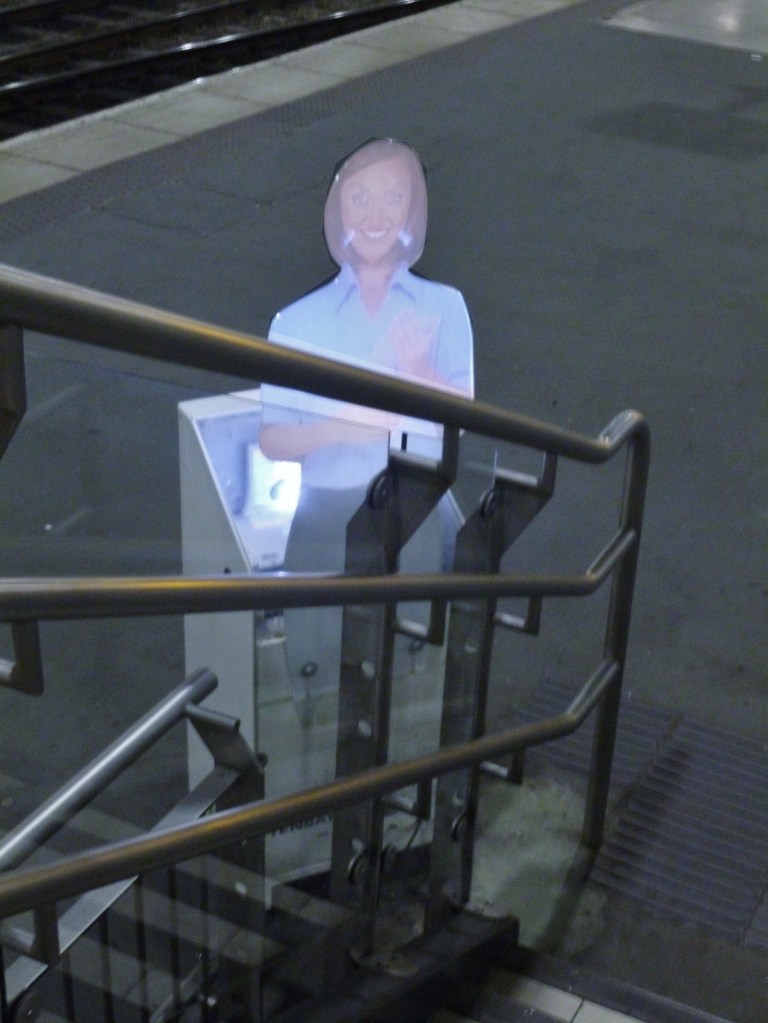
The Tickets Officer approaches me as I enter Kirkgate station’s platforms. Their increasing presence closing in on those fluke times when you get a free ride – those little bits of luck that do much to take some of the weight of everything off your day. Not unfriendly, just non-friendly transactions – as they must always assume that we’re trying to ‘pull a fast one’ at such stations. Notice PMT/SML/PST (? – some abbreviating anyway) above Northern Rail on his staff name tag. A security firm subcontract, or joint venture – whatever it is it makes me queasy. But it’s not the officer’s fault. He hums a tune whilst we wait for the machine to print my ticket. Just like me, he’s trying to make ends meet. The relationship between vendor and customer may be constitutive of false bonds, but maybe they’re the only bonds now holding the entire social structure together, after 40-years-hate-your-neighbour has been drilled into us. I think how futile calls for immediate insurrection, anarchic alternatives are after 40 years of Thatcherism. “We’d tear each other apart – we’ve been bred to hate each other”. Any change surely has to begin with slow social transformation, before any high-end idealism could work – to help us not see each other purely as competitors for diminishing returns.”


“A long queue begins to form in the Poundland shop in Wakefield centre, as the cashier is way behind our contemporary demands for Internet-speed purchasing in the physical world. Nobody who has been emotionally hijacked in futility to prove themselves of worth in an entrepreneurial society can endure being in Poundland for too long. “Why can’t the cashier be faster/better? Why can’t I be faster/better?” What an harsh world we’ve made.”

“Approaching Darton railway station. This railway line (from Sheffield up to Leeds) could stand in for my entire adult life. And I increasingly have this feeling that it at least owes me something.”


10 April 2015

“I pass 30 pence to an homeless woman on the road leading northwards from The Headrow towards the Universities. Homeless on street corners of UK cities so normal now it almost becomes assimilated into the simulcra of ‘city scene’. Not quite entirely though; the exhaustive sense of responsibility and potential vulnerability to homelessness it provokes in me cuts through all the Simulcra City that often eases us into our desire to shirk responsibility.”

.
“Millennium Square [Leeds] empty of fun fares/winter festivals, open space freed up again. Breathable. The only real breathing space in the city – maybe there is down by the canal, but down there the constant barrage of kitted-up joggers provokes too much anxiety over one’s own ‘biopolitical value’. The paving stones of Millennium Square stretch into the horizon of seating areas constituting workers gearing up for their UKWeekend (the macho football-fan-like chanting erupting from one of the tables is too far way to bother me). A young girl takes advantage of the open space to ride her scooter up and down, in a simplistic manner that could momentarily strike you as a shard from our post-war past, in our current securitised, paranoid, surveillance state. Whilst I become mildly incensed over my inability to tell myself just what it is I find so wrong about the big screen replays of the highly skilled performers involved in the ‘Grande Departe 2014’ (the ranter within internally shouts “Jesters for Dystopia!), an homeless man, too honest for me to dispute any of his story, very politely asks me for money for food. But having given change to the homeless woman, and worrying over my own financial-capabilities to stand as tall as I can in this world, I refrain from giving him any change. I feel bad. What could I do? This isn’t breathing space at all. Breathing space doesn’t exist. I move on.”


“Walking past the high rise blocks of ‘luxury apartments’ along the canal-side. Man looks pleased with himself; enjoying the sun. Who can blame him? I want to. I want to blame something. Bad feelings building like nausea. So much choice, no fruition. Always barred entry. It isn’t choice though – always the same stale taste. A group of lads all suited-up. Maybe they work in the city. But all together. In unison. The lads away from home.”

.
“Under the footbridge crossing the canal are the ragged remnants of somebody’s sleeping place. Still used or not – it’s hard to tell. It seems an odd place to choose, but if one is constantly moved on within the city streets, what choice is there? Like the ever-increasing visibility of homelessness on the streets, this again highlights the severity of it.”

“Walking down the side of the canal (where the old Leeds/Liverpool canal ends). Sometimes everybody seems 6 foot; neoliberal perfection achieved in body-form. Jogging, laughing, they make me look like the 1980’s flotsam and jetsam washed up on the shore of the ‘Brave New 90’s’. Of course, this is just the gentrified city landscape, but this acknowledgement just makes it so much worse.”

.
“As I walk this city alone, with every instance collapsing my efforts to be at ease into a now-default gritting of teeth/poker-face, I know in my heart of hearts that my loneliness is a political issue, bigger than me whom it is inflicted upon. Yet in words it will forever provoke its response of violin-strings-mimcry-mockery. My decision to buy a soft drink when I reach the pub, and finally managed to quench my thirst, lapses into a determined desire for an alcoholic drink.”

11 April 2015


“Barnsley central. I always like my home town at this time, within a 11:30AM – 1:30PM period; a short, vibrant energy that vanishes into fear-inducing zombie-pleasure-addiction (like all UK towns?) as the day descends into night. Unfortunately I was more of a captive participator in the latter – one of the reasons I felt It was wise to temporarily leave here, even if such instilled behavioural patterns follow me.

“As I walk toward the exit in a charity shop on Division Street (Sheffield), the Power Ballad CD playing in the shop sticks, repeating a one second point on the song over and over. It always takes us a moment to realise what has occurred. And why do we all smirk when we realise? Is it because such technical faults momentarily reveal the truth? That the ‘stuck record’ is the truth.”

.
“As I look down the hill from West Street I notice a huge banner draped down the side of (what I thought still were) the BT offices. But such a banner surely states that they’re now being converted into student accommodation. The aspirationalism of it all (a word that would sound bizarre in association with student life even a decade ago) is an underlying given due to the “book now/don’t miss out” promise/warning. I would’ve never imagine that such an dominating block of offices within this city would eventually become student accommodation and once-again reminds me of what is big business now in this city. I would’ve never imagined myself thinking negatively of the expansion if universities/colleges within our towns/cities, but maybe I should have been careful of what I wished for. Education purely as business, driven by profit-making, with perpetual expansion is (dare I say it, as a Post-Grad?) beginning to have a parasitical impact on towns and cities rather than a positively-transformative force. It’s depressing, and needn’t be like this.”


“As I walk down towards Sheffield train station I begin to hear one of my least-liked sounds. Is the football-fan-like chanting/jeering the most indicative noise of the experiential-enclosure-affect of towns/cities over the UKWeekend? The potential of passive aggression , and the avoidance and discomfort of places, is largely absent during weekdays. Their search for a jeer-target lands on two young women, who look to have had their weekend’s fun already turned sour, with the men aiming the slur “plastic fantastic” at one of the women due to the dress she is wearing.”

‘Another Lonely Night. Stare at TV Screen’

Relatively recent BBC4 documentaries regarding popular music from the 1970’s to the early 1980’s have once again got me fixated on that I would call the pivotal moment in leaving a world that believed in the future into becoming one that is incredibly despondent, yet whilst being lit-up with an end-of-the-world-selfishness to paper over the melancholia and sickness that prevails. If this sounds like an over-dramatic interpretation of our current predicament, I’ll try my best to explain why I increasingly feel this way, especially in my blog I’m writing regarding the recent showing of the Joy Division documentary on BBC4. However, this blog deals with Kraftwerk, specifically the 5 landmark albums they released in a row from 1974 to 1981 (Autobahn, Radioactivity, Trans Europe Express, The Man Machine and Computer World).

One really interesting thing I find about Kraftwerk, something talked about in David Cunningham‘s essay Kraftwerk and The Image of the Modern,  (featured in Kraftwerk: Music Non Stop) is that they, along with many other German musicians/artists growing up in post-war Germany (I should say, West Germany), sought out something that was their own cultural identity, not the the Anglo-Saxon rock ‘n roll scene at the time of their inception. And in doing so, looked ‘back to the future‘, bypassing the black hole of Nazism to look back to the modernism of early 20th century Germany (such as the Bauhaus movement and the early Frankfurt School). But rather than looking back in a retro-fetish sense, a tendency dominating contemporary music, Cunningham writes that “[T]hey [Kraftwerk] gain their meaning as modern from their dynamic relation to past works [my own italics], through a determinate negation of what precedes them…” and whilst their immediate past was “…the increasingly stagnant conventions of a dominantly Anglo-rock or popular music of the late 1960’s … Kraftwerk’s own articulation of [] modernity, at the level of its accompanying image…is more often the than not dependent upon a certain non-synchronous reactivation of those stranded [by the horrors of Nazism?] objects made up of past visual and conceptual motifs drawn from a specifically 1920’s European Culture.” (2011)

Regardless of its quirks, I’ve never really been interested in listening to very early Kraftwerk, when they had long hair, and played guitar, because somehow it doesn’t feel right. It doesn’t conjure the futuristic, the grand modernist impulse that their 74-81 group of albums do –  an aura that simultaneously remains  exciting to this day to anyone still ‘accidentally’ infected with the desires of a modernism, whilst gut-wrenchingly melancholic due to the conspicuous absence of that aura in our current (non)times.

A74-D-front-250

Why Does the Future Still Feel Analogue?

The first 4 of these aforementioned albums were all released in the 70’s, in an era that I’d argue was still modernist in nature (if we are to talk about the idea of it being an uneven, disjointed, yet somehow still collective grand project looking forwards). And I’d argue that all 4 of these albums, even when they deal with the dark issues looming over the post-war period (Radioactivity, etc), have a real Utopianist essence to them – certainly taking from the early 20th century spirit. But I believe the reason Kraftwerk worked is because it was still possible to be Utopianist in the mid 70’s.

If you listen to Autobahn or Trans-Europe Express on a bright midday moment, when the private-profit social-infrastructure (especially in the UK) is functioning as it is supposed to, you can almost momentarily shirk the gut feeling that the future has disappeared, stolen maybe. Whereas the machines-are-singing-back-to-us Ohm Sweet Ohm, the final moment on 1975’s Radioactivity, can almost be emotionally overwhelming in the way that it conjures the feeling of an almost magical aura, mainly due to its conspicuous absence in these (non)times. (If magical seems like an overly powerful world, I mean that beyond the fog of the aspirational hyperbole of contemporary life, the emptiness seems so engulfing that the likes of me, born halfway into what Franco Berardi called ‘the slow cancellation of the future’, become convinced that the void within contemporary life wasn’t always so hard to avoid.)

The 5th album, however, Computer World, has a crucially different feel to it. Basically it is the end of the modern: Computer World is a postmodern world. I associate the beginnings of postmodernity, with the incoming Margaret Thatcher/Ronald Reagan(1979/81) agenda of “there is no alternative (to capitalism)” (aka ‘no future’), and the increasing individuation which, if anything allowed the creeping digitisation/computerisation of life a much easier penetration of our (increasingly) personal affairs. This only really started to kick in the at the end of the 1970’s and the beginning of the 1980’s, a point when we began to see ‘the slow cancellation of the future’ to (quote both Franco Berardi and Mark Fisher). Computer world was released in 1981, within the crucible of this seismic change, but at which point The New in culture was still possible and still felt “to be infinitely available. [Whilst now] the 21st century is oppressed by a crushing sense of finitude and exhaustion” (Fisher, 2014).

Mark Fisher puts arguments forward at the beginning of his book Ghosts of My Life as to why theorist Fredric Jameson‘s argument that “the postmodern ‘waning of historicity’ is synonymous with “the cultural logic of late capitalism” is a truth. For me it is already a given. And although I’m leaving this as a given with in this blog, I’m saying so as much as I feel that Computer World documents their synonymous relationship, which is why the album sounds more like contemporary life every day, whilst the previous 4 albums both sound like the before and after of this ‘eternal present’ of a computerised quagmire.

Is Computer World the first postmodern album? Maybe not exactly. Many people would say mid-70’s punk, even the Velvet Underground in the late 60’s, were postmodern in their deconstruction of pop music. But for me, Kraftwerk, with these 5 albums really showed that they had their radars fully tuned to the seismic cultural shifts, and, whilst they showed that modernism was still very much a living thing in 70’s,  I’d argue that Computer World was the first album to document the postmodern world we’d all come to recognise – more than anything due to the way that we still see the previous 4 Kraftwerk albums as futuristic.

Kraftwerk-Computer-World-327825

“Business, money, numbers, people”

The words on the tracks Computer World and Numbers are spoken in a very punctuated manner that evokes the pressing of buttons. It all sounds so eerily familiar when we feel lost, powerless, lonely, and insignificant in a post-millennial broadband world, where the information overload fills us with disbelief and a desensitisation to the world, whilst addicting us to the pursuit of contact with others. The loneliness is crucial here; one song on the album evokes the human being sinking further into a cyberspacial abyss, but desperate to be pulled back out of it ...by someone.

“I don’t know what to do, I need a rendezvous”

The track Computer Love is a tragic track in our sad times where it rings so true. It isn’t a song you’d instantly think of when thinking of tear-jerking tracks, but it really does depict our escalating epidemic of loneliness, so movingly written about in 2014 in an article by George Monbiot. A friend once argued that Computer Love was an upbeat track, but for me, hearing it at the back end of 2008, it is a ode to the fate that would fall befall our species. Computer Love not only sounds more relevant today, it seems to depict a potential descent that knows no end. The omnipresence of computerisation enables corporate state interference and profit-motive social media platforms to make us increasingly slave-like to behavioural patterns the increase physical isolation.

Computer Love is far sadder than even Nick Drake’s (for example) odes to the pain of loneliness, because music such as Nick Drake’s evokes a idyll that cyberspacial communications may as well have obliterated due to the way to it disconnects us from each other whilst purporting to do the opposite (who could anymore imagine the world described by Drake existing, without the constant interruptions from cyberspace or our itching desires to be reconnected to it?). Despite people I know finding true companionship via Online Dating, for me it is a symptom of ‘Our Age of Loneliness‘ (Monbiot) and is, like all social media platforms, saturated with the imperatives of a marketised form of individualism, with the obnoxiously elitist dating sites being at the extreme end of this. Online Dating seems to me to now be a ‘When in Rome’ situation: although people do find love/happiness etc, the reason people go onto it is because we’ve become so lonely as a species that meeting people in any other way can seem impossible.

_64711980_64585037

Kraftwerk  – After the Future

After The Future is the title of a Franco Berardi book that examines how this slow cancellation of the future from the late 70’s onwards occurred. With Autobahn (1974), Radioactivity (1975), Trans Europe Exrpess (1977), The Man Machine (1978),  Kraftwerk entice us with visions of ‘tomorrow’s world’. However, once they had produced Computer World (1981), which “might well be Kraftwerk’s greatest achievement…” with “…its turn to the increasingly abstract spaces of  the global rather than the European…” (Cunningham), was there a future left for Kraftwerk to articulate? David Cunningham seems to suggest that the group lost their way after this album, with in a air of inevitability due to the wider context, with “the return of vague invocations of a European avante garde coffee-shop culture on Electric Cafe (1986), seeming unconvincing and unfocused.”

The fact that The BBC broadcast the Kraftwerk,  Joy Division, and Synth Britannia documentaries all within the space of a month inevitability touched upon something. They had an air of difference from music documentaries focusing on the 60’s or post-89 music documentaries. But what made them different, and why show them all now?  Although all documentaries were intelligible and sensitive to the changes to how we live, and lived in the 70’s/80’s, they were finally frustrating in how they failed to recognise why (I believe) they were even being shown now; not just the high demand for nostalgia for (a time that believed in) the future, but melancholia that constitutes the hipster-less moments of wanting a future again. The Joy Division documentary (for example) articulated the creeping social, political and existential misery that the band channeled with uncanny brilliance, but then completely failed to pick up on/or even acknowledge that the reason such documentaries are being made now is due to the undead presence of these feelings, oozing from the cracks between the hyperbolic lies of the late capitalist pleasure sphere; I am convinced that the reason Joy Division T-shirts are being worn by people born after 1990’s ‘Britpop’ isn’t down to the fashionable nature of ‘dark things’, but is actually because they speak a truth, denied mainstream articulation, that an increasing majority of us connect with.

The Kraftwerk documentary used the Utopianist track Neon Lights to soundtrack a sped-up drive through central London, with no sense of irony. Yes, on a superficial level Postmodern London gels with the essence of Neon Lights, but having spent hours on end aimlessly strolling the totalised-urban-space of the centre, I am left feeling tomorrow’s world was hijacked, gutted, and yet left as a undead body in which to inhabit. I experience elements of Kraftwerk’s post-millennium tours, upon which this documentary rested, and focussed on as its foreground, like I would a much-liked device that has now been unplugged from the mains that initially supplied it with so much inventiveness. With the accompanying blocky computerised imagery inaccessable as anything but 80’s-computer-pastiche to anyone living now, I experience the comeback tours as Kraftwerk being subsumed into commodity fetish. Yet the documentary seems as oblivious to this as the Joy Division documentary seemed oblivious to the ridged-persistence of the pain the band evoked.

To me, their post-millennial comeback tours seem as tragic as the initially-intuitive documentaries uncritical response the usage of the Computer Love melody by post-millennial consumer-emotions-band Coldplay. Now, as far as sugary enjoyment goes, there’s a couple of tracks from the early Coldplay albums I do like; but an uncritical response to a band like Coldplay borrowing a melody from something-much-more-than-a-band that helped us imagine another type of world seems mildly criminal to the likes of someone who, no matter what, can never come to terms with the narrowed idea of life and civilisation that we’re sold every day. This is an entrenched feeling, borne out of daily reactions to life today, and I won’t suddenly envisage a better future by someone telling me “there’s decent contemporary [musical] artists out there...if only you’d try to look for them.”

Stories From Forgotten Space (March)

Stories From Forgotten Space builds on 2014 Mapmaking with the aim of taking the most prominent features of the project a little further.


“Passing through the Thornes area of Wakefield. Leafy, inner-city suburbia, with sun shining on rooftops. Like many things from a surface level inspection, it should all feel right/OK. But it just doesn’t.”

“Sat in a cafe made almost entirely of windows, in the 4 year old, yet seemingly still brand new, Trinity Walk shopping Complex [Wakefield]. A shopping plaza that after all this time still prompts the gut-reaction-word ‘Americanized’ within a UK citizen. The windows help give perspective, pause for contemplation. Sat here I can see as clear as possible the contradictions of the current state of affairs (and my own immobility within it), yet I am as perplexed as ever as to how this state of affairs could be transcended. Two women from the Baby Boomer generation chatter away on the table behind me. For all us 35 years and younger, largely services workers, locked into communicative capitalism, we are probably the most articulate, linguistically-competent generation ever. Yet we were sold down the line, by the ‘Blairites’ more than anyone else. We now perpetually fight the feeling of being ‘surplus to requirements’.”

“With my guard down more than usual, within a fleeting hope within a sunny midday point, I create a fleeting fondness for the young woman shop attendant giving me assistance with the damaged phone I possess. But how can it be anything more than a fleeting dream? For an emotionally-detached person, who lacks the ability to find ‘tastes’, ‘preferences’ and ‘hobbies’ to fill those in-between points in life, I’m more up against it than ever in a lonelier, more cynical world, where Internet dating takes precedence.”

“A young woman, clearly a victim of Anorexia, is caught in a moment of indecision over what food products to buy in central Wakefield’s 2nd Sainsburys superstore. Personal memory prompts me to envisage the anorexic subject as a perpetual prisoner to these palaces of excess choice. “Trapped between life and death” by paraphrase a Manic Street Preachers song on the same subject.”

“The train stops in the hinterland of Holbeck/Wortley whilst waiting for room in Leeds train station. Sun light in the window creates a false wall on the landscape. I think about this thing I just don’t seem to be able to get around: an invisible wall that, in turn, makes all alternatives to the place I’m stuck in invisible. But they must be there; I’ve seen glimmers of them throughout my life.”

“Leaving the Waterstones bookstore, the eyes of Audrey Hepburn gleam back at me from a photograph calendar. ‘The Dead won’t go away’. At the other side of the room, the smiling faces of celebrity chefs rebound back from production-line lifestyle cookery books. To me, this all wishes to end itself now.

“Staring up the river [Aire] at a now gentrified landscape, yet consisting of appealing redbrick buildings all the same. However, the Bridgewater tower, hangs over the buildings like a giant upturned N64 or Internet hub system. It is a monstrous imposition, mainly because of the Dubai-like world it suggests. Serving as a constant reminder of the criminally-unequal logic of neoliberal capitalism that potentially still lays in store for this country. I run out of words whilst staring at the reflections on the night-time river; trying to look for clues – a way out.”

7 March 2015

“Haigh. On one side of the road there remains a slightly derelict red brick wall, which must have been something to do with the mine that once stood here. On the other side of the road, two bungalows are being built on waste ground. Private property – the only thing that seems to be built these days.”

“The adrenalin from running, mixed with that fact that I’m now within my most consistently melancholic period I can recall, makes everything from here on this vantage point ridge-way over South and West Yorks somewhat tragically symbolic. This sense of loss, of dysfunction feels so environing that it cannot simply be specific to my own subjectivity. And even if it is, my current inability to get out if this predicament, necessitates my need to write about the external as if it is so. There is a great view of the dark grey figure of Emley Moor Mast from here. It specifically seems symbolic of something missing, as if their aura can only be felt in a melancholic sense.”

“On Wilthorpe Road a middle aged man is clearly struggling with the weight of his rucksack. Regardless of his actual circumstances, thoughts on the forced-acceptance of low pay work, and general country-wide hardship abounds. Low pay enslaves us to work, making us more obedient, and leaving the top down conservative attitude towards work ringing in our ears all day.”

“In the sunlight of a midday that promises springtime, the town [Barnsley] suddenly feels rich with promise. Expansive. It is as perplexing as it is dispiriting how this changes into its opposite as the day drags on and the streets are slowly engulfed under a desperate search for some kind of stimulus/titillation before the new day.”

“As I stare at a poster advertising for male models, for an establishment specialising in styling male facial hair, in a ‘retro/vintage’ fashion. I realise that whatever it is I’m looking for, I won’t find it within this ‘cultural centre’ situated around Division Street. I’m generalising when I begin to wonder of in today’s world there is only space for two subjects: the hipster and the melancholic.”

“Especially in cities like Sheffield, I seem to be in an endless quest for something. But it never materialises. Or it is forever displaced. I walk over the hill, from West Street down to Solly Street.”

“5 years-worth of fading anti-austerity posters cling to boards covering up disused land next to Sheffield bus station.”


12 March 2015


“From the bus window I can see into a living room in a mid 20th century, endless-suburbia-style, semi-detached house. There is a large abstract painting hung in the space, the kind you’d expect in a ‘homely’ environment that is used to build a future for your family. Expansion rather than contraction.”

“I almost choke on the smell of Ammonia emanating from the floor next to what was once the Royal Hotel [ central Barnsley]. I initially mistake it for the smell of vomit, but nothing so strong and un-shifting could emanate from a single person. I wonder, wildly, whether it is actually an ‘anti-social-behaviour’ deterrent tactic. The town centre has an incredibly high concentration of youths in a perpetually aimless state, which the authorities are always trying to disperse. The ammonia smell is still in my nostrils as I enter into the turquoise-coloured transport interchange; they go awfully together.”

“On the express train to Sheffield. My attempts to hide the drawing I’m working on from the gaze of other passengers fails as a man who I’m sat across from, who looks to be in his 60’s, brings it up in an unending-paragraphs way of speaking, that quickly moves over to his admiration for the “one off” talent of street artist Banksy. My initial thoughts about pretending to exit the train a stop prematurely (at Meadowhall) and then sneaking to the other carriage fills me with guilt, as I’d just be spreading this ruthless (anti)social virus of loneliness, that each generation suffers from, but some just can’t adjust to. If I’d have been reared in a less individualistic atmosphere, I probably now wouldn’t feel physically seized with the urge to try to escape what feels like incarceration (communication). Perhaps it’s also the realisation that in 30 years I could be this man, socially-stranded, and desperate to speak to other human beings in an age that secretly wishes that old faces would just disappear and stopping getting in the way of the ‘bright young things’. In truth he has a decent well-verse life story which isn’t too hard on my work-tired brain.”


“The woman I notice sat talking as I walk past the window of a bar seems to possess an essence of the city [Sheffield] that now seems forever displaced on the actual streets; something about the way she carries off her leather jacket look, conjures a working class confidence, and an inventive popular culture that followed its lead. The city of The Human League an Pulp that now seems no longer present. At least not in the centre.”


‘He’s not setting out to hurt people. He’s got a lot of love in him …He actually, I think, wants to do the right thing. So its more a question of, will power and self discipline and circumstances.’ The sample from the track Etched Headplate by Burial (a song that literally haunted my dreaming in 2014) is so timely as it comes on my Ipod, in how it encapsulates my endless-evening struggle with keeping my frustration with these circumstances at bay. I want to do good. I want to be civil. But there’s a destructive element that sets in many a eve.”


“Semi-Surbuban streets of ex-mining settlements at night – walked them so many times. I feel so faded and old, as if the perfume of youth has finally worn off. Always thought I’d had found my own ground (so to speak) before this inevitable point found me.”

13 March 2015


“The train stops in the usual hinterland just outside Leeds railways station. The majority of the buildings still derelict, sort of waiting in line for the infrastructural developments (especially the southern entrance into Leeds station); for the channels that allow the flow of ‘sparkling financial dust’ to spread virally, and turn it into the late capitalist blend of unending work-consumption, that greets you just north of the river Aire. As I stare at the dirty old railways bridges I realise we have left behind the first hour of the afternoon. From 2pm onwards the looming anticipation of the evening’s depressive lassitude hangs over ever thought/action. The 1pm hour is usually the one I find easiest out of all 24, upon the pivot of the see-saw that each day is.”


“Walking up a pretty tiring steep incline into Burley Park. The hard faces, heavy brows, weight-on-shoulders-look of the poor, which is so so hard to disguise from a world that offers no leg up to those who cannot hide these scars.”
“Overly familiar style of suburbia, and redbrick terraces further down, that possible only remain used due to our characterless, placeless present holding on to character and place from times that have gone. For all that quintessential Leeds-feel, the row upon row of warren-like terraces are certainly not an environment I feel has many positive impacts on your state of mind. A labyrinth-like nature which I’m probably more sensitive to at present due to being drained-tired and stressed from taking the wrong turn from Headingley train station. I mistook the size of these parts of the city, they go and on – a Victorian metropolis.”

“Drained-tired, I decide to stop walking when seeing a young woman at a bus stop makes me trust in frequent buses back to the centre. As I wait, 2 men who have the appearance of one made hard by life, look drunk, punch-drunk and passively-frustrated as they attempt the road. I mistake one of the mens’ decision to return back to the pavement I’m on as him coming up to confront me due to him seeing me looking at him. Despite this not being the case, this gets me feeling aggressively self-defensive. My accent hardens due to this, making the young woman find me undecipherable when I ask her about the next bus.”

“Sitting over a coffee now, I can almost feel the violence, fear, schizophrenia of the city drain out of me and fall from my shoulders, helped by the soft white noise of machinery within the otherwise quiet café. My discontent has, for all my post-grad years, largely centred on having an un-fading desire to have the social freedoms of the city at my beckoning, and my repeated failure in being unable to cope in such an environment.”

“Find myself in a brief cocoon of comfort within the ‘retromaniac’, pop-cultural bar, Jam in Wakefield. Refuge feels like the right word – against the anxious and desperate landscape that envelopes you outside if you find yourself looking at it for too long. This artifice of yesteryear is comforting. Champagne Supernova is playing on the jukebox; a now-20 year old song by Oasis, who seem more spectrally present in ‘indie bars’ the further we move from 1995. Yet again, it is one of those moments that you can imagine being on repeat forever.”

“Far too drunk, forget all else…”

15 March 2015

“With the Starbucks drive-thru (next to junction 29 of the M1) opening into the evening on a Sunday, it really does stick out within a UK landscape where such a sight should actually be far normal to us than it is. Despite any ethical reservations towards chain cafe drive-thru’s, the sight of it feeds off the conversation I’m having in the car about the immiserating unacknowledged social constraints with, specifically, evening-time UK pleasure-pursuings. In contrast to Europe, where pubs (which always contain the potential for frustration to be acted out) aren’t the only places dominating the town centres in the evening.”

“Something close to a physical confrontation appears to be brewing outside this Premier Inn-incorporated pub/eatery [in Barnsley] on this dry Sunday evening. Due to its location (within a ‘commuterist’ inn) it is both a non-place and of non-place-people – which makes the territorial behaviour that comes with drunken confrontations all the more banal.”

“The feeling of being stuck. That – despite what I know, think, see – I feel embedded in a rut that surely encompasses more than myself (yet is left to be dealt with individually). It envelopes all conversation to the extent that I become fixed on the surrounding environment, which when I think about it makes sense; due to looking for ways out. I am currently staring out the windows of the Glasshouse chain pub/eatery, over the terraces the cluster around the south of Barnsley centre. From here. they look like a tightly-packed labyrinth, forcing your eyes to look for exits. the conversation follows suit, and sometimes the landscape helps me think about, and explain the wider predicament so clearly – but it never alters the [my] general scheme of things.”


“Nearing central New Lodge/Athersley, just as the ‘peak-90’s’ club track Let Me be Your Fantasy [Baby D] comes onto my Ipod. This merges with the appearance of two lone males walking their dogs in front of me. Both look to be late 30’s-pushing 40’s. Both look disheveled from hardship, making the baseball caps they wear look like class scars rather than fashion items. Their drained look, prompts me to imagine their draining to have occurred somewhat in unison with the age of this club track, and its consequential genuine-feel-good alienness to the genuine-depression of our current period. That in the mid 90’s both these men and this track possessed a vitality that has since been slowly sucked out.”

“Kingsway, Mapplewell – largely a road consisting of post-war sheltered accommodation. I walk past a telephone box that now looks terribly stranded in an age of ubiquitous cell-phone communication. I remember in the mid 1990’s when an elderly man died of an heart attack in this phone box calling 999, due to being taunted by youths. I was half-shocked as a young teenager at the apparent joy in the malevolence shown to vulnerable adults in this particular conglomerate of villages. I have often wondered whether it was borne out of inescapable boredom, perhaps more acutely felt around this area due to nearly every space being swallowed up by property developers.