I always return to The scene within a short space of its occurrence whether something messed-up happened, or if it was something that seemed to offer more. (failed attempts to live in cities, hyper-paranoiac festival disasters, or that time when someone held my hand for a few seconds). Looking for that Thing, that different Thing, like it was a black box recording. It occurs to me it has something I need.
It always occurs to me after an heavy drinking, and enjoyable, evening. Maybe a false sense of connection to things. But I realise why my apparent stubbornness and refusal to ‘change’ is not going to go away.
“when I was a child is had a fleeting glimpse, out of the corner of my eye. I turned and looked but it had gone”.
I don’t think it’s merely about rare openings to the potential of romance, or a glimpse of a life of brighter colours to this one, aided by drink from the night before. They are just signs that lead to something that has nestled in my unsettled guts for as long as became a socialised being.
But then the night draws in, that space draws in, as the rush hour begins, and the dream-like-ness is washed away.
Whatever it is, it refuses to be rejected as fantasy, whilst it continually remains out of reach, as if my arms can’t stretch far enough, or there is always a pane of glass between me and it.
But the tide is ebbing on the open field of youth. It’s make or break, now. No more resignation to the slow suicide of mundane type.
This blog was written whilst listening to Under the Script Bridge by the Chameleons. It damn well had to be listened to.
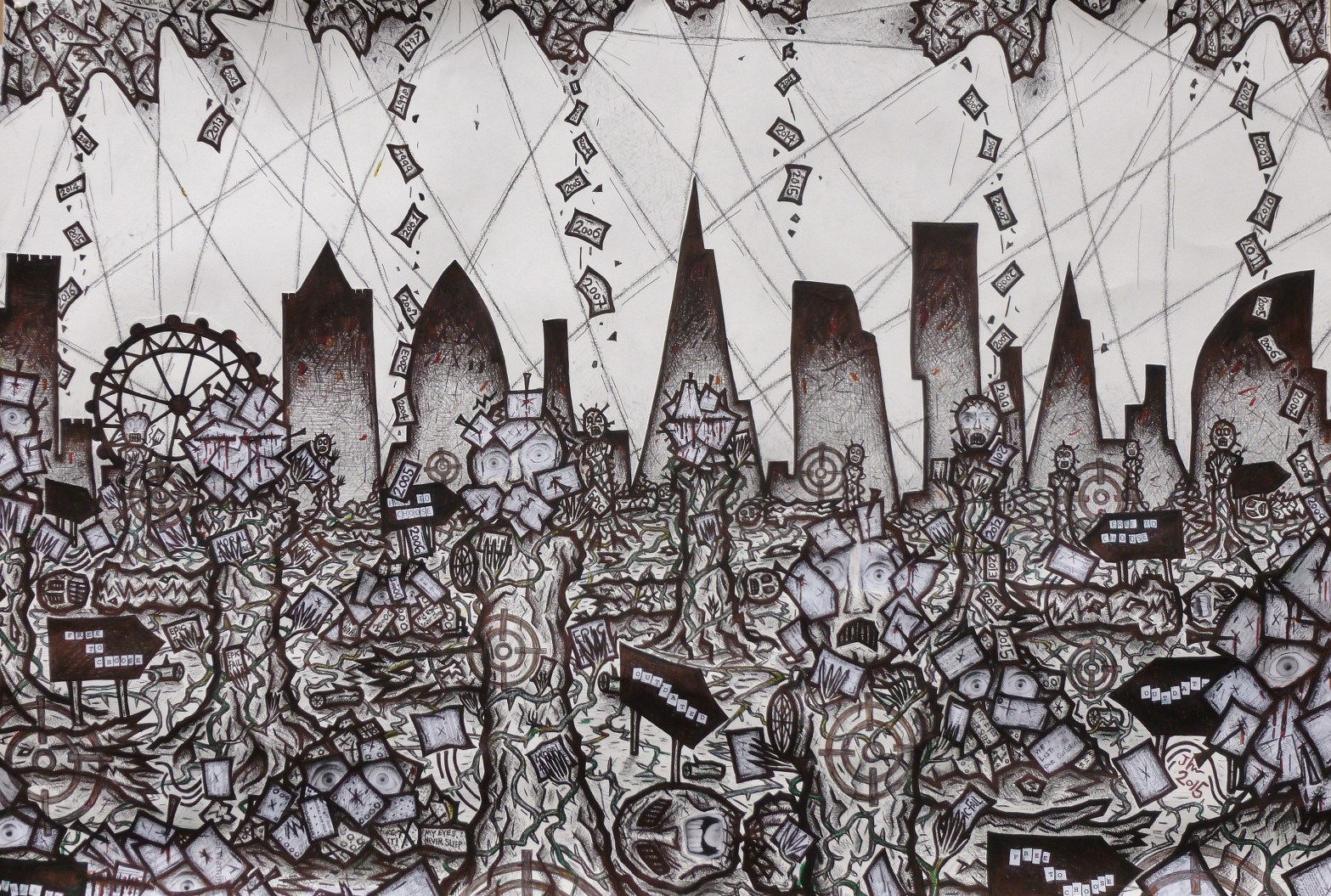
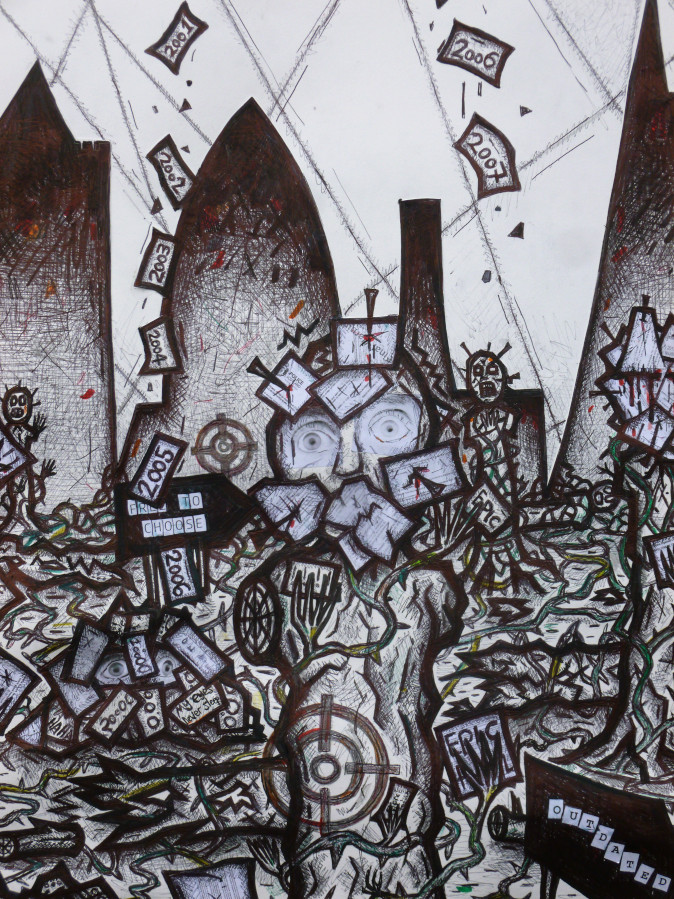
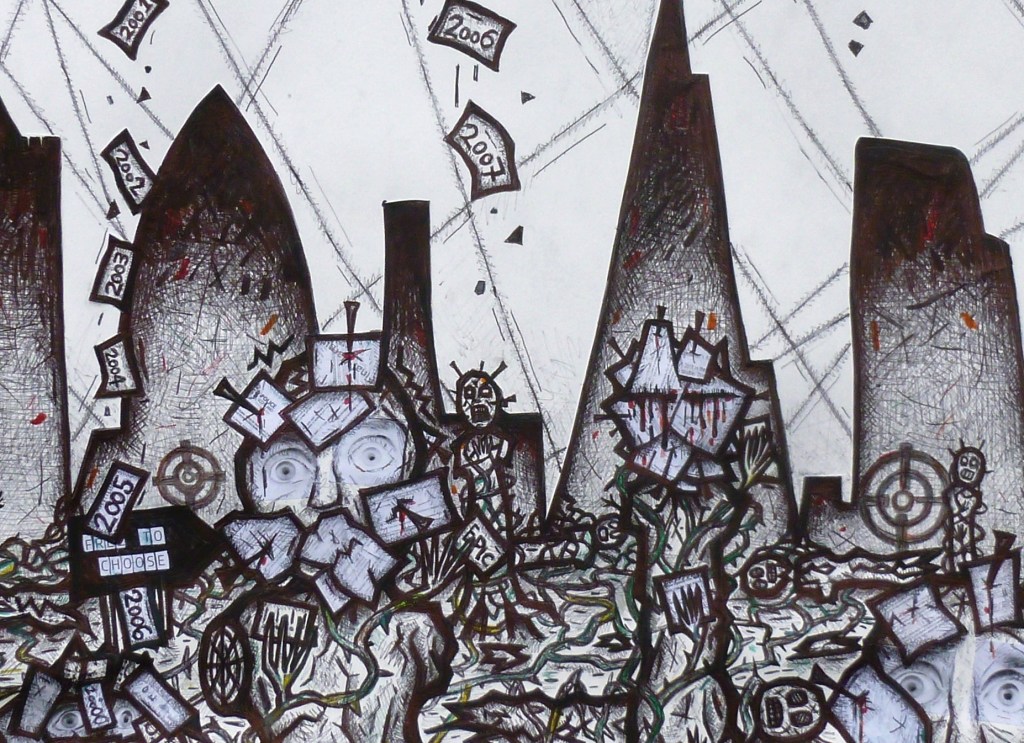
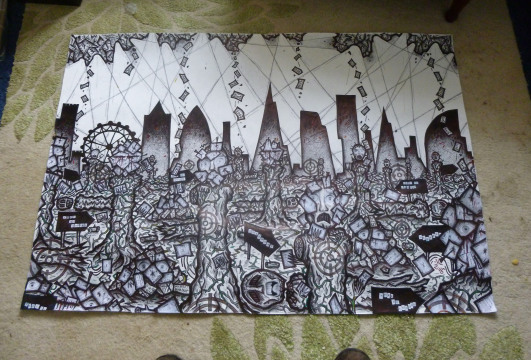
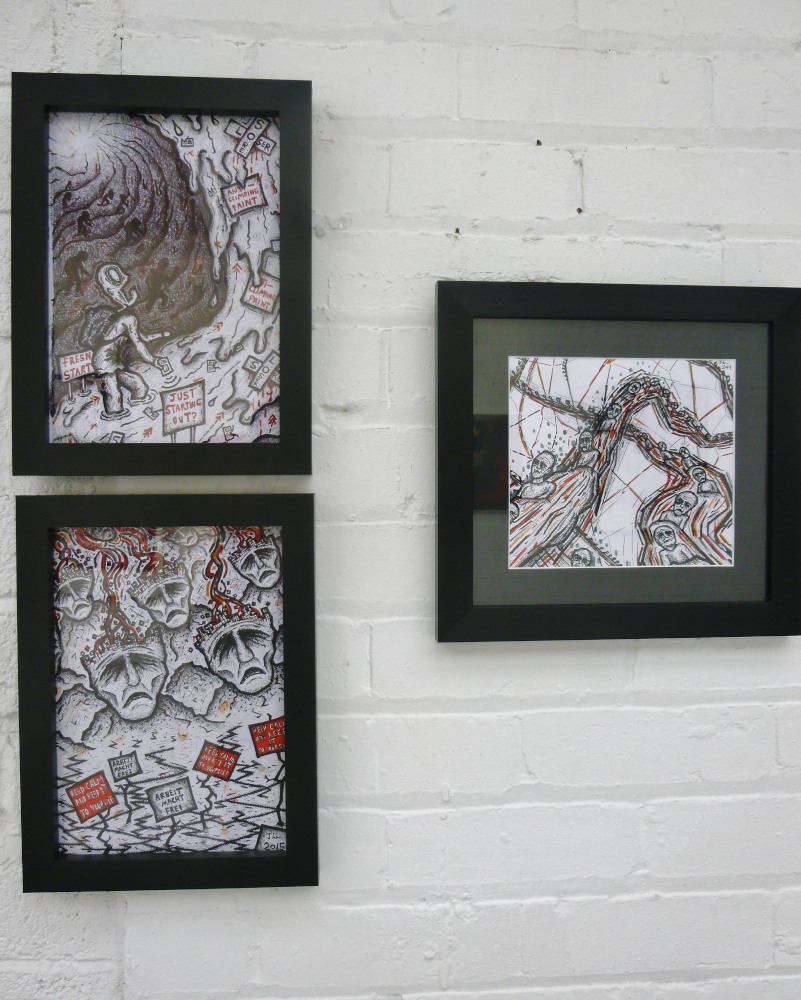
I’ve been on and off with the idea for this piece of work for almost 2 years now, with the initial idea for a work called Debtland coming to mind traveling to Leeds via train on a cold February night I 2014. So I’m glad I finally got around to putting it all together. Sometimes the ideas for my drawings are instantaneously in the right place, and I get on with making them straight away. Pieces such as Debtland sort of grow into so etching worthwhile in the background for a year or so.
Here is a spoken word version of my May blog, Lost Bus Routes and Pre-Election Rambles.
An account of myself and Michael Hill, walking around old haunts (Around South/West Yorkshire), conjuring memories, and futures of the past, on the eve of the 2015 UK General Election. Taking routes where long gone bus routes used to take us.
One hand on a remote Control, a joystick, a keyboard, a touchscreen, itching with a need to turn over stones. Nothing ever matches up, but I feel so wired up that the urge to carry on searching wins every time.
To begin I have to talk about how uncomfortable my disinterest in a recent discovery breakthrough made me feel. News of the ‘Rivers of Mars’ (the headline on the shitbag-from-nowhere The Metro) left absolutely no stain on my train of thought. There seemed to be this lingering sense that it should mean something to me, that the news should run right through me as if I was an electrical rod. Of course, I want it to mean more – I’ve been reared through decades in a society where the words ‘science’ and ‘progress’ are nearly always used in an evangelical light. Yet there is a near total collapse in our faith in the idea that we are progressing to somewhere/something better, all-the-more impounded by the sickly sound the word ‘growth’ has when spouted from the mouths of our world leaders.
The partnership between economic prosperity and civilisation is probably most visibly now defunct in our ambivalence towards discoveries, new technologies that would have, at one time, served as star signs to a better world. Something has turned our radars towards such horizons well-and-truly off. Certain forces have set in, serving as a ‘slow cancellation’ of our faith in the future, making us “oppressed” as Mark Fisher writes (in his book Ghosts of My Life) “by a crushing sense of finitude and exhaustion.” Yet we are still forced to get out of bed in a morning. We have no choice but to go through the motions.
Despite being laced with hypocrisy like an old oak beam is laced with woodworm, Victorian and postwar Britain sustained a collective belief that we were turbulently sailing the seas towards a better world. These pacts that endured through their hypocrisy were torn apart by the emergence of the neoliberal (or market fundamentalist) political economy, and it’s hammering home of its vision of individual guile amidst failed social projects.
There is a synonymous relationship between the move towards neoliberal economics in the 1970s and the rise of the dominance of computer (digital) technologies. It is beyond doubt that they both serve and strengthen each other’s stronghold over reality. In fact the anthropologist and general all round bullshit-busterDavid Graeber argues that the “profound shift, beginning in the 70s, from investment in technologies associated with the possibility of alternative futures, to investment in technologies that furtheres labor and discipline and social control” was instigated by the then-emergent New Right (with their perfect storm-broth of Neoliberal economic theory with Neoconservative politics). He suggests that the economic program they would eventually set in motion under Thatcher and Reagan was motivated by their ‘concerns’ over the potential of a less-work-more-leisure, less economically-driven, and less competitive Western world in the wake of the cultural revolutions and hippy movements of the 1960s. Graeber argues that the Right had finally caught on to the somewhat truth behind the Marxist conviction that “capitalism’s very need to continually revolutionize the means of industrial production, would eventually be its undoing”. Spooked by the social and political progress of the 1960’s they helped put the brakes on this by leading us into an age where one technology would underpin the rest, limiting possibilities and forcing us into an even more work-orientated structure. 40 years later when our ability to contemplate anything, never mind alternative social systems, is literally broken up by our craving to use the devices at our fingertips to find ever-more tasks to complete, we can see who won the war of ideas in the 1970’s.
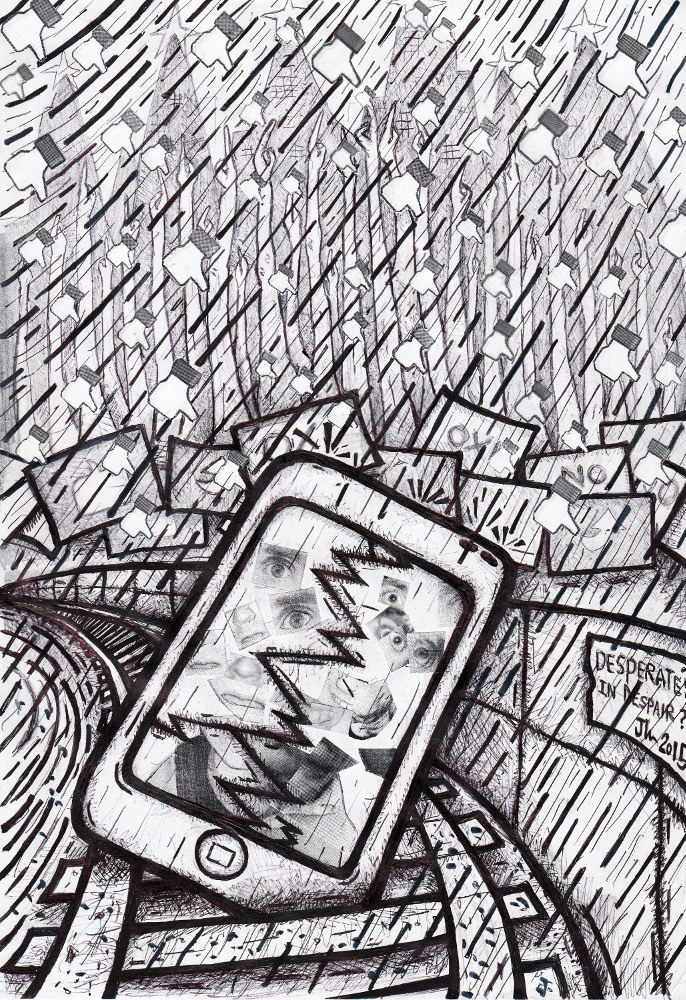
The premise here isn’t that nothing new is possible (I dearly hope the opposite is true), but that the proliferating digitisation of life into security codes and distributive media, that is aggrandized as offering us limitless discovery, actually does more than merely limits our horizons, but actually makes us increasingly tired of life. Computer technologies foreclose all other horizons, compressing them into the same one dimensional blocks of information as everything else, who’s production and distribution, despite promoting difference, hammers down a sensory-attack of the ever-same. There’s Nothing New under Digital Rain.
The words Nothing New under Digital Rain came to me last week whilst hurriedly walking to work, as I end up doing nearly every morning. I have to enter the rural gap between the disjointed conurbations of West and South Yorkshire to get here – hardly the epicentre of cyberspacial connectivity. Digital Rain is a track by the music artist Zomby (from his 2011 album Dedication), who’s very sound takes the one-time-euphoric sound of late 20th century rave music, and takes it under the digital downpour of the 21st century, from where it literally sounds like a disintegration, a collapse of all narrative into an abyss of disbelief.
Even in this relatively broadband-free area, I still exist in a state of apprehension, anticipating unanticipated interruptions to the here and now, and thus having no sense of the here and now. Indeed I am occupied daily by a sense that nothing sticks anymore, that I have no real memory of the past few years, an era in which cyberspacial dependency has increased in conjunction with austerity-age-fueled survivalist anxieties. This clearly isn’t an isolated sensation when 2015 exists as as CGI-version of the 1990’s – the final full decade before the digital downpour. 2015 doesn’t believe in itself. Perhaps here, away from the warm glow of screens, as I walk feverishly quick in order to avoid the embarrassment of being late for work, I can more noticeably recognise that I (we) have been perpetually put to work. Perhapsthe term ‘The Cognitariat’ (which came to my attention through the writings of Italian thinker Franco Berardi) is the best at hand to describe the residual psychological exhaustion of a continuous and largely unrewarded work-life.
In a performance piece myself and Leeds-based curator/artist John Wright undertook earlier in the year, called Non-Stop Inertia: a Stuck Record (named after a succinct account on the contemporary work-life predicament by Ivor Southwood), we concluded that you no longer need to be in the midst of an interruptive Non-Stop environment to be in a state of perpetual apprehension, and that this continual anticipation of the unanticipated may itself be altering our ability to concentrate on the here and now, perhaps more so than computer devices themselves fostering it, which we largely scapegoat the younger generation with, accusing them of speaking in soundbite form. Indeed Jonathan Cary in his book 24/7, suggests that the 24/7 life “has produced an atrophy of Individual patience and deference that are essential to any form of direct democracy: the patience to listen to others, to wait ones turn to speak.” This spreads into every corner of physical life in the all-against-all fixed-race of up-to-our-neck-in-it neoliberalism, where “the waiting that one actually does now – in traffic jams or airport lines – acts to intensify resentment and competitiveness with those nearby”. A work colleague was literally physically attacked in a unprovoked incident recently as a motorist got out of her car and hit her on a seemingly calm autumn morning.
If we aren’t utterly detached, continually sharing ‘buzzfeeds’ and cuddly pics like an electronic-Eloi, then we’re snarling and swearing at those who languish in the very same predicament as us from behind our steering wheels, or within ticket queues. The system is literally sending us mad, and we need to find an exit strategy.
Backwards to go forwards. An acceptance of defeat?
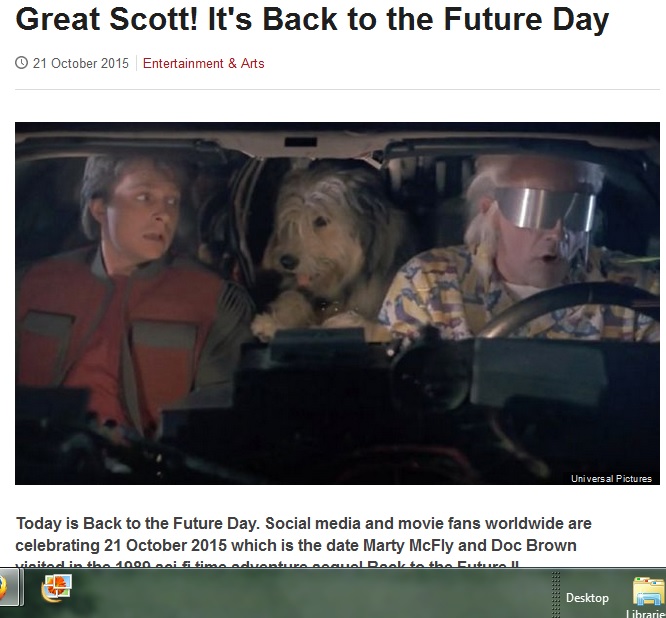
Seriously, is it not possible that the recent craze around the 21st October 2015 being the date when Marty and The Doc traveled into the then-distant future in the 1989 hit film Back to The Future 2 may have been motivated by a longing for us to be able to go back, an then forwards, again? This time onto a better course? Like much retro-phenomena, we are potentially missing the point: that our obsession with them may be down to them alluding to different futures than the one that became our present. One thing is for sure, even if some of the technologies predicted in Back to The Future 2 did arrive, they could not have predicted the depressive nature and lingering sense of broken promises that constitute our digital Dystopia. In 1989 the neoliberal idea was only just beginning to vanquish all other ways of living among each other, and was still far off creating the reality we endure today.
Speaking to my friend/artist Dave Jarvis recently, amidst the initial clarity of drinking, he said “maybe we need to admit we’ve failed?”. This was no knee-jerk reaction. It was a reaction of someone (like myself) who is almost pre-programmed to defend the benefits of contemporary technologies, yet who’s found himself soberly coming to the conclusion that computer technologies have got us so ‘stuck’, in the face of some of the biggest human and ecological crises in the history of our species, that we may have to admit we’ve failed. Concluding that we might have to stop looking for the answers within this technological framework, (which is admittedly hard to do when you’re doing almost everything you do within it), and if not take a step backwards, then at least try to move sideways, out of the way of the glare of the screen.
“One of the standing affronts of disempowerment within 24/7 environments is the incapacitation of daydreaming or of any mode of absent-minded introspection that would otherwise occur in intervals of sloe or vacant time.”
Jonathan Crary’s 24/7 is one of the most moving pieces of prose I have read in a long time. There is an unflinching devotion to the human condition running through the book. He is clearly captive to the longing to see our species transcend capitalist relations. The subtitle of 24/7 is “Late Capitalism and the Ends of Sleep”, and the book warns us that “sleep is a standing affront to capitalism”, due its unproductiveness, and it is being systematically eroded. Yet Crary isn’t just talking about sleeping per-se, it’s about the space to dream, concluding his book with the suggestion that “in many disparate states, including reverie and daydream – the imaginings of a future without capitalism begins as dreams of sleep.”
Such a sentence moved me profoundly, as I suddenly realised how much I shared this sentiment. We are all seeking arrival, a moment when we can finally fucking ‘log out’ for good. Nobody is on the social media all the time, job searching sites in their spare time after work (continuing the daily commute of physical space into cyberspace), because that is where they want to be. They want to be where media platforms promise but never allow them to final arrive at. Over recent years blogs, Facebook posts, and Twitter trends have revealed how the majority of us share the same distress about the world we live in. Social media, unlike Television and Newspapers before it, has allowed us to see that most of us basically want the same things (even if some are led into the destructive demonisation of other social groups). But even if it helps as an initial platform, computer technologies must finally be moved away from as the dominant technological force within our lives.
Acceptance of this does not mean running to the forests, away from the 24/7 world, it means accepting that computer technologies, as David Graeber argues, may not actually be true progress at all, not in the sense of the epoch-defining breakthroughs that went before it. If we can accept that, we may be able to pick up the new tools, ideas, products that have been probably created in-spite of the digital downpour. As my friend John Wright suggests, it’s more than certain that they do already exist, but possibly just can’t be seen by us at the moment: that the tools towards a tommorrow cannot be understood amidst an eternal present under digital rain.
My work is featured in Driftmine’s ongoing online exhibition ‘Affects of Austerity’. With the aim of expanding the exhibition to the point of physically showing it at some near future point.
Over the summer and throughout September, Driftmine had an open call for submissions to it’s Affects of Austerity #AusterityAffects exhibition. No, it wasn’t a grammatical error. Affect is a concept that broadly means having an immediate and unprocessed emotional or psychological (can we separate them?) response to a phenomenon. Driftmine asked people to think about … Continue reading Affects of Austerity Exhibition →
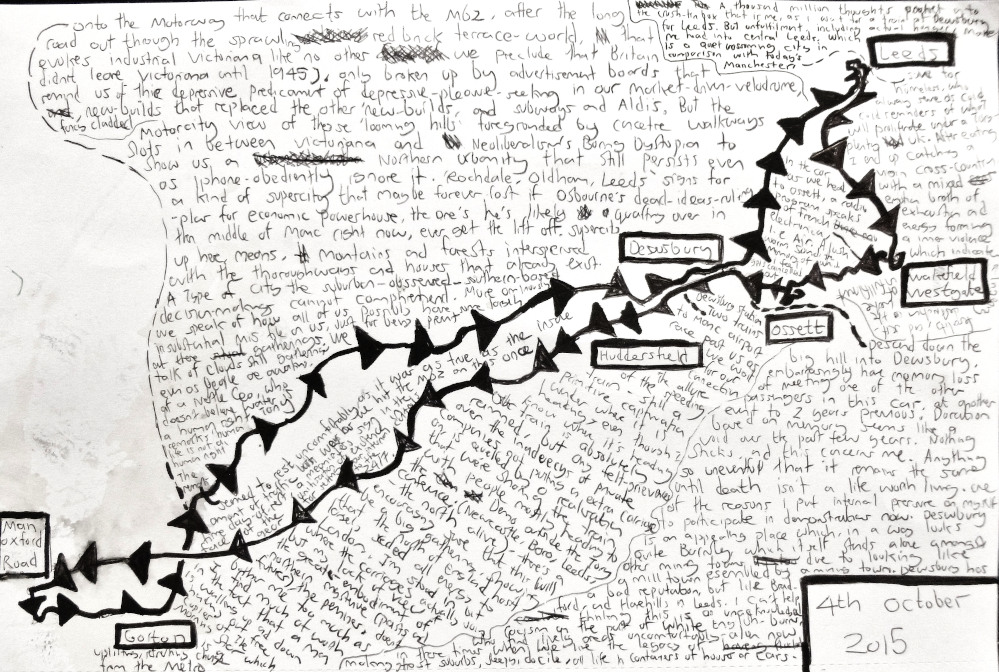
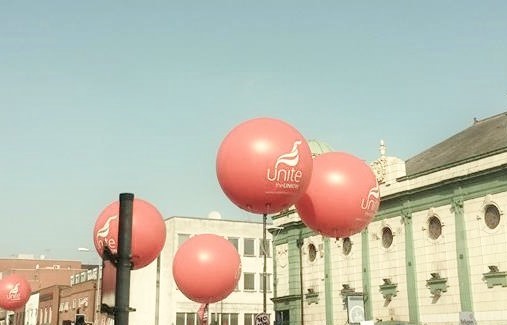
“Michael picks me up early on and we head over to Ossett, a small town sandwiched between Wakefield and Dewsbury; a ligament in the West Yorks conurbation of towns. On the car radio a program speaks of French Electronica, such as the likes of Air – of whom a sample is played. A warm, lush sound. “Why don’t I listen to this more often?” I think to myself, knowing full well I won’t, as something of my reality cancels it out; the warm sunny glow it evokes is squeezed out between the fear and disbelief of these hyper-connected and hyper-competitive times. We pick up Tony and Michael’s partner (both of whom I cannot remember if I’ve met before), and I have a moment of open embarrassment and inner concern over the utter absence of any memory of meeting Michael’s partner at an event almost exactly 2 years ago, as we drop down the hill that brings you to Dewsbury (an attractive town that always surprises you for being so, due its unjustified negative press in the shadow of the Leeds/Harrogate/Ilkley perception of what is good/nice), . I haven’t felt there to be any duration to time or continuity to its passing during the past few years, to the extent that nothing seems to stick anymore – not like it used to. Further more, if this is a common complaint from the elderly who suffer memory loss, could this suggest that something of contemporary life could be bringing about an epidemic of ‘premature’ Alzheimers? – cold stabs of terror that aren’t appropriate to bring into the conversation right now. But any life so uneventful that nothing sticks, and nothing registers until death, isn’t a life worth living, and this is actually one of the reasons contributing to the utmost emphasis I began to place on partaking in political demonstrations in the wake of the May 8 election results. The sun shines on the now-sandblasted yellow sandstone that Dewsbury is built from. It doesn’t look so dissimilar from my home town, Barnsley, which stands alone in Yorks for being a former mining town that looks more like a former mill town.”
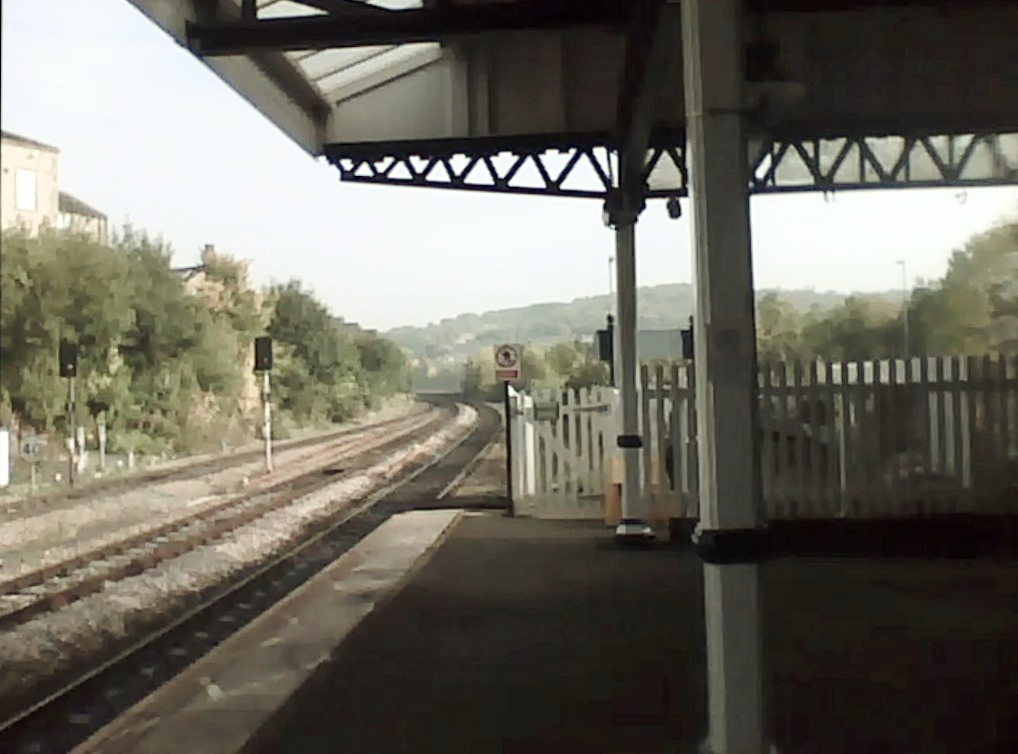
“As we wait for our delayed connection in Dewsbury station, two Manchester Airport-bound trains race past at a pace that can’t help impress in a way that an ever-quicker broadband connection can never. Trains used by TransPennine Express franchise trains aren’t the world’s fastest, but in relation to the still-slightly-slower pace of Sunday life, they are like horizontal space rockets, that force our primitive responses to watch them off into the distance towards the Pennines. As our train approaches we see the Sardine Can-scenario usually reserved for the weekday peak-time commutes. It’s heaving, and the member of staff on the train’s tannoy apologises for this in a tone that may as well have openly spoke of the inadequacy of privatised rail services for not putting on extra carriages. He could probably judge the spirit on board this train, as the majority of the passengers were clearly on course for the anti-Tory demo over in Manchester, and a general good air quelled any of our felt-grievances about being crammed into the wobbly section between the two carriages. With people from the Newcastle, Middlesborough, Leeds Metro areas all piled upon this train, there’s a feeling that The North can show London that not all big demos have to gravitate to the capital. My lack of window views means I’m missing out on my felt-need to see the Pennines as they rise up to separate Yorkshire from the blueprint for modernity – the sprawl of Manchester. However, I find great encouragement in that a man is walking around handing out free copies of the left-wing paper The Morning Star; such a refreshing gesture in comparison to the UK’s usual commuter misery-staple The Metro, which somehow still manages to present itself as not being a right wing rag.”
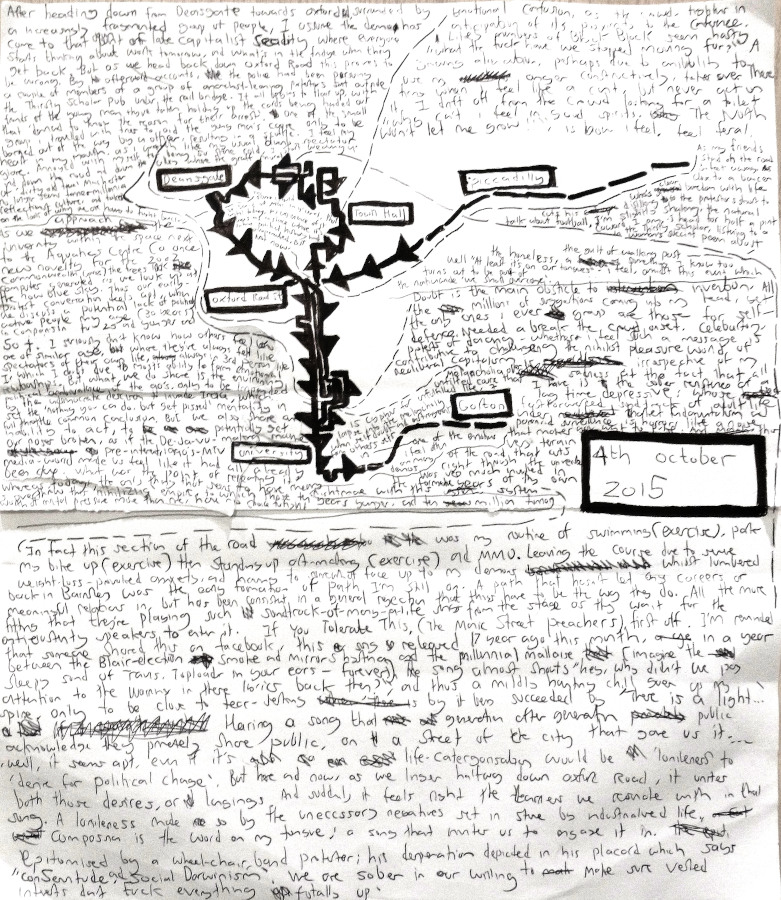
“As we approach Manchester Metropolitan University (MMU), towards the gathering of people, via the carpark next to the Aquatics Centre (a onetime novelty addition to this built-up environment, constructed for the 2002 Commonwealth Games held here), I look up at the surrounding fir trees and into the clear blue sky – it looks computer-generated. I am moving in and out of a melancholia over an unfinished course (at MMU) that is a cipher for an unfulfilled adult life – I lapse into melancholia whenever self doubt and estrangement kicks in when I’m in large social situations. All the more appropriate that I am telling the other two about always feeling like a spectator of my own life, like I’m always in 3rd person to myself, as we’re discussing a potential lack of political engagement within my age group (late 20’s to late 30’s?) compared to those either side of us. Perhaps what my age group shares is the experience of growing up amidst mass political indifference as the so-called ‘end of history’ 90’s passed into the 00’s via the smoke and mirrors of Blair. An ambivalence to anything happening around us that was only compounded by the illusion-of-democracy-erasing military invasion of Iraq, which sent the “nothing you can do but get pissed [find your own privatised happiness]” mentality into a full-throttle common conclusion. My MTV-ED age group share an inability to act, to risk getting our noses broken in the midst of political fracas – maybe because there was an assumption around that millennial moment that everything had already been said and done, and was on constant replay for us now? Whereas today, the only thing that seems to have meaning is to overthrow this ‘nihilizing’ empire, and those ten years younger than I are politically active not because they haven’t been jet-washed with the isolating media technologies and forms like us (as they’ve had it ten times worse since the birth of Broadband), but because they have been left with no illusions about this political-economy offering them any future worth enduring.”
“I move in and out of the crowd, to the toilet and to find [expensive bottled] water, and back onto Oxford Road – the crowd density distorts my perceptions to make me think I am walking far further away. I get Flashbacks to my time here after now standing on this section of road for over two hours, as if the duration of my presence is helping me absorb my old haunts. As I reflect on my inability to act, I realise that doubt is the main obstacle to invention and intervention, and I’m plagued by way too much of it. And all I usually find I can resort to is the sober resistance of a long-time depressive. I think of my life since I came to this place aged 19, and it conjures a soundtrack that is one constant noise….and it makes me nauseous. Leaving that course due to severe weight loss-provoked-anxiety/dysfunction meant I had to go back and face certain demons I’d been literally running, cycling [and swimming – at the Aquatics centre!] away from. This forced out the beginnings of my political awareness and the beginnings of being on the road I am still on. Even if that road now feels blocked.”
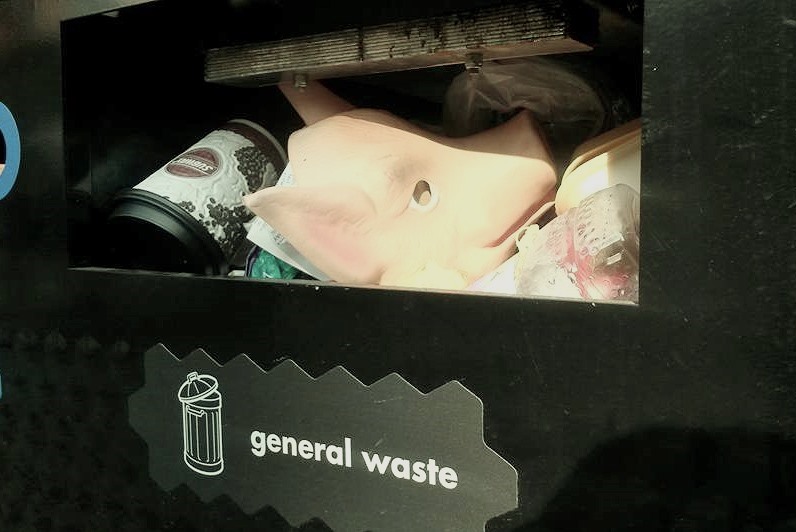
“I’m awash with an hard-to-explain fusion of personal and political memories and feelings as The Manic Street Preachers’ If You Tolerate This plays out to the large crowd packed into the quintessentially narrow streets of this sardine tin-city of mills and terraces. Somebody shared this song on the all-important Facebook newsfeed during the past few days. There is something appropriate about it in 2015, even though it was released 17 years ago(!) this autumn, with a Brit-pop after-the-party musical style, in the year between the ‘things-can-only-get-better’ New Labour victory and the millennial malaise that had Travis/Toploader as its let-down soundtrack. The Manics’ song almost shouts at us “hey, why the hell didn’t we pay attention to the meaning back in the late 90’s?”. They are playing this song, among others from the stage where speakers are soon to enter articulating opposing ideas to the Tories with the aim of giving this crowd hope. If You Tolerate This, in the face of what we’re fighting against, and what disturbing policies are being suggested at the conference up the road, sends shivers all down my arms and legs -“this is serious, deep stuff”. But shivers are nothing close to what hearing The Smiths’ ‘There is a light that never goes out’ is like, played out onto the streets of this city. This all-so-private song, that yet millions upon millions of us have a special place for in our lives, without shame. It’s like when the radio plays your favorite song, and you know that everyone else is hearing too, and how that makes your hairs stand up on your neck. But I bet nearly half the crowd are thinking and feeling exactly like me right now. Why does such a song seem to unite the longings for emotional companionship with the desire for a socio-political revolution? Yet, it does: emotional loneliness and the miseries of living under a ruthlessly-market driven system that requires our atomisation, are part of the same process. Such a song jerks those tears ever-harder in an age when we are all ‘lost-in-commute’ in cyberspace, trying to find our destination, and sick, ever so sick, of living under this system. There is a Light is like a minute’s silence within a national anthem for a de-territorialitised nation of ‘sensitive type’s’, unable to reify themselves for the market-individualism of these times; a silent moment in which they all silently contemplate how they’ve endured, to which the ‘light that never goes out’ becomes an optimistic beacon for our will to survive. As the crowd begins to move, I suppose the sight of wheelchair-bound protesters, draped in skeletons with placards saying ‘fit-for-work’ is a sobering and chilling reminder of the stakes on survival in these times. “Don’t get ill, whatever you do”. One placard sticks with me more than any other: “ConServitude and Social Darwinism” – but so many reminders, yet no sign yet of a closure on this compassion-less reality”.
“We watch most of the demonstration pass us, and as we stay stood down by MMU we join it right at the back. After heading under the bridge, where Oxford Road passes under the inner ring road, we pass a large camp supporting the homeless (echoed by the large graffiti lettering saying ‘homes for the homeless’ written onto a derelict building just over the way). On a visual level only, it resembles the scenes of urban inequality when US cinema dares to show us that nation’s rotten insides. And this is frightening; Manchester is no longer the chilled millennial studenty-indie-music city it became sold to us as in the late 90’s; the politics of class war is once again visible on its streets – a stark reminder that we can’t return to that bubble, we have no choice but to fight back. As we head towards the town hall, we end up clustered among the Black Block – hoods up and mouths covered (“should I be doing that?”). They are frustrated because the crowd has stopped; “what we fucking stopped for?” says one of them with an accent that sounds neither north nor south. Their haste for more direct action against the conference opens up the wounds of my dilemma between who I am, what I think is right, and that inability to act on this makes me uncomfortable about being more cowardly than I wish I was. I begin to lose my temper for reasons I can’t figure out, as my emotional confusion creates my own haste. I leave the crowd and go walking by myself, angry, and mildly paranoid that my abnormal movements will attract attention from the airborne police who may think I’m up to something, rather than just being my aimless self. Constantly feel a need to prove myself, but just walk around chuntering to myself. ”
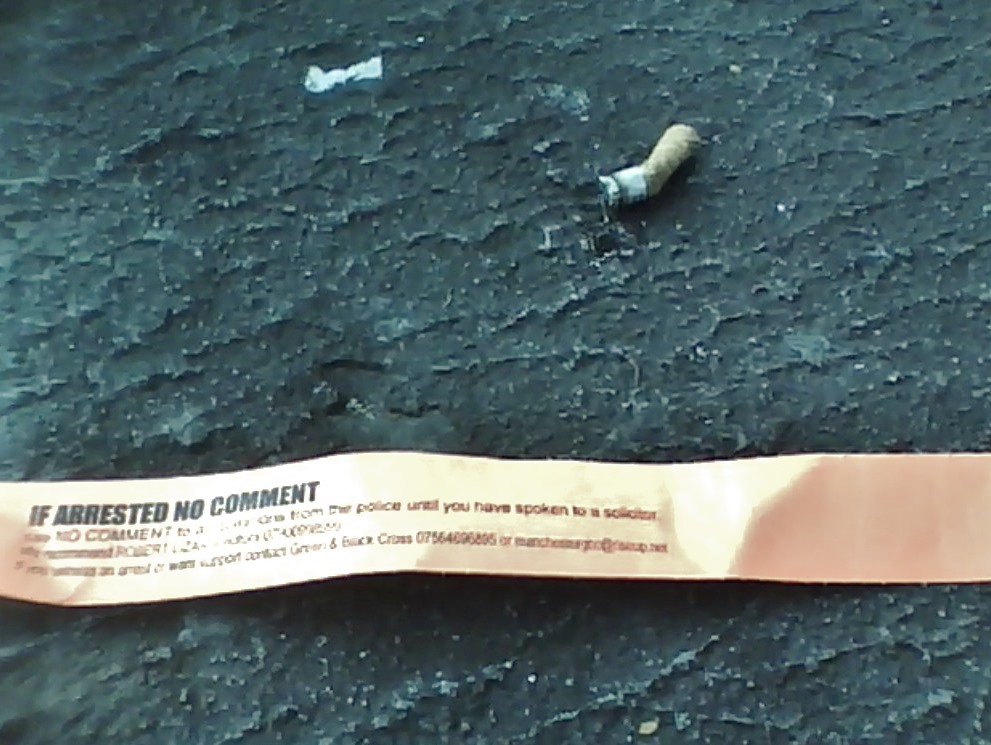
“I eventually return to a level of sociality, retreat from my desire to find a pub, and locate my friends near a pub at Deansgate – where I do have one pint. We head down from here towards Oxford Road, surrounded by an increasingly fragmented group of demonstrators. I assume ‘the demo’ has come to that ‘glass of cold water in the face’ moment of late capitalist ‘realism’ where everyone starts thinking about work tomorrow, and what’s in their fridge for when they get back home (a thought conveniently attended to by the Sainsbury’s store we are now approaching). But as we begin to walk back down Oxford Road this proves to be a massively wrong assumption: whilst stood around the The Thirsty Scholar pub under the railway bridge, the police jump out of a van, approach and arrest a couple of members of an anarchist-leaning group who are having pints outside the pub. Tensions flare up as members/or friends of the young men being taken jump up, brandishing the cards we got handed earlier which state that the police have to state a clear reason for why they are detaining somebody. One of the friends I traveled with tries to intervene to help the young men being incarcerated, only for a police reaction to result in a scuffle that looks like it could get very messed up. And although it doesn’t, the potential sends my cowardly heart right into my mouth, and I’m shaking like always. I watch for what feels like an age with my customary dumb-spectator-glare, only to get more and more annoyed at my inability to act. I end up manically meandering up and down the nearby alleys where the graffiti-mural of ‘dirty old town’ Manchester no longer has that tame-millennia-mush-reflectionist-culture feel to it, and now takes on a look of ‘why we fight back’, which is what could be said of Manchester-2015 in general. As my friends stand on the pavement of Oxford Road absorbing what has just happened, they are in hearing distance of a pub bouncer who is that deeply bored with existence that his initially “everybody hear me(!)” dislike for the protesters is cut short to start talking about the football scores. I’m still shaking, and give in to half a pint within this focal point of trouble, The Thirsty Scholar. I realise I’ve walked into a poetry event, as the woman on stage recites verse on her guilt on walking past an homeless person who is asking for spare change – a guilt I feel I have documented thoroughly during the past few years. The event turns out to be part of this weekend’s nationwide ‘We Shall Overcome’ events.”
“Our friend James, who met up with us towards the end of our time in Manchester today, takes us home in his car, parked on a side-street halfway down Oxford Road. As we exit via the Gorton area of the city, through the mixture of the very-manchester-like red brick terraces, the nowhere place Tesco extras/ Subway sandwich establishments, and drunks stumbling home from Sunday drinking, that seem to constitute the entirety of East Manchester, it all leaves me under an ominous cloud of confusion as to where we go from this point onwards, in the future, and today – as personally speaking, what do you make of the remaining waking hours after such a bombardment of thought and feeling? How do you deal with it, so as to function the day after? As we link up to the motorway system, The conversation leads back to the actions of the police in the city, and focuses in on mild-terror-provoking potential future predicaments in a more extreme, less tolerant world, where state power goes to extreme lengths to stay control. All the more barren does such talk feel due to traveling amidst the overlooked and sinister-beauty of this landscape made up of motorway bridges as they twist and rise in front of the martian-like Pennine terrain, that feels like an unwelcoming ideal setting for the bleak future projections all-so-poorly hidden behind our conversation of tired banter. I decide I can’t go home just yet, and as we pass over into West Yorkshire I ask to be dropped at Dewsbury station, (I mean, we’re going past it, so I may as well) and as the day’s toll on my energy becomes apparent, I exit at Leeds station, almost crawling up to a large Wetherspoons that is scarcely populated in a city that looks deserted in comparison to the one I have just been in.
5 October 2015
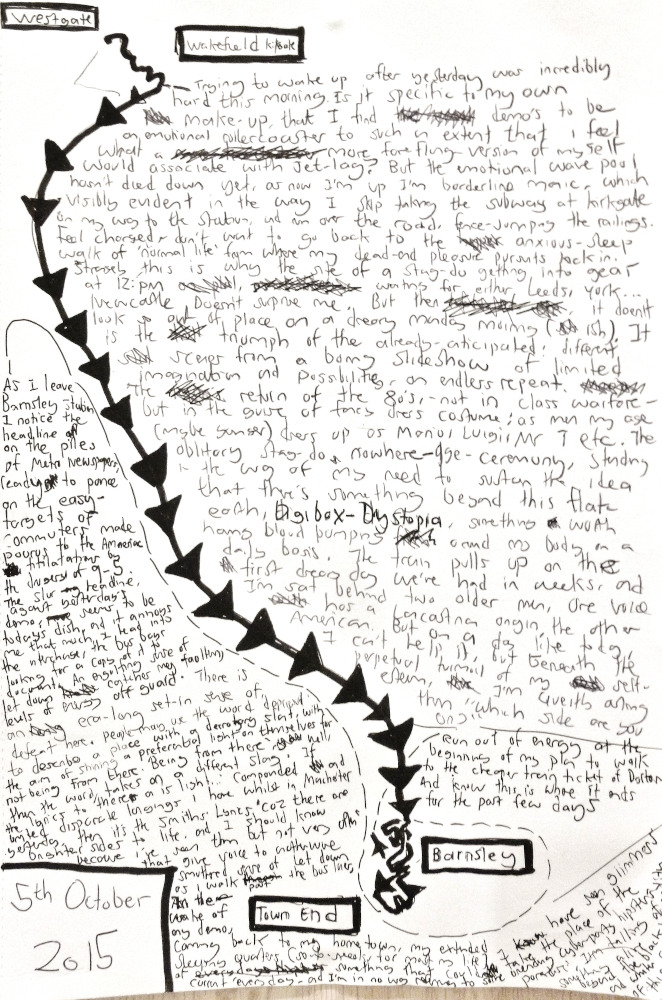
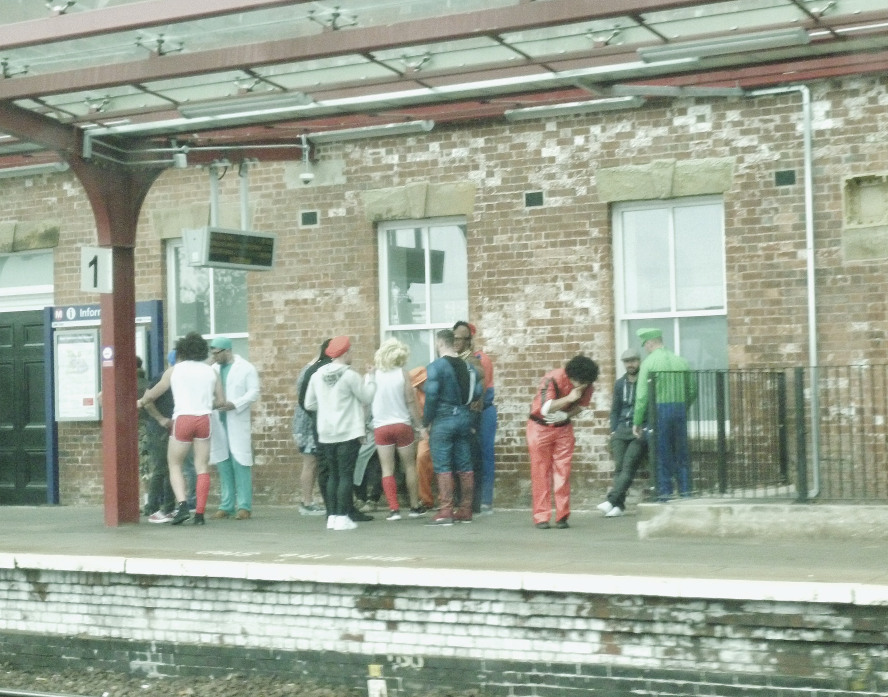
“Trying to wake up this morning, after yesterday, was incredibly hard. Is it specific to my own make-up that I find ‘attending’ demonstrations to be an emotional rollercoaster to such an extent that I experience what a more far-flung version of myself would attribute to ‘jet-lag?’. But the emotional ‘wave-pool’ hasn’t died down yet, as now I’m up and about I’m borderline manic, which I make visibly evident in my haste of avoiding the subway on the way to Wakefield Kirkgate station, skipping over the dual carriageway, and jumping over the railings. I feel charged, you see, and I don’t want to go back to anxious sleep-walk of ‘everyday’ life, from where it’s ‘nihilizing’ affects beat me into daily-depressive-pleasure-seeking. This is why the sight of a stag-do on platform 1, gearing up for a night out (likely heading to York or Newcastle), already spilling beer everywhere, at 12pm on a dreary Monday, doesn’t initially stand out for being out of context. But then I realise that this isn’t down to that fact that I’m out of sync with any normal sequence of events: it’s because such a sight is utterly normal fullstop. It’s just one of many potential scenes from an already-anticipated slideshow; one of limited imagination and possibilities; a slideshow on endless-repeat. The return of the 80’s; not in class warfare, but in caricature, comic book and video-game fancy-dress-rehashing. A now-seemingly-obligatory ceremony for a Nowhere Time. And it’s literally standing in the way of my need to sustain the idea that there’s something beyond this Flat Earth Digi-box-Dystopia. I’m now on platform two as the train pulls in for Barnsley. I’m restless. I’m sat behind two men of baby boomer age – one with a Lancastrian accent, the other American. I can’t help it, but beneath the perpetual turmoil of my self-esteem, I’m quietly looking at the other passenfers and thinking “do you want social change? Are you sick of all of this too?”
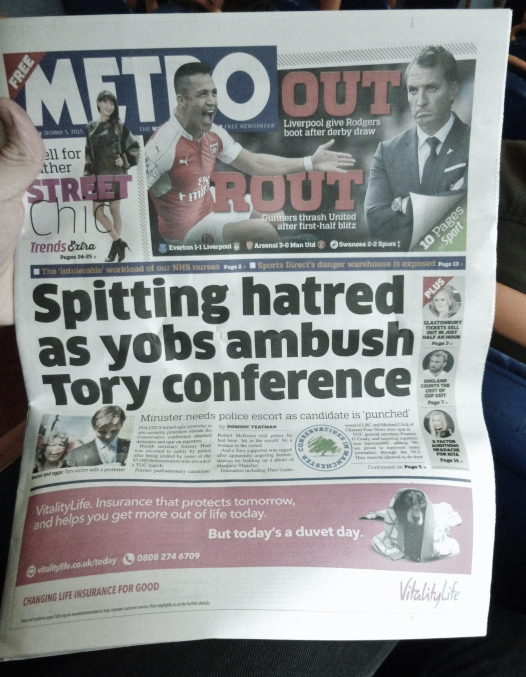
“As I leave Barnsley train station I notice the headline on the piles of The Metro newspapers, ready to pounce on the easy-target of commuters made porous to such amnesiac-titillations by the drudgery of their 9-5’s. Today’s dish is a slur, focusing on a few minor occurrences to tarnish the entirety of yesterday’s demonstrations. It annoys me so much that I head into the interchange, down to the bus bays, looking for a copy I can take with me for documentation purposes only. I become engulfed by a sinking feeling, which captures me off guard as I battle with faltering energy levels. There is an era-long set-in sense of defeat around here. People may use the word ‘depressed’ to describe a place with a derogatory slant with the aim of shining a preferential light on themselves for not being from there (fuck knows what city of gold they come from...). Being from there, well, the word takes on a very different slant altogether. If the song ‘There Is a Light…’ compounded and united disparate longings I have whilst in Manchester yesterday, then it’s The Smiths’ lyrics “…for there are brighter sides to life and I should know because I’ve seen them, but not very often” that currently gives voice to an otherwise unjustified sense of let down, as I walk past the bus lanes. In the wake of being at/or doing anything that momentarily suspends this so-called ‘everyday’, I always get this sense articulated by these Smiths’ lyrics, as I come back to my extended-sleeping-quarters (for most my life) of the Barnsley Borough. I have seen slight glimmers of something that could take the place of this ‘everyday’, and I’m in no way referring to town centres such as this one being ‘Shorditched’ into an unending hipster’s paradise cyberparty. I’m talking of something that feels alive, and is beyond the black and whites of ‘fun/boring’ of this current reality.”
“In the village I was raised in, a distant cousin stands across the road, noticeable by the high-vis jacket he’s wearing. Not sure why he’s stood that side of the road, as by crossing that road you literally leave the mining-settlement-overspill I know as home, to face the farmhouses and barns that predate that former, and in a sense it is a different village entirely. The high-vis vest now alludes to something very different than the sense of pride, or at least place, afforded to the sight of the 20th century miners once present here; for what the high-vis vest signifies is a lack of pride and place – just another number in the global flow of labour, and affords a 25+years local little respect, lacking the worker solidarity of their forefathers, in an aged of ‘LinkedIn’ endless careerist-congratulating, it’s all seen as individual failings/shortcomings – no matter how many of us end up joining the high-vis ranks. I walk past the bookies, which I’ve never stepped foot in, and then the Working Men’s Club, which I haven’t been in since I was 6 or maybe 7, and down the back of the convenience store, crossing the road that literally cuts this settlement into two incompatible pieces; one of council houses for the former miners, and one for the commuters who came once the M1 motorway cuts through here.”
“Sitting backwards for the last leg of this all-too-familiar rail route. I’ve spent what seems like my lifetime, or somebody’s lifetime, looking out of train windows at the same section of the country – a glare never set loose from the feeling, impounded in post-30 life, of being on borrowed time, even if that simply amounts to an awareness of wasting a small wage packet on train tickets. “Don’t Just sit there, do something!” is what the atmosphere on these carriages says to me, as young professionals who seemingly float upon the gaseous quality of this dominant agenda, hijack my window-gazing-solace and force me to listen in to their sharing of next year’s sweetly-poisonous vocation plans. It all sounds so rehearsed, like they’re on a BBC documentary, and I know some of them are imagining shooting themselves in the head whilst they talk, but yet they still carry on making the lie, and make sure the rest of us are beaten down with it. I deal with it by clenching my fists and gnarling my teeth; the only possible response for the unprepared native as he faced the colonisers – and in a way yuppification is colonisation.”
“The night is closing in now as I get on the Supertram. Always like getting an opportunity to travel via Sheffield’s tram system. What is it about it that appeals to me? At a glance, from these sideways seats, it conveys a potential (and the longing that such potential creates) which is what lures me into this city centre, only to be faced with the fall out (and build up) of a neoliberal reality that this city seems to suffer/endure badly more than the other regional cities. Leeds and Manchester seemed to have prospered somewhat in this age, despite vast swathes of their respective populace literally being left in the gutter. But in Sheffield, the homeless issue (for example) stings that little bit harder, because the adaptation to this imposed-agenda here seems so ‘unnatural’, or unnecessarily dominant , like an entire city reacting badly to a medicine it’s been forced to swallow.”
“Langsett View – the tram stop I get off at that refers to the peak district area not far from here. As within Sheffield there is always a possibility of reaching plentiful people or total wilderness at the same time. Perhaps the city is an accidental exemplar for how we should be building our 21st century urban world?”
“Shy and unsure, I find myself slinging my rucksack onto just one shoulder; my default porcupine-posture formed in High School. The steep suburban streets of the uneven sprawl of Sheffield conjure a longing for a good life I think I can recall, but can’t be sure if it’s memories of expectations rather than memories of experience. A distinctly autumn night, perhaps the first of the year. Something that feels like it should be a given right is constantly out of reach. It’s those “avenues all lined with trees” over and over again; those broken promises of, what in hindsight was, a 1990’s cultural counter-revolution against the sci-fi futures of previous decades. I find myself fond of this city, and these leafy, lower middle class suburbs. And I’m unwilling to compromise my meandering to a inadequate substitute – something called ‘life’, but not so.”
“Graveyard train pulls into Wakefield Kirkgate at 12:10am. Frailty borne of fatigue makes a usually familiar UK town seem all-the-more daunting at midnight, amidst the orange lit concrete of its most unfashionable part. Which is why I’m startled, only to become angered, by an over-officious automated voice program, whose distorted car-park warning-info catches me out at the best of times. Disembodied voices with warning-info just impound the sense of distrust in an area you find yourself in. The town is cold, the first cold of autumn. Although nobody is visible, voices that sound best-avoided call out from somewhere. Should I head for one more drink in one of the late-opening bars I would never usually set foot in? Why would I do that to myself? Yet there’s an impulse to do so. As I approach this such area of eternal nights out, Westgate, it takes my fatigue-based inability to show any more compassion to street beggars, to sway me away from it all, as I head up a side street. Just “want to see people and want to see lights” now, no more inconvenient truths tonight. But this female inconvenient truth pursues me a good 50 yards, repeatedly shouting “excuse me” until I can no longer pretend I didn’t hear – she must be that desperate for money. I turn and give her about 25 pence, but I have nothing more, financially or emotionally, to give away tonight.”
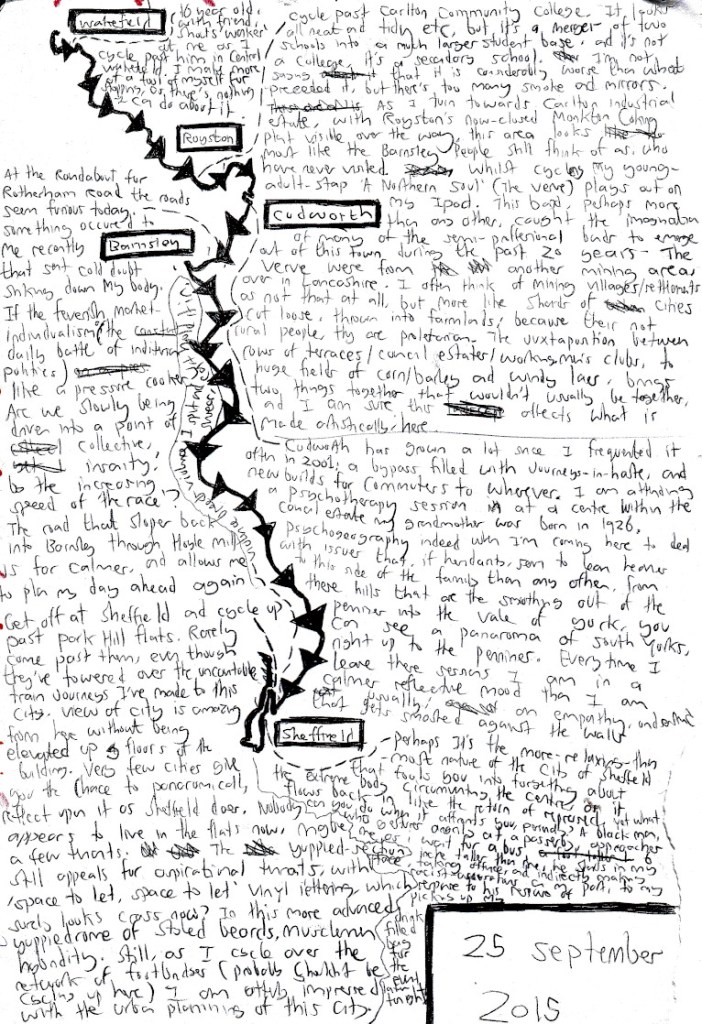
25 September 2015
“I cycle past Carlton Community College on my way to Cudworth, one of many that have silently sprung up around the borough in past half decade. The place looks all neat and tidy etc, but I can’t figure out how it’s a merger of two schools, as it doesn’t look big enough. And it’s not a college, it’s a secondary school – as in this country the word college still predominately means 16+ education. I’ve no real idea if it’s a better or worse state of affairs than what went before it, but there’s way too much smoke and mirrors to find such schemes trustworthy. As I turn towards Carlton industrial estate, I remember that the HS2 project is supposed to cut this jumbled up landscape. With Royston’s Monkton coking plant visible in the distance, this area looks like the impression most people who’ve never been to Barnsley seem to have – one which is normally decades out of date. Whist cycling, my young-adult staple A Northern Soul (The Verve) plays out on my IPod. This band more than any other I can think of caught the imagination of many of the semi-professional bands to emerge out of this town during the past 20 years. The Verve were from another mining area, over in Lancashire. I often think of mining villages as not that villages at all, but more like shards of city suburbs cut loose and slung into farmland; because mining communities are of a proletarian not rural mentality. The Juxtaposition between rows of terraces, council estates, working men’s clubs and large rolling corn fields and windy country lanes, brings two things together that would otherwise never meet, and I wonder if this sensibility is what informed The Verve, and is what informs those from similar places as them.”
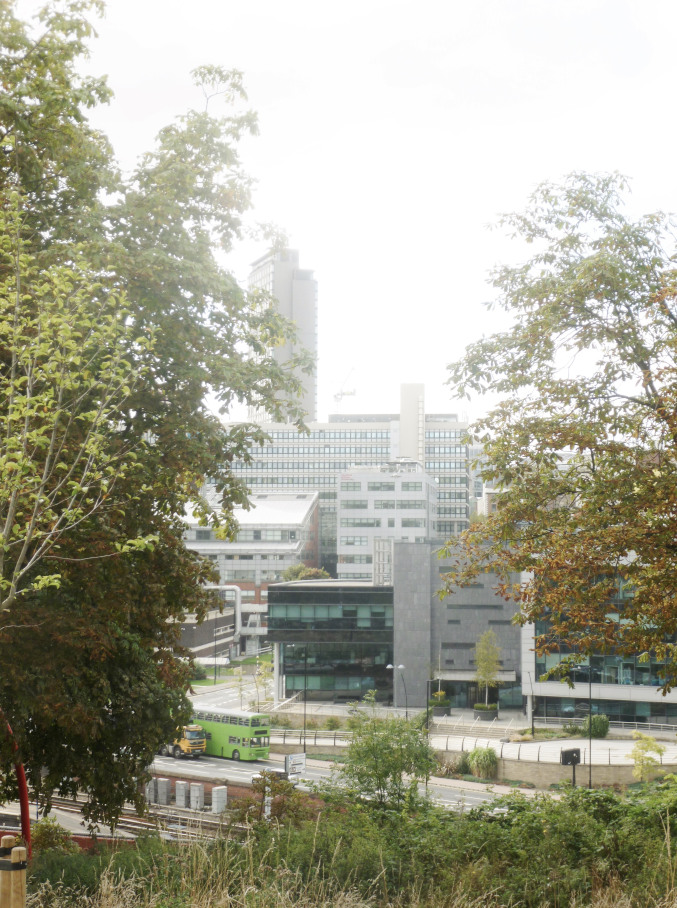
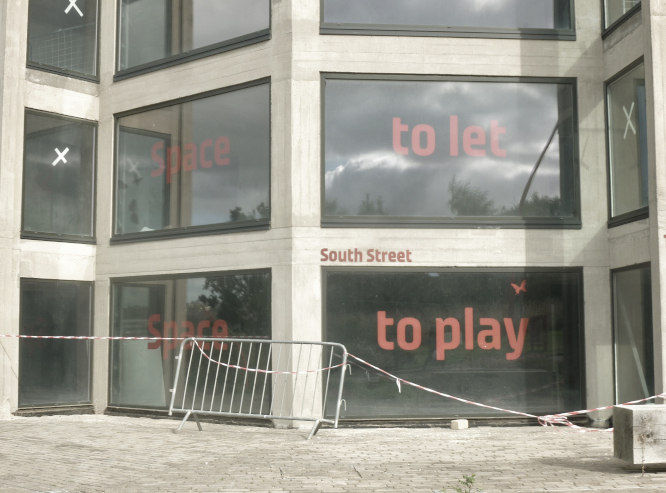
“Get off the train at Sheffield and cycle up past Park Hill flats, more talked about now they’re largely unoccupied than when they were full of people. I rarely come this way, even though they’ve towered over the uncountable train journeys I’ve made in and out of this city for over 10 years. Yet another captivating view of the city from up here – imagine what it must be like 5 floors up in the flats behind me. Very few cities give you the chances to panoramically reflect on it as Sheffield does. There may be a few residents here, but by and large the flats look completely empty. The Yuppied section still only clings to one end of the block of flats, despite being given well over half a decade to colonise them. Large vinyl lettering shouts “space to let, space to play” at you; a rhetoric that aggressively says “don’t just stand there, become a professional!”. You’d have thought such language would appear crass now.”
27 and 28 September 2015
“the train slows down for some reason as we go past my old college, Honeywell. Now a distant memory, as even its rubbly remains have vanished. It’s one place I certainly placed much value on in this town, with it’s green breathing space from the town centre – an opening that certainly aided my artistic development. Apparently such value was valueless though, as all the courses got rehoused into a new shiny red box in the centre, whilst this area is likely to be given up for housing developments. And further down the same road so it seems that the last true bit of open space for 3 miles has been opened up to be eaten up by property developers. I don’t buy the ‘housing shortage crisis’ argument. What I see is an unending frenzy of quick-fix money-grabbing; creating endless dormitories for nearby cities and enterprise zones; filled with consumption-quelled frustrations, aggravated by an unwilling complicity in the making of endless traffic congestion – an hardback intensification of the last 2 decades, with an extra layer of disbelief we work harder to ignore via ever-more absurd retro-rehashing.”
“One noticeable change nestled in the ‘heart of Barnsley’. where the post-hedonist-cum-dead-end-intoxication-streets fork off from Peel Square is the presence of settled homelessness – whereas there’s always been a small visible collective of ‘down and outs’, I’ve never seen so many people laid out in doorway corners – this time it’s different. What makes it look weirder, is that the town is trying to recreate its market-town past, as the stalls have spilled out onto the pedestrianised areas, from their era long residence in the late 60’/early 70’s brutalist complex, that is being demolished; it seems to be heading in the opposite direction from the worry-some future these homeless have stumbled into; both look like they’ve been cut out of different times and pasted into the same place. I head up to the library, but they’re now rarely havens of “silence, please!”, and are now usually laced with interruptive reminders of the anxieties/hardships that so many of us usually so-silently share. Mobiles blurt out, and the ensuing conversations leave you in no doubt that this is another person in desperate need of employment/a wage whose giving is mob number out to as many agencies as possible. On this occasion the agency is only offering this ‘jobseeker’ temporary employment in a line of work he has no experience in.”
“Sat in cafe in Leeds, two young men with accent-less and upwardly-positive-conversational tones, talk proactively about networking, recruitment, relationships and traveling, without any apparent concern over the blurred lines between work and free time. I can’t help feeling affronted by it: “how can they seemingly flow through this age so freely like bearded cybermen? why don’t they sense this struggle and stuck-ness that engulfs me?” This is why I’m always on the back foot, viewed as a ‘negative person’, and this is why I am currently welding my pens above my sketchbook as if they were self-defence weaponry.”
“On Boar Lane, my ‘go-slow’ calm down attempts are ruined as a car turns towards me in a place which anybody could be excused for thinking was pedestrainised. But these days the Futurist bust of the 360 degree sight of Mussolini isn’t an ideal, but an hard-managed necessity. Now on my toes I overhear men laughing in that way that sounds like they are looking for targets to mock; professional alpha males who make you veer from the pavement as they walk in fours, side by side, unwilling to move; the kind of moneyed scum that a polished turdopolis attracts. Maybe I’ve reacted too harshly, but 24/7 self-defensive emotions tend to be harsh. How I wished Leeds accepted its dirt and conventional ugliness, and how better it’d be for doing so. I head into the station, with a “when you’ve gotta eat, you’ve gotta eat” poster in the window of the Sainsbury’s store commanding me to do just that, a control command that compliments the “safety and security” post-9/11 staple that greets me as I get on board this local stopping train that nobody would even consider bombing anyway.”
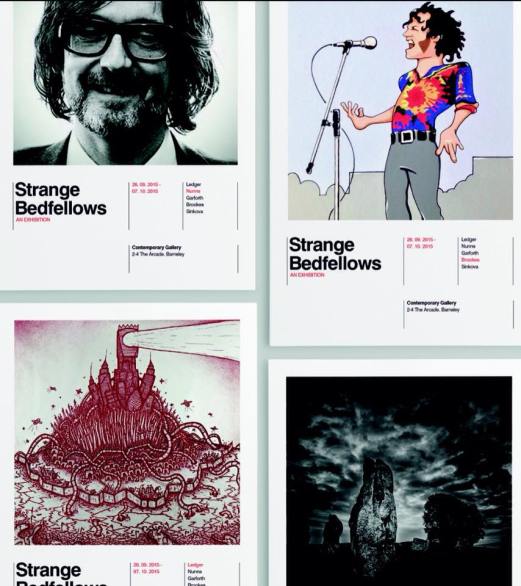
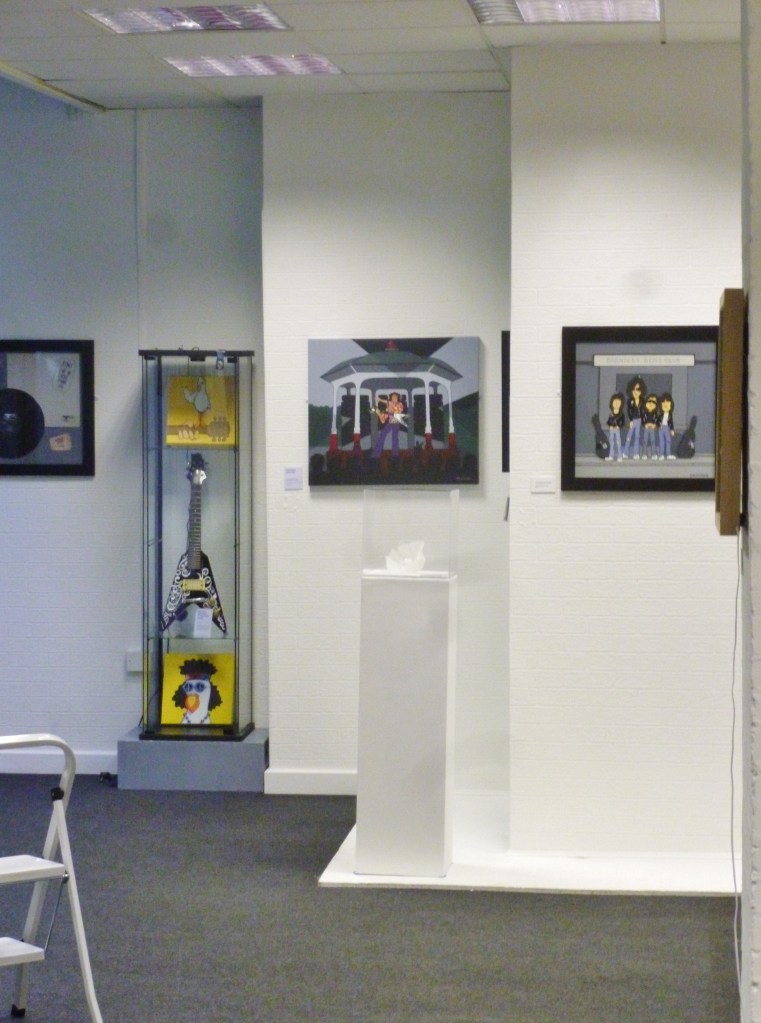
We had been thinking of putting such a show on for a long time, and all feel incredibly pleased with they way it’s ended up looking after yesterday’s installation in this former retail unit in our shared-home town of Barnsley. The reason for the title Strange Bedfellows is precisely down to how much our work differs, in both style and motives, but that we are all somehow part of a community of friends, here in this town of 230,000 people (the same population as Athens “In antiquity”, so I’ve heard…).
Although the five of us agreed that this is first and foremost a celebration of a selection of artists from/involved with Barnsley, I asked the other participating artists, earlier this year, if they would like our show to coincide with another event in town, so it could at least support it on some level. As on the opening night we are giving away some prints of our works, as part of a raffle in aid of food-banks in Barnsley. It felt massively appropriate to partake on some level in this project, under the name of We Shall Overcome, which is a nationwide event, which also consists of many other events across our home town, but primarily focused on a two day music event at The Barnsley Rock and Blues Bar (formerly the Polish Club).
ON OUR OPENING THERE WILL BE….
free drinks/bites to eat
and there will be a decent place to go afterwards:
The usual mad mix of Soul, Ska, 60s Beat, Mod, Garage, Punk and Funk all lovingly played on Vinyl. Friday night ‘afterparty’ special in the upstairs venue at STEREO BAR for the ‘STRANGE BEDFELLOWS’ art exhibition
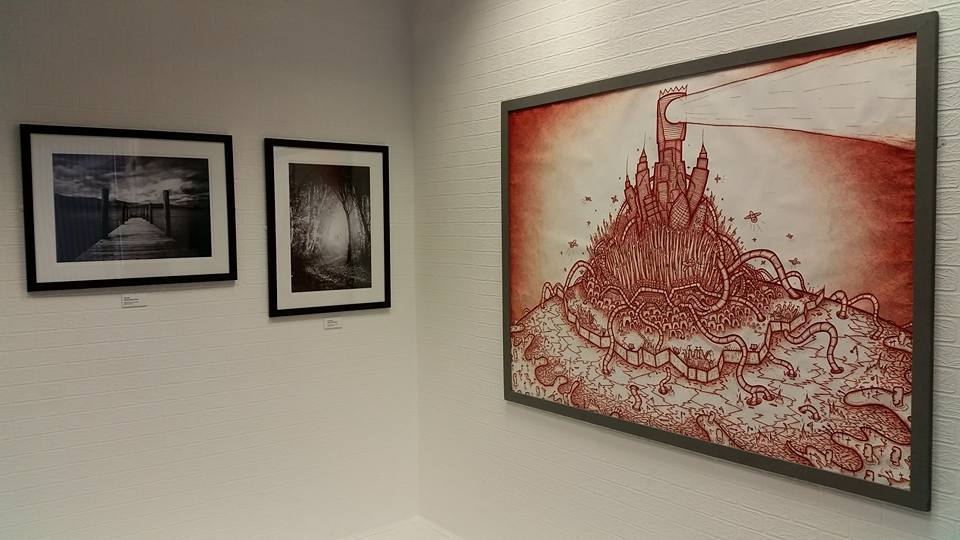
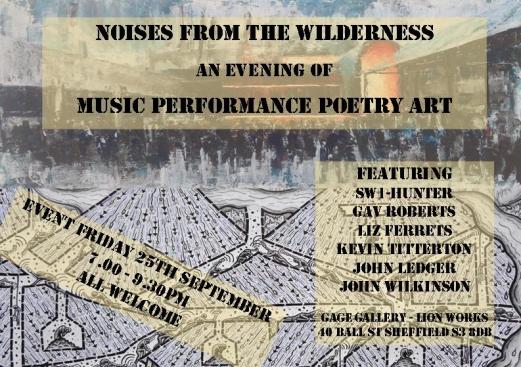
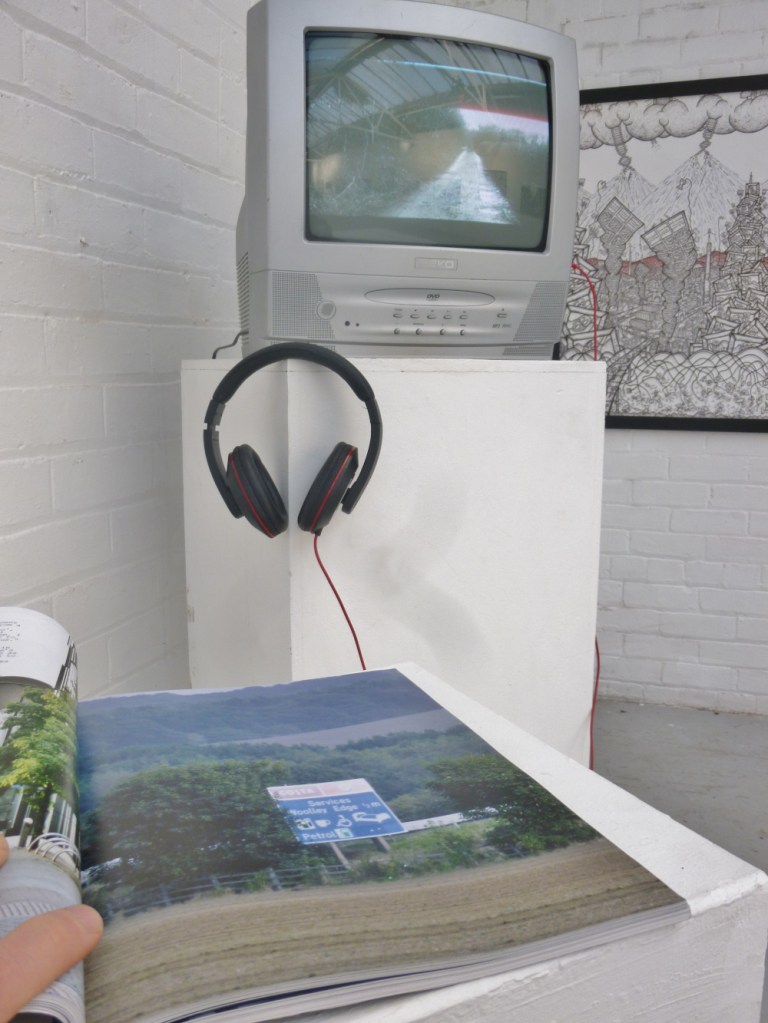
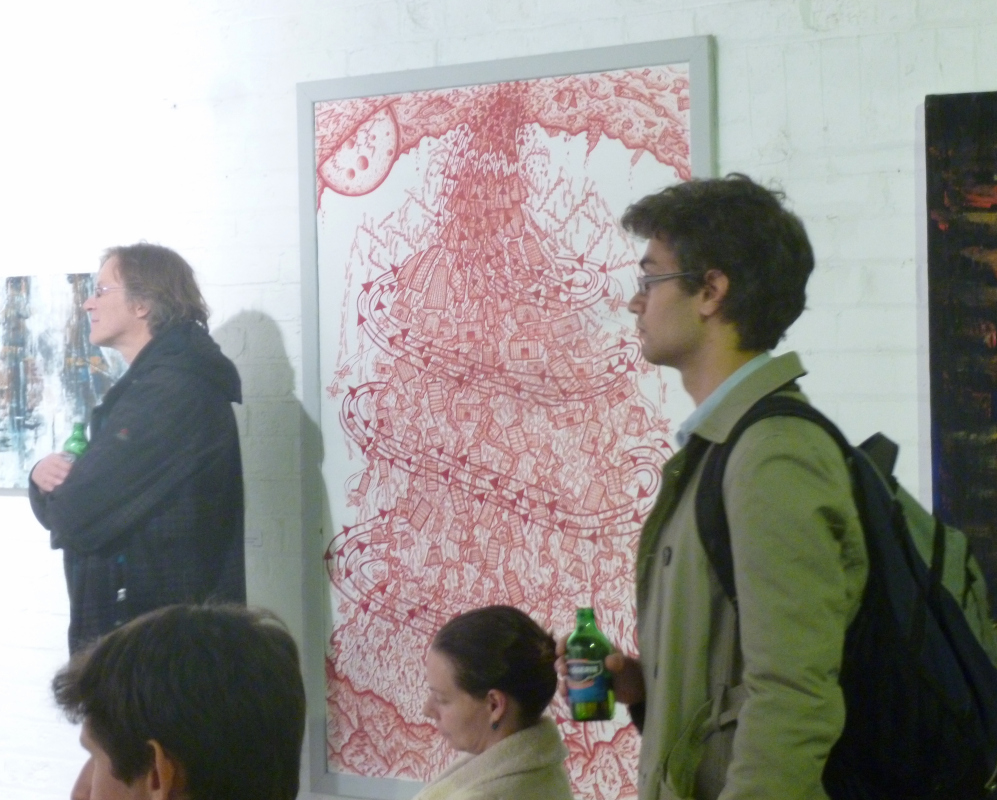
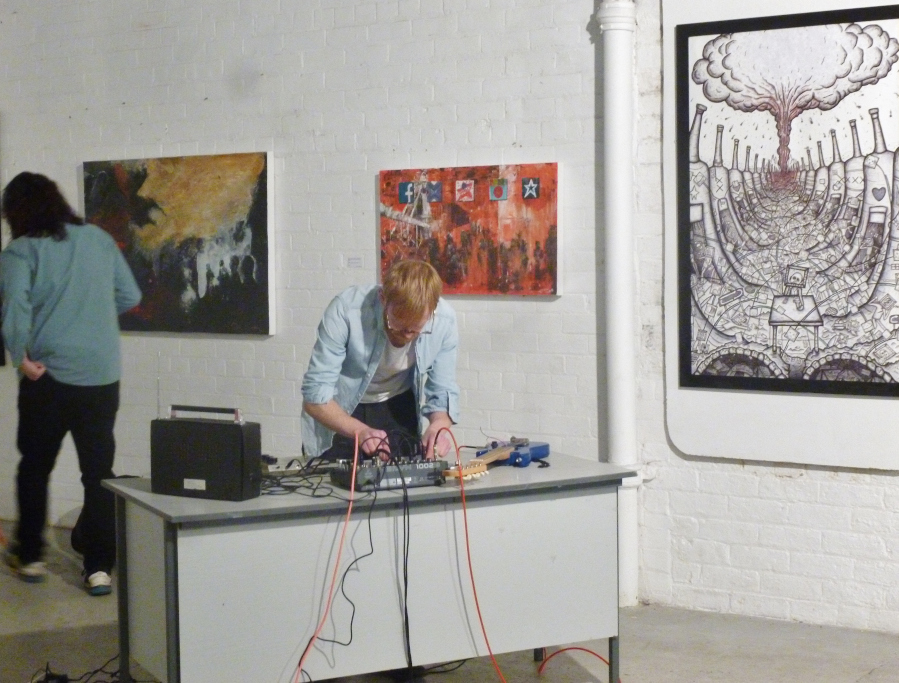
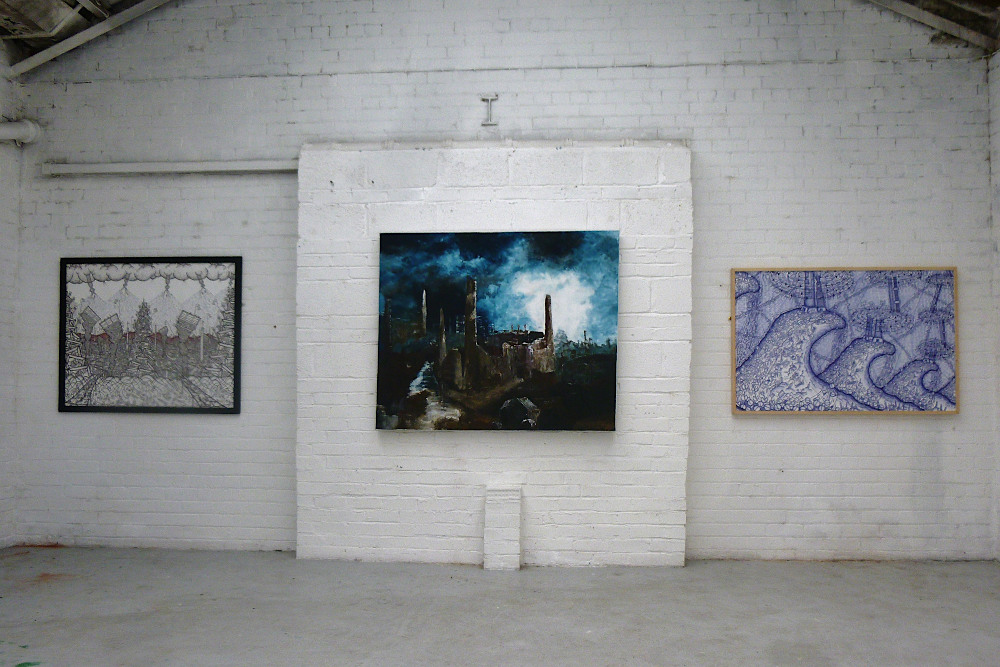
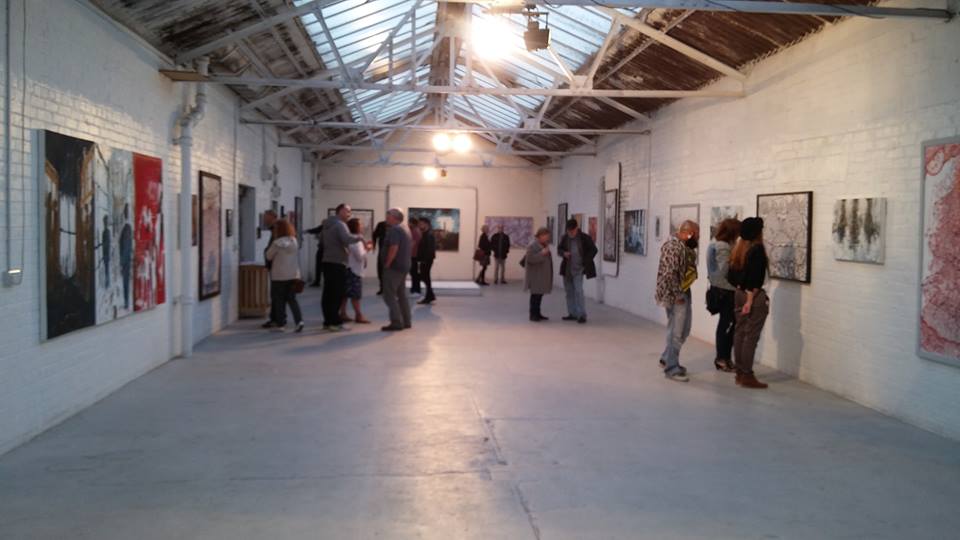
Thanks a lot to SW1-Hunter, Gav Roberts, Liz Ferrets and Kevin Titterton for playing at our exhibition last night. I’m not one for overstating things, but the atmosphere there last night was truly something special, with the sounds/words and paintings/drawings all playing off one another. There were certain points in the poet’s’ most pleading moments against the unnecessary destruction being dealt out in the world today, when there words seem to run on the compositions of my and John Wilkinson’s landscapes. SW1 Hunter, as always (in his many different acts I’ve seen over the years) was amazing, and seemed to be perfectly located in the room behind the specific works dealing most with the noise of life within the cyberspacial frenzy of these out of joint times – as, for me, in this performance it seemed to somehow mimic the infinite chatterings of this age, if those chatterings were to be emptied of their content into one body of noise. My only regret is that I didn’t manage to get photographs of all the performances, for which I apologise.
But here are links to all performers involved last night.
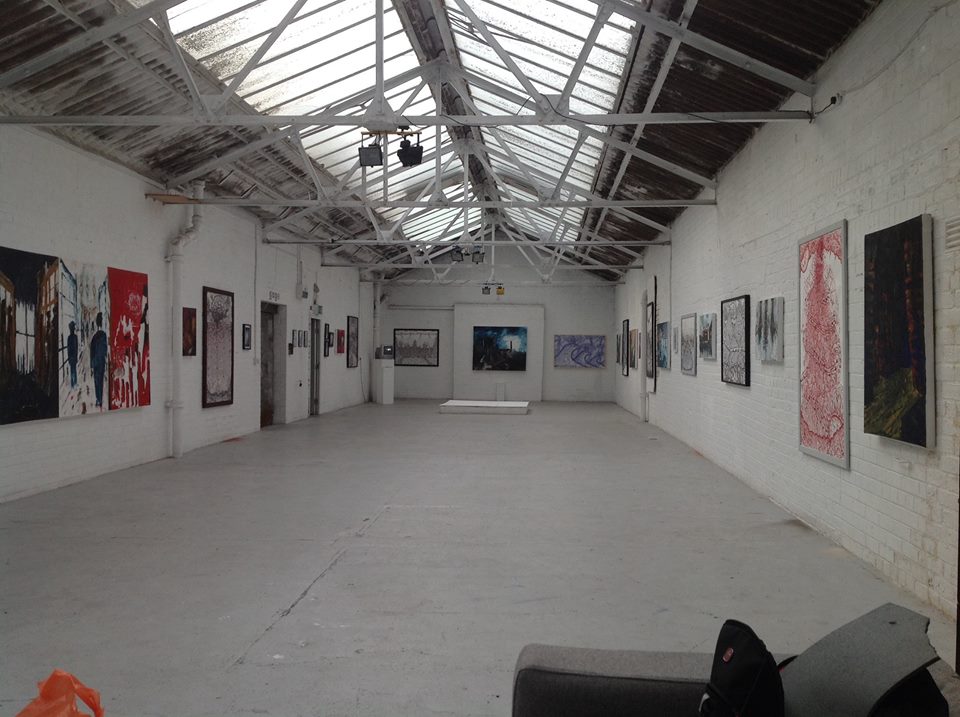
Thanks to everybody who came down last night to my and John Wilkinson’s opening of our exhibition Voices From The Wilderness. We both felt it was well attended, and the evening was full of conversations engaging in the subject of the works, and how and why and John Wilkinson’s works potentially work well together. (The exhibition is open 11-4pm, until 2nd October).
















 John B Ledger
