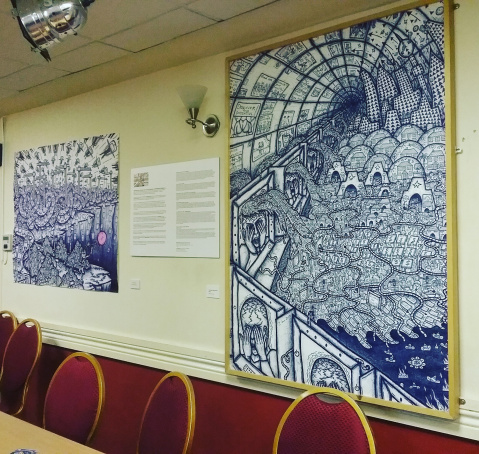
We were all really pleased with how the works played off one another; a coherence of many preoccupations that made up the reasons for having this exhibition which addressed political pessimism, the age of disbelief, austerity and the overlooked areas of the UK.
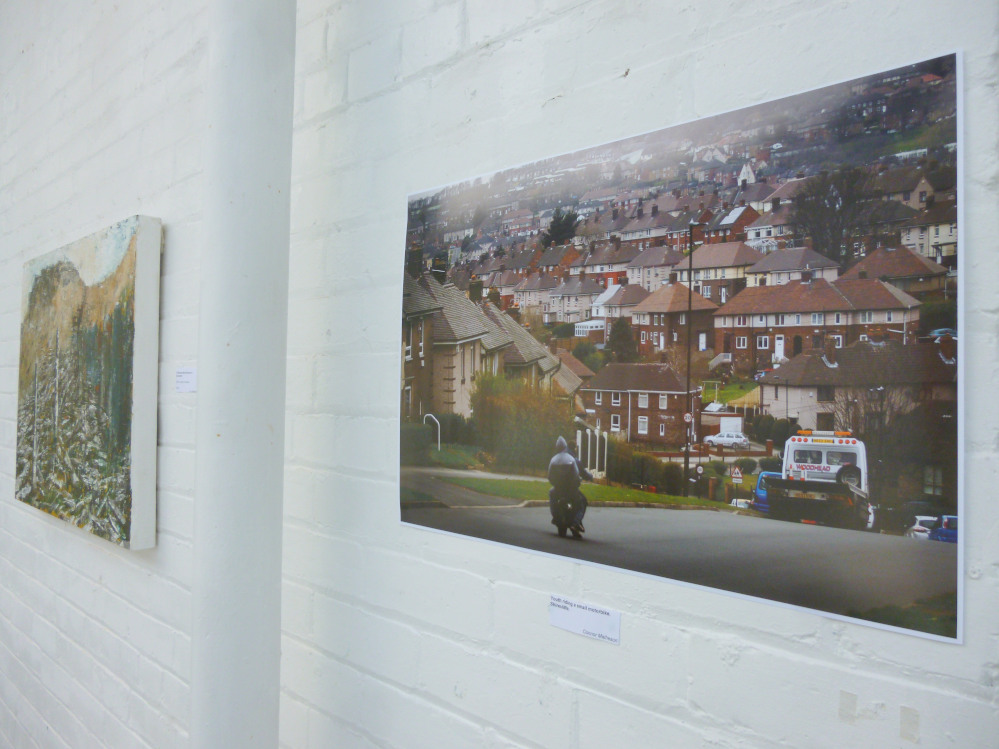
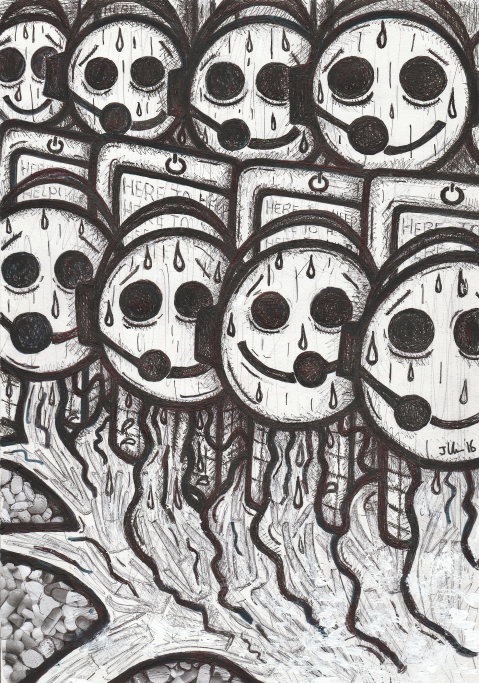
Whilst John Wilkinson’s paintings addressed the damage done both by once worker-hungry industries, and then their disappearance in a global market economy that then told these workers to become entrepreneurs of themselves, Connor Matheson’s photography documents these very areas a generation on, a landscape with little more opportunity than call-centre dead-end jobs. The Dearne Vallery, Sheffield, Rotherham, Barnsley, Wakefield.
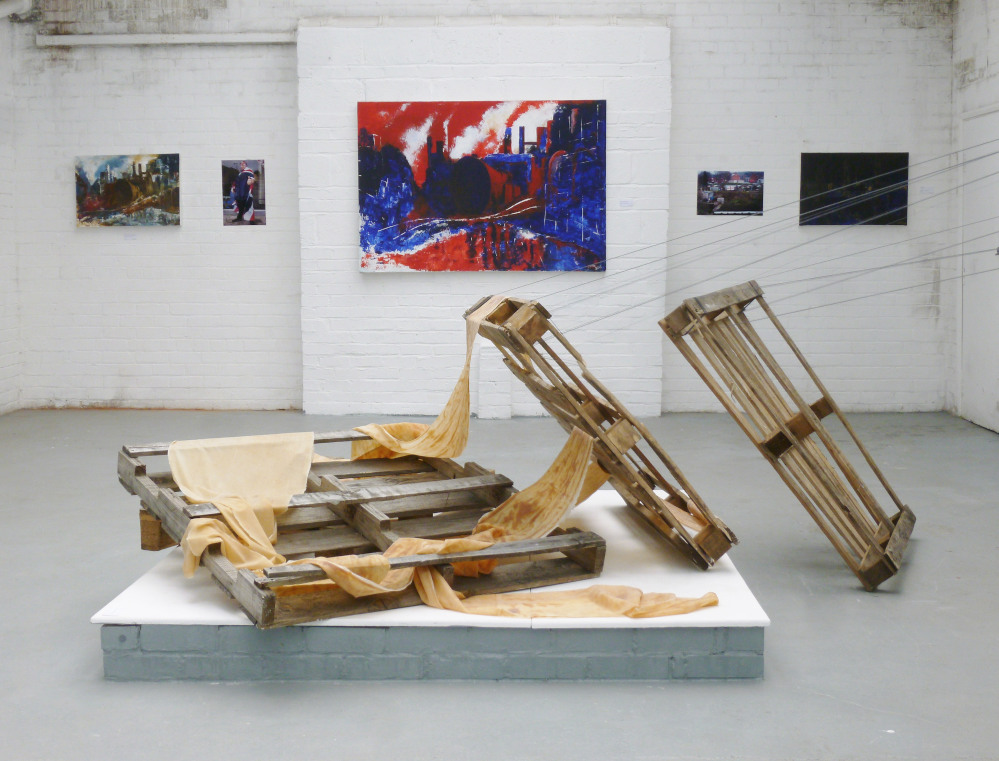
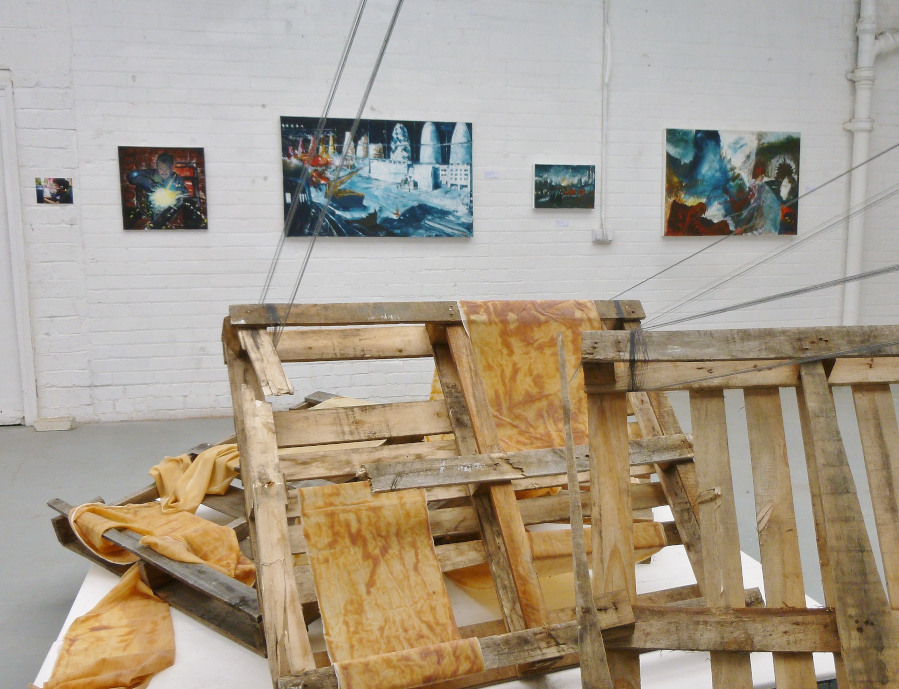
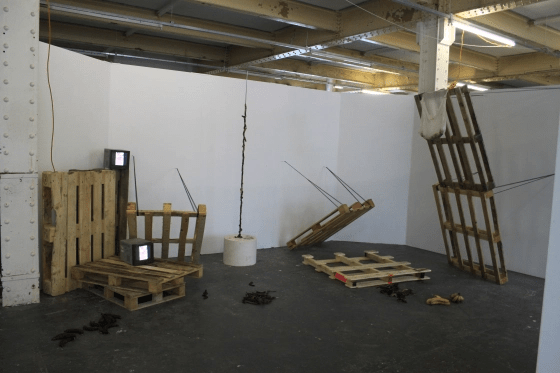
John Wilkinson’s paintings also deal with the post-colonial nationalism that chokes the UK’s horizons, clouding out a future that would lead us from making the same mistakes and get us out of spiraling destructive cycles. Amidst these paintings is an installation by Corinne Deakin, which, more than anything, I feel looks either like flotsam and Jetsom in-the-making or something in decay that refuses to accept it; a empire built on maritime dominance that refuses to give up its ghosts and in process drags everything else down with it.
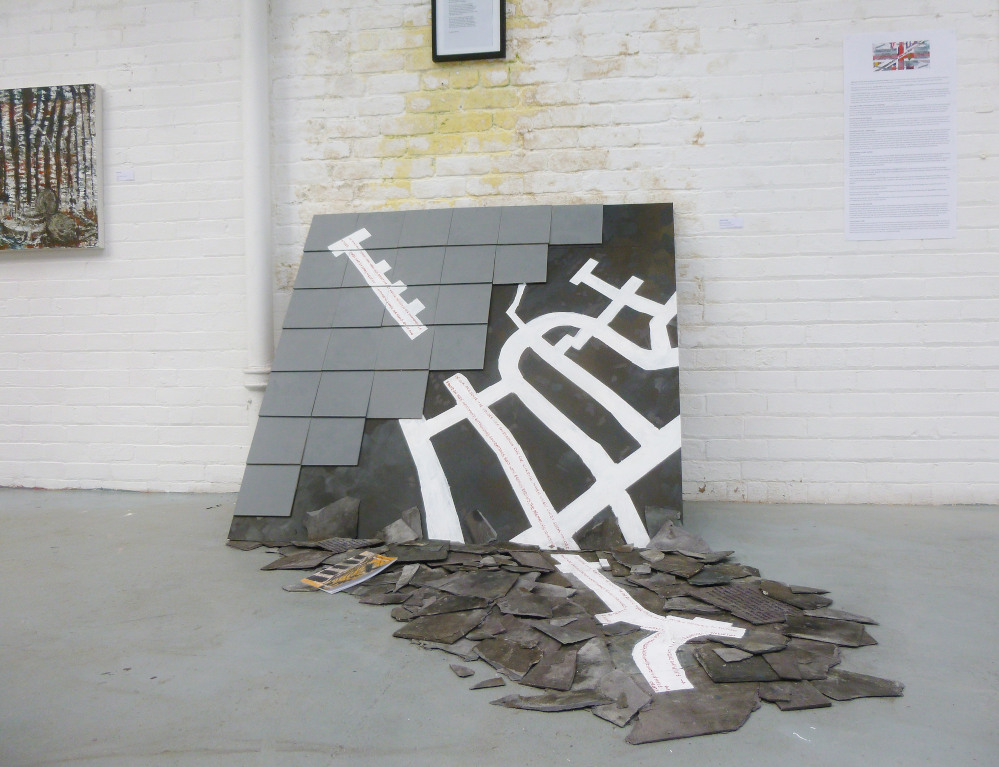
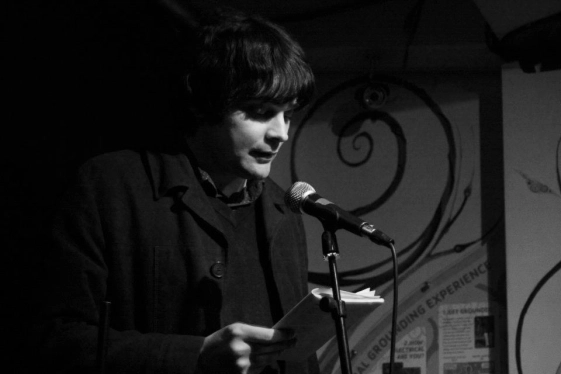
I wanted to put works into the show that both addressed the mood of the land and looked at the geography of the area that connects up the Post-industrial Yorkshire towns intrinsic to the Fighting For Crumbs project. First off I wanted to get the poet Jonathan Butcher involved. John’s poetry is subtly political, a gritty realism and focus on the landscape he has seen community disintegration and lost futures from within. I worked with him to make a way of getting his words into an art exhibition. Growing up on Hall Road, in the Handsworth area in the eastern suburbs of Sheffield, I tried in to incorporate some of my memories of seeing the nearby Manor Estate in a state of dereliction, with the fact that the Sheffield Parkway trunk road slices Hall Road in two, to make a place for Jonathan to write his poetry that visualised community/social disintegration.
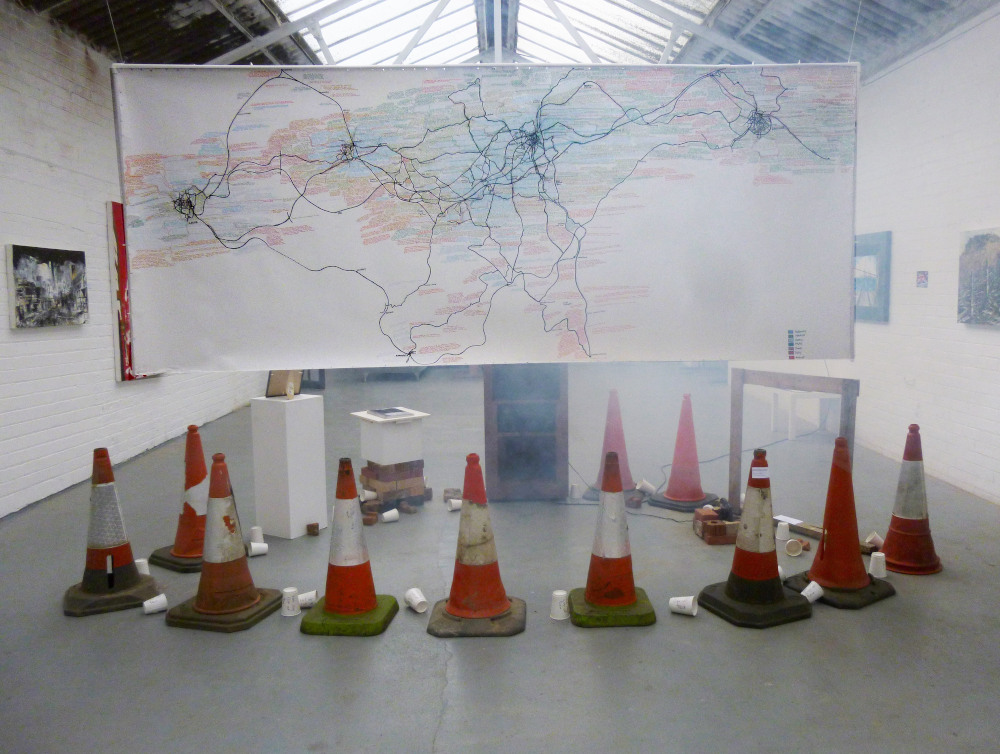
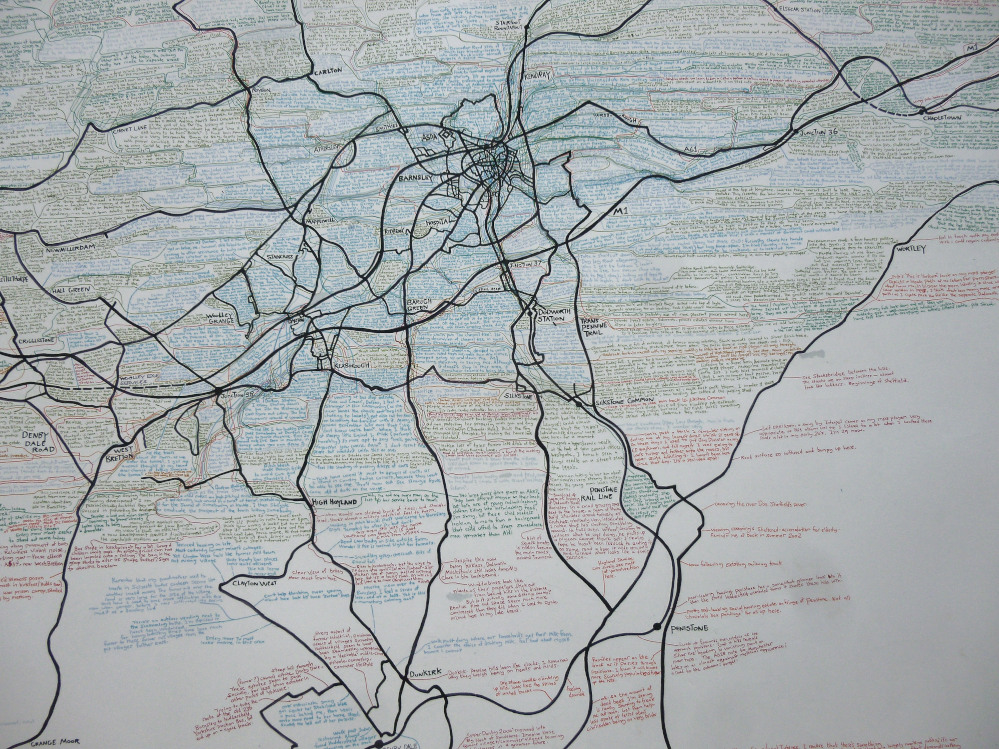
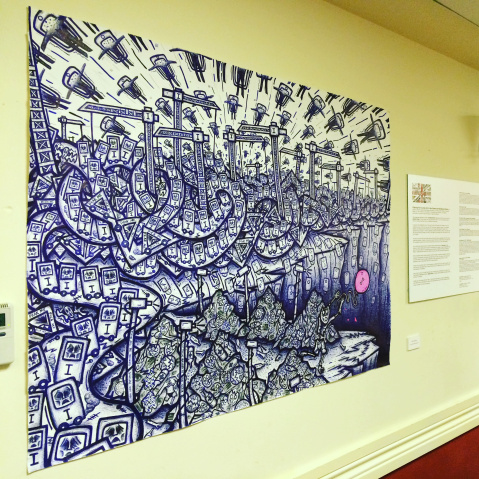
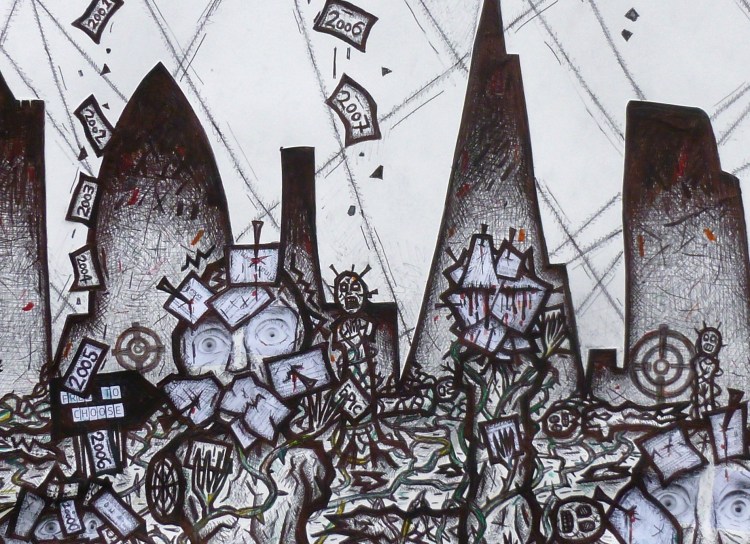
I made a installation centred around a large memory map of The West Riding of Yorkshire I undertook in 2013, mainly focussing on Barnsley, Wakefield, Leeds and Sheffield that documents the visible impacts of austerity next to feelings of confusion, frustration, alienation. I incorporated a other geographically-focused works that look at the mood of the country through the first ‘season’ of austerity, the run up to the 2015 election, and then the run up to the EU referendum. Always intent on tying together the areas where Fighting For Crumbs is based around, being held at (The exhibition continues 20+ miles north of Sheffield at the Wakefield Labour Club, ‘The Redshed’, on Saturday 13th). And I have installed some of my drawings in the somewhat smaller Redshed venue
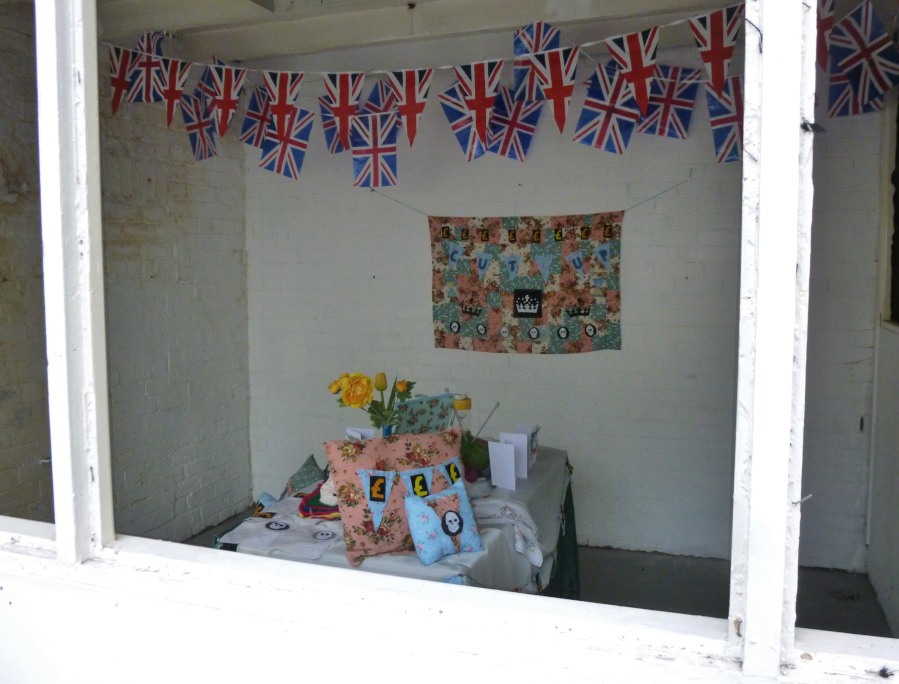
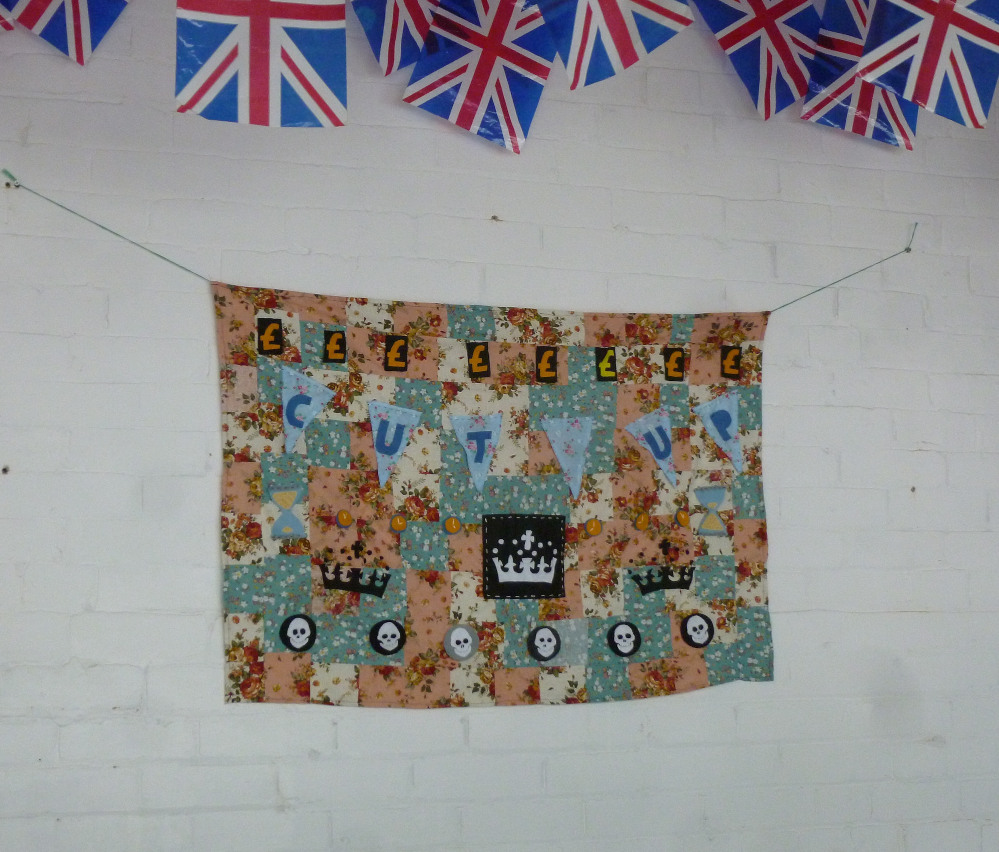
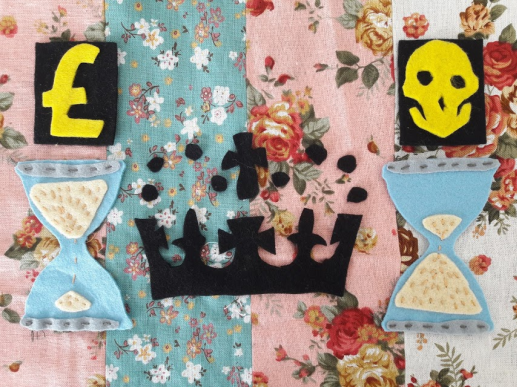
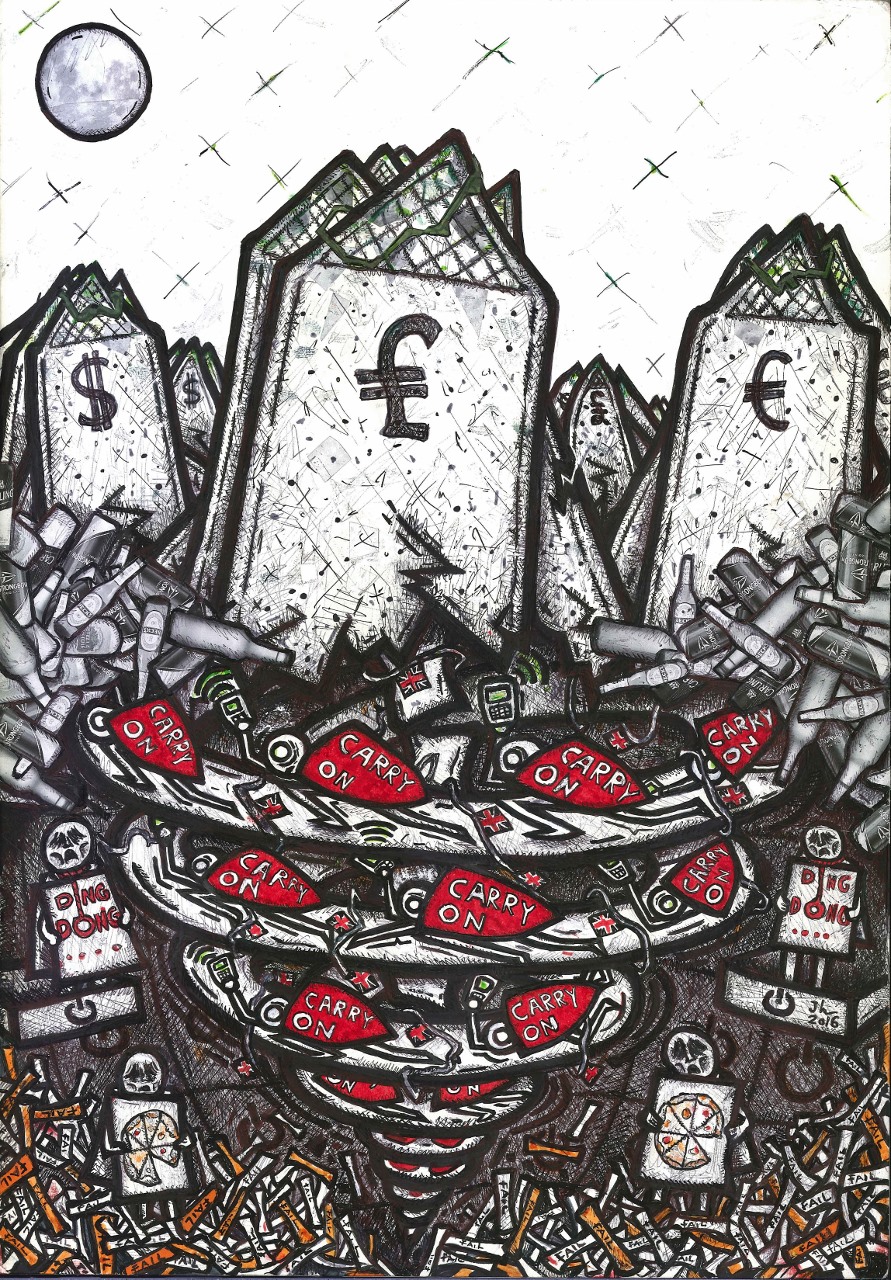
Somewhat hidden in the corner is Rebekah Whitlam’s installation ‘Vanitas Britannia’ that talks about how the riots, kettling, protest and upheavals at the turn of the decade have been swept under a ‘handmade’ carpet of a ‘keep calm and carry on’ crafts culture, satirising the tactics of a nation that retreats into its mythical past, by playing on the morbid theme of mortality that occupies the Dutch Vanitas paintings. “As a textile artist…[Rebekah} feels a pressure of balancing a vision of socially inclusive creativity without undercutting [herself] and other artists financially.” Adding that as a craft-skilled artist it is hard not to become part of the problem when “as handmade, locally sourced business cashes in on developing the streets, financial and emotional security remains distant for their neighbours and the divide becomes increasingly widened.”
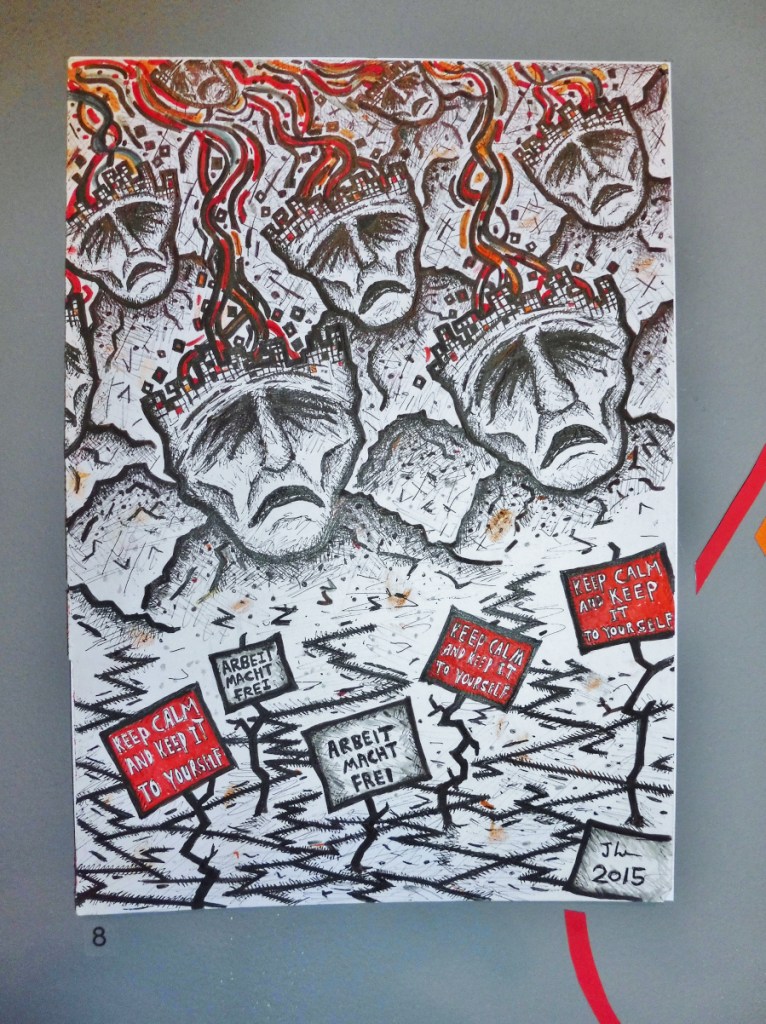
It connects up with a running narrative in the show about the gentrification of a few ‘hip’ areas in these post industrial towns to the cost of all the surrounding working class communitiess which become invisible in their struggles. The fact the there is no lighting in the room both seems to reflect the dark colours of the Vanitas paintings. and, I felt, becomes a satire on the ‘keep calm carry on’ ‘Blitz-spirit’, austerity = black outs, narrative etc etc. Just make sure the that fact the room is unlit doesn’t make you think it’s not part of the exhibition!
The exhibition doesn’t so much dwell on the past as look at the inertia of the present; the future we have forgotten in favour of ways to guide us through the day in hand. We seem to have forgotten that we need something to believe in. The world appears a place in a downward spiral of cruelty and sadness, but dead-end pleasure-seeking in a depressed landscape doesn’t quite hold its excitement for very long – it just sets in stall a pursuit of even more extreme pleasure seeking later on. Fighting for Crumbs somewhat tries to visualise a country that wake from a defeatist slumber that it perhaps doesn’t even recognise as being in.
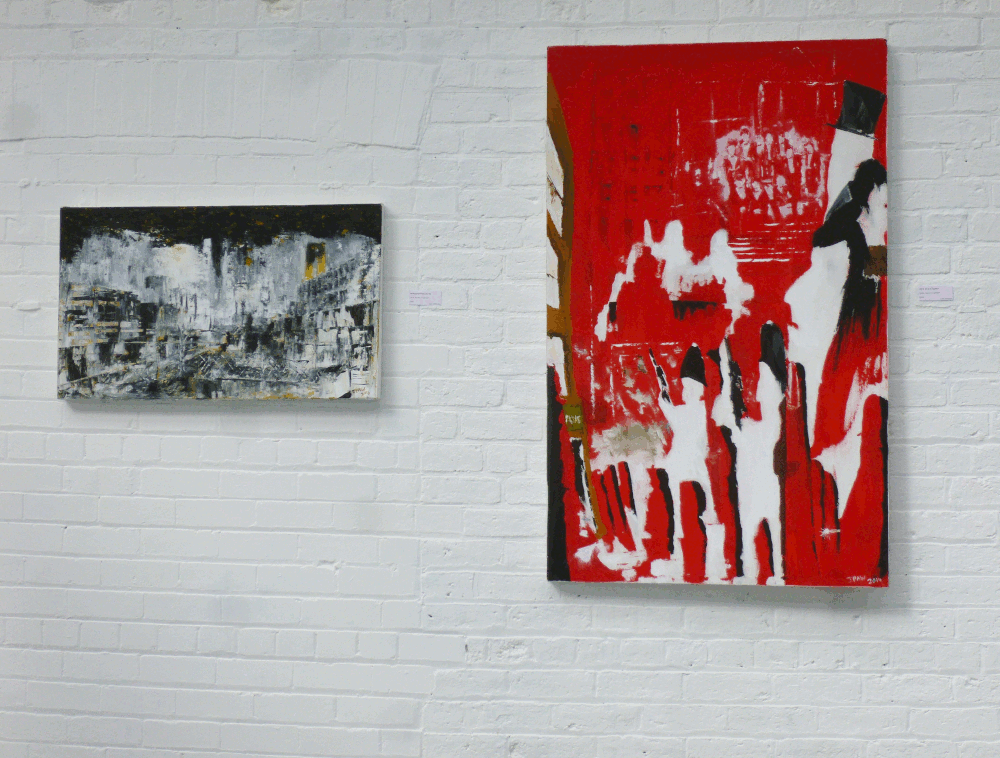
‘Development Opportunity’ and ‘We’re all in it Together’ – John Wilkinson Installation by Corinne Deakin in front of ‘Draped in Faded Glory’ by John Wilkinson
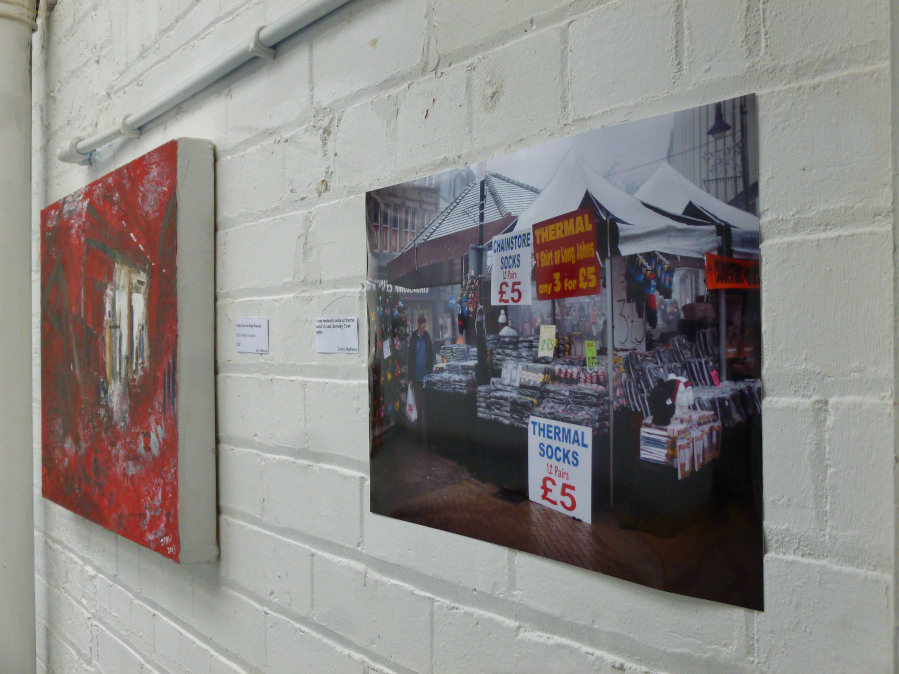
(Right to Left) A Man hesitantly looks at Thermal Socks for Sale in Barnsley – Connor Matheson, ‘Keep Calm and Keep Shopping’ – John Wilkinson
Corinne Deakin’s installation in front of ‘The Imposition of Conformity’ by John Wilkinson Youth Riding a Small Motorbike – Shirecliffe Broken Slates – installation piece – Jonathan Butcher and John Ledger Poppies (For Jonathan Butcher) – a painting John Wilkinson produced for the show in response to one of Jonathan’s poems.
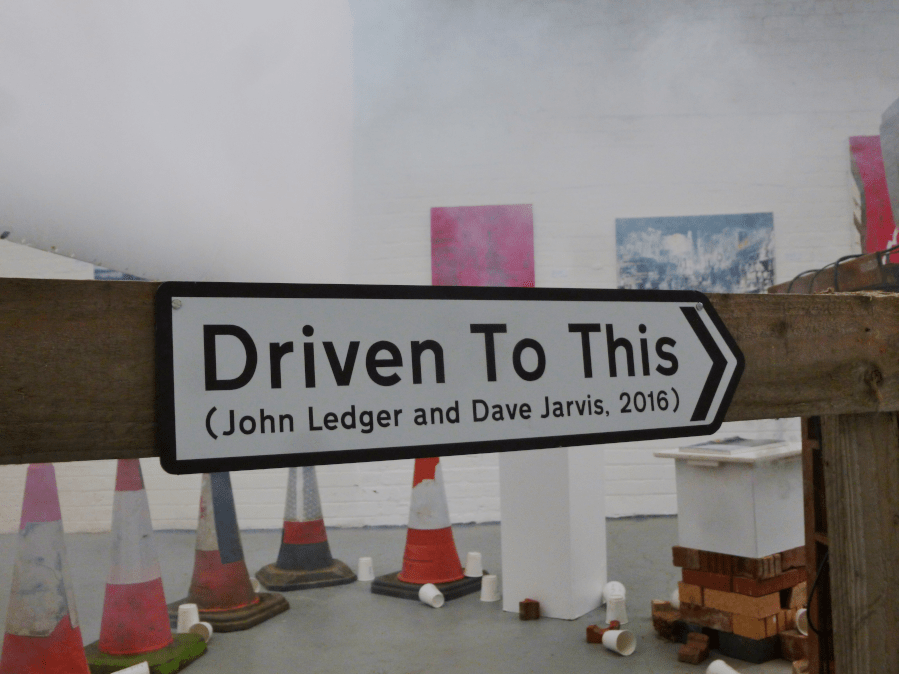
Installation by John Ledger
West Riding of Yorkshire: A Pyschogeographical account
I’ve been involved in setting this project up for the best part of a year…
Over the past few years or so I have found a few people who were agreeing with my growing sentiment:
That the mood and spirit of this society (global too) was in a deep depression, and that this had to be addressed before there could ever be a popular movement that would well and truly galvanise the daily-downtrodden’s into believing in something so much that they were prepared to fight for it.
(Let’s be honest. I’m a daily-downtrodden myself. I’m no freedom fighter.)
Trying to hold a belief that another world is possible up to the light of a new day in UK2015 was like holding a flower up to a nuclear blast – it withered and recoiled before the toothpaste was on the toothbrush. Before you know it the old depressive-pleasure-seeking kicks in: cider after cider, angry self destructive acts, a spree of undecipherable text messages – enough to write another day off until a new dawn fades.
Art has been my backbone in a world which seems bent on being cold and meaningless in equal measure. Without it I’m a mollusc looking for the nearest dark spot to dwell in For “there are brighter sides to life and I should know, because I’ve seen them, but not very often”. And I always recoil to my work as an antidote-maker.
I’m bored of expressing this. Deeply bored.
I…..
Another world….
…a better world
Isn’t there a plant in the desert that only flowers once a generation? Is that not a perfect analogy for English optimism?
The week that followed from May 8 2015 was actually a special week for me, for it felt like I was sharing something with others. What I felt I shared was a despair and fear now that the Tories and the media were taking their gloves off for some sadist pleasures. And I felt this sharing of despair beginning to jolt people into a sort of action most of us hadn’t engaged in before. But it didn’t last…
Rotten Soil….
…A couple of months later I discovered the Sleaford Mods. Their channeling of the rotten soil of nowhereland sank into hole where a soul, a love of life should’ve been. An Antidote. Later that year I was surprised to find that a film called Invisible Britain, that followed the band, was following them on a tour of the Ingored-lands. The Ignored-lands I meandered within and wrote about: mainly Barnsley and Wakefield.
I felt an idea coming along..
This idea was given one leg to stand on when I was asked by friends to put on an exhibition at the Wakefield Labour club (Aka The Redshed).
2016 marks the 50th birthday of The Redshed, also known as The Labour club. Situated in the heart of the Yorkshire city of Wakefield, the place is somewhat unique, and has defiantly resisted the capitalist forces that have penetrated nearly everything else around it. A year-long line-up of events are now marking this anniversary.
I needed to put something on that spoke of the disbelief that has penetrated the years I’ve been an adult.
Artist Corinne Deakin coincidentally came up to me thinking of doing something very similar. Looking at the way the arts were being pushed out of the reach of many people due to 5 years of needless austerity, low wages and high living costs. I must’ve said the words ‘fighting for crumbs’, in one of my waffles that I never remember, and Corinne remembered it and said that we need to call our project this.
And then it just seem to fall into place. I’d worked with the artist John Wilkinson the year before, and knew his work and thoughts were ideal for our project. And during conversations with friends Rebekah Whitlam and poet Jonathan Butcher I realised how appropriate their work was to addressing the cultural mood of this secretly unhappy Island. Corinne knew a photographer from Barnsley called Connor Matheson, who was just that little bit younger than my own town centre social circles for me to have know him prior to the this project, but I think I’d already seen his photographs and thought they would work well alongside our works, especially John Wilkinson’s paintings. In a way that is sort of Inspired by Invisible Britain, I thought it would be great to make a talking head documentary for this project – the Fighting for Crumbs documentary will be on show at the Redshed event, and hopefully all way through the Gage Event. Anyway, here’s a link to all that. https://www.facebook.com/events/1766943633588740/
Here are a few lines from each artist. All I can say is that I hope whoever reads this can make it to at least one of the events that we are putting on:
John Wilkinson (B 1962 – Sheffield based)
The price of coal
Austerity, the ugly reality of post-war Britain and the backdrop to the founding of the welfare state has come back to haunt us once again. Trying to invoke that spirit that enabled us to survive and rebuild the last time, David Cameron famously said ‘We’re all in it together’ but the truth is that we’re not, and it isn’t the same. A North decimated by industrial decline and unemployment is not the same as the manufacturing centres that provided the growth and foreign trade that led us to economic revival in the 50’s. A class abandoned because the education bar has become too costly to climb over is no longer the motor of the economy, and so the economic benefits of whatever financial services revival they paid for never reach them. Instead of building the State that supported growth we are dismantling Health, Education, Housing and Welfare, and replacing all but the cheapest labour with technology that frees us from work and with it income. As an artist, my work is a response to the world I live in – a mirror that reflects reality, and what it might become. Through it I express my compassion for a people who built the foundations of our world, and will be left to rot in its basements until we can see what is happening, and ask for better. Then I’ll paint pretty landscapes.
Corinne Deakin (B 1988)
During the past 5 years, or perhaps longer, we have seen old architecture and independent business give way to gentrification and cuts that effect the working class. Education is being stifled and the youth of Britain are entrenched in large debts they may never be able to pay off, with suggestions of unfair consequences. The idea of community is disintegrating, as we are encouraged to evolve into self absorbed, cutthroat individuals where its constant networking and making a career for yourself is based more and more on who you know, not what you know- and it never hurts if you’re born into wealth. Glorifying low paid internships and getting very little in return. This is the ideology that’s being sold to aspiring artists; the dark introduction of how to make it as a successful artist today.
Jonathan Butcher (poet, B 1978, Sheffield)
Over the last 40 years the structures that should constitute a society have been eaten away by ideals which have been instigated by the few, with the intention to pollute the many. Ideals that strive to restrict us and attempt reduce human expression to the level of the banal and the superfluous; achievements considered wasteful,and without worth. We have been left empty, yet we are expected to remain grateful for the meager gains we have scraped together; gains which when pursued only through shear necessity, place money above time and psychical and mental strain above thought and basic fulfillment. Slivers of hope are offered, but are usually temporary, and for the large part conducted by those just as driven by this machinery as those they purport to despise. This now continual scenario enforced upon us attempts to define us. It claims to speak on our behalf, without offering a single answer to this problem or a solution to our fate.
John Ledger (B 1984, From Barnsley, works in Wakefield)
Debtland
“There has arisen a deep disbelief in the abilities of the human race, without much shared understanding of how we came to feel this way. Maybe it comes from the fact that with what we now know (regarding climate change, the impacts of social inequality, living memories of 20th century horrors), there’s a sense that we SHOULD be in the process of building a far better world to live in. But NO: in 2016 we are within a state of affairs that is making us scrap amongst ourselves for pieces of barely anything. Are we surprised if nervous breakdowns and spells of aimless rage are commonplace amidst this deeply absurd situation?”
Rebekah Whitlam, Sheffield, 1984
Vanitas Britannia.
Since the recession there has been a pseudo-nostalgia of post-war Britain. Kettling, rioting, and protests were swiftly detracted from by weddings, jubilees, and cake on the BBC. The “keep calm and carry on” craft trend has escalated; beer, baking, and bunting have become synonymous with community togetherness.
Whilst we crave authenticity in ourselves and our society, empty slogans are sold back to us. The commodities of craft offer us promises of a community, but leave us all the more alienated. As handmade, locally sourced businesses cash in on redeveloping the streets, financial and emotional security remains distant for their neighbours and the divide becomes increasingly widened.
As a textile artist I feel a pressure of balancing a vision of socially inclusive creativity without undercutting myself and other artists financially. The lapping of cushions, cards, and craft is at my feet, but how do I not become part of the problem?
Austerity strains us economically and is having a detrimental effect on personal integrity and creative freedom.
Connor Matheson (B 1992 Barnsley)
The works I am showing in Fighting For Crumbs explore the everyday lives of normal people in the Post-Thatcher era, with particular focus on themes such as family relationships, the local economy and drinking culture. With a specific focus on the north of England, this project is an accurate representation of working class culture, depicting the everyday lives of people who are often vilified in the mainstream press as “scroungers” or “yobs”. The work shows the effects of government economic policy yet also shows the human element, relationships and humour in life and celebrates the diversity of people and the character of areas.
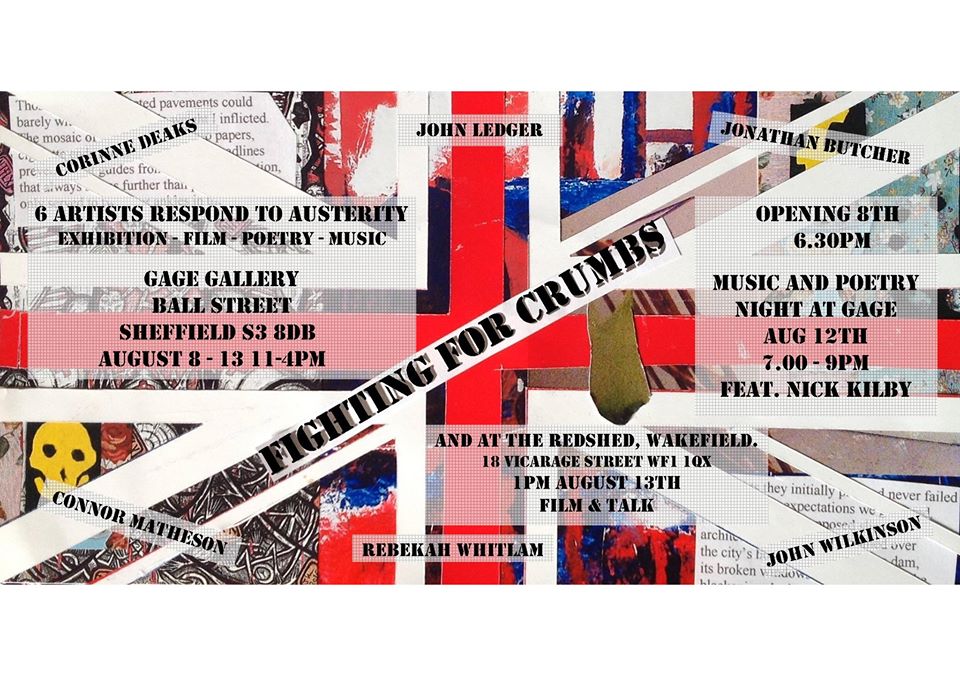
Gage Gallery, Ball Street, Sheffield, S3 8DB
Monday 8 August: Opening night. 6:30 – 9pm Friday 12 August. Music and poetry night. 6:30 – 9 pm 11-4pm
The Redshed, 18 Vicarage St S, Wakefield WF1 1QX
Saturday 13 August. 1Pm onwards. Film-viewing, and talk by JD Taylor Normal gallery opening times: 8 August – 13 August, 7-11pm (call 01924215626 to check room is not in use)
On Friday 12 August as part of Fighting For Crumbs (Art in The Shadow of Neoliberal Britain) there will be performance and poetry within our exhibition at Gage Gallery, Sheffield, starting at 6:30 and running until 9pm.
Artist Nick Kilby will be breaking his two year performance fast to put something together for the Fighting For Crumbs event on August 12th at the Gage Gallery in Sheffield, located inside KIAC, Sheffield, S3 8DB. 6:30 – 9pm
‘”To the 330’ is a noise/aktion blood hex against an occupying administration. Be fun to see some of y’all. There will be no milk x”
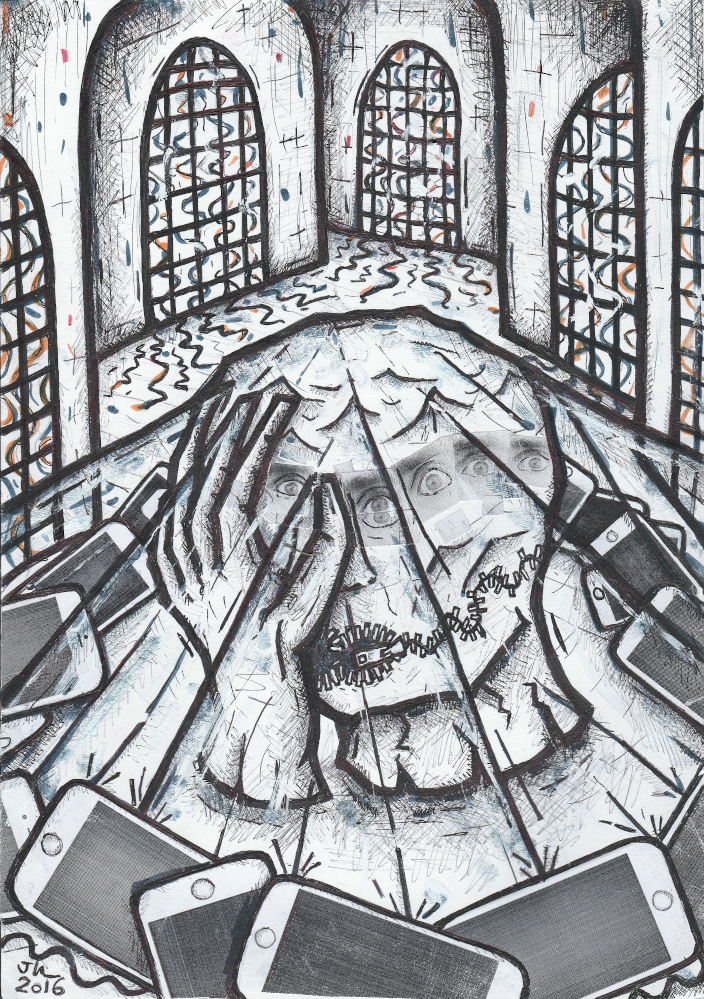
I don’t know when you could say such a time began (maybe at some point during the past decade or even earlier?), but I sense we are overdue some grieving time. And that’s because our civilisation (specifically our faith in a capitalist model – one based on exponential growth – to bring well-being and prosperity) has died. Grief is a natural process in order that we can rehabilitate so as to move on to the next stage of life, but it has been emphatically denied us. Its existence has been denied, and the denial has been played out in a turbo-charging forwards with the persistence of now-dead beliefs. And look at the pain that it is causing; to be forced to work harder for something deep down we know is not only going nowhere, but is in a process of perpetual deterioration. It has made knowing-zombies out us, an anxious-undead, clutching our Iphones, trying to climb out of the daily dread. But it has to give-way at some point. More and more of us are suffering under the psychological strain of knowing we will have to work harder and harder for diminishing returns from a dead/dying system, and all around you can see people cracking up. Nobody knows what this outcome will finally lead to, but there is potential for a rebuilding, not so much physically, but culturally. However, right now we are in need of an healing process.
YOUR Freedom (95X125cm, mixed media on paper, 2016)
‘YOUR Freedom’ is my latest work, and will feature in the Wakefield Redshed part of the group show Fighting For Crumbs (Art in The Shadow of Neoliberal Britain).
Fighting For Crumbs (Art in the Shadow of Neoliberal Britain) is a group of artists from Yorkshire working amidst the after-effects of Austerity Britain 2.0.
The project was inspired by the film ‘Invisible Britain’ (based on the work of Sleaford Mods) that looks at overlooked UK towns and cities, and motivated by a request to contribute to the 50th anniversary celebrations of ‘The RedShed’ (Wakefield Labour Club). The event is based in Sheffield and Wakefield and explores the position of art, and artists, in a period when we are all being pressured to ‘strive’ for crumbs – a time when wages are low, and the market dictates creativity
Saturday 13 August. 1Pm onwards. Film-viewing, and talk by JD Taylor Normal gallery opening times: 8 August – 13 August, 7-11pm (call 01924215626 to check room is not in use).
…not strictly, but they are wrapped up in a thick cloud of confusion and contradiction. But I’m putting out there EXACTLY how I’m feeling in the wake of last week’s referendum vote.
Is this the nervous breakdown of a country? It’s becoming an unavoidable truth that what I’ve seen happening over the past few years has gone into overdrive since 23.06.2016. People around me having some sort of meltdown – something I suspect is happening because the strain and the pain of DECADES of Thatcherite Britain has suddenly become unbearable. Brexit, like it or not, seems to have worked it like an accidental alarm-switch.
Was Brexit an unexpected exercise of a country’s nervous breakdown, long overdue? And was this unexpected exercise the last, skewed, but true exercise of democracy we had left?
It is without doubt that there are people in places around the world enduring a hell the English (as this is mainly regarding the English) cannot imagine. But has this country, the first capitalist country on earth, finally broke down under the experience of late capitalism? Has life under this faded-glory-stained neoliberal project hit saturation point?
Last week I was off work, but, after failing to set up a postal/proxy vote, I wasn’t confidently care-free enough to miss voting. So I decided to spend my days off work heading a bit further than usual. It seemed the right thing to do upon a terrain that could, so to speak, be shifting under my feet.
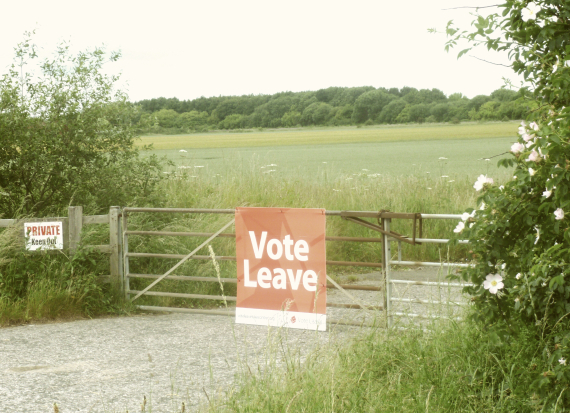
On Tuesday I cycled all the way from Barnsley to York (exhausted, dehydrated, thus all the more porous to the Northern Europe-like feel to North/East Yorks – the red-tile rooftops could convince you there was no body of sea between Yorkshire and Denmark). YORVIK . On Wednesday I went to London, endured a far-more than customary level of alienation at Frustration at the all-out ‘Remain’ consensus congregating around the Kings Cross-based leafleters (even though I voted Remain myself). I felt wounded and inarticulate in a London that felt self-congratulatory-soaked in something that was promoting a cause that had no idea of the type of wounding I was feeling, a wounding I KNOW I’m not the only one feeling, because the wounds are slumped in the city’s streets corners when it bothers to acknowledge them. An anger rising up through the drains of Thatcherite Britain.
But I had too many friends with too many SENSIBLE reasons to vote Remain and too many frightening reasons not to vote Leave for me to take such a reckless leap for the cause of the anger I’ve been feeling for so long now. And on Friday morning I was stunned into inertia just like everybody else.
Aren’t we all lost right now? Heads boiling with a million voices all at once. Looking for blame victims. But I won’t blame 17 million leave voters by calling them stupid or racist. Calling people stupid for what for them is a genuine concern leads to nowhere, except a self-congratulatory flurry of Facebook ‘likes’.
“The Cunt with the gut and the Buzz Light-year haircut…calling all the workers plebs” (The Sleaford Mods)
In recent British history nothing has been as divisive as the destruction of the working class base, built over years of struggle, fucked over by Thatcher, and the market fundamentalism then driven between us all. Yet we overlook ‘the war between all’ conjured by this, and we parrot the words of a more affluent less trapped metropolitan elite for whom issues of race and gender are solely moral issues, and nothing to do with class stratification. The result is what you see in the video above. A top down, media perspective, which doesn’t even need to be based in London to be London-centric, looking at all those intolerant, stupid places like Barnsley -cherry picking the mixed up and politically incorrect voices.“Oh why, oh why can’t they be like us decent London Folk?” A slowly bubbling rage.
“I work my dreams off for two bits of ravioli and a warm bottle of Smirnoff “
So, these places where the majority voted ‘Leave’ – what do we do with these people who refused to do “the right thing”?
In 2015 the documentary Invisible Britain followed the music group the Sleaford Mods on a tour of towns not on the ‘cool-list’. Not just ignored by other music groups but also by the London-centred gaze of society. Invisible Britain is perhaps the only contemporary documentation of the great ignored that hasn’t stuck to a preconceived, condescending stereotype, laden with mockery or contempt. Expensively-educated Sacha Baron-Cohen springs to mind…
When you hear the Sleaford Mods, the lyricist Jason Williamson’s anger, if you ask me, is like a momentary placing of the head back on the shoulders of the decapitated and disempowered body of working class rage. Williamson’s seething anger at the alienation and humiliation of a contemporary life experience many can relate to gives a voice to this rage when the world is made to feel so unaccountably chaotic that the only tools for understanding it available are tools to blame yourself with for the hell that surrounds you. But, as the film states, they are still largely a lone voice.
That which informs racist anger isn’t born out of fresh air. Nor can those who spout it vanish into fresh air – which is what I often feel many on the diminishing liberal class long for. Out of mind out of sight.
What do you do with these people, then? “Get rid of the buggers? “. Create two separate States? One called ‘London‘, for the ‘tolerant’ ‘open-minded’ folks and ‘the rest‘? Actually, doesn’t this petition already exist? The ‘I’m alright Jack-multiculturalism’ mantraconceals an hidden contempt.
The Leave result has clearly blown everything else out of the water. And as denial against it kicks in, the truth of what has simmered underneath the seeming tolerance and liberalism of the past few decades is coming out. It’s nasty, and I’m sorry to say the most upsetting things aren’t just coming from ‘racist idiots’ but from the younger section of the Remain supporters, chatting away in the cooler parts of town. Behind the ‘coolness’, their inherited social Thatcherism is rearing its ugly fucking head. Their contempt isn’t for the migrants, it’s for Britain’s socially immobile who will “probably never leave their home town never mind live in another country” (actually heard!). It’s an hidden hatred for the existence of those who “clearly haven’t tried hard enough to better themselves” and join aspirational and cosmopolitan Britain. It’s not a contempt for people from other countries, it’s a contempt for the working class of this country, and it’s equally toxic – if not more due to its invisibility.
I’m sorry to say this but they may have just sunken your cosmopolitan dreamboat…
I can’t help but be convinced that, even though what evidently galvanised the victory for Brexit was a deep concern about immigration, the anger isn’t really meant for immigrants, but for the ruling class of this country, as inarticulate as the anger was. As self-harming as Brexit could potentially be to everyday people – it’s an anger about being ignored, overlooked and even looked down upon. And I’m not saying I don’t now find it all scary as fuck.
The same present day top-down reasoning bemoans the ‘loutish’ English for their seeming preference to take to throwing chairs and punches at other football fans than taking to the streets like the French. But after nearly 40 years of destruction of class consciousness and a narrowing of political horizons, creating a state of stuckness that Mark Fisher calls ‘reflexive impotence’, Brexit is a seismic working class revolt, even if it ends turning against the working classes.
The Ignored is geographical in nature, but it is fundamentally underpinned by class.
“The sorrows we suffered and never were free” Decades, Joy Division.
Left to endure the hell of ‘prole-life’ with no explanation to the pain felt, or meaning to guide you through it, it’s clear that migrants, who are nearly always thrown into the very same Ignored-lands, are mistaken as being the cause of this pain rather than being effects of the pain being felt.
After 30 years of misdirected rage towards the neighbours, the headless zombie of working class rage reacts in a destructive manner. I’m not saying what has just happened is a good thing by any stretch of the imagination, but the limits of my own imagination saw that something like this was bound to happen in the UK at some point. The cause for either a leftwing Remain or Leave were not being heard because they appealed to how they thought people should think rather than how they actually felt.
In a competitive world everybody wants to speak, but nobody wants to listen.
Blair and Cameron’s Britain…so much to answer for…
Drink to take the edge off the pain. Drink to run away from the pain. Drink to locate the nature of the pain. Drink to find a way out of the pain.
Sooner or later you can’t see anything else. And I’m not even alcoholic – I just can’t deal with it all once the sun goes down.
I’ll be honest, I’ve hit a point in my life where I don’t think I can carry on in this manner much longer….I’m hearing you England.
Regarding the past ten years I can’t yet express the pain at the deep regret at the world I’m supposed to function in. It bursts out in drunken self destruction- it’d be articulated in sober tears if I hadn’t become so walled up over the years.
“Keep calm and carry on”.
It’s very hard not to internalise negativity. After all, it’s encouraged by a process that has seen this island become increasingly private and lonely over the past few decades.
“Feeling uneasy? then stick your headphones in and drift into private inertia”.
But with each passing post-2010-year I’m finding that what I thought was MY Story – that my struggle with depression has felt to have been caused by a loss, and REVERSAL of a sense that the world was becoming and fairer, more tolerant, less cruel place – was actually lots of other peoples’ too. It’s just that it was experienced in loneliness. It turns out that through the last decades of the 20th century many of us thought the millennium would be the harbinger of something better, and the cost on general well-being from the reversal of this conviction must be so huge.
Post-Rave. Post Britpop. Post Binge-drink Britain… what next?
And so to Friday 24 June…
As my train traveled through Manchester, and as a country tries to function after the morning’s news, I look up at the hills that circulate the world’s first modern city. This is a nervous breakdown! It sort of comforts me in some odd sense, because I feel like I’ve been heading towards one for a long time, and it looks like the rest of the country has found its rightful place beside me for this mass collective breakdown. Things could get very dark very quickly, if the racist incidents being caught on film are anything to go by, but I’m in a Kate Bush-methadone right now, as I listen to a slightly slowed-down version of her Wuthering Heights. It seems to always stir a deep conviction of there being something better beyond, for which the pennines (whichever side of the pennines) seem to become a more than adequate threshold to. Some of us can’t give up on Utopia.
LET IT BLEED…
Hearing that the English national football team had lost to a country with the same population as the Wakefield District (and I think the problem is mainly just about England), it felt like a symbolic act of surrender on a much larger scale. The country needs to collapse into a weeping mess, because if it pretends it isn’t having a nervous breakdown than the pain will just be extended and aggravated. Let this ‘pumped up’ ego-bloated nation, deluded about its place in the world, deflate, otherwise the pain will intensify.
This is as much a note to my easily beaten self as anything, but: right now, in the midst of what currently seems Dystopian, let’s not be swayed by the common rhetoric over the foolishness of Utopian dreams.Beneath my pathos, the pain I showcase idiotically at times is a unflinching dream of that better world.
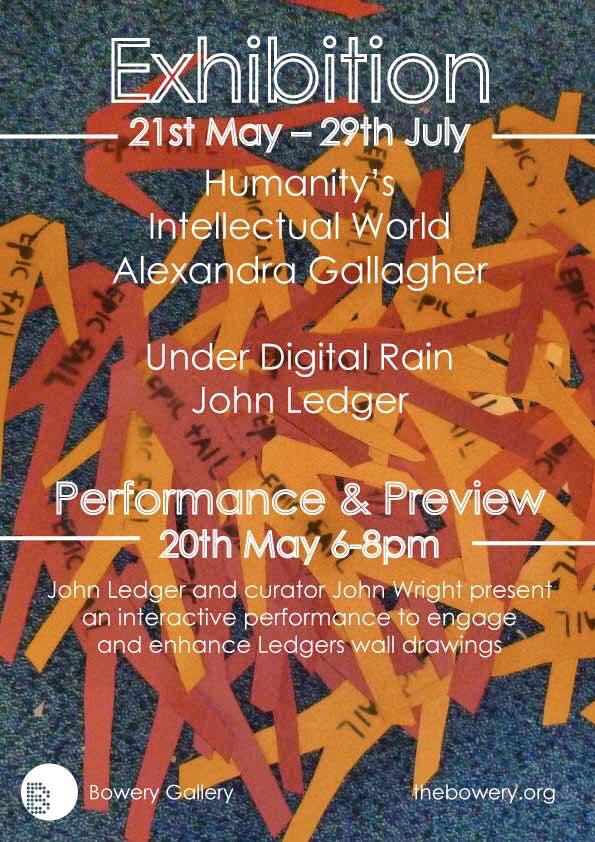
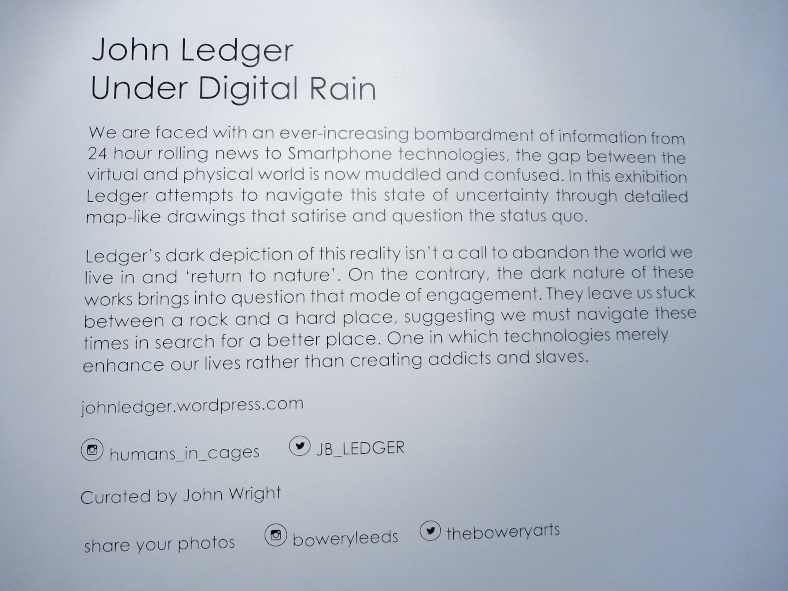
I am showing my work in Under Digital Rain, a show curated by John Wright, alongside artist Alexandra Gallagher’s Humanity’s Intellectual World, at Bowery Gallery in Headingley Leeds.
Under Digital Rain is part of an ongoing project (dialogue?) between myself and John Wright called The Retro Bar at the End of Universe, and on the opening night this coming Friday we will be performing our piece Non-Stop Inertia: A Stuck Record, inspired by an Ivor Southwood book of the same name.
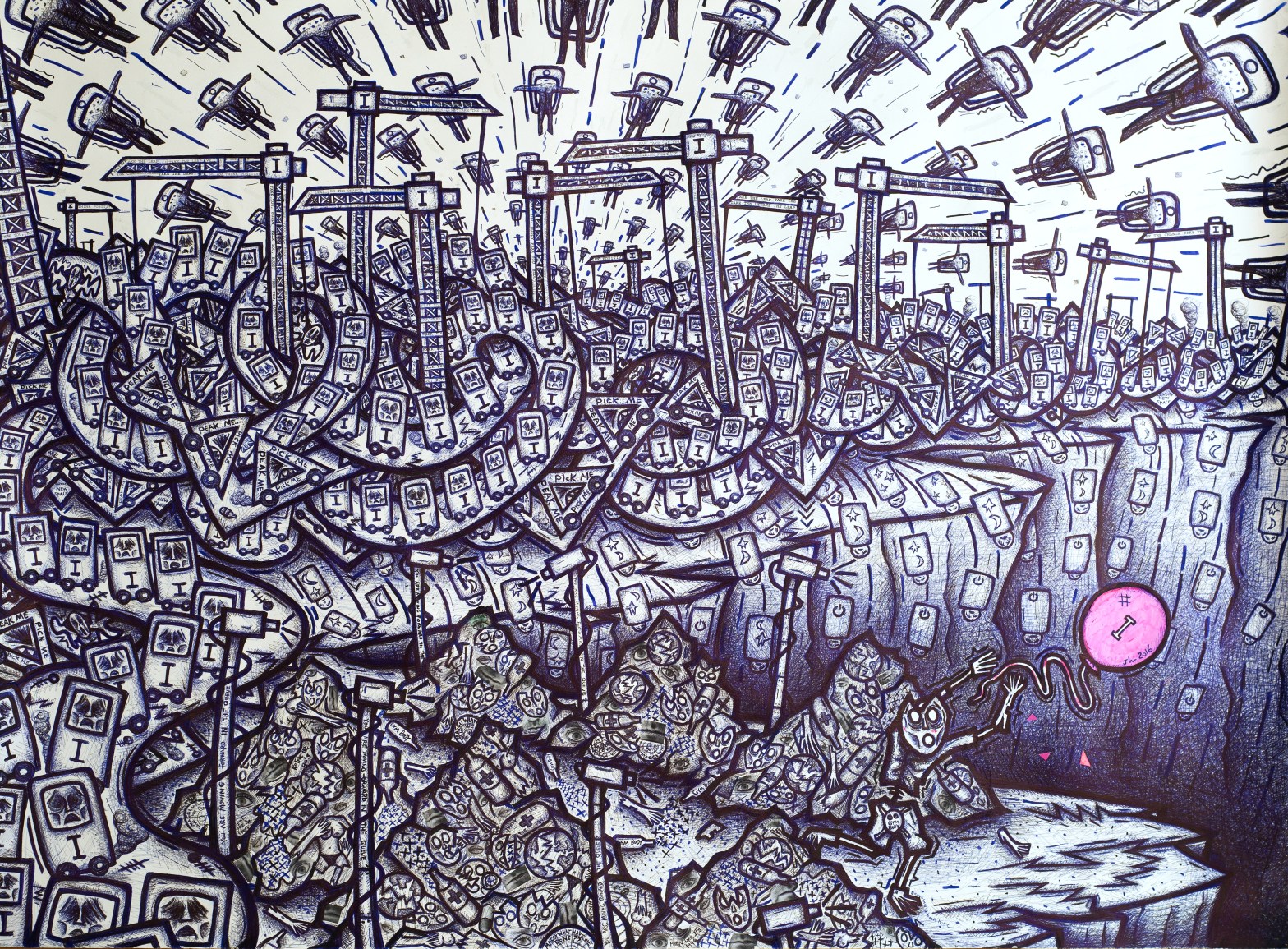
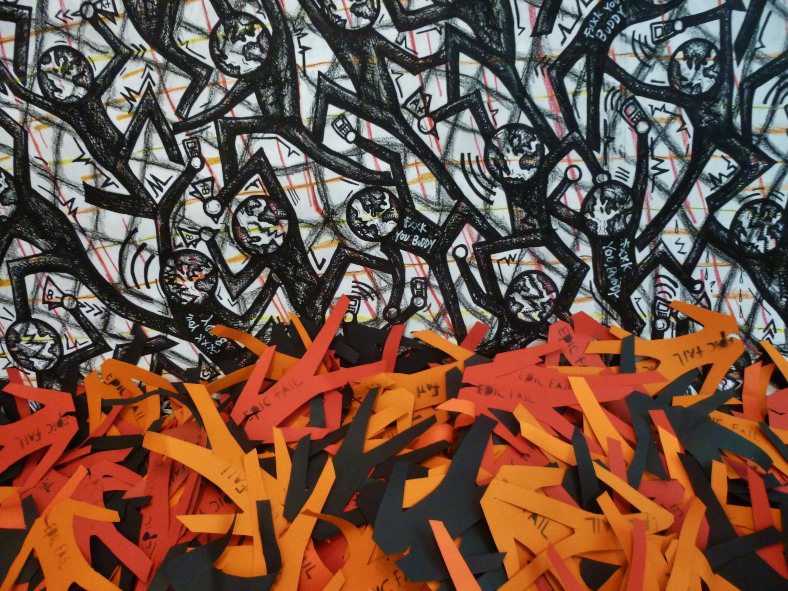
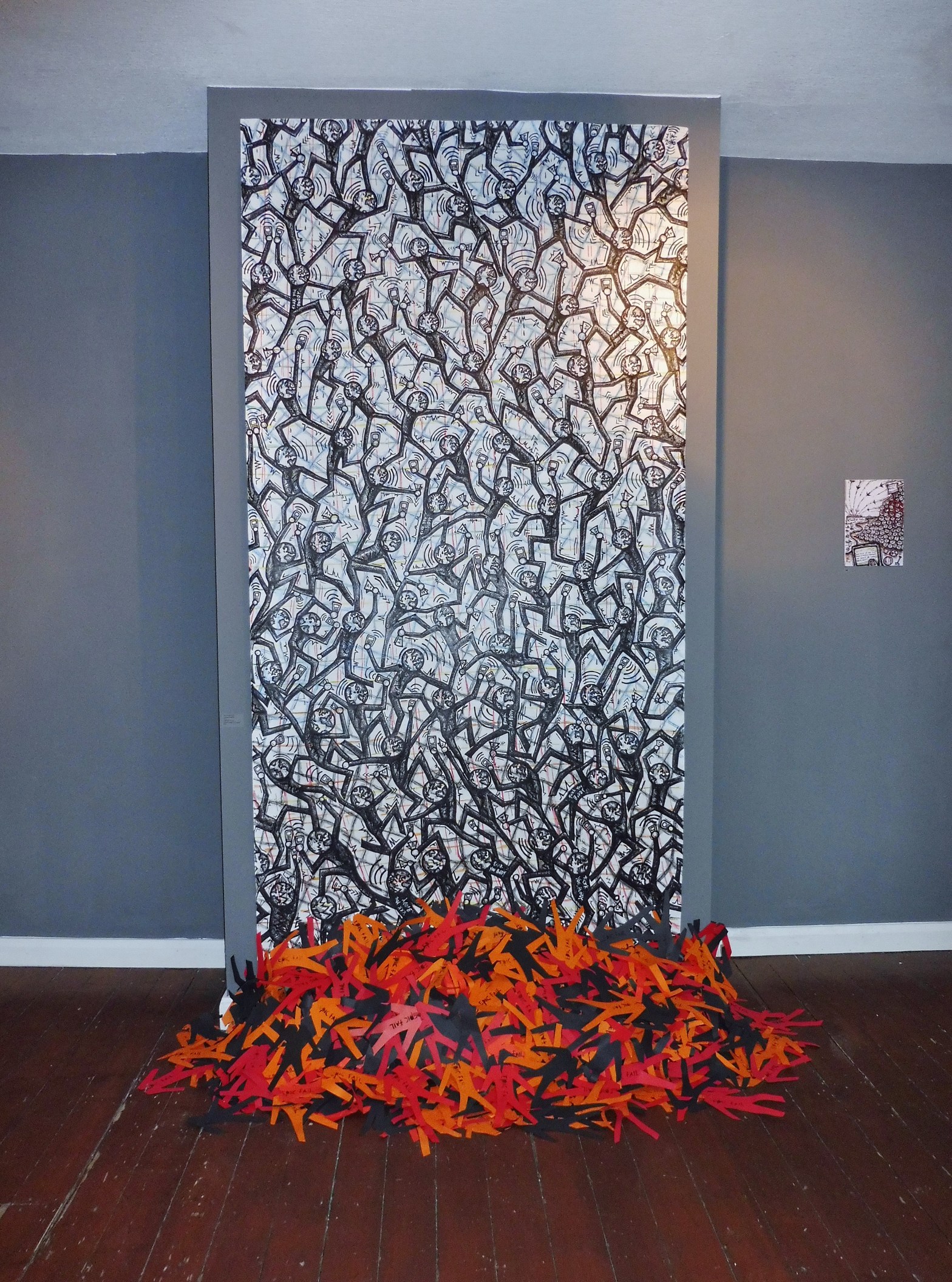
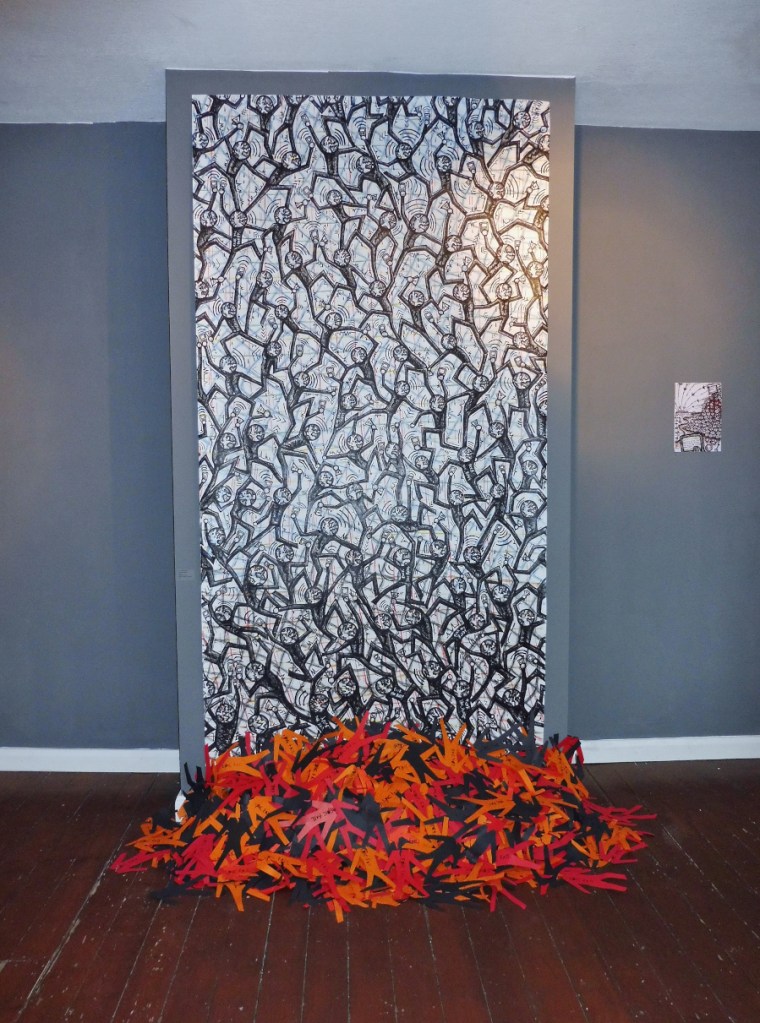
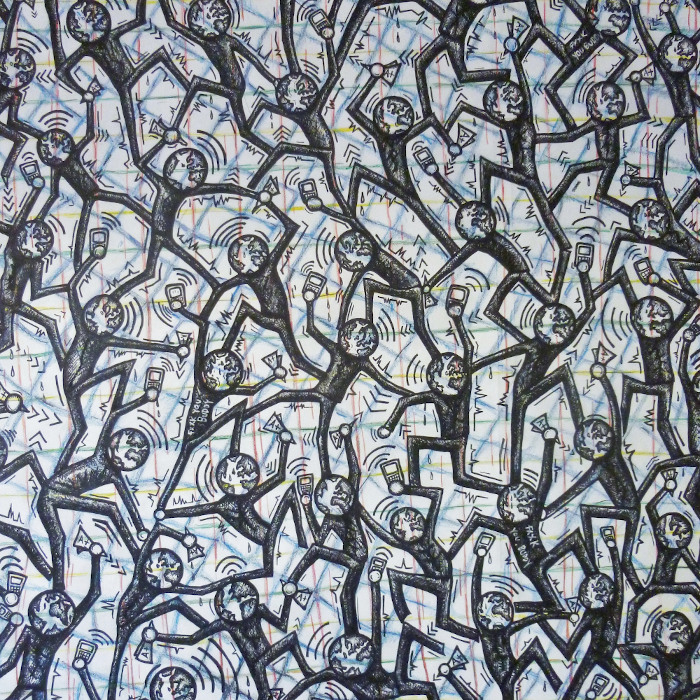
The World-Wide Oneupmanship (2016, 8X4ft, mixed media on paper)
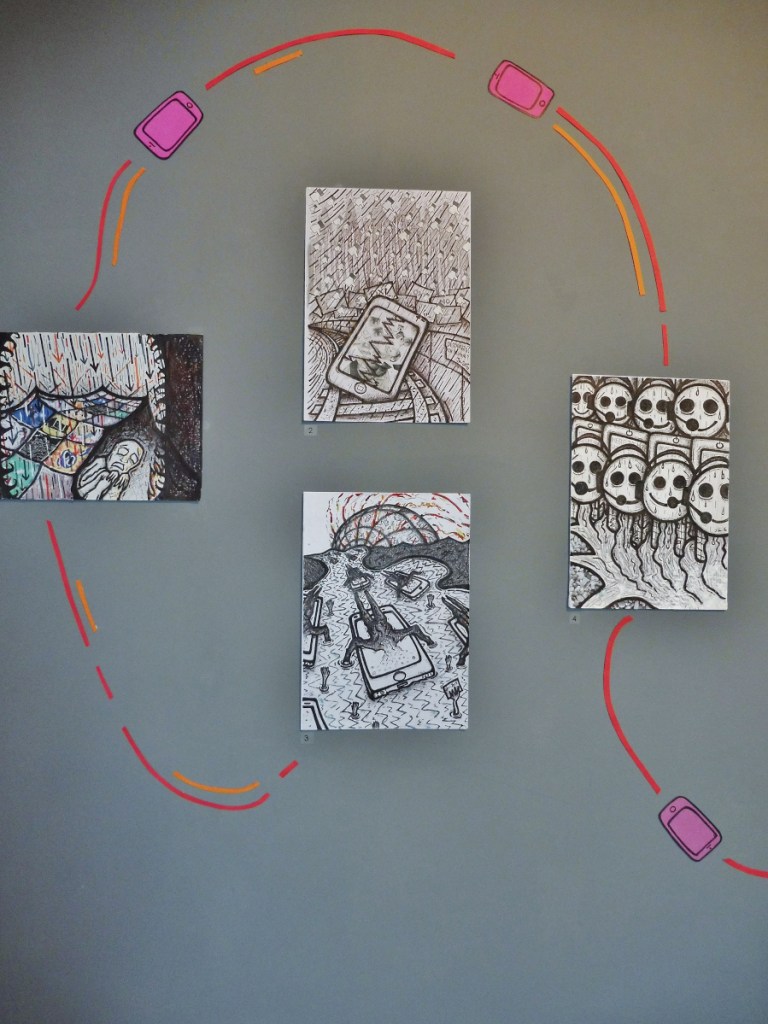
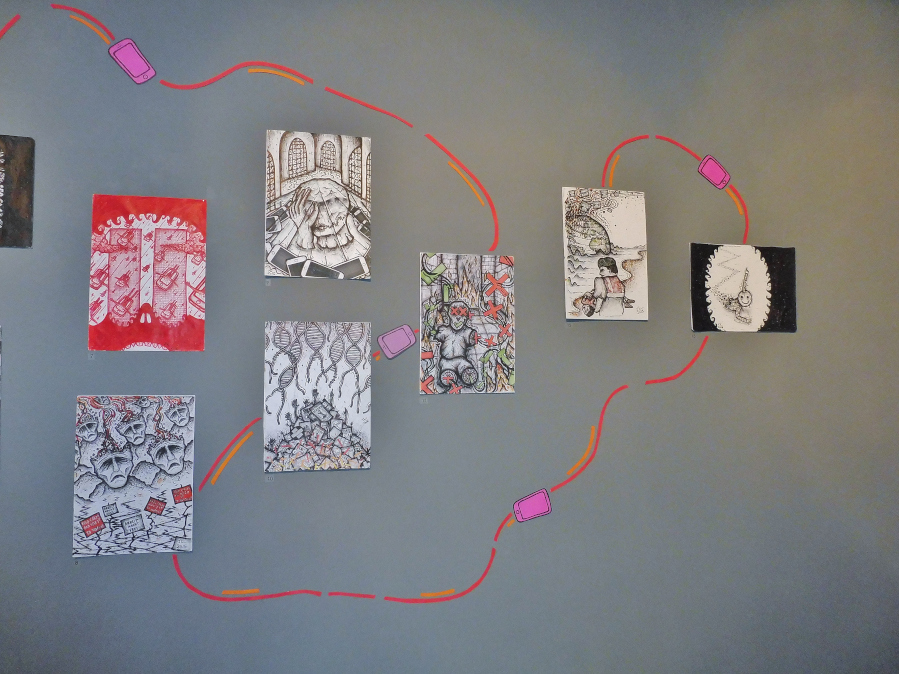
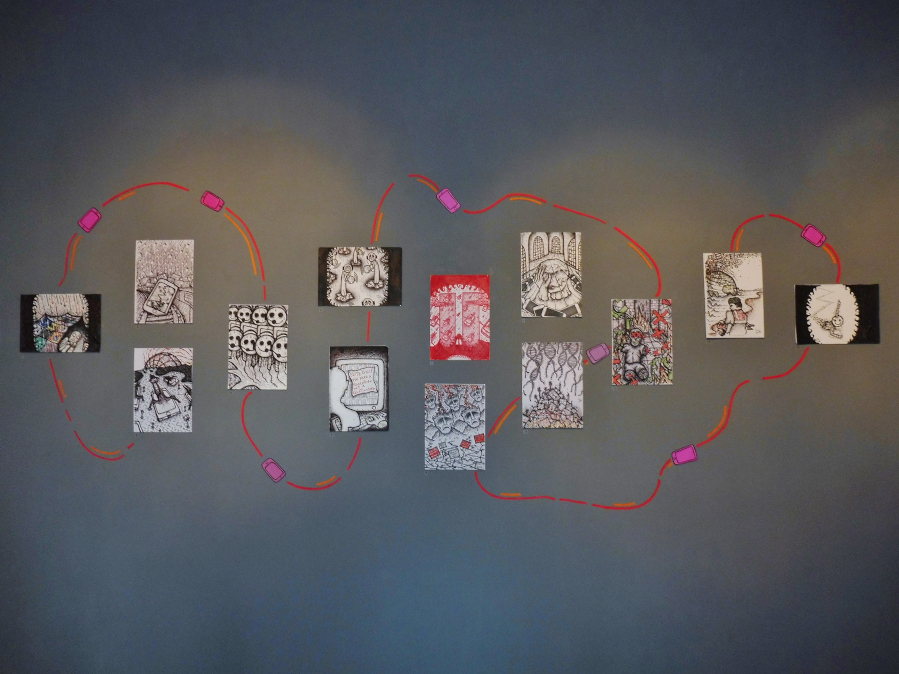
Titles of works in image below (from left to right): Gimme Shelter [Closure No1] (2015); The Self[ie] Under Siege (2015); “Sad, LONELY, Frightened” (2015); Drainage System (2016); Tired of Life/I Want to Leave Myself [Closure No2] (2016); NoteToSelf2016; The Capacity to Care (Closure No5) (2016); A Cognitive Austerity (2015); A Deep Paralysis (2016); Hunger Games Darwinism (2016); Bound up in Binary (2016); “Can We Stop now, Please?”; I am Becoming Nothing (Closure No3) (2015).
The World Wide One Upmanship (2016, 8x4FT mixed media on paper and card)
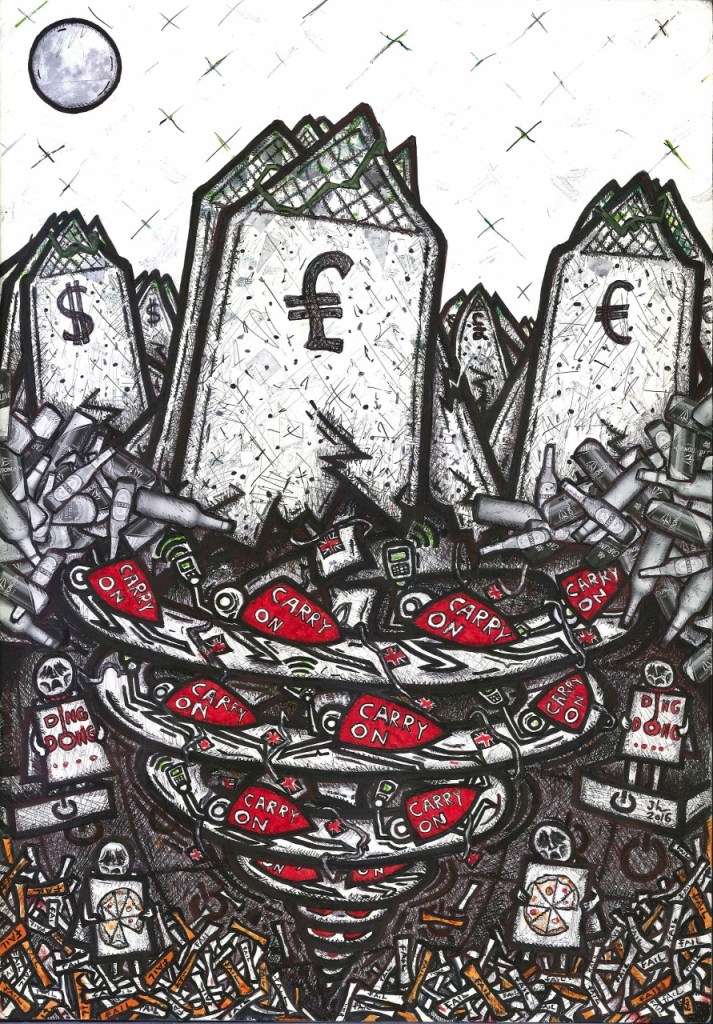
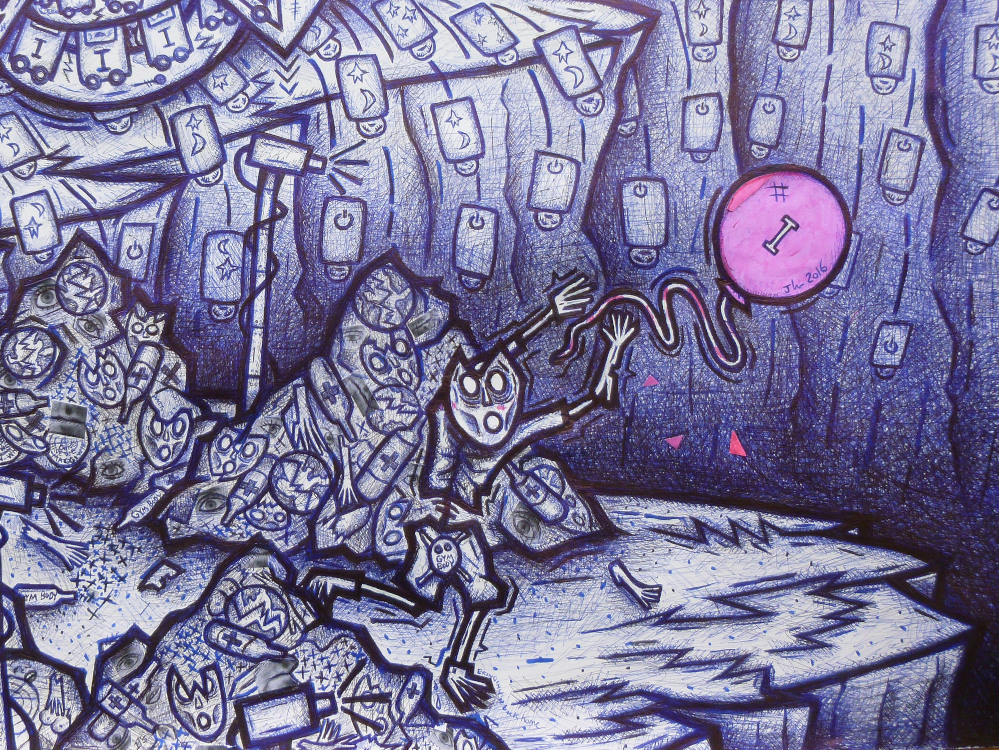
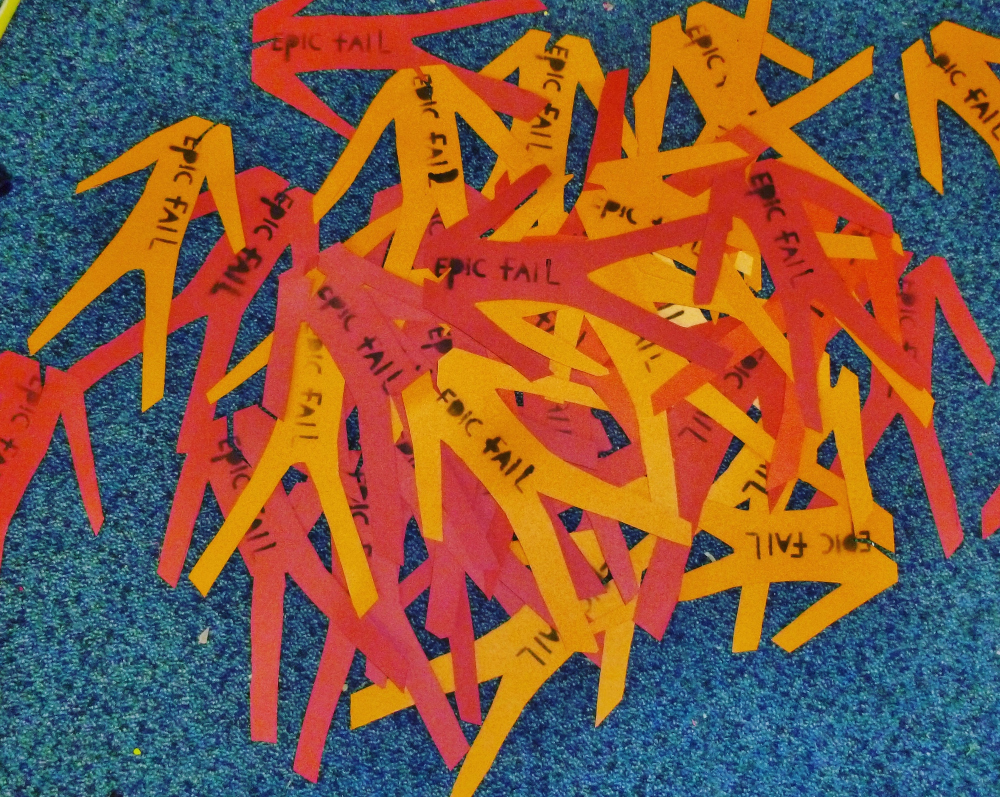
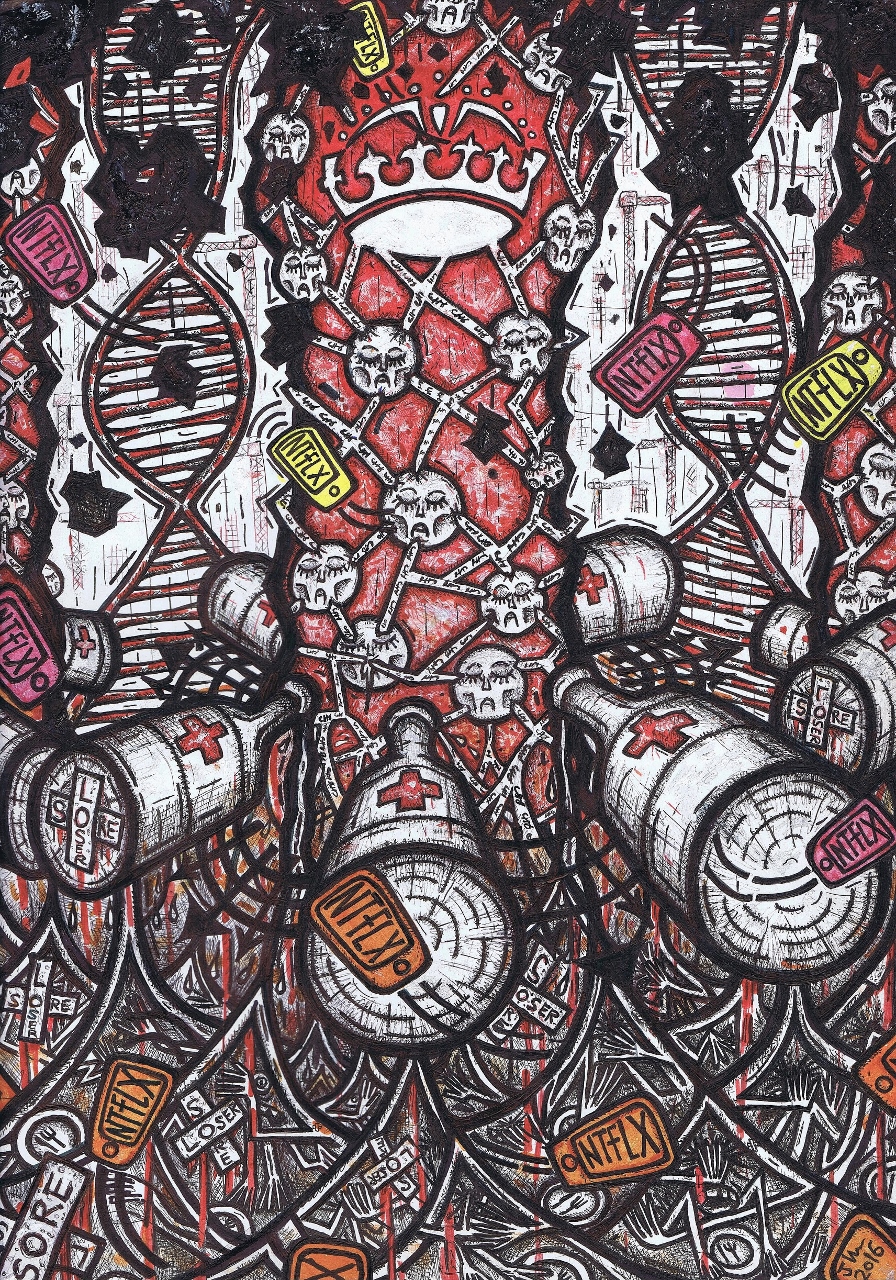
This is a piece I made in response to being asked to make a site specific piece when in the initial stages of planning my current show at Bowery Gallery. The work is called The World Wide One Upmanship, and brings together a lot of thoughts and visual ideas I’ve been playing with for the past half year. I worked these ideas into the shape of the building, by making the ‘epic fail’ detritus, the fallen, surplus-to-requirements, pile of cruel type of society, fit the shape of a fire place, with the wall being part of an old chimney.
Dispossession: The Great Social Housing Swindle is a no holds barred, explosive feature length documentary exploring the decline and deception behind the social housing crisis in Britain. It will be directed by Paul Sng, maker of the acclaimed cinema release Sleaford Mods – Invisible Britain (2015) and the award winning film & television director Lee Skelly (BBC, Channel Four).
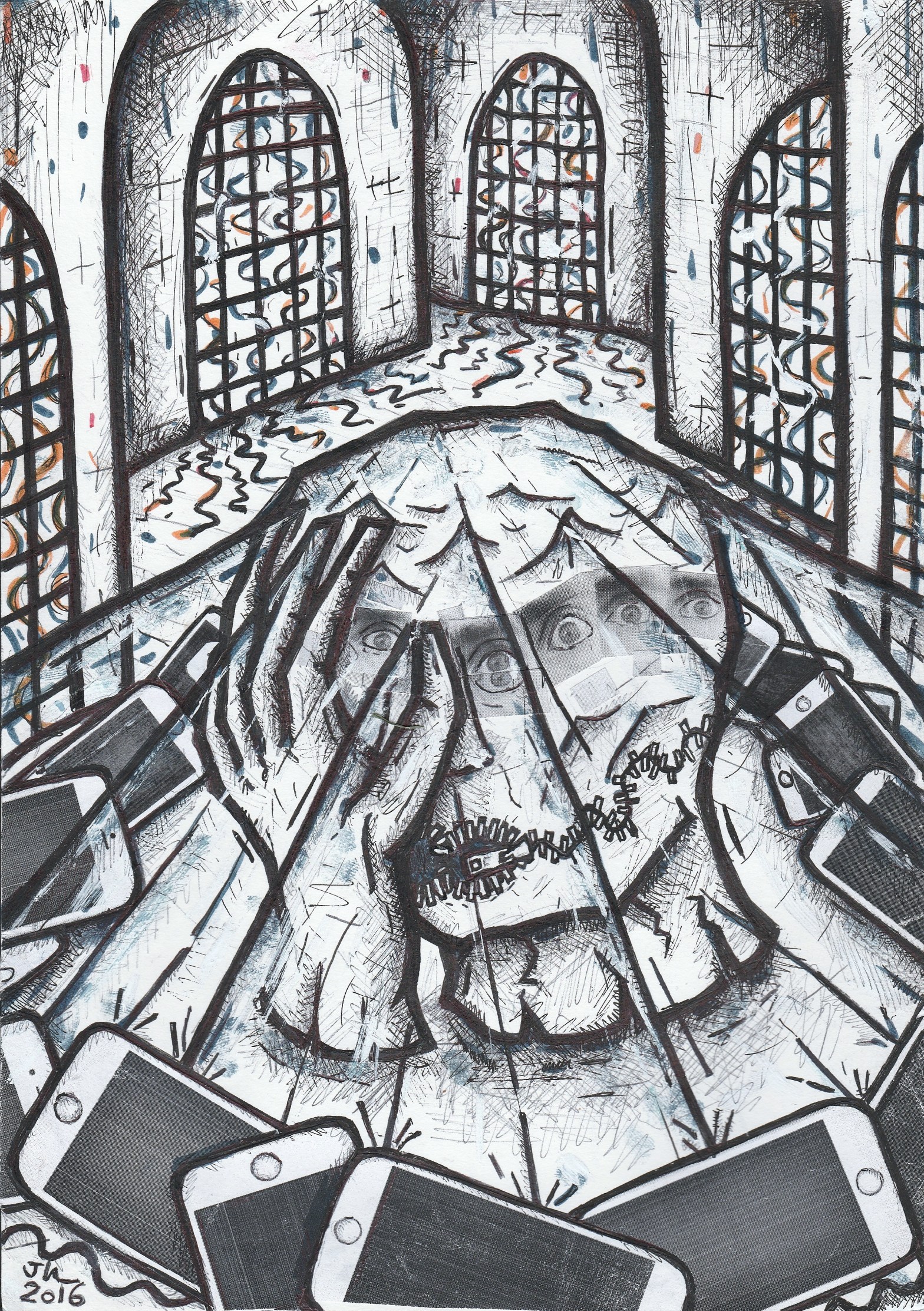
I have donated an original print of a new work I have made after filmmaker Paul Sng asked me if I’d like to be involved in helping support the crowdfunder for this project. This will be an A3 print of my latest work Rot_in_Silence_2016.
As part of a collective, I have embarked on a Crowdfunder project myself, in order to raise funds for an art show and documentary called ‘Fighting For Crumbs (Art in The Shadow of Neoliberal Britain)(Please read more about it here). Very much inspired and informed by Paul Sng’s last film ‘Invisible Britain’, Paul has been very supportive in helping our project get off the ground.












 John B Ledger