I went to see the film ‘Joker’ this week. It was an unplanned visit. I went to see an exhibition at ‘Home’ an arts and film multiplex in ‘Tony Wilson Place’, perhaps the weirdest yet most apt expression of contemporary Manchester (but I’ll leave that to one side for the moment). The show wasn’t on, so I stayed to watch a film instead; Todd Phillips’ ‘Joker’.
I’m not pretending to have self-actualised into a film critic in my post MA torpor, nor do I claim to have much background knowledge on the previous Joker and Batman films; yet, in a hypothetical 4-way conversation between the myself, the film, Russell Brand’s great analysis and the criticism’s in the press it’s received, there are a few thoughts I wanted to share, mainly relating to one scene, and the urban aesthetics the film is set within.
There are two scenes in ‘Joker’ that are likely to stay with you the longest. The first is when Arthur Fleck self-actualises as Joker whilst dancing on the giant inner-city staircase to the tune of Garry Glitter’s Rock and Roll Part 2. The second is Joker’s on air assassination of talk show host Murray Franklin; it’s my opinion that both perform the same ‘controversial’ function: going beyond the accepted boundary between art and life. However, if the second scene crosses this boundary within the cinema frame, the first certainly doesn’t.
I believe director Todd Phillips chose the almost universally-banned music of Garry Glitter, not purely because doing so is controversial, but because whilst our liberal value system can accept the good and bad, it can’t recognise the ‘ugly’, and, my word, there is so much ‘ugly’ currently seeping through a value system that is presented as universal (I guess all ideological value systems are universal…).
‘Ugly’ is the externalities that cannot be recognised for what they are. They have to be moralised as ‘bad’. They are inevitabilities of the social system which it simultaneously denies any involvement in creating. It’s the neutralising ‘Anglo Saxon’ toilet system analogy that Slavoj Zizek infamously repeats, which uses water as the place in which to quarantine and then dispose of complicity. The film is no fight against a fascist ‘bad’ guy like ‘V For Vendetta’; rather, it is an unhinged rage against something that seems both undeniably reasonable and rational, yet is clearly causing so much misery and madness.
For numerous reasons I find it very interesting that it is set in the 1970s. I wasn’t expecting this, but it suddenly began to make sense. I had expected it to be set in a present or near-future tense, a bit like V For Vendetta (to which it must have to be compared, if only for the employment of masks within a social uprising). True, there is no clear indication that it is set in the 70s, but only as much as there is no factual evidence that Gotham is meant be New York; yet it is beyond doubt the New York of the 1970s.
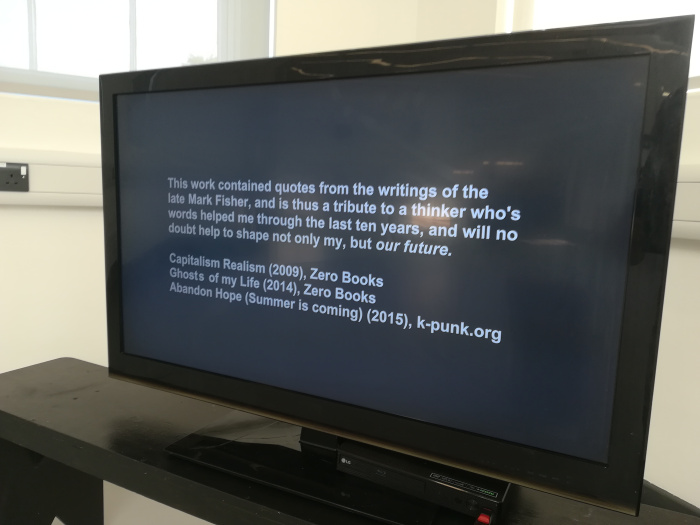
Most of my reasons are better explained by the late Mark Fisher. His book ‘Ghosts of My Life’ goes into this ghastly yet fascinating decade which provoked the deeply conservative political energies that would go on to ‘slowly cancel the future’, so that not only did the idea of a future tense seeming Other to our present become unimaginable, but the gentrification, hispterisation, side by side with the emasculated working class-cum-homeless, and, of course, the ‘always on’ smart tech, seems to have drained any perception of what a present day revolution could look like.
How could we imagine an uprising in present-day Manchester (for example) when we encounter a statue of one-time resident, and Communist Manifesto co-writer Fredrich Engels stood in Tony Wilson Place, around creative industry cafes alive with MacBook café meetings, and the tallest luxury penthouses outside London? Who could justify their revolt against the very place that delivers the ‘revolutionary’ art you consume?
The 1970s, as Fisher explains in Ghost of My Life, were the ‘ugly’ in a way that still makes Zizek’s critique of liberal capitalist democracy stand up. Meanwhile, ‘Joker’ is so powerful because it goes past the restraints of civic politeness, which those who desire revolution are unable to do without employing the very things they have seemingly been fighting against for over a century.
Maybe this is why Zizek has become viewed as a toxic threat to the larger leftist movement. However, maybe he originally became so notorious because he was it’s best opportunity – not because he’s a genius (in current context he’s more boring than toxic, constantly repeating himself), but because he showed a way out of the straight jacket of liberal values that forces any opposition to capitalism to fight it with its hands tied. Extinction Rebellion/Greta Thurnberg, etc are doing amazing and beautiful work (and I’m in no place to judge, anyways), but by and large the value system agrees with them, agrees with gender and sexual equalities, etc – which is possibly why it is able to continuate the perception that the liberal value system and the forces of capital accumulation are not mutually validating.
It seems, rather, that the ‘ugly’, the silent excretive excess, has been taken over by the politics of extreme conservatism. Leftist movements struggle to reverse this; because, in spite of the continuation [even intensification] of the very miseries it fights against, regarding language, it appears to have won... [kind of what Jordan Peterson sees as the victory of ‘cultural Marxism’, only Peterson uses this to apologise for, and justify, racial, gender and class inequalities, in a needlessly reckless manner].
In the context of ‘Joker’, Russell Brand was reminded of the 2011 UK riots. In 2011 Zizek appeared to be the only one trying not to moralise it on from the perspective of the oppressed, and impoverished urban poor. He dared frame it as the ‘ugly’, beyond reason within our value system. The clear joy of the rioters was the momentary liberation from all the cultural politeness that never did them any favours. This was a messy, violent expression of the shadow side a deeply pissed off group of people.
Mark Fisher was a leading light, most notable in Ghosts of my life and the Weird and The Eerie. But the left seem to adore him yet rarely take up the paths he did. True, the places to where Fisher was prepared to go, as evident in his final book he finished ‘the weird and the eerie’, may have not helped his personal health [that’s not for me to speculate, but I can only guess], but there was a sheer earnestness in his need to carry on where most of us hold up the stop sign and say “we can’t go there, or say that” – safe in the comfort that we are ‘correct’, even if it means holding up the status quo.
It was this embrace of liberal values for all in the 21st century, that meant the ‘return of 1970s’ [a section of Ghosts of My Life] was such an existential threat. I cannot vouch for the USA, but in the UK the 1970s’ ‘ugliness’ that seeped through the floorboards in 2012 made it reasonable to think that the entire British entertainment establishment had been paedophilic. What materialised under the MeToo campaign is our recent version of this; it wasn’t so much an existential threat because of the lies and corruption it uncovered, but because sexual exploitation is an product of our social system that the value system cannot understand, it is so ‘ugly’ to look at – yet here it was threatening to undermine, again, the entire entertainment industry.
Our value system forces all who identify with progressive values to morally condemn the crimes. We can successfully neutralise these acts in water closet when they are few, but when they are everywhere, the sewers threaten to burst and take over the city of cafes and cinemas. Which is what occurs in Joker.
Which gets us back to the use of the Garry Glitter song. Russell Brand talks about how Arthur Fleck self-actualises through embracing his shadow, the “explosive, dark Other”. Dare I suggest, that the beyond-fucked up legacy of Glitter, in a 1970s aesthetic, galvanises the joy we experience in this scene. Our shadow side ‘interpassively‘ engages with the dark revolutionary spirit of the film, which we cannot begin to utter in everyday polite culture, because even talk of social transformation, and a radically different society has no room the shadow side. We are secretly pushed to embrace the open sewer of the 70s.
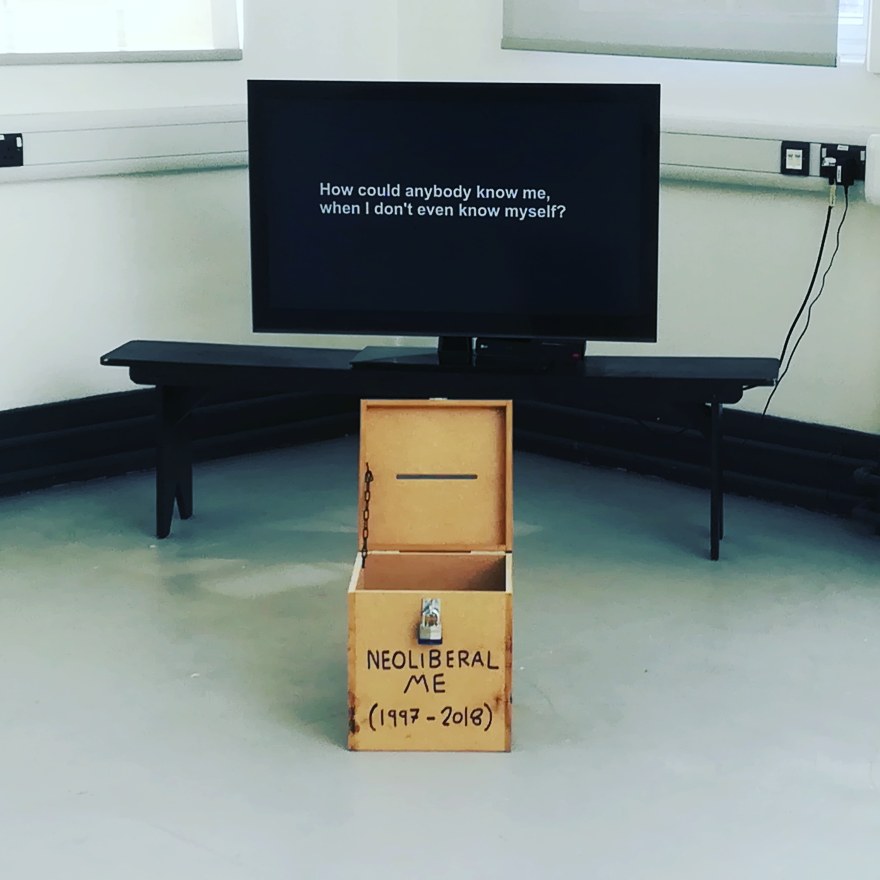
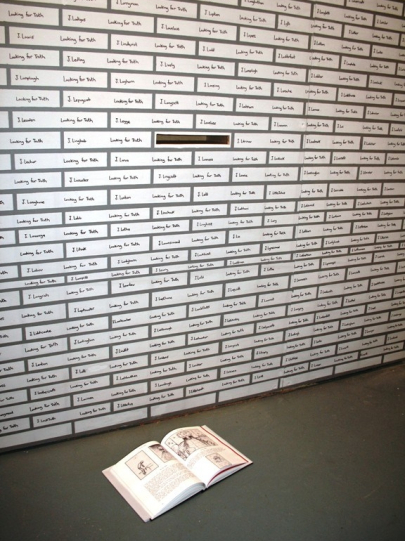
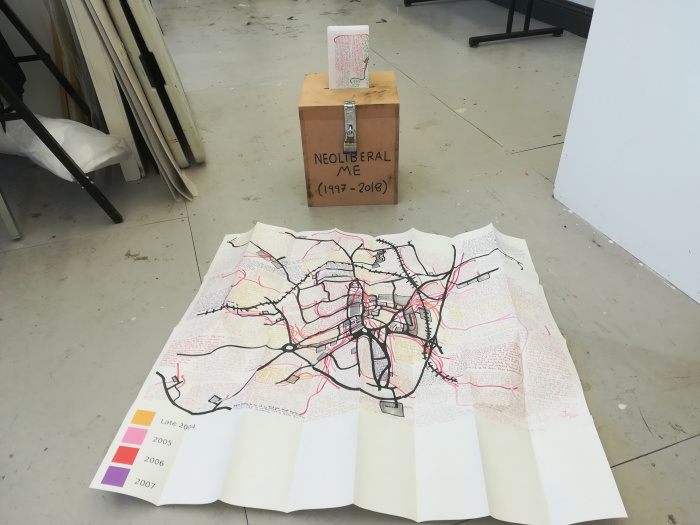
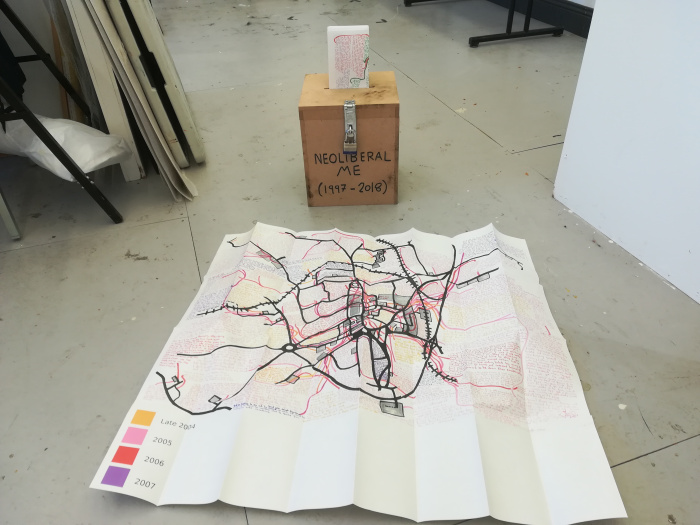
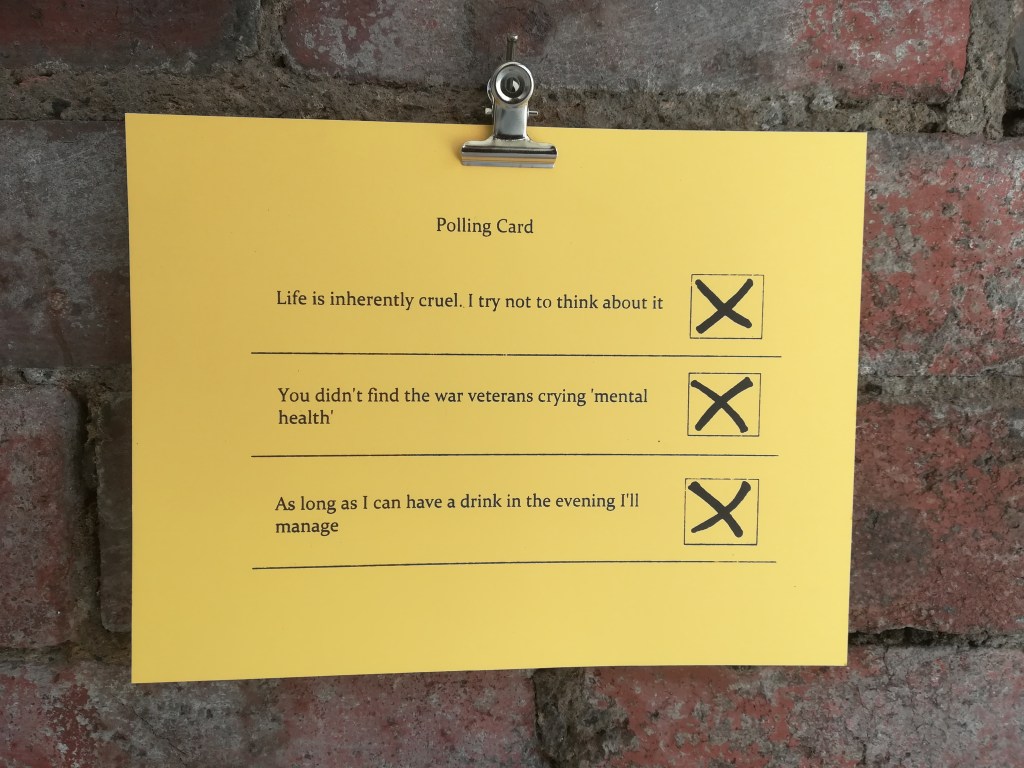
I want to go a little further and talk about how the ‘incels’ have been referenced regarding the protagonist Arthur Fleck’s life, alongside some sensitive issues I tried to broach for a slightly semi-autobiographical position in ‘Wall, i’ (my last major project for sometime). But I will try to come back to this…
![A4_MA Final Show Flyer[4245]](https://ci4.googleusercontent.com/proxy/yyyQXe3rUbSDcFy8_g_ESJTiwRKylFBaxRw3Q6Qp0BN8Q-3FWI8bAbLKiv8XRB8ord9vPNtQUy2ads0UKrW6jCUzshYU582Q8DkHYR2oO1xxWd0oA5FUkJ1Nz8LCufikRYLpZ9yJ=s0-d-e1-ft#https://johnledger.files.wordpress.com/2019/09/a4_ma-final-show-flyer4245.jpg?w=479)
























 John B Ledger