Kraftwerk in the time of Covid 19

This may seem like a ‘stretch’, but I argue that renewed interest in the music of Kraftwerk, brought about by recent passing of co-founder Florian Schneider, makes for strange resonances and recollections in a world partially suspended by the outbreak of Covid 19.
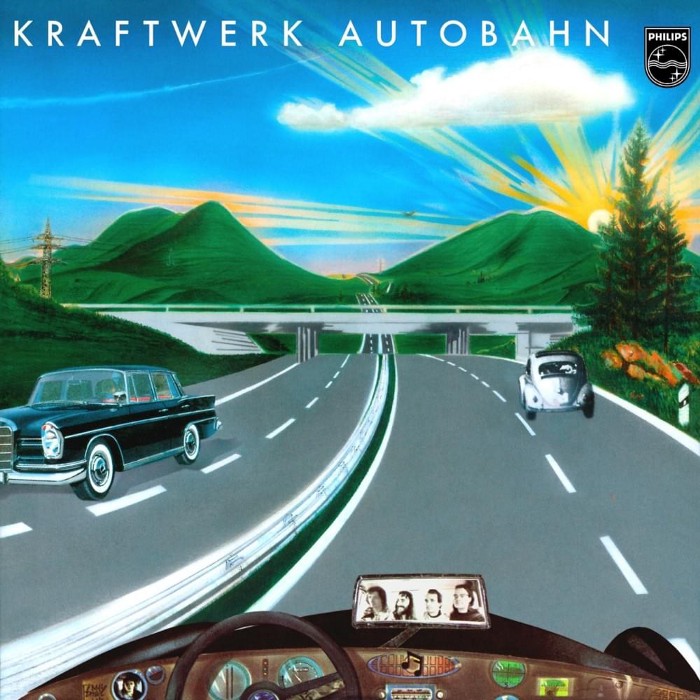
Now, I’m not usually one to share news of the death of a notable artist over Social Media, which often feels like an unending procession of obituaries. But, nonetheless, Kraftwerk had made a deep impression on my 21st century adult life, so I decided to start by playing one of my favourite tracks by the group, Ohm Sweet Ohm, from the album Radioactivity, driving on my way to work.
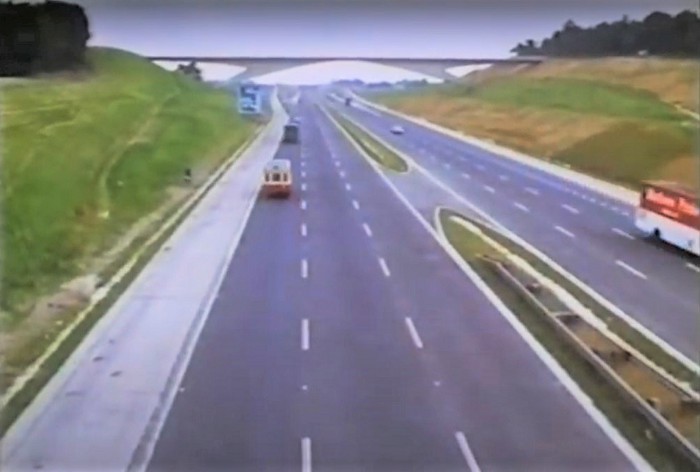
A still from ‘Nairn’s Europe’ a TV series from 1970, showing the motorway junction in Barnsley, that I used today, in 2020.

Driving, or at least commuting to work is an almost universal experience in 21st century life. If you haven’t fallen foul, ‘lumpen-like’, to the grossly uneven economic development of the past 40 years, it’s very likely you have to do it.

However, not today.

Normally, if you were to be commuting at 8:30am, you would be part of an unending flow, so immersed in the stop/start blockages, so very much part of it, that you wouldn’t even be able to ‘notice’ the motorway, the railroad, or the terminals. You’d most likely either be trying not to think about it, or you’d be overcome with thoughts regarding your destination.

But today, the motorway was almost exactly like it was as the once-brand new motorway you can see in the image above, from 1970; which, in turn, is very much like the motorway on the cover sleeve of the 1974 Kraftwerk album Autobahn.

Listening to Ohm Sweet Ohm whilst finding myself on a motorway with significantly less traffic than normal, joyously brought the music of Kraftwerk and the architecture of the M1 motorway together. For the first time in maybe over a decade, this particular synchronisation gave me a joyous ‘allure for the Modern’, and I try to explain why, now.

Although it’s clear the passing of Schneider has absolutely nothing to do with Covid 19, I believe that it’s given us an incentive to re-listen to Kraftwerk at a very appropriate moment: we live through a time when our use of the technologies, infrastructure, that uphold our ‘non-stop’ 21st century lives, have been partly-suspended, seemingly indefinitely.

In fact, I can remember the last time I felt this very joy in the ‘allure for the Modern’. It was on another relatively mundane node within of our hyperconnected world, as my local service train pulled into the Yorkshire hub of Leeds in the autumn of 2008: I was listening to Kraftwerk’s Trans Europe Express.

So what is this ‘allure for the Modern’? Why is it important to Kraftwerk, and why do I think our recent lives pre-Covid lost this ‘allure for the Modern’, and why do I think it gives us a chance to look at our world anew?

I’ll try to answer all this in a post I’ll do my best to keep as interesting and concise as possible.

The ‘Modern’ is arguably quite different from just living in ‘Modern times’. Or, to put it another way, the definition of the past 40 years or so, that we call ‘Post-Modern’ can be misleading. We are still in a world defined by all things ‘Modern’; the way we work, travel, eat, seek leisure, even the procedures around dying. These things have become more chaotic, far more intertwined and uncertain than arguably even for our grandparents and great grandparents, who were also ‘Modern’, and these changes are often what we’d ascribe to Post-modernity. However, I argue what mainly characterises these past 40 years is a feeling, or lack of: a loss of a sense that technology, and progress in general, are leading us to a far better world. The wonder at such technological achievements is what I call ‘the allure for the Modern’.

Chatting about Kraftwerk with friends with similar music tastes in the 21st century would culminate in an utterance that just didn’t feel right. Why would we agree that Kraftwerk’s music still sounded ‘futuristic’, 30/40 years on, in a world, that was, to all intents and purposes that very future to those albums?

I’ve already mined the ideas of theorist Mark Fisher way too much, but Fisher’s and the Italian thinker Franco ‘Bifo’ Berardi’s idea that in the past 40 years we have witnessed a ‘Slow Cancelation of the future’, is still, I argue the most fitting expression of a strange sense that aspects of 20th century culture still seem more ‘futuristic’ than the present. Roughly identified as a cultural reality brought about by a synchronisation of shifts in political and economic life with the rise of computer technologies, it argues we can no longer imagine a world different from the present. For Fisher this change, that he said was most noticeable in cultural forms, especially popular music, was political, and he diagnosed our age as inflicted by a ‘capitalist realism’.

But regarding Kraftwerk, why were they so futuristic?

For a start, perhaps Kraftwerk’s futurism had to come from Germany? David Cunningham, in his essay Kraftwerk and The Image of the Modern, (featured in Kraftwerk: Music Non Stop) argues that Kraftwerk, along many other young German artists at the time, looked ‘back to the future‘, bypassing the black hole left by Nazism and the legacy of the Second World War, to look back to the Modernism of early 20th century Germany (such as the Bauhaus movement and the early Frankfurt School). But rather than looking back in a retro-fetish sense, Cunningham writes that “[T]hey [Kraftwerk] gain their meaning as modern from their dynamic relation to past works [my own italics], through a determinate negation of what precedes them…”

Germany along with Japan, upon unconditional surrender to ‘allied’ forces in 1945, were subjected to ‘the Marshall Plan’, a project to rebuild the nations and their economies after the war. Without going too much detail (their de-militarisation, and how being ‘victors’ also shaped the ‘victors’), it is clear to see that vast swathes of urban Germany and Japan were rebuilt in an ultra Modern style. Unlike the UK, for example, which politically, and physically, was able to maintain enough of its former self during the post-war rebuilding, Germany, for the large part had to start as if brand new. What I’m inferring is that, despite the great leaps in what Mark Fisher and Owen Hatherley call ‘Pop Modernism’ in the UK and USA, the conditions of Germany, and of being German, in the Post-war era, created the conditions to be ‘Kraftwerk’.
But what is it about our current Covid 19 life that highlights this ‘Modern’ (again)?

In an essay for the pop philosophy book ‘Radiohead and philosophy’, Adam Koehler writes about a band who perhaps, like Kraftwerk, make music that isn’t, as Koehler writes, merely ‘about’ the conditions of life produced by technological ages, but is an ‘artefact’ of it.

Koehler here, is making this claim about the music of Radiohead from the Kid A album onwards; how it isn’t “about [the] low-level panic and anxiety produced by living in “the information age”, [but is] an artefact of that information and that age…”

Koehler tells us that Martin Heidegger in his book ‘Being and Time’ says that the technologies that we depend upon for “our everydayness…retreat[] from our attention and becomes invisible to us” and that we only notice them when we don’t want to, when they break down, stop working. He says what makes the ‘anxiety or panic’ that domes Kid A…” so ‘familiar’ is that “we hear technology”, which is very different from simply using technology to make music.

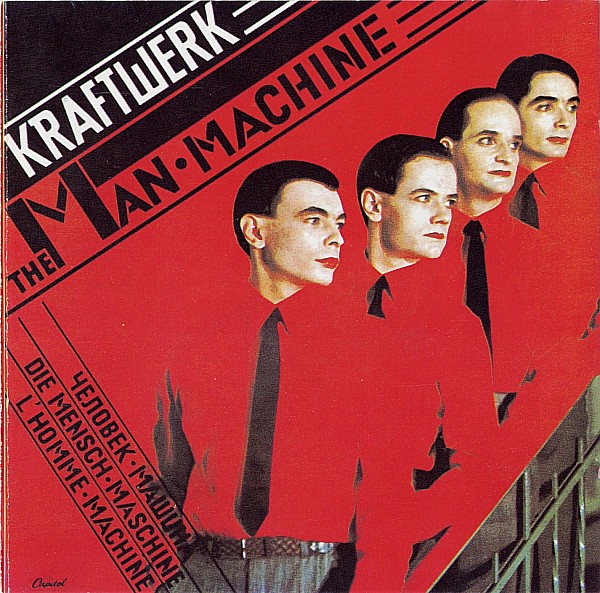
Perhaps (especially within the 5 consecutive albums Autobahn, Radioactivity, Trans Europe Express, The Man Machine and Computer World) no other band has quite enabled to us to “hear technology” quite like Kraftwerk”. However, apart from an implicit melancholia that seems to haunt the otherwise upbeat rhythms of Computer World (that perhaps speaks more to a loneliness of 21st life than anything), we don’t necessarily ‘hear’ technology breaking down as in Radiohead. What we do hear is this ‘modern’ technology in a real world of Covid 19, where partial suspense of ‘everydayness’ has made the intertwined hyperconnected world upon which our ‘non-stop’ lives depend become noticeable, perhaps for the first time in decades we can “see technology”?

We can see the motorways, the railroads, we can see, arguably what remarkable feats of engineering and architecture they are, because we are barely using them. We can see the technology behind food distribution, for example, because, perhaps for the first time in our 21st century life, we have been forced, as a society, not to see it as an endless resource, originating from nowhere.

Covid 19, I argue has made the dust settle over our frantic lives of the past 40 years to settle. What the future holds is uncertain, by what it does is make visible ‘Modern’ infrastructural achievements that wowed our near ancestors, but has become invisible to us, immersed in it as we were until very recently. It is only coincidence that the passing of Schneider has brought Kraftwerk back to our attention during this pandemic. But, in this temporary space where technology is once-again visible, Kraftwerk isn’t just relevant again, but once again a deeply immersive, enjoyable experience, if you happen to be one of the fewer people using the our Modern infrastructure. It really does reactivate the ‘allure for the Modern!’

Wall, i

Precursor: I developed ‘Wall, i’ as a film intended for exhibitions, and independent screenings, but was encouraged to make it accessible online. The work covers a series of complex contemporary issues, so whilst the film is available to share, I just politely ask people not to share clips of it out of context, as, out of context it may unjustly offend (even in our are of stimulation-saturation!), So, please, share with consideration 🙂

‘Wall, i’, is a young male who is born into a world that tells him he can be whoever he wants to be, that the ‘old world’ of duty, discipline, division and drudgery has gone. Yet the promise doesn’t turn out quite how it was anticipated. In a new world of new technologies and self-help slogans, the past returns with anger, and ‘Wall, i’ becomes trapped inside himself. Unable to connect, he descends into a spiral of minor addictions, loneliness, bitterness and hatred, from which he ultimately seeks forgiveness.

A song-based film, Wall, i is a response to the 30 anniversary of the fall of The Berlin Wall, and the affirmation that we had reached ‘the end of history’, and the 40th anniversary of Pink Floyd’s The Wall (‘Wall, i’ tries to employ similar themes for a ‘Millennial’ experience). It is also an autoethnographical (using collated experiences personal and pier experiences, to expand into a fictional self) response to the political, social divisions we now see in 2019.

This film was a highly collaborative film, and I wish to thank everybody who helped. I could never have done anything like this without the help of these people.

Co-songwriter and music composer – Lee Garforth
Assistant director – Jordan Blake
Assistant director (2) – Sheldon Ridley
Lead actor – Ben Crawford
Lead actor and contributing vocalist – Jade Robinson
Lead actor – Laura Clowery
Creative support – Rebekah Whitlam
Editing support – Katherine Lacey
Support assistant director – Rob Nunns
Supporting vocalist – Carys Bryan
Sound editing support – William Addy
Technical support – Simeon Dear

Actors: Yew Tree Youth Theatre (Ben Walton, Chloe Walton, Ellie Barraclough, Madison Mersini, Lara Earnshaw, Lucy Gallican, Tom Mason)

Actor – Kevin Parkin
Actor – Mollie Hobson
Actor – Sam Francis Read
Actor – Celeste Taylor
Actor -Lucy Crouch
Event support- Chris Scarfe
Event support – John Chambers (Temple of Muses)
Event support – Steve Ellis
Supporting actor – Ben Parker
Supporting actor – Rose Merry
Supporting actor – Rachel Marie Thornhill

We Want to live

dav

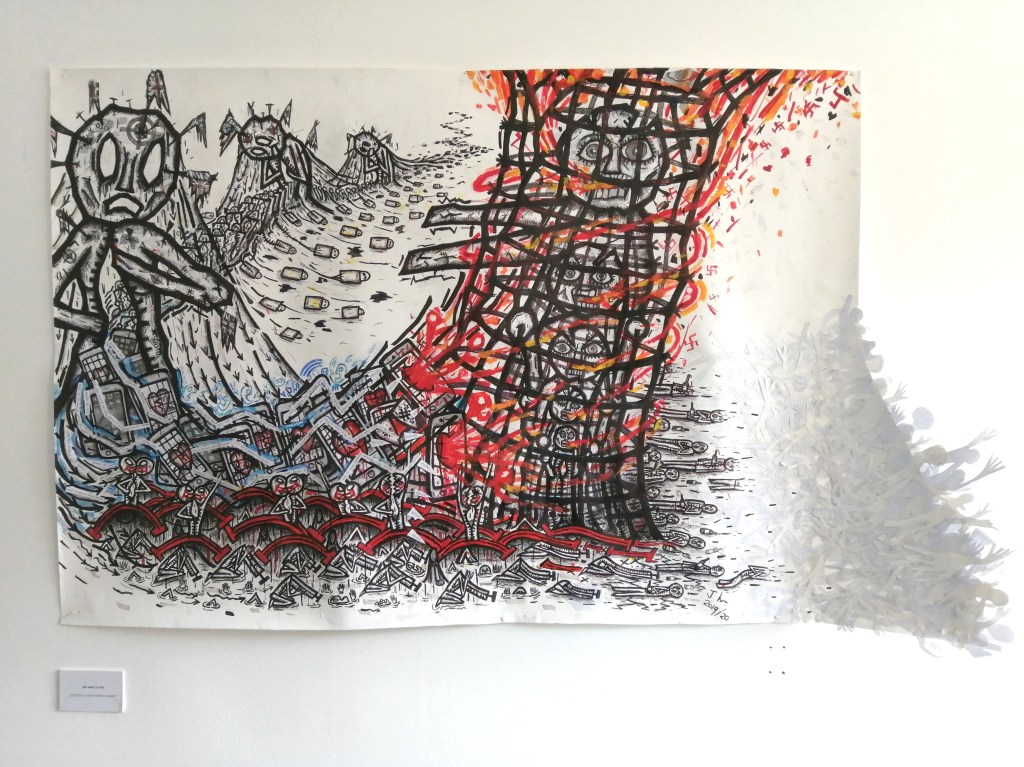
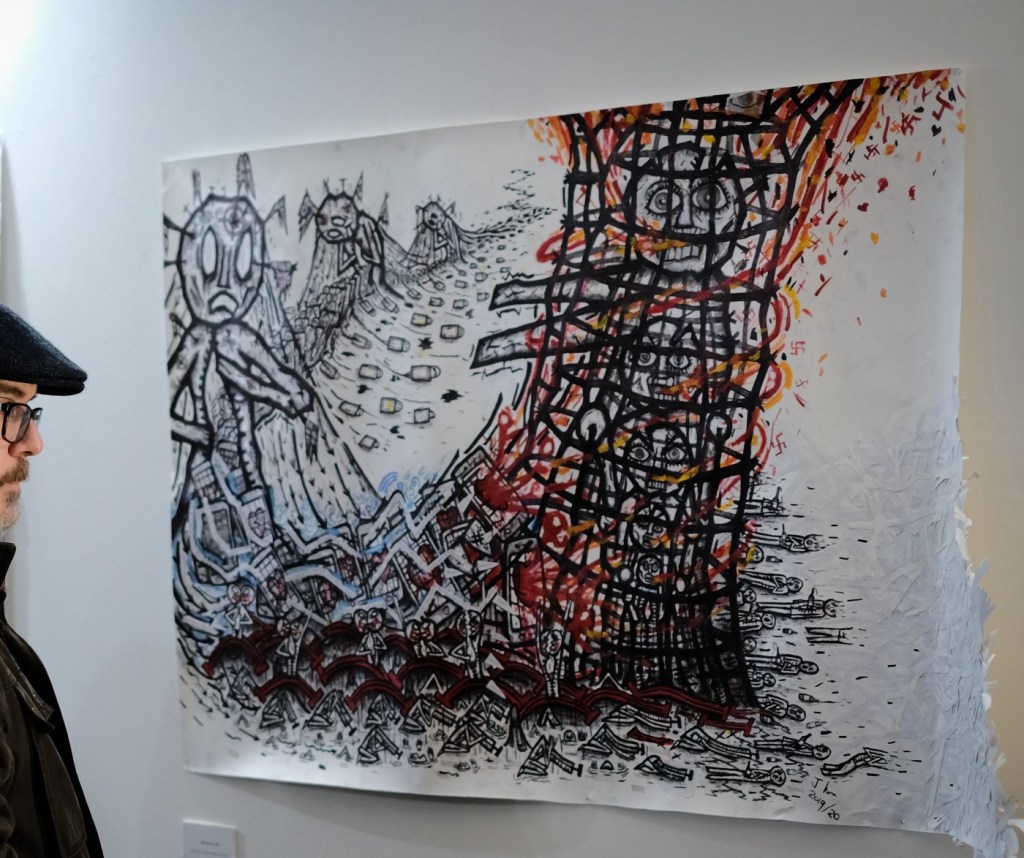
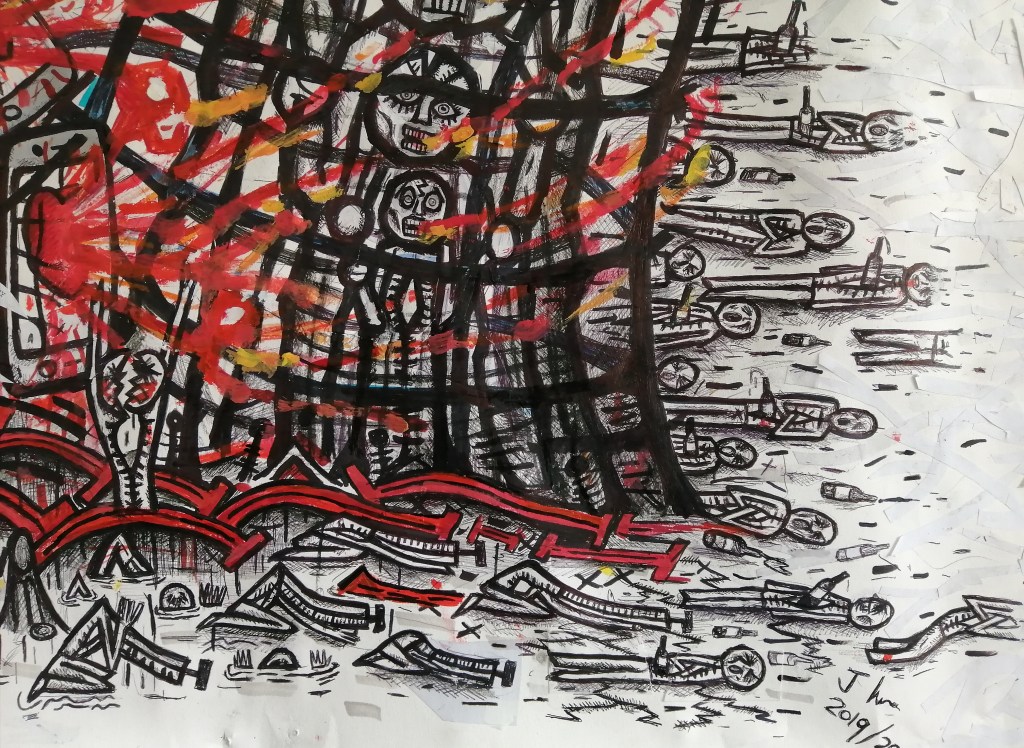
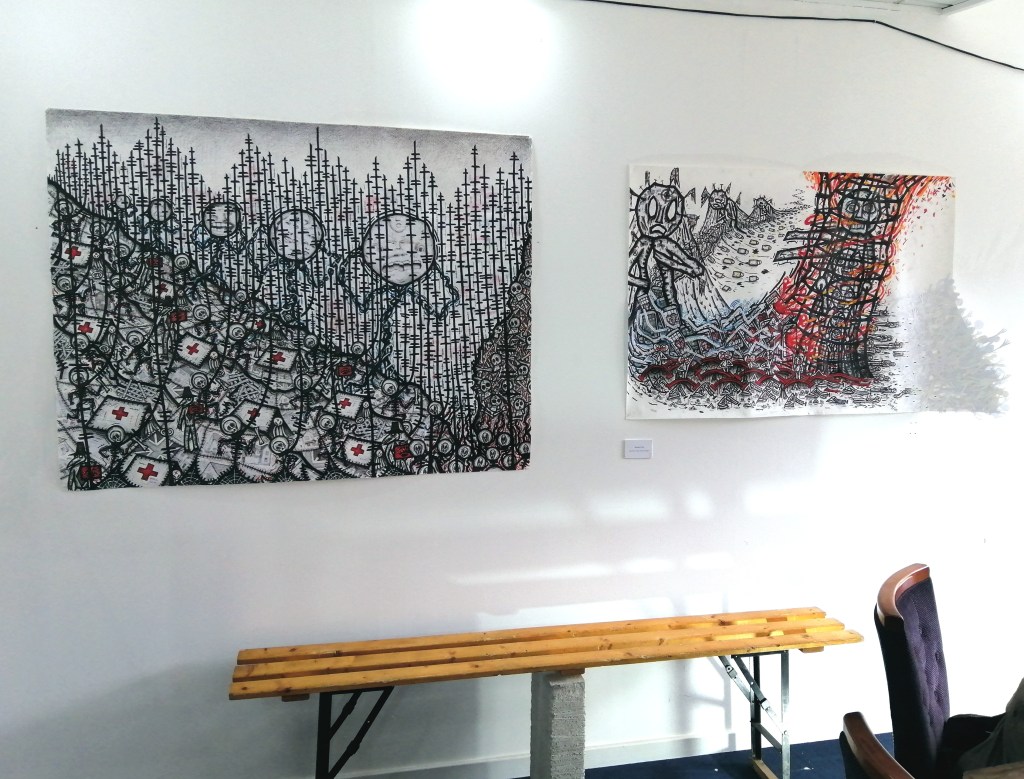
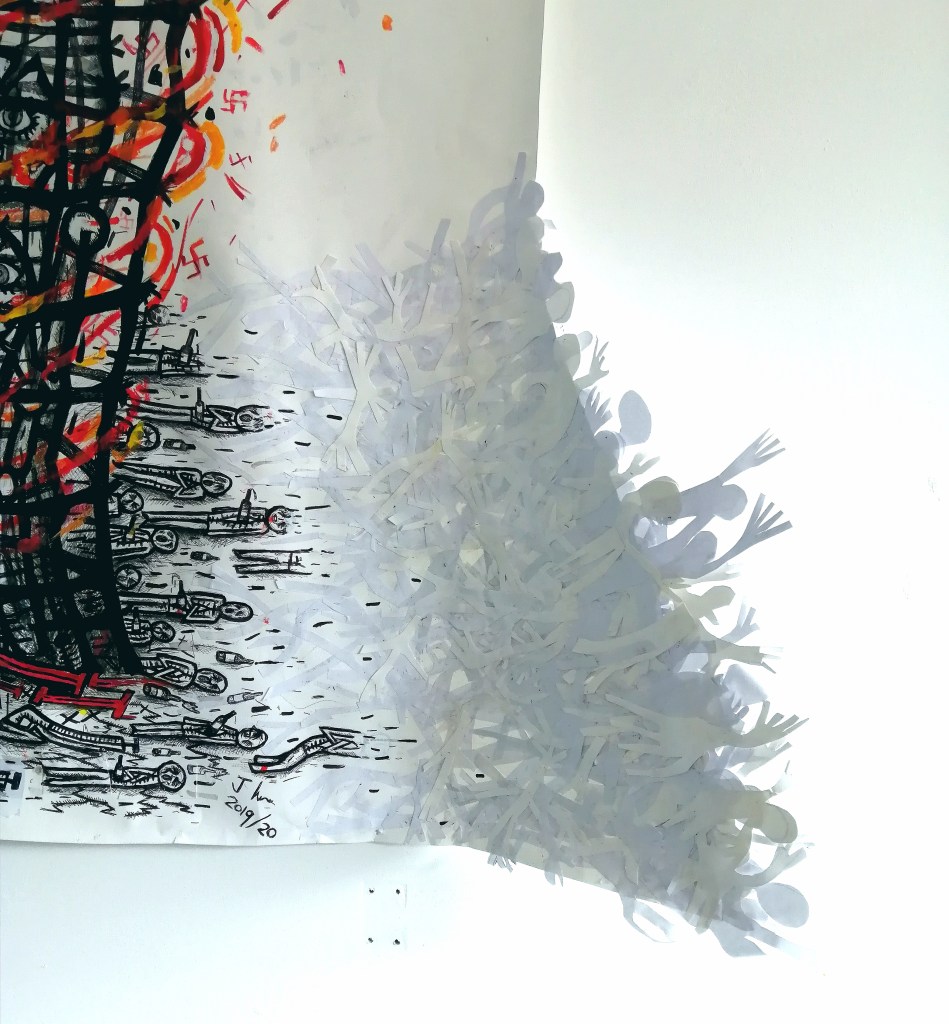
My recent show ‘A Eulogy for a Lost Decade’ in Doncaster, has been a really defining show for me. The exhibition brought together my film about identity, mental health, loneliness and other things in the Millennial generation (Wall, i) with a series of my drawings from over the past decade. I never realised that I was now looking at the end of a story, a life narrative, a sign to move on in life, to live a better life, with or without being an artist.

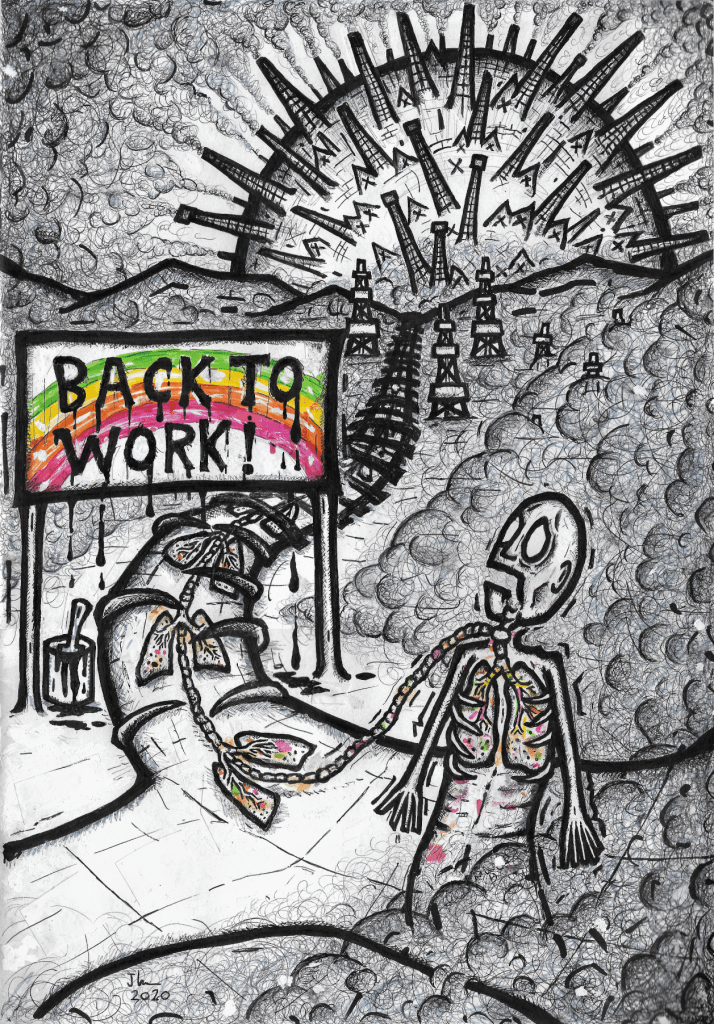
This means that the work that this recent and the first large scale drawing in over 2 years, ‘We want to live’ is not only a full stop and the end of all this work, it is now time to take heed. As the person I currently am, the ego ecosystem it sustains, I have said all I can say. The reason I made my film, which was very much about my own life, was because I realised I had reached a point where I had to move on, change. This exhibition has told me that there is no going back, whatever happens.

I have written more extensively about this here: “My resolution for this decade? I no longer want to be ‘John Ledger is an artist’” by John Ledger https://link.medium.com/EFKW0S4Sq3.

Personal summary of the 2010s: it’s time to learn to live

img_2746

So here we are, at the end of the 2010s…

Despite my ambivalence towards today being Christmas day (ambivalent to the point of having my heart and mind changed by future happenstance), dates have always held their symbolic sway. Perhaps, you could argue, too much.

Nonetheless, we are about the leave the 2010s, and I want to tell you why this is important to me.

10 years ago I would protest how “anti-Christmas (!!!)” I was. Now I wouldn’t use such words….

I realise I only superficially rejected Christmas on the grounds of a ‘woke’, anti-consumerist, ‘rejection of herd mentality’ position, to hide the fact that I didn’t know how to engage with joyful experiences, outwardly show happiness; and at such times when it is sort of a social custom to do so (which, in itself is certainly an aggravation of the emotional distress many experience) I was secretly filling up with an anguish that I could only think to counter by saying ‘fuck your ‘socially sanctioned’ happiness’.
As you can imagine, this superficial ‘woke’ tactic didn’t work…

This will not happen again, not on my post 2020 life…

As the snow laid thick in the murky final days of 2009 I envisaged the future as one permanent winter.

‘Tighten your coping belt’ I told myself ‘because life will only get worse’.

Yet as I left the first decade of this century, aged 25, I still held onto a vague conviction that the future would arrive for me. In-spite of all the things like a seemingly inevitable climate breakdown, in a world of ever-diminishing returns, I had a future, and this future would be defined by ‘being saved’, saved from the external world, and more importantly, from myself.

This ‘saving’ would be done by a woman (‘of course’ haha), of an even more vague a description than one given by my beer goggled-self who would consequently continue to lunge from bar to bar in the following decade, ever more desperate to be saved than before.

This is because a 25 year old has no idea what a 35 year old will feel like.

This is obvious really…

But not so obvious, it seems.

We can project our present souls into a future space. What we cannot project is our bodies, our ageing, less youthful, less glamorous bodies, into a future space. Try it…it’s impossible.

It’s why we love the morbid pomp of a Dystopian odyssey like Blade Runner, but suggestions that today is a (boring) Dystopia don’t feel so morbidly fascinating, because our bodies are involved. We recognise ourselves, our discomfort in our own skin, our joint aches, our stoops as someone more glamourous, more youthful, or materialistically well-turned out, brushes past us like we are leaves in the wind.

Two artists Burial and Sleaford Mods were loosely my ad hoc soundtrack of the 2010s (although the former made most of their most acclaimed music in the decade that came before).

Whilst Burial’s ‘archangels’ melancholically haunt a undesignated inner-city space of futures that never materialised, let down in a perpetual Blade Runner-like deluge, the Sleaford Mods never allowed you to forget that you ‘still remain’, ‘putting up with it’, in these ‘weekends that give you a kicking’.

In 2009 I had yet to discover the writings of Mark Fisher. His term ‘capitalist realism’ described a world where economic and technological advances grew in sync with a growing cultural sense that there was no alternative to capitalism. He spoke of a ‘slow cancelation of the future’; that from the 1980s, but especially since the 2000s, there had been a drying up of a sense of possibilities both in popular culture (especially noticeable, he argued, in music), and possibilities of how life could be lived. There are ‘no more shocks of new’ as he says in ‘capitalist realism’.

Fisher’s writings were a guiding light, not just for myself, but it now seems, for a hidden generation of young(ish) people who were stumped for ways of describing the condition of the world they were in, and how it affected them, especially their mental health.
Reaching my 30’s, was like running out of life credits just as it seemed I needed them the most (and I say this carefully; I am infinitely more fortunate than many; I speak from some privilege, where I can speak almost entirely about this as emotional experience, and not as a literal fight for economic survival, as it has been for many in this decade).
In 2010 I envisaged the incoming ‘austerity’ as something more akin to an ‘eco austerity’; that all belts would be tightened as we braced ourselves for less available resources. Not that I’d prepared myself for this, but I certainly also hadn’t prepared myself for an age where the fusion of the immaterialised high maintenance of social media use would merge with lived personal materialist standards. I suddenly felt out of date, scruffy, and, admittedly, more overcome with my own feelings of personal failure.

There was a quality to the air, a loneliness that didn’t seem as noticeable before.
Yet, equally what I hadn’t, didn’t dare face up to, is to why I was out in those spaces, scruffily carrying all my daily necessities in a rucksack, in the first place.

I had spent the previous decade expecting to be saved from myself, and the world, because I couldn’t like or accept myself, I guess. Because I never felt good enough, I could never tell myself to go home, be at ease. I always had to chase proof that I was good enough; my low pay job equated to me not being good enough, so I would go to my studio, make art that proved I was. I still didn’t feel good enough, because I was single, or something vague like that, which equated to then going straight into town. And guess what? I never found it (whatever ‘it’ was), all I found, or (most accurately) all others found was a man with a rucksack, on a liquid tea, who, as much as they themselves probably had little critical judgement of, clearly couldn’t accept himself.

I often used Fisher’s analysis of the loss ‘the future because we can’t remember present’ to make the excuse that everything current in life was meaningless, or depressing and uninspiring. It was an excuse to hide the fact that because I didn’t like myself, and couldn’t accept myself, I also had no idea what I enjoyed. It was easier to say that nothing mattered in culture anymore, than to admit that I couldn’t make anything matter to me.
Fisher’s writings are still so important, powerful, beautiful, but the last thing he would have wanted (I can only imagine) is for people to employ his analysis against life itself.
Separating the right to like oneself and the right to be happy in a world that seems so fucked and cruel is something I have never managed to do. This decade I used a notion of a ‘Dystopia of the present’ as a wall to hide the fact I didn’t know how to live a life. Nobody, whatever their political standpoints should do this; most of all, because it is they who pay the most.

I feel I have paid for this through an odyssey of negative emotions and semi-addiction cycles in this decade. Recognising this in the past year or so allowed me to embark on my largest ever art project, a semi-fictionalised pop song/film biopic, about the life of ‘millennial’ called ‘Wall, i’, as he came of age in a post-industrial town.

‘Wall, i’, (with all the help I most gratefully received from good-hearted friends and fellow students who helped me for nothing more than petrol fuel and crisps) is possibly the one project I feel most proud of. And yes, I will confidently assert ‘I like this work, I feel proud of it!’ It’s my passing gesture not just to one decade, but to three decades of a life not lived to its true capacities.

The film was centred around what I call the most enticing yet consequently crippling and life-messing cultural command of that era: to “go forth and be yourself”; the cry to self-actualise that were emitted from countless pop cultural products in the 1990s and 2000s.
Yet, self-actualisation, isn’t a bad thing! It’s just if nobody gives you any tools, or any mild idea of how to pursue it, you just wait for the world to give you a self-actualised body, or you lunge at the world in a stupor, desperately demanding to be given it: I did both in the past 30 years.

But now I feel different. Or at least I know different.

In-spite of what, to my eyes, seems like a far more desperate political situation than ten years back, my personal message for the 2020s is different: I want to embrace life, not fear it. I no longer accept the idea my 25 year old self had that things have to get worse.
I may not ever figure this stuff out. I may always feel like I’m chasing my tail around and around. But at least I can know say to myself “I want to live a good life.”

But one last word: the dreams, and day-dreams, when your body isn’t weighed down by its self-consciousness responses to being in physical space; when you walk into that space and be that person who isn’t haunted by the ghosts of past and future self-critiques, but fully capacitated, from feet to fingers with the good will, joy, and fun, you wish to give and receive. If this self isn’t worth aiming for, despite all obstacles, then what is the point of life?

So…

…2020 is going to be hard. But it doesn’t need to be miserable.

Upcoming exhibition: A eulogy for a ‘lost’ decade.

A eulogy for a ‘lost’ decade. The New Fringe, Doncaster. 11th January 2020.

hope-of-the-nihilized-2016

Hope of The Nihilized (2016)

Through a series of carefully chosen works produced over the past ten years by the artist John Ledger, we are asked to reflect on the decade we have just passed through

What was it? Did it even occur? Do I even recall? Was I really living?

Over the past ten years John Ledger’s work has largely taken the form of large-scale drawings, that through their merging of ecological, social, personal distress, shout out for an exit.

But an exit from what?

Maybe some answer lies in the central feature in ‘A eulogy for a ‘lost’ decade’, as we get a chance to see a screening of John’s most recent project, a film about the life of the ‘millennial’ ‘Wall, i’, as he comes of age in a post-industrial world.

2019-12-26_10-32-18

‘Wall, i’ brings it all home, the ‘too close to home’. Scripted to pop songs, that enframe his emotional states like the alienating tendencies of contemporary life, we observe just one coming-of-age in a new age of individualism and new technologies.

In a life trapped in an identity of loneliness, purposelessness, and failed expectations, there is a consequential spiral into self-medication, self hatred and hatred towards others. ‘Wall, i’ becomes a car-crash life, from where there is ultimately only a plea for forgiveness, to be given another chance.

For we are ultimately asked to meditate on how we look after ourselves in the coming decade. A new start based on self-empathy, thus empathy for others, maybe?. The starting point for a new decade, despite all odds stacked against so many, others more than others.

Above and beyond there is a desire to live.

The exhibition opens Saturday 11th January 2020 at 5pm, with screening 1 of ‘Wall, i’ held at 6pm.

The second opening is Saturday 18th January, with screening 2 also at 6pm.

Ignore your cynical sentiments, GE2019 is truly a chance to overcome the politics of despair.

As the 2010s draw to a close, I am thinking of the late Mark Fisher. I first discovered his book ‘Capitalist Realism’ in the summer of 2010, and as I subsequently began to discover his many articles and essays kept upon his blog page Kpunk, it was like I’d opened a concealed crate inside of which were forbidden fruits; the most imaginative use of pop cultural metaphor to explain experiences of life in the 21st century that I’d experienced myself but never had the language to articulate.

It’s not too vast an overstatement to say I’d only then recently learned how to read and right properly. I’d recently finished an art degree in my home town. My experiences growing up were far more insular than I’d ever realised, but Fisher’s work opened my eyes to a way of understanding politics, philosophy and mental health that was sincerely intimate; poetic without being poetry.

It’s not unreasonable to suggest that when this man, who I’d seen speak but never met, took his own life in 2017, I was gutted. I admit, throughout the 2010s, I used to anticipate his next blog or publication, like I was waiting for a pair of eyes, so I could see the latest cultural-political developments, feeling like my perceptions were being placed within the most trustworthy of hands.

Yet dig beneath the surface, and you’ll find an entire online literature inspired by Fisher: it clearly wasn’t just myself who’d found by solace and friendship with the words he used.  Fisher’s writings were like a public secret for a large section of society that, for numerous reasons, felt like their life narrative had broken down in the first and specifically the second decade of the 21st century.

An old friend/work colleague, who knew Fisher (although he’s since taken the blog down) talked of how Fisher ‘wagered on a shared experience’. There was a humanity, intimacy in his writings that made you feel you were in a safe space, whoever you were – whereas much ‘left’ identifying literature can often make you feel more ashamed and lonely than before. Anybody could resonate with Mark Fisher’s words.

In 2015 he posted a series blogs that I believe are his most inspiring. Amidst the tepid uncertainty and then the outpouring of disbelief that many experienced around the time of the 2015 Conservative Party election victory, Fisher did the unthinkable and offered his hand to Conservative voters; sympathising with the resulting worldview of a ‘jaded’ and politically-disengaged work force, too ‘overworked’ to be more engaged in life and politics, and ‘told they must work harder’. 

Arguing that true democracy is actually a joyful, Fisher used the philosophy of Spinoza, to see collective life how it could be, by no unreasonable stretch of the imagination. Seeing contemporary Conservative sentiment, especially in a ‘burnt out protestant country like England’, as the result of a state of collective disempowerment, and a pervading ‘depressive realism’, we can see our boozed-up, car-dependent, self consumed country not as a result of bad people making bad choices, but as ‘sad passions’ that result from the lonely and disempowering experience of contemporary life. When many people talk about collectives, they often have a strange way of making you feel on the outside; when Fisher talks of a Red Plenty – it’s a picture of a collective that is open to all, in spite of our bespoke experiences and hang ups.

It’s the first time I can recall, off hand, feeling accepted and no longer guilt-ridden when thinking about politics. I do seriously wonder how much influence these writings had on the rise of Jeremy Corbyn a month or so afterwards: whatever you think of Corbyn, there was a clear desire to overcome a politics of despair behind his ascendancy.

Yet, much as happened in the past 4 and half years, not to mention the loss of Fisher’s ‘eyes’ to navigate us through times that have used all of us as emotional punchbags.

The space to discuss self-acceptance, and liking yourself ‘no matter who you are’ is lacking when it comes to politics. But I’m writing, here, not because I feel I ought to, but because I want to. Self acceptance, believing my own experiences, my own eyes (!), no longer living in the shadow of my imposter syndrome.

If we end up with a Labour Party government, or a coalition led by the Labour party in December, I seriously believe it will be the first time in my adult life where we have a political project that offers us the chance of a better world. What I mean is that it’s the first time in my life I can recall a realistic chance of changing a pervading sense that life is only getting worse.

In recent years my instinct has always been to defend the reason a large percentage of this country voted for Brexit. I believed, still do, that the rage of ‘Leave’ saw the Referendum as a ripened target upon which to impress a myriad of the felt injuries of contemporary English life (Some of them class-based, but certainly not all!) that previous general elections simply bypassed.

3 years down the line, I believe we can now observe how the cream of the establishment (or ruling class) react like the kind of parasitic organism that will rip off part of its own body so that another part thrives. The British ruling class instinctively knew that it could devour it’s formal flesh (‘the liberal elite’) in order that another part, a limb, could flourish, by appealing to the popular discontent in a way the other part couldn’t. In 2016, Brexit was a populist reaction against the establishment, whereas voting for the Brexit Party/Conservatives in 2019 is a total capitulation to those very forces.

I still believe the Leave vote rebellion was an affirmation of ‘a thousand cuts’ of contemporary British life (as a friend said). Brexit was a rebellion against a sense that nobody in politics cared that life was getting slowly worse. What we need now is a rebellion in affirmation of a better world.

In 2009 I was pretty much convinced that the world would only get worse. Framed in a pre-austerity climate change context, what was coming felt so abstract, but nonetheless a hopeless situation. The reality was far from anticipated; hitting my 30s in the middle of a decade that has felt deeply cruel in many ways; we leave the 2010s a more divided, competitive, and lonely society than when we entered it. Although most of the injuries of this decade are personal to my own journey, I truly resonate with the idea that this has been a lost decade.

I’m on a different part of my journey now, only in that I know I am leaving this part of my life behind – learning to work on myself, so that some form of self-care can remain no matter what the socio-political landscape looks like, and where I find myself within it.

But as a country that is struggling, as we secretly know, with loneliness, addiction, depression and anxiety, struggling to ignore the poverty on our streets (if you aren’t directly affected, you’re certainly affected by living in a place where such suffering is visible); as such a country, why make things even harder for ourselves?

I’m trying my hardest to understand the reasons so many people would rather vote for a continuation, intensification of this. Is it really anything to do with a fear of being taxed more, a fear of some communist take-over? Really?

Is it more a case of what a friend called ‘societal Stockholm syndrome’? A rebellion against the prospect of being free from our sadness, our depression?

It’s clear that this election won’t be won on facts, on objective truth. I think we can see from recent years that people are more than ever willing to believe whatever floats their boat, despite a dumper truck full of the facts. The bafflement comes when people can see these facts, but for some reason have aligned with a politics that doesn’t appear to have their interests at heart.

Look, I’m not one to judge, at all. I’ve also believed distorted things, not out of ignorance, but that to stop believing them would require a huge shift in my perception of life. For most my adult life I’ve believed stories about myself, in order not to try to challenge my own unhappiness, because it felt like the hardest thing in the world to do.

Crazy as it sounds, when the perception of life, your life, has been ringfenced by a politics of despair for years, and suddenly there’s somebody saying “it doesn’t have to be like this anymore”, it can be very frightening. We’re not just asking people to vote in a different political project, we’re asking them to go through therapy; asking them to take a chance on changing their own personal journeys, no longer to be defined by the bitter feelings that accumulate through the countless disempowering and disillusioning encounters that characterize the road-congested, scam-wary, ‘rip off’ Britain of the last 20/30 years.

Part of my own promise to myself (so my life journey doesn’t relapse into this decade’s bad habits) is to no longer identify ‘being saved’ by some external factor, be it a political change, or a incoming lover rescuing me. Similarly to not get sucked into the whirlpool of political spleen, which is more negatively harmful for myself than others.

I want joyous, lighter experiences in life. One’s I’ve always blocked.

But we live in a world, and if the world feels a little lighter and softer, it will make doing this so much easier.

Please don’t help continue this politics of despair!

Punching above your weight (reflections on impostor syndrome)

I recently completed a dissertation at masters level. I recently made an art and music, film odyssey that has received great feedback from nearly everyone who’s seen it.

Interestingly both of these projects dealt with a lot personal experience loop of impostor syndrome: the feeling of never being good enough, whatever one has achieved isn’t through faculties one possesses, but through some one off.

As much as these projects dealt with many skeletons in the closet, the one they most had to come to terms with was the one holding my body up. Maybe I was wanting their audience to accept that I was an artist and writer by fluke, and would they let me crawl back into the shadows. Or maybe it would force me to look at myself and accept that the things I’ve done are good because I am good enough.

Now, as the feeling of being inferior slowly seeps back in (as I knew it would), I can’t crawl into the shadows, because there’s nowhere to hide, I have to face my reflection.

I tell myself that once I get a better job, and my clothes look tidier and I can pay to go to a gym, or once I find a way of living independently, and I can write and create in my own space, I will feel better about myself.

But at some point I have internalised a feeling that I’m not really as good as other people. Whatever I achieve it’s because I’m obsessive and driven, and this can momentarily compensate for my inferiority.

I was a poor performer at school. I much preferred day-dreaming about anything that wasn’t in relation to the present, always revolving around a happy ending. Once the happy ending came, I’d no longer have to prove myself in competitive world where I wasn’t good enough, I could sit back and some unidentifiable other would accept my inferior but ‘good’ self.

As I began to develop my own skills, I carried this sense that any recognition I had achieved was because I’ve been punching above my weight. You see, I was never ‘cultured’ enough growing up — never snook out at night to gigs, never wore cool clothes, never smoked weed listening to singer-songwriters — I was just a kid in an Umbro sweater, waiting to self-realise in adulthood.

I told myself,I was merely pulling out all the stops to gain things others could do with far less effort. And it’s factually true that I am far far from being a great, technically gifted artist; sometimes I can’t play a single chord on a guitar, and sometimes it takes me a week to read a page in a book.

Yet I’ve made art, music, writing, and now film, that people say are really good. But even now I’m never able to shift the feeling that once I stop it becomes clear I was just punching above my weight.

The closest things that have come to describe this feeling are Mark Fisher’s essay Good For Nothing, and David Smail’s The Origins of unhappiness. From a class-based perspective they look at how power is imbued into us from birth onwards, and how such affirming nurturing develops our confidence to achieve in life, whilst those who are from lower class upbringings always feel they can’t achieve, or an utter fraud if they do.

Although I can’t help but agree, as I look at the current bumbling, self-important, privately educated people currently governing this country, I think it’s unlikely there was much class-based difference between those I felt in unwanted competition with as a young child. Additionally, although this competitive culture certainly has political implications, I have already spent a long time making the mistake of using these books and essays as proof of my predicament rather than as motivation to accept myself. What I mean is that whilst I accept all this to be true, and we should be rightly angry, only I can stop myself feeling like an imposter.

I now accept this. But my word, it’s not easy trying to rectify this issue.

“Not now, Jeremy, we’ve gotta get on the with show”

In recent years I have tried hard to stay away from the gut-driven urge to be an ideologue. Perhaps this is for reasons I am about to go into. However, what I see being offered by the UK Labour Party is more like the kind of opportunity offered by a counsellor; not a rigid doctrine, but enabling a way out of our current life state. I’ll explain why I think this.

I’ve heard few positives about Pink Floyd’s 1980’s album ‘The Final Cut’ (often due to accusations that Roger Waters had taken over the band). I think if anything, it’s the logical conclusion to the realisations made in their famous 1979 album ‘The Wall’. The Final Cut reminds me of the crazed voices that want us to carry on existing through our trauma, even when we have identified it, all that’s caused it, and all the damage it has down.

To begin on a personal note. I recently undertook a huge project that tried to come to terms with a lot of my own unhappiness. ‘Wall, i’ is a collaborative film project, and is a loose reemployment of this rock-opera, emotional odyssey template for a ‘Millennial’ experience; for a fictionalised account of my own journey from childhood to my mid 30’s, from the fall of The Berlin Wall, and ‘The End of History’, to what has been called the ‘lost decade’ of the past 10 years. It’s the biggest project I have ever embarked on, and I would wish for others to watch it via the Youtube link I have left.

Yet when it comes to what I do next; the life I know I must now try to build; I often get a golem-like voice in my head saying “not now!”

The song ‘Not Now, John’ on The Final Cut is this voice of burnt ego, and score-settling, that refuses to give up the ghost.

When it comes to the general election the UK is about to embark on, I believe this is, collectively, where we are at.

There has been a societal-level emotional shift quietly occurring over the past ten (maybe fifteen) years. I wouldn’t say ‘consciousness’ shift, because it is rarely aware of itself; the conditions we inherited from previous eras are blocking it. These conditions aren’t just external, they inform our egos, and self worth, which are still clinging onto to the dream of the rock and roll individualism sold to us in the neoliberalist salad days of the late 1980s and 1990s. “One more JD and coke, matey?”.

I firmly believe that a large cause of the mental health crisis, or perhaps the part that makes it an unavoidable part of our collective make up, is the fact that the cracks in the life foundations, past traumas, that can lay dormant in ‘normally functioning’ times, have become unavoidable. If the deep structural inequalities, competitiveness of society, and atomising nature of it all, wasn’t underpinned by a vast breakdown of cultural narrative, these injury causing features of life may not have seemed as unacceptable as they clearly are.

Indeed, I believe this is one of the main points of miscomprehension between the generations. It’s clear that the living conditions that the average Baby Boomer generation came of age in were far worse than the average Millennials’, but what seems to have happened in recent decades is the collapse of a story, a narrative to life. This has caused the traumas implicit to this very social system, the school, work, and domestic-based traumas brought about by the institutions of capitalist life, to emerge violently in our stream of consciousness, whereas when the ‘story’ was working, we could ignore them.
This doesn’t mean those traumas were acceptable so long as the story was working. More, this is an opportunity at hand. One that I believe many can see but perhaps can’t quite quaff about in everyday polite conversation. The accounts of people leaving more high paid jobs to work helping others, the accounts of people who are seeking new, peaceful paths in life, are too many to count — too many to dismiss for what it is: a phenomena.

This is where politics, or the political structures we currently have, fall short. I’d argue they still largely operate through the trauma, rather than beyond it. I have long felt that the forces vested in blocking socio-political change are at heart, unhappy ones. Life experience, whether its a ‘lose’ or a ‘win’ in terms of materialist success, seems to largely inform an idea that life isn’t very nice, — a ‘depressive realism’ as the late Mark Fisher put it. The politics that wishes to bring great change, must engage in a system that it is not its own, it must therefore argue on turf that is not its own; for many on the ‘left’ from what I see, this, on some low-level has a ‘triggering’ affect, forcing them to argue as they would have when they first sensed injustice, around pedagogical figures, or schoolground bullies.

Whatever you think of Roger Waters, Pink Floyd, or the relevance of talking about a band a white guys who were big in the 20th century, I have found they were fantastic when it comes to exploring the trauma involved in the institutions the make up Modern, capitalist, life (family, school, work, and the threat of prison, war). ‘The Wall’ is far more revered than ‘The Final Cut’. Yet if ‘The Wall’ is about the cause and affect of living in a traumatised, alienated state, The Final Cut is about coming to terms with it, painfully.
And this is where we are, now — if we recognise it for what it is. We are a society that is hurting. Some of us have had to realise this. Some not so, maybe. But some, and I am talking about myself here, still haven’t finally given up living through their trauma, and want another pop, another go on the emotional rollercoaster, another way of proving yourself to the unhappy memories rather than overcoming them.

“Not Now, John” is the penultimate track on ‘The Final Cut’. It’s a rejection of sense, reason, and a peaceful life, all in aid of settling old scores: “Fuck all that…we’ve gotta compete with the wily Japanese”, and “Hollywood waits at the end of the rainbow”. Waters is clearly also taking aim at Margaret Thatcher, for her demolition of the ‘post war dream’, in favour of throwing the nation back into the chest-beating big player game.

But here we are in 2019, and whatever your politics, you can’t deny those sugar rush (for some) days of Thatcherism seem a long way away. The sugar rush of neoliberalism, the ego boost it enabled, became a severe addiction; the competitive career-driven culture of our age is a mirror image of the spice and opioid addiction on our streets by those left behind. It’s just not easy to admit.

So, here is where I state my cards. In spite of shortfalls of our political structures, I’m voting Labour.

They are the only party who seem to actually want to bring this show to an end. Jeremy Corbyn isn’t god, and I’m not ‘Labour till I die’, but what I recognise is an offer similar to an offer made by a counsellor. It’s an offer to leave our past selves behind, overcome our trauma. They can’t do all the work, and we don’t know the future outcome, but it’s an hopeful message for a fresh start. It may not work as we expected, but surely it’s time to work through our demons and take new steps?

Like any sort of therapy, it can be enabling, allowing us to see opportunities where there were previously dead ends. It’s the reason I wouldn’t just ask those who have turned away from the nastiness in the personalising of politics (for the sake of their own peace) to vote, but also anarchists; surely the goal of self-realisation, autonomy away from institutions, can only be achieved by supporting people in the first place? Our current systems have put people in a state of perpetual anxiety — a disempowerment from where all we can attain are what Spinoza called ‘the sad passions’.

Many voices are currently screaming “Not now, Jeremy, we gotta get on with the show”.

But do you want the show to go on…?