Stories From Time-locked Space. 3

Free-fall in Stasis

(Barnsley, The First Week of Winter, 2016)


Walking back to the suburbs through an M1 junction-hinterland in the dark of a new winter. But nothing feels new. It’s late 2016.

To Ride The Fine Line of Purpose on Placebos…

 …that’s what I achieved ten years ago this winter month. And I’ve even tried listening to that very same sequence of albums that narrated late 2006, attempting to rekindle such momentum.

“I’m on a good mixture, I don’t want to waste it”

But these days I can feel the cogs in my head wanting to stop, like workers in a factory who’ve come to realise absurdity lies in the heart of the notion that what they produce is building towards ‘the good life’. I know it’s much more than lifestyle changes, personal attitudes. But to play the game of attaining placebos, one has to pathelogise their pain. A one-off bluff to be prescribed a painkiller. But can the placebos of the past even work for the present? 

“Look forward to a future in the past”

1996. 2006. 2016. It’s funny how straightforward the shit-neoliberal Britain of 2006 felt, compared to now. Words, art, they seem inadequate, thrown into a free-flowing torrent in stasis – this chaos in a world which yet still appears to be frozen.

For the best part of 5 years I have felt that the life I unwillingly act in is at a dead-end, and that the only way forward is to destroy and rebuild. Illogical as this sounds, it enables me to sympathise with the logic towards the sheer illogic of Brexit and Trump, because I fear that for many they are votes borne of existential desperation.

Thus I can only conclude that two are interlinked. A willing for the ultimate of reset buttons; a fantastical reset button that erases the hyperconnected age, leaving us the choice to pursue a route that fucks with the mind a little less.

And rest…

Every night I fantasise about cutting all ties, walking out my job on my lunch break and walking west to the hills…as if the world was actually different over those hills, and not a mere barrier between two parts of an overcrowded, infrastructurally-unsound, unhappy, LONELY island.

But every day I play the part, a small part. Like the protagonist Sam Lowry in Terry Gilliam’s ‘Brasil’, I carry out a life I find deeply absurd, with smiles less convincing than Gordon Brown’s in a mad mad world. I found some sort of hope in the amount of reception Adam Curtis’s recent documentary Hypernormalisation received, because it’s exactly about this: being unable to believe or have faith in anything in the world you are condemned to live in, but not being able to act out this disbelief and thus carrying on like it’s all fine. This is because for a long time I have felt that the negativity I experience from drunks, drivers, shoppers alike, is because they feel exactly like me: utterly fucking sick of it, but unable to act on it. That illusion of otherness those pennine hills contain thus remains.

The traffic builds as I approach this supposedly small town. Over the past 6 years I’ve watched the connections between these ex-coal village-conurbations become inefficient arteries. Thick to burst with self-preservation anxieties,  created by an artificially maintained level of scarcity, and contained in glorified tin cans. Claycliffe: a place-name that evokes stuckness. Yet a place that nobody calls home, nobody identifies as being in on an Instagram photo. Yet it’s a place where many end up stuck, morning and evening.

Infrastructure; what does it even mean anymore? That all plans are at a standstill is the only fucking certainty here. No one is really in charge, and managerial thought itself is trapped in a past tense; maybe autumn 2008, maybe 2010, or maybe 1999… But the process itself proliferates, mauls through a defenseless scene like a braindead alien predator.

There is so much movement, yet thought itself remains frozen…


The oft-unbearable middle class chlorophoric-quagmire of the work-a-day-job-existence seems bent of regenerating a shock in me every time I return to my home town on a midweek teatime. A reminder of what life is actually like for many beyond the blinkers of educated career-seeking. But I’m doubting whether it is a reminder: as what I believe I’m seeing is a new development. From Cheapside to Town End,  I feel like I have stumbled upon scenes fit for rust-belt America right here in England.  The centre is seemingly the hub for the borough’s social pain, whereas in the surrounding ‘more prosperous’ boroughs the pain is forced out of view by waves of gentrification.

Comewhatmay, such desperate sights are new to my eyes on such familiar territory. Post 2010 the lycra-clad joggers have proliferated around here, but so too have those locked in a day to day battle with a dead end, either through drink, drugs or survivalist-shoplifting.

I text a friend. She responds saying how “it’s bad how it looks [our shared hometown] looks better on a Saturday night than it does in ‘civilised’ daylight”. This is such a striking conclusion we arrived at, being, as we are, veterans of the town nightlife in its notorious early 2000’s stage.


I pass the No 66 Elsecar Stagecoach bus, promoting ‘relaxation’ with its new onboard Wifi –  the warm glow of The Feed as the nights draw in. I initially think of how being connected in every space imaginable isn’t relaxing at all. But I think again: maybe the anxiety is more in the gaps between the points of connection? The urge have unending stimulation. Perhaps it’s turning buses into the quiet, solitary modes of transportation that cars have always been, rather than the overspill of frustration borne from class injuries and alienation that they always used to be. Less aggro, less social anxiety. But more loneliness.

A zeitgeist of disbelief...


I think about Hypernormalisation again…

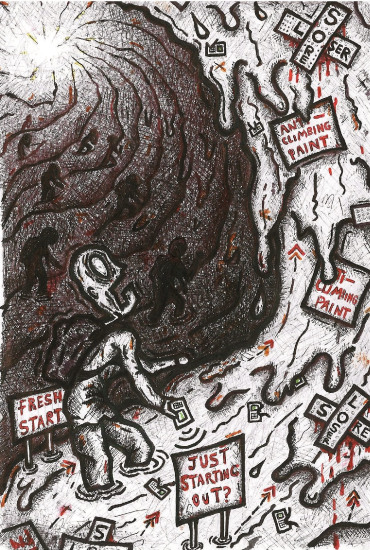
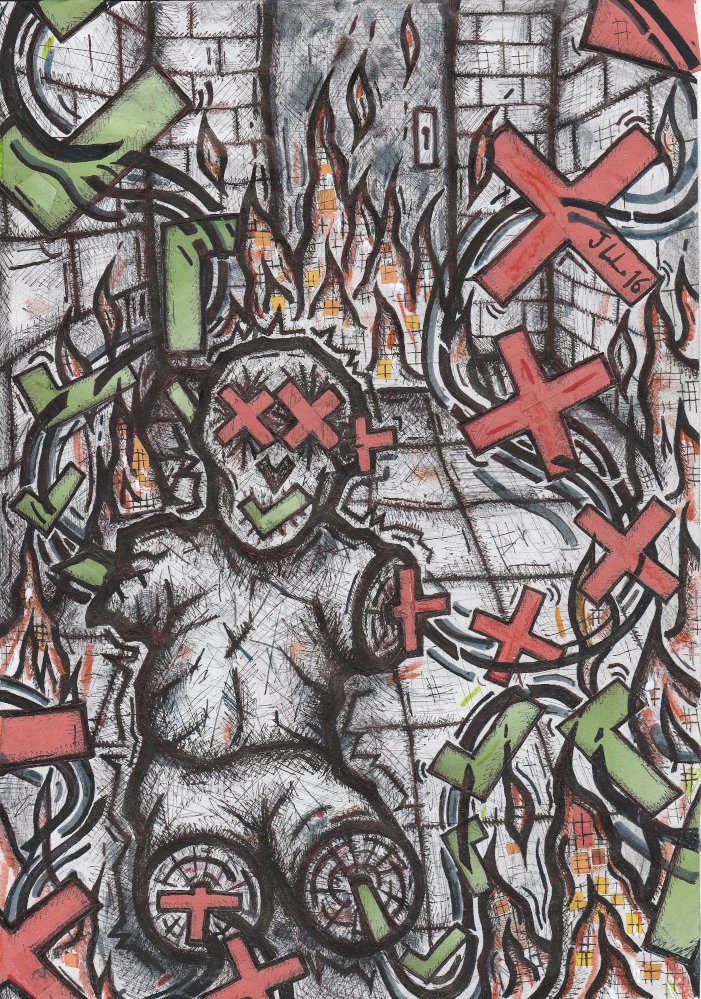
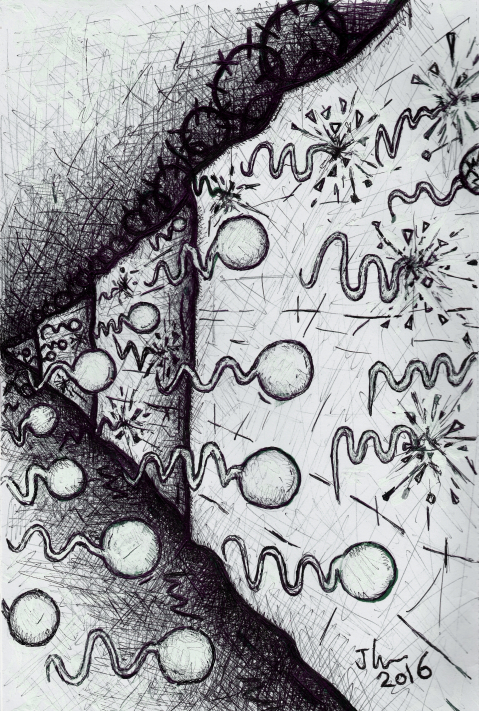
2 years ago I made a work about how stuck things felt, how stuck I felt. I used this town as ground on which to gather evidence.  It’s weird. It feels like we’re still stuck there, but yet something seems very different, unreal, and unable to be pinpointed. The Mary Celeste Project was about the frozen world. But what can you trust to be real when there is chaos in a frozen world?

I feel cold, anxious and lonely as I look at all the people in the station who feel as anxious and as lonely as I do. Its evidential; it’s on their faces. They wait for their 5pm commute back to the candle-lit-alehouse-utopia of Sheffield, where every other word heard on the street is a plea for spare change, to be spared from the returning freezing winter nights. Of course, decent working headphones will cancel out this growing noise. But for how much longer can one’s lonely little mind hold itself together?


No Holiday Until Postcapitalism (A Last Resort to Forgotten Fun)

We’re relieved to get out of bottleneck of the north (Leeds station) as we join the now mostly emptied train for our journey to the North Sea coastline on this cold November morning. This station is making us both uneasy. This cold, hollow sort of self-reflection is filled horribly by the noise of this metal-on-metal place. At one point, when a certain sort of examination of life didn’t seem so paralysed by painful introspection, I had a mutual agreement with this place: I’d have to feel stressed and drained – but it would supply me a fresh mine of morbid fascination of the ‘man-machine-matrix’ (Will Self) for artistic purposes. But now that things just feel so stuck it just aggravates a searching for silence amidst the madness.

Going Nowhere. The whole thing is going nowhere, but this giant hamster wheel is beyond the day-to-day experience of a mere melancholic mortal, and there’s sometimes nothing as crushing as feeling like you’re Going Nowhere. Expecting one to obtain a mindset content with staying within 100 metres of their introduction to life is idiocy as things stand.

So hop on the train coz it kills the pain”

True, this trip to the forgotten fun of Filey is one of the furthest trips I’ve made for sometime, but open my wallet and you’ll find evidence of a person who, although stuck in the day-to-day, makes dozens of train trips to nearby towns.

No destinations until Postcapitalism, just movement…


Wallet being the crucial word: too busy making sure I have my camera, pens and notepad, that I leave it on the train as it leaves Filey. Sending a trip already teetering on the edge of the ridiculous, into potential absurd oblivion.

Liquid Fear in the frozen world…

Suddenly a place caught between the twee and bleak by the tectonic shifts of a seismic systemic change, is totally locked in the Now, as I’m forced to enter the endless corridors of Distrust-ocracy of the scarcity network. 0345… 0800…  0113… You can be trapped in it, or trapped outside it – locked outside the gates of so-called civilisation. But my next coffee, next pint, next train trips to nowhere, next 2nd pint, means right now I’d much rather be trapped within the matrix, and it makes you wonder if being thrown out of matrix next to th3 North Sea is more frightening than Big Brother’s microphones in bushes monitoring Winston Smith as he wandered through England’s green and pleasant fears from yesterday.

No connection to Liquid Boredom…

At this point it’s probably wise to head towards the brigg, jutting out into the North Sea. Yet another one of our attempts to break free of the noise. To find thought. To think beyond the day-to-day. To just think, in the moment. The day-to-day isn’t the moment – it consists of constantly trying to get somewhere but never arriving. Like an insect smashing against a window until it burns itself out. Just to get beyond this point, and begin anew.

The Conversation is open and honest as we sit at the cliff edge, as if the proximity to such dangerous forces prises out such honesty about our deep struggles. Three of us, in our 30s and early 40s, all at sea in a world that has lost all sense to us. We walk out onto the brigg, we listen to the sea through an old defence barrier. The sea appears to breathing. Perhaps it is a kind of breathing? But the breathing’s getting heavier. At this point it’s probably head back towards the noise…

A land that anxiety forgot…

We’re not far from being the only ones here. Yet everything remains open, like a fun land abandoned 30 years ago. But, unlike Chernobyl, nobody turned the lights off, nobody unplugged the coin machines. They push back and forth almost like reminders of the long gone machines worked by the Mill-town workers who’d’ve flocked here on mass for leisure. What is Leisure?  Leisure existed before liquid boredom flattened out our lives.

The arcades are a somewhat comforting bleak. Were they always this Bleak? No. Their mimicry once worked. It worked when the American adventure still worked – when it met with an Island still living out the ghosts of Victorianna. With a deco more in tune with old WMC’S, it’s a far cry from a world perpetually posing for instagram.

Suddenly a cheap quality recording of ‘The Good, The Bad and The Ugly’ theme rings out from a Wild West ride for young children. A song that evokes a frontier is lost to the last century. That very frontier inverted itself and spread back over the world a long time back now. Like childhood memories of holidays, it all seems like a thousand years ago. Suddenly a coin machine blurts out the Star Trek theme tune. The Final Frontier. The horses of this machine face the exit  – they look to be galloping into a void.


The temperature drops, and we find a pub to sit in whilst we wait for our train. We find ourselves listening to a soundtrack that could well have been playing to itself for years. 1960’s. 1970’s. 1980’s, and a scattering of 90’s, then back to the beginning, maybe forever. David Bowie’s version of All The Young Dudes makes me think who are today’s young dudes ‘carrying the news’? Like the arcades it’s a place that isn’t even trying to be a Retro Bar; abandoned on the highway between the past with a future and a future trapped in the past. And like the arcades it’s a comforting sort of bleak.


The anxiety over not being believed is over. The trust of the train conductors, an unexpected trust, allows me to breath a sigh of relief at the lack of confrontation. I hate confrontation; just can’t do it. It’s what’s kept me from being unable to act on my beliefs over what is wrong and what is right. This awareness is probably why it leads to guilt. Guilt over losing my grip on grasping the chaos of Brexit, and the US presidential race. The two shape-shift, become one and then two again, and reflect back from the anxious faces of the sober commuters, like an airborne disease. Guilt over no longer having the ‘right’ feelings about what is wrong and what is right in this upside down world.

Trump and Brexit? Rational descision making? I think of the mental health of our human race, the rock bottom mental health of the human race. Mental health being crushed between a rock and hard place.  The way we are made to behave – how it’s making us sick of life. Why the fuck would anyone want to continue this? But perceived future confrontations forced me to take the vote of least resistance: I voted to remain. I’m just a coward, stuck in the middle, waiting…

The boarding of a gang of young lairy Manchester-bound squaddies at York, who annex the shared space of the train with masculine-insecurities they already seem condemmed to, forces Dave’s melancholia over the state of present-day life into spoke word: “Britain is a country that no longer likes anything, including life itself,  because it has forgotten what life is. And the tragedy is that our generation don’t even have the luxury of forgetting what we could’ve had. We just hustle around for a crummy job and hope that’s enough to fill the hole…”

But if anything ,today was a humbling day, where failure has been acceptable.

Let Forever be…


1999….

No Holiday Until Postcapitalism…

2016…

A sadness finds its way in after an anxious day placed upon an easily anxious person. A comfort in let down, a solice in the acceptance of failure. The tenners Dave and Steve lent me feel like tenders for my last drinks. I get like this on these kind of days,  these rare days of surrender. I don’t mean a contemplation of suicide, but days which almost reach over the years into the future and touch glasses with my final ever glass.

Maybe this is my only access to the future?

Let Forever be… 

As I’m in the past at the same time.

The song Let Forever be, from the weary summer of 1999, seemingly spontaneously entered my head as I left the station and walked into the city. A summer that felt so chilly in the face of the coming millennium. So different from memories of the roaring heat of the mid-90s-euphoria summers. A first point of depression, a year when a switch felt like it had been flicked in my head, was also a year when the teenage kicks of the neoliberal project gave in to a pre-millennial malaise, which, as much of a comedown as it was, couldn’t quite anticipate the hyper-horror ahead.

No Holiday Until Postcapitalism…this is where it began. For me, at least. There’s been no rest in the soul since. What remains of that soul. There must be hope for the nihilised – I may be impatient in most parts of my life, but this is one thing I’ve waited so patiently for.  As much as the future still seems inaccessible,  there is harder times still to come. Who knows who is and isn’t made for them. But at this moment I’m OK.  Thanks for asking.

Stories From Time-Locked Space. 2

Illusions of ‘otherness’ – Over The Pennine Horizon

Darton-to-Wakefield-to-Mirfield-to-Huddersfield-Manchester-to-Leeds-to-Darton (Northern Rail-to-Grand Central-to-Northern  Rail-to-Transpennine Express-to Northern Rail.


September 2016.

“Today’s Manchester is dominated by the sounds of the trams. They beep, clunk and even scream as they turn on the tracks, in spaces so close to pavements you wonder how they all function. How do they all function? How does everything keep carrying on? The embarrassing urban anxiety kicks in. The pursuit of something which leads me to the same point I departed at. What to do in this world…today – this city? “Don’t know which way to turn. The best possible use”.  Thought paralysis – it makes me unable to show my human face to an homeless man, despite managing to chuck him a quid. But I’m stunned into shy teenage mumbling when he speaks of his plans of getting through the night ahead of him. I turn down towards Victoria station, stalling as the minutes pass along, knowing full-well I’m aiming for one of the few pubs I know in this city. “What to do in this world…today – this city?”


“An empty seating area in a pub on Friday teatime, a familiar jukebox soundtrack, and I’m regaining mild rays of confidence. “What spurs me on to travel to other towns and cities?” I thought to myself earlier today, whilst the rain mocked any escape plans I had. Maybe my anxiety to “get on the bus and get out” isn’t so much a desire to travel through space, but a desire to travel purely through time. I have a deep longing to leave these times, and traveling allows for a temporary confusion of time and space that throws fools gold in my direction. I find out that the place I have arrived in is, to all intents and purposes, the same as the one I’d just left.”

“The default Manchester-of-my-mind is a first-industrial-city-Manchester, mixed with a Joy-Division-Manchester, mixed with a Blair-years-failed-attempt-at-studying-here-Manchester. But I return to realise it’s more like a 2016 Leeds, but with less of a Canary-Wharf-steroid-injection and more of Shoreditch-smug-injection. The old mills and engraved testaments to the hard-fought gains of the working man easily fall from mind amidst the banal bazaar of retro bars, hip cafes, veggie restaurants, all named anything and everything under the sun. Where is the Manchester that is buried in our heads like old folklore? I’d had liked to have witnessed it before it became an overly decadent city with an ambivalence that pulls LGBT gains to the same level as homelessness epidemics. Maybe I can now see why the drama Life on Mars‘ recreation of 1970’s Manchester was such an appealing fantasy. We don’t crave homophobia,  the real IRA, or for the gates to reopen to those dark mills, but we crave an authenticity. And whether or not authenticity ever existed, our postmodern addiction to the idea of it seems to distance us further from anything that could be called it. Places become parodies of themselves, as if a city could be constantly taking selfies, just to reassure itself it still exists. A once-industrial titan, obsessively staring into a mirror, whilst the land shifts worryingly underneath it’s feet, as fracking and nuclear contracts give a green light to those less decadent players on global capitalism’s stage.”

“In an age where companionship has been turned into a highly valued resource, made to feel in short supply, we are left to feel ashamed of our loneliness. The weekend is scarcity-central, with everything feeling in short supply, especially time itself. As Friday evening begins, it doesn’t matter where you are because if you are alone you’re alone –every seat in every pub, usually for a rendezvous with stable solitude, is taken, and every space for daydreaming is swallowed up. I walk back and forward, like a stuck soundtrack, only noticeable to the homeless, the only static bodies in our hasty times. I bump into a friend in the Piccadilly rush. It’s awkward. He wouldn’t care, but I do. “Just what am I doing?” These whole endeavours seem so pathetic under the weekend’s spotlight. “The city can be a lonely place” – an old piece of wisdom digs itself up to the surface, more like woodworm than earworm.”

By now the peak fare rail curfew is lifted and I grab a can of M&S cider and head for the train back to Yorks. My anxiety is curbed as a 6 carriage train pulls in. But no: it seems that any train attending to the needs of the millions who make up the discontinuous Northern Metropolis has to be a scarcity train.  The first 3 carriages stay put as the tired have to use their one last burst of energy to run up to the other 3. If you want a picture of a Northern English future, imagine continual disappointment under signs for ‘the Northern Powerhouse’ – forever.  “We should never have it so good” is what Macmillan meant to say. As we travel eastwards the early Autumn sunset penetrates the windows and makes silhouettes of Manchester’s millennial monoliths – they pray to the Gods that the sun will never set on the world that built them. But despite the illusions of clairvoyance the September sun gives as it penetrates the scene, their day of reckoning isn’t today.”


“Land-locked on an Island”

Darton-to-Dunford Bridge-to-Langsett-to-Sheffield


“As I begin my cycle up to those hills, yesterday’s impulse is today’s: always trying to escape reality by fooling myself I am doing so by traveling across space, away from wherever the sense of stuck-ness is most claustrophobic.  I always end up where I was, and who I was, before. But during these cyclical doings I exercise the very best and worst in me – new depths of contempt and idealist manifestos crisscross in my thoughts. As the first of many hills give way, still on the foothills, I ask myself what it is I really want to happen – a question prised out of me from a pressure to DO SOMETHING. I answer myself with this: “What is to be Done? Lots of things have been done, and lots don’t seem worthwhile doing again. Right now the only thing that is to be Done, is to ditch capitalism – transcend it, upend it, or just end it”. That is the immovable objective of now.”

“I’ve always wanted to reach the Metropolis on the other side, only to realise it’s no lost world, no place where things are done differently, after all. This is what happened yesterday, but yet the climb to the hilltop Horizon is where the allure still lives. After all these years I’m still climbing up here to see if there is something beyond this reality. From the road the other side of the valley, the Woodhead pass looks like a river made of Mercury. And I don’t care what more far-flung wanderers think of this, because this area, for me, sometimes contains an otherworldly essence, like a gateway to another celestial body.”

“The Stocksbridge Bypass valley almost broke me, and as the thirst and exhaustion kicked in, it took on an almost mythologised representation of itself as the ravines, pylons and conifer plantations began to look threatening – almost a concrete abstraction of the notoriously dangerous road I was climbing up. So, by the time I reached Sheffield I was massively relieved. But not before long I felt estranged amidst the weekender endeavours. The locus of this seemed to be the diversion I had to take, after realising a large concrete chunk of postwar Sheffield, centred around the Grosvenor hotel, was ring-fenced for demolition. The erasure of yet more of one specific era also made a physical embodiment out of what I was feeling today and yesterday in as the cities reached their weekend point: a sense of being forced either onto the narrow curbways or of being funneled into a design for late capitalist life. Neither appeal. Nor does hanging about this evening, and I call today off at an earlier than usual point.”


The Land That Noise Forgot.

September 2016


There’s strangely a normality to Sunday evenings, that reassures, quells anxieties often found at other times. Which means that our post-working-hour walk up onto the very tops of hills between Yorks and Manchester is going to work out OK today. These barren stretches up here seem to speak something of the concealed melancholia of life down below. Perhaps they allow you to feel at ease with its truth, ridding yourself of social status anxiety like the weight of a poorly-designed work uniform, as you climb further from the road, to the point that even if you went to far into the early autumn sunset, and found yourself in mortal danger, such anxiety wouldn’t reappear – all you would have is clean fresh fear, a sensation that is somewhat different from dog-shit stink of anxiety that clings to us down below.”


We look over to both Saddleworth Moor and Holme Moss. A beginning. Or the ending. Like reaching a land’s end, in-land. We are Landlocked on an island. Time-locked in space. But this area is like a frontier, even if there turns out to be nothing beyond it. What is it about the life down below that makes us want to seek such desolation? Steve speaks of the value he places on the silence up here.  A silence that separates it from everywhere else on this noisy land. As up here, like staring at the sea, or into space, you can see things move before you can hear them moving.  In a noise-filled age this is almost non-existent. From these hilltops we access the lack of real dialogue amidst the noise below. What is the use of thought down there, when it seems reduced to shards of information in perpetual battle for dominance with one another? These monochrome colours and featureless plains help bleach that noise, opening our eyes like portals to a frontier out of which sprung our industrialisation, and into which we see a space waiting, waiting, and waiting, to be filled by a future.”

“We look down to where the first few cluster-settlements begin the outer edges of a Greater Manchester sprawl that changes from cobbled-stone to concrete within our hazy horizon. Dave talks of how, by seeing where the green farming land gives up to the ‘desertified’ hilltops, such stark end/beginning points allow you to visualise how it all began, and continues, everywhere else. Like the streams that flow down to form the necessary rivers of this ‘first’ industrial city, I think of

the flows of people coming down from these hills, the upheavals, the Peterloo Massacre, the endless rows of workers crammed together, the hopes, aspirations for something better, which informed a pop music that in turn informed the world. All for what? A noisy competition in consumption? An Instagram App on an Iphone? An overpriced hovel overlooking other, lesser, hovels? Surely this can’t be how it all ends?

Walking back down the hills, anticipating the mental noise awaiting us, Dave remembers how his noise cancelling headphones kept in his terrace house in a busy suburb of Huddersfield gives him access to a silence provided by capitalism to endure capitalism, rather than a silence from capitalism. But the break out of it’s frenetic inertia hasn’t ended for us just yet, as we decide to seek refreshment in a place that you couldn’t even designate as an Inn. It in it’s location on the border of Yorks and Lancs, this is more of a non-place from a time that is gone. As the night falls around it, who could have ever been a ‘local’ up here on this horse-drawn-carriage-cum-commuter highway? Lights on and open, it still feels forgotten, trapped in a time-vacuum.  There’s a jukebox in a dark corner of the room, the music on it dates no later than 1999. But this isn’t the re-hashed CGI Steroid-90’s you find in the towns below, this is the late nineties as we left it. It’s like the millennium never occurred. Maybe the sentence at the end of our narrative had ended already by then, and the emptiness up here is like a pause at the end of a sentence that’s only exhaustively prolonged down below because it’s amidst an feverish command for economic growth? But where’s the next sentence? Maybe it isn’t Manchester that has ‘so much to answer for’ after-all, but the moors themselves?.

Fighting for Crumbs, at The World Transformed, Liverpool

I was very pleased to be invited to exhibit at The World Transformed, a 4 day festival hosted by Momentum as The Labour Party held their conference,  and the leadership election results were announced, in the very same city. It felt great to be taking our exhibition project ‘Fighting For Crumbs (Art in The Shadow of Neoliberal Britain) to the Black-E in Liverpool, to have our work in the same location as speeches by many figureheads at the forefront of a movement to push for much needed changes to the way politics is done and society is run.


#TWT2016 is about practising the new politics. We believe in a positive, future oriented approach to changing society. We believe in amplifying unheard, grassroots voices. We believe in broadening the definition of politics to include art, music and spoken word. We believe that politics is a bout more than just PMQs and Westminster. 

With Fighting For Crumbs being somewhat instigated by the ask to do something to celebrate the 50th anniversary of The Redshed  (Wakefield Labour Club), we worked with the organisers of The World Transformed find a way of using ‘Redsheds’ to exhibit our work and documentary by Connor Matheson. Here are some photographs of the project.

JD Taylor – Island Story: Journeys Through Unfamiliar Britain

Island Story: Journeys Around Unfamiliar Britain. JD Taylor. Repeater Books

I’ve finally finished reading JD Taylor’s brick of a book ‘Island Story: Journeys Through Unfamiliar Britain’ published by Repeater Books. Admittedly I missed most of the section on Scotland, due to a large pen leak defacing most of the section – but there again, being a visual artist, who carries everything he needs even when he makes a short journey means rucksack spillages happen against best intentions. But I read most of this 450 page brick (although it’s probably more fitting to liken it to a piece of sedimentary stone, carbon dated to the British Isles in the second decade of the 21st century), and although it’s a large book, it’s pleasurable reading.

I started following JD Taylor’s blog after taking an interest reading his 2012 book ‘Negative Capitalism’, published by Zero Books. In 2014 I realised he’d been undertaking the sort of project that had become close to my heart in the last few years: assessing the social spirit of the times by traveling the land, and getting close as possible sense of what it feels like to live in the towns and cities of this country. I caught up with the blog literally just after he had posted about traveling through the area from where I was reading the post! And I was intrigued by what he was saying from then onwards.

JD Taylor didn’t go around the Island telling folk what was and wasn’t, he actually listened to what they had to say. Listening isn’t an easy thing to do, and I’m as bad as the next person for making interruptions before somebody has finished a sentence.  I don’t think it’s ever been easy to sit down and let somebody else explain how they see and feel about the world, but certainly not in times where there is an intense social pressure to compete against each other for economic survival. Listening thus requires our want for empathy to win over our gut feelings to get our opinion over before others can. But for those wishing for a future beyond the current inertia, telling rather than listening possibly entrenches the necessary one-upmanship of a social model based around scarcity.

‘Fighting For Crumbs’ at Wakefield ‘Redshed’. Image courtesy of Connor Matheson Photography

I asked JD Taylor to come speak at a recent art and film project I was involved in undertaking. ‘Fighting For Crumbs (Art in The Shadow of Neoliberal Britain)’ was somewhat a response to being asked to show my artwork in the Wakefield Labour Club (commonly known as ‘The Redshed’) as part of its 50th anniversary events. I’m not in the habit of carelessly flinging works up on walls, and I was keen to do something that spoke of the political mood and social spirit of these times, to contrast with what my friend, and Redshed stalwart, Sandra Huthinson, said was the spirit of 1966; one of political optimism, in spite of the troubles in the world. Taylor seemed not only to speak for the same generation as my own, but I thought his findings upon the roads of this island were closely in tune with the aims of our project. I’ve never asked a writer to speak at an event before so it was an initially daunting task, but thankfully Taylor seemed more than happy to take part, and it became part of a larger tour promoting his book.

Within the island-round journey taken his book unearths forgotten uprisings to challenge the assumption that our collective story is one of putting up and shutting up. There’s a disconnect between Here and There, that seems to become an Us and Them.As a northerner there’s a tendency think we are the worst treat by the powers that be, with the locus being London. This isn’t an unreasonable feeling, especially when looking at the half-century’s worth of diabolical infrastructural neglect over this region. But it’s not necessarily true, and Taylor’s accounts of Kent, as he comes to the end of his travels, leave me quite moved. As it seems that many of the people populating a county most think of as England’s green and pleasant land are as struggling and confused as anywhere else on the island – possibly even more so due to lacking a strength through identity that still gives many in other regions spoons full of spirit every now and then.

The overall conclusion in Island Story is a sense of confusion but mostly defeat. I think he’s on the pulse when saying “young people are worst affected by the peculiar “nowhereness” of the moment” – I’ve heard this misdirected into a sense of personal failure in many who were traveling through their teens and twenties especially since the financial crash. However, the conclusion is not one of eternal defeat.  Aren’t many of us more punch-drunk optimists than pessimists? One section of his conclusion particularly stirs my damaged optimism. Taylor says that

“this sense of inertia and in-betweeness suggests the accruement of desiring energies around the block. Gathering force yet unable to release, time is slowing into one interminable moment before the extraordinary happens, what few considered possible even a few moments before.”

Whether this is a good sum up of this great book, or more of a means of thanking  JD Taylor for speaking at our Fighting For Crumbs event, I’d strongly recommend this book to both my like-minded friends, and my not-so-like-minded friends – after all, the conclusion I hope the book gives you is that wherever we are we all more or less desire and worry about the same things in life.

(Stories From Time-locked Space. 1)

Leeds Under Pre-Digital Rain (2016).

“Always a higher level of caution in your gait when arriving in Leeds on a Saturday – 52 times a year, not including Xmas and bank holidays – as if I’ve walked over a picket line for piss ups, which is far less unnerving if you have a designated piss up waiting for you. So I take the sleek, but silent south-way entrance. As if it grew out of an hallucination, it never seemed to arrive (although it opened this year) and its architecture enters your vision like the easy-come-easy-go liquidity of CGI. Yet it still remains impressive, as if it arrived from a time beyond the present, whilst otherwise Leeds remains so time-locked in a late 2008 gaze for me. Where did 2008 go? Those days when I rediscovered Orwell, Huxley, Fritz Lang and Roger Waters, mixing it with late 20th century synth pop as a means of gaging a Dystopia in Disguise I’d slowly come to feel within post-millennial Britain. I was looking back to find a truth about The Now unaware that The Now was turning to liquid CGI under the frozen picture of the crash I stared at; a seizure in CGI that I only recognise now because I’m swimming in it too – my fucking Android.”

“The city is pent-up because it’s raining. A rain-phobia-fever takes over the Saturday pleasure-seeking. Only the homeless seem acclimatized to a weather pattern that is supposed to be the essence of this island, unable to buy into an hallucination of Californian weather stuck on repeat. “Nice weather for ducks” says one homeless man I give 50 pence to outside a Currys/PC World store, as I try to smile, catching a reflection of my hesitance to exchange friendliness, as if at some point I’d come to see open generousity as something to be ashamed of. Double-sided-shame, out of which you become aware that merely tossing 50 pence at a problem is a get-of-clause solution.”

“Anyway, I catch up with John outside the Corn Exchange, and we walk under the railway bridge, following The Calls. This traffic artery is always faster flowing than those at the other side of the railway, but there’s an added tension that is no doubt due to this rain. John senses it and stresses “for fuck’s sake, it’s only a bit of rain!”. But we agree that a few things are at play here, making the contemporary sensibility of this island so incompatible with the age-old unpredictability of its weather patterns. Is the amnesia towards an uneven climate synonymous with our amnesia towards the larger problem of uneven geographies under the supposedly flat-earth 24/ 7 contemporary global capitalism? Is this incompatibility part of a flattening of perspectives to fit the needs of 24/7? Not only to be able to have a flat-earth playing field for unending work/leisure demands, but to be able to look/and perform at one’s best all the time? A sensibility that would be likely lost on an older stage of industrial Britain – whereas getting drenched every now and then was part of life, now it seems a locus of personal humiliation, most commonly associated with the poor – society’s ‘losers’ by current standards – who have less means to enter places to get out of the rain. “The poor never seem to carry umbrellas”, I say, unlike the canopy of umbrellas John describes seeing on his work trips to London, watching a largely business class, commuting to and fro. The contradictions in our expectations of a flat-earth playing field for our work-life are impounded as we approach the river Aire, spotting a sign notifying pedestrians of the ongoing “Leeds Flood Alleviation Scheme”. This riverside suffered badly in winter floods at the tail end of 2015; and such seismic historical events such as climate disruption are repeatedly discredited by a culture that requires an eternal flat-earth playing field upon which to do business. We talk of an ‘Instagramisation‘ – because, if social media sites Twitter and Facebook are emblematic of the flattening of conversation, then Instagram is emblematic of that very flat-earth-look; that everyday-is-some-glorious-holiday-snapshot look. And we wonder if there is a lull in Instagram uploads when the weather’s shit.”

As we exit the canal and walk back to the city we talk of how this rain isn’t the tropical rain of a future depicted in the likes of Blade Runner or a Drowned-world-Britain, but rain as the persistence of the past. The intolerable mundanity that ’24/7 ‘ aggravates by pretending it is no longer. After nearly an hour we seek refuge and end up in a Starbucks cafe. Although it is probably teeming with employees from the city’s the financial sector in the week, on this UKweekend day it is utterly empty, and in this sense it’s perhaps the only bit of Leeds-city that has managed to totally successfully mimic a part of a non-place London – any outsider to the ‘Big Smoke (and Mirrors) will be surprised find that ‘The City’ (as in the financial heart) is like a ghost town on a Saturday.”

“I can’t remember if we carry on from our outdoor talk or start anew, but we discuss how the prevalence of scientific reductivism has reached into deep the state of play, from where social bonds are located, broken down, and then made to reintegrate through the market. This has become most evident in the mess that ‘mass communication’ has made of conversation. Perhaps we lead on to argue that we are beyond the point of philosophy, and can now only be theorists of now, due to wondering what will eventually lead the way beyond the current inertia. But the conversation is upbeat, it always is with John, no matter the gravity of the matter. We get up and walk back towards the station.”

“It must be over a year since I walked down Wellington Street in Leeds, a tunnel for wind and rain today. Since then it’s evidently become an avenue of tower-blocks; Café Neros and upmarket chain restaurants clinging to their bases and waiting for the people to come. John speaks of how this city didn’t take as long to adjust to the financial crash (8 years back!) as much as other nearby places, and there’s a feeling that whatever London’s taking, Leeds is taking some of it too. But it’s somewhat built on nothing, fresh air, and it can’t surely last forever. But so far nothing seems to have changed, not even by the nervous breakdown of Brexit.  I say goodbye to John and end up back in the station. Although unsure of my plans, the yells and screams of weekend pleasure-seeking make me hasty to form a plan as soon as possible.”

Fighting for Crumbs (Art in the Shadow of Neoliberal Britain) – Video Documentary.

This is our video documentary, crafted and produced by Connor Matheson/DEADIDEA Productions. It accompanied our recent exhibition. Please take a look.

Thank you for everybody who contributed to our crowdfunder earlier in the year.

Fighting For Crumbs – a Virtual Tour

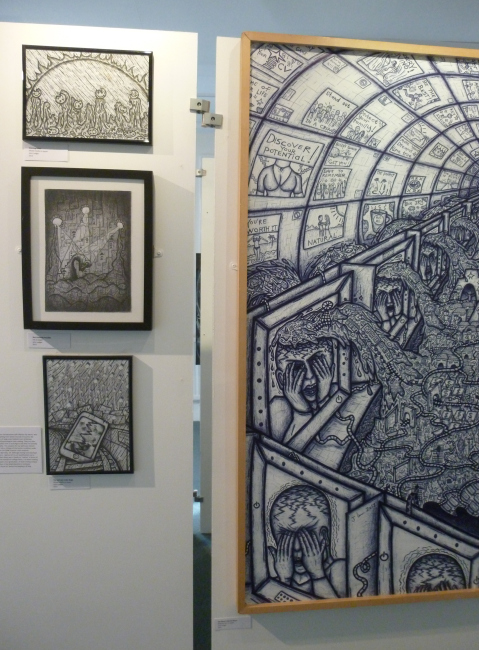
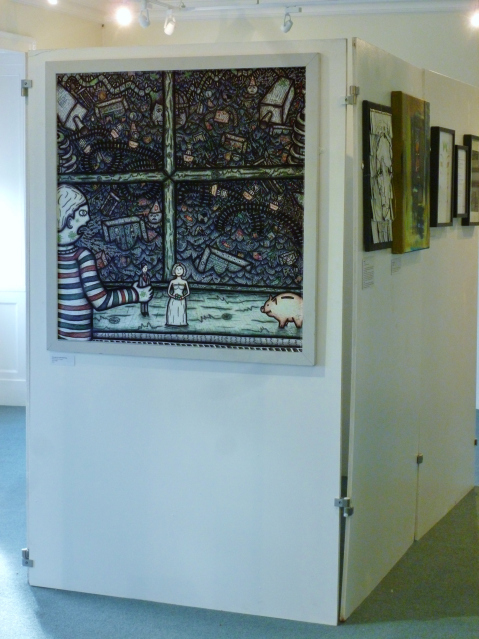
We were all really pleased with how the works played off one another;  a coherence of many preoccupations that made up the reasons for having this exhibition which addressed political pessimism, the age of disbelief, austerity and the overlooked areas of the UK.

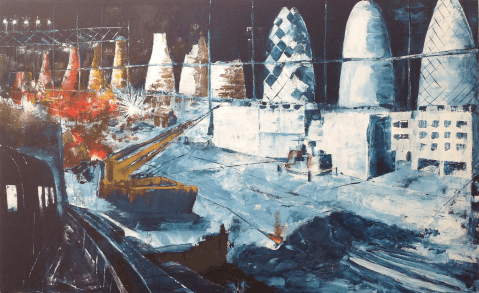
Whilst John Wilkinson’s paintings addressed the damage done both by once worker-hungry industries, and then their disappearance in a global market economy that then told these workers to become entrepreneurs of themselves, Connor Matheson’s photography documents these very areas a generation on, a landscape with little more opportunity than call-centre dead-end jobs. The Dearne Vallery, Sheffield, Rotherham, Barnsley, Wakefield.

John Wilkinson’s paintings also deal with the post-colonial nationalism that chokes the UK’s horizons, clouding out a future that would lead us from making the same mistakes and get us out of spiraling destructive cycles. Amidst these paintings is an installation by Corinne Deakin, which, more than anything, I feel looks either like flotsam and Jetsom in-the-making or something in decay that refuses to accept it; a empire built on maritime dominance that refuses to give up its ghosts and in process drags everything else down with it.

I wanted to put works into the show that both addressed the mood of the land and looked at the geography of the area that connects up the Post-industrial Yorkshire towns intrinsic to the Fighting For Crumbs project. First off I wanted to get the poet Jonathan Butcher involved. John’s poetry is subtly political, a gritty realism and focus on the landscape he has seen community disintegration and lost futures from within. I worked with him to make a way of getting his words into an art exhibition. Growing up on Hall Road, in the Handsworth area in the eastern suburbs of Sheffield, I tried in to incorporate some of my memories of seeing the nearby Manor Estate in a state of dereliction, with the fact that the Sheffield Parkway trunk road slices Hall Road in two, to make a place for Jonathan to write his poetry that visualised community/social disintegration.

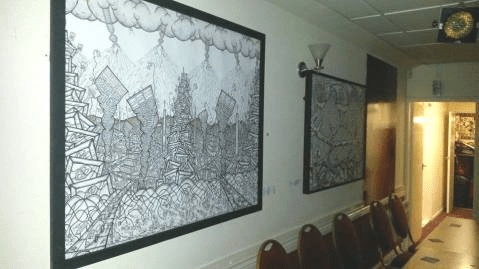
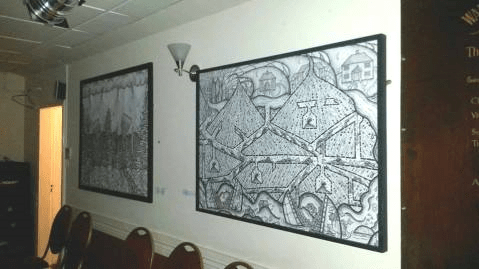
I made a installation centred around a large memory map of The West Riding of Yorkshire I undertook in 2013, mainly focussing on Barnsley, Wakefield, Leeds and Sheffield that documents the visible impacts of austerity next to feelings of confusion, frustration, alienation. I incorporated a other geographically-focused works that look at the mood of the country through the first ‘season’ of austerity, the run up to the 2015 election, and then the run up to the EU referendum. Always intent on tying together the areas where Fighting For Crumbs is based around, being held at (The exhibition continues 20+ miles north of Sheffield at the Wakefield Labour Club, ‘The Redshed’, on Saturday 13th). And I have installed some of my drawings in the somewhat smaller Redshed venue

Somewhat hidden in the corner is Rebekah Whitlam’s installation ‘Vanitas Britannia’ that talks about how the riots, kettling, protest and upheavals at the turn of the decade have been swept under a ‘handmade’ carpet of a ‘keep calm and carry on’ crafts culture, satirising the tactics of a nation that retreats into its mythical past, by playing on the morbid theme of mortality that occupies the Dutch Vanitas paintings. “As a textile artist…[Rebekah} feels a pressure of balancing a vision of socially inclusive creativity without undercutting [herself] and other artists financially.” Adding that as a craft-skilled artist it is hard not to become part of the problem when “as handmade, locally sourced business cashes in on developing the streets, financial and emotional security remains distant for their neighbours and the divide becomes increasingly widened.”

It connects up with a running narrative in the show about the gentrification of a few ‘hip’ areas in these post industrial towns to the cost of all the surrounding working class communitiess which become invisible in their struggles. The fact the there is no lighting in the room both seems to reflect the dark colours of the Vanitas paintings. and, I felt, becomes a satire on the ‘keep calm carry on’ ‘Blitz-spirit’, austerity = black outs, narrative etc etc. Just make sure the that fact the room is unlit doesn’t make you think it’s not part of the exhibition!

The exhibition doesn’t so much dwell on the past as look at the inertia of the present; the future we have forgotten in favour of ways to guide us through the day in hand. We seem to have forgotten that we need something to believe in. The world appears a place in a downward spiral of cruelty and sadness, but dead-end pleasure-seeking in a depressed landscape doesn’t quite hold its excitement for very long – it just sets in stall a pursuit of even more extreme pleasure seeking later on. Fighting for Crumbs somewhat tries to visualise a country that wake from a defeatist slumber that it perhaps doesn’t even recognise as being in.

‘Development Opportunity’ and ‘We’re all in it Together’ – John Wilkinson
Installation by Corinne Deakin in front of ‘Draped in Faded Glory’ by John Wilkinson

(Right to Left) A Man hesitantly looks at Thermal Socks for Sale in Barnsley – Connor Matheson, ‘Keep Calm and Keep Shopping’ – John Wilkinson


Corinne Deakin’s installation in front of ‘The Imposition of Conformity’ by John Wilkinson
Youth Riding a Small Motorbike – Shirecliffe
Broken Slates – installation piece – Jonathan Butcher and John Ledger
Poppies (For Jonathan Butcher) – a painting John Wilkinson produced for the show in response to one of Jonathan’s poems.

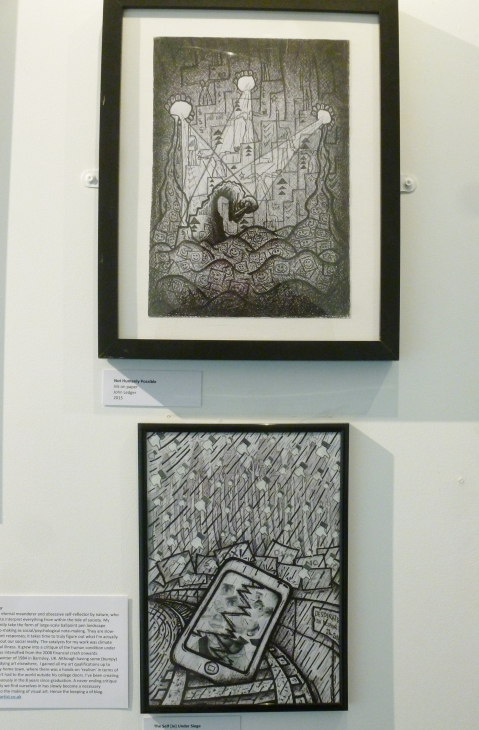
Installation by John Ledger

West Riding of Yorkshire: A Pyschogeographical account

Vanitas Britannia – Rebekah Whitlam

Vanitas Britannia – Rebekah Whitlam


At the Redshed, Wakefield on Saturday, 1pm onwards, we will be showing our Fighting For Crumbs documentary, which will look at all the artist involved. We will be showing the brilliant documentary Sleaford Mods – Invisible Britain, and JD Taylor will be giving a talk. JD Taylor is the Author of Negative Capitalism: Cynicism in The Neoliberal Era, and Island Story: Journeys Through Unfamiliar Britain

Images of Redshed show

Fighting For Crumbs…


I’ve been involved in setting this project up for the best part of a year…

Over the past few years or so I have found a few people who were agreeing with my growing sentiment:

That the mood and spirit of this society (global too) was in a deep depression, and that this had to be addressed before there could ever be a popular movement that would well and truly galvanise the daily-downtrodden’s into believing in something so much that they were prepared to fight for it.

(Let’s be honest. I’m a daily-downtrodden myself. I’m no freedom fighter.)

Trying to hold a belief that another world is possible up to the light of a new day in UK2015 was like holding a flower up to a nuclear blast – it withered and recoiled before the toothpaste was on the toothbrush. Before you know it the old depressive-pleasure-seeking kicks in: cider after cider, angry self destructive acts, a spree of undecipherable text messages  – enough to write another day off until a new dawn fades.

Art has been my backbone in a world which seems bent on being cold and meaningless in equal measure. Without it I’m a mollusc looking for the nearest dark spot to dwell in For “there are brighter sides to life and I should know, because I’ve seen them, but not very often”. And I always recoil to my work as an antidote-maker.

I’m bored of expressing this. Deeply bored.

I…..

Another world….

…a better world

Isn’t there a plant in the desert that only flowers once a generation? Is that not a perfect analogy for English optimism?

The week that followed from May 8 2015 was actually a special week for me, for it felt like I was sharing something with others. What I felt I shared was a despair and fear now that the Tories and the media were taking their gloves off for some sadist pleasures. And I felt this sharing of despair beginning to jolt people into a sort of action most of us hadn’t engaged in before. But it didn’t last…


Rotten Soil….

…A couple of months later I discovered the Sleaford Mods. Their channeling of the rotten soil of nowhereland sank into hole where a soul, a love of life should’ve been. An Antidote. Later that year I was surprised to find that a film called Invisible Britain, that followed the band, was following them on a tour of the Ingored-lands. The Ignored-lands I meandered within and wrote about: mainly Barnsley and Wakefield.

I felt an idea coming along..

This idea was given one leg to stand on when I was asked by friends to put on an exhibition at the Wakefield Labour club (Aka The Redshed).

2016 marks the 50th birthday of The Redshed, also known as The Labour club. Situated in the heart of the Yorkshire city of Wakefield, the place is somewhat unique, and has defiantly resisted the capitalist forces that have penetrated nearly everything else around it. A year-long line-up of events are now marking this anniversary.

Sandra Hutchinson, a lifelong supporter of the club, spoke of how The Redshed began at the height of the social and political changes happening in the 1960’s. In-spite of the seismic troubles around the world, it was an age of political optimism, and there was a strong belief that things could be and would be changed.

I needed to put something on that spoke of the disbelief that has penetrated the years I’ve been an adult.

Artist Corinne Deakin coincidentally came up to me thinking of doing something very similar. Looking at the way the arts were being pushed out of the reach of many people due to 5 years of needless austerity, low wages and high living costs. I must’ve said the words ‘fighting for crumbs’, in one of my waffles that I never remember, and Corinne remembered it and said that we need to call our project this.

And then it just seem to fall into place. I’d worked with the artist John Wilkinson the year before, and knew his work and thoughts were ideal for our project. And during conversations with friends Rebekah Whitlam and poet Jonathan Butcher I realised how appropriate their work was to addressing the cultural mood of this secretly unhappy Island. Corinne knew a photographer from Barnsley called Connor Matheson, who was just that little bit younger than my own town centre social circles for me to have know him prior to the this project, but I think I’d already seen his photographs and thought they would work well alongside our works, especially John Wilkinson’s paintings. In a way that is sort of Inspired by Invisible Britain, I thought it would be great to make a talking head documentary for this project – the Fighting for Crumbs documentary will be on show at the Redshed event, and hopefully all way through the Gage Event. Anyway, here’s a link to all that. https://www.facebook.com/events/1766943633588740/

Here are a few lines from each artist. All I can say is that I hope whoever reads this can make it to at least one of the events that we are putting on:

John Wilkinson (B 1962 – Sheffield based)

The price of coal

Austerity, the ugly reality of post-war Britain and the backdrop to the founding of the welfare state has come back to haunt us once again. Trying to invoke that spirit that enabled us to survive and rebuild the last time, David Cameron famously said ‘We’re all in it together’ but the truth is that we’re not, and it isn’t the same. A North decimated by industrial decline and unemployment is not the same as the manufacturing centres that provided the growth and foreign trade that led us to economic revival in the 50’s. A class abandoned because the education bar has become too costly to climb over is no longer the motor of the economy, and so the economic benefits of whatever financial services revival they paid for never reach them. Instead of building the State that supported growth we are dismantling Health, Education, Housing and Welfare, and replacing all but the cheapest labour with technology that frees us from work and with it income. As an artist, my work is a response to the world I live in – a mirror that reflects reality, and what it might become. Through it I express my compassion for a people who built the foundations of our world, and will be left to rot in its basements until we can see what is happening, and ask for better. Then I’ll paint pretty landscapes.

Corinne Deakin (B 1988)


During the past 5 years, or perhaps longer, we have seen old architecture and independent business give way to gentrification and cuts that effect the working class. Education is being stifled and the youth of Britain are entrenched in large debts they may never be able to pay off, with suggestions of unfair consequences. The idea of community is disintegrating, as we are encouraged to evolve into self absorbed, cutthroat individuals where its constant networking and making a career for yourself is based more and more on who you know, not what you know- and it never hurts if you’re born into wealth. Glorifying low paid internships and getting very little in return. This is the ideology that’s being sold to aspiring artists; the dark introduction of how to make it as a successful artist today.

Jonathan Butcher (poet, B 1978, Sheffield)

Over the last 40 years the structures that should constitute a society have been eaten away by ideals which have been instigated by the few, with the intention to pollute the many. Ideals that strive to restrict us and attempt reduce human expression to the level of the banal and the superfluous; achievements considered wasteful,and without worth. We have been left empty, yet we are expected to remain grateful for the meager gains we have scraped together; gains which when pursued only through shear necessity, place money above time and psychical and mental strain above thought and basic fulfillment. Slivers of hope are offered, but are usually temporary, and for the large part conducted by those just as driven by this machinery as those they purport to despise. This now continual scenario enforced upon us attempts to define us. It claims to speak on our behalf, without offering a single answer to this problem or a solution to our fate.

John Ledger (B 1984, From Barnsley, works in Wakefield)

Debtland

“There has arisen a deep disbelief in the abilities of the human race, without much shared understanding of how we came to feel this way. Maybe it comes from the fact that with what we now know (regarding climate change, the impacts of social inequality, living memories of 20th century horrors), there’s a sense that we SHOULD be in the process of building a far better world to live in. But NO: in 2016 we are within a state of affairs that is making us scrap amongst ourselves for pieces of barely anything. Are we surprised if nervous breakdowns and spells of aimless rage are commonplace amidst this deeply absurd situation?”

Rebekah Whitlam, Sheffield, 1984

Vanitas Britannia.

Since the recession there has been a pseudo-nostalgia of post-war Britain. Kettling, rioting, and protests were swiftly detracted from by weddings, jubilees, and cake on the BBC. The “keep calm and carry on” craft trend has escalated; beer, baking, and bunting have become synonymous with community togetherness.

Whilst we crave authenticity in ourselves and our society, empty slogans are sold back to us. The commodities of craft offer us promises of a community, but leave us all the more alienated. As handmade, locally sourced businesses cash in on redeveloping the streets, financial and emotional security remains distant for their neighbours and the divide becomes increasingly widened.

As a textile artist I feel a pressure of balancing a vision of socially inclusive creativity without undercutting myself and other artists financially. The lapping of cushions, cards, and craft is at my feet, but how do I not become part of the problem?

Austerity strains us economically and is having a detrimental effect on personal integrity and creative freedom.

Connor Matheson (B 1992 Barnsley)


The works I am showing in Fighting For Crumbs explore the everyday lives of normal people in the Post-Thatcher era, with particular focus on themes such as family relationships, the local economy and drinking culture. With a specific focus on the north of England, this project is an accurate representation of working class culture, depicting the everyday lives of people who are often vilified in the mainstream press as “scroungers” or “yobs”. The work shows the effects of government economic policy yet also shows the human element, relationships and humour in life and celebrates the diversity of people and the character of areas.


Gage Gallery, Ball Street, Sheffield, S3 8DB

Monday 8 August: Opening night. 6:30 – 9pm
Friday 12 August. Music and poetry night. 6:30 – 9 pm
11-4pm

The Redshed, 18 Vicarage St S, Wakefield WF1 1QX

Saturday 13 August. 1Pm onwards. Film-viewing, and talk by JD Taylor
Normal gallery opening times: 8 August – 13 August, 7-11pm (call 01924215626 to check room is not in use)

Friday 12 August. Fighting For Crumbs – Poetry and performance night

On Friday 12 August as part of Fighting For Crumbs (Art in The Shadow of Neoliberal Britain) there will be performance and poetry within our exhibition at Gage Gallery, Sheffield, starting at 6:30 and running until 9pm.

Artist Nick Kilby will be breaking his two year performance fast to put something together for the Fighting For Crumbs event on August 12th at the Gage Gallery in Sheffield, located inside KIAC, Sheffield, S3 8DB. 6:30 – 9pm

‘”To the 330’ is a noise/aktion blood hex against an occupying administration. Be fun to see some of y’all. There will be no milk x”

Our poets and poetry readings are yet to be confirmed, but follow our events page on facebook to keep up to date. https://www.facebook.com/events/1766943633588740/permalink/1777196522563451/

A Grief That’s Been Gagged and Buried (2016)

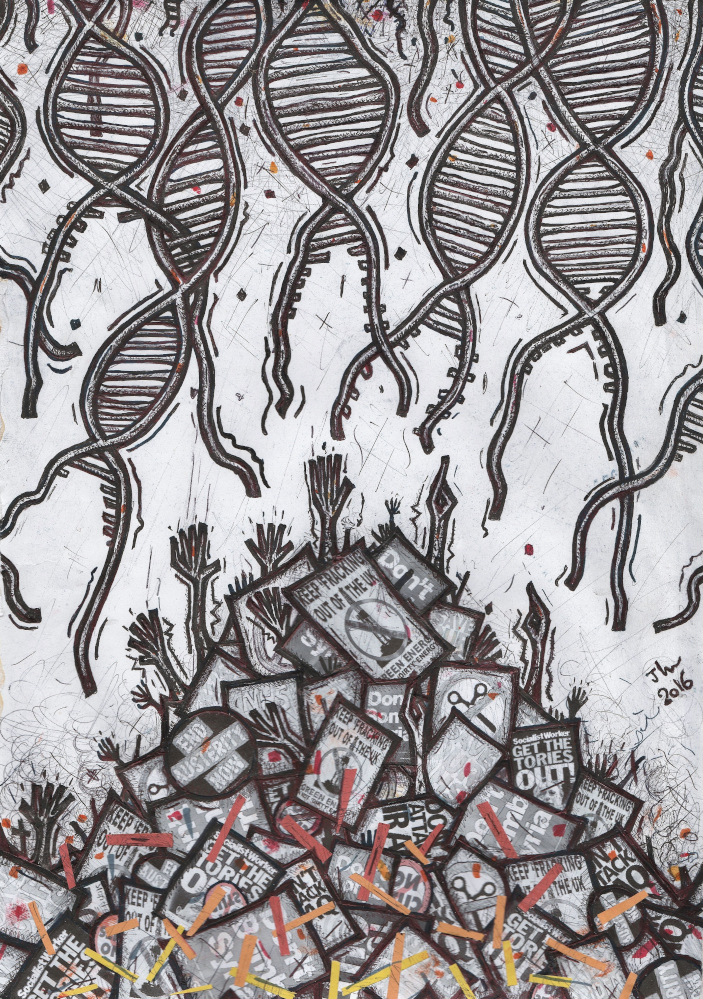
I don’t know when you could say such a time began (maybe at some point during the past decade or even earlier?), but I sense we are overdue some grieving time. And that’s because our civilisation (specifically our faith in a capitalist model – one based on exponential growth – to bring well-being and prosperity) has died. Grief is a natural process in order that we can rehabilitate so as to move on to the next stage of life, but it has been emphatically denied us. Its existence has been denied, and the denial has been played out in a turbo-charging forwards with the persistence of now-dead beliefs. And look at the pain that it is causing; to be forced to work harder for something deep down we know is not only going nowhere, but is in a process of perpetual deterioration. It has made knowing-zombies out us, an anxious-undead, clutching our Iphones, trying to climb out of the daily dread. But it has to give-way at some point. More and more of us are suffering under the psychological strain of knowing we will have to work harder and harder for diminishing returns from a dead/dying system, and all around you can see people cracking up. Nobody knows what this outcome will finally lead to, but there is potential for a rebuilding, not so much physically, but culturally. However, right now we are in need of an healing process.