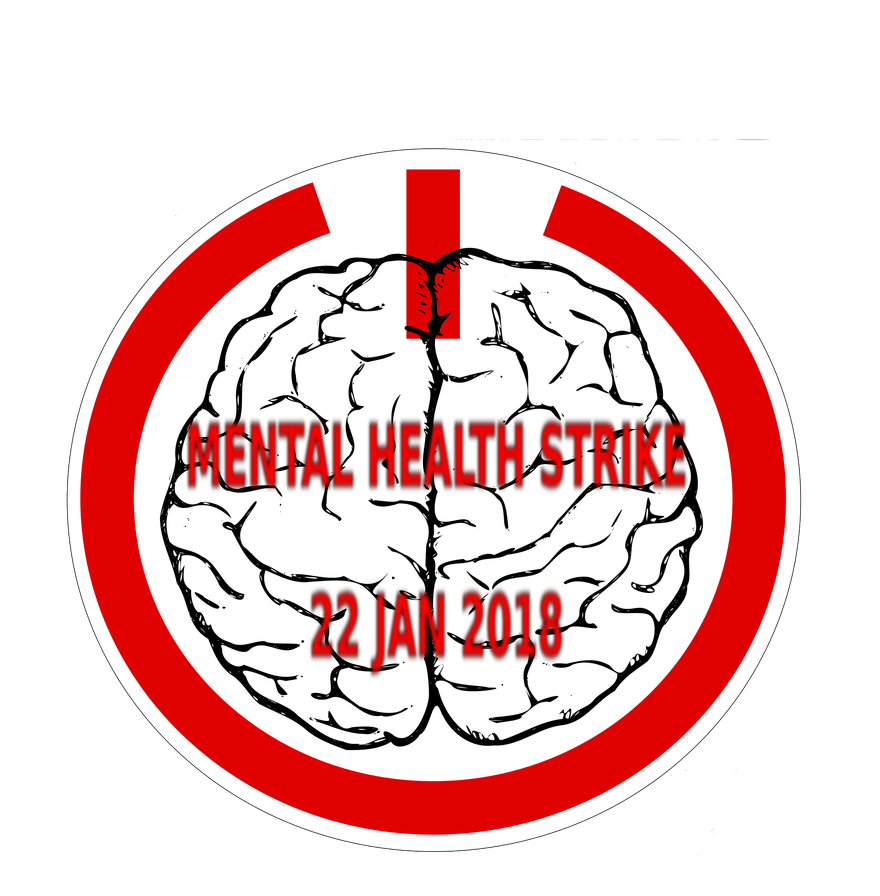
The Mental Health Strike is part of a project I am building as part of the Retro Bar at the End of the Universe collective. The project is based on actions and moments that deposit social and political actions within the contemporary cultural landscape that would be seen as impossible asks, as if they are apparitions from near-futures where a completely different set of tools and demands are available to build a 21st century world where collective mental well-being is at crucible of social organisation.
The Mental Health Strike, which was set for the date of January 22 2018 (supposed to be the most depressing day of the year) is neither a case of ‘what if’, nor is it an actual strike that has been organised. It exists in the in-between, where it could become real.
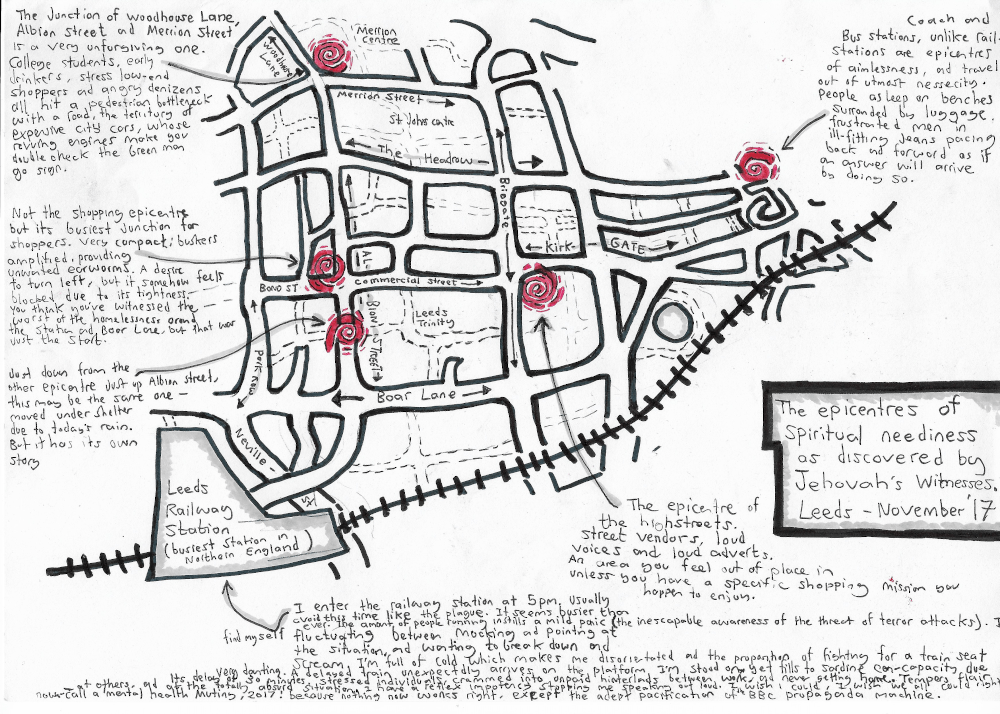
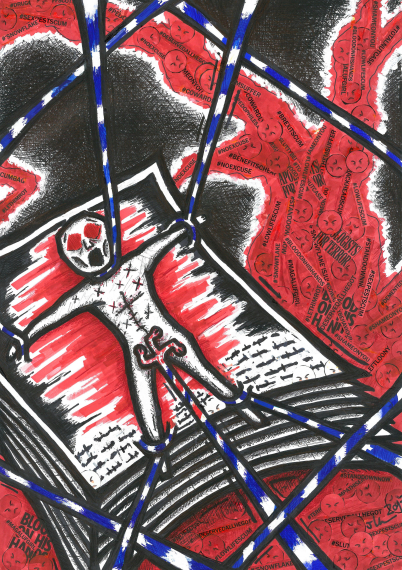
The week before Jan 22 these placards were placed around specific areas in Leeds city centre. I chose the places the Jehovah’s Witnesses usually have their stands on a weekday; speculating that they had located the areas within each city which are the epicentres of spiritual neediness, the places where the most negative emotions prevalent in late capitalist life are felt on the street.
The above flyers were distributed on the night of the exhibition where I exhibited the audio-piece ‘(M.H.S) Sunscreen ’18’, an audio work put together for the project by myself and collective member Benjamin Parker.
The above flyers were distributed on the night of the exhibition where I exhibited the audio-piece ‘(M.H.S) Sunscreen ’18’, an audio work put together for the project by myself and collective member Benjamin Parker.
I’ve gone back to study this year. After years of wrangling over whether to go back or not, I finally decided that I had nothing to lose by doing so. Additionally, it has enabled me to have a bit more thinking space, away from working 5 days a week. Because no matter what job you do, I find repetitious work endeavours to corrode the will to be creatively and intellectually engaged with life. Although now in my 30’s, regrettably there are many things I haven’t experienced or engaged with, and in many ways I feel deprived of so much, but partly because of this, I still have much freedom from excessive responsibilities that many don’t, and this has enabled me to break free of 9-5, if only for 2 years.
I’ve still been working on my drawings, but spending much time considering and working on how the other main outlets for my work relate back to my drawings. I’m not a natural illustrator, I spend way too much musing things over than putting pen to paper, so it always feels a little disingenuous to go along with the ‘drawer’ tagline. It gives people the wrong impression about how I work.
It’s quite hard to explain this whilst also explaining how important my drawings are to the ideas and concepts that drive me to make and do. But the drawings are intermittent moments where the cognitive mapping of this chaotic world suddenly seems to come into focus, and make sense, even if this doesn’t seem to be the case for others who view the final outcomes.
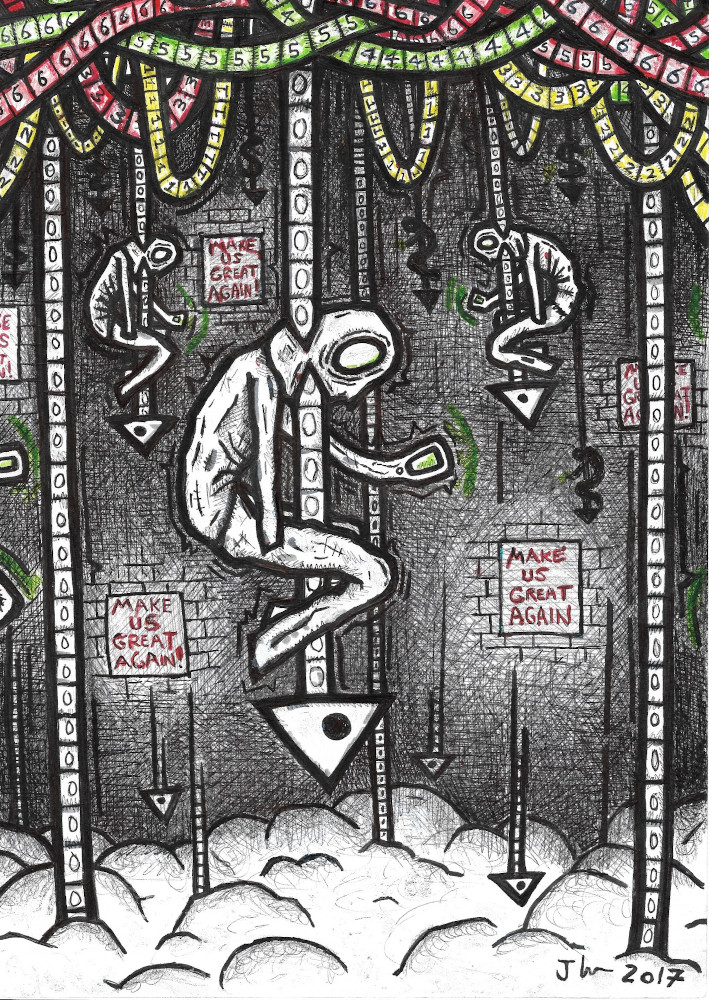
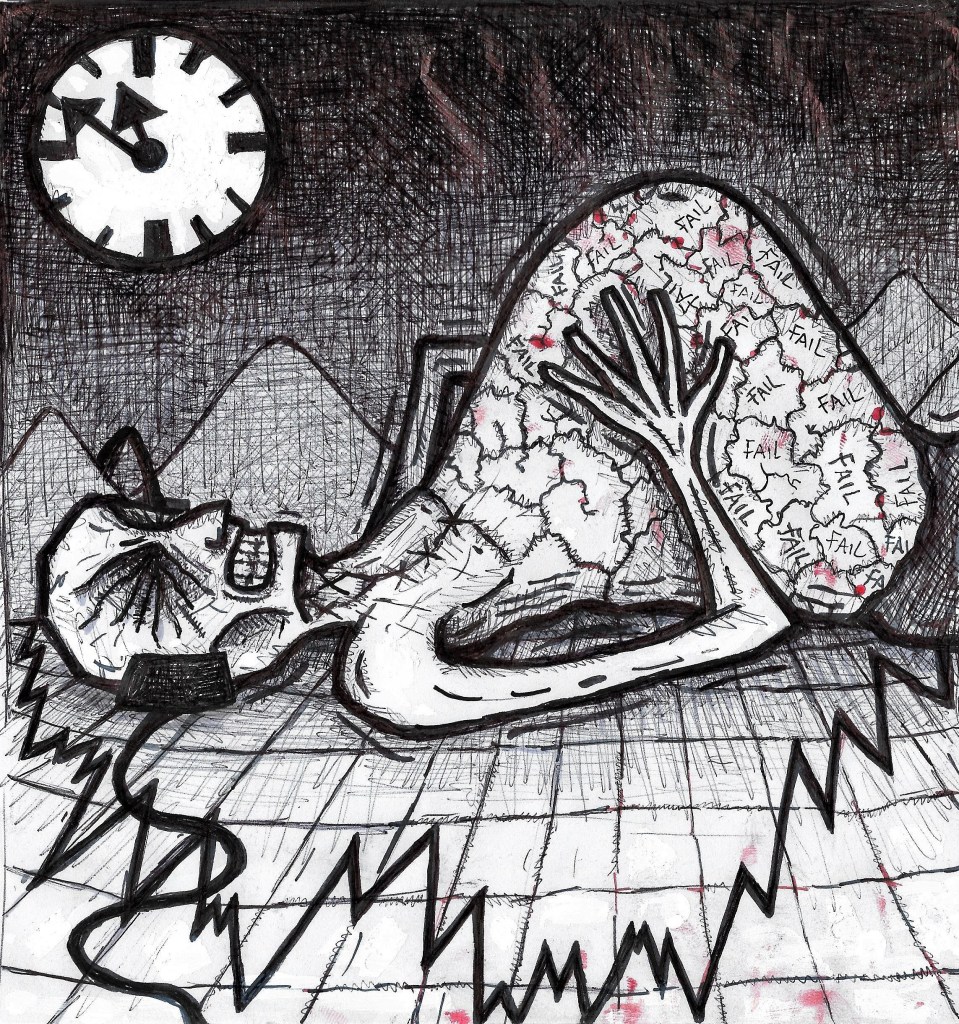
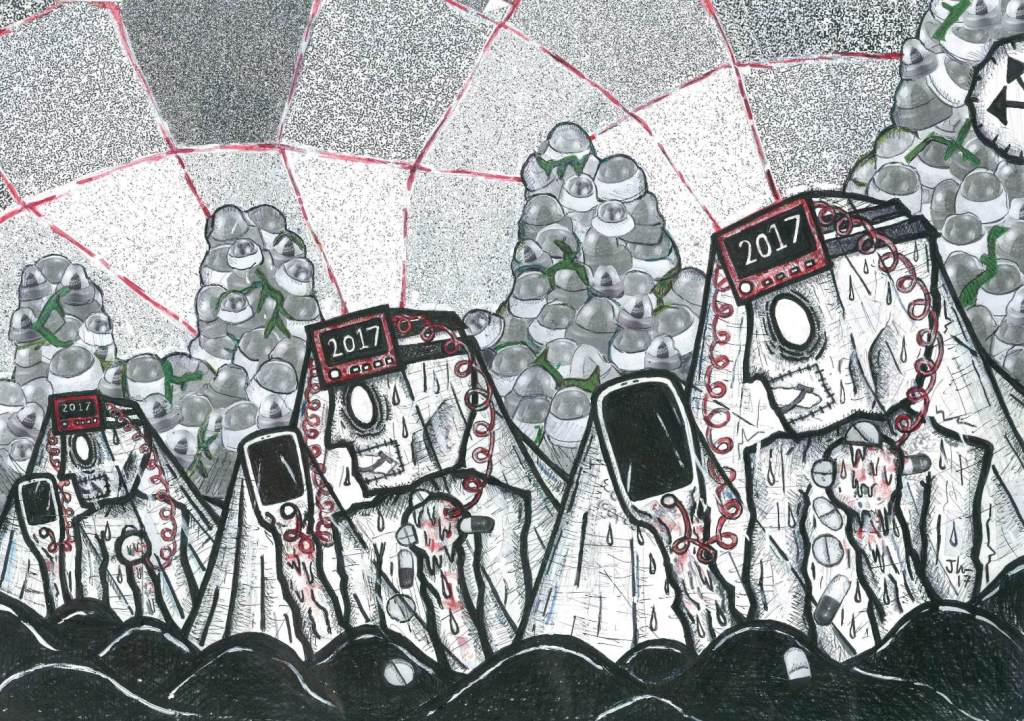
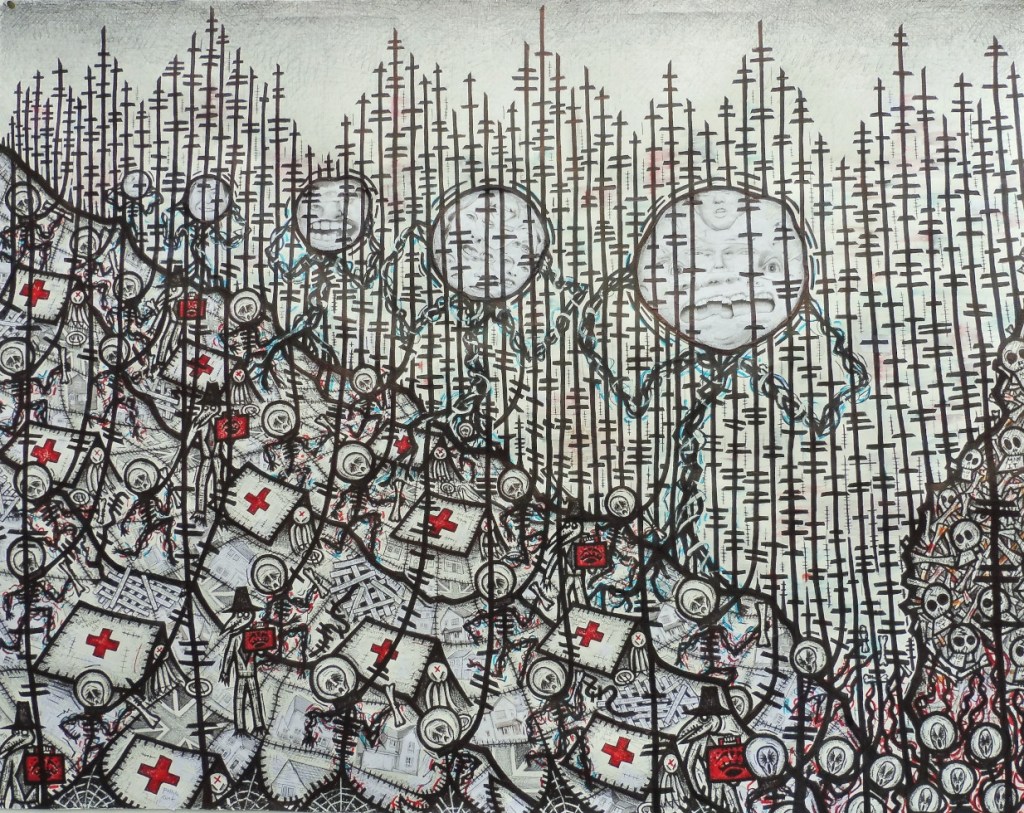
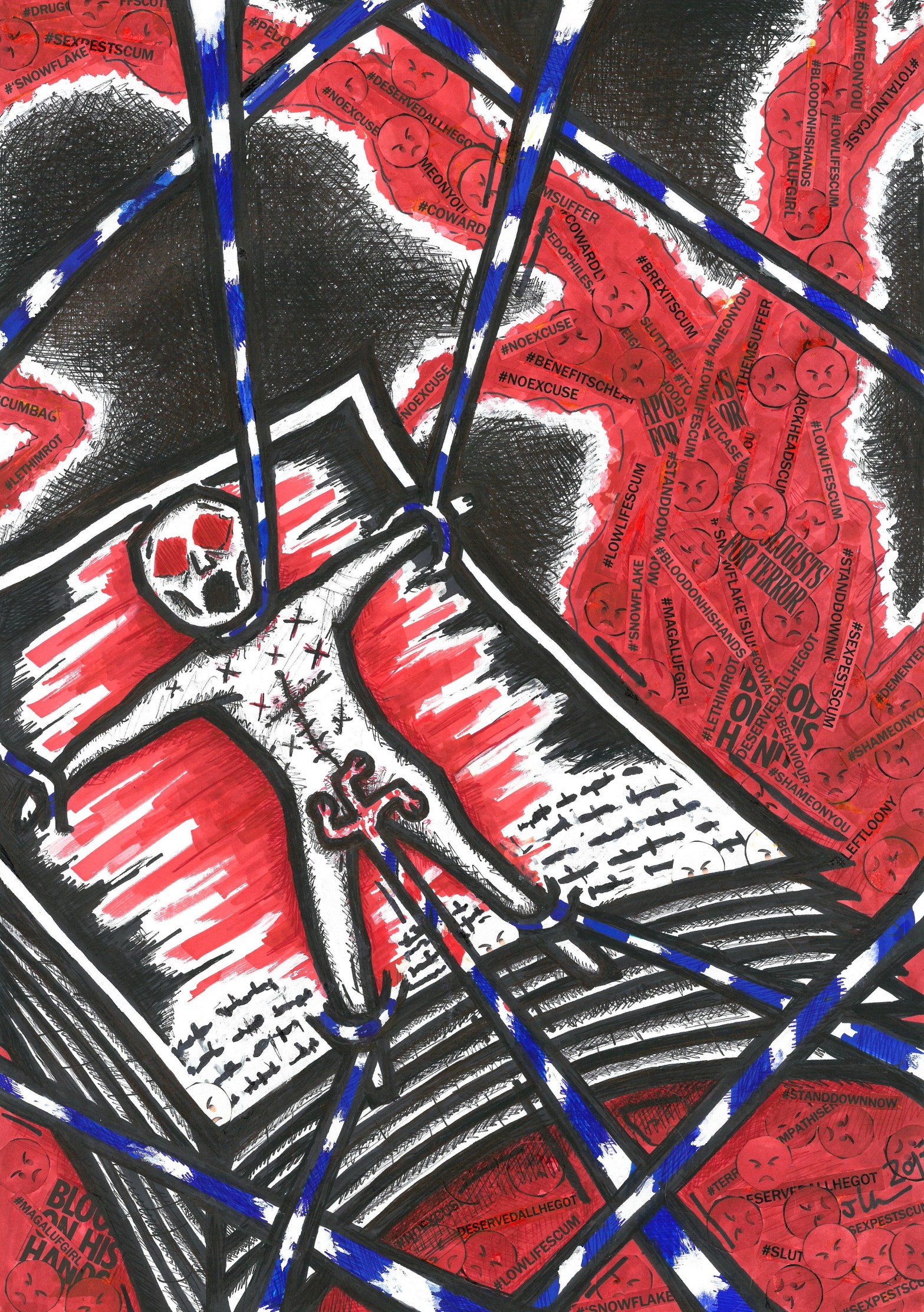
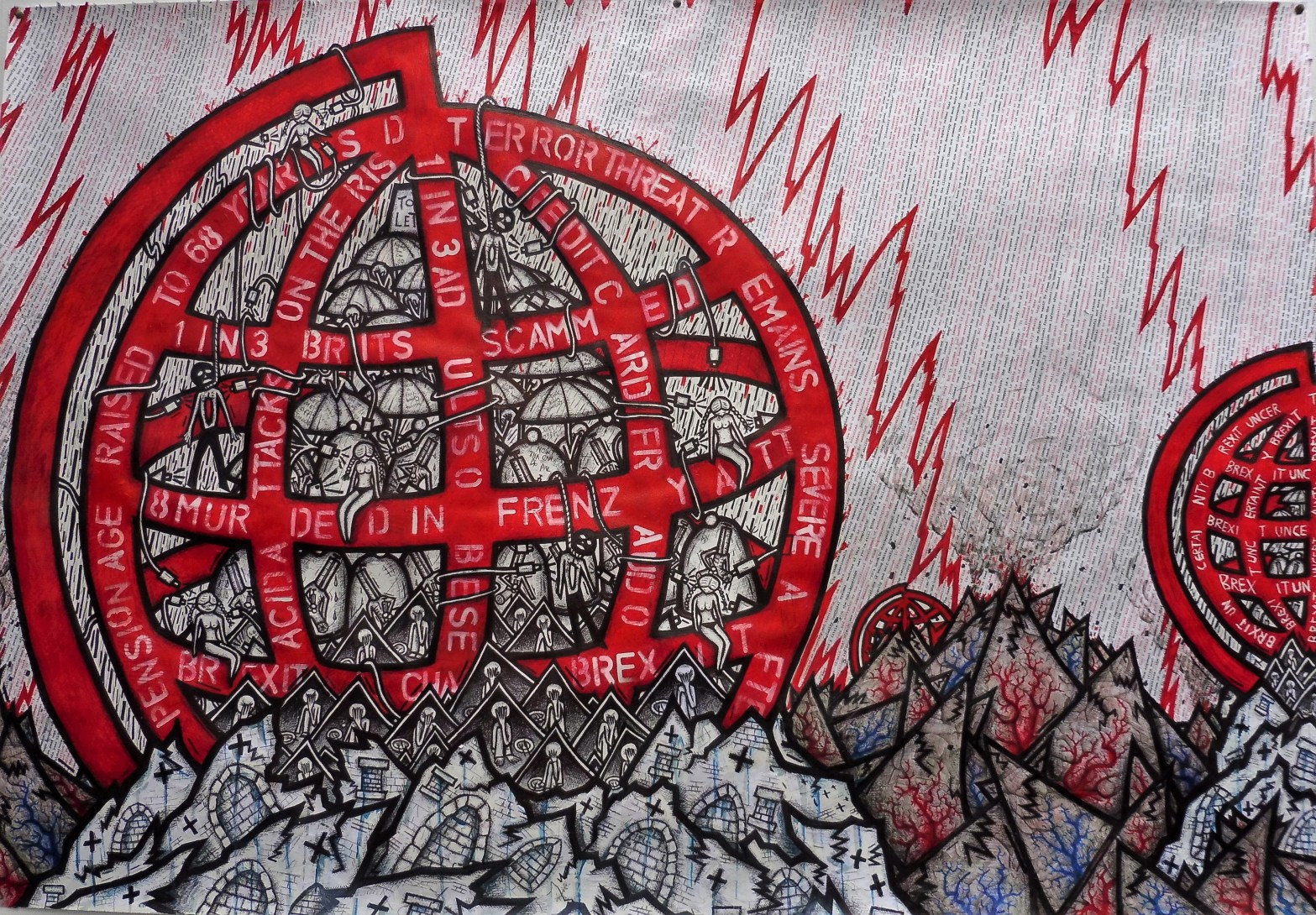
Nonetheless, the current works are trying to take on the concepts of ‘dark optimism’ (which I borrowed some time back for my own uses, from ‘The Transition Towns Handbook’, by Rob Hopkins), and (my own) ‘punch-drunk idealism’, largely by pitting the capabilities we have before us, against the evidential mass mental breakdown that our current hysterical accumulation of modernity is causing. There has become within myself and my work an almost religious conviction that this moment, where we are at a saturation point regarding our ability to care and hope, will cause a tipping point where we will be forced to collectively transcend the ‘soul fracking’ of late-stage capitalism. I say religious to be cautious that I may just be fooling myself, but I guess if I didn’t at least have some belief that the future will be live-able the I’d be a nervous wreck.
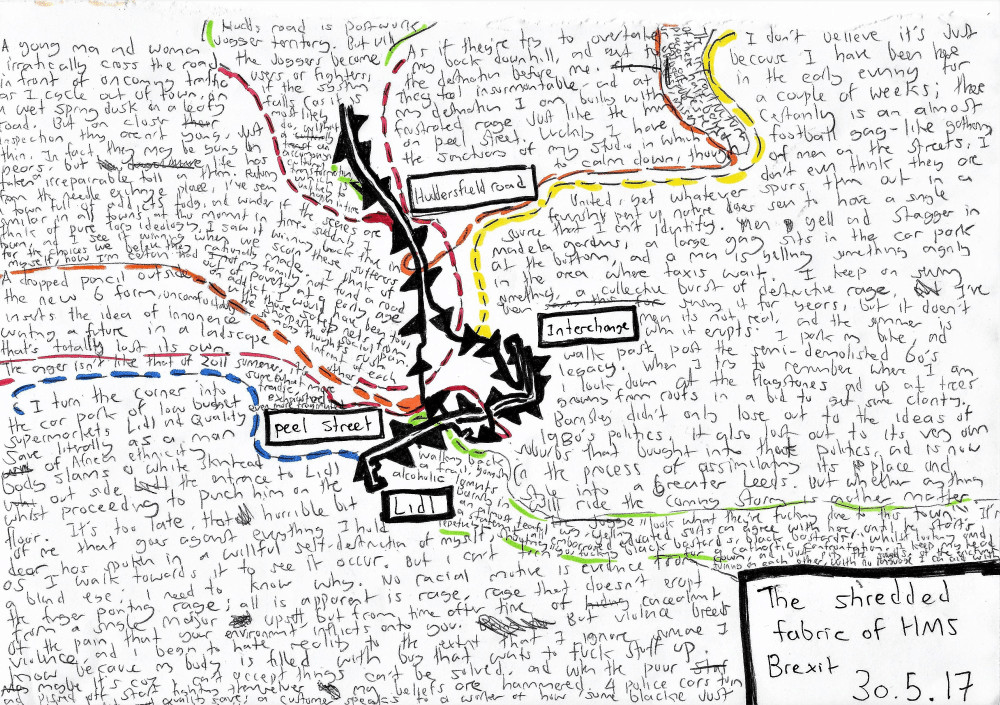
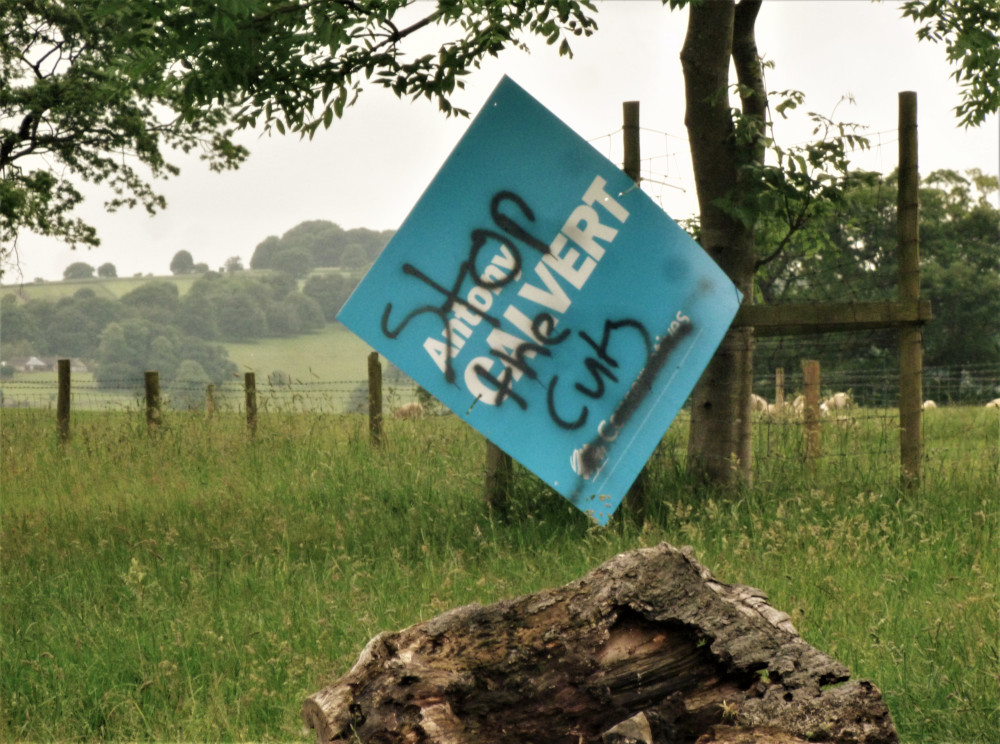
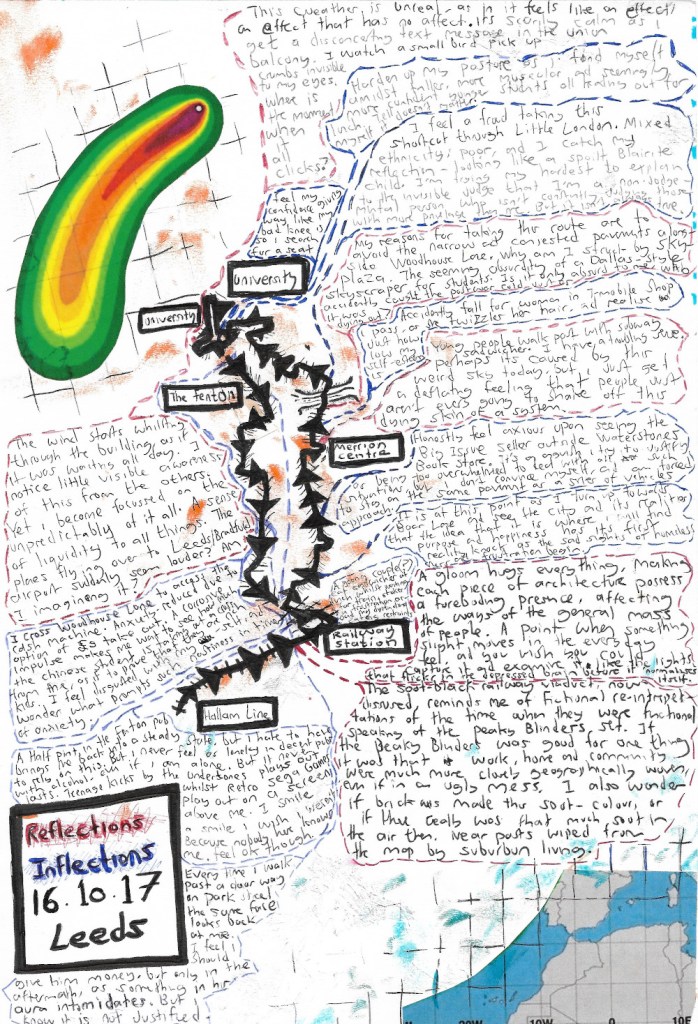
One of the most important works, for me, was a written work, accompanied by maps, that sadly became an unrealised project. ‘How did I get so old? (Pre GE2017 musings)’ was a response to the then-upcoming snap election called by Teresa May. Although Jeremy Corbyn himself would never pretend he was the ‘golden ticket’ to a post-austerity, potentially post-capitalist society, his unexpected popularity with symbolic of a desire to break out downer-fuelled neoliberalist Britain. And this work was an attempt at reckoning with the potential of choosing to vote to challenge these depressed, foreclosed horizons, alongside trying to come to terms with my own depressed experiences of adulthood, and a willing to change this, also.
I’ve always found the balancing act of these two seemingly separate issues very difficult to communicate, because the language to effectively communicate a notion of a societal depression is inherently flawed, whilst when I veer more towards my own experiences as a better form of explanation, it appears merely pathological, or, at worst, that I’m wallowing in it.
The election, however, did surprise us somewhat, and was probably the last period of collective optimism, before the absurdity of Brexit, and the sex scandals that seemed to hover around it like accumulating flies around its rotting carcass of [the illusion of] neoliberal society, began to overwhelm such capacities for optimism. I guess there’s always next year..
WILL THE LAST PERSON TO LEAVE THE 20TH CENTURY PLEASE TURN OUT THE LIGHTS?
The biggest project was also to be the most spectral.
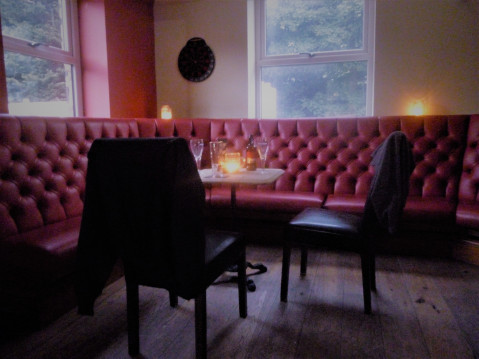
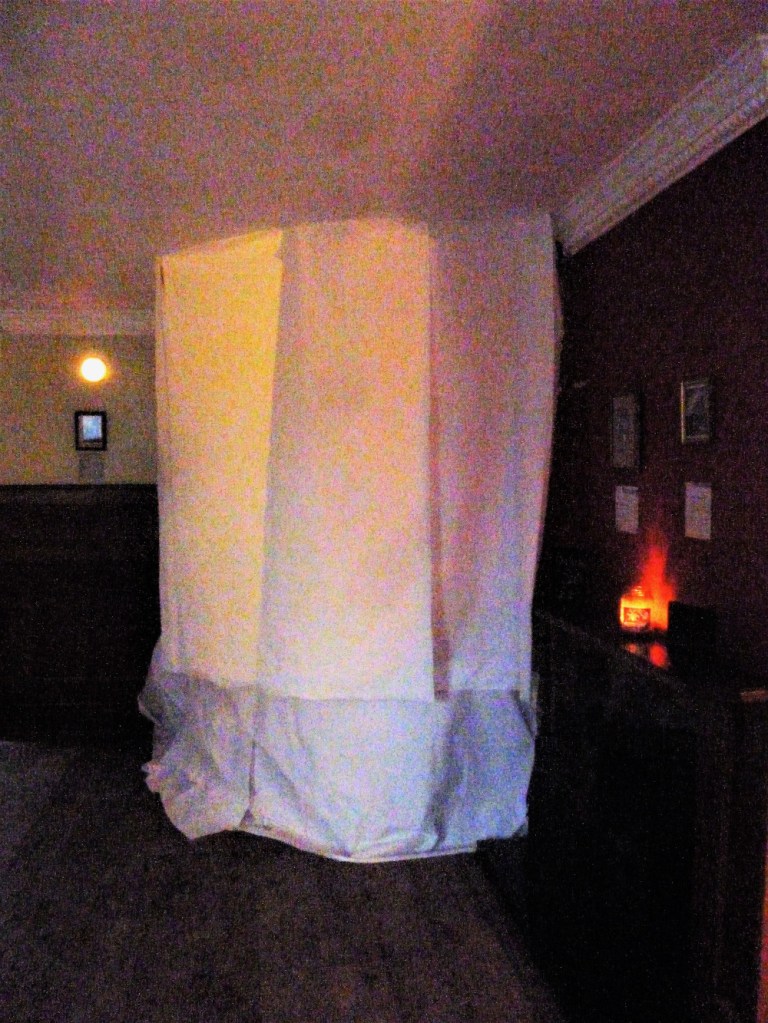
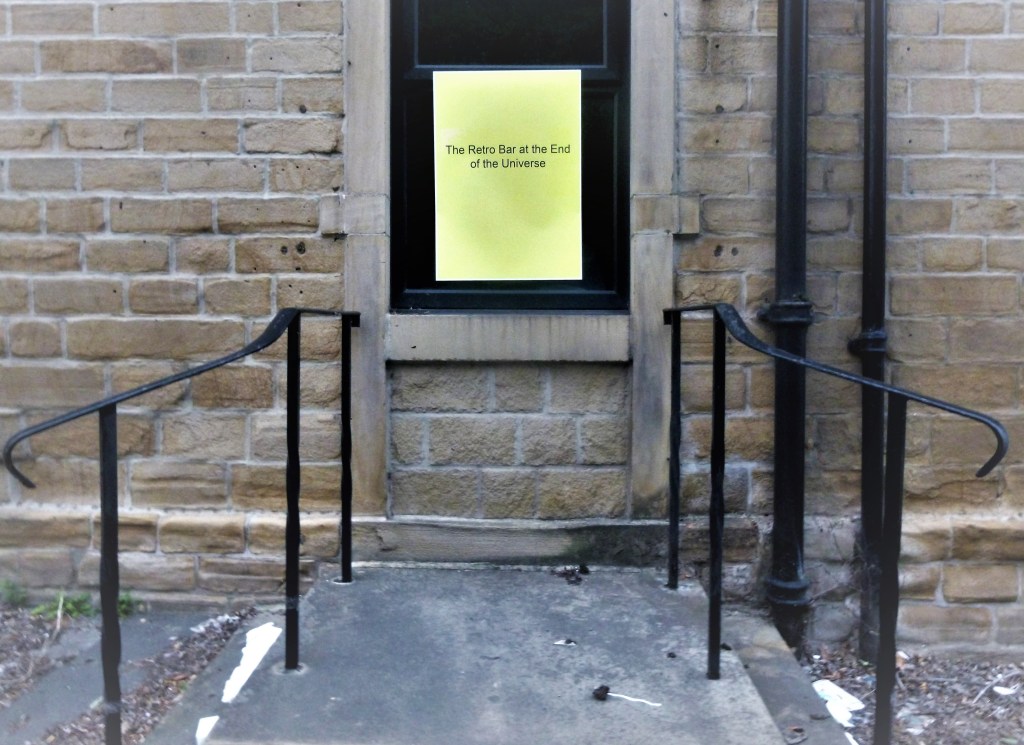
In 2017 The Retro Bar at The End of the Universe [the collective I am part of) was given the chance to curate a disused pub. The pub, which epitomises the weird and eerie landscape of post-industrial West Yorkshire, was situated on the relentless Otley Road, within the Saltaire/Shipley region. Yet, the building itself contained ghostly remnants of a political and cultural era which the RBATEOU argues is currently coming to an end.
Due to a location made ‘strange’ by our descent into a commuter existence, the event ‘Will The Last Person To Leave The 20th century Please Turn Out The lights?’received NO VISITORS. This was an exhibition at the end of the universe, making the collective wonder “are we the last person?”. Perhaps it was meant to be?
We curated both floors of this large building, to create something that actually began to creep us out as a collective, as if we’d uncovered a truth about the era we arguably just leaving that wasn’t comfortable.
The Eternal Blip(A Mary Celeste Decade)
I have some projects that I am wanting to conceal until the new year, but they will, without doubt, be documented upon here in good time. But perhaps the last point of interest to finish on would be my rookie attempts trying to map an idea of society’s emotional patterns in response to certain political upheavals during the past decade.
Working on ideas put down in 4 years back in ‘The Mary Celeste Project (The Scene of The Crash)’, The Eternal Blip (A Mary Celeste Decade) basically tracks the past ten years, since the year when the financial crash happened to now, asking if others feel the same way as I do: that with retrospect it feels like a lost decade (?).
Now, I haven’t been forced to rely on food handouts, had to choose between heating and eating, or found myself on the streets (an awful new normality in the past ten years). But in hindsight I feel like it has stunted me, almost caged me in a previous point of my life. I feel like when I shut my eyes and reopen them, I can’t remember the decade, as it has been sucked from under me.
The parallels between a long depression, and the memory loss it can cause are very closely tied, and I can only hope that it isn’t a lone experience, because I want the other aspects of the work to make sense to people, as they are where the optimism lies. Within this submerged soundscape there are points of emergence that correlate with times within the past decade when I felt ruptures in default reality fabric occurred. For good or for worse, new horizons felt palpable, as was a sense to act. Ultimately the default reality fabric reasserted itself, and, arguably the depression/memory loss resumed.
From the 2011 English riots to Trump, from Corbyn to Brexit, constructive or destructive, the fact is that these ruptures offer(ed) alterior possibilities from the business-as-usual outcome. I don’t know, I just know how I feel /felt in these moments seemed to contain some kernel of something other, that allowed me to imagine myself in relation to the world in a different manner.
Next year is going to be a real challenge on so many levels. But I feel far less of the objectless and hopeless confusion I had in many of the previous years. I’m hoping I, and those I work closely with, are onto some great ideas for 2018…
In the United Kingdom many areas believe they are marginalised and overlooked in favour London and the South East. Although I’d argue the primary cause for such grievance isn’t geographically located, but located inside of us, from being subjected to the kind of society created through 40 years of fidelity to the ideology of market fundamentalism and market individualism – which personalises social problems, and affects people in London as much as the North (for example) – there are many reasons why people in the UK feel ignored and marginal to matters due to where they live. For example, “London will see £1,500 more in transport spending per person than the North over the coming years” a fact that is cause for bitterness for anyone who regularly has to use Northern Rail or Transpennine Express.
Additionally, the idea that a sense of belonging to a geographical location has been totally illegitimatised by these globally interconnected times has been proven to be totally flawed. I think it’s an impossibility to expect the human animal to thrive with no sense of connection to an area they have lived in for a number of years. And it doesn’t have to be forged around hard oppositionalism to other regions. I’d argue regional identity can take on different forms, and doesn’t have to be borne from the alienation and humiliation many feel in impersonal nation states that can conversely result in a more ferocious fever of xenophobic nationalism.
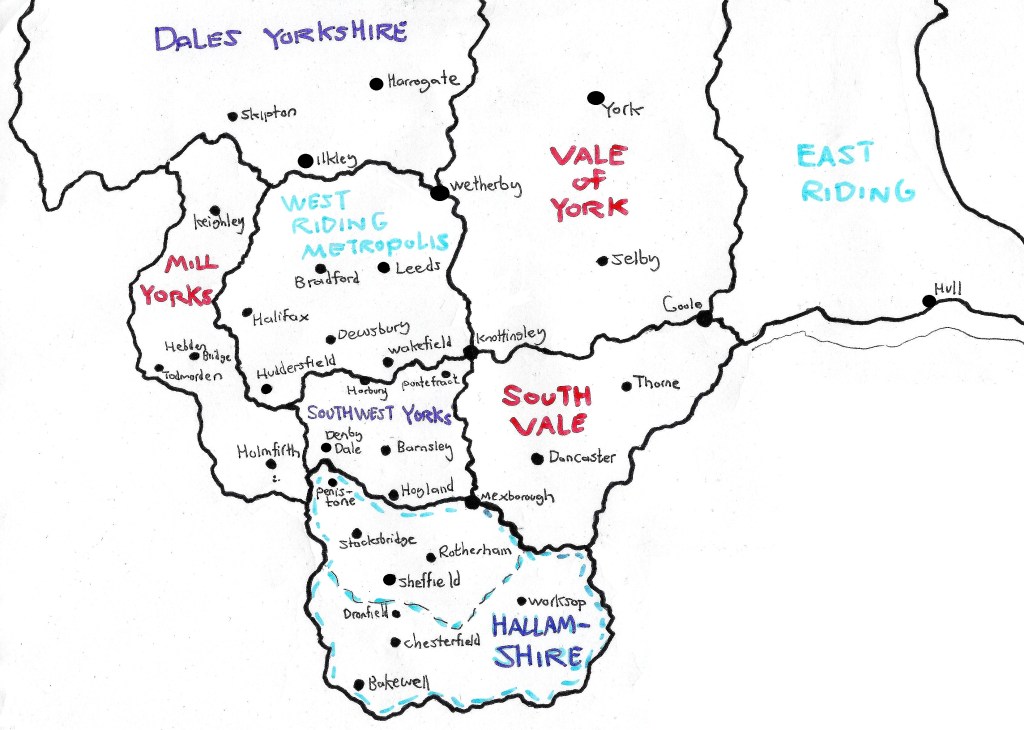
However that’s a topic for another time. Also, I’m not here to make such statements of what type of devolution should be sought, whether they would work, and all that, etc. I am simply employing my years making mind maps around the South and West Yorkshire areas, to hypothesise about ‘workable’ constitutional boundaries that could deal with the ongoing dilemma of devolution between the Sheffield City Region and the Wider Yorkshire Region..
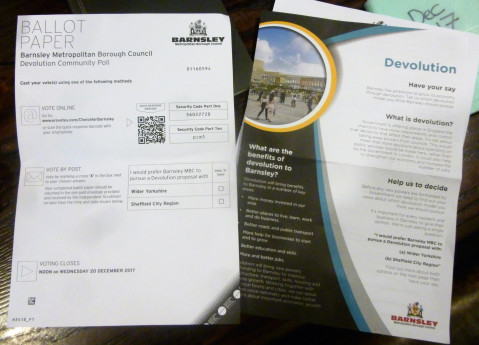
Residents in the Barnsley and Doncaster districts are being asked to ‘have their say’ on a decision over whether to agree to be part of a stronger Sheffield City Region (which they are currently the most northerly areas of) or as part of a Wider Yorkshire Region. Barnsley and Doncaster councils have voted against on their initial agreement to be part of a mayor-run Sheffield City Region, in favour of a Wider Yorkshire Region, for reasons, they say, are due to the amount of changes in British Politics since the original agreement was made in 2015.
After much consideration, I started playing around with an idea for a map that de-draws constitutional boundaries that I think could potentially work.
Yorkshire is giant county in proportion with other England centres, with a massive sense of identity, which, in turn, has made it forget that some of the areas now in within its boundaries, weren’t always so.
The reason I would propose to change a Sheffield City Region (excluding Barnsley and Doncaster) into a place of its own called ‘Hallamshire’ isn’t out of some petty wish to exclude it from the bloated belly of Yorkshire, but to agree with the thoughts of the Writer/critic Ian Nairn when he visited the town in 1960’s. Nairn says:
The reason ‘South Riding’ wouldn’t work, however, is due to one of the main obstacles to Sheffield being part of a Wider Yorkshire Region. Much of the south of Sheffield is situated, at least historically, in Derbyshire, especially as the housing developments continue to sprawl out towards the south and east. Additionally, much of the City Region that sees Sheffield as its nearest city is in Nottinghamshire. Although the nearest city to most of the Doncaster and Barnsley boroughs is Sheffield, they are also very close to the conurbation that has built up around Leeds.
I think Sheffield would fair well being known as the centre of a ‘Hallamshire’. I roughly propose it would begin in the north, following the Don valley from Dunford Bridge, taking on Penistone (which has much more in common, culturally and geographically, with Sheffield, than it does being currently part of the Barnsley district). It would stretch to the eastern side of the Derwent valley in the Peak District, and follow the Rother valley from the south in Derbyshire and into Rotherham, and stretch out South East to include the former mining areas of north Nottinghamshire around Worksop.
There are historical reasons to suggest that Sheffield may have existed on boundary lands between the North and the Midlands. According to the historian David Hey, The river Sheaf, from which Sheffield takes its name, means ‘boundary in Old English’. he suggests, in his 2000 paper ‘Yorkshire’s Southern Boundary’ that:
“it might easily be thought that the boundary would follow the river Sheaf to its confluence with the Don, and so on to The Humber. This in fact may have been the division between the Brigante and the Corieltauvi tribes when the Romans erected their fort at Templeborough in A.D 54…”. David Hey (2000) Yorkshire’s Southern Boundary, Northern History, 37:1
Even though this map is purely hypothetical I felt it still it could offend Sheffielder’s who feel just as strongly about their Yorkshire identity. Yet, I am actually trying to point that Sheffield’s ‘uniqueness’ (often evoked more by Southern expats who moved to the city, surprised how different the city is to the dated perceptions of it being an ‘unsightly’ place) puts it in a category of cities whose identities have outgrown their origins. Despite it being considerably smaller than Manchester and Liverpool, it is of similar ilk, in not belonging to one area, but of forging an area all for itself. Leeds’ identity, for example, seems to be far more at entwined with a Yorkshire identity, seeing itself as the main Yorkshire city.
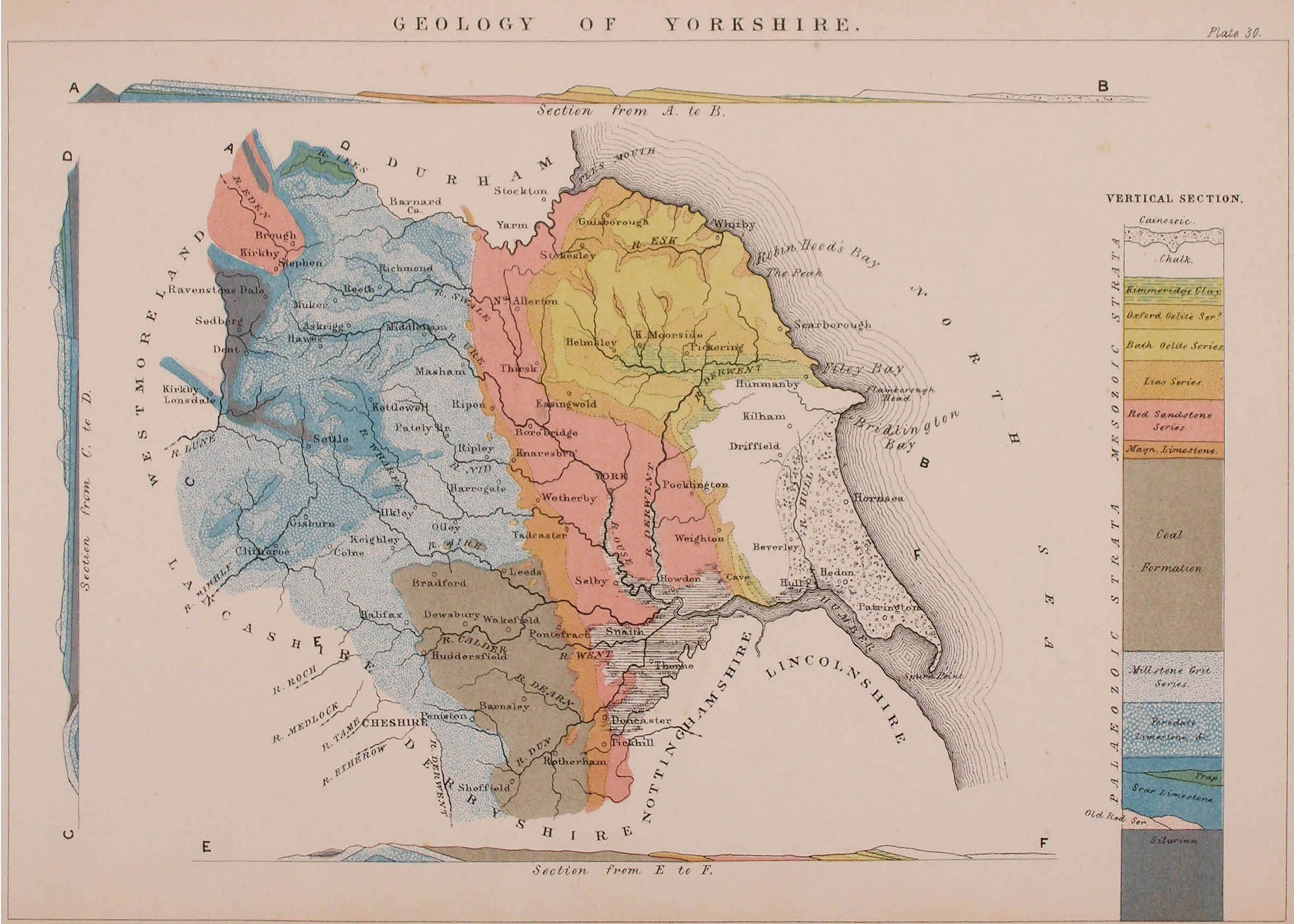
As we move ‘into’ Yorkshire from the hypothetical Hallamshire, I tried to make districts that I feel could possibly work both geographically and culturally. ‘Southwest Yorks’ would follow the Dearne Valley from its source on the hills just west of Denby Dale to its end as it joins the river Don. However, it would also include the land that lies south of the middle and lower Calder Valley. The reason for this district is that although much of this area is closer to the centres of Huddersfield, Dewsbury and Wakefield, once you actually hit their respective urban areas you are clearly in a wider urban area that is more than the sum of its parts and, although haphazardly, spreads right up to Bradford and Leeds.
‘Southwest Yorks’ roughly spans the areas of industrial Yorkshire that never became so built-up because they were largely mining communities. The same applies for the Doncaster area, but the reason I felt this was a separate area was due to its geography being more like the vale of York, which is noticeable in the change in the colour of the rock formations, which changes from the orangey brown sandstone found in ‘Southwest Yorks’ to a thin strip of ‘magnesium Limestone’ that runs north to south as the land flattens out almost completely.
The ‘West Riding Metropolis’ was a hypothetical name that the writer Owen Hatherley came up with, to designate one of the most built up, heavily populated areas in England, which has never yet worked as a fully functional metropolis due to its incoherent and discontinuous urbanity; indeed, speaking of the current counties, as they stand, I feel it is accurate to call South Yorkshire a ‘discontinuous conurbation of villages’ and West Yorkshire a ‘discontinuous conurbation of towns’.
The western perimeter of the former industrial side of Yorkshire also has a separate geography to the ‘West Riding Metropolis, a side that is a mirror of the land just over the pennine border. This area is post-industrial, yet is more rural, but unlike the mining areas, seems to visualise not only its own history but the very beginnings of the industrial revolution. I struggled for a potential name and called it ‘Mill Town Yorks’, but perhaps ‘Uppermill Yorks’ would be better. The area would likely start in the south at Holmfirth and follow the western edge of the West Riding Metropolis up to Keighley.
These are very simple plays with the area of I know of Yorkshire best, and I don’t expect it to be taken too seriously. However, it would be nice to think it could help think differently about a wider area which certainly needs infrastructural rethought.
I’m really in a work-in-progress point at the moment. I’ve got a bit more time, because I’m doing a part-time Masters, and working less hours. Getting into more debt by taking a loan and returning to further develop my art may seem like a foolish move to some, but with working five days a week (no matter what that work is!!) the sheer lack of time was meaning my ability to think creatively and strengthen my work was being starved. Fair enough some may say: ‘that’s life’. If I was to stay working 5 days a week I would have had to give up making my work, because it had no room to maneuver and expand, and could only contract. But I saw an opening to keep on working on it, and that’s what I’ve done.
The Eternal Blip (A Mary Celeste Decade)
For years I have been reeling from accusations that not only is my work very negative, but I also am negative. I have never accepted this, and from a person who suffers quite a lot of anxiety, I think it’s a given that on first impressions I’m not as warm and accommodating as I’d like to be, even though I nearly always come around, when I have chance to ‘breathe’.
The work (or ‘what I can contribute’) is more difficult. I’ve felt that my work has been trying to help harness a ‘dark optimism’ or a ‘punkdrunk idealism’ for some years now. But maybe it hasn’t been a strong enough element. I have become tired of trying to piece together how fucked up the grand scheme is, if it shows no sign of leading anywhere, especially when the grand scheme, and the awareness of it, isn’t offering yourself out of a future of deteriorating mental health and behavioral patterns.
It may not seem evident within these works in progress straight away, but there is a concerted effort to try to reach out to others in the work. The Eternal Blip (A Mary Celeste Decade) basically tracks the past ten years, since the year when the financial crash happened to now, asking if others feel the same way as I do: that with retrospect it feels like a lost decade (?).
Now, I haven’t been forced to rely on food handouts, had to choose between heating and eating, or found myself on the streets (an awful new normality in the past ten years). But in hindsight I feel like it has stunted me, almost caged me in a previous point of my life. I feel like when I shut my eyes and reopen them, I can’t remember the decade, as it has been sucked from under me.
The parallels between a long depression, and the memory loss it can cause are very closely tied, and I can only hope that it isn’t a lone experience, because I want the other aspects of the work to make sense to people, as they are where the optimism lies.
Within this submerged soundscape there are points of emergence that correlate with times within the past decade when I felt ruptures in default reality fabric occurred. For good or for worse, new horizons felt palpable, as was a sense to act. Ultimately the default reality fabric reasserted itself, and, arguably the depression/memory loss resumed.
From the 2011 English riots to Trump, from Corbyn to Brexit, constructive or destructive, the fact is that these ruptures offer(ed) alterior possibilities from the business-as-usual outcome. I don’t know, I just know how I feel /felt in these moments seemed to contain some kernel of something other, that allowed me to imagine myself in relation to the world in a different manner.
Below is a series of maps that work with the same motives, which are an extension of mapmaking I have been doing for around 5 years now.
I can’t fling last night’s dreaming into the Sleep Dustbin of the all the funny things your brain can do.
The non-linear nature of memory has reminded of me that I have only ever experienced dreams similar to last night’s a few times in my life. Last night felt like the past speaking to me directly, through memory in dream-scape.
Others have spoken to me of the uncanny dreams they’ve had when they’re lives have hit the rocks. I’m not sure I’m quite at the rocks yet, but I know there’s a truth to what they are saying.
It could be a self defense mechanism? When a crisis hits, the brain creates chemical formulas that we experience as spiritual moments? Maybe.
In last night’s dream state I went into my grandparents’ house, to check, or look over something for the family. Neither the fact that we haven’t had hold over this house since my grandad passed away 6 years ago, nor the fact that the dog, which died in 2003 before both of my grandparents, was present stuck our as being abnormal within a dream-scape.
The shock came when I went into the main room to find my Grandma stood there – a woman who, basically died when Alzheimer’s ate her up in 2003, but factually survived until summer 2007, was stood there as she would have been in the 1990’s and 80’s.
Prior to this the dream felt like a dream. This part didn’t, it felt like a presence.
The second equally weird moment came when, from shock, I ran out of the house, towards a shop that is still standing, across the road. I ran in to tell my mother.
But the shop was the shop as it was before 1999, and I wasn’t speaking to my mother in the way I would now. Nor was she the person who I interact with now, in a manner (unfortunately) massively mediated by my functional depression, and the shame and humiliation over my unfulfilled adult life; she was the woman I used to see as a mum rather than a reminder of my failure as an adult human being. It felt like another direct encounter with another time; it was un-dream-like.
Like all the mornings of this week, I haven’t been leaving my bedroom until noon. Unlike my ‘normal state’ of trying to critique our society’s nostalgiaism, I have been injecting pure nostalgia straight into my veins – it felt like the only option.
This morning I found myself listening to a song by long-haul Scottish indie-pop band Teenage Fanclub. I get like this when it feels like I can’t hold the depressive functioning together anymore, I get sucked in by anything that seems to speak of a life I had when I loved life, and didn’t function in it by a general deadness to time and space.
I first heard ‘Baby Lee’ on 6 Music some months back. I thought Teenage Fanclub had decided to cover a 1960’s pop classic.
Or maybe even a 1950’s pop classic? This is because as I walked along an unforgiving traffic-choked road earlier on, it sparked a thought in my head: maybe the mid to late twentieth century had more in common with the late Victorian (and even earlier?) than it does now. I exhaled, looked down so the white van drivers couldn’t see my slapped-face and thought of how horrific and disturbing our present social body is.
‘Baby Lee’ is pure nostaglia, but it isn’t the ‘zombie super-cut’ (Mere Pseud) of most current music, especially since The Strokes. Britain (and the world is too big of a project when it comes to Pain) is a dead dog, where all the flees (as in us) are fighting each other for ever-diminishing salvation from the life-stripping machine, and ‘Baby Lee’ evokes (even if nostalgically) a time where compassion and empathy were ‘natural’.
This harking back to a post-war moment is nothing short of something that is bringing tears to my eyes. I admit I’m in a poor state as I write, and thus maybe I shouldn’t be blogging, but here I am. I never experienced the post-war period, and I am aware it wasn’t great either, but I certainly experienced it in dying gestures (seriously even the streets of the 90’s are a huge jump from now) , and experience that what gained from its loss as an awful feeling of lack that never ebbs, and forces its sad subjects into zombieist nostalgia due to lack of another option.
I wanted to go talk about one of the other few dreams that were similar to last night’s… I must have been 7 going on 8. It was around a time when our Junior School was going to Wigan Pier. The dream I had was in retrospect mixed up with my dad playing a song by the Rolling Stones about meeting a factory girl after her shift (?).
All I can remember is that in this dream I fell in love with a mill girl.
And for months after (in fact it probably never really disappeared) I had a feeling that I can only think is the one I’ve never experienced in the my REAL adult life: heartbreak (I guess I was just about becoming a sexualised being at 8).
It was another when something occurred that WAS REAL, because I can remember fantasising about being able to travel back in time to meet her. I can also remember makign an utter fool of myself trying to explain the ‘experience’ to a fellow class friend after class registration (it must have been late 1991 or early 1992).
These dreams were not experienced as dreams, they were experienced as presences. But the disclaimer to this blog is that I am not particularly well at the moment, but with lack of connection with people elsewhere, I felt I wanted to post this – even if it I come through this shit and it all seems like nonsense. BTW, I’m not looking for comments. thanks for your consideration
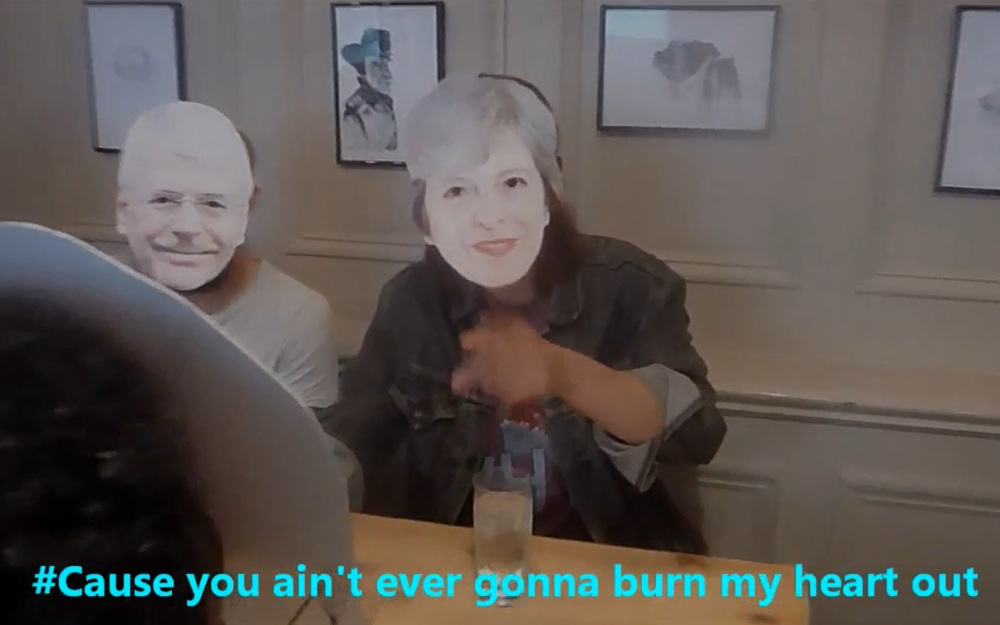
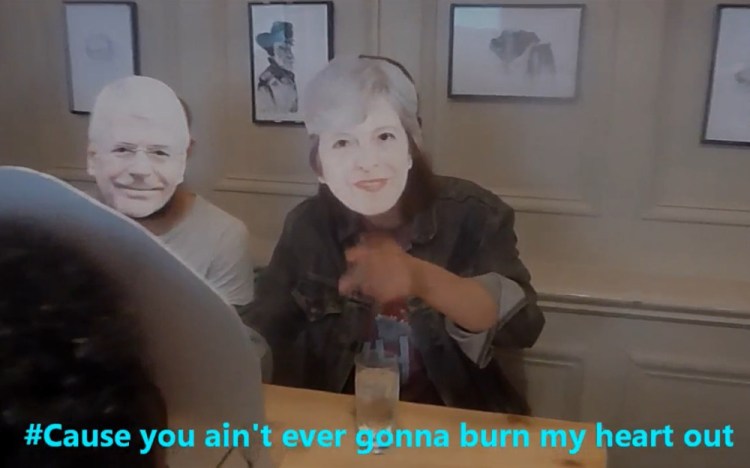
Don’t Look Back in Grandeur (title by DS Jarvis) was a videowork quickly thought up for the introductory section to the ‘exhibition space’ in ‘Will The Last Person To Leave The 20th Century Please Turn out The Lights?‘ – an event staged by the collective ‘the Retro Bar at the End of the Universe, in a disused pub within the eerie and unidentified West Yorkshire metropolis.
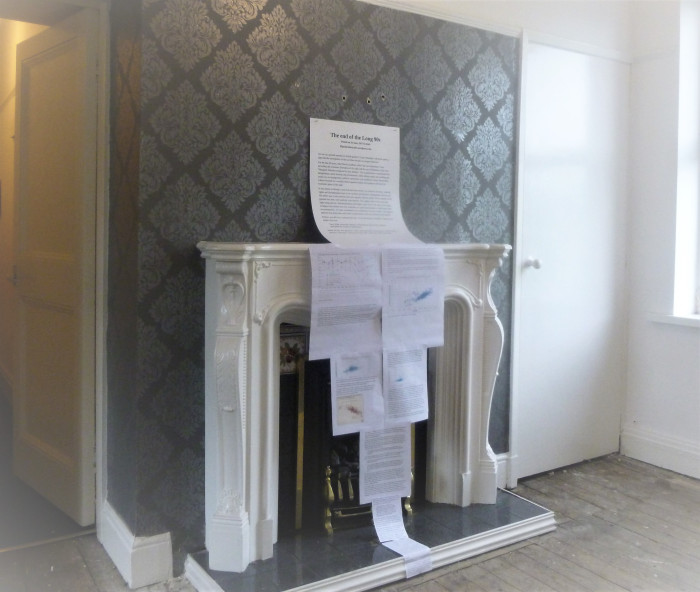
This introductory space became a quick response to the sense of structural ‘unraveling’ occurring around us in the months of May and June. Across from the videowork is an installation of blog-article ‘The End of The Long 90’s’, posted by Rick of Flipchartfairytales in the week we had a potentially game-changing General Election, and the farcical and despicable tragedy at Grenfell Tower in London.
Obviously in May we had the horrific terror attack in Manchester, and while nobody can (or should want to) argue against showing compassion and trying to create togetherness in the aftermath of such a traumatising act, I couldn’t help thinking that the song that became a unifying singalong, the 1996 Oasis track ‘Don’t Look Back in Anger’ was beginning to embody the entire state of the nation in 2017.
Because Oasis, and Britpop (the pop music moment they embodied more than any other band), was a decadent and nostalgic movement in music that looked back to more visually recognizable times in British History, it seemed not only doubly odd that it came back strong after 21 years, but doubly fitting for a country that was slowly seeming to unravel after a long period of deep identity crisis, propped up by apparitions of former glories.
“May as well get another round in” for a boozed-up population that lost their culture not to waves of immigrants coming in, but to being coerced into buying into an ideology that cut communities into pieces, and began selling back pieces of the past to us in increasingly absurd forms, with left us with no identity based in the present, save for our own lonely narratives of how we’ll find happiness…eventually.
The video consists of all the prime ministers that have presided over this period, enjoying a boozed up ‘trip down memory lane’.
VIEW UPON REQUEST [see below for contact details] Monday July 3 Tuesday July 4 Wednesday July 5
OPENING EVENING AND INFORMAL SYMPOSIUM Thursday July 6 | 6pm – 11pm
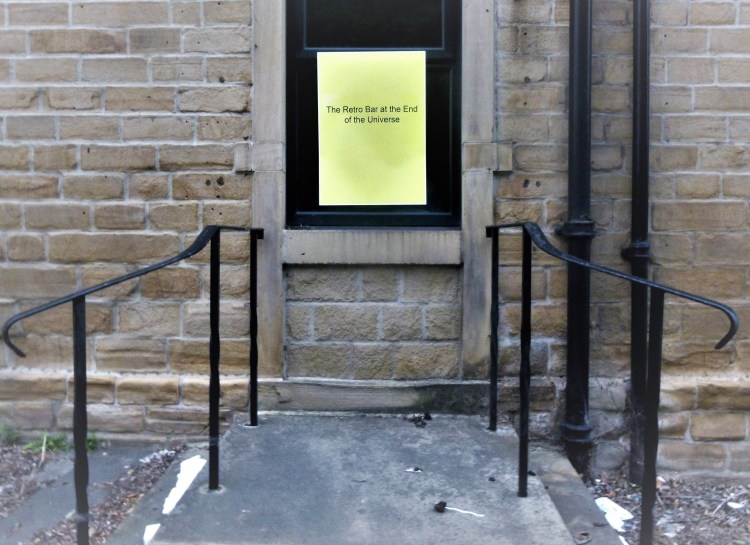
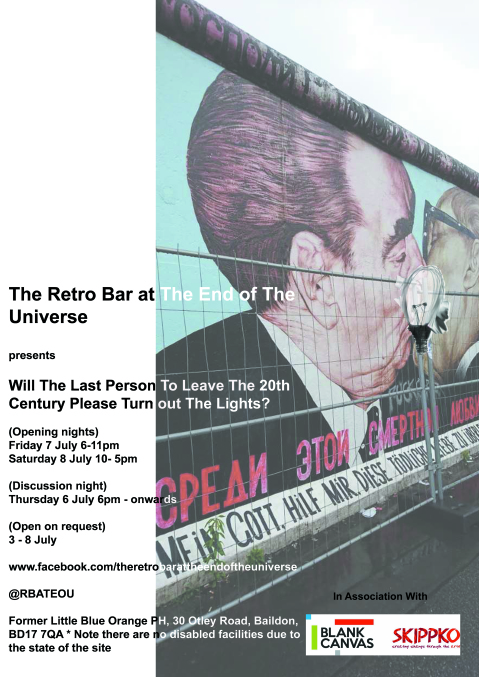
Our collective The Retro Bar at the End of the Universe is currently staging an event and exhibition titled Will The Last Person To Leave The 20th Century Please Turn out The Lights?
Through the Leeds-based arts group Skippko we have gained access to an eerie old building on the road from Bradford to Otley, last used as a pub. This disused pub, and the remnants of all the pasts, in and outside the doors, met with a disconcerting present of endless volumes of traffic for the now-more affluent side of the Urban West Riding, has to be the most perfect of settings for the first proper exhibition our collective has held.
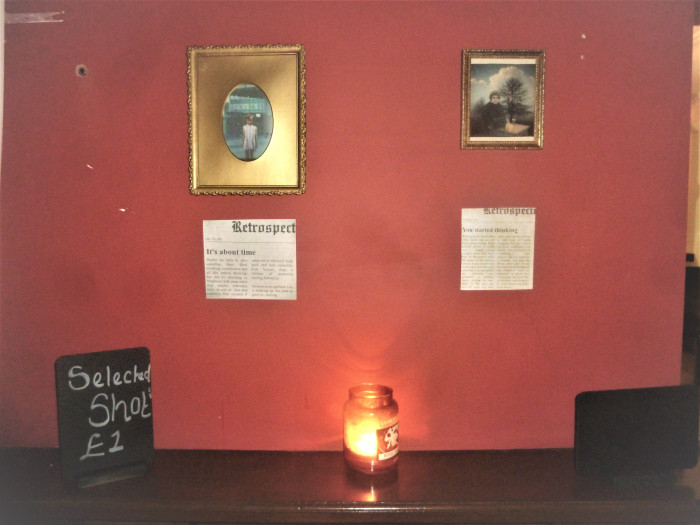
The pub, and the area embody the all the possible hinterlands that epitomise the weird and eerie West Yorkshire landscape; the visual collision of urban, surburban, post-industrial, picturesque-rural; the hauntingly old, the forgotten, and the upwardly new, the aspirational and materialistic. The only potential downside is that the location is so apt, that it is off the beaten track and difficult to attract people to (I’m hoping ‘ attracting people right now!).
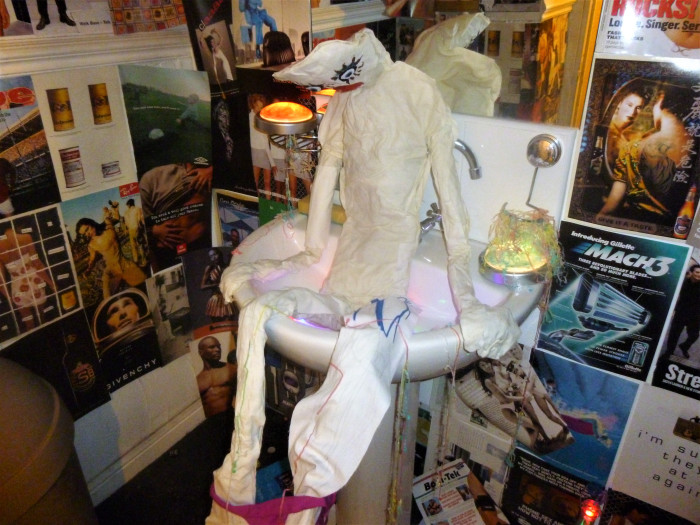
Upstairs, the event’s exhibition begins as we’re met with installation of the recent, but surely prescient, blogpost The End of Long 90s by Flipchartfairytales. The blogpost is accompanied by an appropriate video piece, and forgotten photo frames, showing our perpetually absented collective member.
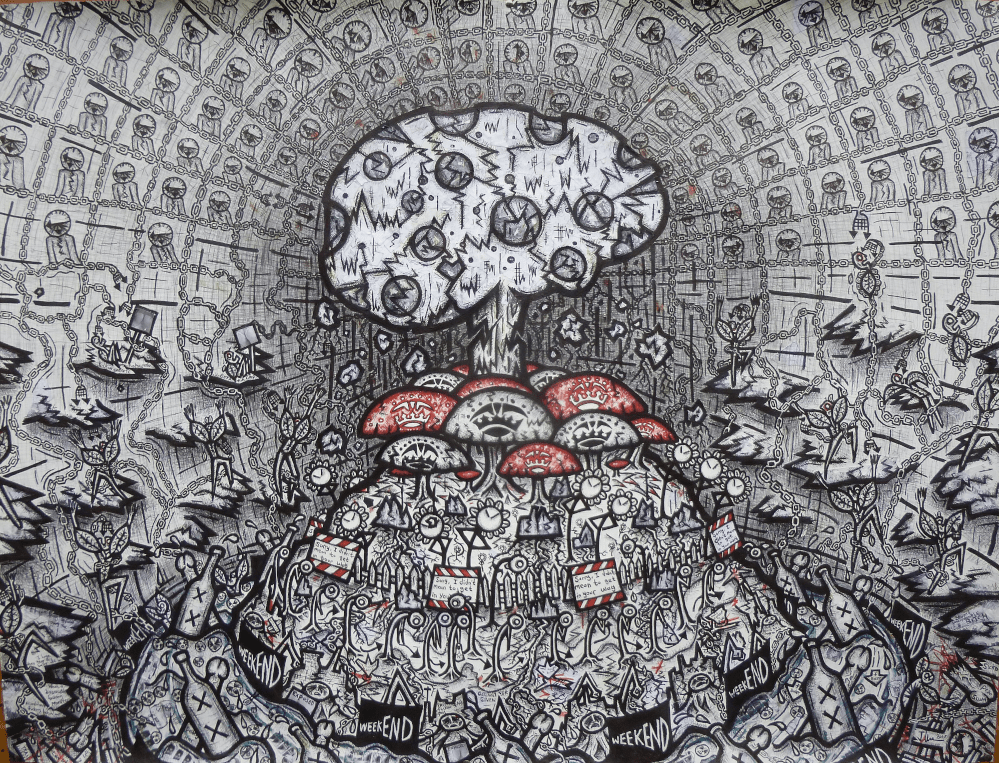
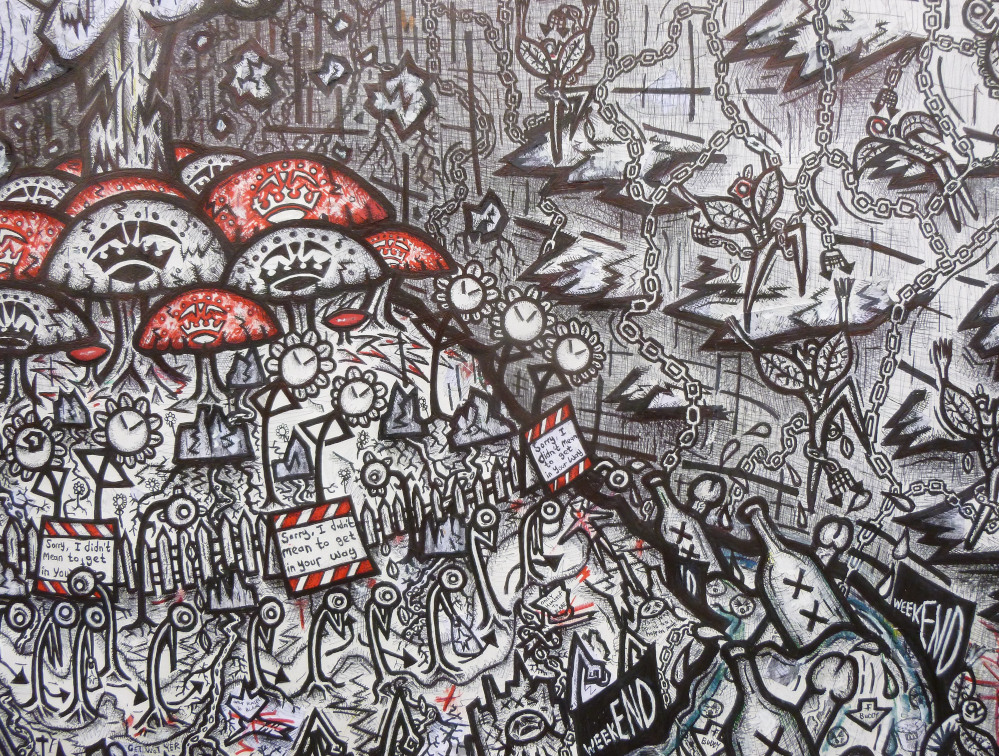
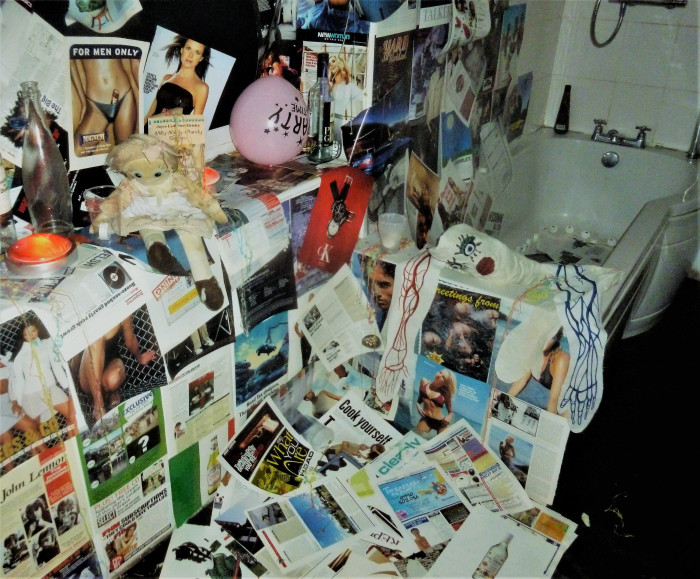
We move on to a room exhibiting many of my most recent drawings, including Hope of The Nihilized, and Dead Ethics Hysteria,only to become aware of disconcerting sounds from a darkened room opposite; a remix of collective member Benjamin Parker’s composition ‘I Thought I Was Awake’. We reach a dead end, with collective member Rebekka Whitlam’s installation ‘Milly-Mollyy-Mandy Gets Loaded and Other Stories’, which ‘looks at a nation’s 21st century come down from 20th century hedonism’ in the bleakest of ways.
A mixed media installation exploring a nations 21st century come down from 20th century neoliberal hedonism. A new generation of adults become petrified in 90s juvenility. Numbers in anxiety, depression, ADHD, and liver disease have doubled over the past 30 years. We’re broke, confused, and desperately scrambling for the exit.
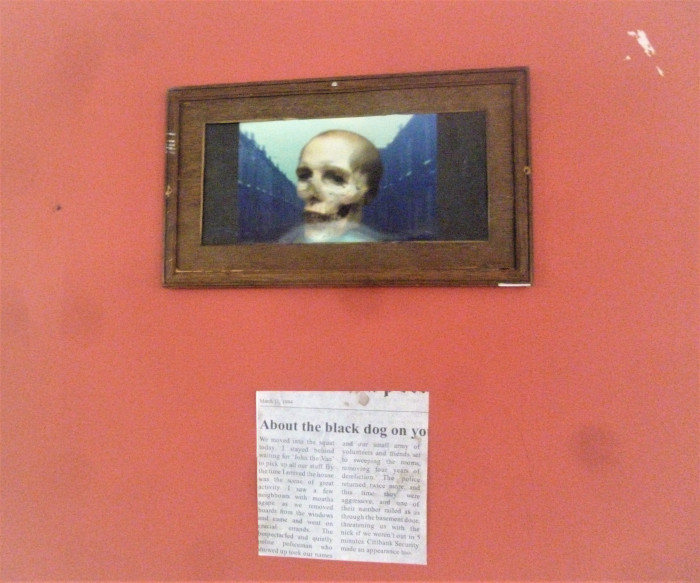
Downstairs in the bar. Events and non-events occur. The one-time resident of nearby Shipley, Mere Pseud haunts the room with displays that have run out of time, and now exist like crime scenes for a cancelled future. His Retrospectral Dispatches, a title taken from the words of late theorist Mark Fisher, exhibits residual traces of his formative years, coming of age in the strangest of times when the future began to retreat and arrive us who came after in a place unsure of its time or place.
At the corner of the pub we have an event ,yself, poet Jonathan Butcher, and the writer JD Taylor (author of Island Story: Journeys around unfamiliar Britain) have made spoken word pieces for the event Writings From HMS Brexit to be held this weekend – the blogger Mere Pseud may or may not still be able to make this event.
In this disused pub, looking back over a dislocating time; an erosion of time and place; a vacuum filled by unfulfilled ghosts from the past. Always in homage to the late cultural theorist Mark Fisher, this series of prose speeches is strange due to the absence of the speakers. Only their half-finished endeavors will be visible; half finished pints and coats flung over the seats – as they proceed to dissect a body that has become to be known as ‘Brexit Britain’.
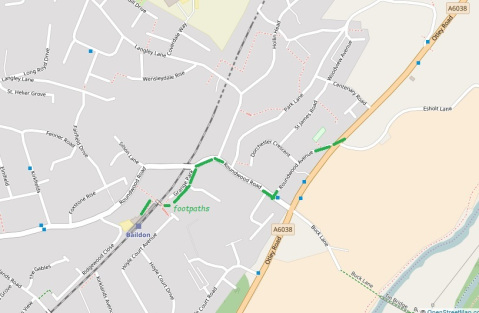
If you can’t get thee by car, here is a map telling you how the hell to get there from the train station!#
First and foremost for anybody who has never heard of Baildon (mainly people south of Wakefield), just think ‘2 miles north of the World Heritage Site, Saltaire.
I’m really looking forward to this event. To be honest it’s our first proper outing as a collective. The Artists’ Bookfair at The Tetley Gallery in Leeds earlier this year was sort of leading up to this. In light of the series of events that have unfolded in the past month (for better and worse) the title of the event, ‘will the last person to leave the 20 century please turn out the light?’, really does seem loaded. No longer does it merely seem to be a ironic nod towards the serious structural inertia that has dominated culture and political thought for what feels like an eternity, but it now seem to on the point of potentially being seriously responded to. Indeed, the post The End of The Long 90’s on the blog Flip Chart Fairy Tales, really puts into focus the unavoidable proposition that recent events will change British politics for good – that maybe the “Summer of ’17 really will be the end of the Long 90s”. I’m excited to say Rick from Flip Chart Fairy Tales has allowed us to use the blog in an introductory installation to the exhibition part of the event.
We have to be cautious, and what is still clear is that the apparatus that foster cultural inertia and negative realism are still in the driving seat, even if it’s now clear the vehicle has no idea how to navigate the new roads. However, with trepeditity, and paraphrasing the words of Juliet Jacques’ recent post for Repeater Books, ‘For the first time in [adult] my life, I don’t feel like [I’m stalked by depression]’. It may be a flash in pan, a hysteria brought about by the heatwave and the flurry of events discrediting Neoliberal agenda’s freezing of social life into billboard graphic impressions of public space. But I’m feeling more than ever that this negative realism can be fought against, both in my art and life.
Comewhatmay, we have a series of artists, writers and academics parttaking on some level in this exhibition. I’m sure the outcome will be a fruitful one!
As well as the collective (which currently revolves around myself, artist Rebekah Whitlam, Artist-Curator John Wright, and composer Benjamin Parker, – ghosted by DS Jarvis), we have invited contributions from DS Jarvis, photographer Steve Schofield, writers Merepseud and JD Taylor, the poet Jonathan Butcher, the blog Flip Chart Fair Tales, and potentially the engineer David Hooppell. All in all it is looking like












 John B Ledger