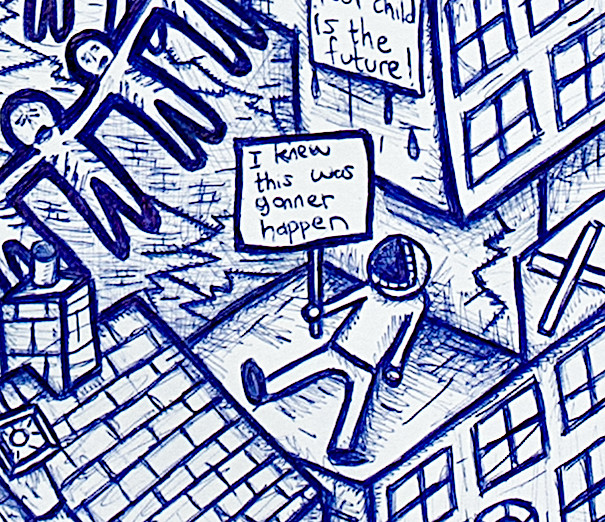
You know, sometimes you think something and say to yourself “that’s a good point, but what are the implications of making it?”. This could be my epitaph, but equally it should have been a forewarning for the first half of the 21st century.
…Cultural cynicism, unironic irony because “it was always going to happen, wasn’t it?”.
Of course there’s a fine-line between a culture of knowing irony and dark cynicism, and a diagnosis of our reality that may appear to use the same reference points.
Reading Mark Fisher’s Capitalist Realism was like coming up for air, a moment of clarity and consciousness raising at the start of the 2010s. However, it was seen as ‘doomer’ by some people at the time, and perhaps this is what led him to work on ideas of ‘post capitalist desire’ and ‘Acid Communism’; two ideas that, since his passing, have become (ironically?!) spectres haunting a 2020s that has lost Fisher’s eyes – eyes that many of us found ourselves looking through.
This isn’t to idolise Fisher, it’s just to wonder he we are now lacking an expert mapper of our times. And without him, or David Graeber, or John Berger, we are finding it harder to find ourselves collectively.
But nonetheless, many, could not see the crucial difference between Fisher’s analysis and the likes of Charlie Brooker’s Black Mirror, for example.
But returning to the original point, I have always also wrestled with this as an artist. My drawings have often been said to conjure a miserable outlook. I was always troubled by this, because the creative process, or breakthrough when an idea finally works, brings me a joy that feels like political empowerment, in that my drawing becomes my mouth and eyes that were previously unable to see and speak.
Yet, since the 2020s began, any sense of the work having any agency beyond my engagement and production of it has felt harder to believe in. Worse, in a world overexposed and thus overwhelmed by bad and scary news, where images compete with ever-more ferocity for our attention, what is my work but something that makes people feel more depressed, more disempowered?
Art in the age of Cosplay
Indeed, I have become lost in what seems to be a new artistic culture. Perhaps the 2010s was a fever dream of intentions? I don’t know, but in this period my work felt like it attached to something bigger than itself. Now, trying to make it exist for its own sake feels confusing, and it often feels like a project that has been ox-bow-laked.
If in the 2010s social media was a contested territory in terms of the platform’s subjectivation, now it feels that the self-as-brand as totally triumpthed.
Because of the ubiquity of Instagram, more than any other social media platfrom, this has changed what it means to be an artist, or at least tweeked it further down a specific road.
My theory is that to be an artist in an age of Instagram is actually to be an artist in the age of cosplay.
Formally we understand Cosplay to be dressing up as Spiderman, Wonderwoman or whatever and posting it on social media, with the most most popular profiles usually looking super sexy and suggestive of other types of imagery.
But I believe that Cosplay is now a requirement for artists.
The New doesn’t exist on Social media, just digitally reified iterations of things reduced to costumes that we all endorse to be valid. Sadly, now, to be a succesful artist from grassroots up, you have to cosplay like hell. You even have to cosplay a variation of your own identity, where working class artist perform a tired version of working class-ness.
Should all ‘good points’ be made?
I ask this question, because I’m not sure this observation helps, but in fact follows a long line of critiques of life to day that bereft of any agency, are more likely to be taken personally, taking a snipe at an individual’s behaviour, rather than being seeing as something we can work on.
To return to Fisher’s Post-capitalist desire, and Acid Communism, these were attempts to overcome the knowing irony, and cynicism that underlined what he called ‘capitalist realism’ but could be also said to be our culture from the 90s to the present. It was perhaps inspired partly by a critique of his own theory prior to this period, and whether it could become too easily tied up with the larger “everything’s shit, yes we know that” culture.
I sincerely hope my works, and my thoughts don’t contribute to the “everything’s shit, yes we know that” culture.
Sometimes the need to speak, in order to feel like you exist, can often produce sounds that aren’t really the ones you truly wish to make.
 John B Ledger