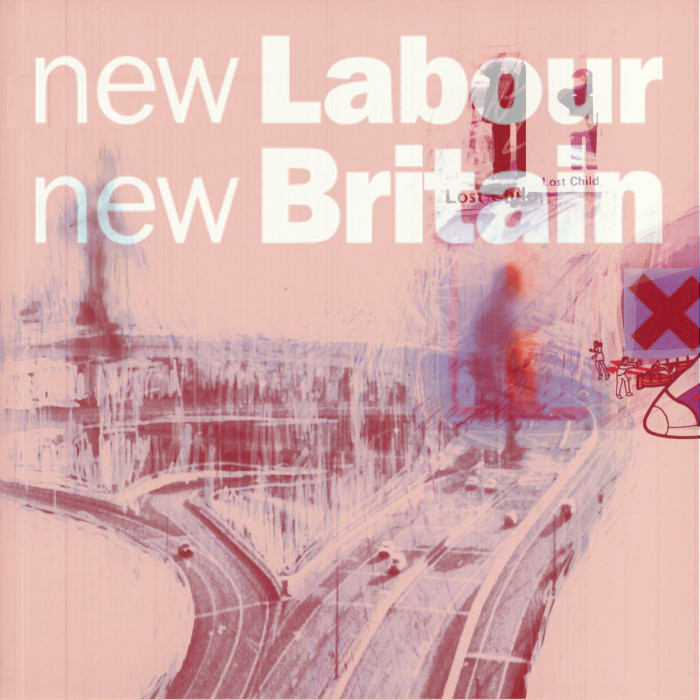
All memory is worked upon backwards – they are private sculptures that are never completed.
Today when I think back to spring/summer 1997 the ambient backdrop is the b-sides from Radiohead’s OK Computer, which I didn’t actually hear until the 2000s. I heard bits of OK Computer and The Prodigy’s The Fat of the Land at the same time on a holiday journey, and they gave me what I’d come to understand as ‘future shock’; a vision of a place we hadn’t quite arrived into yet.
Because very little music, as great as it may well be, has felt ‘futuristic’ ever since, this moment has a gravitational pull that drags later encounters backwards into its orbit.
My personal accounts are difficult to separate from the fact that a pervasive structure of feeling in British culture seems to be one haunted by the ghost of 1997.
As Labour come back into power this week, all focus is on 1997, eclipsing all other Labour election victories. Despite the Labour party being the biggest party in Western Europe when Corbyn was leader, despite most people not really believing that this current Labour Party can deliver the structural changes much-need by most of the country, a kind of narrative remains fixed around this idea that if we can just get back to how things felt in 1997 things can be ok again.
I think it was the writer David Graeber who said that ideology works not by believing in the dominant narrative about life, but by believing that everybody else believes in it. We know the world is very different to 1997, we know what happens when private sector funding of public services was done before (for example), we know so much isn’t working and isn’t going to work, but yet we cling to threads of the governing discourse because if everybody else does then surely they are right?
Trying my hardest to chip away at the retroactive alterations made to my memories of 1997, I still recall a euphoric atmosphere that permeated all aspects of life. Even as a 13 year old I still obsessively looked for connections, and when my local football team gained promotion to the Premier League for the first time, and then a rock star ‘man of the people’ became prime minister, the future momentarily looked nailed on to the better than the past.
Did I know much about the damage that Thatcherism had done to towns like my own as a 13 year old? There’s definitely much that I’ve sown onto these recollections afterwards, but you couldn’t help but be aware that a lot of bad stuff had happened around here and things could be a whole lot better. But unlike how it feels as a 40 year old after 14 years of feeling like I’ve been punched in the stomach, 1997 was almost a momentarily transcendental release from the weight of past through the Messianic rock star, Blair.
Again, this is likely because I had no reason to feel out of breath as a 13 year old. But it’s also a sign of how different reality now is.
The Corbyn era was also about 1997 but not in the same way.
Although Corbyn, the man himself, may be more associated with a post-1945 social democratic politics, the ‘momentum’ that pushed the movement along was also born in 1997.
Yet, unlike the mainstay of the progressive wing of the establishment, in parliamentary politics, business and media, it wasn’t trying to set the clock back to 1997. Whether it was ever made aware or not, a movement dominated by people in their formative years in 1997, people for whom Blair’s “education, education, education” speech momentarily meant something, we were undertaking something that Tom Whyman in his book Infinitely Full of Hope, called Applied Hauntology.
Hauntology, lazily or simply (on my part) characterised as the present moment being haunted by the past through ‘lost futures’ that never materialised, is here progressively activated.
If you were fortunate enough to assume that you were guaranteed a life of expanded horizons, university, new experiences, and a better quality of life than your parents and grandparents, the 1990s embedded an expectation of life in you that, by the late 2000s returned as a form of unworked-through grief.
Far from merely being a Western Consumer attitude of the late 20th century, it permeated old industrial areas, which, although traumatized by post-industrialisation, believed help was on its way, and it was all underpinned by the cultural exuberance born from what Francis Fukuyama called ‘the end of history’, a moment after the end of the Cold War, and East/West divides, when just for a moment it looked like we could collectively ‘do this’, and make a more peaceful world.
As wafer thin as the grand narratives of the 90s may have been, they gave young people a vision of a better life, and a better world to come in the Millennium. Jeremy Corbyn’s surprise election to be the leader of the Labour Party seemed to open a door, that seemed to connect directly from Millennials optimistic expectations and a future that looked workable, bypassing the encroaching sense of dread of reality in the 2010s.
It was a moment when a generation applied hauntology to almost reactivate the lost futures that culminated around the year 1997.
In 2024 this momentum has been squashed, exhausted, and what we have again is an obsession with trying set the button back to 1997.
And to be honest, I’m not crushed. It’s a relief to get the Conservatives out. And, maybe because the Tories have exhausted me so much, I’m not as quick to condemn this new government as many are. Every little improvement makes big changes in life. As if some of this creeps back into everyday life, perhaps the ability to feel the idealism inside oneself will come back too.
 John B Ledger