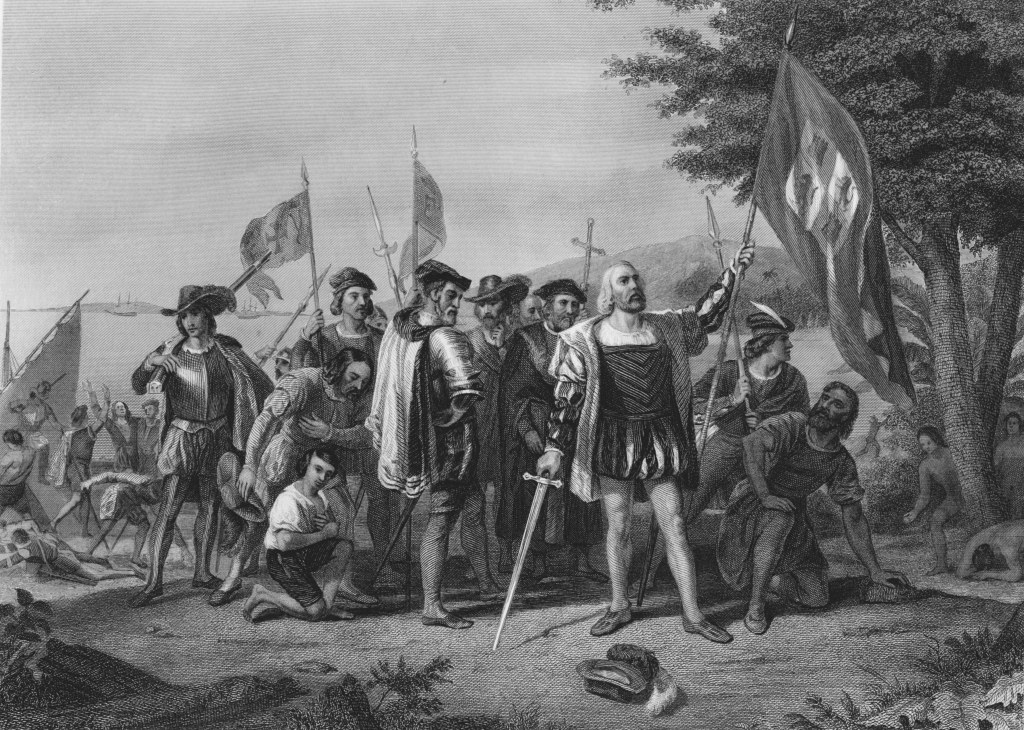
When I worked as a front of house member of staff in a nearby art institution, we had a saying to describe certain visitors who would arrive from, let’s be fair, mainly London and South East: ‘Columbusing’.
The males doing the ‘Columbusing’ would arrive towards the end of the day, and step into the gallery, like they’d stepped off a boat into a land ‘untouched’ by civilisation. ‘Wow, how could such a place exist near Wakefield?’ as they walked past the staff like a European ‘discoverer’ would walk past the savages. (This particular gallery is situated between the ex coal mining towns of Barnsley and Wakefield and the former heavy woollen areas of Kirklees).
They weren’t doing this knowingly because it’s simply an expression of the very old relationship between ‘the metropolis’ and the rest of the land.
‘Columbusing’ came back into my mind as I read an article published today in the Guardian in which the journalist describes the sense of betrayal in areas that voted predominantly in favour of Brexit, 3 years after the Tories, under Johnson, won an election landslide on the promise of ‘getting Brexit done’.
I’m not intending to go into the larger concerns of the article, although the idea that a voter response to this god awful period of Tory Rule-by-Gaslight would be to turn to a party (Reform UK) that could soon be lead by Nigel Farage, is a worrying and a depressing reminder that the quagmire of a sense of ‘abandonment’ that was being articulated a decade ago, is still being dominated by fears and angers over immigration.
I’m intending to talk about how the relationship between the metropolis and the rest of the country is not only expressed via liberal media establishments like the Guardian, but kind of reaffirmed by theses articles. It’s a concern that when a place sees itself in the mirror of the mainstream media, which after all is a manifestation of symbolic power, its formal identity is constructed – it becomes what it is represented as being.
This is very much done in how that place is framed. Today’s Guardian article visited Goldthorpe, a small town on the eastern side of the Barnsley borough that has never really recovered from the aggressive closure of coal mines in the 80s and 90s. Barnsley is by and large classed as a deprived area, and everything in this article is true. But the Guardian and BBC only ever frame Barnsley through its poverty, and hostility to immigration. You can guarantee that if they don’t visit the town centre, they will visit one of the two G’s, Goldthorpe and Grimethorpe, both of which have become iconic places in their struggles ever-since the pits closed.
I like John Harris as a journalist, for example I like his UK road trip vlogs, I think he’s a journalist who genuinely seems to care about the people he interviews up and down the country. He recently visited places like Grimbsy and Grimethorpe, to discuss peoples’ post-Brexit struggles, the picture he painted was bleak and very true.
But, due to the ‘touristy’ nature that field work journalism assumes when it comes out of the ‘Metropolis’ and into the ‘savageries’, it is always in a position of waiting to be discovered and waiting to be ‘real’. I think John Harris is a good example, because he clearly recognises this, and acted on this in his vlog series ‘Anywhere but Westminster’, but it’s very hard to break down that colonial relationship that exists in the UK between Londonish institutions and the rest of the country.
8 years ago Channel 4 news visited Sheffield for the beginning of Nigel Farage’s UKIP campaign tour. I believe that the coverage framing was all but defined by the use of two words to describe Sheffield as a ‘northern town’. Sheffield is a city, perhaps also a conglomeration of other towns, which a total population of 800,000. It is not a town to anyone who lives around here. 2 years later Channel 4 news visited Barnsley the day after the UK woke up to find out that Farage’s UKIP aims of leaving the EU had been successful. The voxpops and the tweets by the journalist were framed by a sense of bafflement with these people who didn’t think and feel like they did. To quote Jarvis Cocker lyrics, C4 news seemed ‘amazed that they exist’.
Symbolic power in the UK continues to operate through the colonial relationship London has over the rest of the country. Even in times of grass roots media outlets on the internet, the big media establishments still possess the ultimate power to make a reality officially ‘real’. This doesn’t mean this relationship doesn’t operate internally, within London. For example, Grenfel tower fire in the borough of Kensington and Chelsea; it was only through their deaths that their situation became a ‘reality’. But when it comes ‘north’, sometimes the ‘truth’ it uncovers causes as much damage as the good intentions of the journalists. Nobody is individually to blame for Columbusing, but it reaffirms the colonial relationship much of the country has with London.
 John B Ledger