This may seem like a ‘stretch’, but I argue that renewed interest in the music of Kraftwerk, brought about by recent passing of co-founder Florian Schneider, makes for strange resonances and recollections in a world partially suspended by the outbreak of Covid 19.
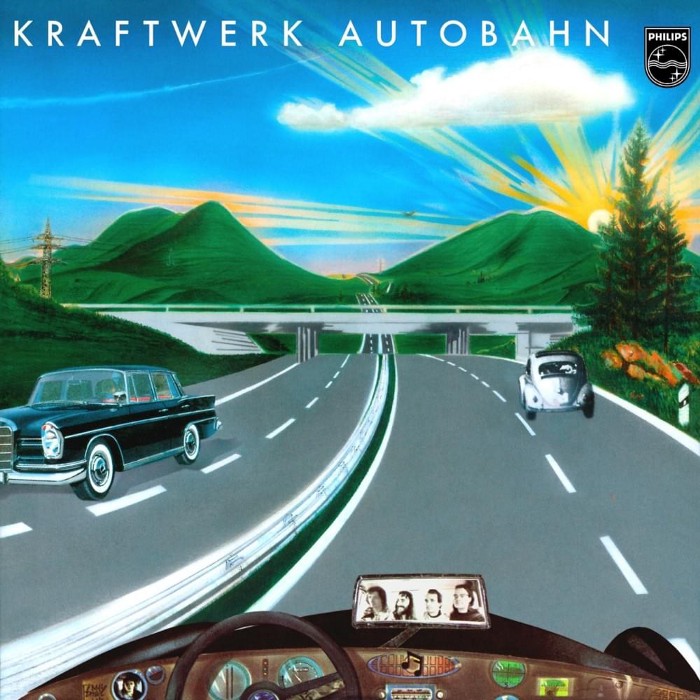
Now, I’m not usually one to share news of the death of a notable artist over Social Media, which often feels like an unending procession of obituaries. But, nonetheless, Kraftwerk had made a deep impression on my 21st century adult life, so I decided to start by playing one of my favourite tracks by the group, Ohm Sweet Ohm, from the album Radioactivity, driving on my way to work.
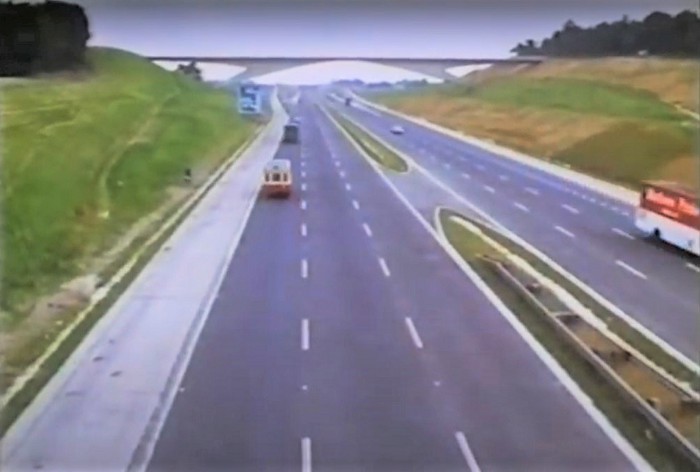
Driving, or at least commuting to work is an almost universal experience in 21st century life. If you haven’t fallen foul, ‘lumpen-like’, to the grossly uneven economic development of the past 40 years, it’s very likely you have to do it.
However, not today.
Normally, if you were to be commuting at 8:30am, you would be part of an unending flow, so immersed in the stop/start blockages, so very much part of it, that you wouldn’t even be able to ‘notice’ the motorway, the railroad, or the terminals. You’d most likely either be trying not to think about it, or you’d be overcome with thoughts regarding your destination.
But today, the motorway was almost exactly like it was as the once-brand new motorway you can see in the image above, from 1970; which, in turn, is very much like the motorway on the cover sleeve of the 1974 Kraftwerk album Autobahn.
Listening to Ohm Sweet Ohm whilst finding myself on a motorway with significantly less traffic than normal, joyously brought the music of Kraftwerk and the architecture of the M1 motorway together. For the first time in maybe over a decade, this particular synchronisation gave me a joyous ‘allure for the Modern’, and I try to explain why, now.
Although it’s clear the passing of Schneider has absolutely nothing to do with Covid 19, I believe that it’s given us an incentive to re-listen to Kraftwerk at a very appropriate moment: we live through a time when our use of the technologies, infrastructure, that uphold our ‘non-stop’ 21st century lives, have been partly-suspended, seemingly indefinitely.
In fact, I can remember the last time I felt this very joy in the ‘allure for the Modern’. It was on another relatively mundane node within of our hyperconnected world, as my local service train pulled into the Yorkshire hub of Leeds in the autumn of 2008: I was listening to Kraftwerk’s Trans Europe Express.
So what is this ‘allure for the Modern’? Why is it important to Kraftwerk, and why do I think our recent lives pre-Covid lost this ‘allure for the Modern’, and why do I think it gives us a chance to look at our world anew?
I’ll try to answer all this in a post I’ll do my best to keep as interesting and concise as possible.
The ‘Modern’ is arguably quite different from just living in ‘Modern times’. Or, to put it another way, the definition of the past 40 years or so, that we call ‘Post-Modern’ can be misleading. We are still in a world defined by all things ‘Modern’; the way we work, travel, eat, seek leisure, even the procedures around dying. These things have become more chaotic, far more intertwined and uncertain than arguably even for our grandparents and great grandparents, who were also ‘Modern’, and these changes are often what we’d ascribe to Post-modernity. However, I argue what mainly characterises these past 40 years is a feeling, or lack of: a loss of a sense that technology, and progress in general, are leading us to a far better world. The wonder at such technological achievements is what I call ‘the allure for the Modern’.
Chatting about Kraftwerk with friends with similar music tastes in the 21st century would culminate in an utterance that just didn’t feel right. Why would we agree that Kraftwerk’s music still sounded ‘futuristic’, 30/40 years on, in a world, that was, to all intents and purposes that very future to those albums?
I’ve already mined the ideas of theorist Mark Fisher way too much, but Fisher’s and the Italian thinker Franco ‘Bifo’ Berardi’s idea that in the past 40 years we have witnessed a ‘Slow Cancelation of the future’, is still, I argue the most fitting expression of a strange sense that aspects of 20th century culture still seem more ‘futuristic’ than the present. Roughly identified as a cultural reality brought about by a synchronisation of shifts in political and economic life with the rise of computer technologies, it argues we can no longer imagine a world different from the present. For Fisher this change, that he said was most noticeable in cultural forms, especially popular music, was political, and he diagnosed our age as inflicted by a ‘capitalist realism’.
But regarding Kraftwerk, why were they so futuristic?
For a start, perhaps Kraftwerk’s futurism had to come from Germany? David Cunningham, in his essay Kraftwerk and The Image of the Modern, (featured in Kraftwerk: Music Non Stop) argues that Kraftwerk, along many other young German artists at the time, looked ‘back to the future‘, bypassing the black hole left by Nazism and the legacy of the Second World War, to look back to the Modernism of early 20th century Germany (such as the Bauhaus movement and the early Frankfurt School). But rather than looking back in a retro-fetish sense, Cunningham writes that “[T]hey [Kraftwerk] gain their meaning as modern from their dynamic relation to past works [my own italics], through a determinate negation of what precedes them…”
Germany along with Japan, upon unconditional surrender to ‘allied’ forces in 1945, were subjected to ‘the Marshall Plan’, a project to rebuild the nations and their economies after the war. Without going too much detail (their de-militarisation, and how being ‘victors’ also shaped the ‘victors’), it is clear to see that vast swathes of urban Germany and Japan were rebuilt in an ultra Modern style. Unlike the UK, for example, which politically, and physically, was able to maintain enough of its former self during the post-war rebuilding, Germany, for the large part had to start as if brand new. What I’m inferring is that, despite the great leaps in what Mark Fisher and Owen Hatherley call ‘Pop Modernism’ in the UK and USA, the conditions of Germany, and of being German, in the Post-war era, created the conditions to be ‘Kraftwerk’.
But what is it about our current Covid 19 life that highlights this ‘Modern’ (again)?
In an essay for the pop philosophy book ‘Radiohead and philosophy’, Adam Koehler writes about a band who perhaps, like Kraftwerk, make music that isn’t, as Koehler writes, merely ‘about’ the conditions of life produced by technological ages, but is an ‘artefact’ of it.
Koehler here, is making this claim about the music of Radiohead from the Kid A album onwards; how it isn’t “about [the] low-level panic and anxiety produced by living in “the information age”, [but is] an artefact of that information and that age…”
Koehler tells us that Martin Heidegger in his book ‘Being and Time’ says that the technologies that we depend upon for “our everydayness…retreat[] from our attention and becomes invisible to us” and that we only notice them when we don’t want to, when they break down, stop working. He says what makes the ‘anxiety or panic’ that domes Kid A…” so ‘familiar’ is that “we hear technology”, which is very different from simply using technology to make music.
Perhaps (especially within the 5 consecutive albums Autobahn, Radioactivity, Trans Europe Express, The Man Machine and Computer World) no other band has quite enabled to us to “hear technology” quite like Kraftwerk”. However, apart from an implicit melancholia that seems to haunt the otherwise upbeat rhythms of Computer World (that perhaps speaks more to a loneliness of 21st life than anything), we don’t necessarily ‘hear’ technology breaking down as in Radiohead. What we do hear is this ‘modern’ technology in a real world of Covid 19, where partial suspense of ‘everydayness’ has made the intertwined hyperconnected world upon which our ‘non-stop’ lives depend become noticeable, perhaps for the first time in decades we can “see technology”?
We can see the motorways, the railroads, we can see, arguably what remarkable feats of engineering and architecture they are, because we are barely using them. We can see the technology behind food distribution, for example, because, perhaps for the first time in our 21st century life, we have been forced, as a society, not to see it as an endless resource, originating from nowhere.
Covid 19, I argue has made the dust settle over our frantic lives of the past 40 years to settle. What the future holds is uncertain, by what it does is make visible ‘Modern’ infrastructural achievements that wowed our near ancestors, but has become invisible to us, immersed in it as we were until very recently. It is only coincidence that the passing of Schneider has brought Kraftwerk back to our attention during this pandemic. But, in this temporary space where technology is once-again visible, Kraftwerk isn’t just relevant again, but once again a deeply immersive, enjoyable experience, if you happen to be one of the fewer people using the our Modern infrastructure. It really does reactivate the ‘allure for the Modern!’
 John B Ledger