
The Place of Dead Ends (2013, biro and collage on paper, 120X100cm)
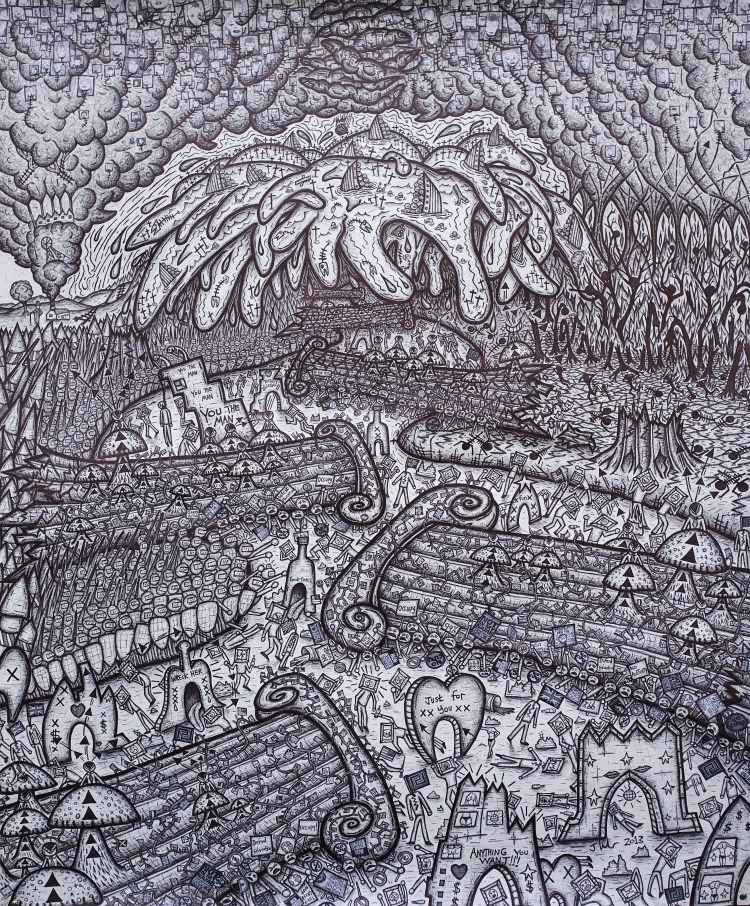


The idea for The Place of Dead Ends fixed itself together whilst I was walking around the park-lands of Greenwich, London (a place saturated with popular history), in the autumn of 2012. I stumbled across the Queen Elizabeth [the 1st] Oak, a tree that the Tudor queen is said to have often taken refreshment under. Queen Elizabeth the 1st reigned over an historical period that played a crucial part in the formation of the British Empire, and (of course) the modern industrial world.
What I didn’t realise until then was that this tree had actually been dead for well over 100 years old. Yet the tree trunk remained; laying heavy upon the ground. Always having the gravity of the 21st century stalking my thoughts, I couldn’t help but see this dead relic as a metaphor for a world which is being ruled to ruin by ideas and beliefs that belong in the past; a result of a civilisation that is unable to look to the future.
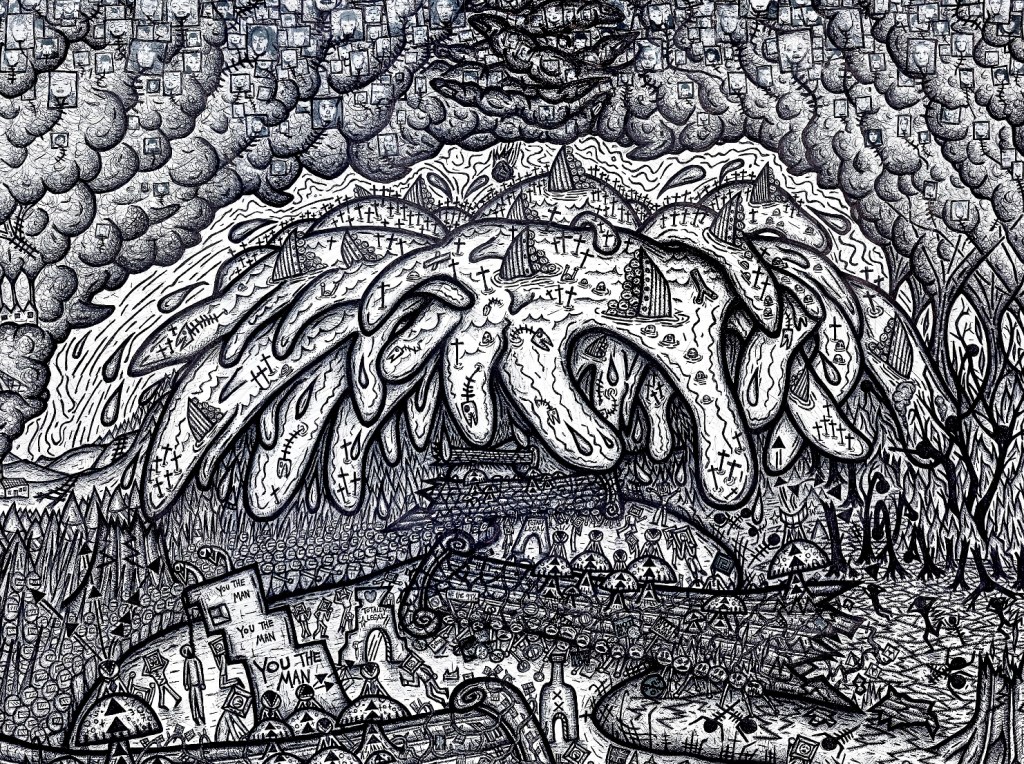
In the drawing the pillars of (a) civilisation have fallen across the route, like dead trees blocking the path. In this landscape protests are being made by many who desperately want to change the world into a better, more just place, but these pillars have landed on the protests, trapping them, making them unable to move – unable to make a difference (the most well-know example of this would be the 2003 protests against the US/UK imperial war on Iraq, where millions filled the streets world-wide, and were utterly ignored by the decision makers). On the rotting of the tree-like pillars grows all the forces that feed off the death of a future; runaway finance with no grounding in theory, and jingoist patriotism that feeds off the fears of global uncertainty.
The rest of this blocked route is occupied by people who have given up on the belief of a better future, and have given up fighting ; they live in a never ending avoidance of truth and empty feeling, condemned to the pursuit of immediate pleasures (drugs, alcohol, sex), only to spend much time in stupors of dissatisfaction and depression. I am not excluded from such a scene; I am both the protester and the individual drunken and frustrated roaming the evening streets, trying to forget reality. Every figure is interchangeable in my drawings; no individual is solely to blame and yet everybody is complicit.
Each side of the road are the barriers one faces when they try to think of a way out: the violence of the nation state, which becomes more ruthless and repressive the more it is threatened; and at the other side one faces the even worse plight of the poorer parts of the world, and the parts of the world already suffering greatly from changes to the global climate brought on by this governing system. There seems to be no way out. Clouds envelope preventing us from imagining another kind of world; they are both the very real human-made pollution we are failing to tackle, and the blotting out of imagining ourselves somewhere different; the clouds are full of the faces of ‘dead stars’, the icons of 20th century capitalism, who died and became immortalised in our collective hearts, having an ever greater ghostly presence that seeps onto the skins of us as we run backwards from the current world, in search of better times.
Drawing, for me is as much as a controlling (or management) of my darkest thoughts in which everything seems out of control. Yet, I hope my work can reveal the modern world to viewers in a way that is constructive to a collective demand for a better world.
 John B Ledger